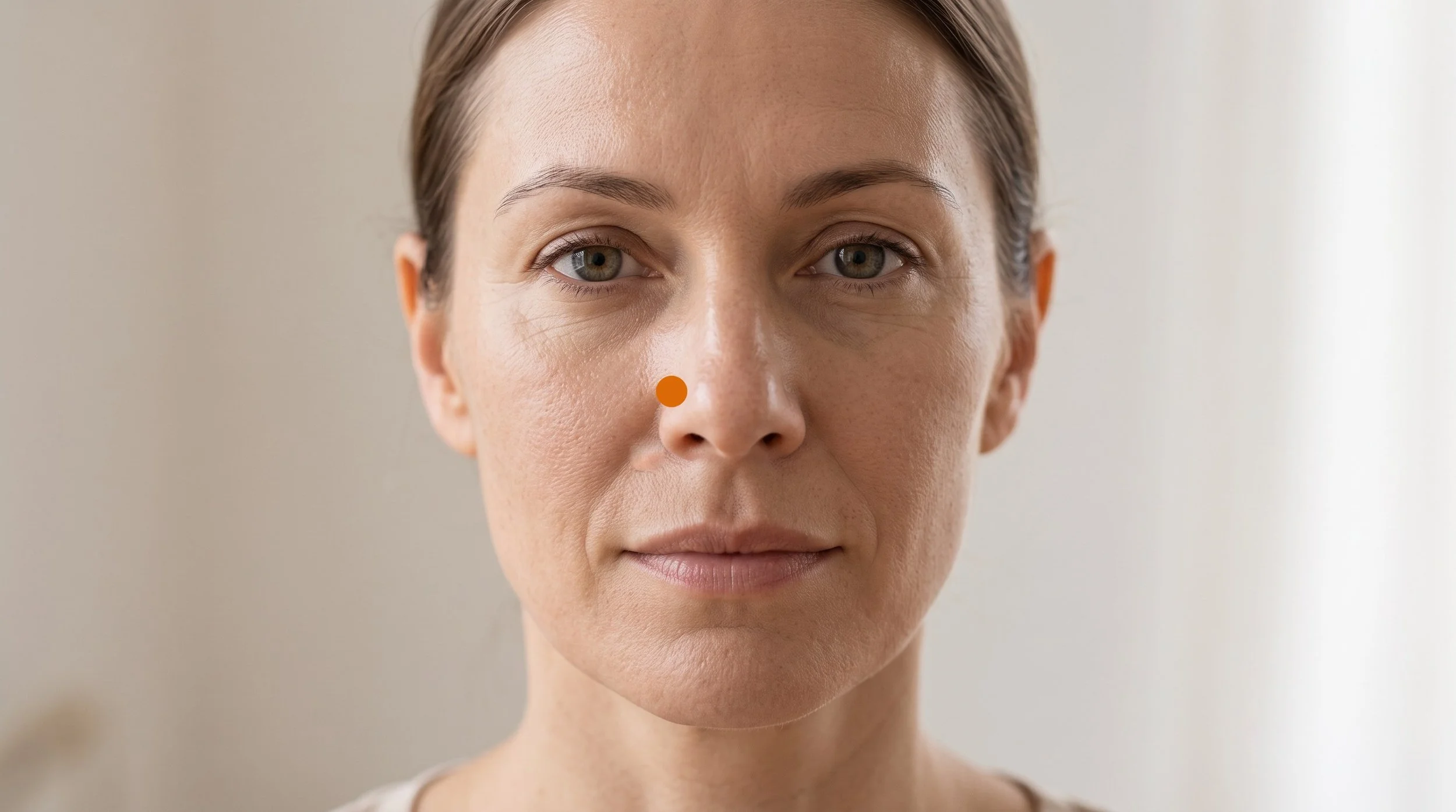
Bitong Acupuncture Point (M-HN-14)
Penetrating the Nose at the Top of the Nasolabial Groove: Anatomy, Autonomic Mechanism, and Why This Modern Extra Point Anchors Nasal Treatment
BITONG (M-HN-14), whose name is usually rendered as Penetrating the Nose or Free Nose Passages, is a modern extra point that sits at the very top of the nasolabial groove, in the small depression just below the edge of the nasal bone where the springy cartilage of the nose meets firm bone. It's one of the few points in the entire acupuncture literature with a single-subject record: essentially everything ever written about the bitong acupuncture point concerns the nose.
Clinicians reach for it for stuffiness, runny nose, allergic and perennial rhinitis, sinus pressure across the bridge, and, in modern Chinese listings, nasal polyps and nosebleed. Because it lies in richly innervated facial tissue supplied by trigeminal branches, and because the nasal lining is governed largely by autonomic reflexes, BITONG is best understood as a local neurovascular access point rather than as anything mystical about the nose itself.
- Location and layers: BITONG sits at the highest point of the nasolabial groove, immediately below the nasal bone, where skin and thin subcutaneous fat overlie the levator labii superioris alaeque nasi and the junction of the frontal process of the maxilla with the upper lateral nasal cartilage. Standard practice is transverse insertion of 0.3 to 0.5 cun angled toward the bridge of the nose, very often by threading upward from LI20.
- Traditional attribution: the classical texts credit this point with one action only, benefiting the nose, and the indication list stays inside that lane (rhinitis and allergic rhinitis, blocked nose, nasal discharge, nosebleed, nasal polyps and nasal boils). In modern terms that's a local point for nasal mucosal congestion, secretion, and sinus pressure rather than a systemic point.
- Mechanism: needling here stimulates infraorbital and external nasal branches of the trigeminal nerve, whose afferents converge in the trigeminal spinal nucleus alongside input from the nasal mucosa itself, giving a plausible route for somato-autonomic reflex change in mucosal blood flow and secretion (Zhao, 2008).
- Point-adjacent physiology: a randomized study of acupuncture aimed at the sphenopalatine (pterygopalatine) ganglion, the autonomic relay that supplies the nasal lining, reported improved self-rated nasal ventilation, lower nasal airway resistance, and shifts in nasal neuropeptide Y compared with sham, which is the clearest published demonstration that needling near the nose can move nasal autonomic outcomes (Wang et al., 2016).
- Research picture: reviews of acupuncture for allergic rhinitis are cautiously positive for symptom scores and quality of life, with better signals for perennial than seasonal presentations and honest concerns about blinding and trial quality (Lee et al., 2009; Feng et al., 2015; He et al., 2022). No trial has isolated BITONG on its own, so the evidence describes protocols it belongs to, not the point by itself.
- In practice: BITONG is a comfort-sensitive point. The needle stays shallow and transverse, patients typically report a local pressure or distending ache spreading across the side of the nose, the eyes may water briefly, and treatment is usually paired with distal points and, where relevant, dry needling of jaw and neck muscles that contribute to facial and sinus-type head pain.
Stuffy Nose and Sinus Pressure That Won't Quit?
Chronic congestion wears people down: broken sleep, mouth breathing, a dull heaviness across the bridge of the nose that antihistamines only partly touch. At Morningside Acupuncture, we use BITONG with LI20, Yintang, and distal points as part of a nasal protocol tailored to whether your pattern is allergic, post-viral, or structural. Sessions are gentle, shallow, and designed around your comfort. Schedule a visit and let's map out a plan for your nose.
Schedule NowAnatomy of BITONG: Why the Top of the Nasolabial Groove Is Such an Important Location
Run a fingertip up the crease that separates the cheek from the nose and you'll feel it end in a shallow dip just below the hard edge of the nasal bone. That dip is BITONG. The tissue here is thin: skin, a sparse subcutaneous layer, and the slim fibers of levator labii superioris alaeque nasi, the strap of muscle that flares the nostril and lifts the upper lip. Deep to that lies the seam where the frontal process of the maxilla meets the upper lateral nasal cartilage, the transition from bone to springy cartilage that gives the point its landmark.
What loads this region is not weightbearing but repetition and pressure: chronic sniffing, forceful nose blowing, mask and eyewear pressure, and the sustained facial muscle bracing that accompanies weeks of congestion. Just millimeters deep on the other side of that bony-cartilaginous wall sits the anterior nasal cavity and the head of the inferior turbinate, the erectile mucosal tissue that swells and shrinks through the day.
The sensory geography is dense. Branches of the infraorbital nerve (maxillary division of the trigeminal nerve) supply the skin lateral to the nose, while the external nasal branch of the anterior ethmoidal nerve (ophthalmic division) emerges right at the bone-cartilage junction to cover the nasal dorsum and tip. Both feed into the trigeminal spinal nucleus, the same brainstem territory that receives afferent traffic from the nasal mucosa and sinuses.
That convergence is the mechanistic heart of the point: a needle in facial skin and muscle enters a processing pool shared with the lining of the nose, which is one route by which local stimulation may alter how nasal irritation is registered and how the reflexes it drives behave. Needling also recruits A-delta and C fiber input that engages descending inhibitory pathways involving endogenous opioid and monoamine systems, the general analgesic machinery mapped in acupuncture neurophysiology research (Zhao, 2008). For the pressure-type facial ache that rides along with congestion, that matters as much as any effect on airflow.
The vascular story explains the needling conventions. The angular artery and vein, terminal branches of the facial vessels, ascend in and near the nasolabial groove toward the inner canthus, and the face bleeds and bruises easily. This is why BITONG is needled transversely toward the bridge of the nose at 0.3 to 0.5 cun rather than perpendicularly, often as a through-needle threaded upward from LI20, and why practitioners use fine gauge needles, gentle insertion, and firm post-removal pressure.
Depth beyond the described range serves no purpose here: the target tissue is superficial, and the point's whole clinical logic is local. Patients on anticoagulants, or anyone prone to facial bruising, should say so before treatment so technique can be adjusted.
Related Best Acupuncture Points For Headaches Related LI4 Acupuncture PointBITONG at a Glance: Classification, Location, and Clinical Use
| Category | Detail |
|---|---|
| Traditional Name | Bitong (Penetrating the Nose, also translated as Free Nose Passages) |
| Channel Classification | Extra point, M-HN-14, numbered Extra 8 in some Chinese texts; not a member of any of the fourteen channels |
| Point Categories | Modern extra (miscellaneous) point with no five-shu status, no meeting or crossing designations, no extraordinary vessel intersection, and no hui-meeting role. The reference texts list a single traditional action: benefiting the nose. |
| Precise Location | At the highest point of the nasolabial groove, in the depression immediately below the lower edge of the nasal bone, at the junction of nasal bone and cartilage beside the nostril, directly above LI20 |
| Tissue Stimulated | Skin and thin subcutaneous tissue over levator labii superioris alaeque nasi and the nasalis fibers at the bone-cartilage junction of the nose, in infraorbital nerve territory; often treated in the same session as jaw and temple muscles, including the temporalis |
| Needle Depth / Direction | Transverse (subcutaneous) insertion directed toward the bridge of the nose, 0.3 to 0.5 cun; commonly performed as a through-needle threaded upward from LI20 |
| De Qi Sensation | A localized pressing, distending ache at the side of the nose that may spread toward the nasal tip or inner eye; eyes often water briefly, and some patients notice the nostril opening within a minute or two |
| Primary Clinical Uses | Rhinitis including allergic and perennial rhinitis, nasal congestion and discharge, sinus pressure across the bridge of the nose, nasal polyps in modern listings, nasal boils, and nosebleed |
| Common Point Combinations |
|
The point manuals are unusually consistent about BITONG, and unusually brief. A Manual of Acupuncture by Deadman, Al-Khafaji and Baker presents it as a modern addition to the extra points, gives it one traditional action, benefiting the nose, and lists indications that never leave the nasal region: rhinitis and allergic rhinitis, blocked nose, nasal discharge, nosebleed, and nasal polyps. The same manual notes that in practice the point is most often reached by through-needling upward from LI20, and offers a single combination, a chronic rhinitis formula pairing BITONG with LI4, GV23 and BL7.
Chinese Acupuncture and Moxibustion adds nasal boils to the list and describes the same subcutaneous upward puncture of 0.3 to 0.5 inch, while Maciocia's clinical notes place BITONG in pattern-based groupings for a blocked nose and for a weak sense of smell. What's striking is the absence of drift. Most points accumulate secondary indications over centuries; BITONG, being modern, never did, and its entire recorded identity is one anatomical target treated one way.
Why BITONG Is Used for Stuffy Noses, Sinus Pressure, and the Dull Facial Ache That Comes With Them
The nose is not a passive tube. Its lining contains erectile venous sinusoids that engorge and drain under autonomic control, and most of what people call a blocked nose is swelling of that tissue rather than mucus alone. Parasympathetic supply arrives through the pterygopalatine ganglion and drives secretion and vasodilation, sympathetic fibers drive vasoconstriction and opening, and sensory trigeminal fibers report irritation while triggering reflexes of their own.
BITONG sits in trigeminal territory a few millimeters from that whole apparatus. Needling it delivers input into the trigeminal spinal nucleus, where facial skin afferents converge with afferents from the nasal mucosa, which provides a segmental route by which local stimulation may modulate reflex tone in the mucosa and change how nasal irritation is centrally weighted (Zhao, 2008).
There's more than theory behind the autonomic part of that story. A randomized, sham-controlled study of acupuncture directed at the sphenopalatine ganglion in healthy volunteers found improved self-reported nasal ventilation, measurable reductions in nasal airway resistance, increased nasal cavity volume, and a rise in nasal neuropeptide Y, a marker associated with sympathetic vasoconstriction, at 30 minutes and 2 hours after treatment (Wang et al., 2016). That study used a deeper, specialized approach and not BITONG itself, so it cannot be read as evidence for this point specifically.
What it does show is that needling in the nasal region can shift nasal autonomic outcomes in a measurable direction, which is the mechanism practitioners have implicitly relied on for decades.
Alongside airflow, patients want the pressure gone. Facial heaviness during rhinitis and sinusitis is a mix of mucosal and sinus signaling and myofascial contribution from weeks of clenching, mouth breathing, and forward head posture. Needling engages descending inhibitory pathways that dampen nociceptive transmission at the spinal and brainstem level (Zhao, 2008), and the broader individual patient data analyses of acupuncture for chronic pain support modest but persistent effects on pain outcomes across conditions (Vickers et al., 2018). In clinic, that combination shows up as a nose that opens a little and a face that feels less tight, which most patients rate as two separate wins.
What the Research Shows for BITONG
A fair reading of the evidence starts with a caveat: no clinical trial has tested BITONG in isolation. Studies of acupuncture for rhinitis and sinus conditions test multi-point protocols in which BITONG, when it appears at all, is one local nasal point alongside LI20, Yintang, GV23, and distal points such as LI4. Reviews are also complicated by the difficulty of blinding needle interventions and by uneven trial quality.
With those limits in mind, the literature suggests acupuncture protocols containing nasal points may reduce nasal symptom scores and improve rhinitis-related quality of life, with results looking steadier for perennial than for seasonal presentations, and with a consistently good safety record.
| Study | Type | Focus | Key Finding |
|---|---|---|---|
| Brinkhaus et al., 2013 | Randomized controlled multicenter trial (422 patients) | Acupuncture plus rescue medication versus sham acupuncture plus rescue medication versus rescue medication alone in seasonal allergic rhinitis | Acupuncture was associated with improvements in rhinitis quality of life and reduced rescue medication scores compared with the control conditions, though the authors judged the size of the benefit to be of questionable clinical importance. |
| He et al., 2022 | Systematic review and meta-analysis with trial sequential analysis (30 trials, 4,413 participants) | Acupuncture for allergic rhinitis versus no intervention, sham, and antihistamines | Acupuncture may improve total nasal symptom scores and quality of life in adults compared with no intervention and sham, with effects broadly similar to cetirizine or loratadine, and the authors called for further confirmatory trials. |
| Lee et al., 2009 | Systematic review of high-quality randomized trials | Acupuncture for symptomatic treatment or prevention of allergic rhinitis | The evidence was mixed: seasonal presentations showed no specific effect over placebo needling, while perennial presentations showed suggestive benefit on nasal symptom scores. |
| Feng et al., 2015 | Systematic review and meta-analysis | Clinical efficacy of acupuncture in allergic rhinitis, with quality of life measures | Pooled data pointed toward improved rhinitis-related quality of life, and no serious systemic adverse events attributable to acupuncture were reported in the included trials. |
| Yin et al., 2020 | Systematic review and Bayesian network meta-analysis | Comparison of different acupuncture methods for allergic rhinitis | Several acupuncture approaches appeared more effective than control conditions, but the ranking between methods remained uncertain given heterogeneity across trials. |
| Wang et al., 2016 | Randomized sham-controlled physiological study in healthy volunteers | Sphenopalatine ganglion acupuncture, nasal patency, and autonomic markers | Active needling was followed by better self-reported nasal ventilation, lower nasal airway resistance, and increased nasal neuropeptide Y compared with sham, supporting an autonomic mechanism for nasal-region needling. |
Allergy Season Hitting Harder Every Year?
Seasonal and perennial rhinitis respond best when treatment starts before symptoms peak and continues through the season. Our licensed acupuncturists combine the bitong sinus point with LI4, GV23, and constitutional points, and we coordinate with whatever medication plan your physician has you on rather than replacing it. Many patients use a short weekly series during high-pollen weeks, then taper. Book your first appointment and get ahead of the season.
Schedule NowBITONG in the Context of Trigger Point Work
BITONG itself isn't a classic myofascial target. The muscle beneath it, levator labii superioris alaeque nasi, is small and rarely the driver of a patient's complaint. What matters clinically is the company it keeps. People with months of congestion clench, mouth breathe, and hold their heads forward, and the muscles that pay for that are the masseter, temporalis, sternocleidomastoid, and upper trapezius.
Trigger points in those muscles refer pain into the face, the maxillary and periorbital region, the forehead, and behind the eye, which is exactly the territory patients describe as sinus pressure (Simons et al., 1999). Treating the nose while ignoring the jaw and neck often leaves half the symptom picture intact.
At Morningside, a typical session for congestion with facial ache combines gentle facial needling at BITONG, LI20, and Yintang with dry needling of the temporalis and masseter, and often the upper cervical and suboccipital region when there's a headache component. Facial points are needled shallowly with fine needles and light stimulation, while the jaw and neck work is done with the standard trigger point approach of locating taut bands and eliciting a local twitch response where appropriate.
Since acupuncture is defined by the use of an acupuncture needle, the same tool covers both parts of the treatment, and the distinction is one of reasoning and target rather than of instrument.
BITONG Rhinitis and Sinus Treatment at NYC's Highest-Rated Acupuncture Clinic
Morningside Acupuncture is the highest-rated acupuncture and dry needling clinic in New York City with over 500 five-star Google reviews, and nasal and facial complaints are a routine part of our caseload. We integrate classical point selection like the BITONG and LI20 through-needling pair with modern dry needling of the jaw, temple, and neck muscles that often accompany sinus-type head pressure. Every plan starts with a thorough intake so we're treating your presentation, not a template. Schedule your appointment today.
Schedule NowFrequently Asked Questions
What does BITONG feel like when needled?
Most people feel a brief pinch as the needle passes through the skin, followed by a distinct pressing or distending ache along the side of the nose that can spread toward the tip or up toward the inner corner of the eye. Eyes commonly water for a few seconds, which is a normal trigeminal reflex and not a sign of anything wrong. Because the needle is placed transversely and shallowly, the sensation usually settles within a minute, and many patients report the nostril feeling noticeably more open before the session ends. If the sensation is sharp rather than dull, tell your acupuncturist so the needle can be adjusted.
Why needle at the nose instead of just using distal points like LI4?
Both approaches are used, and most protocols combine them. Distal points like LI4 are traditionally selected for the face and head and work largely through spinal and supraspinal mechanisms, while BITONG works segmentally: it puts input directly into the trigeminal territory that shares brainstem processing with the nasal mucosa (Zhao, 2008). For a symptom that's fundamentally about local mucosal swelling and secretion, the local point gives you access that a hand point can't replicate, and studies of needling near the nose show measurable changes in nasal patency and autonomic markers (Wang et al., 2016). Classical practice reflects the same logic: the chronic rhinitis formula recorded in A Manual of Acupuncture pairs BITONG with LI4, GV23 and BL7 rather than choosing between local and distal.
Can I press BITONG myself between sessions?
Yes, and it's one of the easier points for self-care. Find the crease running from your nostril up along the side of your nose, follow it to the top where you feel a small hollow just below the hard edge of the nasal bone, and place an index fingertip there on each side. Apply steady, moderate pressure angled slightly inward and upward toward the bridge, hold for 30 to 60 seconds, then release and repeat for a total of 3 to 5 rounds. Small circular movements work equally well. Two or three sessions a day during a congested stretch is reasonable, and many people find it pairs nicely with pressing LI20 just beside the nostril and Yintang between the eyebrows. Keep the pressure comfortable, use clean hands, skip it over broken skin, acne lesions, or an active nasal boil, and don't expect acupressure to match needling: think of it as a way to extend the effect of treatment, not replace it.
Is BITONG safe to needle?
In trained hands, yes. The technique is deliberately shallow and transverse, 0.3 to 0.5 cun toward the bridge of the nose, which keeps the needle in skin and superficial muscle. The main practical risk is bruising, since the angular artery and vein run through this region and facial skin marks easily, so practitioners use fine needles and apply firm pressure after removal. Tell your acupuncturist if you take anticoagulants or antiplatelet medication, bruise readily, or have had recent facial surgery, filler, or other cosmetic injections, since technique and point choice may be modified. The point is avoided over active skin infection, and treatment should always be done with single-use sterile needles by a licensed practitioner. Serious adverse events from acupuncture for rhinitis were not reported in pooled trial data (Feng et al., 2015).
Where exactly is BITONG located?
Place a fingertip in the nasolabial groove, the crease that separates the cheek from the wing of the nostril, and slide upward along it. The groove ends in a small depression at the junction where the flexible nasal cartilage meets the lower edge of the nasal bone, and that depression is BITONG, also known as the bitong nose point or m-hn-14. It sits directly above LI20, which is located beside the midpoint of the nostril's outer border, which is why the two are so often connected with a single through-needle. There's one point on each side, and treatment is nearly always bilateral.
References
- Deadman, P., Al-Khafaji, M., & Baker, K. (2009). A manual of acupuncture. Journal of Chinese Medicine Publications.
- Cheng, X. (Ed.). (1999). Chinese acupuncture and moxibustion (Rev. ed.). Foreign Languages Press.
- O'Connor, J., & Bensky, D. (Eds. & Trans.). (1981). Acupuncture: A comprehensive text. Shanghai College of Traditional Medicine. Eastland Press.
- Maciocia, G. (2005). The foundations of Chinese medicine: A comprehensive text for acupuncturists and herbalists (2nd ed.). Elsevier Churchill Livingstone.
- Cunningham, P. M. (2000). Acupuncture points: A practical guide to classical and modern usage. Odyssey Press.
- Simons, D. G., Travell, J. G., & Simons, L. S. (1999). Travell & Simons' myofascial pain and dysfunction: The trigger point manual, Vol. 1: Upper half of body (2nd ed.). Williams & Wilkins.
- Brinkhaus, B., Ortiz, M., Witt, C. M., Roll, S., Linde, K., Pfab, F., Niggemann, B., Hummelsberger, J., Treszl, A., Ring, J., Zuberbier, T., Wegscheider, K., & Willich, S. N. (2013). Acupuncture in patients with seasonal allergic rhinitis: A randomized trial. Annals of Internal Medicine, 158(4), 225-234. https://doi.org/10.7326/0003-4819-158-4-201302190-00002
- He, M., Qin, W., Qin, Z., & Zhao, C. (2022). Acupuncture for allergic rhinitis: A systematic review and meta-analysis. European Journal of Medical Research, 27(1), 58. https://doi.org/10.1186/s40001-022-00682-3
- Lee, M. S., Pittler, M. H., Shin, B. C., Kim, J. I., & Ernst, E. (2009). Acupuncture for allergic rhinitis: A systematic review. Annals of Allergy, Asthma & Immunology, 102(4), 269-279. https://doi.org/10.1016/S1081-1206(10)60330-4
- Feng, S., Han, M., Fan, Y., Yang, G., Liao, Z., Liao, W., & Li, H. (2015). Acupuncture for the treatment of allergic rhinitis: A systematic review and meta-analysis. American Journal of Rhinology & Allergy, 29(1), 57-62. https://doi.org/10.2500/ajra.2015.29.4116
- Yin, Z., Geng, G., Xu, G., Zhao, L., & Liang, F. (2020). Acupuncture methods for allergic rhinitis: A systematic review and Bayesian meta-analysis of randomized controlled trials. Chinese Medicine, 15, 109. https://doi.org/10.1186/s13020-020-00389-9
- Wang, K., Chen, L., Wang, Y., Wang, C., & Zhang, L. (2016). Sphenopalatine ganglion acupuncture improves nasal ventilation and modulates autonomic nervous activity in healthy volunteers: A randomized controlled study. Scientific Reports, 6, 29947. https://doi.org/10.1038/srep29947
- Zhao, Z. Q. (2008). Neural mechanism underlying acupuncture analgesia. Progress in Neurobiology, 85(4), 355-375. https://doi.org/10.1016/j.pneurobio.2008.05.004
- Vickers, A. J., Vertosick, E. A., Lewith, G., MacPherson, H., Foster, N. E., Sherman, K. J., Irnich, D., Witt, C. M., & Linde, K. (2018). Acupuncture for chronic pain: Update of an individual patient data meta-analysis. Journal of Pain, 19(5), 455-474. https://doi.org/10.1016/j.jpain.2017.11.005
Disclaimer: This web site is intended for educational and informational purposes only. Reading this website does not constitute providing medical advice or any professional services. This information should not be used for diagnosing or treating any health issue or disease. Those seeking medical advice should consult with a licensed physician. Seek the advice of a medical doctor or other qualified health professional for any medical condition. If you think you have a medical emergency, call 911 or go to the emergency room. No acupuncturist-patient relationship is created by reading this website or using the information. Morningside Acupuncture PLLC and its employees and contributors do not make any express or implied representations with respect to the information on this site or its use. For any legal interpretation of scope of practice in your state, consult a licensed attorney or regulatory authority.
Read more from our blog



