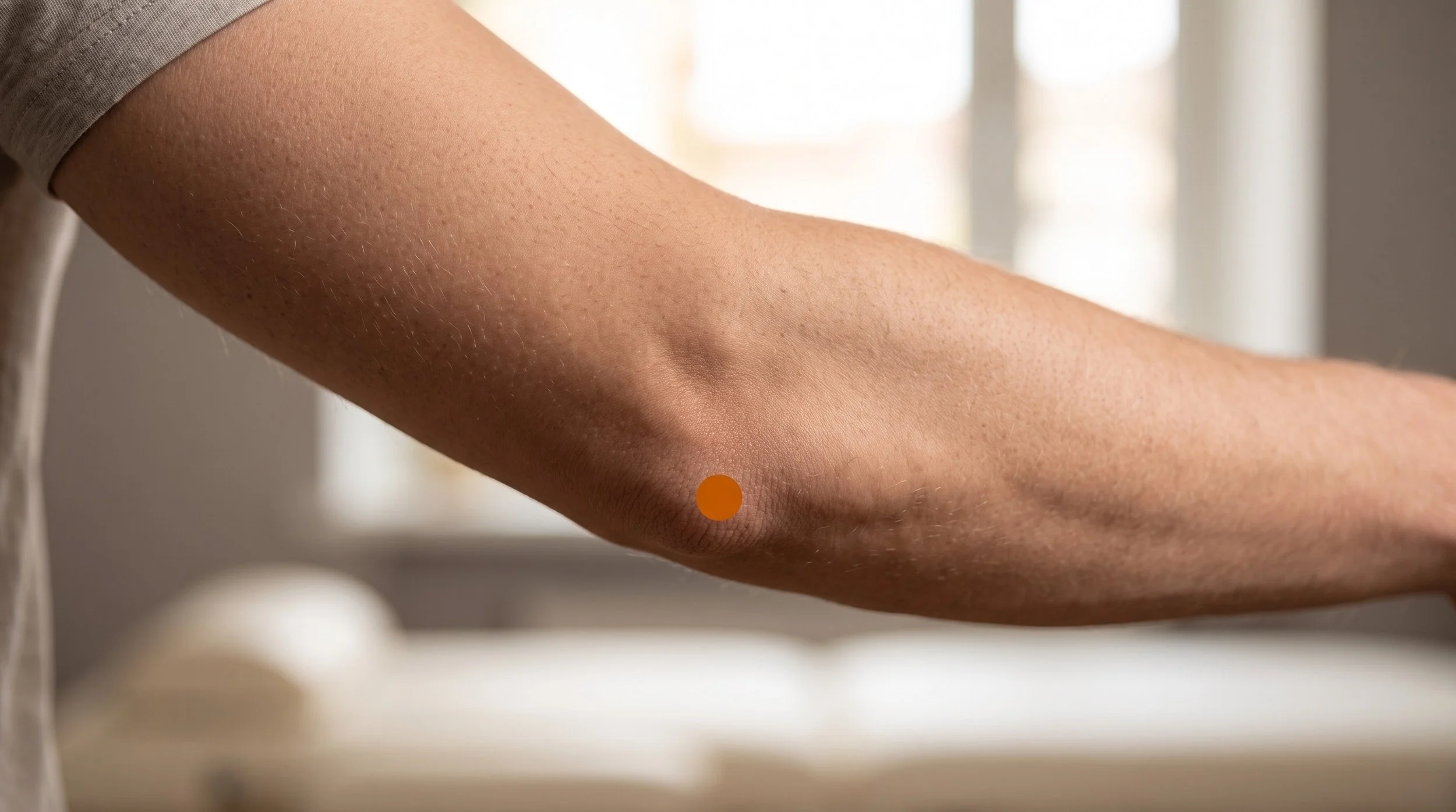
Zhoujian Acupuncture Point (M-UE-46)
The Elbow Tip Point: Anatomy, Thermal Mechanisms, and Why a Moxibustion-Only Extra Point Was Classically Used for Nodules Far From the Arm
Zhoujian (M-UE-46), whose name is usually translated as Elbow Tip, is an extra point that sits directly on the bony apex of the olecranon, the point of the elbow you feel when you rest your arm on a table. It's unusual in two ways.
First, it isn't a channel point at all, so it carries no five-shu or meeting designations, and second, the classical literature treats it as a moxibustion site rather than a needling site, since there's almost nothing between the skin and the bone. The Elbow Tip point earned its place in the texts through a narrow but persistent set of uses, above all the treatment of nodular swellings of the neck, which classical writers called scrofula, along with boils, carbuncles, and deep-rooted sores (Deadman et al., 2007).
For modern patients, the zhoujian acupuncture point matters less as a routine treatment and more as a window into how heat applied at a distant, well-defined landmark was thought to influence swellings and skin lesions elsewhere in the body.
- Zhoujian (M-UE-46), also listed in standard extra point nomenclature as Ex-UE1, lies on the tip of the olecranon process of the ulna, best located with the elbow flexed so the bony apex stands out (Deadman et al., 2007; Cheng, 2010). The tissue stack is thin: mobile skin, a small subcutaneous bursa, the distal fibers of the triceps tendon, and then periosteum.
- Classical texts assign this point the traditional action of transforming phlegm and dissipating swelling, and list scrofula, carbuncles and furuncles, deep-rooted sores, and intestinal abscess among its indications (Deadman et al., 2007). Read in modern terms, that cluster describes nodular and inflammatory soft tissue conditions rather than an energetic process.
- The elbow tip point is treated with moxibustion only, not with a needle. Chinese clinical texts describe roughly seven to fourteen cones in ordinary use, while the classical scrofula method used far larger cone counts at a single sitting (Cheng, 2010; Deadman et al., 2007).
- Mechanistically, moxa heat is best understood as controlled thermal stimulation of skin and subcutaneous tissue that recruits warm and polymodal receptors, with TRPV1 channels acting as a temperature-dependent gate for at least some of moxibustion's systemic effects (Deng & Shen, 2013; Wang et al., 2013).
- Skin over the olecranon is supplied by branches of the posterior and medial cutaneous nerves of the forearm at roughly C8 to T1, which is nowhere near the cervical segments serving the neck. Any effect at a distance is therefore better framed through heterosegmental and descending modulatory pathways than through local segmental convergence (Zhao, 2008).
- There's no modern trial evidence for Zhoujian specifically. Moxibustion reviews in other conditions are mostly small and at high risk of bias, and adverse event reports center on burns, blistering, and local infection, so technique and clinician judgment matter (Choi et al., 2011; Park et al., 2010).
- Because this is a heat point rather than a needle point, the expected sensation isn't classic de qi. Patients describe a deep, spreading warmth over the bone that builds toward a brief sharp bite of heat, then fades into a lingering flush and pink skin.
Struggling With Elbow Pain, Swelling, or a Stubborn Neck Lump?
At Morningside Acupuncture, we use the elbow tip region as an anatomical anchor for treating the posterior arm, and we combine gentle moxibustion with careful needling of the surrounding muscles when it fits your case. Every plan starts with an exam, so we can tell you clearly what's likely to respond to needling and heat and what belongs with your physician instead. If you've been dealing with a persistent lump, we'll say so directly and coordinate rather than treat around it. Schedule an evaluation and we'll map out a sensible plan.
Schedule NowAnatomy of ZHOUJIAN: Why the Olecranon Apex Is Such an Important Location
Zhoujian sits on the very crest of the olecranon, the hook-shaped upper end of the ulna that forms the point of the elbow. Flex the elbow to about ninety degrees and the apex becomes a sharp, easily palpated landmark. The layers here are remarkably shallow: loose, mobile skin that slides over the bone, a thin fat layer, the subcutaneous olecranon bursa (a small fluid-filled sac that lets skin glide during flexion), the deepest fibers of the triceps brachii tendon as they insert, and then periosteum.
What loads this area is pressure and friction rather than muscular strain, which is why leaning on hard surfaces, repeated floor work, and falls onto the point of the elbow are the usual sources of local irritation. Because the bursa and periosteum sit so close to the surface, this landmark tolerates heat and pressure far better than it tolerates a needle, which is exactly why the classical texts designated it a moxibustion site (Deadman et al., 2007; Cheng, 2010).
The nerve geography here is worth understanding. Skin over and around the olecranon is supplied mainly by the posterior cutaneous nerve of the forearm from the radial nerve and by the medial cutaneous nerve of the forearm, drawing on roughly C8 and T1 spinal levels. The ulnar nerve runs in its groove just medial to the point, behind the medial epicondyle, which is the structure most people know as the funny bone. Heat applied at the apex activates cutaneous thermoreceptors and polymodal nociceptors whose signals enter the dorsal horn at those lower cervical and upper thoracic levels (Deng & Shen, 2013).
Sustained, moderately noxious thermal input of this kind is one of the classic ways of engaging descending inhibitory systems that dampen pain processing more broadly, a mechanism well described in the acupuncture analgesia literature (Zhao, 2008). Animal work also suggests that moxibustion's effects are temperature dependent and partly mediated by TRPV1, the heat-sensitive channel on small-diameter afferents, since the effects diminish when that channel is absent (Wang et al., 2013).
There's no large vessel directly at the apex to worry about, though the rich anastomotic network around the elbow, including the recurrent ulnar branches, lies deeper and slightly to the sides. The practical safety issues are thermal and mechanical rather than vascular. Skin here is thin and sits directly on bone, so heat builds quickly and can blister with little warning, and the olecranon bursa can become irritated or infected if the skin is broken.
That's the reasoning behind the standing convention: Zhoujian is treated by moxibustion only and isn't needled (Deadman et al., 2007; Shanghai College of Traditional Chinese Medicine, 1981). In practice this means indirect or pole moxa held at a comfortable distance, or small cones on a protective medium, with constant attention to skin color and patient feedback, and with heat avoided entirely over numb, scarred, or compromised skin (Park et al., 2010).
Related Dry Needling For Tennis Elbow Related Best Acupuncture Points For Neck PainZHOUJIAN at a Glance: Classification, Location, and Clinical Use
| Category | Detail |
|---|---|
| Traditional Name | Zhoujian, commonly translated as Elbow Tip |
| Channel Classification | Extra point of the upper extremity, coded M-UE-46 and listed as Ex-UE1 in standard extra point nomenclature; not part of a regular channel pathway |
| Point Categories | No five-shu, meeting, hui-meeting, or extraordinary vessel designations. Classified simply as a miscellaneous extra point of the arm, traditionally credited with transforming phlegm and dissipating swelling, and conventionally reserved for moxibustion (Deadman et al., 2007) |
| Precise Location | On the tip of the olecranon process of the ulna, at the point of the elbow, most easily found with the elbow flexed so the bony apex protrudes |
| Tissue Stimulated | Thin sliding skin, subcutaneous fat, the subcutaneous olecranon bursa, the distal insertional fibers of the triceps tendon, and periosteum of the olecranon. Adjacent myofascial targets used in clinic include the distal triceps and anconeus, often treated during dry needling for tennis elbow |
| Needle Depth / Direction | Not needled. Treated by moxibustion only, classically seven to fourteen cones in routine use, with much larger cone counts described in classical scrofula protocols; indirect, pole, or shielded cone moxa is preferred in modern practice |
| De Qi Sensation | Not a needling sensation. Expect deep, spreading warmth over the bone that builds toward a brief sharp bite of heat, followed by a lingering flush and local pinkness that settles within an hour |
| Primary Clinical Uses | Traditionally used for nodular swellings of the neck (scrofula), carbuncles and furuncles, deep-rooted sores, and, in the earliest source, intestinal abscess. Modern clinical use is limited and adjunctive, alongside conventional medical evaluation |
| Common Point Combinations |
|
The Elbow Tip point enters the record early. Deadman and colleagues trace its first discussion to the seventh century Thousand Ducat Formulas, where it appears in connection with intestinal abscess, and note that its longer-running reputation was for scrofula, a traditional term covering nodular swellings on the sides of the neck and, by extension, similar lumps in the armpit and groin (Deadman et al., 2007).
The Shanghai and modern Chinese teaching texts carry the same short list forward, pairing scrofula with abscessed carbuncle and prescribing moxibustion rather than needling (Shanghai College of Traditional Chinese Medicine, 1981; Cheng, 2010). The traditional action assigned to the point, transforming phlegm and dissipating swelling, is a category statement about lumps and thickened tissue rather than a physiological claim in the modern sense.
What makes the classical pattern striking is its geometry: a point on the elbow, treated only with fire, prescribed for lumps in the neck, and in at least one text applied on the side opposite the problem. That's a deliberate, rule-governed use of distance, and it tells you the old writers were thinking about whole-body responses rather than local treatment.
Why ZHOUJIAN Was Used for Lumps in the Neck When It Sits at the Elbow
The honest starting point is that this can't be explained segmentally. Skin over the olecranon reports to roughly the C8 and T1 spinal levels, while the tissues of the lateral neck are served by upper cervical segments. There's no shared dorsal horn territory to work with, so the usual convergence explanation, where two inputs meet at the same spinal level and one modulates the other, doesn't apply here the way it does when we needle a point near the structure we're treating (Zhao, 2008).
What's left is a heterosegmental story. Sustained, moderately intense thermal input at a small area of skin recruits warm receptors and polymodal C fibers, and that traffic ascends to brainstem and hypothalamic regions capable of turning down pain processing across wide areas of the body and of shifting autonomic tone (Deng & Shen, 2013; Zhao, 2008). Experimental work indicates this is dose and temperature dependent rather than symbolic: when the heat-sensitive TRPV1 channel is removed, temperature-graded effects of moxibustion largely disappear in animal models (Wang et al., 2013).
Local heating also produces predictable vascular and inflammatory changes in the treated tissue, including vasodilation and an increase in local blood flow, which is a plausible partial account of why classical writers reached for fire when dealing with sores and thickened tissue.
None of that means moxa at the elbow shrinks lymph nodes. Scrofula in the historical sense most often corresponded to tuberculous cervical lymphadenitis, a condition that today requires diagnosis and antimicrobial treatment. Any persistent neck lump needs medical evaluation first, and acupuncture or moxibustion sits alongside that workup rather than in place of it. Where the elbow tip point still earns attention in a modern clinic is as a comfortable, low-risk site for warmth in the posterior arm and as part of the historical vocabulary practitioners draw on when building a treatment.
What the Research Shows for ZHOUJIAN
There's no clinical trial testing Zhoujian on its own, which is unsurprising for an extra point that appears in a handful of classical indications and is applied with heat rather than a needle. What the literature offers instead is indirect: reviews of moxibustion as a modality, mechanistic work on how thermal stimulation is transduced, safety data on what goes wrong when moxa is applied carelessly, and the broader evidence base for acupuncture in pain conditions.
All of these test multi-point protocols or moxibustion in general, so they tell you something about the plausibility and safety of the method rather than about this specific landmark. Read the table below with that limitation in mind.
| Study | Type | Focus | Key Finding |
|---|---|---|---|
| Choi et al., 2011 | Systematic review and meta-analysis | Moxibustion for rheumatic conditions, 14 randomized trials | Pooled response rates favored moxibustion in some comparisons, but all included trials were of low methodological quality, so the authors judged the evidence inconclusive. |
| Park et al., 2010 | Systematic review of adverse events | Reported harms from moxibustion across trials, case reports, and observational studies | Burns, blistering, local skin reactions, allergic responses, and infection were the recurring problems, which supports conservative technique over bare skin on bone. |
| Deng & Shen, 2013 | Mechanistic review | Thermal, radiant, and pharmacological components of moxibustion | Thermal stimulation reaches both superficial and deeper tissue and appears to act through warm and polymodal receptors rather than through any single pathway. |
| Wang et al., 2013 | Controlled animal experiment | Moxibustion at two temperatures in wild-type and TRPV1-deficient mice | Effects were temperature dependent in normal animals and largely absent without TRPV1, suggesting this heat-sensitive channel helps gate moxibustion's systemic effects. |
| Vickers et al., 2018 | Individual patient data meta-analysis | Acupuncture for chronic musculoskeletal, headache, and osteoarthritis pain | Needling produced modest but statistically robust benefits over sham and no-acupuncture controls, with effects persisting over follow-up. |
| Zhao, 2008 | Narrative review of mechanisms | Neural pathways underlying acupuncture analgesia | Peripheral afferent activation engages spinal and supraspinal circuits, including descending inhibition and endogenous opioid systems, which provides the framework for distant point effects. |
Moxibustion in NYC: Warmth, Precision, and Clear Boundaries
Moxa is one of the oldest tools in East Asian medicine, and we use it the way the classics intended: at defined landmarks, in measured doses, with the skin watched closely. Our practitioners apply indirect and pole moxa over points like Zhoujian to deliver comfortable heat without blistering. We'll also tell you when heat isn't appropriate, including over numb skin, active infection, or an undiagnosed swelling. Book a session to see how thoughtful heat therapy fits alongside acupuncture and dry needling.
Schedule NowZHOUJIAN in the Context of Trigger Point Work
Zhoujian itself isn't a trigger point target, since there's no muscle belly at the apex of the olecranon to needle. What surrounds it, though, is prime territory. The distal triceps brachii converges on this bone, and trigger points in the triceps, particularly in the long and medial heads, are described as referring pain toward the back of the elbow and down the posterior forearm, while anconeus trigger points produce a nagging ache right at the lateral elbow (Simons et al., 1999).
When a patient points at the tip of the elbow as the source of their pain, those muscles plus the wrist extensor group are usually the first places we examine.
At Morningside, we handle this region by separating the two tools. Moxibustion goes on or near the elbow tip point when warmth is appropriate and the skin is healthy, while the needling happens in the surrounding musculature: distal triceps, anconeus, extensor carpi radialis brevis and longus, supinator, and the brachioradialis when forearm loading is part of the picture. That combination is common in stubborn lateral elbow pain, where the tendon findings are only part of the problem and the posterior arm muscles are quietly contributing.
We keep needles away from the olecranon apex and the ulnar groove, and we palpate the ulnar nerve's position before working anywhere on the medial side of the joint.
ZHOUJIAN Elbow and Neck Treatment at NYC's Highest-Rated Acupuncture Clinic
Morningside Acupuncture is the highest-rated acupuncture and dry needling clinic in New York City with over 500 five-star Google reviews, and our approach blends classical point knowledge with modern pain science. We treat elbow pain, neck tension, and posterior arm dysfunction using precise needling of named muscles alongside traditional points like the Elbow Tip. You get a clear explanation of what we're doing and why at every visit. Schedule your appointment today and let's get to work.
Schedule NowFrequently Asked Questions
What does ZHOUJIAN feel like when needled?
It isn't needled, so the honest answer is that you shouldn't feel a needle here at all. Zhoujian is a moxibustion point, and what you'll feel is heat: a slow, spreading warmth over the point of the elbow that gradually intensifies until it reaches a brief sharp edge, at which moment the practitioner moves the moxa away. Afterward the skin is pink and warm and there may be a mild residual glow for a half hour or so. You should never feel a burning sting that lingers, and you should always be able to speak up and have the heat removed immediately.
Why treat the elbow for a problem in the neck?
Because classical practice used distant heat deliberately, and because the nerve anatomy rules out a simple local explanation. Skin over the olecranon reports to the lower cervical and upper thoracic spinal levels, not to the upper cervical levels that serve the neck, so any influence at a distance would have to travel through brainstem and hypothalamic circuits that modulate pain and autonomic tone more broadly (Zhao, 2008; Deng & Shen, 2013). One classical text even specified treating the opposite elbow from the affected side of the neck (Deadman et al., 2007). That said, a lump in the neck is a medical finding and needs proper evaluation first.
Can I press ZHOUJIAN myself between sessions?
You can, though pressure isn't the traditional method here and expectations should stay modest. Bend your elbow to about ninety degrees, find the hard bony point at the back of the joint, and use your opposite thumb to apply firm, steady pressure directly on the apex for 30 to 60 seconds, then release and repeat two or three times. Small circular motions over the surrounding triceps tendon are usually more useful than pressing the bone itself. Two or three short rounds per day is plenty. Stop if the area becomes tender, warm, or swollen, since the bursa here can get irritated, and don't apply heat or pressure over broken skin, a visible swelling, or an area that feels numb.
Is ZHOUJIAN safe to needle?
No, and that's the point of its classification. The classical texts specify moxibustion only, and the anatomy explains why: there's very little between skin and periosteum, the subcutaneous olecranon bursa sits right there and can be irritated or infected by a puncture, and the ulnar nerve runs in its groove just medial to the landmark (Deadman et al., 2007; Shanghai College of Traditional Chinese Medicine, 1981). Moxibustion itself is generally well tolerated but not risk free, with burns, blistering, and local infection being the reported problems, so it should be applied by a trained practitioner and avoided over numb skin, active infection, or undiagnosed swellings (Park et al., 2010).
Where exactly is ZHOUJIAN located?
On the tip of the olecranon process of the ulna, which is the hard point of the elbow. To find it, flex your elbow to roughly ninety degrees so the bone stands out prominently, then run a finger up the back of the forearm along the ulna until you reach the apex. That's the point. It's a single, unambiguous bony landmark, which is one reason it survived in the extra point lists for so long despite having a short indication list.
References
- Deadman, P., Al-Khafaji, M., & Baker, K. (2009). A manual of acupuncture. Journal of Chinese Medicine Publications.
- O'Connor, J., & Bensky, D. (Eds. & Trans.). (1981). Acupuncture: A comprehensive text. Shanghai College of Traditional Medicine. Eastland Press.
- Cheng, X. (Ed.). (1999). Chinese acupuncture and moxibustion (Rev. ed.). Foreign Languages Press.
- Maciocia, G. (2006). The channels of acupuncture: Clinical use of the secondary channels and eight extraordinary vessels. Churchill Livingstone Elsevier.
- Kim, H. (2008). Handbook of Oriental medicine (3rd ed.). Harmony & Balance Press.
- Simons, D. G., Travell, J. G., & Simons, L. S. (1999). Travell & Simons' myofascial pain and dysfunction: The trigger point manual, Vol. 1: Upper half of body (2nd ed.). Williams & Wilkins.
- Deng, H., & Shen, X. (2013). The mechanism of moxibustion: Ancient theory and modern research. Evidence-Based Complementary and Alternative Medicine, 2013, 379291. https://doi.org/10.1155/2013/379291
- Wang, G. Y., Wang, L. L., Xu, B., Zhang, J. B., & Jiang, J. F. (2013). Effects of moxibustion temperature on blood cholesterol level in a mice model of acute hyperlipidemia: Role of TRPV1. Evidence-Based Complementary and Alternative Medicine, 2013, 871704. https://doi.org/10.1155/2013/871704
- Park, J. E., Lee, S. S., Lee, M. S., Choi, S. M., & Ernst, E. (2010). Adverse events of moxibustion: A systematic review. Complementary Therapies in Medicine, 18(5), 215-223. https://doi.org/10.1016/j.ctim.2010.07.001
- Choi, T. Y., Kim, T. H., Kang, J. W., Lee, M. S., & Ernst, E. (2011). Moxibustion for rheumatic conditions: A systematic review and meta-analysis. Clinical Rheumatology, 30(7), 937-945. https://doi.org/10.1007/s10067-011-1706-5
- Zhao, Z. Q. (2008). Neural mechanism underlying acupuncture analgesia. Progress in Neurobiology, 85(4), 355-375. https://doi.org/10.1016/j.pneurobio.2008.05.004
- Vickers, A. J., Vertosick, E. A., Lewith, G., MacPherson, H., Foster, N. E., Sherman, K. J., Irnich, D., Witt, C. M., & Linde, K. (2018). Acupuncture for chronic pain: Update of an individual patient data meta-analysis. Journal of Pain, 19(5), 455-474. https://doi.org/10.1016/j.jpain.2017.11.005
Disclaimer: This web site is intended for educational and informational purposes only. Reading this website does not constitute providing medical advice or any professional services. This information should not be used for diagnosing or treating any health issue or disease. Those seeking medical advice should consult with a licensed physician. Seek the advice of a medical doctor or other qualified health professional for any medical condition. If you think you have a medical emergency, call 911 or go to the emergency room. No acupuncturist-patient relationship is created by reading this website or using the information. Morningside Acupuncture PLLC and its employees and contributors do not make any express or implied representations with respect to the information on this site or its use. For any legal interpretation of scope of practice in your state, consult a licensed attorney or regulatory authority.
Read more from our blog



