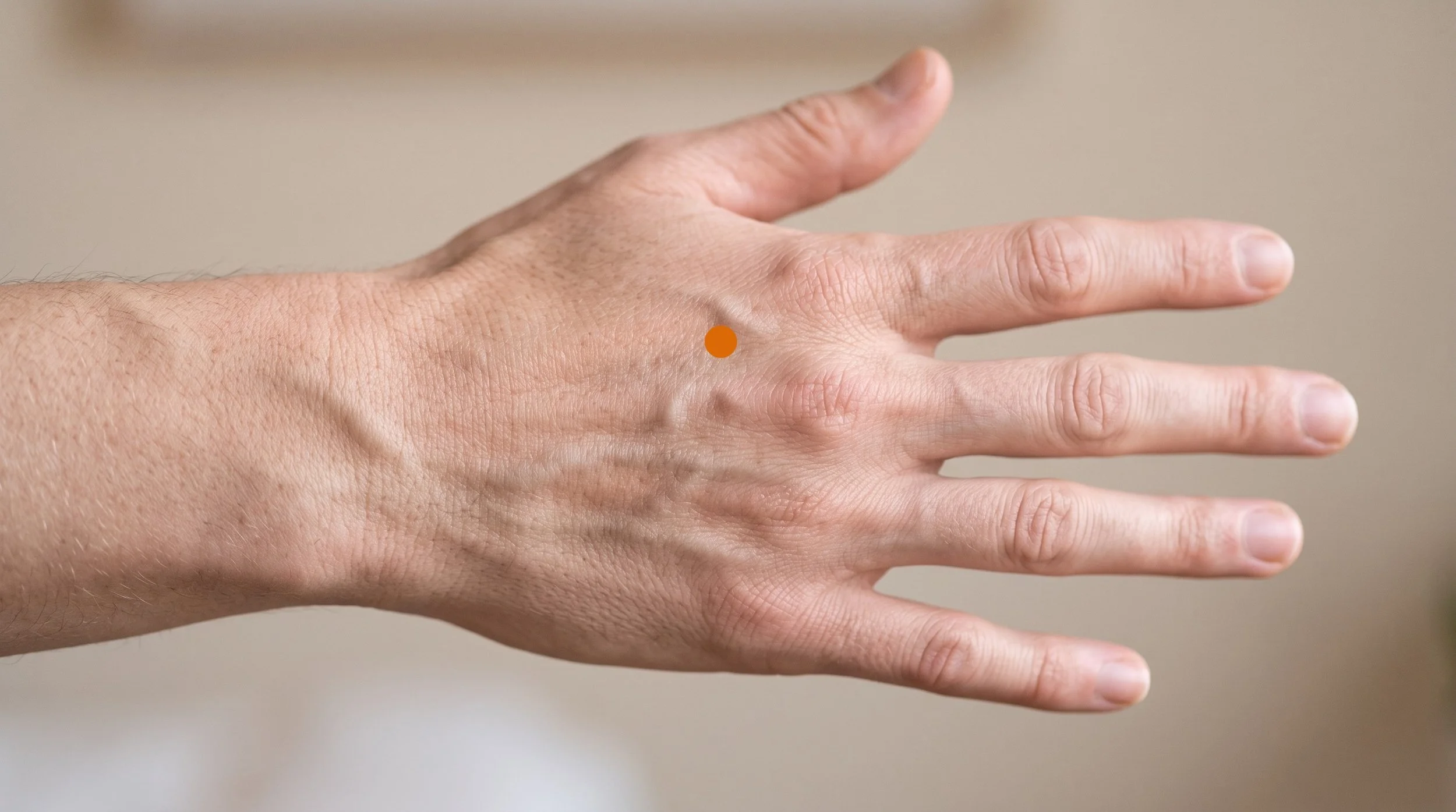
Luozhen Acupuncture Point (M-UE-24)
The Stiff Neck Point on the Back of the Hand: Anatomy, Distal Pain Modulation, and Why LUOZHEN Is Needled While You Turn Your Head
LUOZHEN (M-UE-24), whose name is usually rendered in English as Stiff Neck, is an extra point that sits on the back of the hand in the small hollow just behind the knuckles of the index and middle fingers, roughly opposite PC8 in the palm. It belongs to no channel and carries no classical channel-point title, yet it is one of the best known distal points in modern practice because of how it is used: the acupuncturist needles the luozhen hand point on the painful side and then asks the patient to slowly turn, bend and extend the neck while the needle is stimulated.
That pairing of a distal needle with active cervical movement is the reason this small point on the hand has become a standard first move for the person who woke up unable to look over one shoulder.
- LUOZHEN lies in the second intermetacarpal space on the dorsum of the hand, just proximal to the second and third metacarpophalangeal joints, and is easiest to find with the hand in a loose fist; the needle passes through thin skin and the dorsal venous network into the second dorsal interosseous muscle, a small, dense, mechanically busy muscle that grips, types and carries all day (Deadman et al., 2007).
- Traditional sources classify it simply as an extra point of the upper limb, with the attributed action of invigorating qi and blood in the neck region and classical indications covering neck stiffness, inability to turn the head, headache, and shoulder and arm pain (Deadman et al., 2007). Read physiologically, that language describes strong somatosensory input from the hand producing analgesia and reduced muscle guarding somewhere else.
- The hand dorsum is supplied by cutaneous branches of the radial nerve with deep motor supply to the interossei from the ulnar nerve, carrying afferent traffic into the lower cervical cord segments; needling here recruits A-delta and C fibers whose input engages spinal and brainstem pain-modulating circuits rather than acting on the neck tissue itself (Shanghai College of Traditional Chinese Medicine, 1981; Zhao, 2008).
- The research picture is honest but incomplete: reviews support acupuncture for neck pain in general (Trinh et al., 2016; Fang et al., 2024; Vickers et al., 2018), a multicenter trial found that adding guided movement to needling outperformed static needling for acute neck pain (Lee et al., 2026), and trials designed around single distal hand points and around movement-during-needling protocols are still being reported (Sun et al., 2014; Pei et al., 2024).
- In clinic, LUOZHEN is usually a first-move point rather than the whole treatment: needle it on the affected side, coach 60 to 90 seconds of slow rotation and side bending, reassess range of motion, then move to local work at the neck and shoulder once guarding has eased.
- De qi at this point is distinctive and fairly strong: a heavy, spreading ache between the metacarpal bones that may travel toward the fingers or up the back of the forearm. Patients should feel dull pressure and fullness, never a sharp electrical zap held for more than an instant.
Woke Up With a Neck That Will Not Turn?
Acute wry neck is one of the fastest-responding complaints we see, and LUOZHEN is often the first needle we place. We use the hand point with guided cervical movement to reduce guarding, then treat the upper trapezius, levator scapulae and suboccipital muscles once rotation improves. Most patients notice a change in how far they can turn within the first few minutes of the visit. Schedule an appointment and let us take a look before you spend another week sleeping in one position.
Schedule NowAnatomy of LUOZHEN: Why the Second Intermetacarpal Space Is Such an Important Location
Make a loose fist and slide a fingertip back from the knuckles of the index and middle fingers. About half an inch behind those two prominences you drop into a soft hollow between the second and third metacarpal bones. That hollow is LUOZHEN. Under the skin sit the dorsal veins of the hand and the extensor tendons running out to the index and middle fingers, and beneath those lies the second dorsal interosseous muscle filling the space between the two bones.
These small muscles abduct and stabilize the fingers, and they work constantly during gripping, pinching, typing and phone use, which is part of why the area is often tender even in people who have never thought about it (Deadman et al., 2007).
Sensation from the back of the hand travels through cutaneous branches of the radial nerve, while the interossei themselves are driven by the deep branch of the ulnar nerve, and the local vessels include the dorsal metacarpal arteries with the deep palmar arch lying deeper in the palm (Shanghai College of Traditional Chinese Medicine, 1981). All of that afferent traffic enters the spinal cord in the lower cervical segments, the same region of the cord that also handles input from the lower neck, shoulder girdle and upper limb.
Needling creates a sustained barrage of small-fiber input that engages segmental gating at the dorsal horn and recruits descending inhibitory pathways from the brainstem, along with endogenous opioid and monoamine signaling, which is the best current explanation for why a needle in the hand can change pain that lives in the neck (Zhao, 2008).
Because the deep palmar structures sit on the other side of the interosseous space, needling convention here is conservative: perpendicular or oblique insertion angled proximally along the groove between the metacarpals, 0.5 to 1 cun, staying in the muscular plane rather than transfixing the hand (Deadman et al., 2007). Visible dorsal veins are avoided, and needle depth is kept modest in thin hands. Sensation may radiate toward the fingertips, which is expected, but sustained numbness or sharp radiating pain means the needle is repositioned (Shanghai College of Traditional Chinese Medicine, 1981).
Related Acupuncture For Neck Pain Related Best Acupuncture Points For Neck PainLUOZHEN at a Glance: Classification, Location, and Clinical Use
| Category | Detail |
|---|---|
| Traditional Name | Luozhen, commonly translated as Stiff Neck; the Chinese term is associated with waking up with a crick in the neck after sleeping awkwardly |
| Channel Classification | Extra point of the upper limb, M-UE-24; not a member of any of the twelve regular channels |
| Point Categories | Extra (miscellaneous) point with no five-shu, yuan-source, luo-connecting, xi-cleft, hui-meeting or extraordinary vessel designation, and no meeting or crossing point status; traditionally described as invigorating qi and blood in the neck region (Deadman et al., 2007) |
| Precise Location | Dorsum of the hand, in the depression between the second and third metacarpal bones roughly 0.5 cun proximal to the metacarpophalangeal joints, located with the hand in a loose fist; described in classical texts as the apex of an equilateral triangle formed with the index and middle finger knuckles, and as lying opposite PC8 on the palm |
| Tissue Stimulated | Skin, dorsal venous network and extensor tendons of the index and middle fingers, then the second dorsal interosseous muscle |
| Needle Depth / Direction | Perpendicular or oblique insertion angled proximally along the intermetacarpal groove, 0.5 to 1 cun; typically needled on the affected side and stimulated while the patient slowly flexes, extends and rotates the neck |
| De Qi Sensation | Heavy, dull, spreading ache or fullness between the metacarpals, often noticeably strong, sometimes radiating toward the fingertips or proximally into the forearm |
| Primary Clinical Uses | Acute stiff neck and wry neck with restricted rotation, neck pain referring into the shoulder and arm, headache associated with neck tension; classical listings also include epigastric pain |
| Common Point Combinations |
|
In A Manual of Acupuncture, Deadman and colleagues place Luozhen among the extra points of the upper limb, giving it a single attributed action, to invigorate qi and blood in the neck region, and a short indication list built around neck stiffness, inability to turn the head, headache, and pain of the shoulder and arm, with the more unexpected additions of epigastric pain, diarrhea and childhood fright wind (Deadman et al., 2007). These are traditional attributions, recorded within the framework of Chinese medicine rather than as clinical claims.
The commentary is equally spare about method: choose the point on the affected side, and manipulate it while the patient flexes, extends and rotates the neck. What is striking about the classical pattern is how narrowly functional it is. Most points in the tradition accumulate long, sprawling indication lists across centuries of use, while this one was named for a single problem, kept a method attached to that problem, and never really drifted from it.
Why LUOZHEN Is Used for a Neck That Will Not Turn
The first question most patients ask is why a needle in the hand would do anything for the neck. Part of the answer is anatomical bookkeeping. Sensory information from the back of the hand enters the spinal cord in the lower cervical segments, the same neighborhood that receives input from the lower cervical spine, the shoulder girdle and the upper limb. Strong input arriving at those segments can dampen the transmission of pain signals from neighboring inputs, a gating effect that has been described in detail in the acupuncture analgesia literature (Zhao, 2008).
Acute wry neck is largely a protective problem: the tissue injury is usually small, but the nervous system responds by locking down rotation. Reducing the alarm signal often lets rotation return faster than treating the muscle alone would predict.
The second part of the answer is not segmental at all. Needling at a distance also recruits descending inhibitory control from the midbrain and brainstem, releasing endogenous opioids, serotonin and noradrenaline that reduce pain sensitivity in a widespread way (Zhao, 2008). That is why a distal point can be chosen on the side of pain, or occasionally on the opposite side, and still change how the neck feels. It also explains why the point may take the edge off an associated headache in the same session.
The third and most practical part is movement. Needling LUOZHEN while the patient turns the head pairs analgesia with active, graded exploration of the range the person has been avoiding. The neck moves under conditions where it hurts less, the guarding reflex gets less reinforcement, and the patient gets immediate feedback that turning is possible.
A multicenter randomized trial in acute neck pain found that combining needling with guided movement produced larger reductions in movement-related pain than needling without movement, with differences sustained over several weeks, although that trial used local cervical and shoulder points rather than a distal hand point (Lee et al., 2026). The mechanism it points to, sensorimotor input during motion, is the same one the classical Luozhen method relies on.
What the Research Shows for LUOZHEN
No high-quality trial has isolated LUOZHEN by itself, and it would be misleading to suggest otherwise. What the evidence base offers is three layers of indirect support: reviews of acupuncture for neck pain that test multi-point protocols in which distal hand points frequently appear, trials of the needling-with-movement method that gives this point its identity, and mechanistic work explaining how distal needling could plausibly modulate cervical pain.
Read the table below as context for a clinical tool, not as proof of a single point's effect, and note that two of the entries are trial protocols whose results speak to how actively this question is being studied rather than to what the answer is.
| Study | Type | Focus | Key Finding |
|---|---|---|---|
| Trinh et al., 2016 | Cochrane systematic review | Acupuncture for acute, subacute and chronic neck disorders across 27 randomized trials | Reported moderate quality evidence of benefit for mechanical neck pain compared with sham at immediate and short-term follow-up, though the review was subsequently withdrawn from the library pending updating, so conclusions should be held loosely. |
| Fang et al., 2024 | Systematic review and meta-analysis | Durability of acupuncture effects in chronic neck pain at three months or more | Acupuncture used as an adjunct was associated with sustained pain relief at three and six months, while comparisons against sham did not reach statistical significance. |
| Vickers et al., 2018 | Individual patient data meta-analysis | Chronic pain conditions including neck and shoulder pain, roughly 20,000 patients | Acupuncture was modestly superior to both sham and no-acupuncture controls, with effects that persisted over 12 months rather than fading immediately. |
| Lee et al., 2026 | Multicenter randomized controlled trial | Motion style acupuncture (needling with guided movement) versus conventional acupuncture in acute neck pain | Adding guided cervical movement to needling produced greater reductions in movement-related pain at week 3 with effects sustained to week 9, supporting the method rather than any specific point. |
| Sun et al., 2014 | Pilot randomized trial protocol | A single distal hand point (SI3) added to local massage for acute neck pain from stiff neck | Designed specifically to test whether one distal hand point improves acute stiff neck, illustrating that formal evidence for this class of point is still at an early stage. |
| Pei et al., 2024 | Randomized controlled trial protocol | Immediate effects of acupuncture combined with active exercise over a single 10 minute session in acute stiff neck | Tests the movement-during-needling approach against sham needling plus exercise and exercise alone, with minute-by-minute outcomes; results will help clarify how much of the rapid change is needle-specific. |
| Zhao, 2008 | Mechanistic review | Neural mechanisms of acupuncture analgesia | Describes segmental dorsal horn modulation plus descending inhibitory pathways and endogenous opioid signaling as the principal explanation for pain relief from needling at sites distant from the symptom. |
Neck Pain That Travels Into the Shoulder and Arm?
When neck stiffness spreads across the top of the shoulder or down the arm, treating only the sore spot often falls short. Our licensed acupuncturists combine distal points like LUOZHEN and SI3 with targeted dry needling of the muscles that reproduce your pattern, plus practical loading and posture advice for desk work. The goal is measurable range of motion, not just a pleasant hour on the table. Book a session and we will map where your pain is actually coming from.
Schedule NowLUOZHEN in the Context of Trigger Point Work
Acupuncture is defined by the use of an acupuncture needle, and that includes the hundreds of styles practiced worldwide, dry needling among them. At Morningside we rarely treat a stiff neck with the hand point alone. LUOZHEN opens the session because it changes rotation quickly and requires no needling near the cervical spine while the patient is still guarded.
Once range of motion improves, we move to the muscles that actually reproduce the complaint: upper trapezius, levator scapulae at its scapular attachment, splenius cervicis and the suboccipitals, all of which have well-described referral patterns into the neck, occiput and behind the eye (Simons et al., 1999). Treating in that order tends to be more comfortable for the patient and lets us judge how much of the restriction was protective.
There is also a local trigger point story at the point site itself. The dorsal interossei can harbor taut bands and tender nodules in people who grip, climb, play instruments or spend long hours at a keyboard, and needling into the second interosseous space is functionally the same target whether you call it LUOZHEN or a dorsal interossei trigger point. That overlap is useful clinically: a hand that is already tender in this space usually gives strong de qi and responds well, while a hand with no local tenderness may need firmer stimulation or a switch to SI3.
Either way, the movement instruction stays the same, because the coordination between needle stimulation and active cervical rotation is what makes this method work.
LUOZHEN Stiff Neck Treatment at NYC's Highest-Rated Acupuncture Clinic
Morningside Acupuncture is the highest-rated acupuncture and dry needling clinic in New York City with over 500 five-star Google reviews. We treat acute stiff neck, cervical strain, headaches and shoulder tension with a blend of classical point selection and modern orthopedic needling. Every visit includes reassessment, so you can see what changed rather than guess. Schedule your appointment at our Upper West Side office today.
Schedule NowFrequently Asked Questions
What does LUOZHEN feel like when needled?
Most people describe a heavy, dull, expanding ache between the bones on the back of the hand, sometimes with a warm or buzzing quality that travels toward the fingers or up the forearm. It is one of the stronger sensations in a typical treatment because the interosseous muscle is compact and richly innervated. The feeling should be intense but tolerable and should fade within seconds if the practitioner pauses stimulation. Sharp, sustained electrical pain is not the goal and means the needle needs repositioning.
Why treat the neck from a point on the hand instead of the neck itself?
Two reasons, one physiological and one practical. Physiologically, sensory input from the hand feeds into lower cervical spinal segments and recruits descending pain-inhibiting pathways, so needling here can reduce pain and protective muscle guarding in the neck (Zhao, 2008). Practically, a person in acute wry neck often cannot lie down comfortably or tolerate pressure on the affected muscles, and the hand point lets treatment begin while the neck is still highly reactive. We usually add local neck and shoulder work later in the same visit, once rotation has improved.
Can I press LUOZHEN myself between sessions?
Yes, and it is one of the easier points to self-treat. Make a loose fist with the affected hand, then use the thumb of the other hand to slide back from the knuckles of the index and middle fingers into the hollow between the two metacarpal bones, about a fingertip's width proximal to the knuckles. Press firmly enough to feel a strong ache, hold steady or use small circular pressure for 30 to 60 seconds, and while you press, slowly turn your head toward the restricted side to the edge of comfort and back, without forcing past pain. Repeat for two or three rounds, several times a day during an acute episode. Stop if pressure produces numbness in the fingers or sharp pain.
Is LUOZHEN safe to needle?
In trained hands it is a low-risk point. The main considerations are the visible dorsal veins on the back of the hand, which are avoided, and depth, since the needle is kept within the interosseous muscle plane rather than driven through toward the palm where the deep palmar arch and palmar nerves lie. Typical insertion is 0.5 to 1 cun angled proximally along the groove between the metacarpals (Deadman et al., 2007). Temporary local soreness or a small bruise is the most common side effect. Tell your acupuncturist if you take anticoagulants, have a hand injury or infection in the area, or have significant swelling or arthritis in the hand.
Where exactly is LUOZHEN located?
On the back of the hand, in the depression between the second and third metacarpal bones just behind the knuckles of the index and middle fingers, roughly half a cun proximal to those joints. Classical location notes offer two useful cross-checks: the point sits at the apex of an equilateral triangle formed with the two knuckle prominences, and it lies approximately opposite PC8 in the center of the palm (Deadman et al., 2007). Locating it with the hand in a loose fist makes the hollow easier to feel, and in most people it is noticeably tender compared with the surrounding tissue.
References
- Deadman, P., Al-Khafaji, M., & Baker, K. (2009). A manual of acupuncture. Journal of Chinese Medicine Publications.
- O'Connor, J., & Bensky, D. (Eds. & Trans.). (1981). Acupuncture: A comprehensive text. Shanghai College of Traditional Medicine. Eastland Press.
- Cheng, X. (Ed.). (1999). Chinese acupuncture and moxibustion (Rev. ed.). Foreign Languages Press.
- Cunningham, P. M. (2000). Acupuncture points: A practical guide to classical and modern usage. Odyssey Press.
- Kim, H. (2008). Handbook of Oriental medicine (3rd ed.). Harmony & Balance Press.
- Simons, D. G., Travell, J. G., & Simons, L. S. (1999). Travell & Simons' myofascial pain and dysfunction: The trigger point manual, Vol. 1: Upper half of body (2nd ed.). Williams & Wilkins.
- Trinh, K., Graham, N., Irnich, D., Cameron, I. D., & Forget, M. (2016). Acupuncture for neck disorders. Cochrane Database of Systematic Reviews, 2016(5), CD004870. https://doi.org/10.1002/14651858.CD004870.pub4
- Fang, J., Shi, H., Wang, W., Chen, H., Yang, M., Gao, S., Yao, H., Zhu, L., Yan, Y., & Liu, Z. (2024). Durable effect of acupuncture for chronic neck pain: A systematic review and meta-analysis. Current Pain and Headache Reports, 28(9), 957-969. https://doi.org/10.1007/s11916-024-01267-x
- Vickers, A. J., Vertosick, E. A., Lewith, G., MacPherson, H., Foster, N. E., Sherman, K. J., Irnich, D., Witt, C. M., & Linde, K. (2018). Acupuncture for chronic pain: Update of an individual patient data meta-analysis. Journal of Pain, 19(5), 455-474. https://doi.org/10.1016/j.jpain.2017.11.005
- Lee, Y. J., Kim, D., Park, K. S., Kim, S., Seo, J.-Y., Cho, H. W., Heo, I., Shin, W.-C., Cho, J.-H., Kim, J.-H., Seo, B.-K., & Ha, I.-H. (2026). Effectiveness and safety of motion style acupuncture treatment for acute neck pain: A multicenter randomized controlled trial. Chinese Medicine, Advance online publication. https://doi.org/10.1186/s13020-026-01332-0
- Sun, Z.-r., Yue, J.-h., Tian, H.-z., & Zhang, Q.-h. (2014). Acupuncture at Houxi (SI 3) acupoint for acute neck pain caused by stiff neck: Study protocol for a pilot randomised controlled trial. BMJ Open, 4(12), e006236. https://doi.org/10.1136/bmjopen-2014-006236
- Pei, X., Huang, G., Tang, X., Chen, Z., Huang, Y., Li, Q., Liang, F., Liu, Z., & Guo, T. (2024). Immediate efficacy of acupuncture combined with active exercise as 10 min rapid therapy for pain and movement disorders in patients suffering from acute stiff neck: Protocol for a randomised controlled trial. BMJ Open, 14(7), e080793. https://doi.org/10.1136/bmjopen-2023-080793
- Zhao, Z. Q. (2008). Neural mechanism underlying acupuncture analgesia. Progress in Neurobiology, 85(4), 355-375. https://doi.org/10.1016/j.pneurobio.2008.05.004
Disclaimer: This web site is intended for educational and informational purposes only. Reading this website does not constitute providing medical advice or any professional services. This information should not be used for diagnosing or treating any health issue or disease. Those seeking medical advice should consult with a licensed physician. Seek the advice of a medical doctor or other qualified health professional for any medical condition. If you think you have a medical emergency, call 911 or go to the emergency room. No acupuncturist-patient relationship is created by reading this website or using the information. Morningside Acupuncture PLLC and its employees and contributors do not make any express or implied representations with respect to the information on this site or its use. For any legal interpretation of scope of practice in your state, consult a licensed attorney or regulatory authority.
Read more from our blog



