GB13 Acupuncture Point (Benshen)
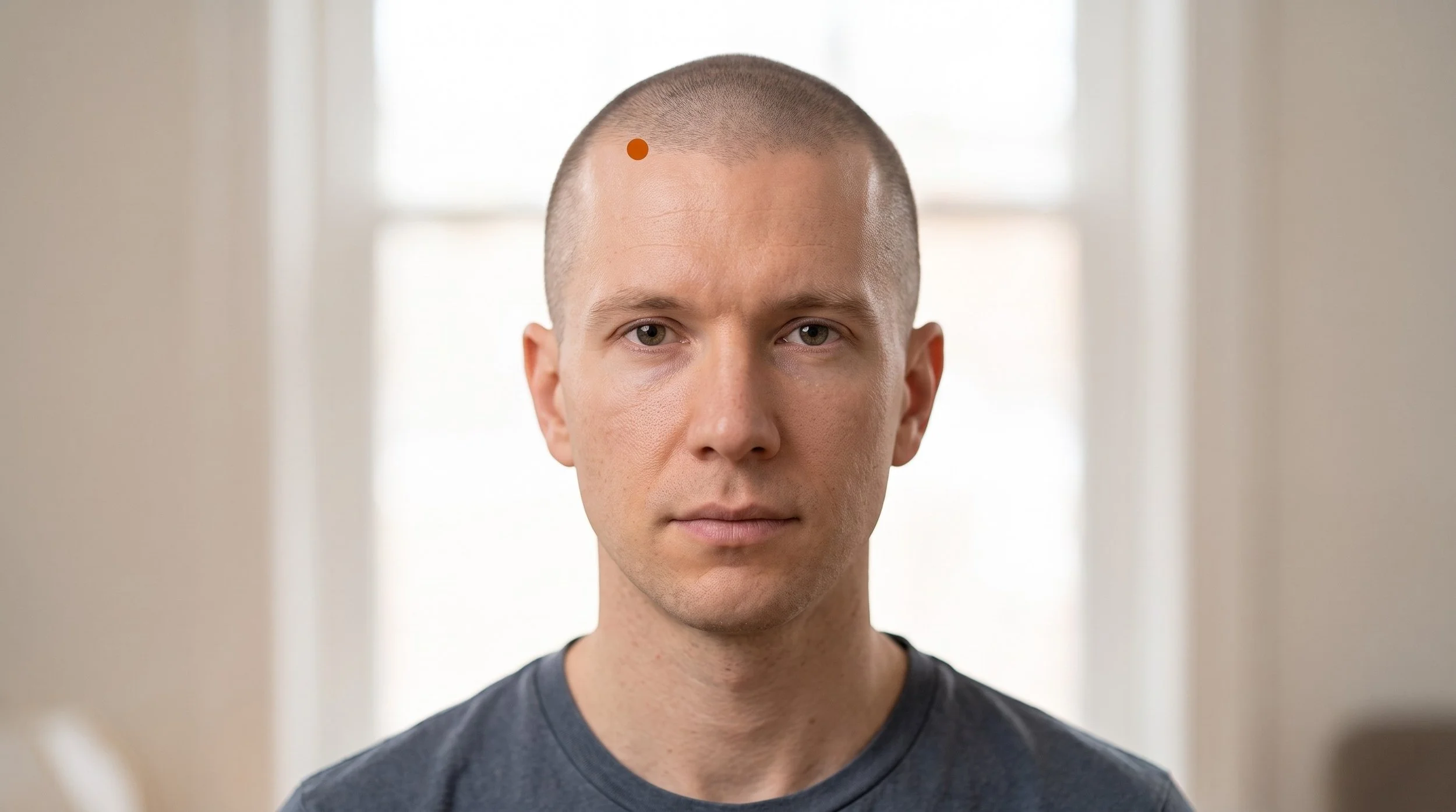
GB13 Acupuncture Point
Root of the Spirit at the Corner of the Forehead: Anatomy, Mechanism, and Why This Hairline Point Bridges Headache Care and Nervous System Calming
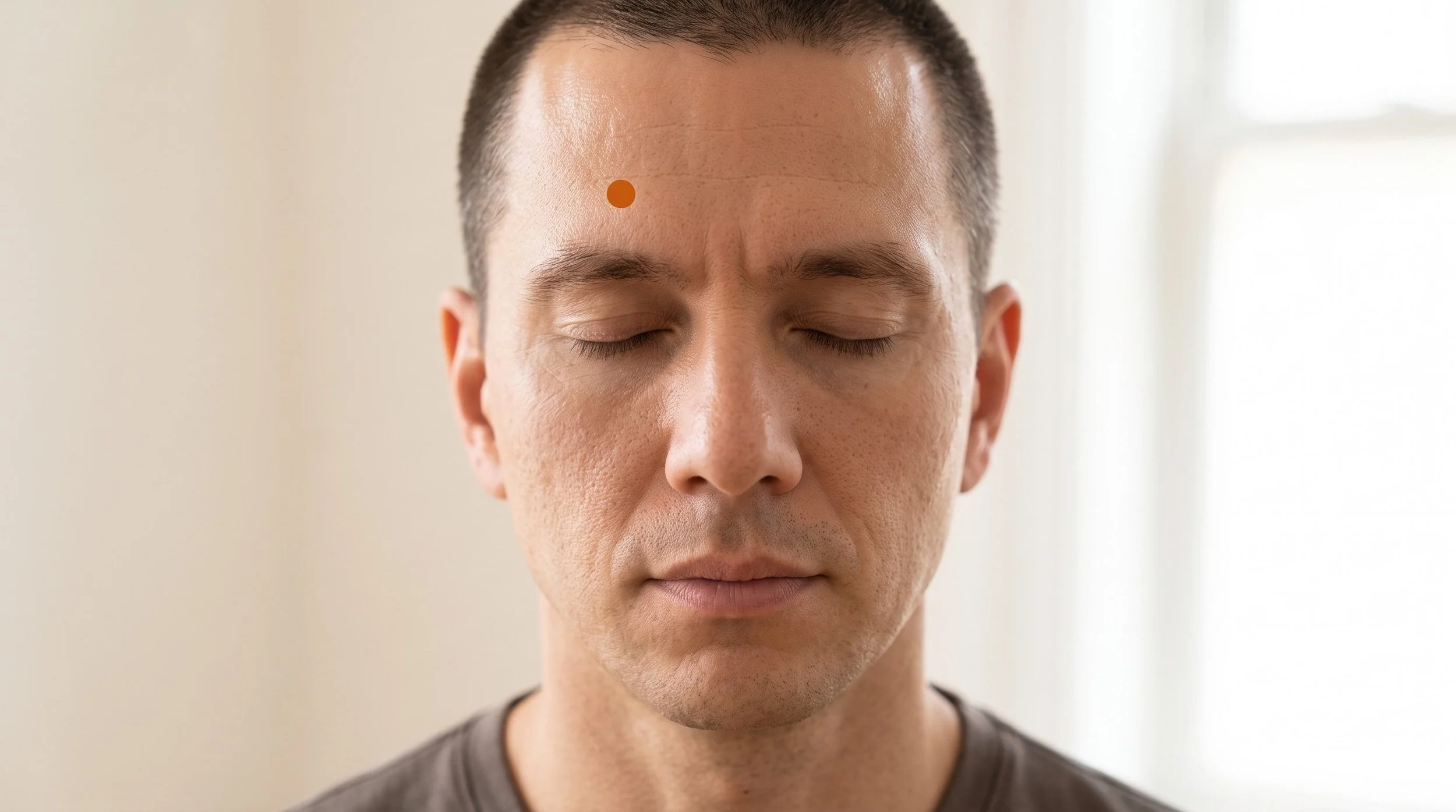
GB13 (Benshen, often translated as Root of the Spirit or Mind Root) sits on the forehead just inside the front hairline, roughly two thirds of the way out from the midline point GV24 toward ST8 at the corner of the hairline. In classical texts it is grouped as a meeting point of the Gallbladder channel with the Yang Linking vessel, one of the eight extraordinary vessels that classical writers described as linking the yang channels of the head, neck, and trunk.
Clinically the gb13 acupuncture point matters for two overlapping reasons: it lies directly in the frontal branch territory of the trigeminal nerve, which is the anatomical highway for most front-of-head pain, and it carries a long traditional association with settling agitation and clearing the head. That combination is why gallbladder 13 shows up in modern treatment plans for frontal and one-sided headache in patients who also arrive wired, braced, and unable to downshift.
- Location and layers: GB13 is 0.5 cun inside the anterior hairline, about two thirds of the distance from GV24 to ST8 (roughly 3 cun lateral to the midline in the measurement used by several modern point manuals). The needle passes through thin scalp skin into the loose subgaleal plane, which is why a transverse thread of 0.5 to 1.5 cun is comfortable here.
- Traditional categories, read neurophysiologically: classical sources list Benshen as a crossing point of the Gallbladder channel with the Yang Linking vessel and attribute to it actions such as dispelling wind, clearing the head, and calming the mind. Translated into modern terms, that maps onto stimulation of trigeminal cutaneous afferents feeding brainstem circuits that also handle head pain and arousal (Zhao, 2008).
- The nerve story: the medial part of this region is supplied by supraorbital and supratrochlear branches of the ophthalmic division of the trigeminal nerve, with auriculotemporal territory nearby laterally. Sustained stimulation of supraorbital trigeminal afferents has been shown to reduce monthly migraine days compared with sham in a randomized trial of a wearable stimulator, which supports the idea that frontal afferent input can modulate headache circuits (Schoenen et al., 2013).
- The research picture: no trial has isolated GB13 on its own. Cochrane reviews of multi-point acupuncture protocols found benefit over no prophylaxis and small effects over sham for migraine prevention and tension-type headache prevention (Linde et al., 2016a; Linde et al., 2016b), and individual patient data from chronic pain trials show effects that persist over time (Vickers et al., 2018).
- Clinical framing: at Morningside we use GB13 as a local and calming addition rather than a stand-alone solution, usually threaded alongside GV24 or Yintang for frontal headache, and paired with GB20 behind the head when neck stiffness travels forward. Reviews of acupuncture for anxiety report reductions in symptom scores, though trial quality varies and conclusions remain cautious (Yang et al., 2021).
- De qi here is subtle: most people feel a dull spreading pressure or a light tugging along the scalp rather than the deep ache produced at limb points. Sharp or burning sensation is not the goal and usually means the angle needs adjusting.
Frontal Headaches That Start Behind the Eyes and Settle at the Hairline?
Forehead pain rarely comes from the forehead alone, and treating only the painful spot tends to disappoint. Our team combines GB13 and neighboring hairline points with needling of the neck and shoulder muscles that refer pain into the front of the head, then adds distal points to broaden the response. Most patients notice a change in headache frequency or intensity within a handful of visits. Schedule an evaluation and we will map where your headache pattern actually starts.
Schedule NowAnatomy of GB13: Why the Frontal Hairline Corner Is Such an Important Location
GB13 sits over the frontal bone where the forehead curves back toward the temple. Under the skin lies a thin layer of subcutaneous tissue bound tightly to the galea aponeurotica, the tough fibrous sheet that connects the frontal and occipital bellies of the occipitofrontalis muscle. Below the galea is a loose areolar plane that slides over the periosteum, and it is this plane that allows a needle to travel a full inch or more transversely without the resistance felt in dense muscle.
Habitual brow raising, squinting at screens, jaw clenching, and prolonged mental strain all load this fascial sheet, which is one reason patients so often describe a band of tightness across the forehead during headache episodes.
The nerve geography here is the clinically important part. The medial and central forehead is supplied by the supraorbital and supratrochlear nerves, terminal branches of the ophthalmic division of the trigeminal nerve, while the region toward the temple falls under auriculotemporal supply from the mandibular division.
These trigeminal afferents converge in the trigeminocervical complex in the brainstem, the same relay that receives input from the upper cervical segments, which explains why neck tension and forehead pain so often travel together and why treating both regions tends to work better than treating either alone. Needling recruits small diameter afferents that engage descending inhibitory pathways involving endogenous opioid, serotonergic, and noradrenergic signaling, a mechanism mapped in detail in the acupuncture analgesia literature (Zhao, 2008).
Sustained supraorbital afferent stimulation has independently been shown to reduce migraine days relative to sham, which gives the frontal territory some direct clinical plausibility (Schoenen et al., 2013).
Blood supply at the hairline comes from the supraorbital and supratrochlear arteries medially and branches of the superficial temporal artery laterally, all running in the superficial layer. The scalp is richly vascular and bleeds readily, so a small bruise or a bead of blood on withdrawal is common rather than alarming, and steady pressure for thirty seconds after removal is standard practice.
Because the frontal bone is solid and the needle travels flat under the skin, transverse threading of 0.5 to 1.5 cun is the conventional technique, with practitioners avoiding perpendicular insertion, any area of skull defect or surgical hardware, and open fontanelles in infants.
Related Best Acupuncture Points For Headaches Related Best Acupuncture Points For AnxietyGB13 at a Glance: Classification, Location, and Clinical Use
| Category | Detail |
|---|---|
| Traditional Name | Benshen (Root of the Spirit, also translated Mind Root), Gallbladder 13 |
| Channel Classification | Gallbladder channel of Foot Shaoyang, head and forehead segment |
| Point Categories | Meeting point of the Gallbladder channel with the Yang Linking vessel (Yang Wei mai), listed among the coalescent points of that extraordinary vessel alongside GB14 through GB20, GB21, GB35, BL63, SI10, TE15, GV15, and GV16. It is not a five-shu, yuan-source, or hui-meeting point. |
| Precise Location | On the forehead, 0.5 cun inside the anterior hairline, two thirds of the distance from GV24 on the midline toward ST8 at the corner of the hairline (about 3 cun lateral to the midline). Some texts place it on a vertical line above the outer canthus of the eye, so a brief palpation for the most tender or reactive spot is worthwhile. For related regional mapping see Pain Finder Head Neck. |
| Tissue Stimulated | Scalp skin, subcutaneous layer, galea aponeurotica and the frontal belly of occipitofrontalis, with the needle riding in the loose subgaleal plane over frontal periosteum |
| Needle Depth / Direction | Transverse (subcutaneous) insertion 0.5 to 1.5 cun, threaded along the scalp, typically directed posteriorly or toward the adjacent hairline point; perpendicular deep insertion is not used |
| De Qi Sensation | A dull spreading pressure, mild heaviness, or gentle tugging along the scalp; occasionally a warm or tingling band across the forehead. Sharpness is not expected and signals a need to adjust angle or depth. |
| Primary Clinical Uses | Frontal and one-sided headache, forehead tension and brow tightness, visual dizziness and neck stiffness in classical listings, and calming or settling uses drawn from the point's traditional spirit-related associations |
| Common Point Combinations |
|
Deadman's Manual of Acupuncture presents Benshen as a Gallbladder point where that channel meets the Yang Linking vessel, and attributes to it the traditional functions of dispelling wind, transforming phlegm, and treating epilepsy. Its classical indication list runs along two tracks that are worth separating. The first is regional and musculoskeletal: headache, visual dizziness, stiffness and pain of the neck, and pain through the chest and flank severe enough that turning the body becomes difficult.
The second is neurological and psychiatric in the language of the period: seizure disorders including childhood fright epilepsy, foaming at the mouth, wind stroke with one-sided weakness, and deviation of the mouth and eyes. Other classical compendia and modern textbooks add clearing the brain and calming the mind to the list, and Maciocia's prescriptions pair GB13 with GV24 specifically for that settling effect.
These are traditional attributions rather than verified physiological claims, but the pattern is striking: the name Root of the Spirit points to the brain as the foundation of mental activity, and the indications cluster almost entirely around disorders of consciousness, movement, and the head, which is unusual coherence for a point list assembled across many centuries.
Why GB13 Is Used for Agitation and Poor Downshifting, Not Just Headache
Start with convergence. The forehead is trigeminal territory, and trigeminal afferents from the supraorbital and supratrochlear nerves terminate in the same brainstem region that receives input from the upper neck. That shared relay is why a headache can feel like it wraps from the base of the skull to the brow, and why input applied at the hairline can influence a pain pattern that seems to originate further back. Needling GB13 introduces a steady, low-grade afferent signal into that convergence zone, which is a plausible route by which local stimulation affects a broader head pain circuit (Zhao, 2008).
The calming side has a similar logic. Small diameter afferent input from needling engages descending pathways using endogenous opioid, serotonergic, and noradrenergic signaling, systems that regulate arousal and mood as well as pain (Zhao, 2008). Frontal stimulation specifically has been observed to produce sedative-type effects in healthy volunteers, with reductions in measures of vigilance during and after supraorbital stimulation sessions (Piquet et al., 2011).
That is not a study of GB13, and it should not be read as one, but it does suggest that the forehead is a reasonable place to influence arousal rather than a purely symbolic location.
Clinically, this is why we reach for the gb13 acupuncture point in patients whose headaches come bundled with clenching, shallow breathing, and difficulty settling at night. Reviews of acupuncture for anxiety report reductions in symptom scores compared with control conditions, though the trials vary widely in quality and most use multi-point protocols centered on points like HT7, PC6, and GV20 rather than GB13 (Yang et al., 2021). GB13 earns its place in those plans as a regional contributor with a long traditional pedigree, not as a stand-alone treatment.
What the Research Shows for GB13
Almost all acupuncture research tests complete protocols rather than single points, so there is no trial that isolates GB13 and reports what it does by itself. What the literature can tell us is whether protocols that include forehead and scalp points help with the conditions GB13 is used for, and whether the anatomical region it occupies has any independent evidence behind it. On both counts the picture is modest but real: benefit over no prophylaxis is fairly consistent, differences from sham are small, and the mechanism work supports afferent stimulation in trigeminal territory as a plausible route of action. Expect gradual change across a course of treatment rather than a single dramatic session.
| Study | Type | Focus | Key Finding |
|---|---|---|---|
| Linde et al., 2016a | Cochrane systematic review | Acupuncture for prevention of episodic migraine | Acupuncture reduced headache frequency compared with no prophylaxis and showed a small additional effect over sham, with results broadly comparable to prophylactic drugs. |
| Linde et al., 2016b | Cochrane systematic review | Acupuncture for prevention of tension-type headache | Adding acupuncture to usual care was associated with fewer headache days, though the advantage over sham needling was small. |
| Vickers et al., 2018 | Individual patient data meta-analysis | Acupuncture for chronic pain including headache | Effects were superior to sham and no-acupuncture controls and persisted over about a year, supporting more than a short-lived placebo response. |
| Schoenen et al., 2013 | Randomized sham-controlled trial | Supraorbital trigeminal neurostimulation for migraine prevention | Daily stimulation of forehead trigeminal branches significantly reduced monthly migraine days versus sham, supporting the relevance of this anatomical territory. |
| Piquet et al., 2011 | Controlled experimental study | Supraorbital transcutaneous neurostimulation in healthy volunteers | Forehead stimulation produced measurable sedative-type effects, suggesting frontal afferent input may influence arousal as well as pain. |
| Yang et al., 2021 | Systematic review and meta-analysis | Acupuncture for anxiety disorder | Pooled results favored acupuncture for anxiety symptom reduction with few adverse events, but methodological limitations across trials warrant caution. |
| Zhao, 2008 | Narrative mechanistic review | Neural mechanisms of acupuncture analgesia | Needling activates small diameter afferents that recruit spinal and supraspinal inhibitory circuits involving opioid, serotonergic, and noradrenergic signaling. |
Wired, Braced, and Unable to Downshift Between Headaches?
Many headache patients describe a nervous system stuck in the on position, with jaw clenching, shallow breathing, and interrupted sleep. GB13 has been used for centuries under the name Root of the Spirit for exactly this kind of restlessness, and we pair it with points chosen to shift autonomic tone rather than simply chase pain. Treatment is quiet, comfortable, and built around your specific triggers. Book a session and we will build a plan that addresses both the headache and the state it lives in.
Schedule NowGB13 in the Context of Trigger Point Work
GB13 does not sit over a thick muscle belly, so it is not a classic trigger point target in the way a temporalis or upper trapezius site is. What it does sit over is the galea aponeurotica, the fascial sheet that transmits tension between the frontal and occipital ends of the occipitofrontalis. Muscles that refer pain into the forehead are mostly elsewhere: trigger points in the sternocleidomastoid, upper trapezius, semispinalis, suboccipitals, and temporalis are documented sources of referred pain into the frontal, temporal, and retro-orbital regions (Simons et al., 1999). Patients frequently point at their forehead while the generator sits at the base of the skull or along the side of the neck.
That is exactly how we sequence a session at Morningside. Dry needling addresses the taut bands in the neck, jaw, and shoulder girdle that are feeding the referral, and GB13 is threaded locally at the hairline along with GV24 or Yintang to treat the region the patient actually feels. Because acupuncture is defined by the use of an acupuncture needle across hundreds of styles, including dry needling, there is no conflict in using channel-based points and myofascial targets in the same treatment. In practice, combining the two tends to produce a more complete response than either approach used on its own.
GB13 Headache Treatment at NYC's Highest-Rated Acupuncture Clinic
Morningside Acupuncture is the highest-rated acupuncture and dry needling clinic in New York City with over 500 five-star Google reviews, and headache care is one of our most requested services. We use GB13 within a structured plan that may include scalp threading, trigger point dry needling of the neck and jaw muscles, and distal points such as LI4 and LV3. Every plan is built after a full assessment, not from a template. Schedule your first visit and start treating the pattern instead of the flare.
Schedule NowFrequently Asked Questions
What does GB13 feel like when needled?
Most people feel very little on insertion because the scalp skin is thin and the needle goes in flat rather than straight down. As the needle is threaded under the skin, the usual sensation is a dull spreading pressure, a gentle tug, or a light heaviness across the forehead, sometimes with warmth. It should not be sharp or burning; if it is, the practitioner will adjust the angle or depth. Many patients report a settling or drowsy feeling within a few minutes of the needles being placed, which is common with forehead and scalp points.
Why needle a point on my forehead when my headache feels like it starts in my neck?
Because the two regions share a brainstem relay. Sensory input from the forehead travels through trigeminal branches and converges with input from the upper cervical segments in the same area of the brainstem, which is why neck-driven pain is so often felt at the brow and behind the eyes. Treating only the neck sometimes leaves the front-of-head component untouched, and treating only the forehead can miss the generator. GB13 gives us local access to the trigeminal side of that convergence, and it is usually combined with GB20 or with dry needling of the neck muscles rather than used alone (Zhao, 2008).
Can I press GB13 myself between sessions?
Yes, acupressure at GB13 is safe and easy to do. Find your front hairline, place a fingertip about half an inch inside it, then slide out toward the corner of the forehead, roughly two thirds of the way from the midline. Use the pad of your index or middle finger and apply steady, moderate pressure for 30 to 60 seconds, breathing slowly, then release. You can also make small circles or sweep gently backward along the hairline for a minute or two. Repeating this two or three times per side, once or twice a day, is reasonable. Pair it with pressure at Yintang between the eyebrows for forehead tension. Stop if pressure sharply increases your headache, and do not press over any area of skull surgery, injury, or unhealed skin.
Is GB13 safe to needle?
In trained hands it is a low-risk point. The needle is inserted transversely under the skin over the solid frontal bone, so there is no risk to deeper structures the way there is at points over the chest or abdomen. The main practical consideration is that the scalp is well supplied with blood vessels and can bleed or bruise slightly on withdrawal, which is why practitioners hold pressure briefly afterward. GB13 should be avoided over skull defects, surgical plates or shunts, open fontanelles in infants, unhealed wounds, and active skin infections, and used with extra caution in anyone on anticoagulants. Tell your acupuncturist about any head surgery or implanted devices before treatment.
Where exactly is GB13 located?
For gb 13 location, start at GV24 on the midline, which sits 0.5 cun inside the front hairline. Then move laterally along a line 0.5 cun inside the hairline toward ST8 at the corner of the forehead, and GB13 is about two thirds of the way out, which corresponds to roughly 3 cun from the midline in the measurement used by many modern texts. Some classical and modern sources place the benshen point on a vertical line drawn up from the outer corner of the eye, so practitioners typically palpate the area for the most tender or reactive spot within that zone. If your hairline has receded, the reference is the original hairline position rather than the current one, which is another reason palpation matters.
References
- Deadman, P., Al-Khafaji, M., & Baker, K. (2009). A manual of acupuncture. Journal of Chinese Medicine Publications.
- Maciocia, G. (2005). The foundations of Chinese medicine: A comprehensive text for acupuncturists and herbalists (2nd ed.). Elsevier Churchill Livingstone.
- Cunningham, P. M. (2000). Acupuncture points: A practical guide to classical and modern usage. Odyssey Press.
- Kim, H. (2008). Handbook of Oriental medicine (3rd ed.). Harmony & Balance Press.
- Cheng, X. (Ed.). (1999). Chinese acupuncture and moxibustion (Rev. ed.). Foreign Languages Press.
- Simons, D. G., Travell, J. G., & Simons, L. S. (1999). Travell & Simons' myofascial pain and dysfunction: The trigger point manual, Vol. 1: Upper half of body (2nd ed.). Williams & Wilkins.
- Linde, K., Allais, G., Brinkhaus, B., Fei, Y., Mehring, M., Vertosick, E. A., Vickers, A., & White, A. R. (2016a). Acupuncture for the prevention of episodic migraine. Cochrane Database of Systematic Reviews, 2016(6), CD001218. https://doi.org/10.1002/14651858.CD001218.pub3
- Linde, K., Allais, G., Brinkhaus, B., Fei, Y., Mehring, M., Shin, B. C., Vickers, A., & White, A. R. (2016b). Acupuncture for the prevention of tension-type headache. Cochrane Database of Systematic Reviews, 2016(4), CD007587. https://doi.org/10.1002/14651858.CD007587.pub2
- Vickers, A. J., Vertosick, E. A., Lewith, G., MacPherson, H., Foster, N. E., Sherman, K. J., Irnich, D., Witt, C. M., & Linde, K. (2018). Acupuncture for chronic pain: Update of an individual patient data meta-analysis. Journal of Pain, 19(5), 455-474. https://doi.org/10.1016/j.jpain.2017.11.005
- Zhao, Z. Q. (2008). Neural mechanism underlying acupuncture analgesia. Progress in Neurobiology, 85(4), 355-375. https://doi.org/10.1016/j.pneurobio.2008.05.004
- Schoenen, J., Vandersmissen, B., Jeangette, S., Herroelen, L., Vandenheede, M., Gerard, P., & Magis, D. (2013). Migraine prevention with a supraorbital transcutaneous stimulator: A randomized controlled trial. Neurology, 80(8), 697-704. https://doi.org/10.1212/WNL.0b013e3182825055
- Piquet, M., Balestra, C., Sava, S. L., & Schoenen, J. E. (2011). Supraorbital transcutaneous neurostimulation has sedative effects in healthy subjects. BMC Neurology, 11, 135. https://doi.org/10.1186/1471-2377-11-135
- Yang, X. Y., Yang, N. B., Huang, F. F., Ren, S., & Li, Z. J. (2021). Effectiveness of acupuncture on anxiety disorder: A systematic review and meta-analysis of randomised controlled trials. Annals of General Psychiatry, 20, 9. https://doi.org/10.1186/s12991-021-00327-5
Disclaimer: This web site is intended for educational and informational purposes only. Reading this website does not constitute providing medical advice or any professional services. This information should not be used for diagnosing or treating any health issue or disease. Those seeking medical advice should consult with a licensed physician. Seek the advice of a medical doctor or other qualified health professional for any medical condition. If you think you have a medical emergency, call 911 or go to the emergency room. No acupuncturist-patient relationship is created by reading this website or using the information. Morningside Acupuncture PLLC and its employees and contributors do not make any express or implied representations with respect to the information on this site or its use. For any legal interpretation of scope of practice in your state, consult a licensed attorney or regulatory authority.
Read more from our blog