DU24 Acupuncture Point (Shenting)
The Courtyard of the Spirit at the Front Hairline: Anatomy, Mechanism, and Why DU24 Anchors Treatment for Insomnia, Anxiety, and Frontal Head Symptoms
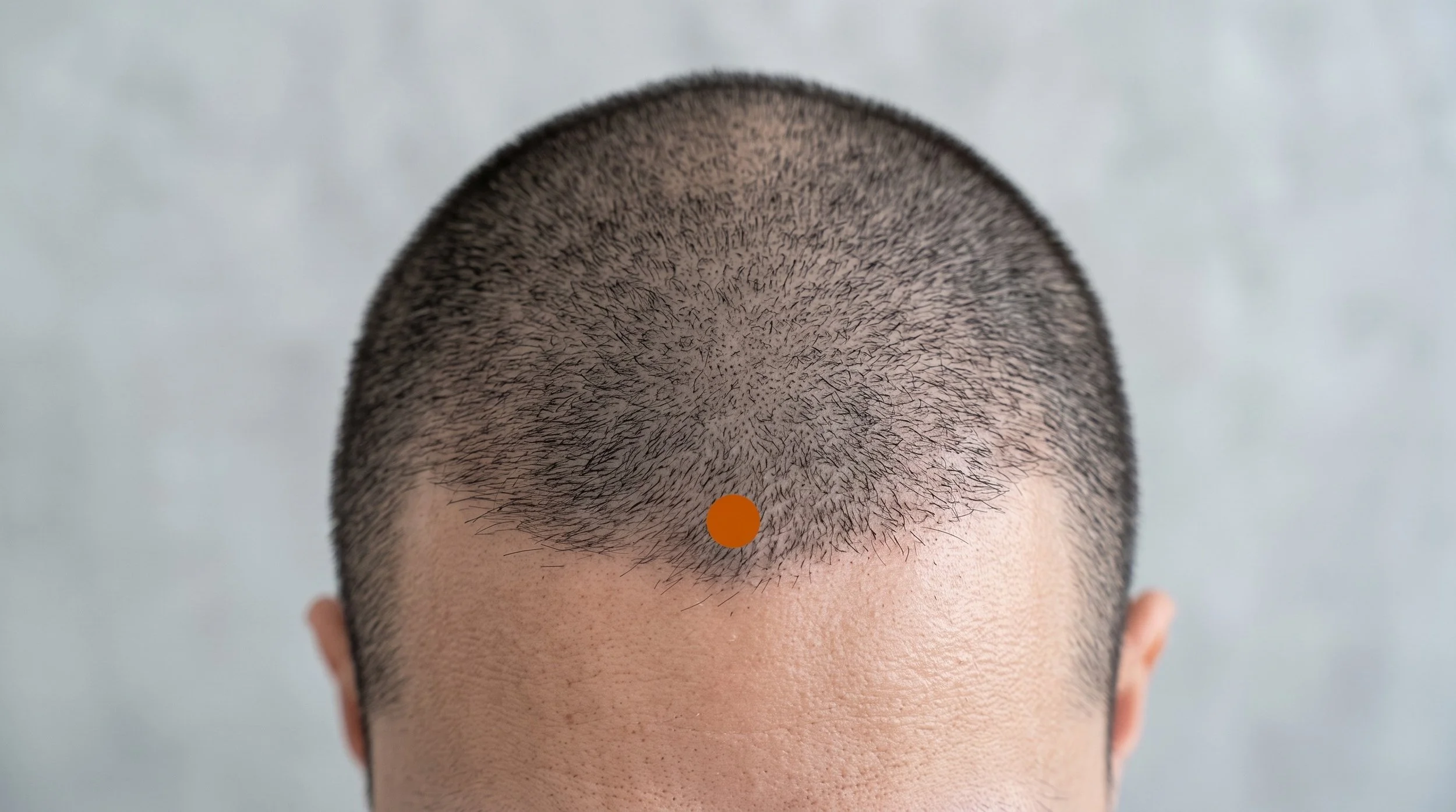
DU24 (Shenting, often translated as Courtyard of the Spirit or Mind Courtyard), also written GV24, sits on the midline of the forehead, half a cun above the front hairline and half a cun in front of DU23. It's one of the most heavily used calming points on the scalp, and it's easy to find: run a finger up the center of the forehead until you cross the hairline, then stop just past it.
Classical texts treat this as a place where the Governing vessel meets the Bladder and Stomach channels, and they attribute to it a strong effect on the spirit along with actions on wind patterns of the head, the nose, and the eyes. In modern terms, the GV24 acupuncture point is a superficial forehead point in trigeminal (supratrochlear) territory that's needled transversely and shows up constantly in protocols for insomnia, anxiety, frontal headache, and post-stroke rehabilitation.
- Location and layers: DU24 lies on the midline 0.5 cun posterior to the anterior hairline, over the frontal belly of occipitofrontalis and the galea aponeurotica, with only skin, a septated fatty layer, muscle and aponeurosis, and a loose areolar plane between the needle and the frontal bone (Deadman et al., 2009).
- Traditional categories, translated: it's classified as a meeting point of the Governing vessel with the Bladder and Stomach channels, and classical actions of calming the spirit, dispelling wind from the head, and benefiting the nose and eyes map cleanly onto trigeminal afferent stimulation, frontalis muscle relaxation, and autonomic modulation rather than anything mystical (Deadman et al., 2009).
- Nerve story: DU24 is innervated by the supratrochlear branch of the frontal nerve (V1 of the trigeminal), and stimulation of scalp points in trigeminal territory has been linked with changes in cerebral blood flow through trigeminovascular and reflex autonomic pathways (Jin et al., 2023).
- Research picture: DU24 appears in a large share of insomnia and anxiety trial protocols, usually paired with DU20, and reviews of acupuncture for sleep quality and anxiety report favorable trends alongside serious limits on study quality (Cheuk et al., 2012; Shergis et al., 2016; Yang et al., 2021).
- Clinical framing: the point is needled transversely at 0.5 to 1 cun because it sits over bone, and several classical texts list it as contraindicated to needling, which is why careful modern practice keeps the technique shallow and gentle (Deadman et al., 2009).
- De qi at DU24 is a spreading, dull tightness or tugging across the forehead rather than a sharp jolt, and many patients report a heavy, sedating quality within a minute or two of insertion (Zhao, 2008).
Struggling With Racing Thoughts and Broken Sleep?
At Morningside Acupuncture we use DU24 as a quiet anchor point in sleep and anxiety treatments, usually combined with DU20, Yintang, and distal points on the wrist and lower leg. Sessions are calm and low-stimulation, with shallow scalp needling that most people find sedating rather than activating. We also look at what's driving the pattern, including jaw and neck tension, breathing habits, and caffeine timing. Schedule a visit and let's build a plan around your sleep.
Schedule NowAnatomy of DU24: Why the Front Hairline Is Such an Important Location
DU24 sits at the transition zone where forehead becomes scalp. Moving from surface to depth, the needle passes through thin skin, a dense subcutaneous layer laced with fibrous septa that tether skin to the layer beneath, the frontal belly of the occipitofrontalis muscle as it blends into the galea aponeurotica, a loose areolar plane, and finally the pericranium over the frontal bone.
That galea is a continuous sheet running from the brow to the occiput, so sustained bracing anywhere in the system (raised brows during screen work, squinting, clenching, or chronically shortened suboccipital and cervical extensors) loads the tissue directly under this point. Patients with frontal pressure headaches frequently have a forehead that feels tight and slightly tender to palpation along the hairline, which is exactly where DU24 is found.
The nerve geography here is straightforward and clinically useful. The frontal nerve, a branch of the ophthalmic division of the trigeminal nerve, divides into supratrochlear and supraorbital branches, and the supratrochlear branch supplies the midline strip of forehead that includes DU24 (Jin et al., 2023). Trigeminal afferents from the forehead converge in the brainstem with input from the upper cervical segments, which is one reason forehead symptoms, eye strain, and upper neck tension so often travel together, and why a needle placed at the hairline can influence sensation felt elsewhere in the head.
Needle stimulation of these small-diameter afferents recruits segmental modulation and descending inhibitory pathways involving endogenous opioid and monoaminergic systems (Zhao, 2008). Trigeminal stimulation has also been associated with reflex changes in cerebral blood flow, which is the mechanism most often proposed for scalp point effects on brain-related symptoms (Jin et al., 2023).
Vascular structures at DU24 are superficial and generous: the supratrochlear and supraorbital vessels anastomose freely across the midline forehead, and scalp tissue bleeds and bruises more readily than most body regions. There's no cavity to enter here in an adult because the frontal bone lies directly beneath the aponeurosis, which is why the point is needled transversely rather than perpendicularly.
Standard technique is transverse insertion of 0.5 to 1 cun, angled either toward the vertex or toward the brow, and it's worth noting that several classical texts warn against needling this point at all, so a light hand and shallow depth remain the sensible default (Deadman et al., 2009). Practitioners apply brief pressure on withdrawal to limit bruising, and take extra care in patients on anticoagulants or with fragile skin.
Related Governing Vessel Related Best Acupuncture Points For HeadachesDU24 (GV24) at a Glance: Classification, Location, and Clinical Use
| Category | Detail |
|---|---|
| Traditional Name | Shenting (Courtyard of the Spirit, also translated Mind Courtyard); also recorded in classical sources as Tianting, Courtyard of Heaven |
| Channel Classification | Governing Vessel, point 24 (Du 24), on the frontal scalp at the anterior hairline (also called the Du Mai or Du channel) |
| Point Categories | Meeting (crossing) point of the Governing vessel with the Bladder and Stomach channels; several classical texts list it as contraindicated to needling, which shapes how it's used today |
| Precise Location | On the midline of the head, 0.5 cun posterior to the anterior hairline and 0.5 cun anterior to DU23. If the hairline is indistinct, measure 3 cun above the glabella or 5 cun in front of DU20. |
| Tissue Stimulated | Skin and septated subcutaneous fat, frontal belly of occipitofrontalis, galea aponeurotica, loose areolar plane over the pericranium of the frontal bone; supratrochlear branch of the frontal nerve (V1) |
| Needle Depth / Direction | Transverse (subcutaneous) insertion 0.5 to 1 cun, angled posteriorly toward the vertex or anteriorly toward the brow; never perpendicular, since bone lies immediately deep |
| De Qi Sensation | A spreading dull tightness, tugging, or pressure across the forehead, sometimes with warmth or a heavy, drowsy feeling; sharp pain means the needle should be adjusted |
| Primary Clinical Uses | Insomnia and fright palpitations, anxious arousal and mental restlessness, dizziness and head wind, frontal headache, nasal congestion and discharge, watering eyes; used in modern scalp protocols for post-stroke cognitive rehabilitation |
| Common Point Combinations |
|
Deadman, Al-Khafaji and Baker's A Manual of Acupuncture presents DU24 as one of the Governing vessel's major spirit points, grouping its traditional indications into three families: disturbances of the mind (insomnia, fright palpitations, loss of consciousness, and the vivid mania descriptions of climbing to high places, singing, discarding clothing, and mimicking others' speech), wind patterns of the head (dizziness, head wind, headache with chills and fever, upward staring eyes, and epilepsy), and disorders of the nose and eyes (persistent clear discharge, congestion, nosebleed, and watering eyes).
The text explains the traditional reasoning three ways: the Governing vessel was held to have the closest relationship of any channel to the brain, its anterior branch was said to enter the Heart, and its points were considered useful for clearing heat as the sea of the yang channels.
Deadman also notes the Daoist attribution that DU24 reaches the Niwan, described in that tradition as the central palace of the brain and the material seat of the spirit, and records that because this point is a meeting place with the Stomach channel it was specifically listed for dizziness accompanied by vomiting. What makes the classical pattern striking is the contradiction sitting inside it: the same texts that credit this point with unusual power over the mind, including the Systematic Classic and the Illustrated Classic of the Bronze Man, also warn practitioners not to needle it at all.
Why DU24 Is Used for Sleep and Anxious Arousal Rather Than Just Forehead Pain
The intuitive assumption is that a forehead point should treat forehead problems, and DU24 does get used that way for frontal headache, sinus pressure, and eye strain. The convergence story explains that part well. Supratrochlear afferents from this patch of scalp enter the trigeminal system and share second-order neurons with input arriving from the upper cervical spine, so needling here lands in a sensory pool that also receives signals from the neck, temples, and periorbital region (Jin et al., 2023).
Reducing input into that shared pool is a plausible reason a scalp needle can soften pain and pressure felt across a wider area of the head than the point itself covers.
The calming use is a different mechanism. Needle stimulation recruits descending inhibitory systems in the brainstem and modulates autonomic tone, effects that involve endogenous opioids and monoamine transmitters and that don't stay local to the segment stimulated (Zhao, 2008). Scalp points in trigeminal territory have also been associated with changes in cerebral perfusion, which is the leading proposed explanation for why forehead and vertex points feature so heavily in scalp acupuncture protocols for brain-related conditions (Jin et al., 2023).
Add the simple physical effect of relaxing a chronically braced frontalis, and you have a reasonable account of why patients often describe a wave of drowsiness after these points go in.
There's also a point-specific clinical signal worth mentioning cautiously. DU24 paired with DU20 has been tested directly in rehabilitation research: a small randomized controlled trial found that adding acupuncture at these two points to standard care and rehabilitation was associated with better cognitive scores in post-stroke cognitive impairment (Zhan et al., 2016), and a later meta-analysis of Governing vessel acupuncture in the same population reported similar direction of effect while flagging methodological limitations (Han et al., 2024).
That's supportive rather than definitive, but it does suggest this pair of points has been studied on its own terms and not only as filler in larger prescriptions.
What the Research Shows for DU24 (GV24)
One note on naming before the evidence: in the research literature this point is almost always listed as GV24, the WHO standard code, so GV24 is the term to search if you want to read the studies below in full.
A caution before the table: almost no trial isolates a single acupuncture point, and DU24 is no exception. What the literature actually tests is multi-point protocols in which DU24 typically appears alongside DU20, Yintang, HT7, SP6, and PC6, so the honest reading is that DU24 is a frequently chosen component of protocols that have shown promise, not an independently validated intervention. Review quality in this area is also uneven, with many included trials rated at high or unclear risk of bias, small sample sizes, and heterogeneous outcome measures.
The reasonable conclusion is that acupuncture including DU24 may help with sleep quality and anxious arousal for some people, and that stronger trials are still needed.
| Study | Type | Focus | Key Finding |
|---|---|---|---|
| Cheuk et al., 2012 | Cochrane systematic review | Acupuncture for insomnia (33 randomized trials, 2,293 participants) | The reviewers judged all included studies to be at high risk of bias and concluded that high-quality evidence on efficacy and safety was lacking, despite widespread clinical use. |
| Shergis et al., 2016 | Systematic review and meta-analysis | Acupuncture for sleep quality in people with insomnia, using protocols built around core points including DU20 | Pooled results favored acupuncture for sleep quality measures, though the authors noted that most comparisons were against medication and that methodological quality limited confidence. |
| Yang et al., 2021 | Systematic review and meta-analysis | Acupuncture for anxiety disorder (20 randomized controlled trials) | Acupuncture showed beneficial effects on anxiety symptoms compared with controls, with the authors calling for higher-quality trials before firm conclusions are drawn. |
| Li et al., 2022 | PRISMA-compliant systematic review and meta-analysis | Acupuncture for generalized anxiety disorder | Acupuncture was associated with reduced anxiety scores and few side effects, but the review noted the need for larger, higher-quality randomized trials. |
| Zhan et al., 2016 | Randomized controlled trial (point-specific) | Acupuncture at DU20 and DU24 added to basic treatment and rehabilitation for post-stroke cognitive impairment (50 patients) | The group receiving needling at these two Governing vessel points showed greater cognitive improvement than rehabilitation alone, in a small single-center sample. |
| Han et al., 2024 | Meta-analysis of randomized controlled trials | Governing vessel acupuncture therapy for post-stroke cognitive impairment | Pooled data suggested benefit and acceptable safety for Governing vessel protocols, with the authors highlighting variable trial quality as a limitation. |
| Linde et al., 2016 | Cochrane systematic review | Acupuncture for the prevention of tension-type headache | The available evidence suggested acupuncture may be effective for frequent episodic or chronic tension-type headache, with further comparative trials needed. |
| Jin et al., 2023 | Mechanistic review | Scalp innervation and neural control of cerebral blood flow in scalp acupuncture, identifying the supratrochlear nerve as the supply to DU24 | The authors argue that stimulating specific scalp points and their nerves may increase cerebral blood flow through trigeminal, facial, and cervical nerve pathways. |
Frontal Headaches and Forehead Tension That Won't Let Go?
Forehead pressure often involves the frontalis, corrugators, temporalis, and the upper neck extensors that feed the trigeminocervical complex, and DU24 sits right in that territory. We combine gentle scalp needling with dry needling of the muscles that actually refer pain into the forehead, then add manual therapy and simple home strategies. Most patients notice a change in the tension quality within the first few visits. Book an evaluation and we'll map your headache pattern.
Schedule NowDU24 in the Context of Trigger Point Work
Acupuncture, as we define it, is the use of an acupuncture needle, and that includes dry needling of myofascial trigger points. DU24 sits directly over the frontal belly of occipitofrontalis, a muscle whose trigger points refer pain up and across the forehead on the same side, so the point and the myofascial target overlap almost exactly (Simons et al., 1999).
For a patient with forehead pressure, we may needle DU24 transversely for its calming and local effect, then address the frontalis and corrugator region, the temporalis, and the sternocleidomastoid and suboccipital muscles whose referral patterns commonly reach the forehead and behind the eye. Treating the referral source rather than only the site of the ache is usually what changes the pattern.
In practice the two approaches complement each other. Scalp needling at DU24 tends to produce a broad, sedating sensation and is well tolerated even by needle-sensitive patients, which makes it a useful opening point before more intensive work in the neck and jaw. Dry needling of the cervical extensors, upper trapezius, and masseter then handles the mechanical contributors that keep the galea loaded.
At Morningside Acupuncture we frequently sequence sessions this way, pairing a small number of calming midline points with targeted trigger point release, and we adjust the balance depending on whether the patient's dominant complaint is tension, pain, or poor sleep.
DU24 Insomnia and Anxiety Treatment at NYC's Highest-Rated Acupuncture Clinic
Morningside Acupuncture is the highest-rated acupuncture and dry needling clinic in New York City with over 500 five-star Google reviews, and our Upper West Side practice blends classical point selection with modern pain science. DU24 is one of the points we reach for most often when a patient's chief complaints are poor sleep, anxious arousal, or forehead heaviness. Every plan is individualized, explained clearly, and adjusted based on your response. Schedule your appointment today and see what a thoughtfully designed session feels like.
Schedule NowFrequently Asked Questions
Is DU24 the same point as GV24?
Yes. DU24 and GV24 are two codes for the same point, Shenting. DU comes from Du Mai, the Chinese name of the Governing Vessel, and it is the code used in most Chinese texts and many acupuncture schools. GV is the WHO standard abbreviation and the one you will see in most Western textbooks and research papers. You will also come across it written as Du 24, GV-24, or Governing Vessel 24. Whichever code is used, the location and the uses are the same.
What does DU24 feel like when needled?
Most people feel a brief pinch as the needle passes the skin at the hairline, then a spreading dull tightness or gentle tugging across the forehead. Because the needle travels flat under the skin rather than downward, there's no deep ache the way there is at a point like ST36. Many patients describe a heavy, sleepy sensation within a minute or two, and some feel a faint warmth around the brow. Sharp, burning, or electric pain isn't expected and means the needle should be repositioned.
Why needle the forehead for insomnia and anxiety instead of just the wrists and ankles?
Both approaches get used, and in most protocols they're combined. The reason forehead and vertex points feature so heavily is that they sit in trigeminal territory, and stimulating those nerves has been linked with reflex changes in cerebral blood flow and with modulation of arousal-related pathways (Jin et al., 2023; Zhao, 2008). Classically, DU24 was valued as a spirit-calming point on the channel considered most closely connected to the brain (Deadman et al., 2009). Clinically, patients often report a faster settling sensation from scalp points than from distal points alone, which is why a Shenting calming point pairing with DU20 shows up in so many sleep and anxiety trial protocols.
Can I press DU24 myself between sessions?
Yes, and it's an easy one to find. Place a fingertip on the midline of your forehead and slide it upward until you feel the hairline, then move about a half inch (0.5 cun) beyond it. Press with the pad of your index or middle finger using steady, moderate pressure, enough to feel a dull sense of tension but nothing painful. Hold for 30 to 60 seconds, release, and repeat two or three times, ideally with slow nasal breathing and a longer exhale. Small circular massage along the hairline for one to two minutes also works well. Many people find it most useful in the 30 minutes before bed or during a mid-afternoon tension build. Stop if you feel lightheaded, and skip the area entirely if the skin is broken, inflamed, or recently injured.
Is DU24 safe to needle?
In trained hands, yes, with a few caveats worth knowing. Several classical texts list this point as contraindicated to needling, and while modern practice doesn't follow that prohibition, it does explain the convention of shallow transverse insertion of 0.5 to 1 cun rather than perpendicular technique (Deadman et al., 2009). The frontal bone lies immediately beneath, so a perpendicular needle has nowhere useful to go. The scalp is well vascularized and bruises easily, so brief pressure on withdrawal is standard, and extra caution applies for patients on blood thinners. Needling is avoided over broken skin, active infection, or recent surgical sites, and in infants the anterior fontanelle region requires particular care. Tell your practitioner if you're prone to fainting, since head points are sometimes better done lying down.
Where exactly is DU24 located?
DU24 is on the midline of the head, 0.5 cun posterior to the anterior hairline and 0.5 cun anterior to DU23 (Shangxing). If the hairline is receded or unclear, two proportional measurements are used: the point sits 3 cun above the glabella (the smooth spot between the eyebrows) or 5 cun anterior to DU20 at the vertex. Practically, it's the midline spot just past where forehead skin becomes scalp, and it's often slightly tender in patients with frontal tension. BL3 and BL4 lie lateral to it along the same hairline, which is how those points are traditionally located relative to Shenting.
References
- Deadman, P., Al-Khafaji, M., & Baker, K. (2009). A manual of acupuncture. Journal of Chinese Medicine Publications.
- Maciocia, G. (2005). The foundations of Chinese medicine: A comprehensive text for acupuncturists and herbalists (2nd ed.). Elsevier Churchill Livingstone.
- Simons, D. G., Travell, J. G., & Simons, L. S. (1999). Travell & Simons' myofascial pain and dysfunction: The trigger point manual, Vol. 1: Upper half of body (2nd ed.). Williams & Wilkins.
- Cheuk, D. K. L., Yeung, W. F., Chung, K. F., & Wong, V. (2012). Acupuncture for insomnia. Cochrane Database of Systematic Reviews, 2012(9), CD005472. https://doi.org/10.1002/14651858.CD005472.pub3
- Shergis, J. L., Ni, X., Jackson, M. L., Zhang, A. L., Guo, X., Li, Y., Lu, C., & Xue, C. C. (2016). A systematic review of acupuncture for sleep quality in people with insomnia. Complementary Therapies in Medicine, 26, 11-20. https://doi.org/10.1016/j.ctim.2016.02.007
- Yang, X. Y., Yang, N. B., Huang, F. F., Ren, S., & Li, Z. J. (2021). Effectiveness of acupuncture on anxiety disorder: A systematic review and meta-analysis of randomised controlled trials. Annals of General Psychiatry, 20(1), 9. https://doi.org/10.1186/s12991-021-00327-5
- Li, M., Liu, X., Ye, X., & Zhuang, L. (2022). Efficacy of acupuncture for generalized anxiety disorder: A PRISMA-compliant systematic review and meta-analysis. Medicine, 101(49), e30076. https://doi.org/10.1097/MD.0000000000030076
- Zhan, J., Pan, R., Guo, Y., Zhan, L., He, M., Wang, Q., & Chen, H. (2016). Acupuncture at Baihui (GV 20) and Shenting (GV 24) combined with basic treatment and regular rehabilitation for post-stroke cognitive impairment: A randomized controlled trial. Zhongguo Zhen Jiu (Chinese Acupuncture & Moxibustion), 36(8), 803-806. https://doi.org/10.13703/j.0255-2930.2016.08.007
- Han, J. Z., Yang, Y., Wang, Y. F., Feng, J. H., Song, C. N., Wu, W. J., & Lin, H. B. (2024). Effectiveness and safety of Governor vessel acupuncture therapy for post-stroke cognitive impairment: A meta-analysis of randomized controlled trials. Ageing Research Reviews, 99, 102355. https://doi.org/10.1016/j.arr.2024.102355
- Jin, G. Y., Jin, L. L., Jin, B. X., Zheng, J., He, B. J., & Li, S. J. (2023). Neural control of cerebral blood flow: Scientific basis of scalp acupuncture in treating brain diseases. Frontiers in Neuroscience, 17, 1210537. https://doi.org/10.3389/fnins.2023.1210537
- Linde, K., Allais, G., Brinkhaus, B., Fei, Y., Mehring, M., Shin, B. C., Vickers, A., & White, A. R. (2016). Acupuncture for the prevention of tension-type headache. Cochrane Database of Systematic Reviews, 2016(4), CD007587. https://doi.org/10.1002/14651858.CD007587.pub2
- Zhao, Z. Q. (2008). Neural mechanism underlying acupuncture analgesia. Progress in Neurobiology, 85(4), 355-375. https://doi.org/10.1016/j.pneurobio.2008.05.004
Disclaimer: This web site is intended for educational and informational purposes only. Reading this website does not constitute providing medical advice or any professional services. This information should not be used for diagnosing or treating any health issue or disease. Those seeking medical advice should consult with a licensed physician. Seek the advice of a medical doctor or other qualified health professional for any medical condition. If you think you have a medical emergency, call 911 or go to the emergency room. No acupuncturist-patient relationship is created by reading this website or using the information. Morningside Acupuncture PLLC and its employees and contributors do not make any express or implied representations with respect to the information on this site or its use. For any legal interpretation of scope of practice in your state, consult a licensed attorney or regulatory authority.
Read more from our blog