KI20 Acupuncture Point (Futonggu)
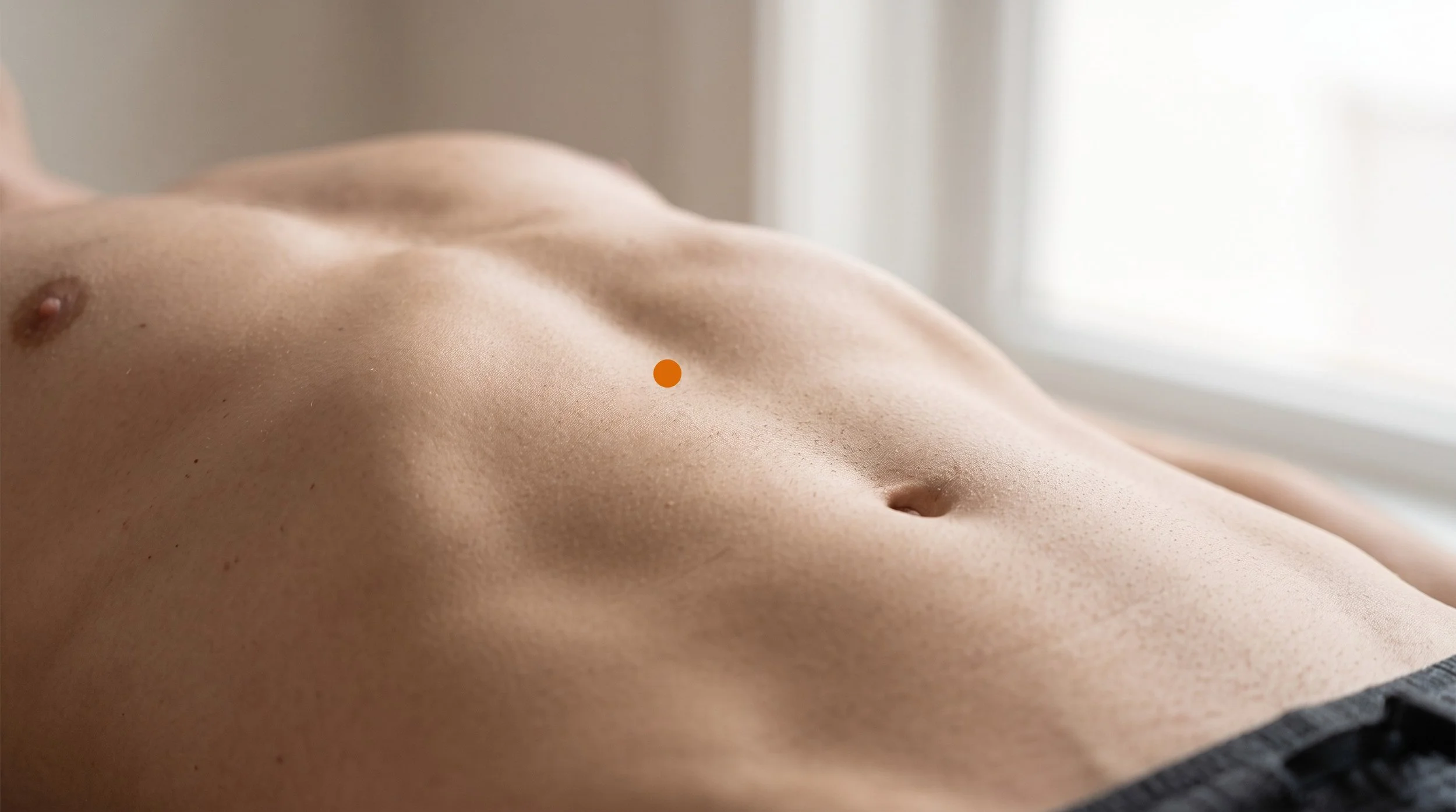
KI20 Acupuncture Point (Futonggu)
Abdomen Connecting Valley: Anatomy, Mechanism, and Why This Upper Abdominal Kidney Point Belongs in Digestive and Breathing Work
KI20, known in Chinese as Futonggu and usually translated as Abdomen Connecting Valley, is the twentieth point of the Kidney channel and sits high on the belly, about five cun above the navel and just half a cun off the midline, directly beside CV13 (Shangwan). Classical sources class it as a meeting point of the Kidney channel with the Penetrating vessel, and traditional texts credit it with harmonizing the middle jiao, unbinding the chest, and transforming phlegm (Deadman, 2000).
In modern anatomical terms, it is a point over the upper fibers of the rectus abdominis, in a segment (roughly T7 to T8) whose sensory nerves share spinal territory with the stomach and duodenum, which is why the ki20 acupuncture point shows up in treatments for epigastric fullness, nausea, bloating, and that tight, guarded feeling under the ribs that so often travels with shallow breathing.
- Location and layers: KI20 lies 5 cun above the umbilicus and 0.5 cun lateral to the midline, level with CV13, so the needle passes skin, subcutaneous fat, the anterior rectus sheath, and the medial fibers of the upper rectus abdominis (Deadman, 2000; Kim, 2018). Beneath that lie the posterior sheath, peritoneum, and, depending on body habitus, the stomach and the left lobe of the liver.
- Traditional categories, read neurophysiologically: the classical actions of harmonizing the middle jiao and unbinding the chest describe what we would now call segmental modulation of upper gastrointestinal and thoracoabdominal wall function rather than movement of substance through a vessel (Deadman, 2000; Ma, 2020).
- Mechanism: abdominal wall stimulation at this level engages T6 to T9 afferents that converge in the same dorsal horn segments as visceral input from the stomach, and animal work shows that abdominal and limb acupoints drive gastric responses through different autonomic routes (Li et al., 2007; Ma, 2020). Diffuse effects add descending inhibitory and opioidergic modulation (Zhao, 2008).
- Research picture: a Cochrane review of acupuncture for functional dyspepsia found the evidence inconclusive despite some quality of life signals, and a later mechanistic review reported effects on gastric accommodation, emptying, and vagal tone with wide variation in protocols (Lan et al., 2014; Guo et al., 2020). No trial has isolated KI20 on its own.
- Clinical framing: at Morningside we use kidney 20 as a local point inside a larger prescription, typically alongside CV12, CV13, and distal points such as ST36 or PC6, and we treat it as one input into a nervous system rather than a switch for the stomach.
- De qi at KI20 is usually a slow, dull heaviness or a spreading fullness under the upper belly, sometimes with audible gut sounds. Sharp, electric, or radiating sensation is a signal to withdraw and redirect (White, 2004).
Bloating, Reflux, or an Upper Belly That Never Quite Settles?
Upper abdominal fullness, early satiety, and post meal nausea often persist after imaging and bloodwork come back clean. Our acupuncturists combine gentle needling at KI20 and neighboring points on the upper abdomen with distal points that studies suggest may influence gastric motility and vagal tone. We also look at breathing mechanics, abdominal wall tension, and meal timing, because the belly rarely acts alone. Book a visit and let us build a plan around how your symptoms actually behave.
Schedule NowAnatomy of KI20: Why the Upper Rectus Abdominis Beside CV13 Is Such an Important Location
KI20 sits in the upper third of the abdominal wall, five cun above the navel and only half a cun off the midline, which places it on the medial edge of the rectus abdominis just lateral to the linea alba and level with CV13 (Deadman, 2000; Kim, 2018). The tissue stack here is thin and layered: skin, a variable pad of subcutaneous fat, the anterior rectus sheath, then the muscle belly itself with its tendinous intersections.
This is the part of the abdominal wall that works hardest during coughing, bracing, sit ups, and long hours of seated flexion, and it is also the region that goes protectively tight after abdominal surgery, reflux flares, or prolonged stress breathing. Palpation before needling matters, because the muscle at the ki 20 abdomen location is frequently ropy and tender in exactly the patients who report epigastric pressure.
Sensory supply to this patch of abdominal wall comes from the anterior cutaneous branches of the lower intercostal nerves, roughly T7 and T8. Those same spinal segments receive afferent traffic from the stomach and proximal duodenum through the greater splanchnic nerve, so somatic and visceral inputs converge on shared dorsal horn neurons. That convergence is the plainest explanation for why upper abdominal tenderness tracks with upper gut symptoms, and why needling here can change how those signals are processed.
Experimental work shows that stimulation at abdominal sites and stimulation at limb sites recruit different autonomic pathways, with abdominal input weighted toward segmental sympathetic reflexes while limb input more readily drives vagal facilitation of gastric activity (Li et al., 2007; Ma, 2020). Layered on top of the segmental story are the broader antinociceptive mechanisms documented across acupuncture research, including descending inhibition and endogenous opioid release (Zhao, 2008).
Deeper structures set the safety rules. The superior epigastric artery runs within the rectus sheath, and beyond the posterior sheath lie the peritoneum, the stomach, and in many people the left lobe of the liver, which can sit surprisingly low and lateral. Textbook guidance for KI20 is perpendicular insertion of 1 to 1.5 cun with an explicit warning that deep needling may enter the peritoneal cavity (Deadman, 2000), while other sources are more conservative and recommend 0.5 to 1 cun with moxibustion as an option (Kim, 2018; CAM, 1999).
In practice we needle shallowly, adjust for body composition, avoid deep perpendicular technique in thin patients, and never needle over an enlarged organ, a hernia, a surgical scar of unknown depth, or an undiagnosed abdominal mass.
Related Rectus Abdominis Trigger Points Related Kidney ChannelKI20 at a Glance: Classification, Location, and Clinical Use
| Category | Detail |
|---|---|
| Traditional Name | Futonggu (Abdomen Connecting Valley), KI20, listed as KID-20 in Deadman and Al-Khafaji |
| Channel Classification | Twentieth point of the Kidney channel of Foot Shaoyin, on the abdominal portion of the channel |
| Point Categories | Meeting point of the Kidney channel with the Penetrating vessel (Chong mai). It carries no five-shu, yuan, luo, xi, or hui-meeting designation; its classical grouping is with the local upper abdominal points that harmonize the middle jiao and unbind the chest. |
| Precise Location | On the upper abdomen, 5 cun above the umbilicus and 0.5 cun lateral to the anterior midline, level with and immediately beside CV13 (Shangwan), medial to ST20 |
| Tissue Stimulated | Skin and subcutaneous tissue, anterior rectus sheath, and the medial fibers of the upper rectus abdominis, with functional overlap into the external abdominal oblique and the deeper transverse abdominis |
| Needle Depth / Direction | Perpendicular 1 to 1.5 cun per Deadman, with more conservative sources advising 0.5 to 1 cun; many clinicians angle obliquely along the rectus sheath in lean patients. Moxibustion is traditionally permitted. Deep perpendicular needling may penetrate the peritoneal cavity. |
| De Qi Sensation | Dull heaviness, pressure, or spreading fullness under the upper belly, sometimes with a warm wave toward the epigastrium or audible gut sounds. Sharp, burning, or radiating sensation calls for immediate withdrawal and redirection. |
| Primary Clinical Uses | Traditionally used for vomiting, undigested food in the stool, abdominal distention and diarrhea, chest fullness with cough or difficult breathing, and palpitations with disorientation. In modern practice it is used locally for epigastric fullness, nausea, bloating, and upper abdominal wall guarding. |
| Common Point Combinations |
|
Deadman and Al-Khafaji present Futonggu as a meeting point of the Kidney channel with the Penetrating vessel and attribute to it two traditional actions: harmonizing the middle jiao and unbinding the chest while transforming phlegm (Deadman, 2000). The classical indication list they compile falls into three loose groups. The first is digestive: vomiting, food passing through undigested, abdominal distention, and diarrhea.
The second is thoracic: fullness in the chest, pain along the ribs, pain in the heart region, cough, and labored breathing. The third is the most unexpected, covering palpitations, disorientation, seizures, sudden loss of voice, swelling under the tongue with difficulty speaking, tongue protrusion, and deviation of the mouth. Older Chinese textbooks keep a narrower list built around abdominal pain, distention, vomiting, and indigestion, with some adding stiff neck and intercostal pain (CAM, 1999; Shanghai, 1981).
What makes the classical pattern striking is that a single small point half a cun off the midline was asked to bridge the gut, the chest, and speech, three territories that modern anatomy links through the vagus nerve and the shared segmental innervation of the upper trunk.
Why KI20 Is Used for Chest Tightness and Breathlessness, Not Just Digestion
Patients are often surprised that a point on the belly appears in classical listings for chest fullness, cough, and difficult breathing. The anatomy makes it less strange. The upper rectus abdominis attaches to the fifth through seventh costal cartilages and the xiphoid, so tension here directly loads the lower rib cage and opposes diaphragmatic descent. At the same time, the sensory nerves serving this patch of abdominal wall enter the cord at roughly T7 and T8, the same segments that receive visceral afferents from the stomach and the lower esophagus.
When two input streams converge on shared spinal neurons, sensitization in one can be felt as the other, which is why upper abdominal guarding, epigastric pressure, and a tight chest so often arrive as a package (Li et al., 2007).
The autonomic layer adds nuance. Reviews of somato-autonomic reflexes describe stimulation effects that are both point specific and intensity dependent, with abdominal stimulation tending to engage segmental sympathetic reflexes and limb stimulation more readily recruiting vagal pathways that facilitate gastric activity (Ma, 2020). That is one practical reason we rarely needle KI20 alone: pairing a local abdominal point with a distal limb point gives access to more than one route into the same system.
Mechanistic reviews in functional dyspepsia report changes in gastric accommodation, emptying rate, and heart rate variability measures of vagal tone following acupuncture and electroacupuncture, though protocols and outcome measures differ widely (Guo et al., 2020).
Finally, there is the general analgesic machinery that applies to any needle insertion. Needling activates A-delta and C fiber afferents, engages descending inhibitory pathways from the midbrain and brainstem, and triggers endogenous opioid release, which helps explain why abdominal wall tenderness often eases before the visceral symptoms do (Zhao, 2008). Across chronic pain conditions, individual patient data meta-analysis shows modest effects over sham and larger effects over no acupuncture, a realistic frame for what local needling can contribute here (Vickers et al., 2018).
What the Research Shows for KI20
There is no clinical trial that tests KI20 in isolation, and it would be misleading to suggest otherwise. What exists is research on multi-point acupuncture protocols for upper gastrointestinal complaints, where abdominal points near CV12 and CV13 are routinely included alongside distal points, plus laboratory work on how somatic stimulation at abdominal versus limb sites changes gastric activity. Read the table below as context for the role Futonggu acupuncture may play inside a prescription, not as evidence for the single point.
| Study | Type | Focus | Key Finding |
|---|---|---|---|
| Lan et al., 2014 | Cochrane systematic review | Manual acupuncture and electroacupuncture for functional dyspepsia | The reviewers found the available trials too small and too methodologically limited to support firm conclusions about symptom benefit, despite some quality of life signals in a subset of studies. |
| Guo et al., 2020 | Systematic review of clinical and mechanistic studies | Effects and mechanisms of acupuncture and electroacupuncture in functional dyspepsia | Reported effects on gastric accommodation, emptying, and autonomic measures of vagal tone, with the authors noting substantial heterogeneity in stimulation parameters and outcome selection. |
| Li et al., 2007 | Animal neurophysiology study | Neural pathways underlying acupuncture modulation of gastric motility | Stimulation at abdominal and limb sites produced different gastric responses mediated by distinct autonomic routes, supporting a segmental rather than a generic explanation for point effects. |
| Ma, 2020 | Narrative neuroscience review | Somato-autonomic reflexes, acupoint selectivity, and intensity dependence | Summarizes evidence that stimulation site and intensity shape which autonomic pathway is recruited, which may help explain why abdominal and distal points are combined in practice. |
| Vickers et al., 2018 | Individual patient data meta-analysis | Acupuncture for chronic pain across musculoskeletal and headache conditions | Found modest but statistically significant effects over sham and larger effects over no acupuncture control, with benefits persisting over follow-up. |
| White, 2004 | Cumulative safety review | Range and incidence of significant adverse events after acupuncture | Serious adverse events were rare in prospective surveys, with visceral puncture identified as a recognized and largely preventable risk tied to needling technique over the trunk. |
Tight Chest and Shallow Breathing After Months at a Desk?
Classical sources link Futonggu to fullness of the chest and difficult breathing, and modern patients describe the same thing as a band under the ribs that will not release. We pair KI20 with rib cage and diaphragm work, plus dry needling of the upper rectus abdominis and obliques when the abdominal wall is holding tone. Many patients notice a fuller, easier inhale within a few sessions. Schedule an evaluation and we will assess your breathing pattern along with your symptoms.
Schedule NowKI20 in the Context of Trigger Point Work
KI20 sits squarely over the upper rectus abdominis, and that muscle has a well documented habit of producing symptoms that read as visceral. Travell and Simons describe trigger points in the upper rectus referring pain across the epigastrium and midback, with associated complaints including heartburn, indigestion, nausea, and a sense of abdominal fullness (Simons et al., 1999). When we palpate the ki 20 abdomen location and find a taut, exquisitely tender band that reproduces a patient's familiar epigastric pressure, that is useful diagnostic information. It does not rule out a gut problem, but it does mean part of the symptom picture is coming from the abdominal wall.
At Morningside, dry needling and acupuncture are the same act performed with the same tool, and we move fluidly between the two frames. A session for stubborn upper abdominal complaints might combine shallow needling at KI20 and CV13 with taut band work in the rectus abdominis, the external oblique, and sometimes the transverse abdominis, followed by breathing retraining so the diaphragm stops competing with a braced abdominal wall.
Needling over the trunk is always done with conservative depth and angle, and we skip any area with a hernia, a recent surgical site, or unexplained tenderness that has not been medically evaluated.
KI20 Digestive Treatment at NYC's Highest-Rated Acupuncture Clinic
Morningside Acupuncture is the highest-rated acupuncture and dry needling clinic in New York City with over 500 five-star Google reviews, and digestive complaints are among the most common reasons patients come through our door. We treat KI20 as one part of a considered prescription, combining classical point selection with trigger point needling and clear, evidence-informed expectations. Every session is one on one with a licensed acupuncturist, never rushed. Schedule your visit and see how a careful, anatomy-led approach feels.
Schedule NowFrequently Asked Questions
What does KI20 feel like when needled?
Most people feel a dull, heavy pressure or a slowly spreading fullness under the upper belly, occasionally with warmth or a gentle pulling toward the breastbone. Gurgling and a sense of the abdomen softening are common and generally welcome. Because the abdominal wall is thin here, we use shallow insertion and light stimulation, so the sensation should stay mild. Anything sharp, burning, or radiating means the needle needs to be withdrawn and repositioned, and we ask patients to speak up immediately rather than wait it out.
Why needle the abdomen at all when distal points like ST36 exist for digestion?
Because they do different jobs. Distal limb points appear to recruit vagal pathways that can facilitate gastric activity, while abdominal points sit in the same spinal segments (roughly T7 to T8) as the stomach itself and act through local segmental convergence (Li et al., 2007; Ma, 2020). A local point also treats the abdominal wall directly, which matters when part of the discomfort is myofascial rather than visceral (Simons et al., 1999). Combining a point like Futonggu with a distal point gives access to more than one route into the same system, which is exactly how classical prescriptions were built.
Can I press KI20 myself between sessions?
Yes, acupressure here is safe when done gently. Lie on your back with knees bent so the abdominal wall relaxes, find the midpoint between your navel and the bottom tip of your breastbone, then move up slightly toward the sternum and about a thumb's width off center. Press with the pad of two fingers using slow, moderate pressure, hold for 30 to 60 seconds, and breathe into your lower ribs while you hold. Repeat on the other side, then do two or three rounds, totaling about three to five minutes. Small circular massage over any tender band works well too. Avoid it right after a large meal, during acute abdominal pain, if you are pregnant, or if the area is tender for reasons no one has explained yet.
Is KI20 safe to needle?
In trained hands, yes, but it is a point that demands respect. Standard texts allow perpendicular insertion of 1 to 1.5 cun while explicitly cautioning that deep needling may penetrate the peritoneal cavity, and more conservative sources cap depth at 0.5 to 1 cun (Deadman, 2000; Kim, 2018). Underneath the muscle lie the peritoneum, the stomach, and in many people the left lobe of the liver, so depth and body habitus have to be matched. We avoid the area over hernias, unexplained masses, recent surgical sites, and in pregnancy. Prospective safety surveys show serious adverse events from acupuncture are rare, and visceral puncture is largely a technique-dependent and preventable risk (White, 2004).
Where exactly is KI20 located?
KI20 is on the upper abdomen, 5 cun above the center of the umbilicus and 0.5 cun lateral to the anterior midline, which places it immediately beside CV13 (Shangwan) and medial to ST20 (Deadman, 2000; CAM, 1999). To find it at home, measure roughly the midpoint between your navel and the lower end of the sternum, then continue slightly upward and shift about a finger's width to the side. It is a bilateral point, so there is one on each side of the midline, and both are usually treated together.
References
- Deadman, P., Al-Khafaji, M., & Baker, K. (2009). A manual of acupuncture. Journal of Chinese Medicine Publications.
- Cheng, X. (Ed.). (1999). Chinese acupuncture and moxibustion (Rev. ed.). Foreign Languages Press.
- Kim, H. (2008). Handbook of Oriental medicine (3rd ed.). Harmony & Balance Press.
- O'Connor, J., & Bensky, D. (Eds. & Trans.). (1981). Acupuncture: A comprehensive text. Shanghai College of Traditional Medicine. Eastland Press.
- Cunningham, P. M. (2000). Acupuncture points: A practical guide to classical and modern usage. Odyssey Press.
- Simons, D. G., Travell, J. G., & Simons, L. S. (1999). Travell & Simons' myofascial pain and dysfunction: The trigger point manual, Vol. 1: Upper half of body (2nd ed.). Williams & Wilkins.
- Lan, L., Zeng, F., Liu, G. J., Ying, L., Wu, X., Liu, M., & Liang, F. R. (2014). Acupuncture for functional dyspepsia. Cochrane Database of Systematic Reviews, 2014(10), CD008487. https://doi.org/10.1002/14651858.CD008487.pub2
- Guo, Y., Wei, W., & Chen, J. D. (2020). Effects and mechanisms of acupuncture and electroacupuncture for functional dyspepsia: A systematic review. World Journal of Gastroenterology, 26(19), 2440-2457. https://doi.org/10.3748/wjg.v26.i19.2440
- Li, Y. Q., Zhu, B., Rong, P. J., Ben, H., & Li, Y. H. (2007). Neural mechanism of acupuncture-modulated gastric motility. World Journal of Gastroenterology, 13(5), 709-716. https://doi.org/10.3748/wjg.v13.i5.709
- Ma, Q. (2020). Somato-autonomic reflexes of acupuncture. Medical Acupuncture, 32(6), 362-366. https://doi.org/10.1089/acu.2020.1488
- Zhao, Z. Q. (2008). Neural mechanism underlying acupuncture analgesia. Progress in Neurobiology, 85(4), 355-375. https://doi.org/10.1016/j.pneurobio.2008.05.004
- Vickers, A. J., Vertosick, E. A., Lewith, G., MacPherson, H., Foster, N. E., Sherman, K. J., Irnich, D., Witt, C. M., & Linde, K. (2018). Acupuncture for chronic pain: Update of an individual patient data meta-analysis. Journal of Pain, 19(5), 455-474. https://doi.org/10.1016/j.jpain.2017.11.005
- White, A. (2004). A cumulative review of the range and incidence of significant adverse events associated with acupuncture. Acupuncture in Medicine, 22(3), 122-133. https://doi.org/10.1136/aim.22.3.122
Disclaimer: This web site is intended for educational and informational purposes only. Reading this website does not constitute providing medical advice or any professional services. This information should not be used for diagnosing or treating any health issue or disease. Those seeking medical advice should consult with a licensed physician. Seek the advice of a medical doctor or other qualified health professional for any medical condition. If you think you have a medical emergency, call 911 or go to the emergency room. No acupuncturist-patient relationship is created by reading this website or using the information. Morningside Acupuncture PLLC and its employees and contributors do not make any express or implied representations with respect to the information on this site or its use. For any legal interpretation of scope of practice in your state, consult a licensed attorney or regulatory authority.
Read more from our blog



