KI19 Acupuncture Point (Yindu)
KI3 Acupuncture Point
Yin Metropolis Beside the Center of the Epigastrium: Anatomy, Segmental Mechanism, and Why This Small Abdominal Point Earns a Place in Digestive Treatment
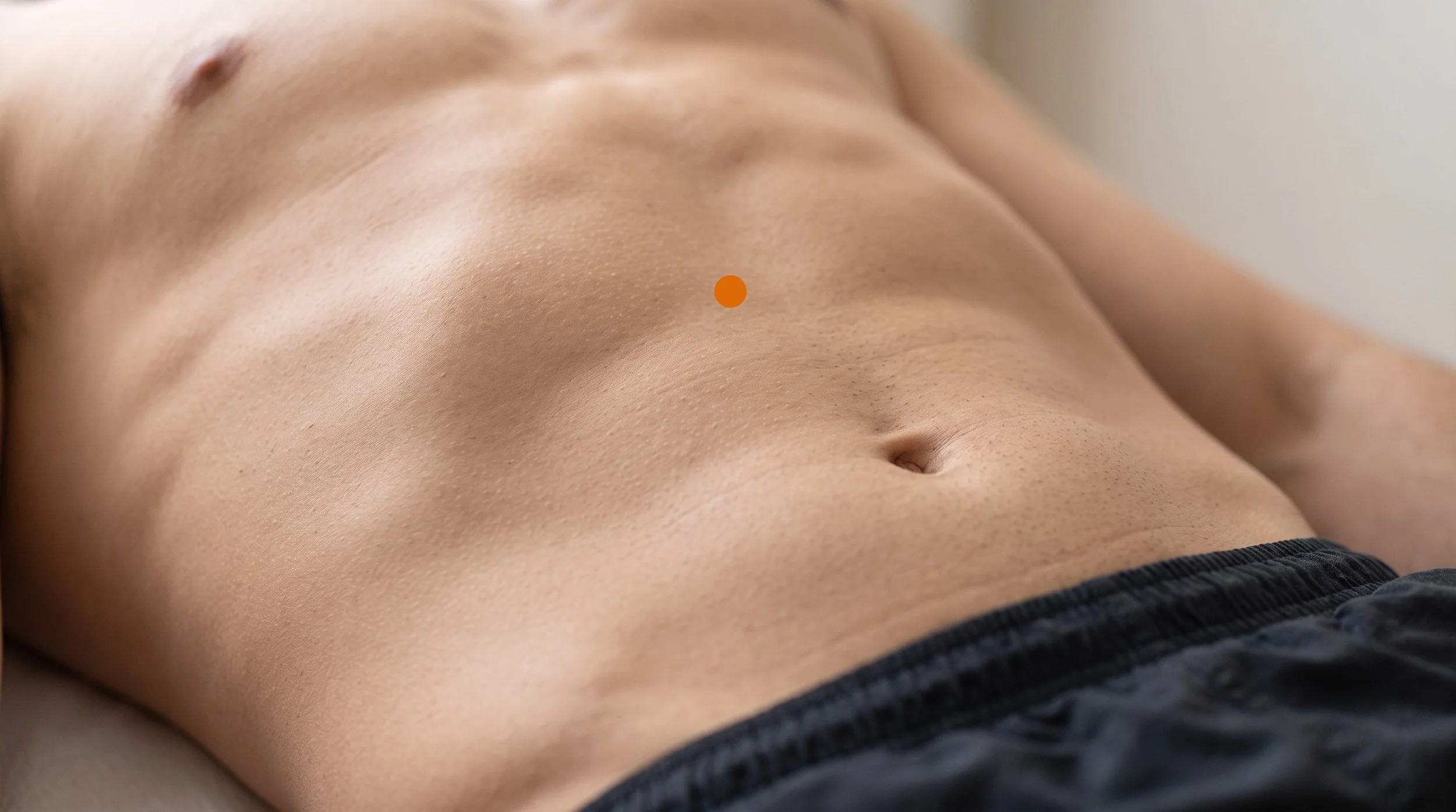
KI19 (Yindu, often translated as Yin Metropolis or Yin Capital) is the nineteenth point of the Kidney channel, sitting on the upper abdomen 4 cun above the navel and just half a cun off the midline, immediately beside CV12 at the level of the stomach. It is a small target in a busy neighborhood: the medial fibers of the rectus abdominis lie directly beneath the skin, the stomach sits behind the abdominal wall, and the classical texts group this point with the Penetrating vessel, one of the extraordinary vessels that runs up the abdomen alongside the Kidney channel.
Clinically the ki19 acupuncture point is used for upper digestive complaints, epigastric pain, nausea and a feeling of fullness or agitation below the breastbone, and it is almost always needled as part of a group rather than on its own. Because the region it covers is thin and the organs behind it are close, kidney 19 is a point where anatomy and needling judgment matter more than enthusiasm.
- Location and layers: KI19 lies 4 cun above the umbilicus and 0.5 cun lateral to the midline, level with CV12, over the medial edge of the rectus abdominis inside its sheath (Deadman et al., 2007; Kim, 2015). The tissue depth from skin to peritoneum here is modest, which is why the standard needling range is deliberately shallow.
- Traditional categories translated: classical sources list KI19 as a meeting point of the Kidney channel with the Penetrating vessel and describe its actions as regulating qi, harmonizing the Stomach and lowering rebellion (Deadman et al., 2007; Maciocia, 2006). Read neurophysiologically, those descriptions map onto segmental modulation of upper gut sensation and motility rather than any literal flow of energy.
- Mechanism: the abdominal wall here is supplied by anterior cutaneous branches of the lower intercostal nerves, and the same mid to lower thoracic spinal segments receive visceral afferents from the stomach, so needling converges with gastric input at the same cord levels. Animal work shows that acupuncture-type stimulation of the abdomen reflexively inhibits gastric motility through sympathetic efferents, while limb stimulation tends to increase it through vagal pathways (Sato et al., 1993).
- Research picture: no trial has isolated KI19, but reviews of acupuncture for functional dyspepsia and irritable bowel syndrome routinely test protocols built on upper abdominal points near CV12 combined with distal points, with modest and uneven results (Manheimer et al., 2012; Pang et al., 2016; Li et al., 2026).
- Clinical framing: at Morningside we use ki 19 abdomen needling as a local complement to distal points such as ST36 and PC6, and we screen carefully first, because epigastric pain and persistent vomiting always need a medical workup before they are treated as a functional pattern.
- De qi at KI19 is usually described as a dull, heavy spreading fullness or a mild sinking ache under the needle rather than a sharp sensation, and some patients notice audible gut sounds or a wave of relaxation within a minute or two (Deadman et al., 2007).
Struggling With Epigastric Pain, Reflux or Post-Meal Fullness?
Upper abdominal discomfort that has been medically cleared but never really resolved is one of the most common reasons patients come to us. Morningside clinicians use KI19 alongside CV12, ST36 and PC6 in gentle, precisely angled protocols designed for the upper abdomen, and we combine needling with breathing and abdominal wall work when the muscle layer is part of the problem. Treatment plans are built around your history, your symptom timing and your medical workup, not a template. Schedule a visit and let's map out what is actually driving your symptoms.
Schedule NowAnatomy of KI19: Why the Upper Abdomen Beside CV12 Is Such an Important Location
KI19 sits 4 cun above the umbilicus and only 0.5 cun lateral to the midline, which places it just off the linea alba at the level of CV12 and roughly medial to ST21 (Deadman et al., 2007; Cunningham, 2015). Under the needle you pass through skin, a thin layer of subcutaneous fat that varies enormously between patients, the anterior lamina of the rectus sheath, and then the medial fibers of the rectus abdominis.
This part of the rectus works hard during trunk flexion, during coughing and forced exhalation, and during any activity that involves bracing, so the tissue at KI19 is frequently tender in people who sit hunched for long hours, in postpartum abdominal walls, and after abdominal surgery. Chronic guarding of the upper abdominal wall is common in patients with long-running gut symptoms, and that guarding is part of what we are treating locally.
The nerve geography explains most of the clinical logic. The skin and muscle at KI19 are supplied by anterior cutaneous and muscular branches of the lower intercostal nerves, which enter the cord at mid to lower thoracic segments. Sensory fibers from the stomach travel with sympathetic pathways into those same segments, so somatic input from the abdominal wall and visceral input from the stomach converge on shared dorsal horn neurons.
That convergence is the reason gastric problems can produce upper abdominal wall tenderness, and it is also the reason needling the wall can modulate how that segment processes visceral signals. On top of the segmental effect, needling recruits ascending pathways that engage brainstem descending inhibitory systems using serotonin, noradrenaline and endogenous opioids (Zhao, 2008), and large pooled analyses of chronic pain trials suggest that effects of this kind are real, if moderate in size (Vickers et al., 2018).
Deep to the muscle lie the posterior rectus sheath, the transversalis fascia, the peritoneum and then the stomach, with the left lobe of the liver and transverse colon nearby depending on body habitus and how recently the patient has eaten. Textbook guidance is perpendicular insertion of 0.5 to 1 cun, with the explicit caution that deep needling can enter the peritoneal cavity (Deadman et al., 2007; Kim, 2015).
In practice we needle shallowly, adjust for tissue thickness, avoid the region entirely in pregnancy, in patients with organomegaly, hernia or recent abdominal surgery, and never needle deeply into an abdomen that is distended, guarded or acutely painful. Moxibustion over the area is a common alternative when a patient prefers less needle depth (Kim, 2015).
Related Kidney Channel Related Rectus Abdominis Trigger PointsKI19 at a Glance: Classification, Location, and Clinical Use
| Category | Detail |
|---|---|
| Traditional Name | Yindu (Yin Metropolis, also translated Yin Capital) |
| Channel Classification | Kidney channel of Foot Shaoyin, nineteenth point, upper abdominal group |
| Point Categories | Meeting (crossing) point of the Kidney channel with the Penetrating vessel (Chong mai); listed among the coalescent Kidney channel points of that vessel from KI11 to KI21; no five-shu, yuan-source or hui-meeting designation |
| Precise Location | On the upper abdomen, 4 cun above the umbilicus and 0.5 cun lateral to the anterior midline, level with CV12 |
| Tissue Stimulated | Skin, subcutaneous tissue and the anterior rectus sheath over the medial fibers of the rectus abdominis, with the transverse abdominis and abdominal obliques contributing to the surrounding wall |
| Needle Depth / Direction | Perpendicular insertion 0.5 to 1 cun, adjusted downward in thin patients; deep needling risks penetrating the peritoneal cavity, and moxibustion is a common alternative |
| De Qi Sensation | Dull heaviness, spreading fullness or a mild sinking ache under the needle, sometimes with audible gut sounds or a settling breath; sharp or referred pain means the needle should be adjusted |
| Primary Clinical Uses | Epigastric pain, nausea and vomiting with counterflow qi, abdominal distention and twisting pain, borborygmus, fullness and agitation below the Heart in classical listings, and upper abdominal wall tenderness accompanying functional gut complaints |
| Common Point Combinations |
|
In Deadman's manual, KI19 is presented as a meeting point of the Kidney channel with the Penetrating vessel, and its traditional actions are given as regulating qi and harmonizing the Stomach along with lowering rebellion to ease cough and wheezing.
The classical indications attributed to it cluster into three groups: upper digestive complaints (pain in the epigastrium, nausea, vomiting, counterflow qi, and a sense of fullness and restlessness below the heart), mid and lower abdominal complaints (distention, cramping or twisting pain, rumbling, and difficult bowel movements), and a smaller set of chest, gynecological and febrile entries including cough, chest and flank fullness, malaria, and stagnant blood in the uterus.
Other commentaries add eye pain beginning at the inner canthus, and Cunningham groups the point's functions around harmonizing the Spleen and Stomach, regulating the Penetrating vessel and easing pain (Deadman et al., 2007; Cunningham, 2015). What makes the classical pattern striking is how consistently it points downward and inward: nearly every indication involves something rising or churning where it should be descending, which is exactly the clinical territory where a point beside CV12 would be expected to be useful.
Why KI19 Is Used for Cough and Chest Tightness, Not Just Stomach Complaints
Patients are often surprised that a point on the upper abdomen appears in classical lists for cough, wheezing and fullness in the chest. Two things explain it. The first is mechanical: the rectus abdominis and the surrounding abdominal wall are active during forced exhalation and coughing, and the diaphragm attaches to the lower ribs and costal margin just above KI19, so chronic cough and guarded breathing load this tissue repeatedly.
The second is segmental. The abdominal wall here is innervated by lower intercostal nerves entering mid to lower thoracic cord segments, and those same segments receive visceral afferents from the stomach and esophagus, so needling input from the wall and sensory traffic from the upper gut converge on shared neurons. When that convergence is turned down, patients often report that the epigastric tightness and the throat or chest discomfort that traveled with it both ease.
The autonomic side is better characterized than most people expect. In anesthetized animals, needle stimulation applied to the abdomen reliably suppressed gastric contractions through a reflex carried by sympathetic gastric branches, while the same stimulation applied to the limbs increased gastric motility through parasympathetic pathways (Sato et al., 1993). That site dependence is why we rarely use abdominal points alone: pairing an abdominal point such as KI19 with a distal point such as ST36 gives access to both arms of the reflex.
In humans, electroacupuncture at digestive points has been shown to alter gastric slow wave activity, with site-specific differences between points (Shiotani et al., 2004), and broader reviews of acupuncture in functional dyspepsia describe motility, gastric accommodation, visceral sensitivity and autonomic tone as the plausible mechanisms (Guo et al., 2020).
Layered on top of the segmental and autonomic effects is the general analgesic machinery that any needle recruits: activation of A-delta and group III afferents drives brainstem circuits that release serotonin, noradrenaline and endogenous opioids, damping nociceptive transmission at the spinal level (Zhao, 2008). For a patient with a tender, over-braced upper abdomen and a hypersensitive gut, that combination of local desensitization, autonomic modulation and descending inhibition is a reasonable working model for why yindu acupuncture may help, without invoking anything mysterious.
What the Research Shows for KI19
There is no clinical trial that tests KI19 by itself, and it would be misleading to suggest otherwise. What exists is a body of evidence on multi-point acupuncture protocols for functional gut disorders, most of which combine upper abdominal points near CV12 with distal points on the legs and forearms, plus mechanistic studies that clarify what needling the abdominal wall does to gastric function.
The honest reading is that acupuncture appears to help some patients with functional dyspepsia and irritable bowel symptoms, that effect sizes are modest and study quality varies, and that KI19's contribution within those protocols has never been separated out. We present the evidence below with that caveat in front.
| Study | Type | Focus | Key Finding |
|---|---|---|---|
| Manheimer et al., 2012 | Cochrane systematic review | Acupuncture for irritable bowel syndrome | Acupuncture was not clearly superior to sham in the pooled sham-controlled trials, though it outperformed no specific treatment and some drug comparators, so benefit may be partly nonspecific. |
| Pang et al., 2016 | Systematic review and meta-analysis | Acupuncture for functional dyspepsia | Pooled results favored acupuncture for symptom improvement, but the authors emphasized methodological limitations across the included trials. |
| Li et al., 2026 | Updated systematic review and meta-analysis with GRADE | Efficacy and safety of acupuncture for functional dyspepsia (23 RCTs, 2,454 participants) | Moderate to high certainty evidence suggested acupuncture probably improves dyspepsia symptoms and quality of life compared with sham, without an increase in adverse events. |
| Guo et al., 2020 | Systematic review of mechanisms | Acupuncture and electroacupuncture in functional dyspepsia | Reported effects on gastric motility, accommodation, visceral sensitivity and autonomic and central regulation, offering a plausible mechanistic frame rather than proof of clinical efficacy. |
| Sato et al., 1993 | Controlled animal experiment | Segmental effects of acupuncture-like stimulation on gastric motility | Abdominal stimulation reflexively inhibited gastric contractions via sympathetic efferents while limb stimulation excited them via parasympathetic pathways, showing that site of needling matters. |
| Shiotani et al., 2004 | Human physiological study | Electroacupuncture and gastric myoelectrical activity in healthy volunteers | Stimulation altered gastric slow wave activity in a point-specific manner, supporting measurable but modest effects on gastric electrophysiology. |
| Vickers et al., 2018 | Individual patient data meta-analysis | Acupuncture for chronic pain across conditions | Acupuncture was superior to sham and to no acupuncture with effects that persisted over time, supporting a genuine but moderate treatment effect for pain generally. |
Bloating, Nausea and Gut Symptoms That Flare With Stress?
Many patients notice that abdominal distention, queasiness and irregular bowels track closely with stress and sleep. Acupuncture may help by shifting autonomic balance and reducing the volume on visceral sensation, and KI19 gives us a direct local target over the stomach region while distal points handle the systemic side. We also look at abdominal wall trigger points, which can mimic visceral symptoms surprisingly well. Book a consultation to get a clear, staged plan.
Schedule NowKI19 in the Context of Trigger Point Work
KI19 sits directly over the medial fibers of the upper rectus abdominis, which makes it an overlap point between classical point location and myofascial territory. Trigger points in the upper rectus are described as referring pain horizontally across the mid back and as producing abdominal symptoms that can imitate visceral disease, including a sense of fullness, queasiness and heartburn-like discomfort (Simons et al., 1999).
When palpation at or near KI19 reproduces a patient's familiar epigastric ache, we treat the wall as a genuine pain generator rather than assuming everything is coming from the stomach, and we say so clearly in the treatment plan.
In the clinic we typically combine shallow needling at KI19 and CV12 with careful dry needling of the rectus abdominis and, when the pattern extends laterally, the external abdominal oblique and transverse abdominis. Needle depth over the abdomen is always conservative, angling is chosen to stay within the muscle layer, and we skip abdominal needling altogether in pregnancy, in patients with a hernia, organomegaly, recent abdominal surgery or unexplained acute pain.
Distal points such as ST36 and PC6 usually round out the session, so the treatment addresses both the local tissue and the segmental and autonomic side of the picture.
KI19 Digestive Treatment at NYC's Highest-Rated Acupuncture Clinic
Morningside Acupuncture is the highest-rated acupuncture and dry needling clinic in New York City with over 500 five-star Google reviews, and our approach blends classical point selection with modern pain and gut science. For digestive complaints we combine careful abdominal points like KI19 with distal needling, dry needling of the abdominal wall when indicated, and practical guidance on meals, sleep and stress load. Every session is one on one with a licensed acupuncturist. Schedule your appointment today.
Schedule NowFrequently Asked Questions
What does KI19 feel like when needled?
Most patients describe a dull, heavy fullness or a spreading pressure under the needle rather than a sharp sting, and the sensation often stays fairly local to the upper abdomen. Because the abdominal wall is thin here, the needle is shallow and the stimulation is usually mild. Some people notice gut gurgling, a deeper breath, or a general settling feeling within a minute or two. Sharp pain, burning or a sensation that shoots away from the point means the needle needs adjusting, and you should tell your acupuncturist right away.
Why needle the abdomen at all when distal points like ST36 and PC6 are famous for digestion?
Because the two work on different arms of the same reflex. Experimental work shows that needle stimulation of the abdomen tends to inhibit gastric contractions through sympathetic pathways, while limb stimulation tends to increase gastric activity through parasympathetic pathways (Sato et al., 1993). Local abdominal points such as KI19 also address the abdominal wall itself, which is often tender, braced and contributing to the symptom picture. In practice we combine both, using KI19 near the symptomatic segment and distal points for the systemic effect.
Can I press KI19 myself between sessions?
Gentle self-acupressure is reasonable for most healthy adults. Find the midline point about halfway between the navel and the base of the breastbone, then move roughly a fingertip's width to one side. Use the pads of two fingers with light to moderate pressure, only enough to feel a mild ache, and hold for 30 to 60 seconds while breathing slowly into the lower ribs. You can repeat on the other side and do the whole sequence two or three times a day, ideally not immediately after a large meal. Stop if pressure causes sharp pain, nausea that worsens, or any pain that is new to you, and skip abdominal acupressure entirely if you are pregnant, have a hernia, have had recent abdominal surgery, or are dealing with undiagnosed abdominal pain.
Is KI19 safe to needle?
In trained hands, yes, with clear limits. The standard depth is perpendicular insertion of 0.5 to 1 cun, and textbooks caution explicitly that deep needling in this region may penetrate the peritoneal cavity (Deadman et al., 2007; Kim, 2015). Depth must be scaled to the patient's build, and the point is avoided in pregnancy, over hernias, in patients with liver or spleen enlargement, after recent abdominal surgery or with abdominal scarring, and in any acutely distended, rigid or severely tender abdomen. New or severe epigastric pain, persistent vomiting, weight loss, black stools, or difficulty swallowing require medical evaluation first, not acupuncture.
Where exactly is KI19 located?
KI19 is on the upper abdomen, 4 cun above the center of the umbilicus and 0.5 cun lateral to the anterior midline, level with CV12 (Deadman et al., 2007). Using proportional measurement, the distance from the navel to the base of the sternum is 8 cun, so KI19 sits at the midpoint of that line and then just off to the side, roughly a fingertip's width from the midline in an average adult. It lies over the medial fibers of the rectus abdominis, medial to ST21 on the Stomach channel.
References
- Deadman, P., Al-Khafaji, M., & Baker, K. (2009). A manual of acupuncture. Journal of Chinese Medicine Publications.
- Cunningham, P. M. (2000). Acupuncture points: A practical guide to classical and modern usage. Odyssey Press.
- Kim, H. (2008). Handbook of Oriental medicine (3rd ed.). Harmony & Balance Press.
- Maciocia, G. (2005). The foundations of Chinese medicine: A comprehensive text for acupuncturists and herbalists (2nd ed.). Elsevier Churchill Livingstone.
- Simons, D. G., Travell, J. G., & Simons, L. S. (1999). Travell & Simons' myofascial pain and dysfunction: The trigger point manual, Vol. 1: Upper half of body (2nd ed.). Williams & Wilkins.
- Sato, A., Sato, Y., Suzuki, A., & Uchida, S. (1993). Neural mechanisms of the reflex inhibition and excitation of gastric motility elicited by acupuncture-like stimulation in anesthetized rats. Neuroscience Research, 18(1), 53-62. https://doi.org/10.1016/0168-0102(93)90105-Y
- Shiotani, A., Tatewaki, M., Hoshino, E., & Takahashi, T. (2004). Effects of electroacupuncture on gastric myoelectrical activity in healthy humans. Neurogastroenterology & Motility, 16(3), 293-298. https://doi.org/10.1111/j.1365-2982.2004.00504.x
- Manheimer, E., Cheng, K., Wieland, L. S., Min, L. S., Shen, X., Berman, B. M., & Lao, L. (2012). Acupuncture for treatment of irritable bowel syndrome. Cochrane Database of Systematic Reviews, 2012(5), CD005111. https://doi.org/10.1002/14651858.CD005111.pub3
- Pang, B., Jiang, T., Du, Y. H., Li, J., Li, B., Hu, Y. C., & Cai, Q. H. (2016). Acupuncture for functional dyspepsia: What strength does it have? A systematic review and meta-analysis of randomized controlled trials. Evidence-Based Complementary and Alternative Medicine, 2016, 3862916. https://doi.org/10.1155/2016/3862916
- Guo, Y., Wei, W., & Chen, J. D. Z. (2020). Effects and mechanisms of acupuncture and electroacupuncture for functional dyspepsia: A systematic review. World Journal of Gastroenterology, 26(19), 2440-2457. https://doi.org/10.3748/wjg.v26.i19.2440
- Li, X. X., Hu, Z. Y., Li, Z. C., Tang, J., Liu, Y. Y., Zeng, D. H., Zhou, Q. Q., Ma, W. B., Lan, L., & Wang, L. (2026). Efficacy and safety of acupuncture for functional dyspepsia: An updated meta-analysis of randomized controlled trials. Frontiers in Medicine, 1718632. https://doi.org/10.3389/fmed.2026.1718632
- Zhao, Z. Q. (2008). Neural mechanism underlying acupuncture analgesia. Progress in Neurobiology, 85(4), 355-375. https://doi.org/10.1016/j.pneurobio.2008.05.004
- Vickers, A. J., Vertosick, E. A., Lewith, G., MacPherson, H., Foster, N. E., Sherman, K. J., Irnich, D., Witt, C. M., & Linde, K. (2018). Acupuncture for chronic pain: Update of an individual patient data meta-analysis. Journal of Pain, 19(5), 455-474. https://doi.org/10.1016/j.jpain.2017.11.005
Disclaimer: This web site is intended for educational and informational purposes only. Reading this website does not constitute providing medical advice or any professional services. This information should not be used for diagnosing or treating any health issue or disease. Those seeking medical advice should consult with a licensed physician. Seek the advice of a medical doctor or other qualified health professional for any medical condition. If you think you have a medical emergency, call 911 or go to the emergency room. No acupuncturist-patient relationship is created by reading this website or using the information. Morningside Acupuncture PLLC and its employees and contributors do not make any express or implied representations with respect to the information on this site or its use. For any legal interpretation of scope of practice in your state, consult a licensed attorney or regulatory authority.
Read more from our blog



