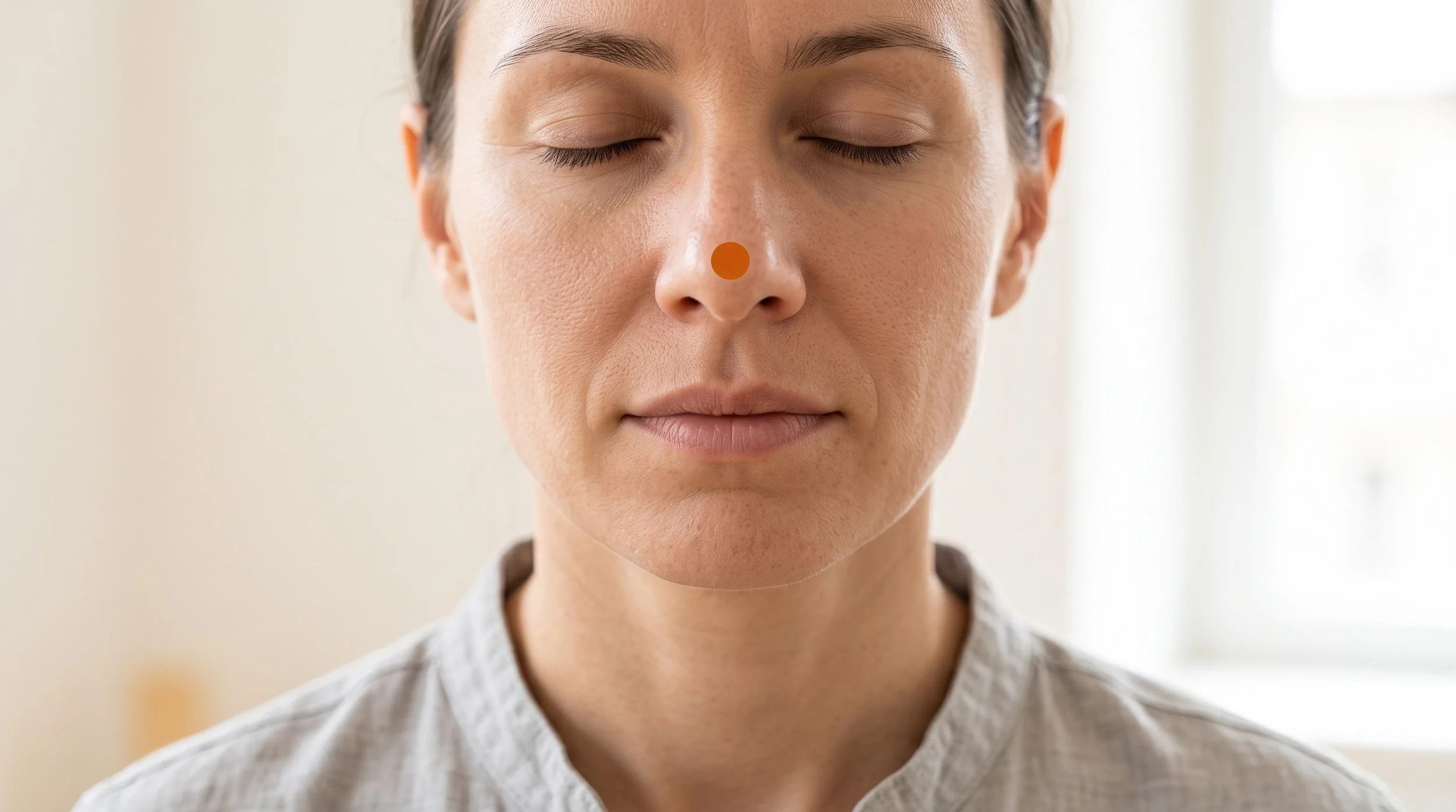
DU25 Acupuncture Point (Suliao)
The White Crevice at the Tip of the Nose: Anatomy, Trigeminal Mechanism, and Why This Small Midline Point Carries Outsized Clinical Weight
DU25 (Suliao, often translated as White Crevice), also written GV25, is the twenty-fifth point of the Governing Vessel, and its Suliao point location is about as easy to describe as any point in the map: it sits exactly on the midline at the tip of the nose.
Deadman and colleagues place it there without qualification, and every major text agrees (Deadman et al., 2009; Cheng, 1999). What makes governing vessel 25 interesting is not the anatomy of the landmark but the density of what sits under it. The nasal apex is thin skin over cartilage in the territory of the external nasal nerve, a branch of the ophthalmic division of the trigeminal nerve, which means a needle here recruits one of the most powerfully represented sensory zones in the brainstem.
Classically the DU 25 nose point was used to open a blocked nose, stop a nosebleed, and address the reddened, thickened nose associated with heavy drinking; in modern Chinese hospital practice it appears in arousal and resuscitation protocols. This post covers what the GV25 acupuncture point is, how it plausibly works in neurophysiological terms, and where the evidence is strong, thin, or simply absent.
- Location and layers: DU25 is on the midline at the very tip of the nose, where thin, sebaceous skin lies over the lower lateral (alar) cartilages with almost no muscle in between (Deadman et al., 2009; Cheng, 1999). There is no deep soft tissue cushion here, which is exactly why needling is shallow.
- Nerve geography: the nasal apex is supplied by the external nasal branch of the anterior ethmoidal nerve, a terminal twig of the ophthalmic division (V1) of the trigeminal nerve, with lateral nasal branches of the facial artery and vein nearby (Cheng, 1999). Trigeminal input converges in the spinal trigeminal nucleus, the same brainstem territory that receives upper cervical afferents, which gives the point a neurological route into facial, frontal, and nasal symptoms.
- Traditional attributions: classical sources describe DU25 as a point that benefits the nose, and later summaries add raising yang to the head, restoring qi, clearing the orifices of the senses, and clearing heat (Deadman et al., 2009; Kim, 2008). Those phrases are traditional category language, not physiology, and we translate them here rather than repeat them as mechanism.
- Mechanism story: stimulating trigeminally innervated nasal territory changes cerebral blood flow, autonomic tone, and arousal-related brainstem and hypothalamic activity in experimental work, and trigeminal stimulation has been shown to activate the spinal trigeminal nucleus and lateral hypothalamus with measurable effects on consciousness level in animal models (Zheng et al., 2021; Powell et al., 2023). Broader acupuncture analgesia research supports segmental gating and descending inhibitory pathways as the general framework (Zhao, 2008).
- Evidence picture: there are no high-quality trials isolating DU25, so its research support is indirect, drawn from meta-analyses of multi-point acupuncture protocols for allergic rhinitis and from trigeminal stimulation physiology (He et al., 2022; Yin et al., 2020; Powell et al., 2023). Reviews of acupuncture for rhinitis suggest modest symptom and quality of life benefits with reasonable safety.
- Practice framing and de qi: this is a short, sharp, memorable needle. Most people report an immediate stinging sensation at the nose tip, watering eyes, and sometimes an urge to sneeze, then a heavy ache that spreads across the bridge of the nose and settles within a minute. We use it selectively, briefly, and always with consent about the sensation, since classical texts also caution against moxibustion at this location (Deadman et al., 2009).
Chronic Nasal Congestion or Seasonal Rhinitis in NYC?
Stuffy, dripping, pressure-behind-the-face symptoms are one of the most common reasons New Yorkers come to us outside of pain complaints. At Morningside Acupuncture we build nasal protocols around local points like DU25 and LI20 combined with distal points and, where relevant, dry needling of the jaw and neck muscles that keep facial tension high. Treatment is gentle, brief at the nose, and always explained before the needle goes in. Schedule a visit and let's map out what your nose is actually doing.
Schedule NowAnatomy of DU25: Why the Tip of the Nose Is Such an Important Location
The nasal apex has a very short tissue stack. Thin, sebaceous, richly vascular skin sits directly over fibrofatty tissue and the paired lower lateral cartilages, with only slender fibers of the nasal musculature nearby and no substantial muscle belly at the midline itself. That means a needle at DU25 engages skin, subcutaneous connective tissue, and perichondrial surface rather than muscle.
It also means there is no room for depth, which is why every standard text keeps insertion shallow, either a perpendicular 0.2 to 0.3 cun or a transverse insertion aimed upward along the nasal dorsum (Deadman et al., 2009; Cheng, 1999). Skin here is also mechanically loaded in an unusual way: repeated nose blowing, mask wear, allergic rubbing, and chronic vasodilation from rosacea all change the tissue you are needling into.
The neurological story is the reason this point matters. The nasal tip is supplied by the external nasal branch of the anterior ethmoidal nerve, a terminal branch of the ophthalmic division of the trigeminal nerve, alongside lateral nasal vessels from the facial artery and vein (Cheng, 1999). Trigeminal afferents from this region project to the trigeminal ganglion and then to the spinal trigeminal nucleus in the medulla, a region that also receives input from the upper cervical segments.
That shared pool of second-order neurons is the anatomical basis for why facial, nasal, and frontal head symptoms so often travel together, and why stimulation in one territory can modulate perception in another. From there, trigeminal signals reach autonomic and arousal-related centers, including brainstem nuclei and the hypothalamus, which is the pathway experimental trigeminal stimulation research has focused on (Zheng et al., 2021; Powell et al., 2023).
Layered on top of this, needle stimulation recruits descending inhibitory control from the periaqueductal gray and rostral ventromedial medulla, the general mechanism described in acupuncture analgesia research (Zhao, 2008).
Safety at DU25 is mostly about vasculature and sensitivity rather than deep structures. There is no lung, no major vessel, and no nerve trunk at risk, but the nasal tip is highly vascular and the skin is fragile, so bruising and small bleeds are common, particularly in people with visible telangiectasias or on anticoagulant therapy. The classical technique of pricking to bleed at this point is exactly that, a deliberate micro-bleed, and it should only be done by a trained clinician with clean-field technique (Deadman et al., 2009; Cheng, 1999).
Needling is skipped over open nasal sores, active skin infection, or inflamed acne lesions. Several classical texts also list this point as contraindicated to moxibustion, a caution that modern practitioners still respect (Deadman et al., 2009; O'Connor & Bensky, 1981).
Related Governing Vessel Related Best Acupuncture Points For HeadachesDU25 (GV25) at a Glance: Classification, Location, and Clinical Use
| Category | Detail |
|---|---|
| Traditional Name | Suliao (White Crevice), DU25 in the Deadman system, GV25 in common English usage |
| Channel Classification | Governing Vessel, the midline yang vessel of the back and head (DU25, also written GV25; also called the Du Mai or Du channel) |
| Point Categories | A local Governing Vessel point at the nasal apex. The reference texts assign it no five-shu status, no hui-meeting role, and no listed meeting or crossing designations with other channels. Maciocia groups it with DU26 as one of the Governing Vessel points said to connect indirectly with the brain by way of the Eye System, and Deadman's stated action is simply to benefit the nose (Deadman et al., 2009; Maciocia, 2005). |
| Precise Location | On the anterior midline at the tip of the nose, over the junction of the paired lower lateral (alar) cartilages |
| Tissue Stimulated | Thin sebaceous skin, subcutaneous fibrofatty tissue, and the perichondrial surface of the alar cartilages, in external nasal nerve (V1) territory. Related facial and cervical myofascial targets are often addressed separately, and our dry needling for neck pain research post covers the cervical side of that picture. |
| Needle Depth / Direction | Perpendicular insertion 0.2 to 0.3 cun, or transverse insertion directed upward along the nasal dorsum 0.5 to 1 cun, or pricking to bleed with a fine lancet. Classical texts contraindicate moxibustion here (Deadman et al., 2009). |
| De Qi Sensation | Immediate, sharp, and unmistakable: stinging at the nose tip, reflex watering of the eyes, a frequent urge to sneeze, then a spreading heavy ache across the nasal dorsum that usually settles within a minute |
| Primary Clinical Uses | Nasal obstruction, rhinitis and copious nasal discharge, reduced sense of smell, nosebleed, nasal sores and polyps in classical listings, reddened rosacea-type nose, and, in modern Chinese emergency and rehabilitation settings, restoring consciousness and supporting low blood pressure (Deadman et al., 2009; Cheng, 1999) |
| Common Point Combinations |
|
Deadman, Al-Khafaji, and Baker give DU25 a single stated action, benefiting the nose, and then list an indication set that is almost entirely nasal: heavy nasal discharge, rhinitis, an inability to distinguish pleasant from foul smells, blocked nose, nasal sores, nosebleed, nasal polyps, and the reddened thickened nose classically called drinker's nose, along with breathlessness and low blood pressure (Deadman et al., 2009).
Their commentary adds two modern observations reported in Chinese sources: that needling here has been used to reduce alcohol intoxication by shifting more of the elimination burden toward the breath, and that research has found this point more effective than DU26 for restoring lost consciousness (Deadman et al., 2009).
Other authors add complementary traditional attributions, including opening the lung qi, transforming blood stagnation, and raising the yang to restore collapse, with the name itself linked to white, the color traditionally associated with the lung, and the nose as the opening through which breathing begins (Cunningham, 2000; Kim, 2008).
What makes the classical pattern striking is its internal consistency: a point defined almost entirely by the nose is also the point old and modern practitioners reached for when someone stopped responding, and the trigeminal anatomy underneath offers a plausible reason why those two uses belong to the same address.
Why DU25 Is Used for Blocked Breathing, Nosebleeds, and Even Restoring Consciousness
Start with convergence. Sensory fibers from the nasal tip travel in the external nasal branch of the anterior ethmoidal nerve into the ophthalmic division of the trigeminal nerve, then to the trigeminal ganglion and the spinal trigeminal nucleus in the brainstem (Cheng, 1999). That nucleus is not a private line for the nose. It pools input from the face, the nasal mucosa, the dura, and the upper cervical spinal segments, which is why a stimulus at one facial location can shift the perception and reflex behavior of an entire region.
It also explains, in ordinary neurological terms, why a point on the nose is traditionally listed for frontal headache, facial swelling, and eye symptoms as well as for the nose itself (O'Connor & Bensky, 1981).
Then add autonomic reflexes. The nasal mucosa is governed by a trigeminal to parasympathetic reflex loop that controls vascular engorgement and glandular secretion, which is the machinery behind congestion, dripping, and sneeze. Stimulating trigeminally innervated nasal territory modulates that loop, and reviews of trigeminal nerve stimulation describe effects on cerebral vasodilation, cerebral blood flow, inflammation, and autonomic tone (Powell et al., 2023).
In animal work, trigeminal stimulation activated the spinal trigeminal nucleus and the lateral hypothalamus, raised hypocretin expression, and improved consciousness level and EEG activity, which is the closest current mechanistic parallel to the classical arousal use of this point (Zheng et al., 2021). None of that proves a needle at DU25 does the same thing in humans, and we present it as a plausible pathway rather than a demonstrated clinical effect.
Finally, the general acupuncture mechanism applies here as it does elsewhere. Needle stimulation activates A-delta and C fiber afferents, engages segmental inhibition at the level of the relevant dorsal horn or trigeminal nucleus, and recruits descending inhibitory control involving endogenous opioid, serotonergic, and noradrenergic pathways (Zhao, 2008). For a patient, that translates into two realistic goals for DU25: a short-term change in how open and comfortable the nose feels, and a contribution to a broader treatment that lowers facial and cervical sensitization over a course of visits.
What the Research Shows for DU25 (GV25)
One note on naming before the evidence: in the research literature this point is almost always listed as GV25, the WHO standard code, so GV25 is the term to search if you want to read the studies below in full.
It is worth being blunt about the state of the evidence. There are no rigorous randomized trials that isolate DU25 as a single intervention in Western populations, so everything below is either research on multi-point acupuncture protocols for nasal conditions (where DU25 may or may not have been included) or physiological research on the trigeminal territory this point sits in. Reviews test packages of points, not single needles, and their results say something about acupuncture as a treatment approach rather than about the specific contribution of the nose tip. Read the table as context for why we use this point, not as proof that it works on its own.
| Study | Type | Focus | Key Finding |
|---|---|---|---|
| He et al., 2022 | Systematic review and meta-analysis (30 trials, 4,413 participants) | Acupuncture for allergic rhinitis, nasal symptom scores and quality of life | Acupuncture was associated with improved nasal symptom and quality of life scores compared with no intervention, with smaller advantages over sham, so effects appear real but modest. |
| Yin et al., 2020 | Systematic review and Bayesian network meta-analysis | Comparison of different acupuncture methods for allergic rhinitis | Several acupuncture methods appeared potentially effective for allergic rhinitis, though the authors emphasized the need for higher-quality evidence before ranking techniques confidently. |
| Powell et al., 2023 | State-of-the-art narrative review (89 studies) | Trigeminal nerve stimulation effects on cerebral blood flow, autonomic function, and consciousness | Trigeminal stimulation modulates cerebral vasodilation, autonomic tone, and inflammation, providing a plausible physiological frame for facial and nasal point effects, with mechanistic gaps still unresolved. |
| Zheng et al., 2021 | Preclinical mechanistic study (rat model) | Trigeminal electrical stimulation and recovery of consciousness | Stimulation activated the spinal trigeminal nucleus and lateral hypothalamus and improved consciousness measures, suggesting a pathway relevant to the traditional arousal use of nasal points. |
| Linde et al., 2016 | Cochrane systematic review | Acupuncture for the prevention of tension-type headache | Acupuncture appeared effective for frequent episodic or chronic tension-type headache, relevant because facial and midline head points are frequently included in such protocols. |
| Vickers et al., 2018 | Individual patient data meta-analysis (about 21,000 patients) | Acupuncture for chronic pain conditions including headache | Acupuncture was superior to both sham and no-acupuncture controls for chronic pain, with effects persisting over time, supporting acupuncture as a whole rather than any single point. |
| Zhao, 2008 | Mechanistic review | Neural mechanisms of acupuncture analgesia | Needle stimulation engages segmental spinal and brainstem inhibitory circuits and endogenous opioid systems, the framework we use to explain local facial point effects. |
Facial Acupuncture With a Clinical Nose Point?
Patients often ask about the reddened, flushed appearance of the nose that classical texts linked to heavy drinking and that dermatology now calls rosacea. We do not promise cosmetic outcomes, but DU25 and the surrounding nasal territory are traditionally used for that presentation and can be integrated carefully into a facial treatment plan. Our licensed acupuncturists will tell you honestly what acupuncture may and may not influence. Book a consultation and we'll set realistic expectations first.
Schedule NowDU25 in the Context of Trigger Point Work
DU25 itself is not a trigger point target, since there is no meaningful muscle belly at the nasal apex. What matters clinically is that the symptoms people bring to this point rarely live at the nose alone. Facial pressure, forehead ache, and a sense of nasal congestion frequently accompany myofascial referral patterns from the masseter, temporalis, sternocleidomastoid, and suboccipital muscles, and the sternal division of the sternocleidomastoid in particular is known to refer pain into the face, forehead, and periorbital region (Simons et al., 1999). Treating only the nose in those cases tends to give short-lived relief.
At Morningside Acupuncture we typically use DU25 as a brief local input inside a larger session. A visit for sinus pressure with headache might include DU25 and LI20 at the nose, midline forehead points, distal points such as LI4, and then dry needling of the masseter, temporalis, upper trapezius, and suboccipital group depending on exam findings. Because dry needling is acupuncture performed with an acupuncture needle under a different explanatory model, these approaches integrate cleanly rather than competing.
The clinical logic is consistent: reduce peripheral drive from sensitized muscles, then use the trigeminal territory at the nose to influence local nasal and facial symptoms directly.
DU25 Nasal and Facial Treatment at NYC's Highest-Rated Acupuncture Clinic
Morningside Acupuncture is the highest-rated acupuncture and dry needling clinic in New York City with over 500 five-star Google reviews, and our team treats nasal congestion, sinus pressure, facial pain, and headaches with an evidence-informed, anatomy-first approach. DU25 is one small tool inside a larger plan that may include LI20, midline forehead points, distal points, and myofascial dry needling. Every session starts with an exam, not a script. Schedule your appointment today.
Schedule NowFrequently Asked Questions
Is DU25 the same point as GV25?
Yes. DU25 and GV25 are two codes for the same point, Suliao. DU comes from Du Mai, the Chinese name of the Governing Vessel, and it is the code used in most Chinese texts and many acupuncture schools. GV is the WHO standard abbreviation and the one you will see in most Western textbooks and research papers. You will also come across it written as Du 25, GV-25, or Governing Vessel 25. Whichever code is used, the location and the uses are the same.
What does DU25 feel like when needled?
Sharp and immediate. Most patients feel a bright sting the moment the needle contacts the skin at the nose tip, followed by eyes watering, sometimes a strong urge to sneeze, and then a heavy, spreading ache across the bridge of the nose. The sensation is intense for a few seconds and usually settles within a minute. It is short-lived and well tolerated by most people, but we always describe it in advance and ask permission, because nobody enjoys being surprised by a needle at the tip of their nose.
Why needle the nose tip instead of a point closer to the sinuses?
Because the nose tip sits in trigeminal (V1) territory via the external nasal nerve, and trigeminal input converges in the spinal trigeminal nucleus alongside afferents from the nasal mucosa, face, and upper neck (Cheng, 1999). That convergence means stimulation at the apex can influence sensation and reflex activity across the whole nasal and facial region, not just the skin under the needle. Practically, we usually pair DU25 with points closer to the nostrils and sinuses, such as LI20 and midline forehead points, rather than choosing one over the other.
Can I press DU25 myself between sessions?
Yes, and acupressure here is simple. With clean hands, place a fingertip flat on the tip of your nose and apply firm but comfortable downward and slightly upward pressure, holding for 30 to 60 seconds, then releasing. Repeat two or three rounds, and add small circular motions along the sides of the nose toward the nostril margins (near LI20) if congestion is your main complaint. Twice or three times a day is plenty during a congested stretch. Skip it if the skin is broken, actively inflamed, sunburned, or if you have acne lesions or fragile rosacea skin at the site, and never try to needle this point yourself.
Is DU25 safe to needle?
In trained hands, yes, with a few specific cautions. Insertion is deliberately shallow, either 0.2 to 0.3 cun perpendicular or transverse along the nasal dorsum, because there is minimal soft tissue over the alar cartilages (Deadman et al., 2009). The area is highly vascular, so small bleeds and short-lived bruising happen more often here than at most body points, which matters more if you take anticoagulants or have visible spider veins. Classical texts contraindicate moxibustion at this point, and we do not needle over open nasal sores or active skin infection. Expect a brief, sharp sensation and tearing eyes rather than any lasting discomfort.
Where exactly is DU25 located?
On the anterior midline, at the tip of the nose, over the junction of the two lower lateral cartilages (Deadman et al., 2009; Cheng, 1999). To find your own Suliao point location, run a fingertip down the bridge of the nose until it reaches the most forward projecting point of the apex, above the columella and between the nostrils. It is one of the few points that requires no measurement in cun and no palpation of landmarks, which is part of why governing vessel 25 has stayed in continuous clinical use for centuries.
References
- Deadman, P., Al-Khafaji, M., & Baker, K. (2009). A manual of acupuncture. Journal of Chinese Medicine Publications.
- Cheng, X. (Ed.). (1999). Chinese acupuncture and moxibustion (Rev. ed.). Foreign Languages Press.
- O'Connor, J., & Bensky, D. (Eds. & Trans.). (1981). Acupuncture: A comprehensive text. Shanghai College of Traditional Medicine. Eastland Press.
- Kim, H. (2008). Handbook of Oriental medicine (3rd ed.). Harmony & Balance Press.
- Cunningham, P. M. (2000). Acupuncture points: A practical guide to classical and modern usage. Odyssey Press.
- Maciocia, G. (2005). The foundations of Chinese medicine: A comprehensive text for acupuncturists and herbalists (2nd ed.). Elsevier Churchill Livingstone.
- Simons, D. G., Travell, J. G., & Simons, L. S. (1999). Travell & Simons' myofascial pain and dysfunction: The trigger point manual, Vol. 1: Upper half of body (2nd ed.). Williams & Wilkins.
- He, M., Qin, W., Qin, Z., & Zhao, C. (2022). Acupuncture for allergic rhinitis: A systematic review and meta-analysis. European Journal of Medical Research, 27(1), 58. https://doi.org/10.1186/s40001-022-00682-3
- Yin, Z., Geng, G., Xu, G., Zhao, L., & Liang, F. (2020). Acupuncture methods for allergic rhinitis: A systematic review and Bayesian meta-analysis of randomized controlled trials. Chinese Medicine, 15, 109. https://doi.org/10.1186/s13020-020-00389-9
- Powell, K., Lin, K., Tambo, W., Palomo Saavedra, A., Sciubba, D., Al Abed, Y., & Li, C. (2023). Trigeminal nerve stimulation: A current state-of-the-art review. Bioelectronic Medicine, 9(1), 30. https://doi.org/10.1186/s42234-023-00128-z
- Zheng, Y., Wu, S., Yang, Q., Xu, Z., Zhang, S., Fan, S., Liu, C., Li, X., & Ma, C. (2021). Trigeminal nerve electrical stimulation: An effective arousal treatment for loss of consciousness. Brain Research Bulletin, 169, 81-93. https://doi.org/10.1016/j.brainresbull.2021.01.008
- Linde, K., Allais, G., Brinkhaus, B., Fei, Y., Mehring, M., Shin, B.-C., Vickers, A., & White, A. R. (2016). Acupuncture for the prevention of tension-type headache. Cochrane Database of Systematic Reviews, 2016(4), CD007587. https://doi.org/10.1002/14651858.CD007587.pub2
- Vickers, A. J., Vertosick, E. A., Lewith, G., MacPherson, H., Foster, N. E., Sherman, K. J., Irnich, D., Witt, C. M., & Linde, K. (2018). Acupuncture for chronic pain: Update of an individual patient data meta-analysis. Journal of Pain, 19(5), 455-474. https://doi.org/10.1016/j.jpain.2017.11.005
- Zhao, Z. Q. (2008). Neural mechanism underlying acupuncture analgesia. Progress in Neurobiology, 85(4), 355-375. https://doi.org/10.1016/j.pneurobio.2008.05.004
Disclaimer: This web site is intended for educational and informational purposes only. Reading this website does not constitute providing medical advice or any professional services. This information should not be used for diagnosing or treating any health issue or disease. Those seeking medical advice should consult with a licensed physician. Seek the advice of a medical doctor or other qualified health professional for any medical condition. If you think you have a medical emergency, call 911 or go to the emergency room. No acupuncturist-patient relationship is created by reading this website or using the information. Morningside Acupuncture PLLC and its employees and contributors do not make any express or implied representations with respect to the information on this site or its use. For any legal interpretation of scope of practice in your state, consult a licensed attorney or regulatory authority.
Read more from our blog



