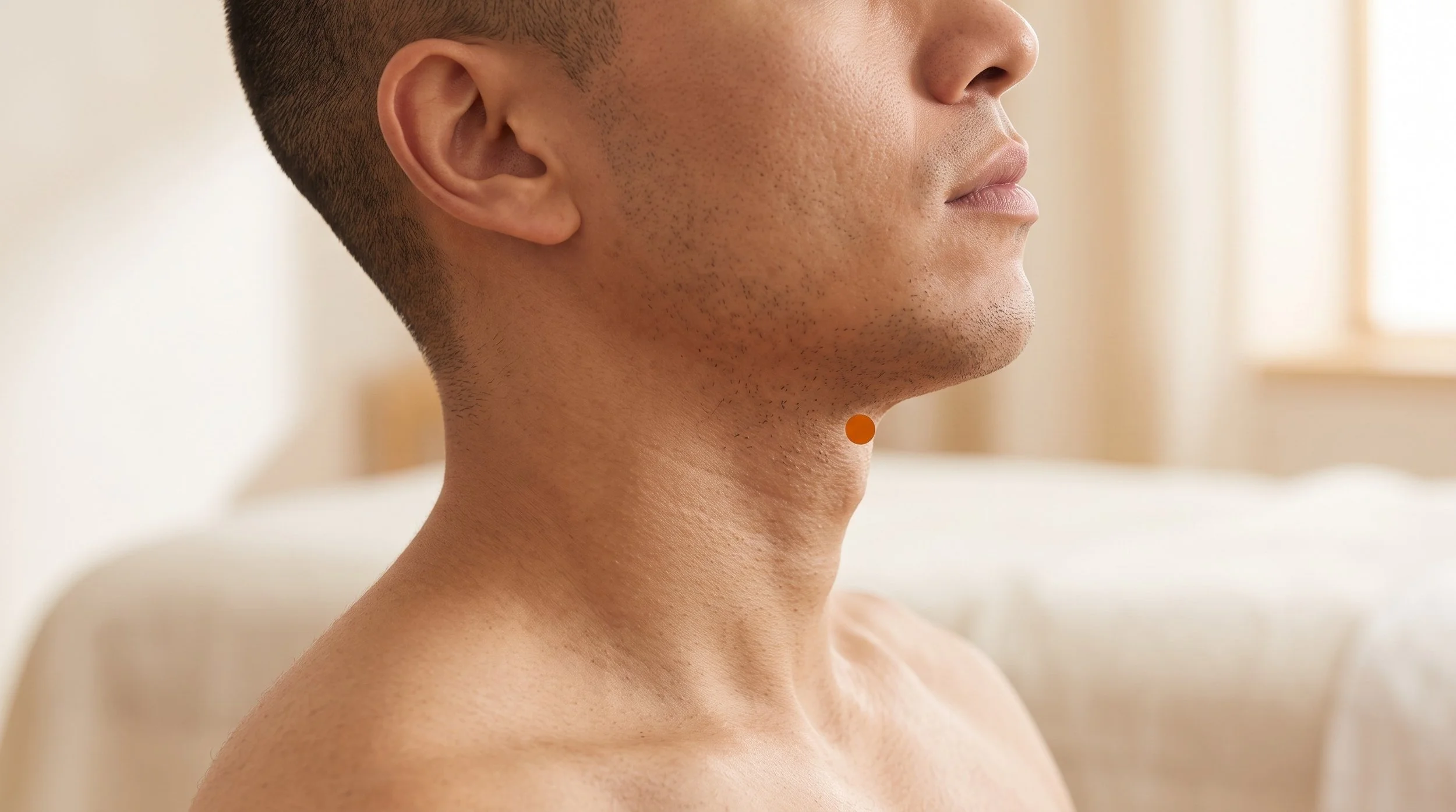
CV23 Acupuncture Point (Lianquan)
The Corner Spring Above the Hyoid Bone: Anatomy, Mechanism, and Why This Tongue Root Point Anchors Swallowing, Voice, and Throat Treatment
CV23 (also written Ren 23), known in Chinese as Lianquan and usually translated as Corner Spring, sits on the front midline of the neck in the soft hollow just above the hyoid bone, the small horseshoe shaped bone you can feel between the underside of the chin and the Adam's apple. It's the second to last point of the Conception Vessel and one of the few classical points that lies directly over the muscles that lift the hyoid and move the tongue.
That anatomy is why the CV23 acupuncture point has such a specific clinical identity: while most points on the front of the neck are described in terms of the throat and chest, conception vessel 23 is described in terms of the tongue itself, and it remains one of the most frequently selected points in modern acupuncture protocols for swallowing and speech rehabilitation after stroke.
- Location and layers: CV23 lies on the anterior midline in the deep depression at the upper border of the hyoid bone, reached by sliding a finger back along the underside of the chin until it drops into the hollow. Under the skin and superficial fascia sit the mylohyoid, geniohyoid, and genioglossus, the floor of mouth muscles that elevate the hyoid and drive the tongue during a swallow.
- Traditional attributions: classical sources group CV23 as a meeting point of the Conception Vessel with the Yin Linking Vessel and place it at the root of the tongue, with actions described as benefiting the tongue and descending rebellious qi (Deadman et al., 2009). Read neurophysiologically, that's a description of a point that influences tongue and suprahyoid motor control and reflex activity in the upper airway.
- Nerve story: the tissue at CV23 sits in trigeminal (mylohyoid nerve) and hypoglossal territory, with cervical fibers supplying geniohyoid and overlying skin, and it lies immediately above structures innervated by the superior laryngeal nerve. Needling here delivers a strong, well localized afferent barrage into brainstem circuitry that already coordinates swallowing (Yao et al., 2023).
- Point-specific physiology: in a post-stroke dysphagia mouse model, electroacupuncture at CV23 improved swallowing function, and the effect depended on primary motor cortex neurons projecting to the nucleus tractus solitarii by way of the parabrachial nuclei (Yao et al., 2023). That's unusually direct mechanistic evidence for a single named point, though it's animal work and shouldn't be over-read.
- Research picture: meta-analyses suggest acupuncture added to swallowing rehabilitation may improve swallowing scores and functional outcomes more than rehabilitation alone (Li & Deng, 2019; Zhong et al., 2021), but overviews of these reviews rate the underlying evidence as low quality (Tian et al., 2019). CV23 is almost always one point inside a larger protocol, never the whole treatment.
- De qi and practice framing: patients typically report a heavy, spreading fullness under the chin and into the tongue root, often with an involuntary urge to swallow. Needling is oblique and angled toward the tongue root in the direction of DU20 at the crown, 0.5 to 1.2 cun, and several modern texts list CV23 as contraindicated to moxibustion (Deadman et al., 2009).
Struggling With Swallowing, Hoarseness, or Throat Tightness?
Difficulty swallowing, a voice that tires quickly, and a persistent sense of tightness at the throat are frustrating precisely because they interrupt eating and talking. At Morningside Acupuncture we use CV23 alongside suprahyoid and cervical muscle work, breathing retraining, and points chosen for your presentation, coordinating with your speech language pathologist or ENT when you have one. Treatment is gentle, precise, and paced to what your tissue tolerates. Schedule a visit and we'll build a plan around your specific symptoms.
Schedule NowAnatomy of CV23: Why the Hollow Above the Hyoid Bone Is Such an Important Location
Start at the point of your chin and run a finger backward along the soft underside toward the throat. The finger drops into a distinct hollow just before it meets a firm transverse bar of bone, and that hollow is CV23. The bone is the hyoid, the only bone in the body that doesn't articulate directly with another bone; it's slung in a hammock of muscles between the jaw, the skull base, the sternum, and the shoulder girdle.
Above it lie the suprahyoid muscles: mylohyoid forming the floor of the mouth, geniohyoid running just deep to it, the anterior belly of digastric on either side, and genioglossus fanning up into the body of the tongue. These are the muscles that hoist the hyoid and larynx forward and upward every time you swallow, roughly a thousand times a day, and they also stiffen and shorten with chronic jaw clenching, forward head posture, prolonged voice use, and post-stroke motor changes.
The nerve geography here is unusually rich for such a small area. Mylohyoid and the anterior digastric are supplied by the mylohyoid nerve from the trigeminal system, geniohyoid receives first cervical fibers traveling with the hypoglossal nerve, and genioglossus is pure hypoglossal territory. Skin over the region is cervical plexus. Deep to the point, the internal branch of the superior laryngeal nerve carries dense sensory input from the epiglottis and laryngeal inlet.
Because trigeminal and upper cervical afferents converge on shared second order neurons in the trigeminocervical complex, and because pharyngeal and laryngeal afferents terminate in the nucleus tractus solitarii alongside vagal input, a needle stimulus at CV23 reaches the exact brainstem territory that organizes the swallow. Animal work at this point supports that reading: electroacupuncture at CV23 improved swallowing in a stroke model and depended on motor cortex input reaching the nucleus tractus solitarii through the parabrachial nuclei (Yao et al., 2023).
More broadly, needle afferents recruit spinal and supraspinal modulatory systems, including descending inhibitory pathways and endogenous opioid mechanisms (Zhao, 2008).
Depth matters here. Beneath the suprahyoid layer sit the pre-epiglottic space, the thyrohyoid membrane, and the airway; the lingual and superior thyroid arteries run laterally, and the carotid sheath lies well off the midline. For this reason the conventional technique is oblique, not perpendicular: the needle is angled back and up toward the tongue root, in the direction of DU20 at the vertex, to a depth of roughly 0.5 to 1.2 cun, staying in muscle rather than heading toward the airway.
Classical texts also direct the needle alternately toward the extra points Jinjin and Yuye beneath the tongue when the goal is regulating saliva, and several modern texts consider CV23 contraindicated to moxibustion (Deadman et al., 2009).
In practice this is a point that rewards precise palpation of the hyoid, light technique, and an unhurried patient who has been told exactly what to expect.
Related Conception Vessel Related Pain Finder Head NeckCV23 (Ren 23) at a Glance: Classification, Location, and Clinical Use
| Category | Detail |
|---|---|
| Traditional Name | Lianquan (Corner Spring), Ren-23 |
| Channel Classification | Conception Vessel (Ren Mai), the twenty-third of its twenty-four points, sitting on the front midline of the neck just below the chin (CV23, also written REN23) |
| Point Categories | Meeting point of the Conception Vessel with the Yin Linking Vessel (Yin Wei Mai); described in classical sources as located at the root of the tongue; also listed among the coalescent points of the Yin Linking Vessel and, in classical channel theory, as the End of the Kidney primary channel |
| Precise Location | Anterior midline of the neck, in the deep depression at the superior border of the hyoid bone. Find it by running a finger back along the underside of the chin toward the throat until it falls into the hollow just in front of the hyoid, the first firm transverse bony structure above the laryngeal prominence. |
| Tissue Stimulated | Skin and superficial cervical fascia over the submental region, then mylohyoid, geniohyoid, and the anterior fibers of genioglossus, with the anterior bellies of digastric on either side; innervation spans the mylohyoid nerve (trigeminal), first cervical fibers traveling with the hypoglossal nerve, and hypoglossal supply to the tongue musculature |
| Needle Depth / Direction | Oblique insertion angled back and upward toward the tongue root, in the direction of DU20, 0.5 to 1.2 cun; alternately angled toward Jinjin and Yuye beneath the tongue when treating saliva production. Several modern texts list this point as contraindicated to moxibustion. |
| De Qi Sensation | A heavy, dull fullness under the chin that spreads into the floor of the mouth and tongue root, frequently with a reflexive urge to swallow and sometimes a brief watering of the mouth. It should feel deep and full rather than sharp, and it usually settles within seconds. |
| Primary Clinical Uses | Traditionally used for stiffness or contraction of the tongue root, loss of voice after windstroke, swelling below the tongue with difficult speech, excessive drooling or conversely dry mouth and thirst, and cough with rebellious qi. In modern practice it's most often used in post-stroke swallowing and speech rehabilitation, hoarseness and voice fatigue, globus sensation, and dry mouth. |
| Common Point Combinations |
|
In A Manual of Acupuncture, Deadman and colleagues present CV23 as a meeting point of the Conception Vessel with the Yin Linking Vessel, positioned at the root of the tongue, with traditional actions given as benefiting the tongue and descending qi to settle cough.
The classical indication lists cluster into three groups: tongue and speech problems (swelling beneath the tongue, a contracted or protruding tongue, sudden voice loss, and loss of voice after windstroke), disorders of oral fluid (excessive spittle and drooling at one extreme, dryness and thirst at the other), and rebellious upward movement (cough, breathlessness, chest pain, and vomiting of froth). These are traditional attributions rather than modern diagnoses.
What's striking is how tightly the classical picture maps onto one anatomical region: a point sitting over the tongue's own muscles was credited with governing tongue movement, saliva, and the reflexes that push air and fluid the wrong way up the throat, which is very close to how a modern clinician would describe the functional territory of the suprahyoid and laryngeal afferent system.
Why CV23 Is Used for Swallowing, Voice Loss, and Even Cough
The convergence story explains most of it. Afferent fibers from the floor of the mouth, tongue root, and laryngeal inlet arrive in the brainstem in the same neighborhood: trigeminal input from mylohyoid, cervical input from the geniohyoid and overlying skin, hypoglossal territory in the tongue, and superior laryngeal input feeding the nucleus tractus solitarii. That nucleus is a hub of the central pattern generator for swallowing.
A needle placed in the hollow above the hyoid isn't reaching a mysterious channel, it's delivering a strong, sustained sensory signal into the exact circuit that sequences a swallow, which is why traditional indications for tongue movement, saliva, and cough all cluster at one location.
The point-specific physiology is more developed than for most acupuncture points. In a mouse model of post-stroke dysphagia produced by focal ischemia in the primary motor cortex, electroacupuncture at CV23 restored swallowing performance, and the benefit required excitatory neurons in the contralateral motor cortex plus activation of the parabrachial nuclei and nucleus tractus solitarii (Yao et al., 2023). In other words, peripheral stimulation at this location appeared to work by re-engaging a descending cortical to brainstem pathway rather than by acting locally on muscle alone.
Human evidence is thinner and comes mostly from clinical trials of multi-point protocols, so this remains a plausible mechanism rather than a settled one.
There's also a general modulation layer that applies to any needling session. Needle stimulation recruits segmental inhibition and descending pain modulating systems involving endogenous opioids, serotonin, and noradrenaline (Zhao, 2008), and individual patient data from chronic pain trials indicate effects that persist beyond the treatment period rather than fading immediately (Vickers et al., 2018). For a patient whose throat tightness is amplified by jaw clenching, effortful voice use, and a nervous system on high alert, that broader downshift often matters as much as the local input.
What the Research Shows for CV23 (Ren 23)
One note on naming before the evidence: in the research literature this point is almost always listed as CV23, the WHO standard code, while many textbooks and Chinese sources write Ren 23 or RN23, so it is worth searching those as well if you want to read the studies below in full.
A word of caution before the table. Almost no clinical trial tests CV23 by itself; the point is nearly always embedded in a protocol that also includes neck, scalp, and distal points, and is usually delivered alongside conventional swallowing rehabilitation. Reviews therefore evaluate packages of care, not this single location. Where CV23 does stand out is that it's the most frequently selected point across published post-stroke dysphagia protocols, and it's one of the few points with a dedicated mechanistic animal study.
Overviews of the literature consistently rate the underlying trial quality as low, so the honest summary is encouraging signals with weak methodology behind them.
| Study | Type | Focus | Key Finding |
|---|---|---|---|
| Yao et al., 2023 | Mechanistic animal study (Nature Communications) | Electroacupuncture at CV23 in a mouse model of post-stroke dysphagia | Stimulation at CV23 improved swallowing performance in a way that depended on motor cortex projections reaching the nucleus tractus solitarii through the parabrachial nuclei, offering a plausible circuit-level mechanism that still needs confirmation in humans. |
| Li & Deng, 2019 | Systematic review and meta-analysis | Acupuncture combined with swallowing training for post-stroke dysphagia | Pooled data from seventeen trials suggested that adding acupuncture to swallowing training may improve effective rates and swallowing assessment scores compared with training alone, with the usual caveats about trial quality. |
| Zhong et al., 2021 | Systematic review and meta-analysis | Acupuncture for dysphagia after stroke across thirty-five trials | Combined acupuncture and rehabilitation outperformed control conditions on several standard swallowing measures, though heterogeneity between studies was high enough to temper confidence. |
| Li et al., 2024 | Systematic review and meta-analysis | Acupuncture for aspiration caused by post-stroke dysphagia | Acupuncture, alone or combined with other therapies, was associated with improvement in aspiration outcomes and few adverse events, but the authors judged the included literature to be of low quality. |
| Tian et al., 2019 | Overview of systematic reviews | Methodological quality of thirty-one reviews on acupuncture for post-acute stroke dysphagia | Most reviews were rated critically low in quality, so current evidence is best described as preliminary and in need of larger, better designed trials. |
| Assy & Brand, 2018 | Systematic review | Acupuncture for xerostomia and reduced salivary flow | Some trials reported improvement in dry mouth sensation or salivary flow, but the overall quality was low and the review considered the evidence inconclusive. |
| Vickers et al., 2018 | Individual patient data meta-analysis | Acupuncture for chronic pain across nearly twenty thousand patients | Acupuncture was associated with modest but persistent benefit over sham and usual care, supporting effects that aren't fully explained by expectation alone. |
Recovering From a Stroke and Working on Speech and Swallowing?
Post-stroke swallowing and speech work is slow, repetitive, and best done alongside rehabilitation rather than instead of it. CV23 is the single most frequently selected point in published acupuncture protocols for swallowing after stroke, and we use it as one part of a session that may also include neck, scalp, and limb points. We coordinate carefully with your rehab team and keep sessions comfortable. Book a consultation to see whether acupuncture fits into your current recovery program.
Schedule NowCV23 in the Context of Trigger Point Work
CV23 sits directly over the suprahyoid group, so the point and the myofascial target overlap almost completely. When we treat a patient with globus sensation, effortful swallowing, voice fatigue, or submental tightness after jaw surgery or prolonged intubation, we're often palpating taut, tender bands in mylohyoid, geniohyoid, and the anterior belly of digastric before we ever pick up a needle.
Trigger points in the digastric are described as referring pain into the throat and the lower front teeth, and sternocleidomastoid trigger points can produce throat discomfort and swallowing complaints without any structural pathology (Simons et al., 1999). Recognizing that pattern changes the treatment: the problem may be muscular and referred rather than laryngeal.
In practice, Morningside sessions for these presentations combine oblique needling at CV23 with careful dry needling of the suprahyoid group and, where indicated, the sternocleidomastoid, scalenes, masseter, and medial pterygoid, since jaw and neck tension usually travel together. Remember that acupuncture is defined by the use of an acupuncture needle, and dry needling is one of hundreds of styles within that; the difference is the reasoning framework, not the tool.
All needling in this region is done in side-lying or supine with the head supported, at conservative depths, with clear communication throughout, and we pair it with breathing and swallowing mechanics work so the muscle change has somewhere useful to go.
CV23 Throat and Swallowing Treatment at NYC's Highest-Rated Acupuncture Clinic
Morningside Acupuncture is the highest-rated acupuncture and dry needling clinic in New York City with over 500 five-star Google reviews, and our approach pairs classical point selection with current pain and neuroscience. For throat, tongue, and voice complaints we combine Ren 23 throat needling with careful assessment of the jaw, hyoid, and cervical spine. Every plan is explained before a needle goes in. Schedule your appointment and let's get started.
Schedule NowFrequently Asked Questions
Is CV23 the same point as Ren 23?
Yes. CV23 and Ren 23 are two codes for the same point, Lianquan. CV stands for Conception Vessel and is the WHO standard abbreviation, the one you will see in most research papers. Ren comes from Ren Mai, the Chinese name of the vessel, and it is the form used in many textbooks and acupuncture schools. You will also come across it written as REN-23, RN23, or Conception Vessel 23. Whichever code is used, the location and the uses are the same.
What does CV23 feel like when needled?
Most people describe a deep, heavy fullness under the chin that spreads into the tongue root and floor of the mouth, often with an involuntary urge to swallow and sometimes a brief increase in saliva. It isn't usually sharp. Because the area is sensitive and close to the airway, the needle is inserted obliquely and shallowly at first, and practitioners typically check in with you within a few seconds. The sensation fades quickly and the tissue tends to soften noticeably after the first minute or two.
Why needle the throat itself instead of a distal point on the arm or leg?
Both approaches get used, but CV23 is chosen when the goal is direct sensory input into the swallowing and tongue control circuitry. The tissue at this point sits in trigeminal, cervical, and hypoglossal nerve territory just above structures supplied by the superior laryngeal nerve, all of which feed the brainstem centers that sequence a swallow (Yao et al., 2023). Distal points like LI4 and PC6 appear in the same protocols and contribute broader modulation, so in clinic we usually combine local and distal rather than choosing between them.
Can I press CV23 myself between sessions?
Yes, with a light touch and reasonable caution. Sit upright, run a fingertip back along the underside of your chin until it drops into the soft hollow just in front of the hyoid bone, and press upward and slightly backward toward the tongue root with gentle pressure, roughly the pressure you'd use on a closed eyelid. Hold for 20 to 30 seconds, release, and repeat two or three times, once or twice a day. Stop immediately if you feel dizzy, breathless, or any pulsing under your finger, and never press on the windpipe itself, on the front of the larynx, or on the sides of the neck where the carotid arteries run. Slow nasal breathing while you hold makes the technique more comfortable and more useful. If you've had head or neck surgery, radiation, a thyroid condition, or any diagnosed swallowing disorder, ask your clinician before trying this at home.
Is CV23 safe to needle?
In trained hands, yes, though it demands more care than most points because of what lies deeper. The airway, the pre-epiglottic space, and the thyrohyoid membrane sit below, and the lingual and superior thyroid vessels run laterally, so the standard technique is oblique insertion toward the tongue root at 0.5 to 1.2 cun rather than deep perpendicular needling. Several modern texts also list CV23 as contraindicated to moxibustion (Deadman et al., 2009). Transient soreness under the chin or a temporary change in saliva is the usual worst case. This is not a point for self-needling under any circumstances.
Where exactly is CV23 located?
On the front midline of the neck, in the deep depression at the top edge of the hyoid bone. The reliable way to find it is to place a fingertip on the point of your chin, slide it straight back along the soft underside toward your throat, and stop where the finger falls into a distinct hollow just before meeting a firm crosswise bar of bone. That bar is the hyoid, the highest palpable bony structure on the midline of the throat, sitting above the laryngeal prominence. The Lianquan tongue point is at its upper border, roughly one to two finger widths above the Adam's apple in most adults.
References
- Deadman, P., Al-Khafaji, M., & Baker, K. (2009). A manual of acupuncture. Journal of Chinese Medicine Publications.
- Cunningham, P. M. (2000). Acupuncture points: A practical guide to classical and modern usage. Odyssey Press.
- Cheng, X. (Ed.). (1999). Chinese acupuncture and moxibustion (Rev. ed.). Foreign Languages Press.
- Simons, D. G., Travell, J. G., & Simons, L. S. (1999). Travell & Simons' myofascial pain and dysfunction: The trigger point manual, Vol. 1: Upper half of body (2nd ed.). Williams & Wilkins.
- Yao, L., Ye, Q., Liu, Y., Yao, S., Yuan, S., Xu, Q., Deng, B., Tang, X., Shi, J., Luo, J., Wu, J., Wu, Z., Liu, J., Tang, C., Wang, L., & Xu, N. (2023). Electroacupuncture improves swallowing function in a post-stroke dysphagia mouse model by activating the motor cortex inputs to the nucleus tractus solitarii through the parabrachial nuclei. Nature Communications, 14, 810. https://doi.org/10.1038/s41467-023-36448-6
- Li, L. X., & Deng, K. (2019). Acupuncture combined with swallowing training for poststroke dysphagia: A meta-analysis of randomised controlled trials. Acupuncture in Medicine, 37(2), 81-90. https://doi.org/10.1136/acupmed-2016-011305
- Zhong, L., Wang, J., Li, F., Bao, X., Liu, H., & Wang, P. (2021). The effectiveness of acupuncture for dysphagia after stroke: A systematic review and meta-analysis. Evidence-Based Complementary and Alternative Medicine, 2021, 8837625. https://doi.org/10.1155/2021/8837625
- Li, H., Li, J., Wang, X., & Zhang, Z. (2024). A systematic review and meta-analysis of acupuncture in aspiration caused by post-stroke dysphagia. Frontiers in Neurology, 15, 1305056. https://doi.org/10.3389/fneur.2024.1305056
- Tian, Z. Y., Liao, X., Gao, Y., Liang, S. B., Zhang, C. Y., Xu, D. H., Liu, J. P., & Robinson, N. (2019). An overview of systematic reviews and meta-analyses on acupuncture for post-acute stroke dysphagia. Geriatrics, 4(4), 68. https://doi.org/10.3390/geriatrics4040068
- Assy, Z., & Brand, H. S. (2018). A systematic review of the effects of acupuncture on xerostomia and hyposalivation. BMC Complementary and Alternative Medicine, 18(1), 57. https://doi.org/10.1186/s12906-018-2124-x
- Zhao, Z. Q. (2008). Neural mechanism underlying acupuncture analgesia. Progress in Neurobiology, 85(4), 355-375. https://doi.org/10.1016/j.pneurobio.2008.05.004
- Vickers, A. J., Vertosick, E. A., Lewith, G., MacPherson, H., Foster, N. E., Sherman, K. J., Irnich, D., Witt, C. M., & Linde, K. (2018). Acupuncture for chronic pain: Update of an individual patient data meta-analysis. Journal of Pain, 19(5), 455-474. https://doi.org/10.1016/j.jpain.2017.11.005
Disclaimer: This web site is intended for educational and informational purposes only. Reading this website does not constitute providing medical advice or any professional services. This information should not be used for diagnosing or treating any health issue or disease. Those seeking medical advice should consult with a licensed physician. Seek the advice of a medical doctor or other qualified health professional for any medical condition. If you think you have a medical emergency, call 911 or go to the emergency room. No acupuncturist-patient relationship is created by reading this website or using the information. Morningside Acupuncture PLLC and its employees and contributors do not make any express or implied representations with respect to the information on this site or its use. For any legal interpretation of scope of practice in your state, consult a licensed attorney or regulatory authority.
Read more from our blog



