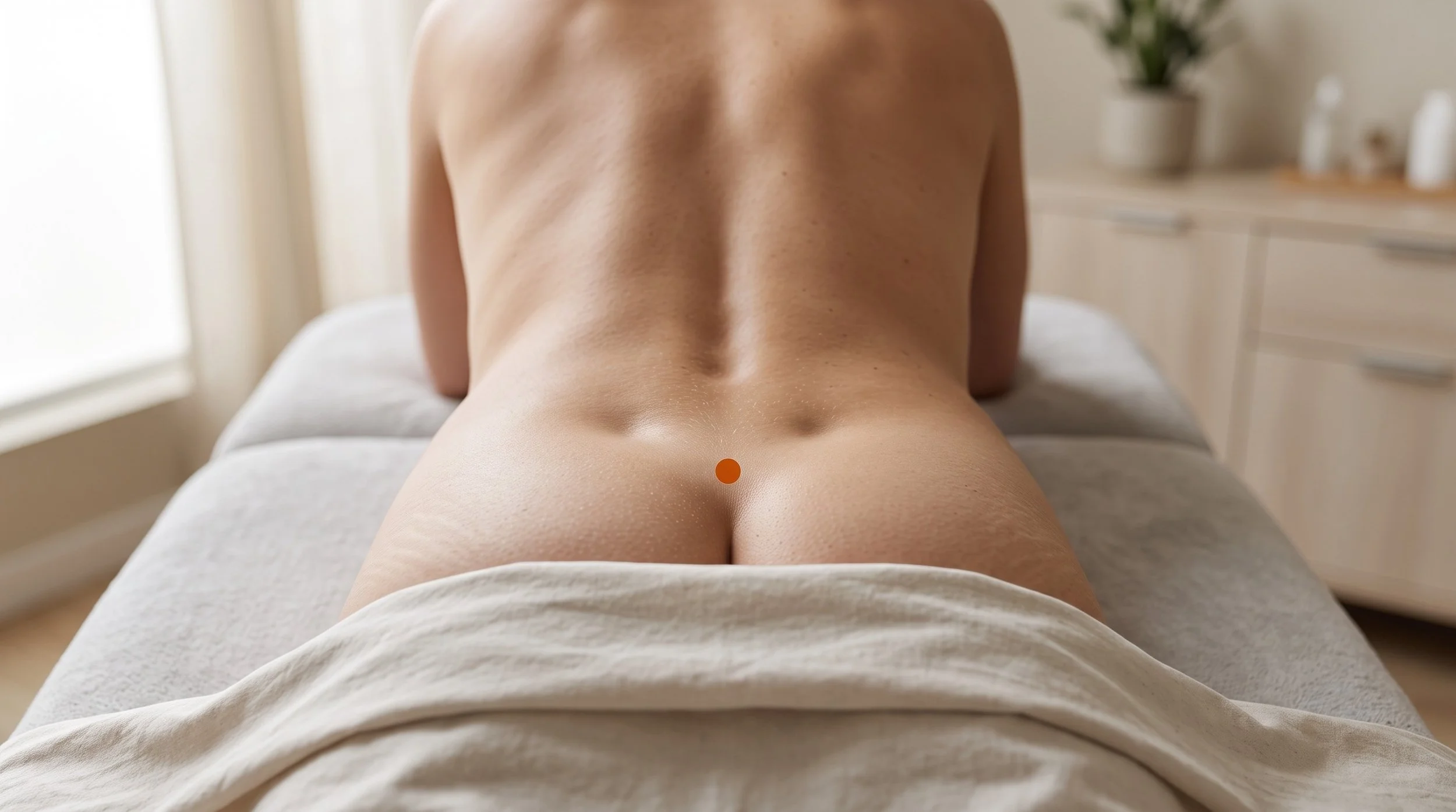
DU2 Acupuncture Point (Yaoshu)
The Lumbar Shu at the Sacral Hiatus: Anatomy, Mechanism, and Why a Midline Tailbone Point Is Used for Low Back, Hip, and Leg Pain
DU2 (Yaoshu, "Lumbar Shu"), also written GV2, is the second point of the Governing Vessel, found on the midline in the sacro-coccygeal hiatus, the small soft depression you can feel between the two bony bumps of the sacral cornua just below the tailbone end of the sacrum.
In plain terms, it sits at the very bottom of the spine, roughly a fingerbreadth or two above the tip of the coccyx, in the gap where the last part of the sacral canal is closed only by ligament rather than bone. That anatomy is exactly why the GV2 acupuncture point matters clinically: it is the one accessible midline window into the lowest sacral segments, the same landmark anesthesiologists palpate for caudal epidural access, and it sits directly over the tissue that anchors the lumbosacral fascia, the multifidus, and the lower fibers of gluteus maximus.
Classical texts traditionally credited Yaoshu with benefiting the lower back and legs, and modern practitioners use governing vessel 2 mainly for sacral and low back pain, especially when the pain spreads into the hips and down the leg.
- Yaoshu point location is straightforward once you find the landmarks: on the midline in the DU 2 sacral hiatus, in the depression between the sacral and coccygeal cornua below the fourth sacral spinous process. Anatomic studies of the hiatus confirm it is variable in shape and height, sometimes extending as high as the third sacral foramina, so palpation rather than measurement should guide the needle (Sekiguchi et al., 2004).
- The needle passes through thin skin and subcutaneous tissue into the sacrococcygeal ligament, the fibrous roof over the lowest opening of the sacral canal. Standard practice is oblique insertion angled upward, about 0.5 to 1 cun, which keeps stimulation in the ligamentous and periosteal layer rather than driving into the canal itself.
- Traditional sources describe DU2 as benefiting the lumbar region and legs and dispelling wind-damp, categories that translate cleanly into a modern picture of segmental stimulation in the S4, S5, and coccygeal territory feeding into lumbosacral pain processing rather than into any literal flow of energy.
- Needling here recruits small-diameter afferents whose input converges in the sacral cord with signals from the low back, buttock, posterior thigh, and pelvic structures, and repeated stimulation engages descending inhibitory pathways involving endogenous opioids and monoamines (Zhao, 2008).
- The research picture is about protocols rather than single points: a Cochrane review found acupuncture may produce small short-term improvements in pain and function for chronic nonspecific low back pain with low to moderate certainty (Mu et al., 2020), individual patient data pooling supports effects that persist beyond a course of care (Vickers et al., 2018), and sciatica evidence remains limited though a large sham-controlled trial reported meaningful leg pain improvement (Qin et al., 2015; Tu et al., 2024).
- De qi at DU2 is usually a dull, heavy, slightly pressurized ache directly at the tailbone, sometimes spreading upward into the sacrum or diffusely forward into the deep pelvis; sharp, electric, or radiating sensation down a leg is not the goal and prompts the practitioner to withdraw and redirect.
Low Back Pain That Runs Into Your Hip or Leg?
Pain that starts at the belt line and travels into the buttock, hip, or hamstring often involves the lumbosacral junction and the sacral segments beneath it. At Morningside Acupuncture, DU2 is frequently used as a midline anchor alongside sacral foramen points, gluteal needling, and paraspinal work at the levels that reproduce your symptoms. Treatment is paired with movement and load guidance so the results carry into the rest of your week. Schedule a visit and we'll map exactly where your pain is coming from.
Schedule NowAnatomy of DU2: Why the Sacro-Coccygeal Hiatus Is Such an Important Location
DU2 sits at the true tail end of the spinal column. Under the fingertip you feel two small bony prominences, the sacral cornua, with a soft midline dip between them. From the surface down, a needle at this point passes through thin skin and a scant subcutaneous layer, then meets the sacrococcygeal ligament, a dense fibrous membrane that roofs over the lowest opening of the sacral canal where the laminae of the fifth sacral segment failed to fuse.
Blending into this region are the lumbosacral fascia, the deepest attachments of multifidus, and the medial origin of gluteus maximus, which is why the area loads with prolonged sitting, repetitive hip extension, posterior pelvic tilt, and any activity that shears the sacrum against the pelvis. Patients often describe the discomfort here as bruised, deep, and worse after hours in a chair or a car.
The skin and superficial tissue at the sacro-coccygeal hiatus are supplied by branches of the coccygeal nerve and adjacent low sacral dorsal rami, while the canal immediately beneath carries the terminal sacral roots. That neighborhood is the mechanism story in a sentence. Afferent input from needling here enters the sacral cord at levels that also receive input from the low back, gluteal region, posterior thigh, and pelvic structures, so the same dorsal horn neurons that process your leg or pelvic complaint are being fed a competing, well-controlled signal.
Repeated stimulation of these small-diameter fibers also recruits descending inhibitory systems from the brainstem, releasing endogenous opioids and monoamines that reduce the responsiveness of spinal pain circuits (Zhao, 2008). Pooled clinical data support the idea that this is more than expectation alone, with acupuncture outperforming sham and non-acupuncture controls for chronic musculoskeletal pain by modest but persistent margins (Vickers et al., 2018).
Deep to the ligament sit the epidural contents of the sacral canal and branches of the median sacral artery and vein, and the hiatus itself varies considerably between individuals in shape, height, and the distance between the cornua (Sekiguchi et al., 2004). This is precisely the target anesthesiologists use for caudal epidural injection, which is a useful reminder about depth discipline rather than a reason for alarm.
Acupuncture technique at DU2 is deliberately conservative: oblique insertion angled upward, roughly 0.5 to 1 cun, keeping the needle within the ligamentous and periosteal layer rather than seeking the canal. Moxibustion is traditionally applied here as well, and in patients with a bony, sensitive, or anatomically unclear hiatus, indirect moxa or shallow needling is a reasonable substitute. Sterile single-use needles and clean technique are standard given how close the point is to the gluteal cleft.
Related Governing Vessel Related Best Acupuncture Points For Back PainDU2 (GV2) at a Glance: Classification, Location, and Clinical Use
| Category | Detail |
|---|---|
| Traditional Name | Yaoshu (Lumbar Shu), Governing Vessel 2, also written GV2 |
| Channel Classification | Governing Vessel (Du Mai), second point of the channel, midline of the lower back (DU2, also written GV2) |
| Point Categories | No five-shu, luo, or command point designation. Its status comes from position: a Governing vessel point sited in the sacro-coccygeal hiatus. Deadman's manual notes that the Essential Questions lists Yaoshu among a small classical group of points used to drain heat from the limbs, alongside LU2, LI15, and BL40. |
| Precise Location | On the midline at the sacro-coccygeal hiatus, in the depression between the bony prominences of the sacral and coccygeal cornua, below the fourth sacral spinous process when that landmark is palpable. The hiatus is variable and can extend as high as the level of the third sacral foramina. |
| Tissue Stimulated | Skin and thin subcutaneous tissue, the sacrococcygeal ligament roofing the sacral canal, sacral periosteum, and the fascial confluence of the lumbosacral fascia with multifidus and the medial gluteus maximus attachments; often combined with Pelvic Floor Trigger Points work in pelvic and tailbone presentations |
| Needle Depth / Direction | Oblique insertion directed upward (superiorly) along the midline, approximately 0.5 to 1 cun; perpendicular deep insertion is avoided. Moxibustion is traditionally applicable. |
| De Qi Sensation | Local heaviness, dull ache, and a sense of pressure at the tailbone, sometimes spreading up into the sacrum or diffusely forward into the deep pelvis; sharp or electric sensation running into a leg means the needle is redirected |
| Primary Clinical Uses | Sacral and low back pain, especially when it radiates into the hips and legs; stiffness and restricted bending of the lumbosacral region; cold-pattern heaviness or numbness of the legs in traditional use; irregular menstruation and haemorrhoids in classical indication lists |
| Common Point Combinations |
|
Deadman's A Manual of Acupuncture frames Yaoshu primarily as a point for pain of the sacrum and lumbar region, particularly when that pain radiates to the hips and travels down the legs, and traditionally attributes to it the actions of benefiting the lower back and legs and dispelling wind-damp.
Its classical indication list groups roughly into three families: local and referred pain patterns (sacral pain, lumbar and hip pain with difficulty bending and straightening, pain reaching the foot, cold painful obstruction with numbness of the leg), lower burner and pelvic complaints (irregular menstruation, vaginal discharge, dark urine, haemorrhoids), and a scattering of heat and spirit-related entries (warm malaria without sweating, epilepsy, persistent heat in the four limbs after cold damage).
Chinese Acupuncture and Moxibustion lists a similar core: irregular menstruation, low back pain and stiffness, haemorrhoids, weakness of the lower limbs, and epilepsy, with oblique upward needling and moxibustion.
What is striking about the classical pattern is its reach. A single midline point at the very bottom of the spine was credited with influence over the entire lower limb and the pelvic organs, a claim that looks less mysterious once you notice that the point sits directly over the lowest sacral segments, which supply exactly those territories.
Why DU2 Is Used for Leg Symptoms and Pelvic Complaints Far From the Tailbone
Patients are often surprised that a point at the tailbone gets used for pain in the hip, hamstring, or calf. The explanation is segmental. The sacral cord segments beneath DU2 receive convergent input from skin, deep fascia, muscle, joints, and pelvic viscera across a wide territory, so a single dorsal horn neuron may be listening to the tailbone, the buttock, the back of the thigh, and the pelvic floor at once.
Introducing a controlled, non-threatening stimulus into that shared segmental pool changes how those neurons weight incoming signals, which is one reason the sensation of local ache at the sacrum can be accompanied by a broader easing through the buttock and leg. Classical descriptions of lumbar pain radiating to the foot, or of cold heaviness in the leg, map onto this convergence surprisingly well.
Beyond the segment, sustained needling activates descending inhibitory pathways from the brainstem that damp spinal transmission through endogenous opioid and monoaminergic mechanisms, an effect that builds across a course of treatment rather than appearing fully in one session (Zhao, 2008). This helps explain why the clinical guidance for DU2 is a series of visits rather than a single dramatic intervention, and why acupuncture's measured benefits for chronic pain persist for months after treatment ends rather than dropping off immediately (Vickers et al., 2018).
The pelvic side of the traditional indication list is also less exotic than it first appears. Sacral needling sits in the same neural neighborhood as the autonomic and somatic supply to the bladder, pelvic floor, and lower bowel, and the best clinical evidence in this space comes from lumbosacral electroacupuncture: a large multicenter trial found that electroacupuncture at sacral points reduced urine leakage more than sham in women with stress urinary incontinence (Liu et al., 2017).
That trial did not use DU2, so it should be read as support for the plausibility of sacral segmental influence rather than as evidence for this specific point. It does, however, put the classical pelvic indications for Yaoshu in a more understandable frame.
What the Research Shows for DU2 (GV2)
One note on naming before the evidence: in the research literature this point is almost always listed as GV2, the WHO standard code, so GV2 is the term to search if you want to read the studies below in full.
There is no clinical trial that isolates DU2 on its own, and that is worth saying plainly. Acupuncture research tests multi-point protocols delivered over a course of sessions, so what the literature can tell us is how well a lumbosacral treatment approach performs overall, not what any single needle contributed. DU2 appears within that context as a midline sacral point used alongside foramen points, paraspinal points, and local needling. The reviews below are framed accordingly, with attention to certainty of evidence rather than headline effect sizes.
| Study | Type | Focus | Key Finding |
|---|---|---|---|
| Mu et al., 2020 | Cochrane systematic review | Acupuncture for chronic nonspecific low back pain, 33 trials with 8,270 participants | Acupuncture may produce small improvements in pain and back-specific function compared with sham and other controls, though certainty of evidence ranged from very low to moderate. |
| Vickers et al., 2018 | Individual patient data meta-analysis | Chronic musculoskeletal, headache, and osteoarthritis pain across nearly 21,000 patients | Acupuncture was more effective than both sham and no-acupuncture controls, with benefits that decreased only modestly over about twelve months. |
| Qin et al., 2015 | Systematic review and meta-analysis | Acupuncture for sciatica, 11 randomized trials | Acupuncture may outperform medication and may add to drug therapy for sciatic pain, but the authors judged the evidence limited by the small number of rigorous studies. |
| Tu et al., 2024 | Randomized clinical trial | Acupuncture versus sham acupuncture for chronic sciatica from herniated disk | Participants receiving real acupuncture reported greater improvement in leg pain and disability than those receiving sham needling, a useful signal in an area with previously thin trial evidence. |
| Liu et al., 2017 | Multicenter randomized clinical trial | Lumbosacral electroacupuncture for stress urinary incontinence in 504 women | Electroacupuncture at sacral points reduced urine leakage more than sham over six weeks, supporting the plausibility of sacral segmental modulation of pelvic function. |
| Sekiguchi et al., 2004 | Anatomic study | Variation of the sacral hiatus across 92 sacra | The hiatus varies substantially in shape and height between individuals, which supports locating DU2 by careful palpation of the cornua rather than by measurement alone. |
| Zhao, 2008 | Narrative mechanistic review | Neural mechanisms of acupuncture analgesia | Needle stimulation of small-diameter afferents engages segmental spinal inhibition and descending brainstem control involving opioid and monoaminergic systems. |
Tailbone, Sacral, and Deep Pelvic Discomfort?
Sitting-related tailbone soreness, sacral aching after long commutes, and stubborn deep pelvic tension respond well to careful work at the sacrococcygeal junction. Our licensed acupuncturists use DU2 with shallow, angled technique, often adding pelvic floor and gluteal trigger point needling when the pattern calls for it. Everything is explained before the first needle goes in, and depth is kept conservative in this region by design. Book an evaluation to talk through your symptoms in detail.
Schedule NowDU2 in the Context of Trigger Point Work
At Morningside Acupuncture, DU2 is rarely the whole treatment. It is usually the midline reference in a session that also addresses the muscles whose referred pain patterns overlap the sacrum and buttock. The Travell and Simons trigger point manual documents that the lower fibers of gluteus maximus, gluteus medius, piriformis, and the deep pelvic floor muscles including levator ani and coccygeus can all refer pain into the sacral and tailbone region, which means a patient who points at DU2 as the source of the problem may in fact be feeling referral from a taut band several centimeters away (Simons et al., 1999). Needling DU2 addresses the local ligamentous and segmental component; needling those muscles addresses the referral pattern.
A typical sequence for sacral and buttock pain begins with palpation to reproduce the patient's familiar symptom, then dry needling of the specific gluteal or paraspinal bands that reproduce it, followed by DU2 and often BL32 or the other sacral foramen points to add midline and segmental input. In tailbone-dominant presentations with sitting intolerance, gentle work in the pelvic floor and coccygeus region may be added when appropriate and consented to.
Because acupuncture is defined by the use of an acupuncture needle, this blend of classical point selection and trigger point technique is one method rather than two competing ones, and treatment is always paired with sitting, loading, and hip mobility guidance so the relief holds between visits.
DU2 Low Back and Sciatic Pain Treatment at NYC's Highest-Rated Acupuncture Clinic
Morningside Acupuncture is the highest-rated acupuncture and dry needling clinic in New York City with over 500 five-star Google reviews, and low back pain with leg symptoms is one of the most common reasons patients come to us. We combine classical point selection like DU2 and the sacral foramen points with modern dry needling of the gluteal, paraspinal, and hip muscles that drive referred pain. Sessions are unhurried, evidence-informed, and built around your specific movement limitations. Schedule your appointment and start with a clear plan rather than guesswork.
Schedule NowFrequently Asked Questions
Is DU2 the same point as GV2?
Yes. DU2 and GV2 are two codes for the same point, Yaoshu. DU comes from Du Mai, the Chinese name of the Governing Vessel, and it is the code used in most Chinese texts and many acupuncture schools. GV is the WHO standard abbreviation and the one you will see in most Western textbooks and research papers. You will also come across it written as Du 2, GV-2, or Governing Vessel 2. Whichever code is used, the location and the uses are the same.
What does DU2 feel like when needled?
Most people feel a dull, heavy, slightly pressurized ache right at the tailbone, sometimes with a spreading sensation upward into the sacrum or a vague deep fullness toward the pelvis. Because the needle is angled upward and kept shallow, the sensation is usually mild and settles within seconds. Sharp pain, burning, or an electric sensation shooting into a leg is not the target response, and a good practitioner will withdraw slightly and redirect if that happens. Some patients also feel a pleasant warmth if moxibustion is used over the area.
Why needle at the tailbone when my pain is in my hip or leg?
Because the sacral segments beneath DU2 receive convergent input from the low back, buttock, posterior thigh, and pelvic structures, so stimulating this small midline window feeds directly into the same spinal circuits that are processing your leg symptoms (Zhao, 2008). Classical texts arrived at the same clinical territory from a different direction, describing Yaoshu as a point for lumbar pain that radiates to the hips, legs, and even the foot. In practice we usually pair it with points closer to where you actually feel the pain rather than relying on DU2 alone.
Can I press DU2 myself between sessions?
Yes, acupressure here is straightforward and low risk. Sit or lie on your side, run a finger down the midline of your sacrum until you feel two small bony bumps just above the tailbone, and settle into the soft dip between them. Apply steady, moderate pressure straight in, or use small circular movements, for 30 to 60 seconds at a time, repeating two or three rounds. A tennis ball against a wall works if you cannot reach comfortably, though keep the pressure gentler than you would on a large muscle. Twice daily is plenty, and you should feel a satisfying dull ache rather than sharp pain. Stop if you have local skin irritation, a pilonidal cyst or sinus, unexplained tailbone pain after a fall, or any numbness in the saddle region, and see a clinician instead.
Is DU2 safe to needle?
In trained hands, yes. The convention of oblique upward insertion at 0.5 to 1 cun keeps the needle in the ligament and periosteal layer rather than advancing into the sacral canal, which is the space clinicians deliberately target for caudal epidural injections. Because the hiatus varies in shape and size between individuals, practitioners locate it by palpating the cornua rather than by measuring from a fixed landmark (Sekiguchi et al., 2004). Clean technique matters given the proximity to the gluteal cleft, and needling is avoided over broken skin, local infection, or a pilonidal sinus. Anyone with new bowel or bladder changes, saddle numbness, or progressive leg weakness needs medical evaluation before any acupuncture treatment, since those are red flags for nerve compression.
Where exactly is DU2 located?
DU2 is on the midline of the body in the sacro-coccygeal hiatus, the depression between the two small bony prominences known as the sacral and coccygeal cornua, sitting below the fourth sacral spinous process when that process can be felt. Practically, it is just above the tip of the tailbone at the bottom end of the flat triangular sacrum. Keep in mind that the hiatus is anatomically variable and in some people extends higher, as far as the level of the third sacral foramina, so the reliable method for finding Yaoshu point location is palpating for the paired cornua and the soft midline gap between them.
References
- Deadman, P., Al-Khafaji, M., & Baker, K. (2009). A manual of acupuncture. Journal of Chinese Medicine Publications.
- Cheng, X. (Ed.). (1999). Chinese acupuncture and moxibustion (Rev. ed.). Foreign Languages Press.
- O'Connor, J., & Bensky, D. (Eds. & Trans.). (1981). Acupuncture: A comprehensive text. Shanghai College of Traditional Medicine. Eastland Press.
- Cunningham, P. M. (2000). Acupuncture points: A practical guide to classical and modern usage. Odyssey Press.
- Simons, D. G., Travell, J. G., & Simons, L. S. (1999). Travell & Simons' myofascial pain and dysfunction: The trigger point manual, Vol. 1: Upper half of body (2nd ed.). Williams & Wilkins.
- Mu, J., Furlan, A. D., Lam, W. Y., Hsu, M. Y., Ning, Z., & Lao, L. (2020). Acupuncture for chronic nonspecific low back pain. Cochrane Database of Systematic Reviews, 2020(12), CD013814. https://doi.org/10.1002/14651858.CD013814
- Vickers, A. J., Vertosick, E. A., Lewith, G., MacPherson, H., Foster, N. E., Sherman, K. J., Irnich, D., Witt, C. M., & Linde, K. (2018). Acupuncture for chronic pain: Update of an individual patient data meta-analysis. Journal of Pain, 19(5), 455-474. https://doi.org/10.1016/j.jpain.2017.11.005
- Qin, Z., Liu, X., Wu, J., Zhai, Y., & Liu, Z. (2015). Effectiveness of acupuncture for treating sciatica: A systematic review and meta-analysis. Evidence-Based Complementary and Alternative Medicine, 2015, 425108. https://doi.org/10.1155/2015/425108
- Tu, J. F., Shi, G. X., Yan, S. Y., Ni, G. X., Yu, F. T., Cai, G. W., Liu, Z. S., Ma, C. Y., Wang, L. Q., Yang, J. W., Zhou, X. Q., Meng, X. L., Fu, H. Y., Li, J., Wan, W. J., Sun, T. H., Wang, X. Z., & Liu, C. Z. (2024). Acupuncture vs sham acupuncture for chronic sciatica from herniated disk: A randomized clinical trial. JAMA Internal Medicine, 184(12), 1417-1424. https://doi.org/10.1001/jamainternmed.2024.5463
- Liu, Z., Liu, Y., Xu, H., He, L., Chen, Y., Fu, L., et al. (2017). Effect of electroacupuncture on urinary leakage among women with stress urinary incontinence: A randomized clinical trial. JAMA, 317(24), 2493-2501. https://doi.org/10.1001/jama.2017.7220
- Sekiguchi, M., Yabuki, S., Satoh, K., & Kikuchi, S. (2004). An anatomic study of the sacral hiatus: A basis for successful caudal epidural block. The Clinical Journal of Pain, 20(1), 51-54. https://doi.org/10.1097/00002508-200401000-00010
- Zhao, Z. Q. (2008). Neural mechanism underlying acupuncture analgesia. Progress in Neurobiology, 85(4), 355-375. https://doi.org/10.1016/j.pneurobio.2008.05.004
Disclaimer: This web site is intended for educational and informational purposes only. Reading this website does not constitute providing medical advice or any professional services. This information should not be used for diagnosing or treating any health issue or disease. Those seeking medical advice should consult with a licensed physician. Seek the advice of a medical doctor or other qualified health professional for any medical condition. If you think you have a medical emergency, call 911 or go to the emergency room. No acupuncturist-patient relationship is created by reading this website or using the information. Morningside Acupuncture PLLC and its employees and contributors do not make any express or implied representations with respect to the information on this site or its use. For any legal interpretation of scope of practice in your state, consult a licensed attorney or regulatory authority.
Read more from our blog



