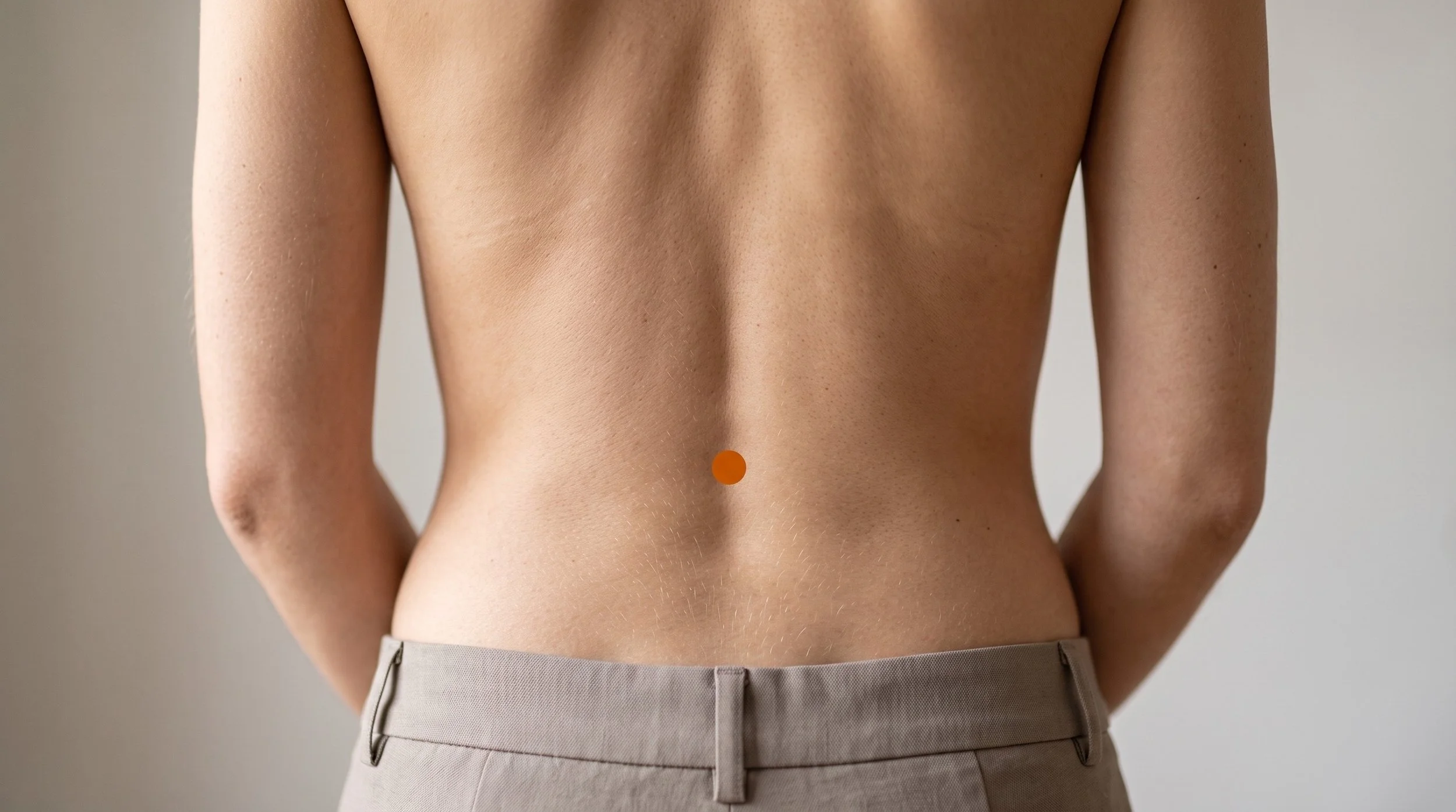
DU4 Acupuncture Point (Mingmen)
The Gate of Life at the Lumbar Spine: Anatomy, Segmental Mechanism, and Why This Midline L2 Point Anchors Low Back and Fatigue Treatment
DU4 (also written GV4), known in Chinese as Mingmen (命門) and usually translated as Gate of Life, is the fourth point of the Governing Vessel and one of the most frequently needled midline points on the lower back. You will find it in the small depression directly below the tip of the second lumbar spinous process, on the same horizontal line as the Kidney back-shu points (BL23) that sit a thumb's width and a half to either side.
That location is the whole story clinically: the DU 4 point sits over the ligamentous midline of a segment that takes enormous mechanical load, in the same neurological neighborhood as the nerves supplying the deep lumbar muscles, facet joints, and upper lumbar sympathetic outflow.
Classically the ming men point was described as the seat of the body's constitutional warmth and vitality, which is why the GV4 acupuncture point shows up in traditional formulas for lumbar pain, exhaustion, and cold sensitivity, and why it remains a workhorse point in modern back pain protocols.
- Location and layers: governing vessel 4 sits on the posterior midline below the L2 spinous process, level with BL23. The needle passes through skin, subcutaneous fat, and the midline raphe of the thoracolumbar fascia into the supraspinous and interspinous ligaments at L2 to L3, with the spinal canal well beyond typical needling depth (Deadman et al., 2009).
- Traditional categories: classical sources list DU4 as a point of the Governing Vessel with attributed actions of clearing heat, regulating the Governing Vessel, tonifying the Kidneys, and benefiting the lumbar spine (Deadman et al., 2009). Read neurophysiologically, those categories describe segmental effects on the lumbar spine and autonomic effects at a level where sympathetic outflow to the lower body originates.
- Mechanism: needling the midline at L2 stimulates deep somatic afferents in ligament and paraspinal tissue that share dorsal horn segments with the facet joints, multifidus, and structures referring pain into the low back, a convergence pattern that helps explain segmental analgesia (Zhao, 2008).
- Research picture: reviews consistently test multi-point lumbar protocols rather than DU4 alone, but Cochrane evidence supports acupuncture for chronic nonspecific low back pain compared with no treatment, with more modest and less certain differences against sham (Mu et al., 2020; Rizzo et al., 2025).
- Point-specific physiology: experimental work using DU4 has reported reduced interleukin-6 and lower disease incidence with moxibustion at this point in an arthritis model (Kogure et al., 2012), and improved locomotor recovery with electroacupuncture at DU14 plus DU4 in a spinal cord injury model (Wang et al., 2016). These are animal studies and do not translate directly to clinical outcomes.
- De qi and practice: patients usually report a deep, dull, spreading heaviness right at the midline, sometimes with a warm band across the lower back rather than a sharp sensation. DU4 is frequently paired with BL23 for lumbar support and with BL40 for low back pain, and it is a common site for moxa or heat in patients who describe their back as cold and tired.
Is Your Low Back Stiff, Achy, and Worse by the End of the Day?
Persistent lumbar stiffness rarely comes from one tissue, which is why we treat the segment rather than a single sore spot. At Morningside Acupuncture, DU4 is often the anchor of a lumbar treatment, combined with BL23, local paraspinal needling, and dry needling of the multifidus and quadratus lumborum when those muscles are involved. We pair the needling with clear guidance on loading, sitting, and sleep positions so the relief holds between visits. Schedule a session and let's map out what is actually driving your back pain.
Schedule NowAnatomy of DU4: Why the L2 to L3 Interspace Is Such an Important Location
DU4 sits on the posterior midline in the hollow just below the tip of the L2 spinous process. Under the skin and a thin layer of subcutaneous fat is the midline seam where the thoracolumbar fascia and the aponeuroses of the paraspinal muscles converge, and immediately beneath that are the supraspinous and interspinous ligaments spanning L2 to L3. This is a mechanically busy zone.
Every time you bend forward, lift, or sit slumped for hours, those midline ligaments and the multifidus fibers bridging adjacent segments take tensile load, and the upper lumbar spine is also where the relatively mobile lumbar segments meet the stiffer thoracolumbar junction above. Patients with chronic lumbar stiffness are often tender exactly here on palpation.
The nerve geography explains why a midline point can influence a broad area of the low back. Sensation and motor supply to the deep paraspinal tissue at this level come from the medial branches of the posterior rami of the lumbar spinal nerves, which also innervate the facet joints and the interspinous ligaments. Because these deep somatic afferents converge on the same dorsal horn segments as other structures in the low back, stimulating them with a needle can modulate how the whole segment processes input, dampening the pooled signal rather than treating one isolated tissue (Zhao, 2008).
Needling also recruits spinal and supraspinal pain control systems, including descending inhibitory pathways from the brainstem, which is part of why sensations of relief often spread beyond the needled spot. The upper lumbar level is additionally where sympathetic outflow toward the lower body arises, which offers a plausible frame for the traditional association between this region and warmth, circulation, and lower body function.
Deeper than the ligaments lies the epidural space and spinal canal, which classical texts place roughly 1.25 to 1.75 cun below the skin surface depending on build (Deadman et al., 2009). Standard needling of DU4 stays well short of that: perpendicular or slightly superior oblique insertion of about 0.5 to 1 cun into the ligamentous midline, with the needle angled to stay between the spinous processes. There are no major vessels at the surface here, and the point is well tolerated in prone position.
Depth should always be adjusted for body size, and needling is modified or avoided over surgical hardware, fusion sites, or areas with broken or inflamed skin. Some classical sources also note a traditional caution against moxibustion at this point in people under twenty years of age.
Related Best Acupuncture Points For Back Pain Related Acupuncture For Low Back PainDU4 (GV4) at a Glance: Classification, Location, and Clinical Use
| Category | Detail |
|---|---|
| Traditional Name | Mingmen (命門), Gate of Life; an alternative classical name is Jinggong, Palace of Essence |
| Channel Classification | Governing Vessel (Du Mai), fourth point of the channel; commonly written DU4 or GV4 |
| Point Categories | Point of the Governing Vessel with no five-shu, hui-meeting, or extraordinary vessel confluent designation. It sits on the midline directly between the paired Kidney back-shu points (BL23), and qigong tradition identifies this region as the Lumbar Pass, one of three gates along the Governing Vessel. |
| Precise Location | On the posterior midline of the lower back, in the depression below the spinous process of the second lumbar vertebra (L2), one interspace above the level of the line joining the tops of the iliac crests |
| Tissue Stimulated | Skin and subcutaneous tissue, the midline thoracolumbar fascia, and the supraspinous and interspinous ligaments at L2 to L3; adjacent deep paraspinal targets include the lumbar multifidus and, laterally, the abdominal obliques as part of the trunk system |
| Needle Depth / Direction | Perpendicular or slightly superior oblique insertion, 0.5 to 1 cun, staying within the interspinous ligament; avoid deep insertion toward the spinal canal, which classical texts place roughly 1.25 to 1.75 cun deep |
| De Qi Sensation | A deep, dull, heavy ache at the midline, often described as pressure or fullness that spreads across the lower back; moxa or heat over the point commonly produces a diffuse warm band rather than a point sensation |
| Primary Clinical Uses | Low back pain, lumbar stiffness and reduced flexion and extension, fatigue and depletion states, and traditionally cold intolerance through the lower back and legs |
| Common Point Combinations |
|
In the classical literature summarized by Deadman and colleagues, DU4 carries attributed actions of clearing heat, regulating the Governing Vessel, tonifying the Kidneys, and benefiting the lumbar spine, and the indication lists cluster into four recognizable groups: fever and heat patterns of the interior, wind patterns affecting the spine and head such as rigidity, headache, and childhood seizure disorders, urogenital and anorectal complaints, and lumbar pain and spinal stiffness (Deadman et al., 2009).
The name itself points to the traditional concept of the ming men as the source of constitutional warmth said to reside between the kidneys, and later authors placed the fire of the Gate of Life at this very spot on the spine (Maciocia, 2005). Later commentators also emphasize its use for exhaustion, weak knees, and cold patterns of the lower body (Cunningham, 2000).
What is genuinely striking is the mismatch Deadman highlights: despite the modern reputation of DU 4 as the great point for warming a depleted constitution, the classical indication lists themselves say relatively little about yang deficiency, and it is the classical point combinations, many of which use moxa, that carry that warming reputation.
Why DU4 Is Used for Fatigue and Cold Sensitivity, Not Just Low Back Pain
The straightforward part is the mechanics. DU4 sits directly over the ligamentous midline at L2 to L3, and the deep afferents there converge in the dorsal horn with input from the facet joints, deep paraspinal muscles, and other structures that refer pain across the low back. When a needle recruits those afferents, the segment as a whole becomes less sensitized, which is why patients often report that a broad band of stiffness eases rather than one pinpoint spot (Zhao, 2008).
This segmental convergence is the same principle that guides local needling anywhere along the spine, and it is why we care about the level, not just the landmark.
The less obvious part is why a lumbar point was traditionally used for tiredness and cold intolerance. Two things are worth saying plainly. First, needling and heat at the spine engage descending inhibitory pathways and produce measurable autonomic shifts, and patients frequently describe a calming, warming, settled feeling after treatment of the lower back that is out of proportion to any local tissue change (Zhao, 2008).
Second, the upper lumbar level is where sympathetic outflow to the pelvis and lower limbs originates, which offers a physiological frame for the traditional link between this region and warmth and circulation in the lower body, without invoking energy flowing through channels.
There is also a small body of point-specific experimental work. Moxibustion applied at the DU4 equivalent in a collagen-induced arthritis mouse model was associated with lower disease incidence and reduced interleukin-6 levels compared with an abdominal control point (Kogure et al., 2012), and electroacupuncture at DU14 with DU4 improved hind limb locomotor scores and altered signaling markers in a rat spinal cord injury model (Wang et al., 2016).
These findings are interesting because they suggest the point is not interchangeable with any nearby location, but they are animal studies with high stimulation doses, and they should be read as mechanistic hints rather than evidence of clinical effect in people.
What the Research Shows for DU4 (GV4)
One note on naming before the evidence: in the research literature this point is almost always listed as GV4, the WHO standard code, so GV4 is the term to search if you want to read the studies below in full.
Very little research isolates a single acupuncture point, and DU4 is no exception. In clinical trials it almost always appears inside a lumbar protocol alongside BL23, BL25, DU3, and local ashi points, so the honest framing is that the evidence supports acupuncture for low back pain as a treatment approach, with DU4 as a commonly chosen component of that approach. The studies below reflect that: broad reviews on the clinical side, and small mechanistic studies on the point-specific side.
| Study | Type | Focus | Key Finding |
|---|---|---|---|
| Mu et al., 2020 | Cochrane systematic review | Acupuncture for chronic nonspecific low back pain (33 trials, 8270 participants) | Moderate-certainty evidence suggested acupuncture improved pain and function compared with no treatment, while differences against sham and usual care were smaller and of lower certainty. |
| Rizzo et al., 2025 | Cochrane overview of reviews | Non-pharmacological and non-surgical treatments for low back pain in adults | Acupuncture was among the non-drug options with supportive evidence for chronic low back pain, though effect sizes across treatments were generally modest. |
| Vickers et al., 2018 | Individual patient data meta-analysis | Acupuncture across chronic pain conditions including chronic low back pain | Acupuncture was associated with better pain outcomes than both sham and no-acupuncture controls, with effects that persisted over twelve months. |
| Kogure et al., 2012 | Animal experimental study | Moxibustion at the DU4 point versus CV12 in a collagen-induced arthritis mouse model | Moxibustion at DU4 was associated with lower arthritis incidence and reduced interleukin-6 levels, suggesting point-specific anti-inflammatory effects in this model. |
| Wang et al., 2016 | Animal experimental study | Electroacupuncture at DU14 and DU4 in a rat spinal cord injury model | Electroacupuncture at these Governing Vessel points improved locomotor scores and altered Wnt signaling markers, though relevance to human treatment remains unclear. |
| Zhao, 2008 | Narrative mechanistic review | Neural mechanisms of acupuncture analgesia | Analgesic effects are attributed to afferent stimulation, segmental spinal modulation, and descending inhibitory control rather than to any single local tissue effect. |
Feeling Run Down With a Back That Never Fully Recovers?
Traditionally, the ming men point was used for people who felt depleted, cold, and heavy through the lower back, and that description still fits a lot of patients we see in Manhattan. We use DU4 with warmth, gentle stimulation, and supportive distal points to help downshift the nervous system while addressing the lumbar tissue itself. Treatments are calm, unhurried, and built around what your body tolerates that day. Book an appointment and see how your back responds to a full treatment plan.
Schedule NowDU4 in the Context of Trigger Point Work
DU4 is a midline ligamentous point, so it is not itself a muscular trigger point, but it sits directly over territory that trigger point work targets constantly. The lumbar multifidus, the deepest layer bridging adjacent vertebrae, lies a few millimeters lateral to the point, and taut bands there commonly produce deep, hard-to-localize lumbar ache.
Slightly further out, the quadratus lumborum and iliocostalis lumborum refer pain into the low back, the iliac crest region, and the buttock, patterns that patients frequently describe as their back pain even though the tender midline is where they point (Simons et al., 1999). Treating only the midline in those cases can help, but it often leaves the muscular drivers untouched.
In practice at Morningside, we tend to use DU4 as the segmental anchor and then work outward. A typical lumbar session might combine DU4 and BL23 on the midline and paraspinal line with dry needling of the multifidus at the symptomatic levels, quadratus lumborum for lateral and crest pain, and gluteus medius or minimus when the referral runs into the hip. Because dry needling is acupuncture performed with an acupuncture needle and a myofascial rationale, the two approaches sit comfortably in the same treatment rather than competing.
The goal is to reduce the segmental sensitivity that DU4 addresses while restoring normal tone and load tolerance in the muscles that keep reproducing it.
DU4 Low Back Pain Treatment at NYC's Highest-Rated Acupuncture Clinic
Morningside Acupuncture is the highest-rated acupuncture and dry needling clinic in New York City with over 500 five-star Google reviews, and lumbar pain is one of the most common reasons patients come through our door. Every visit combines classical point selection like DU4 and BL23 with orthopedic assessment and trigger point dry needling of the muscles that actually generate your symptoms. You get a clear plan, measurable progress, and treatment that respects your time. Schedule your appointment today.
Schedule NowFrequently Asked Questions
Is DU4 the same point as GV4?
Yes. DU4 and GV4 are two codes for the same point, Mingmen. DU comes from Du Mai, the Chinese name of the Governing Vessel, and it is the code used in most Chinese texts and many acupuncture schools. GV is the WHO standard abbreviation and the one you will see in most Western textbooks and research papers. You will also come across it written as Du 4, GV-4, or Governing Vessel 4. Whichever code is used, the location and the uses are the same.
What does DU4 feel like when needled?
Most people feel a deep, dull, spreading heaviness right at the midline of the lower back, sometimes described as pressure, fullness, or a slow ache that broadens outward over a few seconds. Because the needle is going into ligament rather than muscle belly, the sensation tends to be more of a heavy pressure than a twitch. Sharpness is not the goal, and we adjust immediately if you feel anything electric or radiating. Many patients also report a pleasant warmth across the low back, especially when moxa or a heat lamp is used over the point, and it is common to feel noticeably more relaxed while the needles are retained.
Why needle a midline point when my pain is off to one side?
Because pain location and pain source are often different things. The midline at L2 to L3 shares dorsal horn segments with the facet joints, deep paraspinal muscles, and ligaments that refer pain across the whole lower back, so stimulating DU4 modulates the segment rather than one spot (Zhao, 2008). That said, we rarely use it alone. If your pain is clearly one-sided, DU4 usually gets paired with BL23 and local points on the involved side, plus dry needling of the muscles reproducing your symptoms, so you get both segmental and tissue-specific treatment in the same session.
Can I press DU4 myself between sessions?
Yes, and it is one of the easier points to self-treat because you can reach it. Find the top of your hip bones on both sides, imagine a line between them, and move up one interspace along the spine; the small dip below the bony bump at that level is roughly DU4. Use your thumb or knuckle, press straight into the midline with steady moderate pressure, and hold for 30 to 60 seconds while breathing slowly, repeating two or three times for a total of two to three minutes. Pressure should feel like a satisfying deep ache and never sharp. A heating pad over the same area for 10 to 15 minutes is often more comfortable than pressure for people with stiff, cold-feeling backs, and gentle mobility work afterward tends to make the effect last longer. Stop if pressure increases your pain or produces any tingling into the legs.
Is DU4 safe to needle?
In trained hands it is a routine and well-tolerated point. The main anatomical consideration is depth: the spinal canal lies roughly 1.25 to 1.75 cun below the surface depending on body build, so needling stays shallow at about 0.5 to 1 cun within the interspinous ligament and is angled to remain between the spinous processes (Deadman et al., 2009). Practitioners adjust depth for body size and avoid the area over surgical hardware, fusion sites, recent injections, skin infections, or open wounds. Anyone on anticoagulants or with a known spinal condition should mention it before treatment. Some classical texts also recorded a caution against moxibustion here in people under twenty, a historical note we mention for completeness.
Where exactly is DU4 located?
DU4 is on the posterior midline of the lower back, in the depression immediately below the spinous process of the second lumbar vertebra. The standard landmark is the line connecting the highest points of the two iliac crests, which sits at the level of the lower border of L3; DU4 is one interspace above that line. It is also level with the Kidney back-shu points (BL23), which sit 1.5 cun lateral on either side, so if you can locate BL23 you can locate DU4 by tracking straight to the midline.
References
- Deadman, P., Al-Khafaji, M., & Baker, K. (2009). A manual of acupuncture. Journal of Chinese Medicine Publications.
- Maciocia, G. (2005). The foundations of Chinese medicine: A comprehensive text for acupuncturists and herbalists (2nd ed.). Elsevier Churchill Livingstone.
- Cunningham, P. M. (2000). Acupuncture points: A practical guide to classical and modern usage. Odyssey Press.
- Maciocia, G. (2006). The channels of acupuncture: Clinical use of the secondary channels and eight extraordinary vessels. Churchill Livingstone Elsevier.
- Simons, D. G., Travell, J. G., & Simons, L. S. (1999). Travell & Simons' myofascial pain and dysfunction: The trigger point manual, Vol. 1: Upper half of body (2nd ed.). Williams & Wilkins.
- Mu, J., Furlan, A. D., Lam, W. Y., Hsu, M. Y., Ning, Z., & Lao, L. (2020). Acupuncture for chronic nonspecific low back pain. Cochrane Database of Systematic Reviews, 2020(12), CD013814. https://doi.org/10.1002/14651858.CD013814
- Rizzo, R. R. N., Cashin, A. G., Wand, B. M., Ferraro, M. C., Sharma, S., Lee, H., O'Hagan, E., Maher, C. G., Furlan, A. D., van Tulder, M. W., & McAuley, J. H. (2025). Non-pharmacological and non-surgical treatments for low back pain in adults: An overview of Cochrane reviews. Cochrane Database of Systematic Reviews, 2025(3), CD014691. https://doi.org/10.1002/14651858.CD014691.pub2
- Vickers, A. J., Vertosick, E. A., Lewith, G., MacPherson, H., Foster, N. E., Sherman, K. J., Irnich, D., Witt, C. M., & Linde, K. (2018). Acupuncture for chronic pain: Update of an individual patient data meta-analysis. Journal of Pain, 19(5), 455-474. https://doi.org/10.1016/j.jpain.2017.11.005
- Zhao, Z. Q. (2008). Neural mechanism underlying acupuncture analgesia. Progress in Neurobiology, 85(4), 355-375. https://doi.org/10.1016/j.pneurobio.2008.05.004
- Kogure, M., Mimura, N., Ikemoto, H., Ishikawa, S., Nakanishi-Ueda, T., Sunagawa, M., & Hisamitsu, T. (2012). Moxibustion at mingmen reduces inflammation and decreases IL-6 in a collagen-induced arthritis mouse model. Journal of Acupuncture and Meridian Studies, 5(1), 29-33. https://doi.org/10.1016/j.jams.2011.11.004
- Wang, X., Shi, S. H., Yao, H. J., Jing, Q. K., Mo, Y. P., Lv, W., Song, L. Y., Yuan, X. C., Li, Z. G., & Qin, L. N. (2016). Electroacupuncture at Dazhui (GV14) and Mingmen (GV4) protects against spinal cord injury: The role of the Wnt/beta-catenin signaling pathway. Neural Regeneration Research, 11(12), 2004-2011. https://doi.org/10.4103/1673-5374.197145
Disclaimer: This web site is intended for educational and informational purposes only. Reading this website does not constitute providing medical advice or any professional services. This information should not be used for diagnosing or treating any health issue or disease. Those seeking medical advice should consult with a licensed physician. Seek the advice of a medical doctor or other qualified health professional for any medical condition. If you think you have a medical emergency, call 911 or go to the emergency room. No acupuncturist-patient relationship is created by reading this website or using the information. Morningside Acupuncture PLLC and its employees and contributors do not make any express or implied representations with respect to the information on this site or its use. For any legal interpretation of scope of practice in your state, consult a licensed attorney or regulatory authority.
Read more from our blog



