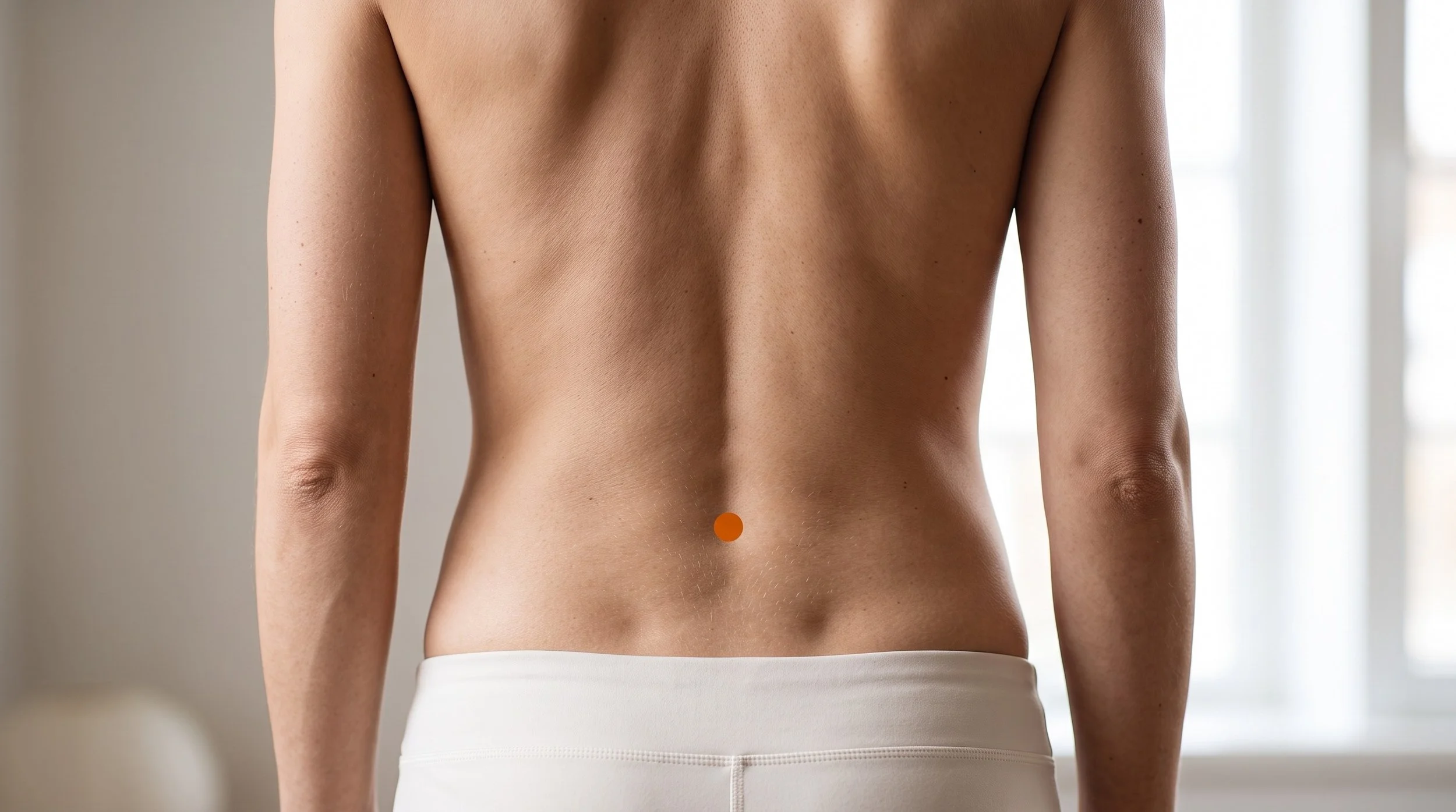
DU3 Acupuncture Point (Yaoyangguan)
The Lumbar Yang Gate at the L4-L5 Interspace: Anatomy, Mechanism, and Why This Midline Point Anchors Low Back and Leg Treatment
DU3 (Yaoyangguan, "Lumbar Yang Gate"), also written GV3, sits on the midline of the lower back, in the small depression just below the spinous process of the fourth lumbar vertebra, one interspace below the line drawn between the highest points of the iliac crests. It is the third point of the Governing Vessel, and in classical texts it belongs to a small group of midline lumbar points used when back pain and leg symptoms travel together.
Modern clinicians reach for the GV3 acupuncture point for much the same reason: it lands directly over the L4-L5 interspinous tissues, the segment that takes the most load when you bend forward, and it sits at the spinal level whose nerve roots supply the very leg territory patients tend to point to.
- DU3 is located on the posterior midline below the L4 spinous process, in the L4-L5 interspace, level with or just below the intercristal line. The needle passes through skin, thoracolumbar fascia, and the supraspinous and interspinous ligaments before reaching the interlaminar space (Deadman et al., 2009; O'Connor & Bensky, 1981).
- Classical sources describe Yaoyangguan as dispelling wind-damp, benefiting the lumbar region and legs, and regulating the lower burner, with later texts adding that it tonifies yang and strengthens the low back and knees (Deadman et al., 2009; Kim, 2008). Translated into physiology, these traditional attributions describe a segmental point used for mechanical lumbar pain, referred leg symptoms, and locally warming, circulation-oriented treatment.
- The medial branch of the dorsal ramus of the lumbar spinal nerve supplies this region, and the same segmental levels carry afferents from the facet joints, disc, and paraspinal muscles, which gives a neurophysiological account of why a midline lumbar point may influence pain felt in the buttock and leg (Zhao, 2008).
- Needling at painful spinal segments engages both spinal gating and descending inhibitory pathways through the periaqueductal gray and rostral ventromedial medulla, mechanisms that have been mapped in detail in acupuncture analgesia research (Zhao, 2008). A neuroimaging protocol built specifically around heat-sensitive moxibustion at DU3 targets these same pain-processing regions (Yang et al., 2023).
- The research picture for the conditions DU3 is used for is reasonably encouraging but not settled: Cochrane found moderate-certainty evidence for pain and function gains versus no treatment in chronic nonspecific low back pain (Mu et al., 2020), while a large sham-controlled trial reported benefit in chronic sciatica from disc herniation (Tu et al., 2024).
- De qi at DU3 is usually a dull, heavy, slightly spreading pressure across the low back rather than a sharp sensation, and it should never produce an electric shock down the leg. Depth is conservative because the spinal canal lies roughly 1.25 to 1.75 cun below the skin depending on build (Deadman et al., 2009).
Low Back Pain That Runs Into Your Leg?
When back pain and leg symptoms show up together, we treat both ends of the problem in the same visit. At Morningside Acupuncture, DU3 is often the midline anchor of a lumbar treatment, combined with segmental points beside the spine and distal points on the leg. We pair that with dry needling of the paraspinal and hip muscles that keep the segment irritable. Book a visit and let's map out where your pain is actually coming from.
Schedule NowAnatomy of DU3: Why the L4-L5 Interspace Is Such an Important Location
Find the top of both iliac crests and draw an imaginary line between them, then drop one interspace below that line and settle into the small midline dip: that is Yaoyangguan. Under your fingertip is skin and subcutaneous tissue, then the posterior layer of the thoracolumbar fascia, then the supraspinous ligament bridging the tips of L4 and L5, and beneath that the interspinous ligament filling the gap between the two spinous processes (O'Connor & Bensky, 1981).
This is a mechanically busy piece of tissue. Lumbar flexion opens the interspinous gap and tensions these ligaments, extension compresses the adjacent facet joints, and the multifidus fibers attaching along the spinous processes work constantly to control both. The classical name, which reads as a lumbar gate or hinge, is a fair description of what the region actually does.
The nerve supply here comes from the medial branches of the dorsal rami of the lumbar spinal nerves, the same small branches that innervate the facet joint capsules and the deep paraspinal muscles (O'Connor & Bensky, 1981). That shared innervation matters clinically. Afferent input from ligament, joint, muscle, and skin converges on the same dorsal horn neurons at these segments, which is why deep lumbar pain is so often felt as a broad, poorly localized band rather than a pinpoint, and why stimulating the surface at the right segment can modulate what those neurons are doing.
Needling produces afferent traffic that engages segmental inhibition locally and recruits descending pain-modulating pathways from the brainstem, mechanisms reviewed extensively in the acupuncture analgesia literature (Zhao, 2008). DU3 sits at L4-L5, the level whose roots contribute to the lower leg and foot, which is the neurophysiological version of the classical claim that this point treats the lumbar region and the legs together.
Deep to the interspinous ligament lies the ligamentum flavum and then the spinal canal, and classical texts put that canal roughly 1.25 to 1.75 cun beneath the skin, varying with body build (Deadman et al., 2009). For that reason the standard technique is a perpendicular insertion of about 0.5 to 1 cun, kept well short of the canal, in a patient positioned prone or side-lying with the practitioner clear about the bony landmarks above and below.
The local vasculature consists of posterior branches of the lumbar arteries and veins along with the vertebral venous plexus, so the region is well perfused but has no large vessel at risk at conventional depths (O'Connor & Bensky, 1981). Moxibustion is traditionally applied here, sometimes over ginger, and warming techniques remain a common adjunct in cold, stiff, chronically aching lower backs (Cunningham, 2000).
Related Acupuncture For Low Back Pain Related Best Acupuncture Points For Back PainDU3 (GV3) at a Glance: Classification, Location, and Clinical Use
| Category | Detail |
|---|---|
| Traditional Name | Yaoyangguan (Lumbar Yang Gate), also translated as lumbar yang joint or lumbar hinge |
| Channel Classification | Governing Vessel 3 (DU3), the third point of the Governing Vessel on the posterior midline (also called the Du Mai or Du channel) |
| Point Categories | Governing Vessel point of the lower lumbar spine. The classical sources consulted list no five-shu, hui-meeting, or extraordinary vessel intersection designation for this point; Deadman and colleagues instead single it out functionally as one of the principal points on the back itself for combined lumbar and lower limb disorders. |
| Precise Location | On the posterior midline of the lower back, in the depression below the spinous process of the fourth lumbar vertebra (the L4-L5 interspace), one intervertebral space below the line joining the highest points of the iliac crests, level with BL25 |
| Tissue Stimulated | Skin and subcutaneous tissue, thoracolumbar fascia, supraspinous and interspinous ligaments at L4-L5, with adjacent multifidus and erector spinae fibers commonly addressed in the same treatment (see Muscles That Cause Low Back Pain) |
| Needle Depth / Direction | Perpendicular insertion 0.5 to 1 cun. The spinal canal lies approximately 1.25 to 1.75 cun deep depending on build, so depth is kept conservative and angulation stays midline. Moxibustion, including warm needle and ginger moxa, is traditionally applied. |
| De Qi Sensation | A dull, heavy, pressing ache that spreads across the lower back and sometimes toward the buttock or sacrum. Radiating electrical sensation down the leg is not the goal and signals that the needle should be withdrawn and redirected. |
| Primary Clinical Uses | Low back pain with or without leg involvement, lumbar stiffness and pain on bending forward, sciatica-type leg pain and numbness, knee pain with difficulty bending and straightening, and, in classical listings, lower burner complaints including menstrual irregularity and seminal emission |
| Common Point Combinations |
|
Deadman and colleagues frame Yaoyangguan primarily as a point for disorders that straddle the low back and the legs, and they describe it as one of the main points located on the back itself that treats lower limb problems.
Its traditional actions are given as dispelling wind-damp, benefiting the lumbar region and legs, and regulating the lower burner, and the classical indication lists cluster into three groups: knee complaints with restricted bending and straightening plus pain along the outer knee; leg symptoms described as numbness, sinew contraction, painful obstruction, and inability to walk, along with lumbar and groin pain from overwork; and lower burner complaints such as seminal emission, impotence, abnormal discharge, and irregular menstruation.
Other texts add a warming, cold-dispelling emphasis and note that the name itself points at the hinge of the low back, recommending the point where pain arrives on bending forward (Cunningham, 2000; Kim, 2008; O'Connor & Bensky, 1981).
What is striking about the classical pattern is how modern it reads: a single L4-L5 midline point credited with both mechanical lumbar pain and symptoms running down the leg, which is precisely the segmental relationship anatomy would predict.
Why DU3 Is Used for Leg and Knee Symptoms, Not Just the Low Back
Patients are often surprised that a point on the spine gets used for pain felt in the buttock, thigh, calf, or knee. The explanation is segmental. The tissues under DU3 and the nerve roots exiting at L4 and L5 feed into the same spinal cord segments that receive sensory input from the leg, and those dorsal horn neurons pool signals from skin, muscle, joint, and ligament. When that pooling becomes sensitized, the brain's read on where the problem lives gets blurry, so a facet joint or disc irritation at L4-L5 can be experienced as a leg problem.
Needling at the relevant segment provides competing afferent input into the same circuitry, which is one of the better characterized components of acupuncture analgesia (Zhao, 2008).
The second layer is central. Needle stimulation recruits descending inhibitory control from the periaqueductal gray and rostral ventromedial medulla, along with endogenous opioid and monoaminergic mechanisms that dampen transmission at the dorsal horn (Zhao, 2008). This part of the response is not limited to the segment being needled, which helps explain why lumbar treatment often eases symptoms further down the limb than the needles reach.
Investigators have specifically chosen DU3 to study these central effects: a neuroimaging protocol examining heat-sensitive moxibustion at Yaoyangguan in lumbar disc herniation and myofascial pain patients targeted sensory cortex, insula, periaqueductal gray, and anterior cingulate as regions of interest (Yang et al., 2023). That study is a protocol rather than a finished result, so it tells us where the field is looking rather than what it has proven.
There is also a practical, mechanical reason clinicians keep returning to this DU 3 low back point. Treating the midline at the hinge segment tends to reduce guarding in the deep multifidus and erector spinae, and patients frequently report that bending feels less apprehensive afterward. Better tolerated flexion means better tolerated loading and exercise, which is where durable improvement in back pain usually comes from.
What the Research Shows for DU3 (GV3)
One note on naming before the evidence: in the research literature this point is almost always listed as GV3, the WHO standard code, so GV3 is the term to search if you want to read the studies below in full.
A fair caution before the evidence: almost no clinical trial tests DU3 by itself. Reviews evaluate multi-point protocols in which Yaoyangguan appears alongside points like BL23, BL25, BL40, GB30, and the huatuojiaji points, so the evidence below speaks to acupuncture for low back pain and sciatica as delivered in practice rather than to the specific contribution of this one location. Trial quality in this literature is uneven, effect sizes vary with the comparison used, and sham-controlled differences are typically smaller than differences versus no treatment. Read the table as support for the treatment approach that includes DU3, not as proof about the point.
| Study | Type | Focus | Key Finding |
|---|---|---|---|
| Mu et al., 2020 | Cochrane systematic review (33 studies, 8,270 participants) | Acupuncture for chronic nonspecific low back pain | Moderate-certainty evidence suggested clinically important pain relief and improved back function immediately after a course of treatment compared with no treatment, with smaller and less certain effects versus usual care. |
| Tu et al., 2024 | Multicenter randomized sham-controlled trial (216 participants) | Acupuncture for chronic sciatica from lumbar disc herniation | Ten sessions over four weeks produced greater reductions in leg pain and disability than sham acupuncture, with differences reported as persisting through 52 weeks. |
| Zhang et al., 2023 | Systematic review and meta-analysis of randomized trials | Acupuncture therapy for sciatica | Pooled results favored acupuncture for pain intensity and pain threshold outcomes, though the authors flagged methodological limitations across the included trials. |
| Vickers et al., 2018 | Individual patient data meta-analysis (about 20,800 patients) | Acupuncture for chronic pain including musculoskeletal pain | Acupuncture outperformed both sham and no-acupuncture controls, with effects that persisted over time rather than dissipating immediately after treatment ended. |
| Yang et al., 2023 | Observational neuroimaging study protocol | Heat-sensitive moxibustion at DU3 in lumbar disc herniation and myofascial pain syndrome | Designed to examine changes in pain-related brain networks after stimulation at Yaoyangguan; a protocol paper, so it establishes method and rationale rather than outcomes. |
Stiff Bending, Aching Standing, Trouble Getting Up From a Chair?
The L4-L5 interspace under DU3 is exactly where lumbar flexion concentrates load, which is why bending-related pain is such a common reason patients end up needing this point. Our treatments combine Yaoyangguan with neighboring Governing Vessel and bladder channel points, gentle heat when appropriate, and targeted needling of the muscles limiting your motion. Most patients get a clear plan within the first two sessions. Schedule an appointment to get started.
Schedule NowDU3 in the Context of Trigger Point Work
Acupuncture, in the sense we use the word, means treatment with an acupuncture needle, and that umbrella covers hundreds of styles including dry needling. In a typical low back session, DU3 gives us the midline segmental input at L4-L5, and from there we work laterally into the muscles that are actually generating the guarding. Multifidus and the deep rotators sit within a fingerbreadth of the point, and the lumbar iliocostalis and longissimus run just lateral to them.
Quadratus lumborum, gluteus medius, and gluteus minimus are frequent partners in this pattern, and referral maps from the trigger point literature show gluteus minimus in particular projecting pain down the lateral or posterior leg in a distribution patients and clinicians often assume is nerve root pain (Simons et al., 1999).
The overlap is useful rather than accidental. Because DU3 sits on tissue innervated by the medial branch of the dorsal ramus, and because that branch also supplies the deep paraspinals, needling the point and needling the adjacent muscle bands both feed the same segmental circuitry. We tend to sequence it as midline first, then paraspinal and gluteal targets, then reassess flexion and single-leg stance before adding any distal points.
If the leg symptoms are largely myofascial, the muscle work usually changes the picture within a session or two; if they are radicular, the response is slower and we adjust the plan and imaging conversation accordingly.
DU3 Low Back and Sciatica Treatment at NYC's Highest-Rated Acupuncture Clinic
Morningside Acupuncture is the highest-rated acupuncture and dry needling clinic in New York City with over 500 five-star Google reviews, and low back pain is one of the conditions we see most. We use DU3 as part of a structured lumbar protocol that blends classical point selection with orthopedic assessment and myofascial needling. Treatment is evidence-informed, clearly explained, and paced to your response rather than a fixed script. Schedule your session and let's get your back moving again.
Schedule NowFrequently Asked Questions
Is DU3 the same point as GV3?
Yes. DU3 and GV3 are two codes for the same point, Yaoyangguan. DU comes from Du Mai, the Chinese name of the Governing Vessel, and it is the code used in most Chinese texts and many acupuncture schools. GV is the WHO standard abbreviation and the one you will see in most Western textbooks and research papers. You will also come across it written as Du 3, GV-3, or Governing Vessel 3. Whichever code is used, the location and the uses are the same.
What does DU3 feel like when needled?
Most people feel a dull, heavy, slightly expanding pressure right in the middle of the low back, sometimes with a warm or spreading quality that reaches toward the sacrum or the top of the buttock. That sensation is de qi, and it typically settles within a few seconds of the needle being placed. It should not feel like an electric shock traveling down a leg. If that happens, tell your practitioner immediately so the needle can be withdrawn and repositioned. Many patients also report a pleasant heaviness or drowsiness during the retention period, which reflects the shift toward parasympathetic tone that often accompanies treatment.
Why treat the spine at DU3 when my pain is in my leg?
Because the leg symptoms and the spinal segment usually share circuitry. The tissues beneath DU3 sit at the L4-L5 level, and afferents from those tissues converge in the dorsal horn with input from the same nerve roots that supply the buttock, thigh, calf, and foot. When that convergence becomes sensitized, pain gets referred outward and feels like a leg problem even when the driver is segmental. Needling the involved segment gives the nervous system competing input and engages descending inhibition from the brainstem (Zhao, 2008). Classical texts arrived at a similar conclusion by observation, describing Yaoyangguan as a back point for combined lumbar and leg disorders (Deadman et al., 2009). In practice we usually treat both ends, midline plus distal leg points, rather than choosing one.
Can I press DU3 myself between sessions?
Yes, and it is one of the easier points to reach. Stand or sit upright, run your thumbs along the top edges of your hip bones and follow that line to the midline of your spine, then move down about one vertebral space until you find the small dip between two bony bumps. Press straight in with a thumb or knuckle using firm, steady pressure at roughly a 6 or 7 out of 10 intensity, hold for 30 to 60 seconds, release, and repeat two or three times. Two to three rounds a day is plenty. A tennis ball against a wall or a warm pack over the area for 10 to 15 minutes works well as an alternative, particularly if your back feels stiff and cold rather than hot and inflamed. Stop if pressure sharpens the pain or produces any tingling into the leg, and pair the pressure with gentle movement rather than using it as a substitute for moving.
Is DU3 safe to needle?
In trained hands, yes. The main consideration is depth: the spinal canal lies roughly 1.25 to 1.75 cun beneath the skin depending on body build, so practitioners keep insertion in the 0.5 to 1 cun range and stay perpendicular on the midline (Deadman et al., 2009). Extra caution applies to people with prior lumbar surgery, spinal hardware, spina bifida occulta, significant osteoporosis, active infection or skin breakdown over the area, or anticoagulant use, and any new bowel or bladder changes, saddle numbness, or progressive leg weakness warrants urgent medical assessment rather than acupuncture. Mild soreness or a small bruise at the site is the most common side effect and typically fades within a day or two.
Where exactly is DU3 located?
On the posterior midline of the lower back, in the depression below the spinous process of the fourth lumbar vertebra, which is the L4-L5 interspace. The usual landmark is the line joining the highest points of the two iliac crests: DU3 sits one intervertebral space below that line. It is level with BL25, the Large Intestine back shu points, which lie 1.5 cun to either side. Locating it is easiest lying face down with a pillow under the abdomen, which slightly opens the interspinous gap and makes the depression easier to feel.
References
- Deadman, P., Al-Khafaji, M., & Baker, K. (2009). A manual of acupuncture. Journal of Chinese Medicine Publications.
- O'Connor, J., & Bensky, D. (Eds. & Trans.). (1981). Acupuncture: A comprehensive text. Shanghai College of Traditional Medicine. Eastland Press.
- Kim, H. (2008). Handbook of Oriental medicine (3rd ed.). Harmony & Balance Press.
- Cunningham, P. M. (2000). Acupuncture points: A practical guide to classical and modern usage. Odyssey Press.
- Simons, D. G., Travell, J. G., & Simons, L. S. (1999). Travell & Simons' myofascial pain and dysfunction: The trigger point manual, Vol. 1: Upper half of body (2nd ed.). Williams & Wilkins.
- Mu, J., Furlan, A. D., Lam, W. Y., Hsu, M. Y., Ning, Z., & Lao, L. (2020). Acupuncture for chronic nonspecific low back pain. Cochrane Database of Systematic Reviews, 2020(12), CD013814. https://doi.org/10.1002/14651858.CD013814
- Tu, J. F., Shi, G. X., Yan, S. Y., Ni, G. X., Yu, F. T., Cai, G. W., Liu, Z. S., Ma, C. Y., Wang, L. Q., Yang, J. W., Zhou, X. Q., Meng, X. L., Fu, H. Y., Li, J., Wan, W. J., Sun, T. H., Wang, X. Z., & Liu, C. Z. (2024). Acupuncture vs sham acupuncture for chronic sciatica from herniated disk: A randomized clinical trial. JAMA Internal Medicine, 184(12), 1417-1424. https://doi.org/10.1001/jamainternmed.2024.5463
- Zhang, Z., Hu, T., Huang, P., Yang, M., Huang, Z., Xia, Y., Zhang, X., Zhang, X., & Ni, G. (2023). The efficacy and safety of acupuncture therapy for sciatica: A systematic review and meta-analysis of randomized controlled trials. Frontiers in Neuroscience, 17, 1097830. https://doi.org/10.3389/fnins.2023.1097830
- Yang, J., Xiong, J., Xu, S., Xie, H., & Xiang, J. (2023). Effect and cerebral mechanism of moxibustion at heat-sensitized Yaoyangguan (GV3) in patients with lumbar disc herniation and myofascial pain syndrome by resting-state functionality magnetic resonance imaging: Protocol for an observational study. Journal of Traditional Chinese Medicine, 43(1), 175-180. https://doi.org/10.19852/j.cnki.jtcm.20221006.002
- Vickers, A. J., Vertosick, E. A., Lewith, G., MacPherson, H., Foster, N. E., Sherman, K. J., Irnich, D., Witt, C. M., & Linde, K. (2018). Acupuncture for chronic pain: Update of an individual patient data meta-analysis. Journal of Pain, 19(5), 455-474. https://doi.org/10.1016/j.jpain.2017.11.005
- Zhao, Z. Q. (2008). Neural mechanism underlying acupuncture analgesia. Progress in Neurobiology, 85(4), 355-375. https://doi.org/10.1016/j.pneurobio.2008.05.004
Disclaimer: This web site is intended for educational and informational purposes only. Reading this website does not constitute providing medical advice or any professional services. This information should not be used for diagnosing or treating any health issue or disease. Those seeking medical advice should consult with a licensed physician. Seek the advice of a medical doctor or other qualified health professional for any medical condition. If you think you have a medical emergency, call 911 or go to the emergency room. No acupuncturist-patient relationship is created by reading this website or using the information. Morningside Acupuncture PLLC and its employees and contributors do not make any express or implied representations with respect to the information on this site or its use. For any legal interpretation of scope of practice in your state, consult a licensed attorney or regulatory authority.
Read more from our blog



