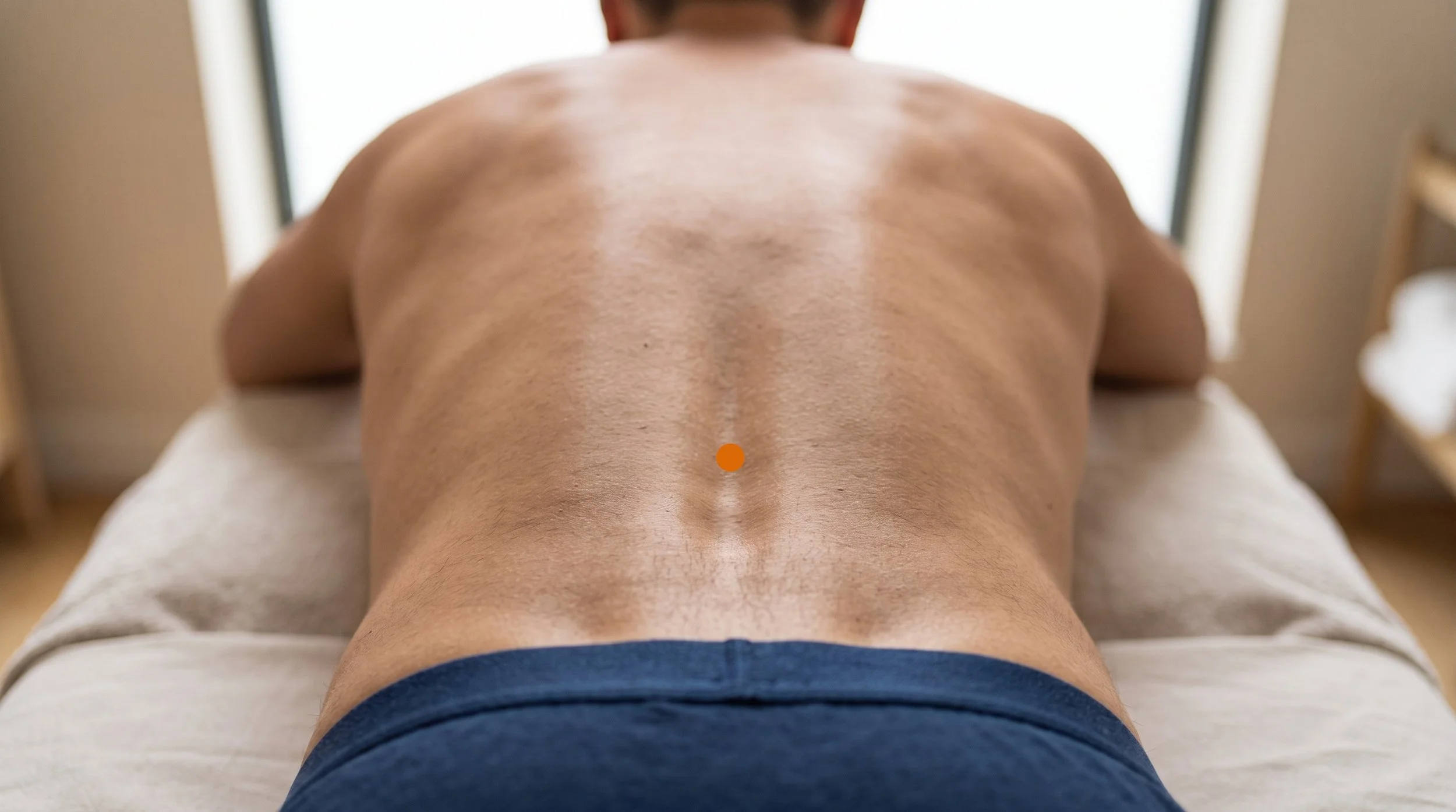
DU5 Acupuncture Point (Xuanshu)
The Suspended Pivot Below the First Lumbar Vertebra: Anatomy, Mechanism, and Why This Thoracolumbar Junction Point Bridges Low Back Stiffness and Digestive Complaints
DU5 (Xuanshu), also written GV5, the fifth point of the Governing Vessel, sits on the midline of the lower back in the small depression just below the spinous process of the first lumbar vertebra, level with BL22 on either side. The name is usually translated as Suspended Pivot, and the anatomy earns it: this is the hinge zone where the rib cage and the relatively stiff thoracic spine hand off motion to the mobile lumbar spine.
Classical texts grouped its uses into two apparently unrelated families, stiff and painful upper lumbar spine on one hand and loose stools, undigested food, and lower abdominal complaints on the other. Modern segmental anatomy makes that pairing far less strange, because the T12 and L1 nerves that supply this level also project to the flank, groin, and abdominal wall, and the same spinal segments carry sympathetic outflow toward the gut.
- Location and layers: the GV5 acupuncture point lies in the interspinous depression below L1, and a needle passes through skin, subcutaneous fat, the supraspinous and interspinous ligaments, and the thoracolumbar fascia, with deep multifidus fibers immediately lateral. Because the spinal canal lies roughly 1.25 to 1.75 cun deep depending on build, shallow perpendicular insertion of 0.5 to 1 cun is the standard convention described in A Manual of Acupuncture.
- Traditional attributions: classical sources credit DU5 with benefiting the lumbar spine and the lower burner, and later commentaries add strengthening of the Spleen and Stomach and support of the Kidneys and bones. Read neurophysiologically, those categories describe a point positioned to influence both the upper lumbar motion segment and the T12 to L2 autonomic outflow to abdominal viscera (Uchida et al., 2017).
- Nerve story: needling here stimulates the medial branches of the dorsal rami at the thoracolumbar junction, a region long recognized as a source of referred low back, flank, iliac crest, and groin pain that patients rarely localize to the level itself (Randhawa et al., 2022).
- Research picture: no trial has isolated Xuanshu on its own, but Cochrane work supports acupuncture for chronic nonspecific low back pain compared with sham and no treatment, with modest and variable certainty (Mu et al., 2020), and a 2025 Cochrane overview positions acupuncture among the better supported nonsurgical options (Rizzo et al., 2025).
- Clinical framing: at Morningside we use DU 5 back needling as a segmental anchor for upper lumbar stiffness, thoracolumbar junction pain, and pain that wraps toward the flank, usually alongside distal points and dry needling of the surrounding muscles rather than as a standalone treatment (Vickers et al., 2018).
- De qi: most patients report a deep, dull, slightly heavy ache directly under the needle that may spread as a band across the lower back, sometimes with a brief pressure sensation traveling toward one flank, which is consistent with A delta and C fiber recruitment described in analgesia research (Zhao, 2008).
Stiff Upper Back and Low Back That Won't Bend or Extend?
If bending forward, arching back, or twisting catches right where the ribs meet the low back, the thoracolumbar junction is often the culprit rather than the lower lumbar spine. At Morningside Acupuncture we treat DU5 alongside the paraspinal muscles, quadratus lumborum, and the deep multifidus at that level, then reassess your motion in the same visit. Treatment may reduce guarding and improve comfortable range, and we pair it with simple home mobility work. Schedule a visit and we'll map the level that is actually driving your symptoms.
Schedule NowAnatomy of DU5: Why the L1 to L2 Interspace Is Such an Important Location
DU5 sits in the midline gap below the L1 spinous process, two intervertebral spaces above the line joining the tops of the iliac crests. The tissue stack under the fingertip is thin and ligamentous: skin, subcutaneous fat, the supraspinous ligament, the interspinous ligament, and the posterior layer of thoracolumbar fascia, with the medial slips of multifidus and the longissimus column just lateral. This is a mechanically demanding spot.
The thoracic facets favor rotation while the lumbar facets favor flexion and extension, so the junction absorbs a change in movement strategy every time you bend, lift, or twist, and repetitive rotational or postural load tends to concentrate here.
The nerves that matter at this level are the dorsal rami of T12 and L1 and their medial branches, which innervate the facet joints, the interspinous ligaments, and the paraspinal muscles, and whose cutaneous branches travel outward toward the iliac crest, flank, and buttock. Irritation at this junction is well described as a cause of low back, hip, and groin pain that the patient never localizes to the junction itself (Randhawa et al., 2022).
Needling into this segment activates small diameter afferents that converge in the dorsal horn with input from those same territories, which is the standard explanation for why local stimulation may reduce more distant referred pain, and for how descending inhibitory pathways from the brainstem are recruited (Zhao, 2008). A small case series of patients diagnosed with thoracolumbar junction syndrome reported improvement in low back symptoms after acupuncture directed at the T11 to L2 region, though uncontrolled reports like this can only be considered preliminary (Lee et al., 2023).
Depth discipline is the whole safety conversation at this point. The vertebral canal generally lies about 1.25 to 1.75 cun beneath the skin surface depending on body build, so the conventional 0.5 to 1 cun perpendicular insertion keeps the needle in ligament and fascia well short of neural structures; some texts prefer a slightly oblique upward angle into the interspinous ligament. Practitioners avoid deep or forceful insertion, take extra care in slim patients, and screen for spinal instrumentation, recent fracture, infection, or local skin problems before needling the midline.
Moxibustion is traditionally applied here, and gentle warming is often more comfortable than aggressive stimulation for patients with cold, achy upper lumbar pain.
Related Governing Vessel Related Acupuncture For Low Back PainDU5 (GV5) at a Glance: Classification, Location, and Clinical Use
| Category | Detail |
|---|---|
| Traditional Name | Xuanshu (Suspended Pivot, also translated Suspended Axis) |
| Channel Classification | Governing Vessel, point 5 (DU5), a midline back point of the Du Mai |
| Point Categories | Governing vessel point below the spinous process of the first lumbar vertebra. The classical texts consulted list no five-shu, luo-connecting, hui-meeting, or extraordinary vessel intersection status for this point; its identity comes from its level, directly medial to the Triple Burner back-shu point BL22. |
| Precise Location | On the midline of the lower back, in the depression below the spinous process of L1, two intervertebral spaces above the line connecting the highest points of the iliac crests, level with BL22. |
| Tissue Stimulated | Skin, supraspinous and interspinous ligaments, posterior thoracolumbar fascia, and the medial fibers of multifidus and erector spinae at the T12 to L2 segments; symptom overlap is common with the abdominal obliques trigger points that share this segmental supply. |
| Needle Depth / Direction | Perpendicular insertion 0.5 to 1 cun, or slightly oblique into the interspinous ligament. Caution: the spinal canal lies roughly 1.25 to 1.75 cun deep, varying with build, so deep insertion is avoided. Moxibustion is traditionally applicable. |
| De Qi Sensation | A deep, dull, heavy ache at the midline that often spreads as a band across the lower back, occasionally with brief pressure traveling toward one flank. Sharp or electric sensation is not the goal and means the needle should be adjusted. |
| Primary Clinical Uses | Upper lumbar and thoracolumbar junction stiffness with difficulty bending and straightening, low back pain that refers toward the flank or iliac crest, and traditionally listed digestive complaints including diarrhea and undigested food in the stool. |
| Common Point Combinations |
|
A Manual of Acupuncture assigns DU5 two traditional actions, benefiting the lumbar spine and benefiting the lower burner, and its indication list divides cleanly along those lines. On the structural side it names stiffness of the lumbar spine with an inability to flex or extend. On the internal side it lists undigested food in the stool, diarrhea, running piglet qi, shan disorder, and retraction of the testicles, all understood here as traditional attributions rather than modern diagnoses.
Other classical compilations add abdominal pain and distension, dysentery, prolapsed anus, and hemorrhoids, and the Cunningham text frames the point as a transition between the middle and lower burners as well as a mechanical pivot. What makes the pattern striking is that a purely midline back point below L1 was consistently applied to complaints of the lower abdomen, bowel, and genitals, which is precisely the referral territory of the T12 and L1 nerves that emerge at that level.
Why DU5 Is Used for Digestive Complaints and Groin or Flank Pain That Seem Unrelated to the Back
The simplest explanation is segmental. Sensory fibers from the skin, muscle, ligaments, and facet joints at T12 to L2 converge in the same dorsal horn neurons that receive input from the abdominal wall, flank, groin, and parts of the gut. When one input becomes persistently noisy, the shared circuitry can make pain feel like it belongs somewhere else entirely, which is why upper lumbar dysfunction is a documented and frequently missed source of low back, iliac crest, and groin symptoms (Randhawa et al., 2022). Needling into that same segment gives the nervous system a strong, competing, non-threatening input at the level where the confusion is happening.
The second layer is autonomic. Preganglionic sympathetic outflow to abdominal organs leaves the cord at roughly T5 to L2, so a needle placed in the T12 to L1 segment sits in the same neurological neighborhood as the pathways that regulate gut motility and secretion. Experimental work on somatoautonomic reflexes shows that stimulating skin and muscle can measurably alter visceral function through spinal and supraspinal reflex arcs, with the direction of the effect depending partly on where the stimulus is applied (Uchida et al., 2017).
That does not mean needling DU5 fixes digestion, but it does offer a plausible reason why traditional sources kept listing diarrhea and undigested food beside lumbar stiffness.
Finally, there is the general analgesia story. Acupuncture stimulation recruits descending inhibitory pathways involving the periaqueductal gray and rostral ventromedial medulla, along with endogenous opioid and monoaminergic mechanisms, which helps explain effects that extend beyond the needled segment (Zhao, 2008). Individual patient data from chronic pain trials suggest the benefits are modest but real and not explained entirely by placebo response, and that they persist reasonably well after a course of treatment ends (Vickers et al., 2018).
What the Research Shows for DU5 (GV5)
One note on naming before the evidence: in the research literature this point is almost always listed as GV5, the WHO standard code, so GV5 is the term to search if you want to read the studies below in full.
There is no clinical trial that tests Xuanshu on its own, and it would be misleading to suggest otherwise. Like nearly every point in this series, DU5 appears inside multi-point protocols, so the honest way to read the evidence is to ask whether the treatments that commonly include upper lumbar midline and back-shu points help the conditions we use them for. For low back pain the answer is a qualified yes, with moderate certainty in some comparisons and low certainty in others. For digestive complaints the literature is more heterogeneous, and study quality varies widely.
| Study | Type | Focus | Key Finding |
|---|---|---|---|
| Mu et al., 2020 | Cochrane systematic review | Acupuncture for chronic nonspecific low back pain, 33 trials | Acupuncture improved pain and function compared with no treatment and showed small effects against sham, with certainty of evidence ranging from moderate to very low. |
| Rizzo et al., 2025 | Cochrane overview of reviews | Non-pharmacological and non-surgical treatments for adult low back pain | Acupuncture emerged as one of the better supported non-drug options for chronic low back pain, though effect sizes remain modest. |
| Vickers et al., 2018 | Individual patient data meta-analysis | Acupuncture across chronic pain conditions including back and neck pain | Effects were superior to both sham and usual care and persisted over 12 months, suggesting benefit is not solely a placebo response. |
| Randhawa et al., 2022 | Narrative review | Thoracolumbar junction (Maigne) syndrome as a cause of low back pain | Dysfunction at the T12 to L2 segments, the level of DU5, is described as a treatable but frequently overlooked source of back, hip, and groin pain. |
| Lee et al., 2023 | Case series | Acupuncture targeting the T11 to L2 region in six patients with thoracolumbar junction syndrome | All patients reported improvement in low back symptoms, but the uncontrolled design means this is hypothesis-generating only. |
| Uchida et al., 2017 | Physiological review | Somatoautonomic reflexes underlying acupuncture effects on visceral function | Somatic stimulation can reflexively modulate visceral activity through spinal and supraspinal pathways, offering a mechanism for segmental points near the gut's autonomic outflow. |
| Yang et al., 2022 | Systematic review and meta-analysis | Acupuncture and moxibustion for irritable bowel syndrome | Pooled results favored acupuncture and moxibustion for symptom response, though methodological limitations across trials temper confidence. |
Low Back Pain With Flank, Groin, or Digestive Symptoms?
Pain that runs toward the flank or groin, or back stiffness that shows up alongside loose stools and abdominal bloating, often points to the same upper lumbar segments. Xuanshu acupuncture gives us direct access to those levels, and we combine it with points on the abdomen and lower leg that studies suggest may influence gut motility. Our licensed acupuncturists screen carefully first so that nothing medical is missed. Book an evaluation and we'll build a plan around your specific pattern.
Schedule NowDU5 in the Context of Trigger Point Work
Dry needling is acupuncture performed with an acupuncture needle toward a myofascial target, and the thoracolumbar junction is a place where the two approaches overlap almost completely. When we needle governing vessel 5 we are already in the interspinous and fascial tissue that the deep multifidus attaches around, and the muscles we most often treat in the same session sit immediately lateral or in the same segmental band: multifidus and longissimus at T12 to L2, the deep and superficial layers of quadratus lumborum, iliocostalis lumborum, and psoas when hip flexion reproduces the pain.
Trigger points in these muscles refer into the lower back, along the iliac crest, and into the buttock, patterns that can be difficult to distinguish from dorsal ramus referral without careful examination (Simons et al., 1999).
The abdominal wall deserves attention too. Trigger points in the external and internal obliques share segmental innervation with this region and can refer pain into the flank, groin, and lower abdomen, and they sometimes produce belching, bloating, or a sense of visceral discomfort that mimics gut pathology (Simons et al., 1999).
In practice, a session for upper lumbar pain with flank or groin symptoms might combine a shallow DU5 insertion, bilateral BL22, segmental multifidus needling, and dry needling of quadratus lumborum and the obliques, followed by movement retraining for rotation and extension at the junction. Any patient with new abdominal symptoms, fever, unexplained weight loss, or bowel changes is referred for medical evaluation first.
DU5 Low Back Pain Treatment at NYC's Highest-Rated Acupuncture Clinic
Morningside Acupuncture is the highest-rated acupuncture and dry needling clinic in New York City with over 500 five-star Google reviews, and low back pain is one of the most common reasons patients come to see us. We combine governing vessel 5 needling with trigger point dry needling, cupping, and movement guidance in a single focused session. Everything is done with sterile single-use needles by licensed practitioners trained in both traditional and orthopedic styles. Schedule your appointment and let's get your back moving again.
Schedule NowFrequently Asked Questions
Is DU5 the same point as GV5?
Yes. DU5 and GV5 are two codes for the same point, Xuanshu. DU comes from Du Mai, the Chinese name of the Governing Vessel, and it is the code used in most Chinese texts and many acupuncture schools. GV is the WHO standard abbreviation and the one you will see in most Western textbooks and research papers. You will also come across it written as Du 5, GV-5, or Governing Vessel 5. Whichever code is used, the location and the uses are the same.
What does DU5 feel like when needled?
Most people describe a deep, dull, heavy ache right at the midline that spreads sideways across the lower back like a band. Some feel a brief pressure or fullness traveling toward one flank, and some feel almost nothing beyond the initial tap of insertion, which is normal and does not mean the treatment is failing. Because the point sits in ligament rather than bulky muscle, the sensation is often more of a pressure than a twitch. Sharp, burning, or electric feelings are not part of a good response and should be reported immediately so the needle can be adjusted or removed.
Why needle the upper lumbar spine when my pain is lower down, in my hip, or in my groin?
Because the pain generator and the painful area are often not the same place. The dorsal rami of T12 and L1 send cutaneous branches out toward the iliac crest, buttock, flank, and groin, so dysfunction at this junction can produce symptoms several inches away from the actual level, and patients typically feel nothing at the junction itself (Randhawa et al., 2022). Needling at the segment where the input originates targets the dorsal horn neurons that receive both the local and the referred input. It is also why we examine the thoracolumbar junction in anyone with stubborn low back, hip, or groin pain that has not responded to treatment aimed lower down.
Can I press DU5 myself between sessions?
Yes, and it's easy to find on yourself. Reach behind your back and locate the top of your hip bones on both sides; the spinous process at that level is roughly L4, and DU5 is about three spinous processes higher, in the small dip below the L1 spine. Using your thumb or a knuckle, press straight in with steady, moderate pressure for 30 to 60 seconds, breathing slowly, then release and repeat two or three times, once or twice a day. A tennis ball or a firm massage ball against a wall works well if you can't reach comfortably, but keep the ball just off midline on the muscle rather than directly on the bone. Pressure should feel like a satisfying ache, never sharp, and pairing it with gentle cat and camel motion or a supported extension stretch usually gives more benefit than pressing alone. Stop if you notice any numbness, tingling, or radiating leg symptoms and check in with your clinician.
Is DU5 safe to needle?
In trained hands it is a routine and well tolerated point, but it does require respect for depth. The vertebral canal lies roughly 1.25 to 1.75 cun below the skin at this level depending on body build, so practitioners keep insertion in the 0.5 to 1 cun range and avoid deep or forceful technique, particularly in slim patients. We also screen for spinal hardware, recent fracture or trauma, osteoporosis, local infection or skin breakdown, and bleeding disorders or anticoagulant use before needling the midline. Single-use sterile needles are standard, and the most common side effects across the body are minor: brief soreness, a small bruise, or a short-lived heavy feeling.
Where exactly is DU5 located?
DU5 lies on the midline of the lower back in the depression immediately below the spinous process of the first lumbar vertebra. A reliable way to find it is to draw an imaginary line across the highest points of both iliac crests, which crosses at the lower border of L3, then count up two intervertebral spaces. It is level with BL22, the Triple Burner back-shu point, which sits 1.5 cun to either side. DU4 (Mingmen) is one space below at L2, and DU6 is above at the T11 level, so DU5 marks the transition zone between the rib cage and the mobile lumbar spine.
References
- Deadman, P., Al-Khafaji, M., & Baker, K. (2009). A manual of acupuncture. Journal of Chinese Medicine Publications.
- Cunningham, P. M. (2000). Acupuncture points: A practical guide to classical and modern usage. Odyssey Press.
- O'Connor, J., & Bensky, D. (Eds. & Trans.). (1981). Acupuncture: A comprehensive text. Shanghai College of Traditional Medicine. Eastland Press.
- Kim, H. (2008). Handbook of Oriental medicine (3rd ed.). Harmony & Balance Press.
- Simons, D. G., Travell, J. G., & Simons, L. S. (1999). Travell & Simons' myofascial pain and dysfunction: The trigger point manual, Vol. 1: Upper half of body (2nd ed.). Williams & Wilkins.
- Mu, J., Furlan, A. D., Lam, W. Y., Hsu, M. Y., Ning, Z., & Lao, L. (2020). Acupuncture for chronic nonspecific low back pain. Cochrane Database of Systematic Reviews, 2020(12), CD013814. https://doi.org/10.1002/14651858.CD013814
- Rizzo, R. R. N., Cashin, A. G., Wand, B. M., Ferraro, M. C., Sharma, S., Lee, H., O'Hagan, E., Maher, C. G., Furlan, A. D., van Tulder, M. W., & McAuley, J. H. (2025). Non-pharmacological and non-surgical treatments for low back pain in adults: An overview of Cochrane reviews. Cochrane Database of Systematic Reviews, 2025(3), CD014691. https://doi.org/10.1002/14651858.CD014691.pub2
- Vickers, A. J., Vertosick, E. A., Lewith, G., MacPherson, H., Foster, N. E., Sherman, K. J., Irnich, D., Witt, C. M., & Linde, K. (2018). Acupuncture for chronic pain: Update of an individual patient data meta-analysis. Journal of Pain, 19(5), 455-474. https://doi.org/10.1016/j.jpain.2017.11.005
- Zhao, Z. Q. (2008). Neural mechanism underlying acupuncture analgesia. Progress in Neurobiology, 85(4), 355-375. https://doi.org/10.1016/j.pneurobio.2008.05.004
- Uchida, S., Kagitani, F., & Sato-Suzuki, I. (2017). Somatoautonomic reflexes in acupuncture therapy: A review. Autonomic Neuroscience, 203, 1-8. https://doi.org/10.1016/j.autneu.2016.11.001
- Randhawa, S., Garvin, G., Roth, M., Wozniak, A., & Miller, T. (2022). Maigne syndrome: A potentially treatable yet underdiagnosed cause of low back pain: A review. Journal of Back and Musculoskeletal Rehabilitation, 35(1), 153-159. https://doi.org/10.3233/BMR-200297
- Lee, H., Chae, H., Ryu, M., Yang, C., & Kim, S. (2023). Acupuncture for patients with Maigne's syndrome: A case series. Medicine (Baltimore), 102(23), e33999. https://doi.org/10.1097/MD.0000000000033999
- Yang, Y., Rao, K., Zhan, K., Shen, M., Zheng, H., Qin, S., Wu, H., Bian, Z., & Huang, S. (2022). Clinical evidence of acupuncture and moxibustion for irritable bowel syndrome: A systematic review and meta-analysis of randomized controlled trials. Frontiers in Public Health, 10, 1022145. https://doi.org/10.3389/fpubh.2022.1022145
Disclaimer: This web site is intended for educational and informational purposes only. Reading this website does not constitute providing medical advice or any professional services. This information should not be used for diagnosing or treating any health issue or disease. Those seeking medical advice should consult with a licensed physician. Seek the advice of a medical doctor or other qualified health professional for any medical condition. If you think you have a medical emergency, call 911 or go to the emergency room. No acupuncturist-patient relationship is created by reading this website or using the information. Morningside Acupuncture PLLC and its employees and contributors do not make any express or implied representations with respect to the information on this site or its use. For any legal interpretation of scope of practice in your state, consult a licensed attorney or regulatory authority.
Read more from our blog



