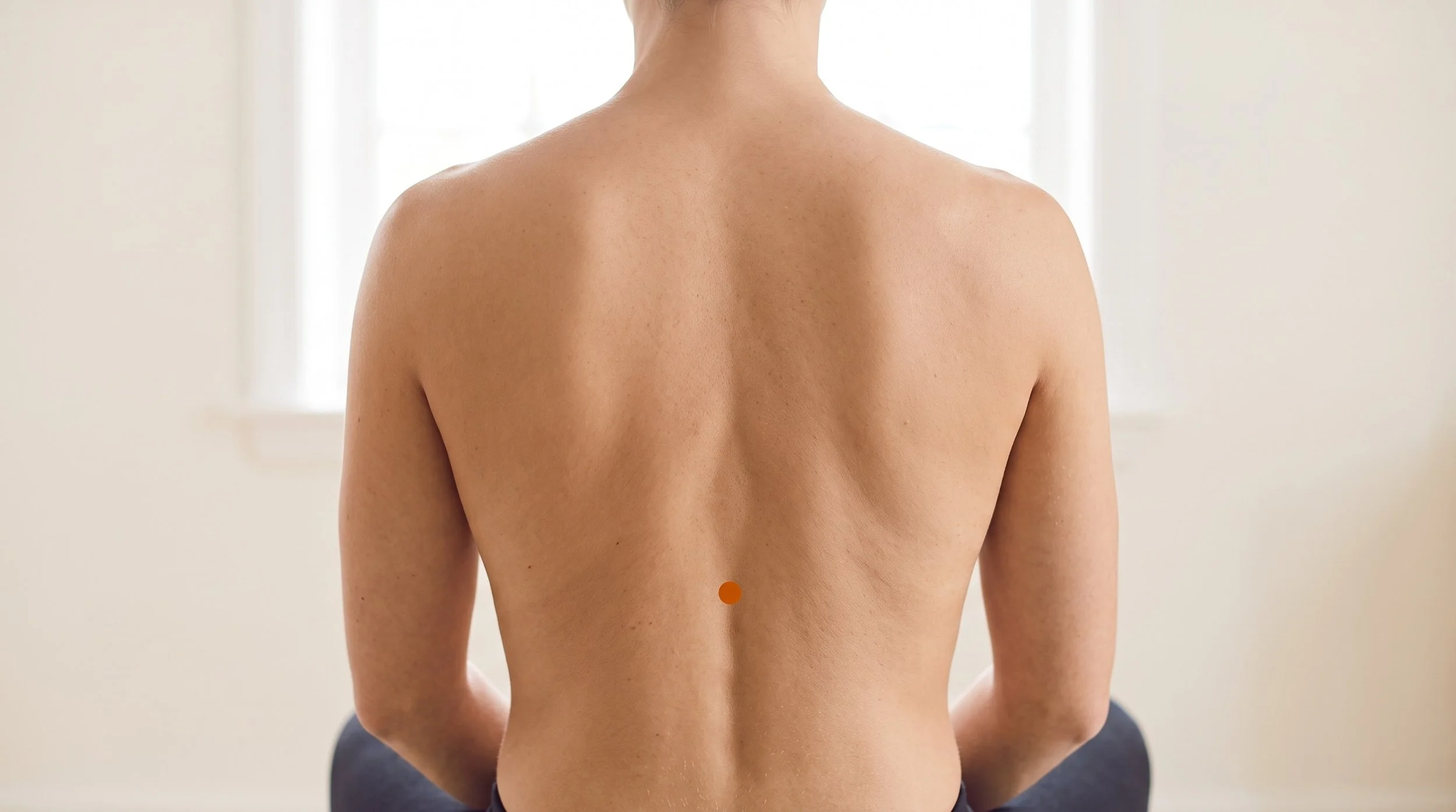
DU7 Acupuncture Point (Zhongshu)
The Central Pivot Below the Tenth Thoracic Vertebra: Anatomy, Segmental Mechanism, and Why This Mid-Spine Point Bridges Back Pain and Digestive Complaints
DU7 (Zhongshu, often translated as Central Pivot or Middle Axis), also written GV7, sits on the midline of the back, in the small depression just below the spinous process of the tenth thoracic vertebra. Put plainly, it is the notch you can feel between two bumps of the spine at the level where the lower ribs begin to give way to the flexible thoracolumbar junction, and it lines up horizontally with BL19, the Gallbladder back-shu points.
The name is a good description of the anatomy: this is a hinge zone where a relatively stiff rib cage meets a mobile lumbar spine, and it is a segment that patients frequently describe as tight, achy, or stuck after long hours at a desk.
Classical texts credit Zhongshu with benefiting the spine and the middle burner, and in modern practice the GV7 acupuncture point is used mainly for mid-back and lumbar pain, often alongside dry needling of the paraspinal muscles that load this exact level.
- Location and layers: DU7 lies on the posterior midline in the depression below the T10 spinous process, five intervertebral spaces above the line joining the highest points of the iliac crests, and level with the Gallbladder back-shu points at BL19 (Deadman et al., 2009). The needle passes through skin, thoracolumbar fascia, and the supraspinous and interspinous ligaments rather than through bulky muscle.
- Traditional categories, translated: the Governing Vessel classification and the classical actions of benefiting the spine and the middle burner are traditional attributions, and they map neatly onto a modern picture of segmental input at a spinal level that shares innervation with the upper abdominal viscera (Deadman et al., 2009; Uchida et al., 2017).
- Mechanism: needling here stimulates the medial branches of the T10 and T11 dorsal rami and the deep segmental tissues they supply, generating dorsal horn input that may reduce local nociceptive sensitivity and recruit descending pain modulation from the brainstem (Zhao, 2008). Segmental somato-autonomic reflexes at thoracic levels have also been shown to influence gut motility and visceral blood flow in animal work (Uchida et al., 2017).
- The research picture: no trial has tested DU7 in isolation, so its support is indirect. Cochrane work on chronic nonspecific low back pain found benefit over no treatment with moderate certainty evidence, while comparisons with sham and usual care were less certain (Mu et al., 2020), and a 2025 Cochrane overview placed acupuncture among the non-drug options with supportive evidence (Rizzo et al., 2025).
- Clinical framing: DU7 is a supporting midline point rather than a headline point. It is usually combined with adjacent Governing Vessel points, with the back-shu points at the same level, and with distal points, which is consistent with individual patient data showing acupuncture effects for chronic musculoskeletal pain that persist beyond the treatment course (Vickers et al., 2018).
- De qi: patients typically report a deep, dull, spreading heaviness or pressure at the spine that may fan sideways toward the lower ribs. Sharp or electric sensation is not the goal here, and needling is kept shallow and angled because the spinal canal lies roughly 1.25 to 1.75 cun deep depending on build (Deadman et al., 2009).
Stuck, Aching Mid Back That Never Quite Loosens Up?
The thoracolumbar junction takes a beating from desk work, lifting, and long commutes, and it often stays tight long after the original strain has settled. At Morningside Acupuncture we use DU7 with neighboring spine points and targeted dry needling of the thoracolumbar erector spinae and multifidus to reduce guarding and restore comfortable rotation and extension. Treatment is paired with simple movement advice so gains hold between visits. Schedule a session and let's map out what your mid back actually needs.
Schedule NowAnatomy of DU7: Why the Depression Below the Tenth Thoracic Vertebra Is Such an Important Location
DU7 sits directly on the posterior midline in the gap below the T10 spinous process, between T10 and T11 (Deadman et al., 2009). From the surface inward, a needle here passes through thin skin and subcutaneous tissue, then the posterior layer of thoracolumbar fascia, then the supraspinous ligament, and then the interspinous ligament running between the two spinous processes. Just to either side sit the deep segmental stabilizers, multifidus and rotatores, with the longissimus and iliocostalis columns further lateral.
This is a transition zone: the ribs above limit rotation and side bending, while the vertebrae below allow much more of it, so shear and repetitive rotational load tend to concentrate right here in lifting, golf, tennis, and long static sitting.
The tissues at DU7 are supplied by the medial branches of the dorsal rami of the tenth and eleventh thoracic spinal nerves, the same nerves that innervate the local facet joints, interspinous ligament, and multifidus. Because ligament, joint, muscle, and skin afferents from a segment converge on shared dorsal horn neurons, stimulating this point delivers concentrated input to the very segment that is generating symptoms, which is the basis for segmental needling in modern practice (Zhao, 2008).
That same convergence explains why deep spinal structures often refer pain in a broad, poorly localized band rather than a crisp point, and why patients may feel needling sensation spread toward the flank. T10 and T11 are also the levels that contribute to the lesser splanchnic nerve, which is one reason segmental input at this height has been studied for its effects on upper abdominal autonomic function (Uchida et al., 2017).
The safety consideration at DU7 is depth rather than the lung, since the point is midline and the pleura is well lateral. The spinal canal lies roughly 1.25 to 1.75 cun deep to the skin, varying with body build, so the standard convention is a perpendicular-oblique insertion angled superiorly to a depth of 0.5 to 1 cun, staying within the ligamentous layer (Deadman et al., 2009). Practitioners advance slowly, respect any change in tissue resistance, and adjust depth for slim patients.
Deadman also notes that the Illustrated Supplement to the Classic of Categories treated this point as contraindicated to moxibustion, a caution some clinicians still observe.
Related Best Acupuncture Points For Back Pain Related Acupuncture For Low Back PainDU7 (GV7) at a Glance: Classification, Location, and Clinical Use
| Category | Detail |
|---|---|
| Traditional Name | Zhongshu (Central Pivot, also translated as Middle Axis or Middle Pivot) |
| Channel Classification | Governing Vessel, point 7 (Du 7), on the posterior midline of the mid back (also called the Du Mai or Du channel) |
| Point Categories | No five-shu, hui-meeting, or extraordinary vessel crossing designations are recorded for this point in the reference sources. It is classified simply as a Governing Vessel point below the tenth thoracic vertebra, positioned level with BL19, the Gallbladder back-shu points. |
| Precise Location | On the midline of the back, in the depression below the spinous process of the tenth thoracic vertebra. It lies five intervertebral spaces above the line connecting the highest points of the iliac crests (that line is level with the lower border of L3). |
| Tissue Stimulated | Skin, posterior thoracolumbar fascia, supraspinous and interspinous ligaments between T10 and T11, with adjacent multifidus and rotatores as nearby dry needling targets |
| Needle Depth / Direction | Perpendicular-oblique insertion angled superiorly, 0.5 to 1 cun. The spinal canal lies approximately 1.25 to 1.75 cun deep depending on build, so depth is kept conservative. One classical source lists the point as contraindicated to moxibustion. |
| De Qi Sensation | A deep, dull heaviness or pressure at the spine, sometimes spreading laterally toward the lower ribs or downward along the back. Sharp, electric, or radiating sensation is not sought and prompts the practitioner to withdraw and redirect. |
| Primary Clinical Uses | Pain and stiffness of the mid back and lumbar region, thoracolumbar junction tension, and traditionally abdominal fullness with poor appetite. Classical lists also include jaundice and amenorrhea, which are historical attributions rather than modern indications. |
| Common Point Combinations |
|
In Deadman, Al-Khafaji and Baker's A Manual of Acupuncture, Zhongshu DU7 is given two traditional actions, benefiting the spine and benefiting the middle jiao, and a short indication list that pairs pain of the lumbar region and back with abdominal fullness, absence of appetite, jaundice, and amenorrhea. These are traditional attributions from the classical record, not modern clinical claims.
What stands out is how compact the record is: unlike its better known neighbors, Zhongshu carries no meeting-point status and no elaborate classical commentary, yet its indication list quietly spans two very different territories, the spine itself and the digestive middle. The text also preserves a practical caution, noting that the Illustrated Supplement to the Classic of Categories lists the point as contraindicated to moxibustion, and a useful measuring instruction placing it five interspaces above the iliac crest line.
The striking part of the pattern is its internal logic: a point named Central Pivot, located at the mechanical hinge of the trunk and at the segmental level feeding the upper abdominal organs, was assigned exactly the back and belly indications that anatomy would predict.
Why DU7 Is Used for Digestive Complaints as Well as Mid-Back Pain
The bridge between a spine point and a belly symptom is segmental convergence. Sensory fibers from skin, ligament, facet joint, and deep muscle at the T10 and T11 levels feed into the same dorsal horn neurons that receive input from upper abdominal structures traveling along splanchnic pathways. When several sources converge on shared neurons, the brain cannot always tell them apart, which is why visceral irritation can present as a stubborn band of mid-back tightness and why needling that band may change how the whole segment behaves (Zhao, 2008).
Traditional texts described this as benefiting the middle burner; a neurophysiological reading describes it as concentrated segmental input at the level where trunk mechanics and upper abdominal innervation overlap.
Animal research on somato-autonomic reflexes adds a second layer. Stimulating body wall tissues produces measurable, segmentally organized changes in autonomic outflow, including effects on gastrointestinal motility and regional blood flow, with trunk stimulation and limb stimulation tending to act through different pathways (Uchida et al., 2017). These findings are laboratory work, not clinical proof, and they do not show that needling DU7 will fix a digestive problem.
They do help explain why practitioners across many styles pair mid-back segmental points with distal points, and why an appetite or fullness complaint might improve alongside back symptoms in the same course of care.
On the pain side, needling appears to work through more than local tissue effects. Sustained stimulation recruits descending inhibitory pathways from the periaqueductal gray and rostral ventromedial medulla and engages endogenous opioid and monoamine systems, which may raise pain thresholds well beyond the needled segment (Zhao, 2008). That combination of segmental and system-wide effects is a reasonable model for why a small midline point at T10 can contribute to relief across the whole thoracolumbar region.
What the Research Shows for DU7 (GV7)
One note on naming before the evidence: in the research literature this point is almost always listed as GV7, the WHO standard code, so GV7 is the term to search if you want to read the studies below in full.
It is worth being direct about the evidence: there are no randomized trials isolating DU7, and there probably never will be. Acupuncture research tests multi-point protocols, so what we can say is that protocols for chronic low back pain and for functional digestive complaints, of the kind that often include mid-back Governing Vessel and back-shu points, have been evaluated with mixed but broadly supportive results.
Certainty varies by comparator, effect sizes over sham are modest, and the studies below should be read as context for how DU7 is used within a larger treatment rather than as evidence for the point itself.
| Study | Type | Focus | Key Finding |
|---|---|---|---|
| Mu et al., 2020 | Cochrane systematic review | Acupuncture for chronic nonspecific low back pain, 33 trials with over 8,000 participants | Moderate-certainty evidence suggested acupuncture improved pain compared with no treatment, while comparisons with sham and usual care produced smaller, less certain differences. |
| Rizzo et al., 2025 | Cochrane overview of reviews | Non-pharmacological and non-surgical treatments for low back pain in adults | Acupuncture was among the non-drug approaches with supportive evidence for chronic low back pain, though the overview emphasized variable certainty across comparisons. |
| Vickers et al., 2018 | Individual patient data meta-analysis | Chronic musculoskeletal, headache, and osteoarthritis pain, roughly 20,000 patients | Acupuncture was superior to both sham and no-acupuncture controls, with effects that appeared to persist over about a year rather than fading immediately. |
| Li et al., 2026 | Systematic review and meta-analysis | Acupuncture for functional dyspepsia, 23 randomized trials | Compared with sham, acupuncture probably improved dyspepsia symptoms and quality of life without an increase in adverse events, on moderate to high certainty evidence. |
| Uchida et al., 2017 | Narrative review of experimental studies | Somato-autonomic reflexes evoked by acupuncture-like stimulation | Body-wall stimulation produced segmentally organized autonomic responses in animal models, offering a plausible mechanism for visceral effects of trunk points. |
| Zhao, 2008 | Mechanistic review | Neural mechanisms of acupuncture analgesia | Analgesic effects were attributed to segmental dorsal horn modulation plus descending inhibition involving endogenous opioid and monoamine systems. |
Back Pain and Digestive Complaints Showing Up Together?
Patients often notice that a tight mid back and a sluggish, full, no appetite stomach travel as a pair, which is exactly the pattern classical texts assigned to Zhongshu. Our licensed acupuncturists combine DU7 with back-shu points at the same level and distal points such as ST36 to address both the musculoskeletal and the autonomic side of the picture. We also screen for red flags and refer out when something needs medical workup. Book an evaluation and we'll build a plan around your specific presentation.
Schedule NowDU7 in the Context of Trigger Point Work
Because DU7 sits in ligament rather than muscle, we rarely treat it alone for mechanical mid-back pain. At Morningside, Zhongshu acupuncture at the midline is typically combined with dry needling of the muscles that actually load the T10 to T11 segment: the thoracolumbar erector spinae (longissimus and iliocostalis thoracis), the deep multifidus and rotatores just off the midline, quadratus lumborum, and sometimes the lower fibers of latissimus dorsi.
Trigger points in the thoracolumbar erector spinae and in rectus abdominis are documented sources of pain referred into the mid back and flank, so a patient pointing at the DU 7 spine level may have drivers a segment or two away, or even on the front of the trunk (Simons et al., 1999).
Practically, that means the exam comes first. We palpate segment by segment for taut bands, reproduce the patient's familiar pain, and check rotation and extension before and after needling. Governing Vessel 7 then serves as the midline anchor for the segment while dry needling addresses the specific taut bands, an approach consistent with how modern trials deliver acupuncture and dry needling for chronic low back pain (Mu et al., 2020).
Dry needling and acupuncture are not separate medicines here: both use an acupuncture needle, and we choose targets based on what the tissue exam shows rather than on style labels.
DU7 Mid-Back and Low Back Pain Treatment at NYC's Highest-Rated Acupuncture Clinic
Morningside Acupuncture is the highest-rated acupuncture and dry needling clinic in New York City with over 500 five-star Google reviews, and mid-back and low back pain is one of the most common reasons people walk through our door. Every session blends classical point selection, including Governing Vessel points such as DU7, with orthopedic assessment and trigger point dry needling. You get clear reasoning, careful needling, and a treatment plan with defined checkpoints. Schedule your first visit today.
Schedule NowFrequently Asked Questions
Is DU7 the same point as GV7?
Yes. DU7 and GV7 are two codes for the same point, Zhongshu. DU comes from Du Mai, the Chinese name of the Governing Vessel, and it is the code used in most Chinese texts and many acupuncture schools. GV is the WHO standard abbreviation and the one you will see in most Western textbooks and research papers. You will also come across it written as Du 7, GV-7, or Governing Vessel 7. Whichever code is used, the location and the uses are the same.
What does DU7 feel like when needled?
Most people feel a deep, dull ache or a sense of pressure and heaviness right at the spine, sometimes spreading a few inches sideways toward the lower ribs or downward along the back. That heavy, spreading quality is what practitioners call de qi. It usually settles within seconds and often gives way to a warm, released feeling in the surrounding muscles. Sharp, burning, or electric sensations are not expected, and you should tell your practitioner immediately if you feel one so the needle can be adjusted.
Why needle a mid-back point when my pain is lower down, or when my complaint is digestive?
Two reasons. First, the thoracolumbar junction is where a stiff rib cage meets a mobile lumbar spine, so restriction at T10 to T11 commonly shifts load into the lower back, and treating the pivot can change how the region below behaves. Second, the T10 and T11 levels share segmental nerve territory with upper abdominal structures, which is why input at this height has been studied for autonomic effects on gut function (Uchida et al., 2017). Classical texts arrived at a similar pairing by describing DU7 as benefiting both the spine and the middle burner, which is a traditional attribution rather than a modern diagnosis.
Can I press DU7 myself between sessions?
Yes, acupressure at this point is low risk. Find the bony bumps down the center of your back, locate the notch between the two spinous processes at roughly the level of the lowest ribs, and press with a thumb, knuckle, or the back of a firm chair. Use steady, moderate pressure for 30 to 60 seconds, release, and repeat two or three times, breathing slowly. A tennis or lacrosse ball against a wall works well if you cannot reach comfortably: lean into the paraspinal area just beside the midline, hold for about a minute, and avoid pressing directly and forcefully on the spinous processes themselves. Twice a day is plenty. Stop if pressure sharpens the pain, causes any radiating or electric sensation, or leaves lasting soreness.
Is DU7 safe to needle?
In trained hands, yes. The main consideration is depth rather than the lung, since DU7 is midline and the pleura sits well to either side. The spinal canal lies roughly 1.25 to 1.75 cun deep depending on body build, so the standard technique is a shallow, superiorly angled insertion of 0.5 to 1 cun that stays in the ligamentous layer (Deadman et al., 2009). One classical source also lists the point as contraindicated to moxibustion. Expected side effects are minor and short lived: brief soreness or a small bruise. It should not be needled through inflamed or broken skin, and anyone with spinal hardware, a known spinal instability, recent spinal surgery, or a bleeding disorder should tell their practitioner beforehand.
Where exactly is DU7 located?
On the midline of the back, in the depression immediately below the spinous process of the tenth thoracic vertebra, between T10 and T11 (Deadman et al., 2009). The reliable way to find it is to draw an imaginary line between the highest points of both iliac crests, which crosses the spine at the lower border of L3, then count upward five intervertebral spaces. It sits level with BL19, the Gallbladder back-shu points, about 1.5 cun to either side, and one space below DU8.
References
- Deadman, P., Al-Khafaji, M., & Baker, K. (2009). A manual of acupuncture. Journal of Chinese Medicine Publications.
- Simons, D. G., Travell, J. G., & Simons, L. S. (1999). Travell & Simons' myofascial pain and dysfunction: The trigger point manual, Vol. 1: Upper half of body (2nd ed.). Williams & Wilkins.
- Mu, J., Furlan, A. D., Lam, W. Y., Hsu, M. Y., Ning, Z., & Lao, L. (2020). Acupuncture for chronic nonspecific low back pain. Cochrane Database of Systematic Reviews, 2020(12), CD013814. https://doi.org/10.1002/14651858.CD013814
- Rizzo, R. R. N., Cashin, A. G., Wand, B. M., Ferraro, M. C., Sharma, S., Lee, H., O'Hagan, E., Maher, C. G., Furlan, A. D., van Tulder, M. W., & McAuley, J. H. (2025). Non-pharmacological and non-surgical treatments for low back pain in adults: An overview of Cochrane Reviews. Cochrane Database of Systematic Reviews, 2025(3), CD014691. https://doi.org/10.1002/14651858.CD014691.pub2
- Vickers, A. J., Vertosick, E. A., Lewith, G., MacPherson, H., Foster, N. E., Sherman, K. J., Irnich, D., Witt, C. M., & Linde, K. (2018). Acupuncture for chronic pain: Update of an individual patient data meta-analysis. Journal of Pain, 19(5), 455-474. https://doi.org/10.1016/j.jpain.2017.11.005
- Li, X. X., Hu, Z. Y., Li, Z. C., Tang, J., Liu, Y. Y., Zeng, D. H., Zhou, Q. Q., Ma, W. B., Lan, L., & Wang, L. (2026). Efficacy and safety of acupuncture for functional dyspepsia: An updated meta-analysis of randomized controlled trials. Frontiers in Medicine, 13, 1718632. https://doi.org/10.3389/fmed.2026.1718632
- Uchida, S., Kagitani, F., & Sato-Suzuki, I. (2017). Somatoautonomic reflexes in acupuncture therapy: A review. Autonomic Neuroscience, 203, 1-8. https://doi.org/10.1016/j.autneu.2016.11.001
- Zhao, Z. Q. (2008). Neural mechanism underlying acupuncture analgesia. Progress in Neurobiology, 85(4), 355-375. https://doi.org/10.1016/j.pneurobio.2008.05.004
Disclaimer: This web site is intended for educational and informational purposes only. Reading this website does not constitute providing medical advice or any professional services. This information should not be used for diagnosing or treating any health issue or disease. Those seeking medical advice should consult with a licensed physician. Seek the advice of a medical doctor or other qualified health professional for any medical condition. If you think you have a medical emergency, call 911 or go to the emergency room. No acupuncturist-patient relationship is created by reading this website or using the information. Morningside Acupuncture PLLC and its employees and contributors do not make any express or implied representations with respect to the information on this site or its use. For any legal interpretation of scope of practice in your state, consult a licensed attorney or regulatory authority.
Read more from our blog



