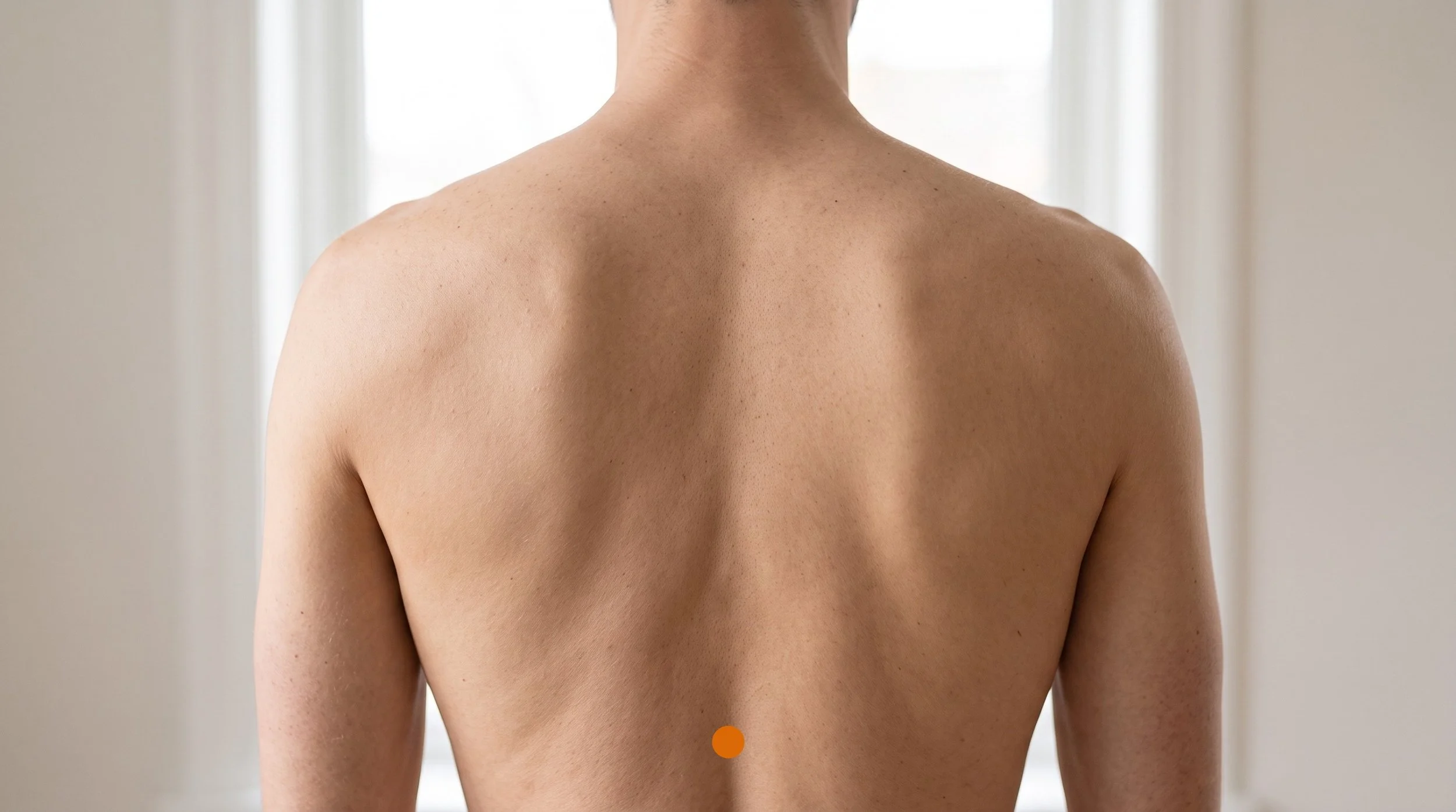
DU6 Acupuncture Point (Jizhong)
The Centre of the Spine at the Thoracolumbar Junction: Anatomy, Segmental Mechanism, and Why This Midline Point Bridges Back Stiffness and Digestive Complaints
DU6 (also written GV6), known as Jizhong (Centre of the Spine), sits on the midline of the back in the small depression just below the tip of the eleventh thoracic spinous process, roughly four interspaces above a line drawn between the tops of the iliac crests. It is one of the quieter points on the Governing vessel, but its position is anything but incidental: it lands at the thoracolumbar junction, the hinge where the relatively stiff rib cage hands off load to the mobile lumbar spine, and it sits exactly level with BL20, the back-shu points of the Spleen.
That double identity, a spinal point and a digestive-level point, explains why classical sources list Jizhong for loose stools, jaundice, and hemorrhoids in the same breath as stiffness of the back. In modern terms, the value of governing vessel 6 comes from the lower thoracic segments it engages, which supply both the deep paraspinal muscles a patient feels as mid-back tightness and, through the splanchnic outflow, much of the gut.
- DU6 lies on the posterior midline between the T11 and T12 spinous processes, and a needle passes through skin, thoracolumbar fascia, and the supraspinous and interspinous ligaments before reaching sensitive deep tissue; the multifidus and erector spinae fill the gutters on either side.
- Traditional sources classify the point as one that fortifies the Spleen, drains damp, and benefits the spine, an attribution that mirrors its level with the Spleen back-shu points rather than any measured organ effect.
- The medial branches of the T11 and T12 posterior rami innervate this segment, and the same lower thoracic cord levels give rise to the splanchnic sympathetic supply of much of the digestive tract, which is the plausible route for any visceral effect (Yu, 2020).
- Experimental work shows that needling trunk points sharing spinal segments with the gut tends to damp motility through sympathetic pathways, while limb points tend to facilitate it through vagal pathways, a segment-dependent pattern rather than a single uniform response (Li et al., 2007; Yu, 2020).
- Clinically, DU6 is used as a midline anchor at the thoracolumbar junction alongside paraspinal and distal points; reviews of acupuncture for chronic low back pain report modest short-term benefit with limited certainty of evidence (Mu et al., 2020; Vickers et al., 2018).
- De qi at Jizhong is usually described as a deep, dull ache or a spreading pressure across the lower ribs and mid-back, sometimes with a brief wave of warmth, and it should never feel like an electric shock or radiating jolt.
Stiff Through the Mid-Back and Bloated After Meals?
Many patients arrive describing two problems that seem unrelated: a band of tightness where the ribs meet the low back, and digestion that feels sluggish or unpredictable. At Morningside Acupuncture we treat DU6 as a segmental hub for exactly that overlap, pairing it with paraspinal needling and distal points based on what your exam shows. Treatment is thorough, gentle, and explained as we go. Schedule a session and we can map out what is driving your symptoms.
Schedule NowAnatomy of DU6: Why the T11 to T12 Interspace Is Such an Important Location
Run your fingers down the midline of the back and you will feel a chain of bony prominences with soft dips between them. DU6 occupies the dip just below the eleventh thoracic spinous process, which is where the spine changes character. Above it, the ribs and their costovertebral joints restrict rotation and side bending; below it, the lumbar facets orient differently and take on flexion and extension.
A needle placed here passes through skin and subcutaneous tissue into the thoracolumbar fascia, then into the supraspinous and interspinous ligaments, with the multifidus and the deeper layers of erector spinae sitting immediately to either side. This is a region that gets loaded during rotation under load, prolonged sitting, repeated bending, and the sort of asymmetric athletic movement common in golf, tennis, and rowing.
The nerve geography here is what makes the point interesting. The medial branches of the posterior rami of the eleventh and twelfth thoracic spinal nerves supply the skin, ligaments, facet joints, and deep muscles at this level, and those same segments feed into a dorsal horn that also receives visceral afferent traffic from the abdomen through the splanchnic nerves.
When somatic and visceral inputs converge on shared second-order neurons, stimulation of the body wall can influence how the nervous system processes both, which is the standard convergence explanation for why paraspinal needling sometimes produces effects beyond the muscle itself (Zhao, 2008; Yu, 2020). Needling of this kind also recruits Adelta and C fiber afferents that trigger spinal and supraspinal responses, including descending inhibition from the brainstem and release of endogenous opioids, which is the best-supported account of acupuncture analgesia (Zhao, 2008).
Safety here comes down to depth and angle. The reference literature places the spinal canal roughly 1.25 to 1.75 cun beneath the skin surface at this level, varying with body build, so needling is kept shallow and controlled, typically a perpendicular to oblique insertion angled superiorly along the interspinous ligament to a depth of about 0.5 to 1 cun. Staying strictly on the midline avoids the pleural recesses and kidneys that sit laterally, and any sharp radiating sensation is a signal to withdraw and redirect rather than press on.
It is also worth noting that several classical texts list Jizhong as a point that should not receive moxibustion, a caution modern practitioners generally respect even though the original reasoning is not preserved in neurophysiological terms.
Related Governing Vessel Related Back Shu PointsDU6 (GV6) at a Glance: Classification, Location, and Clinical Use
| Category | Detail |
|---|---|
| Traditional Name | Jizhong (Centre of the Spine), Governing Vessel 6, also written Du-6 or DU6 |
| Channel Classification | Governing vessel (Du Mai), a midline extraordinary vessel point on the posterior trunk (DU6, also written GV6) |
| Point Categories | No five-shu, luo, xi-cleft, or hui-meeting designation and no listed meeting or crossing point status; its classical identity comes from position, a Governing vessel point at the centre of the spine sitting level with BL20, the Spleen back-shu points |
| Precise Location | On the posterior midline, in the depression below the spinous process of the eleventh thoracic vertebra (T11 to T12 interspace), about four interspaces above the line joining the highest points of the iliac crests |
| Tissue Stimulated | Skin and thoracolumbar fascia, supraspinous and interspinous ligaments, with the adjacent multifidus and deep erector spinae at the thoracolumbar junction; referral patterns from this region can overlap the flank and lower abdominal wall, an area also served by the abdominal obliques |
| Needle Depth / Direction | Perpendicular to oblique insertion angled superiorly, 0.5 to 1 cun; the spinal canal sits approximately 1.25 to 1.75 cun deep depending on build, so depth is deliberately conservative, and several classical texts treat the point as contraindicated to moxibustion |
| De Qi Sensation | Deep dull ache, heaviness, or spreading pressure across the lower thoracic midline, occasionally with warmth toward the flanks; sharp, electric, or radiating sensations are not the goal and prompt repositioning |
| Primary Clinical Uses | Stiffness and aching at the thoracolumbar junction and lumbar spine, and traditionally listed digestive complaints including loose stools, poor appetite with abdominal fullness, jaundice, hemorrhoids, and rectal prolapse in children, plus wind epilepsy in classical sources |
| Common Point Combinations |
|
In Deadman's A Manual of Acupuncture, Jizhong is presented with two traditional actions: fortifying the Spleen while draining damp, and benefiting the spine. The classical indication list attributed to the point falls into three clusters. The first is digestive and abdominal: fullness with no interest in food, palpable abdominal masses, jaundice, diarrhea including diarrhea so persistent the patient cannot eat, and blood in the stool.
The second is anorectal: the five recognized types of hemorrhoids and prolapse of the rectum in children. The third is spinal and neurological: stiffness of the lumbar spine, wind epilepsy, and warm febrile disease. These are traditional attributions rather than tested outcomes, but the pattern is striking for one reason. Everything on the list, digestion, the anorectal region, and the lower back, maps onto structures supplied by the lower thoracic and upper lumbar cord segments, which is exactly the neighborhood a needle at the T11 to T12 interspace engages.
Why DU6 Is Used for Digestive Complaints and Not Just Back Stiffness
Patients are often surprised that a point on the spine is chosen for bowel or appetite complaints. The reason is segmental. The eleventh and twelfth thoracic nerve roots supply the tissues at this level of the back, and the same lower thoracic cord segments give rise to the splanchnic nerves that carry sympathetic outflow to much of the abdominal digestive tract. Sensory information from skin, muscle, and viscera converges in the dorsal horn at shared levels, so a stimulus applied to the body wall enters the same processing neighborhood the gut reports into (Zhao, 2008; Yu, 2020).
Animal work has mapped this in some detail. Stimulation at trunk points that share segments with the stomach and intestines tends to reduce motility through sympathetic pathways, whereas stimulation at limb points tends to increase motility through vagal pathways, and the direction of the effect depends on which segments are engaged and how strongly (Li et al., 2007; Yu, 2020). That is a useful corrective to the idea that a point does one fixed thing. It also fits the clinical impression that spinal-level points behave differently from limb points and are often best used together rather than in isolation.
For the musculoskeletal side, the mechanism is more familiar. Needling recruits small-diameter afferents, which engage descending inhibitory pathways from the brainstem and modulate dorsal horn excitability, an account well supported in the neurophysiological literature (Zhao, 2008). Locally, needling the deep paraspinal tissue at a stiff segment may reduce protective muscle guarding and change how that segment tolerates movement, which is often what patients notice first: less of the catch when they extend or rotate.
What the Research Shows for DU6 (GV6)
One note on naming before the evidence: in the research literature this point is almost always listed as GV6, the WHO standard code, so GV6 is the term to search if you want to read the studies below in full.
There is no trial that isolates DU6 on its own, and it would be unusual if there were. Acupuncture research almost always tests multi-point protocols delivered over several sessions, so the fair question is not whether Jizhong works by itself but whether the treatment approaches that include thoracolumbar and back-shu level points show benefit. The picture from systematic reviews is one of modest, real, but not dramatic effects, with certainty of evidence frequently downgraded for risk of bias and small trial sizes. Mechanistic studies add plausibility for segmental effects on the gut, though most of that work is preclinical and cannot be read as clinical proof.
| Study | Type | Focus | Key Finding |
|---|---|---|---|
| Mu et al., 2020 | Cochrane systematic review | Acupuncture for chronic nonspecific low back pain, 33 trials with 8,270 participants | Reported small improvements in pain and function compared with sham, no treatment, or usual care, with certainty of evidence ranging from very low to moderate. |
| Vickers et al., 2018 | Individual patient data meta-analysis | Chronic pain conditions including back and neck pain across nearly 21,000 patients | Found acupuncture superior to both sham and no-acupuncture controls, with effects that persisted over time, though differences from sham were modest. |
| Manheimer et al., 2012 | Cochrane systematic review | Acupuncture for irritable bowel syndrome | Reported no clear benefit over sham acupuncture, while comparisons against pharmacological therapy and no specific treatment favored acupuncture, so results should be read cautiously. |
| Yu, 2020 | Narrative review of neural mechanisms | How acupuncture stimulation influences gastrointestinal motility | Describes a segment-dependent pattern in which trunk points sharing innervation with the gut act mainly through sympathetic pathways while limb points act through vagal pathways. |
| Li et al., 2007 | Preclinical experimental study | Gastric motility responses to acupuncture stimulation at different body regions in rats | Found that stimulation strong enough to recruit Adelta and C fibers modulated gastric motility, with homosegmental trunk stimulation producing inhibition and limb stimulation producing facilitation. |
Thoracolumbar Junction Pain That Physical Therapy Has Not Resolved?
The T11 to T12 hinge is a common source of stubborn back pain, and it often gets missed because symptoms can refer sideways toward the flank and iliac crest. Our clinicians combine DU6 with dry needling of the deep paraspinals and quadratus lumborum, plus manual assessment of how you rotate and extend. If sessions elsewhere have plateaued, a segmental approach is worth trying. Book an evaluation and we will start with a clear plan.
Schedule NowDU6 in the Context of Trigger Point Work
Acupuncture, in the broad sense of treatment delivered with an acupuncture needle, includes hundreds of styles, and dry needling is one of them. At Morningside we frequently treat DU6 in the same session as the muscles that flank it. The multifidus and the deep thoracolumbar erector spinae at the T11 to T12 level are common sources of localized, hard-to-point-to back ache, and the quadratus lumborum just below can refer pain toward the iliac crest and lateral hip.
The trigger point literature documents referral patterns from thoracolumbar paraspinal and quadratus lumborum musculature that patients often mistake for a joint problem or even a kidney complaint (Simons et al., 1999).
The overlap is anatomical rather than coincidental. DU6 sits at the midline apex of the same segmental territory those muscles occupy, so a treatment that combines a shallow midline needle with careful dry needling of the adjacent paraspinals is addressing one neurological region from two angles. Thoracolumbar junction irritation can also produce symptoms that wrap toward the lower abdominal wall and groin, which is why we assess the abdominal obliques and lower rib cage mechanics rather than treating the back in isolation. Depth, angle, and patient build guide every insertion, and needling near the spine is always kept shallow and controlled.
DU6 Back Pain and Digestive Treatment at NYC's Highest-Rated Acupuncture Clinic
Morningside Acupuncture is the highest-rated acupuncture and dry needling clinic in New York City with over 500 five-star Google reviews, and our team blends classical point selection with modern pain science. DU6 is one of the points we reach for when the thoracolumbar segments look involved in both musculoskeletal and digestive complaints. Every treatment plan is individualized, evidence-informed, and reassessed as you progress. Schedule your first visit and see how the approach differs.
Schedule NowFrequently Asked Questions
Is DU6 the same point as GV6?
Yes. DU6 and GV6 are two codes for the same point, Jizhong. DU comes from Du Mai, the Chinese name of the Governing Vessel, and it is the code used in most Chinese texts and many acupuncture schools. GV is the WHO standard abbreviation and the one you will see in most Western textbooks and research papers. You will also come across it written as Du 6, GV-6, or Governing Vessel 6. Whichever code is used, the location and the uses are the same.
What does DU6 feel like when needled?
Most people feel a deep, dull ache or a sense of pressure and heaviness right at the midline, sometimes spreading a few inches out toward the lower ribs. Some describe a brief warmth or a mild grabbing sensation as the needle engages the ligament and fascia. Because the insertion is shallow and angled upward, it is usually well tolerated even by needle-sensitive patients. What you should not feel is a sharp electric jolt or pain shooting into a limb, and if that happens your practitioner should withdraw and redirect immediately.
Why needle a point on my spine when my problem is digestion?
Because the nerves that supply the tissues at the T11 to T12 level share spinal cord segments with the nerves that supply much of the digestive tract through the splanchnic pathways. Sensory input from skin, muscle, and gut converges in the same region of the dorsal horn, so stimulating the body wall at that level can influence how the nervous system processes signals from both (Zhao, 2008; Yu, 2020). Experimental studies suggest that trunk points sharing segments with the gut act mainly through sympathetic pathways, while limb points such as ST36 tend to act through vagal pathways, which is one reason practitioners typically combine spinal and distal points rather than relying on either alone (Li et al., 2007). Traditional sources arrived at a similar pairing by a different route, grouping Jizhong with the Spleen back-shu points at the same level.
Can I press DU6 myself between sessions?
Yes, acupressure at this location is safe and easy to self-apply. Find the midline of your back and trace down until you are roughly at the level where the lowest ribs begin to angle away, about four finger-width intervals above a line between the tops of your hip bones, then settle into the small dip between two bony prominences. Press with the pads of two fingers or the knuckle of your thumb using steady, moderate pressure, holding for 30 to 60 seconds, then releasing and repeating three to five times. A tennis or lacrosse ball against a wall works well if you cannot reach comfortably, using slow pressure for one to two minutes rather than aggressive rolling. Two or three short sessions a day is plenty, and you should feel a satisfying ache, not sharp pain. Stop if you notice tingling or radiating symptoms into the legs and mention it at your next visit.
Is DU6 safe to needle?
In trained hands it is a safe point, but it deserves respect because of what lies beneath it. The spinal canal sits roughly 1.25 to 1.75 cun below the skin at this level depending on body build, so practitioners keep insertion shallow, usually 0.5 to 1 cun, and angle the needle superiorly along the interspinous ligament rather than driving straight in. Staying precisely on the midline keeps the needle away from the pleural recesses and kidneys that sit further out to the sides. The point is generally avoided or approached with extra care in patients with known spina bifida occulta, prior spinal surgery or hardware at that level, local infection or skin breakdown, or significant bleeding risk. Several classical texts also list Jizhong as contraindicated to moxibustion, a caution most practitioners still follow.
Where exactly is DU6 located?
DU6 is on the posterior midline of the back, in the depression just below the spinous process of the eleventh thoracic vertebra, meaning the T11 to T12 interspace. A reliable way to find it is to locate the line connecting the highest points of both iliac crests, which corresponds to the lower border of the third lumbar vertebra, then count four interspaces upward along the midline. It also sits directly between the two BL20 points, which are 1.5 cun out to either side, so if you can find the Spleen back-shu points, Jizhong is the midline point at the same horizontal level.
References
- Deadman, P., Al-Khafaji, M., & Baker, K. (2009). A manual of acupuncture. Journal of Chinese Medicine Publications.
- Cunningham, P. M. (2000). Acupuncture points: A practical guide to classical and modern usage. Odyssey Press.
- O'Connor, J., & Bensky, D. (Eds. & Trans.). (1981). Acupuncture: A comprehensive text. Shanghai College of Traditional Medicine. Eastland Press.
- Simons, D. G., Travell, J. G., & Simons, L. S. (1999). Travell & Simons' myofascial pain and dysfunction: The trigger point manual, Vol. 1: Upper half of body (2nd ed.). Williams & Wilkins.
- Mu, J., Furlan, A. D., Lam, W. Y., Hsu, M. Y., Ning, Z., & Lao, L. (2020). Acupuncture for chronic nonspecific low back pain. Cochrane Database of Systematic Reviews, 2020(12), CD013814. https://doi.org/10.1002/14651858.CD013814
- Vickers, A. J., Vertosick, E. A., Lewith, G., MacPherson, H., Foster, N. E., Sherman, K. J., Irnich, D., Witt, C. M., & Linde, K. (2018). Acupuncture for chronic pain: Update of an individual patient data meta-analysis. Journal of Pain, 19(5), 455-474. https://doi.org/10.1016/j.jpain.2017.11.005
- Manheimer, E., Cheng, K., Wieland, L. S., Min, L. S., Shen, X., Berman, B. M., & Lao, L. (2012). Acupuncture for treatment of irritable bowel syndrome. Cochrane Database of Systematic Reviews, 2012(5), CD005111. https://doi.org/10.1002/14651858.CD005111.pub3
- Yu, Z. (2020). Neuromechanism of acupuncture regulating gastrointestinal motility. World Journal of Gastroenterology, 26(23), 3182-3200. https://doi.org/10.3748/wjg.v26.i23.3182
- Li, Y. Q., Zhu, B., Rong, P. J., Ben, H., & Li, Y. H. (2007). Neural mechanism of acupuncture-modulated gastric motility. World Journal of Gastroenterology, 13(5), 709-716. https://doi.org/10.3748/wjg.v13.i5.709
- Zhao, Z. Q. (2008). Neural mechanism underlying acupuncture analgesia. Progress in Neurobiology, 85(4), 355-375. https://doi.org/10.1016/j.pneurobio.2008.05.004
Disclaimer: This web site is intended for educational and informational purposes only. Reading this website does not constitute providing medical advice or any professional services. This information should not be used for diagnosing or treating any health issue or disease. Those seeking medical advice should consult with a licensed physician. Seek the advice of a medical doctor or other qualified health professional for any medical condition. If you think you have a medical emergency, call 911 or go to the emergency room. No acupuncturist-patient relationship is created by reading this website or using the information. Morningside Acupuncture PLLC and its employees and contributors do not make any express or implied representations with respect to the information on this site or its use. For any legal interpretation of scope of practice in your state, consult a licensed attorney or regulatory authority.
Read more from our blog



