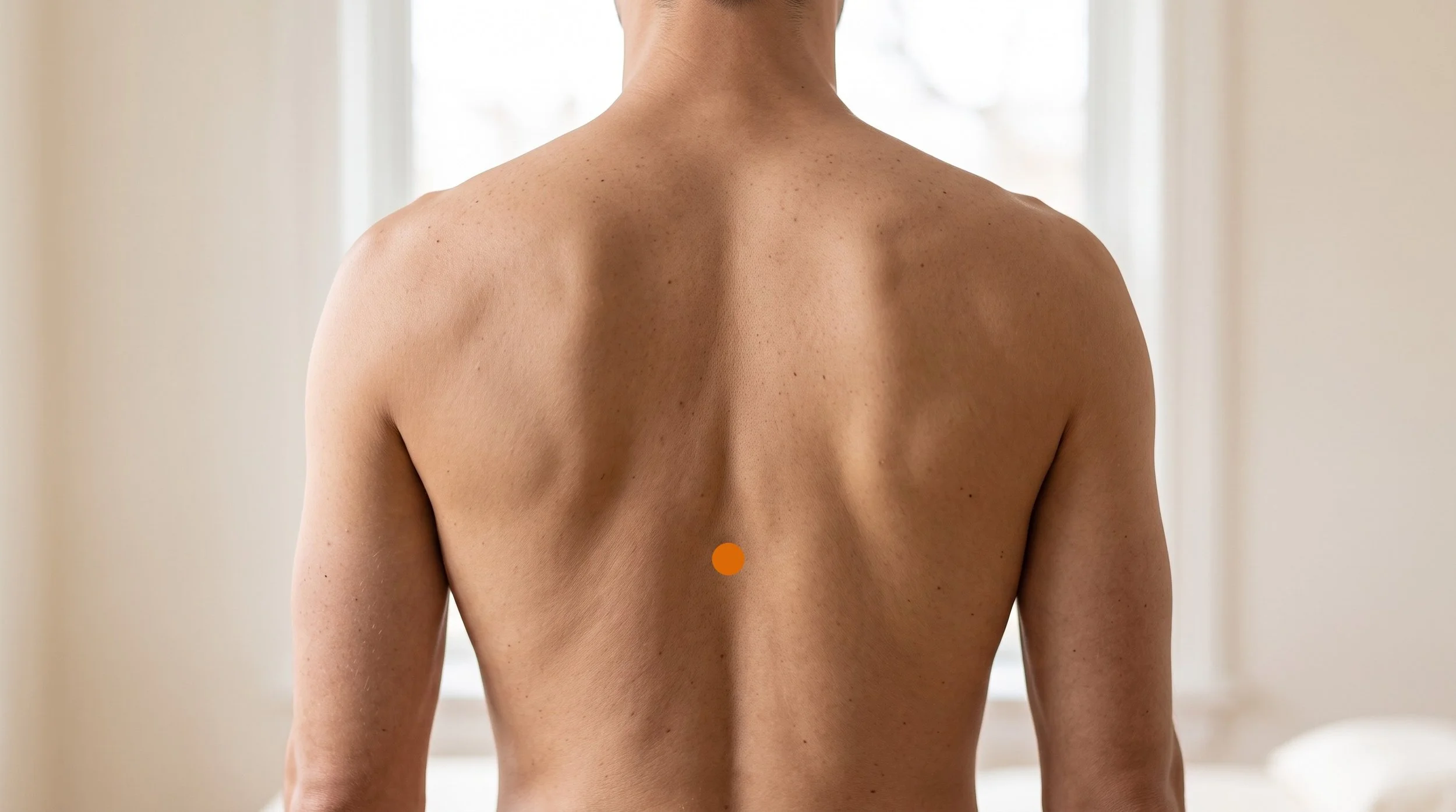
DU8 Acupuncture Point (Jinsuo)
The Sinew Contraction Point Below the Ninth Thoracic Vertebra: Anatomy, Segmental Mechanism, and Why This Mid-Back Midline Point Is Chosen for Spasm and Stiffness
DU8 (also written GV8), known in Chinese as Jinsuo and usually translated as Sinew Contraction, sits on the midline of the mid-back in the small hollow just below the spinous process of the ninth thoracic vertebra, level with BL18, the back-shu points of the Liver. It is one of the quieter points on the Governing vessel, but its name is a clinical instruction: classical texts reached for it when the body was gripping, when the spine felt stiff and unyielding, and when muscles were pulling in ways the patient could not release voluntarily.
In a modern clinic, the GV8 acupuncture point is used mostly for mid-back stiffness, paraspinal guarding, and the band of tension that settles between the shoulder blades and lower ribs in people under sustained stress, and it is needled shallowly and obliquely because the spinal canal lies not far beneath.
- Location and layers: DU8 lies in the depression below the T9 spinous process, passing through skin, subcutaneous tissue, the supraspinous ligament and the interspinous ligament, with the thoracic erector spinae and multifidus immediately lateral. It sits level with BL18, so a needle here is working in the same segmental neighborhood as the Liver back-shu points.
- Traditional attribution, translated: classical sources credit DU8 with soothing the Liver, settling internal wind, releasing spasm and calming the spirit. In neurophysiological language, that describes a segmental point used for paraspinal muscle guarding, altered muscle tone and stress-related tension rather than any literal movement of qi.
- Mechanism: needling stimulates small-diameter afferents in richly innervated midline ligaments and adjacent muscle supplied by the medial branches of the T8 to T10 dorsal rami, feeding dorsal horn segments that also receive visceral input from the same thoracic levels, and recruiting descending inhibitory pathways from the brainstem (Zhao, 2008).
- Research picture: no trial has tested DU8 in isolation. The relevant evidence comes from multi-point protocols for spinal pain and muscle tone, where acupuncture shows modest but real benefit over sham and clearer benefit over no treatment (Mu et al., 2020; Vickers et al., 2018), and from spasticity reviews where results favor acupuncture but the certainty of evidence is low (Xue et al., 2022).
- Clinical framing: at Morningside, DU8 is rarely the whole treatment. It anchors a mid-back protocol alongside BL18, huatuojiaji points at T9 and T10, and dry needling of the thoracic paraspinals when taut bands are palpable (Simons et al., 1999).
- De qi: patients usually describe a deep, dull pressure or a spreading ache along the spine, occasionally a brief band-like sensation curving toward the lower ribs. Sharp or electric sensation is not the goal and means the angle should be adjusted.
Stuck With Mid-Back Stiffness That Stretching Will Not Touch?
Mid-back tension often has more than one driver: ribs that are not moving well, paraspinal muscles holding a protective pattern, and a nervous system that has stopped downshifting. Our licensed acupuncturists use DU8 with the Liver back-shu points and thoracic paraspinal needling to reduce guarding and restore comfortable rotation and extension. Treatment is paired with practical loading and breathing work so the change lasts past the table. Schedule a visit and let us assess what is actually holding your mid-back.
Schedule NowAnatomy of DU8: Why the T9 to T10 Interspinous Space Is Such an Important Location
Run a finger down the midline of the mid-back and you feel a ridge of spinous processes with small dips between them. DU8 occupies the dip below T9, and the needle passes through relatively thick, tethered skin, a thin layer of subcutaneous tissue, the posterior layer of the thoracolumbar fascia, the supraspinous ligament that bridges adjacent spinous processes, and then the interspinous ligament running between them. Immediately to either side lie the thoracic multifidus and the longissimus and iliocostalis divisions of the erector spinae.
This region gets loaded in specific ways: hours of sustained flexion at a desk, restricted rib motion from shallow breathing, and stiffness carried up from the thoracolumbar junction. The result is a segment that becomes both stiff and tender, which is precisely the presentation classical texts filed under contraction of the sinews.
The tissues at DU8 are supplied by the medial branches of the dorsal rami of the ninth and tenth thoracic spinal nerves. Interspinous and supraspinous ligaments carry a dense supply of small-diameter afferents, so a needle placed here produces a substantial afferent volley into the T9 and T10 dorsal horn.
Those same segments receive convergent input from the ninth and tenth intercostal nerves and from sympathetic outflow travelling toward the upper abdominal organs by way of the splanchnic nerves, which is a plausible modern reading of why classical listings for this level include epigastric and hypochondriac complaints alongside spinal stiffness.
Experimentally, needle stimulation of this kind engages spinal segmental inhibition and recruits descending pathways from the periaqueductal gray and rostral ventromedial medulla that dampen nociceptive transmission (Zhao, 2008), and pooled patient-level data indicate that acupuncture effects on chronic musculoskeletal pain persist beyond the treatment course rather than fading immediately (Vickers et al., 2018).
Depth matters here. A Manual of Acupuncture notes that the spinal canal lies roughly 1.25 to 1.75 cun beneath the skin at this level, varying with body build, which is why the standard convention for DU 8 spine needling is oblique insertion angled superiorly to a depth of about 0.5 to 1 cun rather than deep perpendicular insertion. Staying strictly on the midline also keeps the needle away from the pleura, since angling laterally over the thoracic wall introduces pneumothorax risk.
Moxibustion is traditionally applied at this point and is a reasonable option when the mid-back feels cold, stiff and better for warmth. In trained hands with correct angle and depth, DU8 is a low-risk point.
Related Governing Vessel Related Back Shu PointsDU8 (GV8) at a Glance: Classification, Location, and Clinical Use
| Category | Detail |
|---|---|
| Traditional Name | Jinsuo (Sinew Contraction), also translated as Tendon Spasm |
| Channel Classification | Governing vessel (Du mai), point 8 (DU8, also written GV8) |
| Point Categories | A point of the Governing vessel with no five-shu, hui-meeting or extraordinary vessel crossing designation attributed in the sources used here. Its defining relationship is positional: it sits on the midline at the level of BL18, the back-shu points of the Liver, which shapes its traditional actions of soothing the Liver, settling internal wind, relieving spasm and calming the spirit. |
| Precise Location | On the posterior midline of the back, in the depression immediately below the spinous process of the ninth thoracic vertebra. It sits six interspinous spaces above the line joining the highest points of the iliac crests, and is level with BL18, which lies 1.5 cun lateral on each side. |
| Tissue Stimulated | Skin, subcutaneous tissue, posterior thoracolumbar fascia, supraspinous and interspinous ligaments at T9 to T10, with the thoracic multifidus and erector spinae immediately lateral. Referred pain into this region can also arise from the abdominal wall, so the Abdominal Obliques Trigger Points are worth screening when midline mid-back tenderness does not add up. |
| Needle Depth / Direction | Oblique insertion angled superiorly along the interspinous space, 0.5 to 1 cun. Deep perpendicular insertion is avoided: the spinal canal lies approximately 1.25 to 1.75 cun deep depending on build. Moxibustion is applicable. |
| De Qi Sensation | A deep, dull, pressing ache concentrated at the midline, sometimes spreading a short distance up or down the spine or curving as a band toward the lower ribs. Many patients report an involuntary softening of the surrounding paraspinal muscles. Sharp, electric or radiating sensation is not sought and calls for repositioning. |
| Primary Clinical Uses | Mid-back stiffness and paraspinal muscle guarding, spasm and contraction of the back muscles, thoracic segmental restriction, stress-related tension across the mid-back, and irritability accompanied by physical bracing. Classical listings additionally include epilepsy, convulsive presentations, jaundice and epigastric or cardiac pain, which are presented here as historical attributions rather than modern treatment recommendations. |
| Common Point Combinations |
|
The commentary in A Manual of Acupuncture builds its whole reading of this point from two facts: the name and the neighborhood. Sinew Contraction sits level with the Liver back-shu points, and in the classical framework the Liver governs the sinews, so the point was traditionally applied to conditions of abnormal movement and involuntary tightening attributed to Liver wind stirring upward, including upward staring eyes, clonic spasm, epilepsy in children and adults, and rigidity or contraction of the spine.
A second thread runs through the same entry: one classical source recommends the point for anger that has injured the Liver, and the historical indication lists extend to mania, agitated wandering and unstoppable speech, presentations understood at the time as constrained Liver qi turning to fire and unsettling the spirit. Jaundice and pain in the chest also appear.
What makes the classical pattern striking is its internal consistency: a single mid-back point was asked to address both the muscular grip and the emotional pressure behind it, which maps surprisingly well onto what clinicians today call stress-related muscle guarding.
Why DU8 Is Used for Stress-Driven Muscle Guarding, Not Just Local Back Stiffness
Start with the segment. The dorsal horn at T9 and T10 is a busy intersection: it receives input from the midline ligaments and paraspinal muscles at DU8, from the ninth and tenth intercostal nerves wrapping around the trunk, and from sympathetic fibers heading out toward the upper abdominal organs. When one of those inputs becomes persistently noisy, neighboring circuits at the same level can become more excitable, which is one reason mid-back tenderness, rib restriction and upper abdominal discomfort so often appear together in the same person.
Needling at DU8 delivers a strong, well-localized afferent signal into that segment, and segmental inhibition is one of the better-characterized mechanisms by which acupuncture reduces pain and reflex muscle tone (Zhao, 2008).
The second layer is not local at all. Needle stimulation engages descending inhibitory control from the periaqueductal gray and rostral ventromedial medulla, dampening transmission across multiple segments rather than only the one needled (Zhao, 2008). Acupuncture also appears to shift autonomic balance toward parasympathetic predominance, with a meta-analysis of heart rate variability studies reporting greater vagal tone after real needling compared with sham, although the authors urge caution given study quality and heterogeneity (Hamvas et al., 2023).
For a patient whose mid-back tightens predictably during high-stress weeks, that combination matters: you are lowering the drive that keeps paraspinal muscles switched on, not just poking the muscle that hurts.
This is also why we do not treat DU8 as a standalone spasm switch. Muscle tone reflects load, breathing pattern, sleep, joint mechanics and threat perception. Evidence in post-stroke spasticity, the closest research analogue to the classical spasm indication, favors acupuncture added to conventional rehabilitation but rests on low-certainty evidence and methodologically weak trials (Xue et al., 2022). The reasonable clinical position is that Jinsuo acupuncture can help reduce guarding and improve comfort within a broader plan, and should be judged by whether your movement and symptoms actually change.
What the Research Shows for DU8 (GV8)
One note on naming before the evidence: in the research literature this point is almost always listed as GV8, the WHO standard code, so GV8 is the term to search if you want to read the studies below in full.
There is no clinical trial isolating DU8, and it would be misleading to imply otherwise. Like almost every individual acupuncture point, its evidence base is indirect: it appears as one component inside multi-point protocols tested for back pain, muscle tone and stress-related complaints. What the research can tell us is whether needling protocols that include mid-back and paraspinal points produce meaningful change, how large that change tends to be, and where the evidence remains thin.
The studies below are the most relevant to the conditions for which governing vessel 8 is actually selected, and each should be read as context for the protocol rather than proof of the point.
| Study | Type | Focus | Key Finding |
|---|---|---|---|
| Mu et al., 2020 | Cochrane systematic review | Acupuncture for chronic nonspecific low back pain, 33 trials and 8,270 participants | Acupuncture improved pain and function compared with no treatment with moderate-certainty evidence, while differences versus sham and usual care were smaller and of lower certainty. |
| Vickers et al., 2018 | Individual patient data meta-analysis | Chronic musculoskeletal pain including back and neck pain, roughly 20,000 patients | Acupuncture outperformed both sham and no-acupuncture controls, and the benefit persisted over about twelve months rather than disappearing at the end of treatment. |
| Xue et al., 2022 | Systematic review and meta-analysis | Acupuncture for post-stroke spasticity, 88 trials and 6,431 participants | Acupuncture added to conventional rehabilitation was associated with reduced Modified Ashworth Scale scores, though the authors flagged limited methodological and reporting quality. |
| Gattie et al., 2017 | Systematic review and meta-analysis | Trigger point dry needling for musculoskeletal conditions delivered by physical therapists | Dry needling reduced pain compared with sham or control in the short and medium term, supporting its use alongside classical point selection for taut paraspinal bands. |
| Hamvas et al., 2023 | Systematic review and meta-analysis | Acupuncture and heart rate variability as a marker of autonomic function | Real acupuncture increased parasympathetic indices relative to placebo needling, a plausible mechanism for reduced stress-related muscle guarding, though the evidence should be read cautiously. |
| Cheuk and Wong, 2014 | Cochrane systematic review | Acupuncture for epilepsy, the historical indication most associated with this point | The review found no reliable evidence that acupuncture reduces seizure frequency, so the classical epilepsy listing for DU8 should be treated strictly as historical context. |
Does Your Back Tighten Every Time Stress Ramps Up?
Plenty of New Yorkers notice the same pattern: a tough week arrives and the muscles along the spine lock down before anything else does. Jinsuo acupuncture is traditionally used for exactly this overlap of irritability and physical contraction, and we combine it with points that support autonomic downregulation. Most people leave a session noticeably softer through the mid-back and calmer overall. Book an appointment and see how your body responds.
Schedule NowDU8 in the Context of Trigger Point Work
DU8 itself sits on ligament rather than muscle belly, so it is not a trigger point in the myofascial sense. What surrounds it very often is. The thoracic multifidus, longissimus thoracis, iliocostalis thoracis, lower trapezius, rhomboids and serratus posterior inferior all develop taut bands that produce aching, poorly localized mid-back pain and a sense of stiffness that stretching does not resolve, and deep paraspinal trigger points can refer both upward and downward along the spine (Simons et al., 1999).
In practice, we palpate segment by segment, identify which bands reproduce the patient's familiar pain, and treat those directly with dry needling while using DU8 and BL18 to address the segment as a whole.
A typical mid-back session at Morningside might combine oblique needling at DU8, huatuojiaji points at T9 and T10, dry needling of the thoracic multifidus and longissimus where taut bands are found, and a distal point such as GB34 for generalized tightness. Because acupuncture is defined by the use of an acupuncture needle rather than by any single tradition, blending classical point selection with trigger point technique is not a contradiction: it is two mapping systems pointing at overlapping tissue.
Reviews of dry needling for musculoskeletal pain support short and medium term pain reduction (Gattie et al., 2017), and we pair the needling with breathing and thoracic mobility work so the segment keeps the range it gains.
DU8 Mid-Back Pain and Muscle Spasm Treatment at NYC's Highest-Rated Acupuncture Clinic
Morningside Acupuncture is the highest-rated acupuncture and dry needling clinic in New York City with over 500 five-star Google reviews. We treat governing vessel 8 as one tool inside a full assessment that includes posture, rib mechanics, trigger point palpation and stress load. Every plan is built around your presentation rather than a fixed point prescription. Schedule your appointment today and get a clear, evidence-informed plan for your back.
Schedule NowFrequently Asked Questions
Is DU8 the same point as GV8?
Yes. DU8 and GV8 are two codes for the same point, Jinsuo. DU comes from Du Mai, the Chinese name of the Governing Vessel, and it is the code used in most Chinese texts and many acupuncture schools. GV is the WHO standard abbreviation and the one you will see in most Western textbooks and research papers. You will also come across it written as Du 8, GV-8, or Governing Vessel 8. Whichever code is used, the location and the uses are the same.
What does DU8 feel like when needled?
Most people feel a deep, dull pressure or a heavy ache right at the midline, sometimes spreading a short distance along the spine or wrapping slightly toward the lower ribs. It is a distinctly different sensation from a muscle needle: less of a cramping grab, more of a deep, spreading fullness. Many patients notice the paraspinal muscles nearby soften on their own within a minute or two. Sharp, electric or shooting sensation is not what we are after and means the practitioner should adjust the angle or depth immediately.
Why needle a mid-back point when my stiffness feels lower down or across my whole back?
Two reasons. First, segmental: DU8 sits in the T9 to T10 interspinous space, and needling there feeds a strong afferent signal into dorsal horn segments that also receive input from surrounding muscle, the lower ribs and thoracic sympathetic pathways, so the effect is not limited to the exact spot of the needle (Zhao, 2008). Second, needle stimulation recruits descending inhibitory pathways that reduce nociceptive transmission across multiple levels, which is why a well-placed point can influence a broader region than its footprint suggests (Zhao, 2008). Traditionally, the same logic was expressed through the point's name and its position level with the Liver back-shu points, which were held to govern the sinews throughout the body.
Can I press DU8 myself between sessions?
Yes, and it is one of the easier midline points to self-treat with a tool. Find the level by counting up six interspinous spaces from the line between the tops of your hip bones, or simply locate the tender midline dip in your mid-back, roughly level with the lower tip of the shoulder blades and a little below. Lie on your back with a tennis or lacrosse ball placed just beside the midline at that level, breathe slowly, and let your body weight create steady pressure for 60 to 90 seconds per side. If you prefer direct fingertip work, press into the midline depression with a thumb at moderate, sustained pressure for 30 to 60 seconds, release, and repeat two or three times. Once or twice daily is plenty. Stop if you feel any shooting, tingling or radiating sensation, and skip self-pressure entirely over bruised skin, recent spinal surgery, or areas of unexplained pain.
Is DU8 safe to needle?
In trained hands, yes. The safety considerations are specific and well documented: the spinal canal lies roughly 1.25 to 1.75 cun beneath the skin at this level depending on body build, so the convention is shallow oblique insertion angled superiorly rather than deep perpendicular needling. Staying precisely on the midline is equally important, since angling laterally over the thoracic wall brings the pleura into play. Practitioners take extra care in very lean patients, in anyone with spinal instrumentation, osteoporosis or a bleeding disorder, and in anyone on anticoagulant therapy. Mild, brief soreness at the site is the most common side effect.
Where exactly is DU8 located?
DU8 is on the posterior midline of the back, in the depression directly below the spinous process of the ninth thoracic vertebra, in the T9 to T10 interspinous space. The most reliable way to find it is to draw an imaginary line between the highest points of the iliac crests, which crosses at the level of the lower border of L3, then count up six interspinous spaces. Confirm it by locating BL18, the Liver back-shu points, 1.5 cun lateral on either side at the same level. Under the fingertip it feels like a small, often tender hollow between two bony ridges.
References
- Deadman, P., Al-Khafaji, M., & Baker, K. (2009). A manual of acupuncture. Journal of Chinese Medicine Publications.
- Cunningham, P. M. (2000). Acupuncture points: A practical guide to classical and modern usage. Odyssey Press.
- Kim, H. (2008). Handbook of Oriental medicine (3rd ed.). Harmony & Balance Press.
- Maciocia, G. (2005). The foundations of Chinese medicine: A comprehensive text for acupuncturists and herbalists (2nd ed.). Elsevier Churchill Livingstone.
- O'Connor, J., & Bensky, D. (Eds. & Trans.). (1981). Acupuncture: A comprehensive text. Shanghai College of Traditional Medicine. Eastland Press.
- Simons, D. G., Travell, J. G., & Simons, L. S. (1999). Travell & Simons' myofascial pain and dysfunction: The trigger point manual, Vol. 1: Upper half of body (2nd ed.). Williams & Wilkins.
- Zhao, Z. Q. (2008). Neural mechanism underlying acupuncture analgesia. Progress in Neurobiology, 85(4), 355-375. https://doi.org/10.1016/j.pneurobio.2008.05.004
- Vickers, A. J., Vertosick, E. A., Lewith, G., MacPherson, H., Foster, N. E., Sherman, K. J., Irnich, D., Witt, C. M., & Linde, K. (2018). Acupuncture for chronic pain: Update of an individual patient data meta-analysis. Journal of Pain, 19(5), 455-474. https://doi.org/10.1016/j.jpain.2017.11.005
- Mu, J., Furlan, A. D., Lam, W. Y., Hsu, M. Y., Ning, Z., & Lao, L. (2020). Acupuncture for chronic nonspecific low back pain. Cochrane Database of Systematic Reviews, 2020(12), CD013814. https://doi.org/10.1002/14651858.CD013814
- Xue, C., Jiang, C., Zhu, Y., Liu, X., Zhong, D., Li, Y., Zhang, H., Tang, W., She, J., Xie, C., Li, J., Feng, Y., & Jin, R. (2022). Effectiveness and safety of acupuncture for post-stroke spasticity: A systematic review and meta-analysis. Frontiers in Neurology, 13, 942597. https://doi.org/10.3389/fneur.2022.942597
- Gattie, E., Cleland, J. A., & Snodgrass, S. (2017). The effectiveness of trigger point dry needling for musculoskeletal conditions by physical therapists: A systematic review and meta-analysis. Journal of Orthopaedic & Sports Physical Therapy, 47(3), 133-149. https://doi.org/10.2519/jospt.2017.7096
- Hamvas, S., Hegyi, P., Kiss, S., Lohner, S., McQueen, D., & Havasi, M. (2023). Acupuncture increases parasympathetic tone, modulating HRV: Systematic review and meta-analysis. Complementary Therapies in Medicine, 72, 102905. https://doi.org/10.1016/j.ctim.2022.102905
- Cheuk, D. K. L., & Wong, V. (2014). Acupuncture for epilepsy. Cochrane Database of Systematic Reviews, 2014(5), CD005062. https://doi.org/10.1002/14651858.CD005062.pub4
Disclaimer: This web site is intended for educational and informational purposes only. Reading this website does not constitute providing medical advice or any professional services. This information should not be used for diagnosing or treating any health issue or disease. Those seeking medical advice should consult with a licensed physician. Seek the advice of a medical doctor or other qualified health professional for any medical condition. If you think you have a medical emergency, call 911 or go to the emergency room. No acupuncturist-patient relationship is created by reading this website or using the information. Morningside Acupuncture PLLC and its employees and contributors do not make any express or implied representations with respect to the information on this site or its use. For any legal interpretation of scope of practice in your state, consult a licensed attorney or regulatory authority.
Read more from our blog



