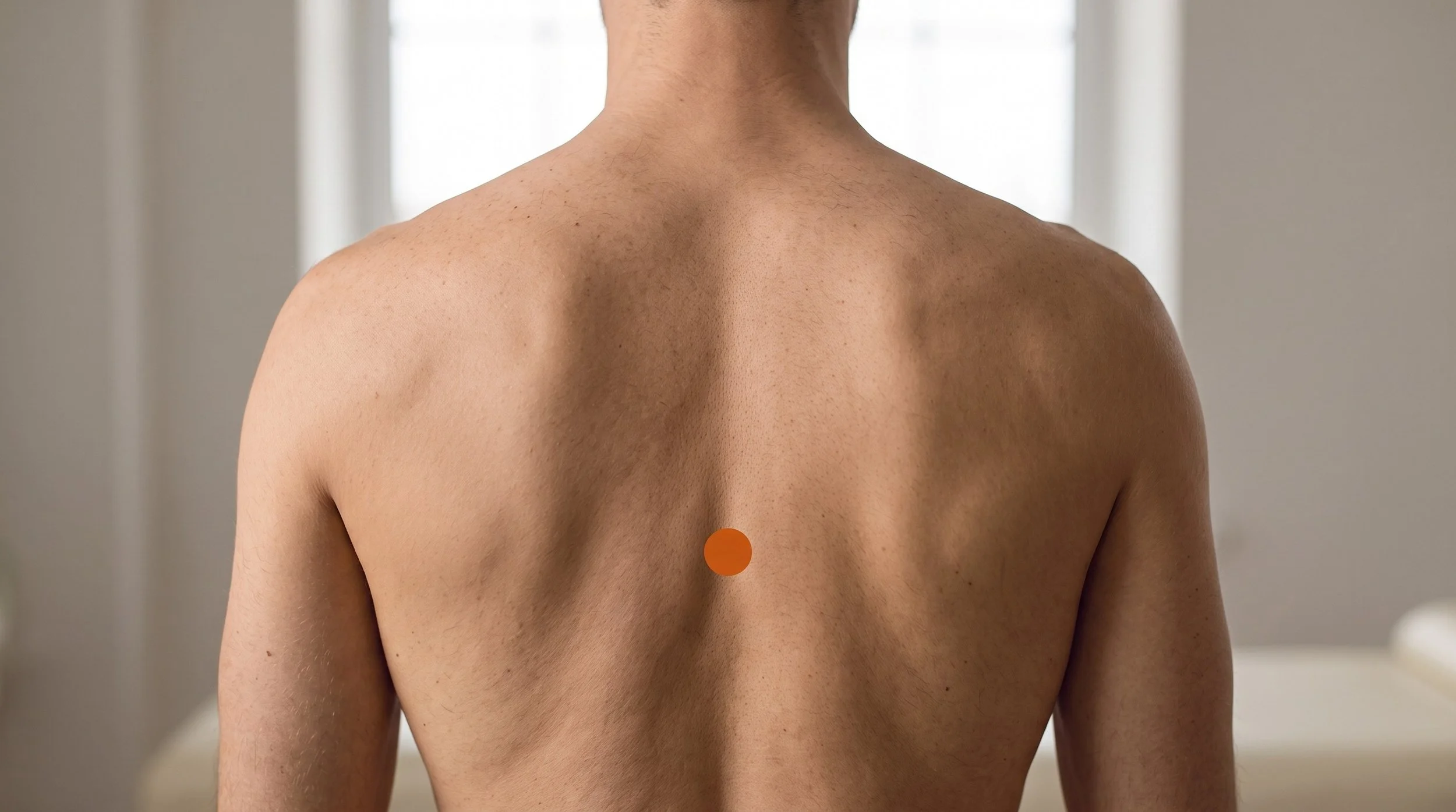
DU9 Acupuncture Point (Zhiyang)
Reaching Yang at the Level of the Diaphragm: Anatomy, Mechanism, and Why This Mid-Thoracic Midline Point Bridges the Chest and the Digestive System
DU9 (Zhiyang, "Reaching Yang"), also written GV9, is the Governing vessel point that sits on the midline of the back in the small depression just below the spinous process of the seventh thoracic vertebra, roughly level with the lower tips of the shoulder blades. It's one of the few midline points that lands exactly at the mechanical and neurological boundary between the chest and the abdomen: the diaphragm attaches at this level, the diaphragm shu points (BL17) sit an inch and a half to either side, and the T7 and T8 spinal segments carry sensory traffic from the lower esophagus, stomach, liver and gallbladder region.
That convergence is why the GV9 acupuncture point shows up in such different-looking treatment plans, from stubborn mid-back stiffness and rib-cage tightness to reflux, upper abdominal discomfort and breathing that never quite feels full.
- Location and layers: DU9 (governing vessel 9) lies on the posterior midline below the T7 spinous process, level with BL17 and approximately level with the inferior angles of the scapulae. A needle here passes through skin and superficial fascia into the supraspinous and interspinous ligament complex, with the multifidus and longissimus columns immediately to either side.
- Traditional categories, read anatomically: classical sources attribute to Zhiyang the functions of fortifying the Spleen, draining dampness, regulating the middle burner and unbinding the chest. Those categories describe a point positioned at the diaphragm line, which in modern terms means a segmental relationship with upper abdominal and lower thoracic viscera rather than any flow of energy.
- Nerve geography: stimulation at this level engages the medial branches of the T7 and T8 dorsal rami and the deep paraspinal tissues they supply, feeding into dorsal horn segments that also receive visceral afferent input, a convergence pattern central to how needling modulates both somatic and referred pain (Zhao, 2008).
- Mechanism beyond the segment: needling recruits A-delta and C fiber afferents that trigger descending inhibition from midbrain and brainstem centers with endogenous opioid involvement (Zhao, 2008), and experimental work shows that needle stimulation drives somato-autonomic reflexes whose effects depend on which body region is stimulated (Liu et al., 2021).
- Research picture: trials almost never isolate a single point, so evidence is indirect. Individual patient data pooling supports modest, durable benefits of acupuncture for chronic musculoskeletal pain (Vickers et al., 2018), while a Cochrane review of chronic nonspecific low back pain found small improvements with cautious confidence in the estimates (Mu et al., 2020). One randomized trial did test needling centered on Zhiyang for reflux-related cough as an add-on to medication (Zhao et al., 2018).
- De qi and practice framing: patients usually report a deep, dull spreading ache or heaviness at the midline that can travel outward toward the ribs, not a sharp or electric sensation. DU9 is needled obliquely upward, typically 0.5 to 1 cun, and is almost always used as part of a mid-thoracic plan rather than alone.
Stuck Between the Shoulder Blades and Nothing Has Helped?
Mid-back stiffness that flares with desk work, deep breaths or long commutes often involves the thoracic paraspinals, the rib joints and the diaphragm all at once. At Morningside Acupuncture we use DU9 with the surrounding BL17 and huatuojiaji points, then add dry needling of the multifidus, longissimus and lower trapezius when a taut band reproduces your pain. Treatment is paired with simple breathing and thoracic mobility work you can repeat at home. Schedule a session and let's map where your mid-back pain actually starts.
Schedule NowAnatomy of DU9: Why the T7 Interspinous Space Is Such an Important Location
Run a finger down the midline of the upper back and you'll feel a row of bony bumps with soft gaps between them. DU9 occupies the gap just below the seventh of those thoracic bumps, seven interspinous spaces down from the prominent vertebra at the base of the neck, and it usually falls at or near the level of the inferior angles of the shoulder blades. From the surface inward the tissue sequence is skin, subcutaneous fat, the thoracolumbar fascia, and then the supraspinous and interspinous ligaments that tie one spinous process to the next.
Flanking that midline gutter are the multifidus and rotatores deep down and the longissimus and iliocostalis columns more superficially, and just lateral to them the rhomboids, middle and lower trapezius, and the costotransverse joints of the seventh and eighth ribs. This is the hinge zone of the trunk: it takes rotational load from reaching and carrying, compressive load from hours of seated flexion, and constant low-grade demand from every breath, since the diaphragm's posterior attachments and the ribs it lifts are all working at this level.
Sensory supply to the tissues around DU9 comes from the medial branches of the T7 and T8 dorsal rami, which innervate the interspinous ligaments, the facet joint capsules and the deep paraspinal muscles. Those same spinal segments receive visceral afferents traveling with the sympathetic chain from the lower esophagus, stomach, duodenum, liver and gallbladder region.
When somatic and visceral inputs converge on shared dorsal horn neurons, the brain can misattribute the source, which is one reason upper abdominal problems commonly present as an ache between the shoulder blades, and why needling into a segment can influence both the muscle and the referral pattern that shares it (Zhao, 2008). Needle stimulation at this depth recruits A-delta and C fiber afferents that engage descending inhibitory pathways from the periaqueductal gray and rostral ventromedial medulla, with endogenous opioid and monoamine mediation (Zhao, 2008).
Animal work has also shown that needle-driven somato-autonomic reflexes are organized by body region and by the depth of tissue engaged, which gives a plausible framework for why a mid-thoracic paraspinal point behaves differently from a limb point (Liu et al., 2021).
The structure that governs technique here is the spinal canal. In the reference literature the canal is described as lying roughly 1.25 to 1.75 cun deep to the skin at this level, varying with body build, so the standard approach is an oblique insertion angled superiorly to a depth of about 0.5 to 1 cun, sliding the needle along the interspinous ligament rather than driving straight in. Perpendicular deep needling is not appropriate at DU9.
Because the point sits over bone and ligament rather than lung tissue, pneumothorax risk at the midline itself is negligible, but any needling that strays laterally into the intercostal spaces must respect pleural depth. Moxibustion is traditionally applied here, and in practice a shallow oblique needle plus warmth is often more comfortable and more effective than depth.
Related Governing Vessel Related Pain Finder Upper Back Shoulder ArmDU9 (GV9) at a Glance: Classification, Location, and Clinical Use
| Category | Detail |
|---|---|
| Traditional Name | Zhiyang (至陽), "Reaching Yang"; alternative classical name Feidi, "Bottom of the Lung" |
| Channel Classification | Governing Vessel (Du mai), point 9; also written GV9 |
| Point Categories | A midline point of the Governing vessel. It is not a five-shu point and carries no hui-meeting or extraordinary vessel intersection designation of its own, but it sits level with BL17, the diaphragm shu and influential point of blood, and its alternative name Feidi records its position at the diaphragm boundary between the middle and upper burners. |
| Precise Location | On the posterior midline of the back, in the depression below the spinous process of the seventh thoracic vertebra, seven interspinous spaces below C7, approximately level with the inferior angles of the scapulae and with BL17. |
| Tissue Stimulated | Skin, thoracolumbar fascia, supraspinous and interspinous ligaments at T7 to T8, with the thoracic multifidus, rotatores and longissimus immediately lateral; clinically related myofascial targets include the thoracic paraspinals and the diaphragm. |
| Needle Depth / Direction | Oblique insertion directed superiorly, 0.5 to 1 cun. Caution: the spinal canal lies roughly 1.25 to 1.75 cun deep depending on body build, so deep perpendicular insertion is avoided. Moxibustion is traditionally applicable. |
| De Qi Sensation | A deep, dull, spreading ache or heaviness at the midline, sometimes described as pressure that eases outward across the mid-back or around the lower ribs. Sharp, burning or electric sensations are not the goal and prompt immediate needle adjustment. |
| Primary Clinical Uses | Mid-thoracic stiffness and midline back pain, rib-cage and interscapular tightness, chest fullness with cough, upper abdominal discomfort and reflux-related symptoms; traditionally emphasized in modern Chinese practice for jaundice and damp-heat patterns of the Liver and Gallbladder. |
| Common Point Combinations |
|
A Manual of Acupuncture, compiled by Deadman and colleagues, presents Zhiyang as a point defined by its position at the diaphragm line, and its traditional attributions split neatly in two directions.
Below the diaphragm it was credited with warming and supporting the digestive center and with draining dampness, and the classical indication lists in that tradition cluster around cold in the Stomach with inability to eat, wasting, rumbling in the abdomen, heaviness and weakness of the limbs, and general malaise, along with the five recognized types of jaundice, a use that modern Chinese practice has kept front and center. Above the diaphragm it was said to open and unbind the chest, and the indications there gather around chest and rib-side fullness, cough and labored breathing.
Like most Governing vessel points, it was also listed for stiffness of the spine and lumbar pain, and one early source added an indication for heat in the Kidneys that later texts quietly dropped. What's striking is that a single midline point acquired two apparently unrelated symptom families, digestive and respiratory, and that both families share the T6 to T9 segmental territory the point actually occupies.
Why DU9 Is Used for Reflux, Upper Abdominal Discomfort and Breathing, Not Just Back Pain
The short answer is segmental. Sensory nerves from the lower esophagus, stomach, gallbladder and the surrounding upper abdominal structures enter the spinal cord around the same T6 to T9 levels that supply the skin, ligaments and deep muscles at DU9. Because those inputs converge on shared neurons in the dorsal horn, irritation in a viscus can present as a deep interscapular ache, and repeated visceral input can leave the paraspinal muscles at that level guarded and tender.
Needling into the segment engages the somatic side of that shared circuit, which is one of the better-established explanations for why local paraspinal points influence referred and visceral-type discomfort (Zhao, 2008).
There's a second layer that is not segment-specific. Needle stimulation activates small-diameter afferents that recruit descending inhibitory control from the periaqueductal gray and rostral ventromedial medulla, with endogenous opioids and monoamines involved, producing analgesia that outlasts the treatment itself (Zhao, 2008). Needling also produces measurable autonomic shifts: a systematic review of heart rate variability studies found changes consistent with reduced sympathetic dominance after acupuncture, though the authors urged caution given the variability across trials (Chung et al., 2014).
Laboratory work in mice has shown that these somato-autonomic responses are organized by body region and by which deep tissue the needle engages, which offers a mechanistic reason why point location matters rather than being incidental (Liu et al., 2021).
On the clinical side, the direct evidence for DU9 specifically is thin but not absent. A randomized trial in a Chinese acupuncture journal tested needling centered on Zhiyang alongside standard acid-suppressing medication for reflux-related cough and reported greater symptom improvement in the combined group than with medication alone (Zhao et al., 2018). That is a single trial, unblinded, in one clinical population, so it should be read as encouraging rather than conclusive.
In practice we treat DU9 as one component of a segmental approach: local needling at the T7 to T8 level, distal points, manual work through the rib cage, and breathing retraining, with medical management of the underlying condition continuing in parallel.
What the Research Shows for DU9 (GV9)
One note on naming before the evidence: in the research literature this point is almost always listed as GV9, the WHO standard code, so GV9 is the term to search if you want to read the studies below in full.
Point-level research is the exception in acupuncture, not the rule. Nearly every high-quality trial tests a multi-point protocol chosen by a practitioner or fixed by a study manual, so the honest framing is that DU9 has been used inside protocols that were studied, rather than being studied on its own. The reviews below tell you what needling protocols in general have achieved for the conditions this point is used within, plus the one randomized trial that placed Zhiyang at the center of the prescription and the mechanistic work that explains how a mid-thoracic paraspinal needle could plausibly matter.
| Study | Type | Focus | Key Finding |
|---|---|---|---|
| Mu et al., 2020 | Cochrane systematic review | Acupuncture for chronic nonspecific low back pain | Acupuncture produced small improvements in pain and function compared with sham and other controls, with the review authors rating certainty in the estimates as low to moderate. |
| Vickers et al., 2018 | Individual patient data meta-analysis | Chronic musculoskeletal, headache and osteoarthritis pain across roughly 20,000 patients | Acupuncture outperformed both sham and no-acupuncture controls, with effects that persisted over about a year, suggesting the benefit is not explained by placebo alone. |
| Zhao et al., 2018 | Randomized controlled trial | Needling at Zhiyang (DU9) and adjacent points plus pantoprazole for damp-heat type gastroesophageal reflux cough | The combined needling and medication group showed greater improvement in cough and reflux symptom scores than medication alone, though the trial was unblinded and single-center. |
| Chung et al., 2014 | Systematic review with meta-analysis | Effect of acupuncture on heart rate variability | Pooled data suggested acupuncture may shift autonomic indices toward reduced sympathetic dominance, with the authors cautioning about heterogeneity and study quality. |
| Liu et al., 2021 | Experimental neuroscience study (mice) | Neuroanatomical basis of point-specific somato-autonomic reflexes | Specific deep fascia sensory neurons were required for low-intensity electroacupuncture to drive a vagal pathway, indicating that the tissue and body region needled shape the systemic response. |
| Zhao, 2008 | Narrative review of mechanism research | Neural mechanisms of acupuncture analgesia | Analgesic effects are attributed to afferent activation of segmental spinal circuits and descending inhibitory pathways with endogenous opioid involvement. |
Reflux, Bloating or Chest Tightness That Tracks With Stress?
Upper abdominal discomfort, throat clearing and a chest that feels compressed frequently share the same T6 to T9 segmental territory that DU9 sits on. Our clinicians combine Zhiyang acupuncture with points on the arms and legs, gentle diaphragm release and paced breathing to reduce guarding through the lower rib cage. Nothing here replaces gastroenterology care, and we'll tell you plainly when a medical workup should come first. Book a visit and we'll build a plan that works alongside your existing treatment.
Schedule NowDU9 in the Context of Trigger Point Work
Acupuncture is the use of an acupuncture needle, and that includes dry needling, so at Morningside a DU9 treatment and a thoracic dry needling treatment are not separate categories of care. They're different targeting logics applied with the same tool. DU9 gives us a midline, ligamentous, segmental target at T7 to T8.
Trigger point work gives us muscle-specific targets nearby: the thoracic multifidus and rotatores that sit in the paraspinal gutter within a finger's width of the point, the longissimus and iliocostalis columns that generate deep aching along the mid-back, and the lower trapezius and rhomboids that produce the classic burning between the shoulder blades. The trigger point literature documents that latent and active bands in these muscles refer pain in patterns patients rarely describe as coming from a muscle at all (Simons et al., 1999).
In a typical mid-back session we start by reproducing the complaint with palpation. If pressure on a taut band in the multifidus at the T7 level recreates the ache, that band is needled directly with careful attention to depth and angle over the thoracic wall. DU9 is then added obliquely and superiorly along the midline, often with BL17 bilaterally and the huatuojiaji points at the same level, so the segment is treated as a unit rather than as isolated spots.
When the presentation includes rib restriction or shallow breathing we add diaphragm-focused manual work and breathing drills, since a mid-back that cannot rotate and a rib cage that cannot expand tend to keep feeding each other. Needling protocols of this kind have shown small to moderate benefits for chronic back pain in pooled analyses (Mu et al., 2020; Vickers et al., 2018), which matches what we see clinically: meaningful relief that holds best when it's paired with movement.
DU9 Mid-Back and Chest Tension Treatment at NYC's Highest-Rated Acupuncture Clinic
Morningside Acupuncture is the highest-rated acupuncture and dry needling clinic in New York City with over 500 five-star Google reviews, and our Upper West Side practice sees mid-thoracic pain, rib restriction and stress-driven breathing patterns every week. Every session starts with an orthopedic and postural assessment so points like DU9 are chosen for your presentation rather than from a template. You'll leave knowing what we found, what we needled and what to do between visits. Schedule your appointment today.
Schedule NowFrequently Asked Questions
Is DU9 the same point as GV9?
Yes. DU9 and GV9 are two codes for the same point, Zhiyang. DU comes from Du Mai, the Chinese name of the Governing Vessel, and it is the code used in most Chinese texts and many acupuncture schools. GV is the WHO standard abbreviation and the one you will see in most Western textbooks and research papers. You will also come across it written as Du 9, GV-9, or Governing Vessel 9. Whichever code is used, the location and the uses are the same.
What does DU9 feel like when needled?
Most patients describe a deep, dull, spreading pressure or heaviness right at the midline of the mid-back, sometimes with a sense of the ache easing outward toward the ribs or downward along the spine. Because the needle is angled upward along the ligament rather than pushed straight in, the sensation tends to build slowly rather than arriving suddenly. A brief muscle twitch can occur if a taut paraspinal band is engaged nearby. Sharp, burning or electric sensations are not expected, and any of those means the needle should be adjusted or withdrawn right away.
Why needle a point on my back for reflux or stomach symptoms?
DU9 sits at the T7 to T8 spinal level, and sensory nerves from the lower esophagus, stomach and upper abdominal organs enter the cord at roughly the same segments. Because those inputs share dorsal horn neurons with the skin, ligaments and muscles of the mid-back, treating the back segment can influence the muscular guarding and referred discomfort that accompany upper digestive complaints (Zhao, 2008). One randomized trial has tested needling centered on this point alongside medication for reflux-related cough, with encouraging but preliminary results (Zhao et al., 2018). This is a supportive approach, not a substitute for medical evaluation of reflux, gallbladder or liver symptoms.
Can I press DU9 myself between sessions?
You can, though its midline position makes self-application awkward, so most people do better with a tool than with fingers. Sit upright and place a tennis or lacrosse ball between your mid-back and a wall, positioning it just below the bump of the seventh thoracic vertebra at about the level of the bottom tips of your shoulder blades. Lean back gently until you feel a firm, tolerable pressure of roughly four or five out of ten, then hold for 30 to 60 seconds while breathing slowly into the lower ribs, and repeat two or three times. You can also work the paraspinal tissue an inch or so to either side for another minute per side. Do this once or twice a day, ease off if the pressure feels sharp or radiates into the ribs, and stop entirely if you have osteoporosis, a recent spinal injury or unexplained mid-back pain that needs a diagnosis first.
Is DU9 safe to needle?
It is safe in trained hands, and technique is what makes it so. The spinal canal lies roughly 1.25 to 1.75 cun deep at this level depending on body build, so the accepted approach is a shallow oblique insertion angled superiorly to about 0.5 to 1 cun, never a deep perpendicular one. Because the point is on bone and ligament at the midline, lung risk at DU9 itself is minimal, though needling that drifts laterally into the intercostal spaces must respect pleural depth. Practitioners take extra care with patients on blood thinners, with local skin infection or rash, with spinal hardware or recent surgery at this level, and with anyone whose mid-back pain has red flag features that call for imaging or referral instead of needling.
Where exactly is DU9 located?
Find the prominent bump at the base of the neck when you tip your head forward, which is usually C7, then count down seven spinous processes to T7. DU9 is in the small depression immediately below that seventh thoracic spinous process, exactly on the midline. A quicker cross-check for DU 9 back location: with the arms relaxed at the sides, the point usually sits at about the level of the lower tips of the shoulder blades, and the diaphragm shu points (BL17) fall 1.5 cun to either side of it. Counting from C7 is more reliable than the scapular landmark, since shoulder position varies considerably between people.
References
- Deadman, P., Al-Khafaji, M., & Baker, K. (2009). A manual of acupuncture. Journal of Chinese Medicine Publications.
- Kim, H. (2008). Handbook of Oriental medicine (3rd ed.). Harmony & Balance Press.
- Cunningham, P. M. (2000). Acupuncture points: A practical guide to classical and modern usage. Odyssey Press.
- Simons, D. G., Travell, J. G., & Simons, L. S. (1999). Travell & Simons' myofascial pain and dysfunction: The trigger point manual, Vol. 1: Upper half of body (2nd ed.). Williams & Wilkins.
- Mu, J., Furlan, A. D., Lam, W. Y., Hsu, M. Y., Ning, Z., & Lao, L. (2020). Acupuncture for chronic nonspecific low back pain. Cochrane Database of Systematic Reviews, 2020(12), CD013814. https://doi.org/10.1002/14651858.CD013814
- Vickers, A. J., Vertosick, E. A., Lewith, G., MacPherson, H., Foster, N. E., Sherman, K. J., Irnich, D., Witt, C. M., & Linde, K. (2018). Acupuncture for chronic pain: Update of an individual patient data meta-analysis. Journal of Pain, 19(5), 455-474. https://doi.org/10.1016/j.jpain.2017.11.005
- Zhao, Z. Q. (2008). Neural mechanism underlying acupuncture analgesia. Progress in Neurobiology, 85(4), 355-375. https://doi.org/10.1016/j.pneurobio.2008.05.004
- Zhao, L., Li, X., & Shi, Z. (2018). Clinical observation of acupuncture at Zhiyang (GV 9) Bazhen points combined with pantoprazole for gastroesophageal reflux cough with damp-heat type. Zhongguo Zhen Jiu (Chinese Acupuncture and Moxibustion), 38(3), 239-242. https://doi.org/10.13703/j.0255-2930.2018.03.003
- Liu, S., Wang, Z., Su, Y., Qi, L., Yang, W., Fu, M., Jing, X., Wang, Y., & Ma, Q. (2021). A neuroanatomical basis for electroacupuncture to drive the vagal-adrenal axis. Nature, 598(7882), 641-645. https://doi.org/10.1038/s41586-021-04001-4
- Chung, J. W. Y., Yan, V. C. M., & Zhang, H. (2014). Effect of acupuncture on heart rate variability: A systematic review. Evidence-Based Complementary and Alternative Medicine, 2014, 819871. https://doi.org/10.1155/2014/819871
Disclaimer: This web site is intended for educational and informational purposes only. Reading this website does not constitute providing medical advice or any professional services. This information should not be used for diagnosing or treating any health issue or disease. Those seeking medical advice should consult with a licensed physician. Seek the advice of a medical doctor or other qualified health professional for any medical condition. If you think you have a medical emergency, call 911 or go to the emergency room. No acupuncturist-patient relationship is created by reading this website or using the information. Morningside Acupuncture PLLC and its employees and contributors do not make any express or implied representations with respect to the information on this site or its use. For any legal interpretation of scope of practice in your state, consult a licensed attorney or regulatory authority.
Read more from our blog



