BL38 Acupuncture Point (Fuxi)
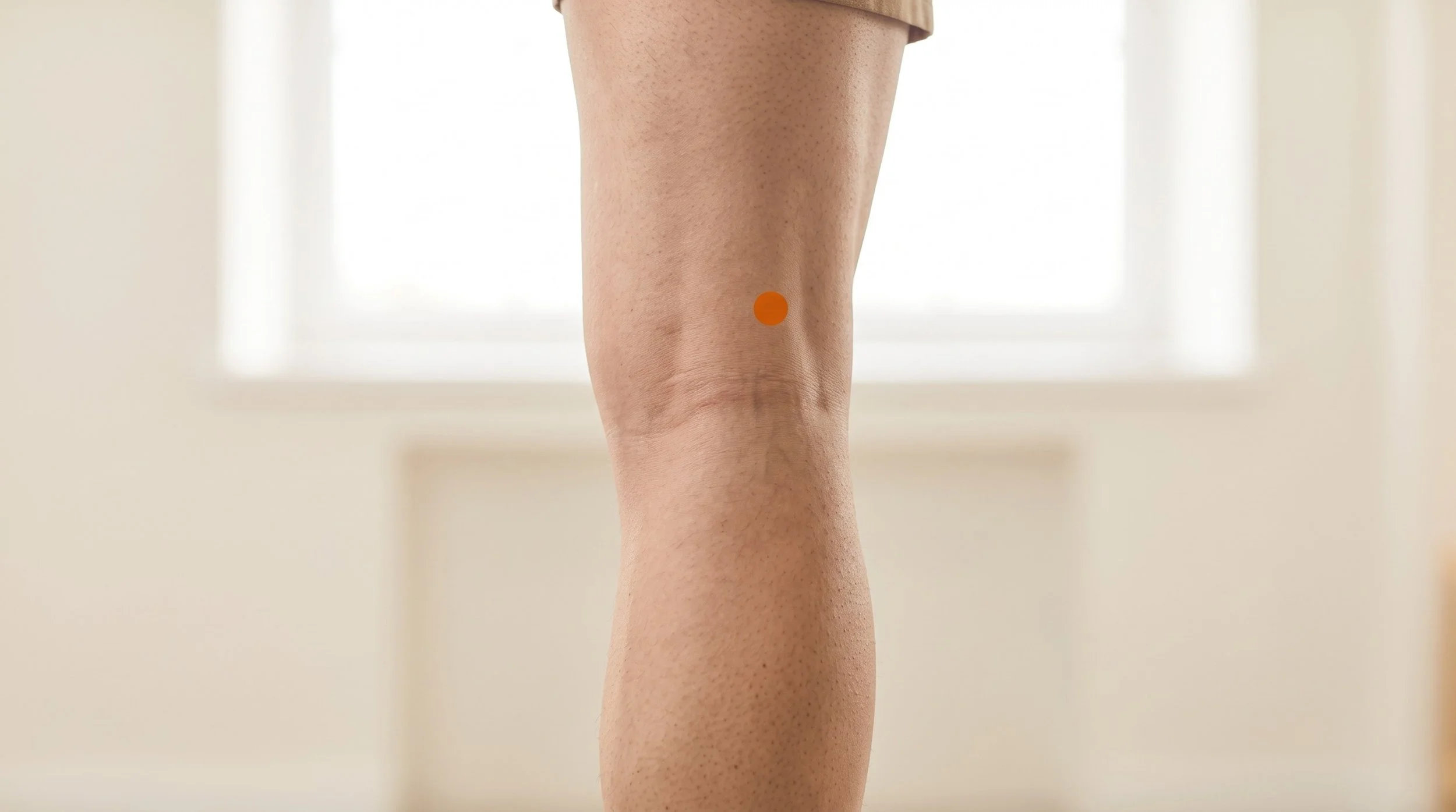
BL38 Acupuncture Point (Fuxi)
The Floating Cleft Beside the Hamstring Tendon: Anatomy, Mechanism, and Why This Small Bladder Channel Point Matters for Knee and Hamstring Tension
BL38 (Fuxi, translated as Floating Cleft) sits in the narrow groove just above and slightly outside the back of the knee, one cun above BL39 on the inner edge of the biceps femoris tendon, and it's found most easily with the knee slightly bent. It's a minor point by classical reputation and a useful one by modern anatomy: the needle sits at the upper lateral corner of the popliteal fossa, right where the lateral hamstring tendon, the popliteal fascia, and the descending common fibular (peroneal) nerve all crowd into a small space.
For patients who describe a pulling, gripping, or cramping sensation behind and outside the knee after running, cycling, or long hours at a desk, the bl38 acupuncture point is a precise place to work. Traditional texts also assign it a second and rather different role, clearing heat patterns affecting the bowels and urination, which we present here as a traditional attribution rather than a mechanism.
- Location and layers: BL38 lies 1 cun above BL39 on the medial side of the biceps femoris tendon, with the knee slightly flexed, so the needle passes through skin and subcutaneous tissue into the fascial groove between the lateral hamstring tendon and the underlying popliteal contents (Deadman et al., 2007; Cunningham, 1996).
- Traditional categories, restated: classical sources credit Fuxi with relaxing the sinews, easing pain, clearing heat, and softening contraction (Deadman et al., 2007; Kim, 2013). In modern terms, those descriptions map onto reduced tone in a chronically loaded musculotendinous junction and reduced local nociceptive input.
- Nerve geography: the common fibular nerve descends along the inner border of the biceps femoris tendon at this level, and the posterior femoral cutaneous nerve supplies the overlying skin, which places BL38 in the L4 to S2 segmental territory shared by the buttock, lateral thigh, and lateral calf (Chinese Acupuncture and Moxibustion, 1980).
- Mechanism: needling here recruits A-delta and group III afferents that converge with deeper somatic input in the dorsal horn and engage descending inhibitory pathways from the periaqueductal grey and rostral ventromedial medulla (Zhao, 2008), which may help explain why patients often report easing beyond the exact needle site.
- Research picture: no trial has isolated bl 38 knee needling on its own, so the evidence comes from multi-point protocols. Individual patient data pooling across chronic pain trials suggests modest but persistent benefits over sham and no-acupuncture control (Vickers et al., 2018), and Cochrane work in peripheral joint osteoarthritis reports small improvements in pain and function (Manheimer et al., 2010).
- De qi and dosing: a correctly placed needle usually produces a heavy, spreading ache in the outer knee crease rather than sharpness, and any electric or shooting sensation down the outer calf means the needle is too close to the fibular nerve and should be withdrawn and redirected (Deadman et al., 2007).
Tight, Gripping Pain Behind the Outer Knee?
That pulling sensation at the back and outside of the knee often traces to the lateral hamstring and the fascia crowding the upper corner of the popliteal fossa. At Morningside Acupuncture we palpate the groove medial to the biceps femoris tendon, needle BL38 with careful angling away from the fibular nerve, and pair it with BL39, BL40, and BL57 to address the whole posterior chain. Most patients notice a change in stretch tolerance within a session or two. Schedule a visit and let's map where your tension actually lives.
Schedule NowAnatomy of BL38: Why the Groove Beside the Biceps Femoris Tendon Is Such an Important Location
Find BL38 with the knee slightly bent so the biceps femoris tendon stands out as a firm cord heading toward the fibular head. The point sits in the soft cleft on the inner side of that cord, one cun above the level of BL39 at the lateral end of the knee crease. The tissue here is thin: skin, a modest layer of subcutaneous fat, then the dense fascial sleeve of the tendon and the fat pad filling the upper corner of the popliteal fossa.
What loads this area is repetitive knee flexion under tension, sprinting and deceleration, cycling with a low saddle, prolonged sitting with the knee bent, and any habit that leaves the lateral hamstring working overtime to control rotation at the knee.
Nerve geography is what makes this point clinically interesting. At this level the sciatic nerve has already divided, and the common fibular nerve travels along the medial border of the biceps femoris tendon before winding around the fibular neck, while the skin above is supplied by the posterior femoral cutaneous nerve (Chinese Acupuncture and Moxibustion, 1980). That means a needle here stimulates tissue innervated from roughly L4 to S2, the same segmental pool that serves the buttock, lateral thigh, and outer calf.
Afferent traffic generated by needling converges with input from those structures in the dorsal horn, and it also recruits descending inhibition through brainstem circuits and endogenous opioid mechanisms (Zhao, 2008). Practically, this is why a point at the knee can influence sensations reported further up the leg.
Deeper and slightly medial lie the popliteal artery and vein and the superolateral genicular vessels, so needling stays superficial to the neurovascular bundle. Standard depth ranges from 0.5 to 1.5 cun with perpendicular insertion, angled into the fascial groove rather than aimed into the fossa itself (Deadman et al., 2007; Kim, 2013). Moxibustion is described as applicable in the classical literature (Chinese Acupuncture and Moxibustion, 1980).
In our clinic we use a shorter, more conservative depth when a patient is thin or when the fibular nerve is easy to palpate, and we stop and redirect immediately if a needle produces electrical sensation traveling toward the outer ankle.
Related Acupuncture For Biceps Femoris Muscle Pain Related Biceps Femoris Trigger PointsBL38 at a Glance: Classification, Location, and Clinical Use
| Category | Detail |
|---|---|
| Traditional Name | Fuxi (Floating Cleft), BL38, also written Bladder 38 and listed historically as B-52 in older numbering systems |
| Channel Classification | Foot Taiyang Bladder channel, lower limb, posterior thigh and knee region |
| Point Categories | No five-shu, hui-meeting, or extraordinary vessel designations are recorded for this point in the standard references. It's classified simply as a regular channel point of the Bladder channel, described by Cunningham (1996) as a minor or lesser-used point. Sterman (2011) lists BL38 among the harmonizing points used in luo channel protocols, being the point one position proximal to the he-sea point BL40. |
| Precise Location | On the back of the knee, 1 cun above BL39, on the medial side of the biceps femoris tendon. Locate with the knee slightly flexed. This fuxi point location sits at the upper lateral corner of the popliteal fossa. |
| Tissue Stimulated | Skin and subcutaneous tissue over the distal tendon and musculotendinous junction of the biceps femoris, the popliteal fascia, and the fat of the upper lateral popliteal fossa; the common fibular nerve lies immediately medial to the tendon at this level |
| Needle Depth / Direction | Perpendicular insertion 0.5 to 1.5 cun, directed into the groove medial to the tendon and away from the neurovascular bundle; moxibustion is described as applicable in classical sources |
| De Qi Sensation | A heavy, spreading, slightly achy fullness in the outer knee crease, sometimes felt as a soft tug along the hamstring tendon; sharp, electric, or shooting sensations toward the outer calf indicate proximity to the fibular nerve and call for repositioning |
| Primary Clinical Uses | Tightness and cramping behind the knee, lateral hamstring and outer thigh pain, numbness or heaviness of the buttock and posterior thigh, popliteal contraction, and traditionally described heat patterns affecting stool and urination |
| Common Point Combinations |
|
Deadman's Manual of Acupuncture presents Fuxi as a point that relaxes the sinews and relieves pain while also clearing heat and softening contraction, and its indication list splits neatly in two. On the musculoskeletal side are numbness of the buttock, contraction of the sinews in the popliteal fossa, contraction and pain along the outer thigh, and cramping during sudden turmoil disorder.
On the internal side are patterns described as Small Intestine heat, knotting of the Large Intestine, and hot urination, with the Great Compendium recording a pairing of BL38 with KI15 for heat in the lower abdomen accompanied by hard stools. Kim's text and Chinese Acupuncture and Moxibustion keep the emphasis narrower, listing numbness of the gluteal and femoral regions and contracture of the popliteal tendons, while Cunningham groups it with hamstring, posterior leg, and calf complaints and notes that it isn't used heavily in practice.
What's striking is the combination itself: a small local point beside a knee tendon that classical authors also asked to address burning urination and constipation, a reminder that traditional point indications were organized by pattern rather than by anatomy.
Why BL38 Is Used for Buttock Numbness and Outer Leg Symptoms That Feel Like Sciatica
Patients are often surprised that a point at the knee gets attention when their complaint is numbness in the buttock or a band of ache down the outside of the thigh. The explanation is segmental. The tissue at BL38 draws innervation from roughly L4 to S2 through the common fibular and posterior femoral cutaneous nerves (Chinese Acupuncture and Moxibustion, 1980), the same spinal levels that supply the gluteal region, the lateral thigh, and the outer calf.
Sensory input from those regions converges on shared dorsal horn neurons, so stimulating one part of the territory can modify how the whole territory is processed. That's the modern reading of the classical indication for numbness of the buttock listed under this point (Deadman et al., 2007).
There's a second layer. Needling that produces a genuine de qi sensation activates ascending pathways that trigger descending inhibition from the periaqueductal grey and rostral ventromedial medulla, along with the release of endogenous opioids and other neurochemical mediators (Zhao, 2008). This is a systemic effect, not a local one, and it may explain why patients frequently report a general softening of leg tension rather than a change confined to the needle site.
Finally, there's a mechanical contribution. Needling into a taut musculotendinous junction may reduce local tone and improve tolerance to stretch, and controlled work on the hamstrings supports that idea: a single-blind randomized trial found that one session of dry needling improved hamstring flexibility in people with hamstring tightness, comparable to static stretching (Alaei et al., 2021). BL38 sits directly over the lateral hamstring's distal tendon, which makes it a sensible place to apply that principle when the outer knee feels short and gripping.
What the Research Shows for BL38
It's worth being clear about what the evidence can and can't say. No randomized trial has tested Fuxi in isolation, and it isn't a headline point in the way BL40 or ST36 are, so its research profile is inherited from the multi-point protocols it appears in. The reasonable claim is that acupuncture as a whole shows modest, repeatable benefits for knee osteoarthritis, chronic musculoskeletal pain, and sciatica-type presentations, and that BL38 is one anatomically defensible contributor within those protocols when the lateral popliteal region is tender.
Studies also vary widely in point selection, needle stimulation, and session number, which limits how precisely any single point's contribution can be estimated.
| Study | Type | Focus | Key Finding |
|---|---|---|---|
| Vickers et al., 2018 | Individual patient data meta-analysis | Chronic musculoskeletal pain, headache, and osteoarthritis across roughly 39 trials | Acupuncture was more effective than both sham and no-acupuncture control, with effects that persisted over time rather than fading immediately after treatment. |
| Manheimer et al., 2010 | Cochrane systematic review | Acupuncture for peripheral joint osteoarthritis, including the knee | Reviewers reported small improvements in pain and physical function at 8 and 26 weeks, with the clinical importance of those changes uncertain. |
| Zhang et al., 2023 | Systematic review and meta-analysis | Acupuncture therapy for sciatica across 30 randomized controlled trials | Acupuncture was associated with greater pain reduction than medication comparisons, though the authors flagged methodological limitations in the included trials. |
| Alaei et al., 2021 | Single-blind randomized controlled trial | Dry needling versus static stretching for hamstring tightness in healthy adults | A single needling session improved hamstring flexibility, suggesting that needling a tight posterior thigh may change stretch tolerance quickly. |
| Zhao, 2008 | Narrative review of mechanisms | Neural mechanisms underlying acupuncture analgesia | Needle stimulation engages spinal and supraspinal circuits, including descending inhibitory pathways and endogenous opioid release. |
Hamstring Strain, Cycling Knee, or Marathon Training Tightness?
Runners and cyclists in New York City load the lateral hamstring hard, and the tendon near the knee crease is often the first place that complains. We combine BL38 with dry needling of the biceps femoris, plus targeted work in the calf and glutes, so the leg moves better rather than simply hurting less for a day. Treatment is paired with practical loading advice you can use between sessions. Book an appointment and get ahead of it before the next training block.
Schedule NowBL38 in the Context of Trigger Point Work
BL38 overlaps almost exactly with the distal end of the biceps femoris, and the trigger point literature describes referral from the lateral hamstring into the back of the knee and upper calf, a pattern patients often mislabel as a knee joint problem (Simons et al., 1999). When palpation at the point reproduces a familiar ache, we treat the region as a myofascial target rather than a purely local one, needling the taut band in the muscle belly higher in the thigh and then addressing the tendinous junction at the knee crease.
Acupuncture is defined by the use of an acupuncture needle, and dry needling is one of the hundreds of styles that use it, so this isn't a different treatment so much as a different reasoning path to the same tissue.
In practice we rarely stop at one muscle. Lateral hamstring tension frequently travels with gastrocnemius and soleus involvement, gluteal restriction, and irritability along the lateral line of the thigh, so a session might combine BL38 with calf needling, gluteal work, and hip mobility retraining. We're conservative around the fibular nerve here, favoring shallower needling and a slightly medial angle, and we always check for changes in knee extension range and stretch tolerance after the needles come out so that the treatment is measured rather than assumed.
BL38 Knee and Hamstring Treatment at NYC's Highest-Rated Acupuncture Clinic
Morningside Acupuncture is the highest-rated acupuncture and dry needling clinic in New York City with over 500 five-star Google reviews, and we treat knee, hamstring, and sciatica-like leg complaints every day. Our approach blends classical point selection like Fuxi with orthopedic assessment and trigger point needling of the muscles that actually reproduce your symptoms. You'll leave each visit knowing what we found and what to do next. Schedule your appointment today.
Schedule NowFrequently Asked Questions
What does BL38 feel like when needled?
Most patients feel a dull, heavy, spreading fullness right in the outer corner of the knee crease, sometimes with a soft tugging sensation along the hamstring tendon. That's de qi, and it typically settles within a few seconds. What you shouldn't feel is a sharp, electric, or buzzing sensation running down toward the outer calf or the top of the foot. That indicates the needle is near the common fibular nerve, and your practitioner should withdraw and redirect. Mild tenderness for a day afterward is normal, especially if the area was already irritable.
Why needle at the knee when my pain is in my buttock or outer thigh?
Because the tissue at BL38 shares spinal innervation with those regions. The common fibular and posterior femoral cutaneous nerves at this level draw from roughly L4 to S2, the same segments that serve the gluteal area, lateral thigh, and outer calf (Chinese Acupuncture and Moxibustion, 1980). Sensory input from all of those areas converges on shared neurons in the dorsal horn, and needling also recruits descending inhibitory pathways from the brainstem (Zhao, 2008). Classical texts arrived at the same clinical territory by different reasoning, listing numbness of the buttock and contraction of the outer thigh among the indications for this point (Deadman et al., 2007).
Can I press BL38 myself between sessions?
Yes, and it's easy to reach. Sit with your knee bent to about 30 degrees and find the firm cord of the biceps femoris tendon at the outer back of your knee. Slide your thumb just to the inner side of that cord and move about a finger's width up from the knee crease, into the soft groove. Apply steady, moderate pressure for 30 to 60 seconds, breathing normally, then release. Repeat two or three times per side and finish with a gentle hamstring stretch. Keep the pressure firm but comfortable, and stop immediately if you feel tingling or electrical sensation traveling down the outside of your calf, since that means you're compressing the nerve rather than the soft tissue. Once or twice a day is plenty.
Is BL38 safe to needle?
In trained hands, yes. The main considerations are the common fibular nerve running along the inner edge of the biceps femoris tendon and the popliteal vessels lying deeper and more medially, which is why standard practice is perpendicular insertion into the fascial groove at a controlled depth of roughly 0.5 to 1.5 cun rather than deep angling into the fossa (Deadman et al., 2007; Kim, 2013). Practitioners use extra caution with thin patients, with anyone taking anticoagulants, and with anyone who has a history of fibular nerve irritation or foot drop. Transient soreness or a small bruise is the most common side effect. If you have a known popliteal aneurysm, a deep vein thrombosis history, or a recent knee surgery, tell your practitioner before treatment.
Where exactly is BL38 located?
BL38 is on the back of the knee, 1 cun above BL39, on the medial side of the biceps femoris tendon, and it's located with the knee slightly flexed (Deadman et al., 2007). In plain terms: find the outer end of the knee crease, identify the tendon cord heading toward the head of the fibula, then move to the inner side of that cord and up about one thumb width. You should land in a small hollow rather than on the tendon itself. Because the point sits in that cleft, patients with lateral hamstring tightness usually find it noticeably tender on the affected side compared with the other leg.
References
- Deadman, P., Al-Khafaji, M., & Baker, K. (2009). A manual of acupuncture. Journal of Chinese Medicine Publications.
- Cheng, X. (Ed.). (1999). Chinese acupuncture and moxibustion (Rev. ed.). Foreign Languages Press.
- Kim, H. (2008). Handbook of Oriental medicine (3rd ed.). Harmony & Balance Press.
- Cunningham, P. M. (2000). Acupuncture points: A practical guide to classical and modern usage. Odyssey Press.
- Cecil-Sterman, A. (2012). Advanced acupuncture: A clinic manual. Classical Wellness Press.
- Simons, D. G., Travell, J. G., & Simons, L. S. (1999). Travell & Simons' myofascial pain and dysfunction: The trigger point manual, Vol. 1: Upper half of body (2nd ed.). Williams & Wilkins.
- Vickers, A. J., Vertosick, E. A., Lewith, G., MacPherson, H., Foster, N. E., Sherman, K. J., Irnich, D., Witt, C. M., & Linde, K. (2018). Acupuncture for chronic pain: Update of an individual patient data meta-analysis. Journal of Pain, 19(5), 455-474. https://doi.org/10.1016/j.jpain.2017.11.005
- Manheimer, E., Cheng, K., Linde, K., Lao, L., Yoo, J., Wieland, S., van der Windt, D. A. W. M., Berman, B. M., & Bouter, L. M. (2010). Acupuncture for peripheral joint osteoarthritis. Cochrane Database of Systematic Reviews, 2010(1), CD001977. https://doi.org/10.1002/14651858.CD001977.pub2 [VERIFY BEFORE PUBLISHING]
- Zhang, Z., Hu, T., Huang, P., Yang, M., Huang, Z., Xia, Y., Zhang, X., Zhang, X., & Ni, G. (2023). The efficacy and safety of acupuncture therapy for sciatica: A systematic review and meta-analysis of randomized controlled trials. Frontiers in Neuroscience, 17, 1097830. https://doi.org/10.3389/fnins.2023.1097830
- Alaei, P., Nakhostin Ansari, N., Naghdi, S., Fakhari, Z., Komesh, S., & Dommerholt, J. (2021). Dry needling for hamstring flexibility: A single-blind randomized controlled trial. Journal of Sport Rehabilitation, 30(3), 452-457. https://doi.org/10.1123/jsr.2020-0111 [VERIFY BEFORE PUBLISHING]
- Zhao, Z. Q. (2008). Neural mechanism underlying acupuncture analgesia. Progress in Neurobiology, 85(4), 355-375. https://doi.org/10.1016/j.pneurobio.2008.05.004
Disclaimer: This web site is intended for educational and informational purposes only. Reading this website does not constitute providing medical advice or any professional services. This information should not be used for diagnosing or treating any health issue or disease. Those seeking medical advice should consult with a licensed physician. Seek the advice of a medical doctor or other qualified health professional for any medical condition. If you think you have a medical emergency, call 911 or go to the emergency room. No acupuncturist-patient relationship is created by reading this website or using the information. Morningside Acupuncture PLLC and its employees and contributors do not make any express or implied representations with respect to the information on this site or its use. For any legal interpretation of scope of practice in your state, consult a licensed attorney or regulatory authority.
Read more from our blog