BL34 Acupuncture Point (Xialiao)
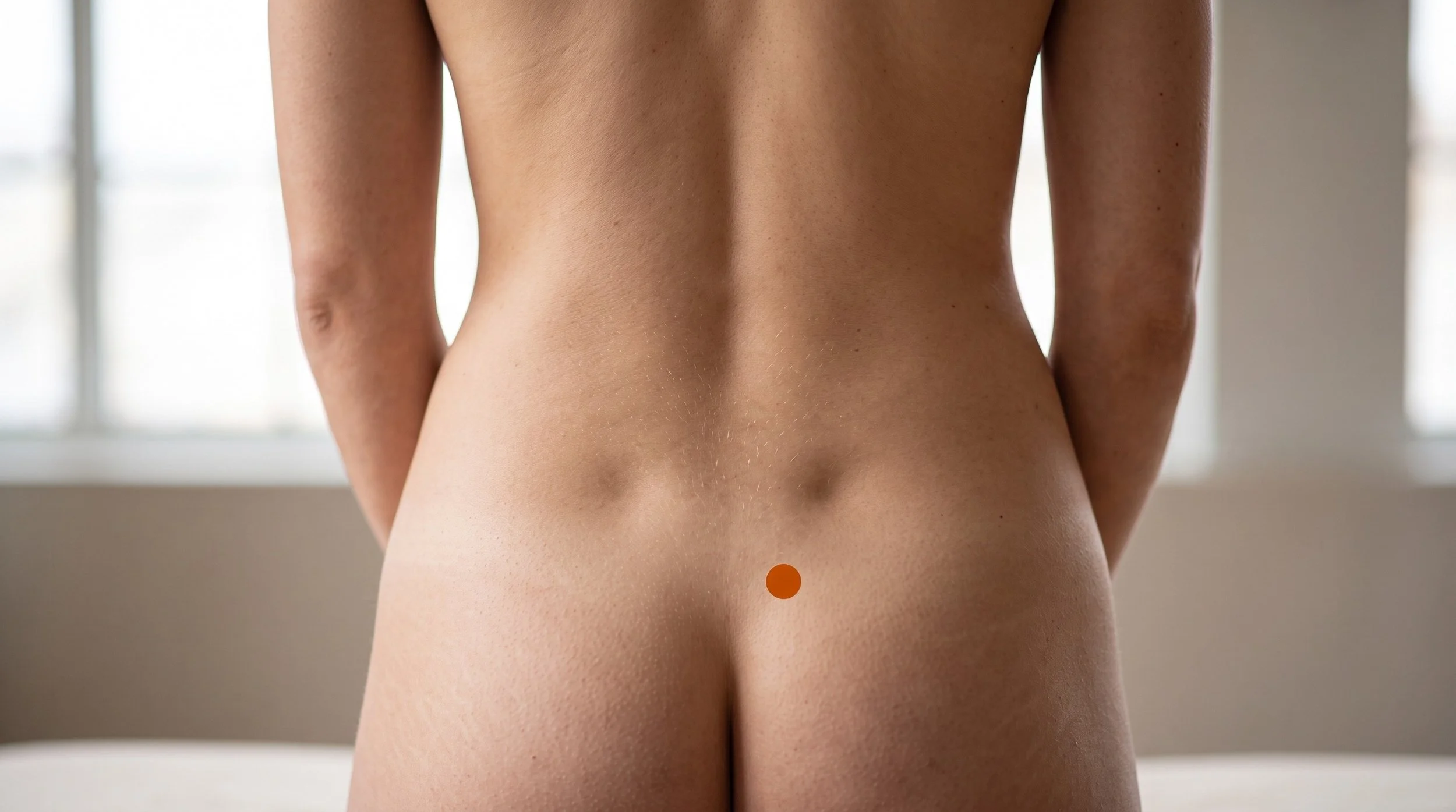
BL34 Acupuncture Point (Xialiao)
The Lower Crevice at the Fourth Sacral Foramen: Anatomy, Mechanism, and Why This Deep Sacral Point Anchors Pelvic Floor and Low Back Treatment
BL34 (Xialiao, translated as Lower Crevice) is the fourth and lowest member of the eight liao, the paired set of points that sit directly over the posterior sacral foramina. You'll find the bl34 acupuncture point low on the sacrum, roughly two to three finger widths below the dimples of the sacroiliac joints and close to the midline, where the bone thins and the last usable foramen opens beneath the fingertip.
Classical texts group it with BL31, BL32, and BL33 and describe it as a meeting point of the Bladder and Gall Bladder channels (Deadman et al., 2007), while modern anatomy explains its interest differently: the fourth posterior sacral foramen sits directly over the S4 segment, which contributes to the pudendal nerve and the pelvic splanchnic supply of the bladder neck, anorectum, and pelvic floor.
That makes bladder 34 one of the most caudal points on the body where a needle can approach sacral nerve territory, which is why it turns up in protocols for sacral and coccyx-region pain, pelvic floor complaints, and lower urinary and bowel symptoms.
- Location and layers: BL34 lies over the fourth posterior sacral foramen, deep to skin, the sacral fascia, the aponeurotic origin of the erector spinae, and fibers arising from the gluteus maximus (Ellis et al., 1991; Shanghai College of Traditional Chinese Medicine, 1981). Needling is perpendicular at 0.5 to 1 cun, or 1.5 to 2 cun when the practitioner intends to enter the foramen itself (Deadman et al., 2007).
- Traditional categories, translated: classical sources attribute to BL34 the ability to regulate the lower jiao, ease urination and defecation, address menstrual and discharge complaints, and benefit the lumbar region and legs (Deadman et al., 2007; Ellis et al., 1991). In neurophysiological terms these are the functions of tissue innervated by the lowest sacral segments.
- Nerve story: the point overlies the posterior ramus of the fourth sacral nerve, and the corresponding anterior rami feed the pudendal nerve and pelvic splanchnic outflow (Ellis et al., 1991). Segmental convergence at the sacral cord gives somatic input from this area access to the same dorsal horn neurons that receive pelvic visceral afferents (Zhao, 2008).
- Research picture: no trial has tested BL34 alone, but its immediate neighbors have been studied. Sacral foramen electroacupuncture reduced urine leakage in women with stress urinary incontinence compared with sham (Liu et al., 2017), and acupuncture protocols including sacral points improved symptoms of chronic prostatitis and chronic pelvic pain syndrome (Sun et al., 2021).
- Clinical framing: at Morningside we treat BL34 as a regional access point rather than a standalone remedy, combining it with the rest of the eight liao, lumbar segmental points, and manual or exercise-based care. Broader evidence supports acupuncture for chronic musculoskeletal pain generally (Vickers et al., 2018), with Cochrane assessing low back pain benefits as modest and short-term (Mu et al., 2020).
- De qi: superficial needling produces a dull, spreading soreness over the sacrum; deeper foraminal placement often creates a heavy, electric fullness that travels toward the buttock, perineum, or leg, a sensation the Shanghai text describes as distension and soreness that may extend distally (Shanghai College of Traditional Chinese Medicine, 1981).
Sacral Pain, Tailbone Aching, or Pelvic Heaviness That Won't Settle?
Pain low on the sacrum rarely comes from one structure, and it often mixes joint irritation, myofascial tension, and sensitized sacral nerve territory. Our acupuncturists palpate the sacral foramina carefully, needle BL34 alongside the upper liao points, and add dry needling to the gluteal and pelvic floor muscles when the exam points that way. Treatment is graded to your tolerance, with clear reassessment between sessions. Schedule a visit and we'll map where your pain is actually coming from.
Schedule NowAnatomy of BL34: Why the Fourth Sacral Foramen Is Such an Important Location
Trace down from the sacroiliac dimples toward the tailbone and the sacrum narrows quickly. Over the bl 34 sacral position the soft tissue envelope is thin: skin, a layer of subcutaneous fat that varies widely between patients, then dense sacral fascia continuous with the aponeurosis of the erector spinae group, then the fibers of multifidus and the medial origin of the gluteus maximus (Ellis et al., 1991; Shanghai College of Traditional Chinese Medicine, 1981).
What loads this area is not lifting so much as sustained sitting, prolonged pelvic tilt, sacroiliac shear during single-leg loading, and the guarding that follows childbirth, coccyx trauma, or long-standing pelvic pain. The fourth posterior sacral foramen is smaller and more variable than the upper two, and imaging work has confirmed considerable individual differences in foraminal shape, which is why practitioners locate it by palpation and adjust angle rather than measuring from a fixed rule.
The nerve geography is what makes this fourth sacral foramen point interesting. The posterior ramus of S4 exits here and supplies the overlying skin and muscle, while the anterior ramus of the same segment contributes to the pudendal nerve and to the pelvic splanchnic nerves, the parasympathetic supply of the bladder, distal colon, and rectum (Ellis et al., 1991).
Sensory input from pelvic organs and from the skin and muscle of the low sacrum converges on shared neurons in the sacral dorsal horn, which is the ordinary anatomical reason a bladder or bowel problem can be felt as sacral aching and why needling sacral tissue can influence how those signals are processed (Zhao, 2008). Needle stimulation also recruits descending inhibitory pathways from the brainstem that dampen dorsal horn transmission more broadly, along with local axon-reflex changes in blood flow (Zhao, 2008). None of this requires an appeal to energy flow: it's segmental input to a well-mapped part of the nervous system.
Vascular structures nearby include branches of the lateral sacral and inferior gluteal vessels (Ellis et al., 1991). The sacrum itself is protective, since bone lies immediately deep to the point except where the foramen opens, and there's no body cavity to enter. The conventional depth is perpendicular insertion of 0.5 to 1 cun for a surface treatment, or 1.5 to 2 cun when the needle is directed into the foramen (Deadman et al., 2007), with Chinese texts giving a similar working range near 0.8 to 1.2 inches (Ellis et al., 1991).
If the needle meets bone, the standard technique is to withdraw slightly and change angle rather than push (Shanghai College of Traditional Chinese Medicine, 1981). Deep foraminal needling should be reserved for practitioners trained in it, since it can produce strong nerve sensation, and electroacupuncture across the sacrum is applied at comfortable intensity.
Related Acupuncture For Low Back Pain Related Pelvic Floor Trigger PointsBL34 at a Glance: Classification, Location, and Clinical Use
| Category | Detail |
|---|---|
| Traditional Name | Xialiao (Lower Crevice), Bladder 34 |
| Channel Classification | Bladder channel of Foot Taiyang, sacral portion; the Gall Bladder channel is described as crossing the liao points in its trunk pathway |
| Point Categories | Meeting point of the Bladder and Gall Bladder channels; fourth and lowest of the eight liao (Baliao) sacral foramen points, with BL31, BL32, and BL33; no five-shu, back-shu, or extraordinary vessel designation |
| Precise Location | On the sacrum, over the fourth posterior sacral foramen, medial and inferior to BL33 (Zhongliao) and just above the level of the sacral hiatus |
| Tissue Stimulated | Sacral fascia, erector spinae aponeurosis and multifidus fibers, medial origin of gluteus maximus, and the posterior ramus of the fourth sacral nerve; often treated alongside pelvic floor trigger points |
| Needle Depth / Direction | Perpendicular 0.5 to 1 cun over the sacrum, or 1.5 to 2 cun directed into the foramen by trained practitioners; angle adjusted if bone is contacted |
| De Qi Sensation | Dull, heavy soreness and distension over the low sacrum, sometimes spreading into the buttock, perineum, or down the leg with deeper placement |
| Primary Clinical Uses | Sacral and coccyx-region pain, low back pain with pelvic involvement, pelvic floor tension and pelvic pain, and lower urinary or bowel symptoms in classical listings |
| Common Point Combinations |
|
The traditional literature treats the four liao points as a family with overlapping duties, and Deadman's Manual of Acupuncture presents BL34 with actions attributed to it by classical sources: regulating the lower jiao so that urination and defecation proceed normally, regulating menstruation and addressing vaginal discharge, and benefiting the lumbar region and the legs.
Its listed indications run through the same territory in traditional terms, covering lower abdominal pain, rumbling and diarrhoea, constipation and difficult defecation, blood in the stool, painful or obstructed urination, shan disorder, painful periods, genital itching and swelling, and sacral, coccygeal, and lumbar pain that can radiate toward the testicles (Deadman et al., 2007).
Other commentators divide the group by emphasis, with the upper liao favored for sciatica and lumbosacral pain and the lower two, BL33 and BL34, leaning toward genital and intestinal complaints, while acknowledging that the functions blur into one another (Cunningham, 1996). What stands out is how tightly that classical list maps onto one anatomical fact: nearly every complaint attributed to this point belongs to tissue supplied by the lowest sacral segments.
Why BL34 Is Used for Bladder, Bowel, and Pelvic Floor Symptoms and Not Just Back Pain
Patients are often surprised that a point on the tailbone end of the sacrum shows up in treatment plans for urinary urgency, incomplete emptying, constipation, or a pelvic floor that never relaxes. The explanation is segmental. The nerves that leave the fourth sacral foramen serve both the skin and muscle you can touch and, through their anterior divisions, the bladder neck, rectum, and pelvic floor muscles you can't.
Sensory traffic from both destinations converges on overlapping populations of neurons in the sacral spinal cord, so needling into that segment delivers a strong, controllable input to circuits that are already handling pelvic signals (Zhao, 2008). This is the same logic behind sacral neuromodulation in urology, though acupuncture is a far milder and non-implanted intervention.
Beyond the segment, needling engages descending inhibitory systems that reduce dorsal horn excitability throughout the body and triggers local vascular and autonomic responses in the treated tissue (Zhao, 2008). Point-specific animal work adds a small piece of support for the sacral foramen approach: in a rat model of overactive bladder, deep electroacupuncture at BL33 lengthened the interval between bladder contractions more than shallow needling at the same site, needling at a nearby non-point, or stimulation at several distant points (Yang et al., 2017).
That study concerns BL33 rather than BL34, and animal findings don't transfer directly to people, but it's consistent with the clinical impression that depth and foraminal accuracy matter in this region.
In practice, this means we use BL34 when the picture involves the low sacrum and pelvis together. Someone with sacral pain that worsens with sitting, tenderness over the lower foramina, and coexisting bowel or bladder irritability is a reasonable candidate. Someone with pure upper lumbar pain and no pelvic component usually isn't, and we'd choose lumbar segmental points instead. Acupuncture is used here as an adjunct to medical evaluation, never as a substitute for one, and any new bowel or bladder change deserves a physician's assessment first.
What the Research Shows for BL34
It's worth being clear about what the evidence does and doesn't say. No randomized trial has isolated BL34, and almost none isolate any single point. What exists are trials of multi-point protocols in which sacral foramen points play a leading role, plus broad reviews of acupuncture for chronic pain that tell us something about the intervention rather than about this location. The findings below are best read as context for why a clinician might select this point, not as proof that BL34 by itself treats a named condition.
| Study | Type | Focus | Key Finding |
|---|---|---|---|
| Mu et al., 2020 | Cochrane systematic review | Acupuncture for chronic nonspecific low back pain | Reviewers found acupuncture may produce small short-term improvements in pain and function compared with sham or no treatment, with evidence graded low to moderate in certainty. |
| Vickers et al., 2018 | Individual patient data meta-analysis | Acupuncture for chronic musculoskeletal, headache, and osteoarthritis pain | Pooled patient-level data showed acupuncture was superior to both sham and no-acupuncture controls, with effects persisting over about a year. |
| Liu et al., 2017 | Multicenter randomized sham-controlled trial | Electroacupuncture at sacral foramen and low sacral points for stress urinary incontinence in women | Six weeks of electroacupuncture at BL33 and BL35 reduced urine leakage more than sham, suggesting sacral segment stimulation may influence continence. |
| Sun et al., 2021 | Multicenter randomized sham-controlled trial | Acupuncture including sacral points for chronic prostatitis and chronic pelvic pain syndrome | Twenty sessions over eight weeks produced greater symptom improvement than sham, with benefits maintained through 24 weeks of follow-up. |
| Lee et al., 2023 | Systematic review and meta-analysis | Acupuncture for overactive bladder symptoms | Reviewers reported possible symptom benefit but rated the overall body of evidence as limited, calling for larger and better-designed trials. |
| Yang et al., 2017 | Controlled animal experiment | Deep versus shallow electroacupuncture at the third sacral foramen point in rats with induced overactive bladder | Deep needling into the foramen produced greater urodynamic change than shallow or non-point needling, hinting that depth may matter at these points. |
Bladder, Bowel, and Pelvic Floor Symptoms Alongside Low Back Pain?
Many patients arrive with low back pain and mention urinary urgency, incomplete emptying, or pelvic floor tightness almost as an afterthought. Because BL34 sits over the S4 segment, it's one of the points we use when those complaints travel together, usually with CV3 in front and gentle electroacupuncture across the sacrum. We coordinate care with your urologist, gastroenterologist, or pelvic floor physical therapist rather than working around them. Book an evaluation to see whether sacral acupuncture fits your case.
Schedule NowBL34 in the Context of Trigger Point Work
Acupuncture, as we define it, is the use of an acupuncture needle, and that includes the trigger point styles usually labeled dry needling. At the low sacrum the two approaches often land in the same neighborhood. The medial fibers of gluteus maximus attach along the sacral border right beside BL34, and taut bands there refer pain into the buttock and posterior hip in patterns catalogued in the trigger point literature (Simons et al., 1999).
Multifidus at the sacral level, the sacrotuberous and long posterior sacroiliac ligaments, and the deeper piriformis are the other structures we assess in patients whose sacral pain is worse with sitting or with single-leg loading.
A typical Morningside session for sacral and pelvic pain might begin with BL32 and BL34 over the foramina, add gentle electroacupuncture across the sacrum, then move to precise dry needling of gluteus maximus, piriformis, and, when indicated and consented to, externally accessible pelvic floor muscles. We reserve any deep foraminal technique for practitioners trained in it and always at a stimulation level the patient tolerates comfortably.
Manual therapy, breathing retraining, and hip and pelvic floor exercise are layered on top, since needling opens a window of reduced pain and guarding that's most useful when something is done with it.
BL34 Sacral and Pelvic Pain Treatment at NYC's Highest-Rated Acupuncture Clinic
Morningside Acupuncture is the highest-rated acupuncture and dry needling clinic in New York City with over 500 five-star Google reviews, and sacral and pelvic pain is one of the areas we see most. Our licensed acupuncturists combine classical point selection at the eight liao with modern trigger point needling and movement-based rehab. Sessions are unhurried, anatomy-driven, and explained in plain language. Schedule your appointment at our Upper West Side office and get started this week.
Schedule NowFrequently Asked Questions
What does BL34 feel like when needled?
Most people notice a dull, heavy ache with a sense of pressure or fullness spreading across the lower sacrum. With deeper placement toward the foramen, the sensation can become more distinct and travel toward the buttock, perineum, or leg, which classical texts describe as distension and soreness extending distally (Shanghai College of Traditional Chinese Medicine, 1981). It shouldn't be sharp or burning. Tell your acupuncturist if it is, and the needle will be adjusted or withdrawn.
Why needle the sacrum for a bladder or bowel complaint instead of the abdomen?
Both are used, and they're often combined, which is why BL34 pairs classically with CV3 on the front of the body. The reason the sacrum works as an access route is anatomical: the nerves at the fourth sacral segment supply the bladder neck, rectum, and pelvic floor as well as the skin over the sacrum, so input at this level reaches circuits already processing pelvic signals (Ellis et al., 1991; Zhao, 2008). Front-and-back combinations bring in more than one segmental route at once.
Can I press BL34 myself between sessions?
Yes, acupressure over this area is low risk. Lie on your side or sit leaning forward, reach behind and find the two dimples at the top of the sacrum, then slide your fingers down about three finger widths toward the tailbone and inward toward the midline until you feel a slight give or tender spot in the bone's surface. Press with the pad of the thumb or a knuckle at a firm but comfortable pressure, around a 4 to 6 out of 10, hold for 30 to 60 seconds, then release. Repeat two or three times per side and do this once or twice daily. A tennis ball against a wall works well if reaching is awkward. Stop if pressure produces sharp pain, numbness, or any change in bladder or bowel function, and check in with your clinician.
Is BL34 safe to needle?
In trained hands it's considered a safe point. The sacrum lies immediately deep to the surface, there's no cavity to enter, and the main vessels nearby are small branches of the lateral sacral and inferior gluteal systems (Ellis et al., 1991). Standard depth is 0.5 to 1 cun perpendicular, with deeper foraminal insertion of 1.5 to 2 cun reserved for practitioners experienced with the technique (Deadman et al., 2007). Deep needling can produce strong nerve sensation, so it's done gradually and with feedback. Patients who are pregnant, on anticoagulants, or who have implanted sacral neuromodulation devices, local skin infection, or a history of sacral fracture or radiation should tell their acupuncturist before treatment.
Where exactly is BL34 located?
BL34 sits on the sacrum over the fourth posterior sacral foramen, medial and inferior to BL33 (Deadman et al., 2007; Ellis et al., 1991). To find it, start at the posterior superior iliac spines (the sacral dimples), which mark the level of the second foramen at BL32, then work downward along the line of foramina, spacing progressively narrows as the sacrum tapers. The fourth foramen is the last palpable one before the sacral hiatus at the top of the tailbone. Practitioners typically confirm it by feeling for a small depression rather than measuring, since foraminal size and position vary considerably between individuals.
References
- Deadman, P., Al-Khafaji, M., & Baker, K. (2009). A manual of acupuncture. Journal of Chinese Medicine Publications.
- Cheng, X. (Ed.). (1999). Chinese acupuncture and moxibustion (Rev. ed.). Foreign Languages Press.
- O'Connor, J., & Bensky, D. (Eds. & Trans.). (1981). Acupuncture: A comprehensive text. Shanghai College of Traditional Medicine. Eastland Press.
- Maciocia, G. (2005). The foundations of Chinese medicine: A comprehensive text for acupuncturists and herbalists (2nd ed.). Elsevier Churchill Livingstone.
- Cunningham, P. M. (2000). Acupuncture points: A practical guide to classical and modern usage. Odyssey Press.
- Simons, D. G., Travell, J. G., & Simons, L. S. (1999). Travell & Simons' myofascial pain and dysfunction: The trigger point manual, Vol. 1: Upper half of body (2nd ed.). Williams & Wilkins.
- Mu, J., Furlan, A. D., Lam, W. Y., Hsu, M. Y., Ning, Z., & Lao, L. (2020). Acupuncture for chronic nonspecific low back pain. Cochrane Database of Systematic Reviews, 12(12), CD013814. https://doi.org/10.1002/14651858.CD013814
- Vickers, A. J., Vertosick, E. A., Lewith, G., MacPherson, H., Foster, N. E., Sherman, K. J., Irnich, D., Witt, C. M., & Linde, K. (2018). Acupuncture for chronic pain: Update of an individual patient data meta-analysis. Journal of Pain, 19(5), 455-474. https://doi.org/10.1016/j.jpain.2017.11.005
- Zhao, Z. Q. (2008). Neural mechanism underlying acupuncture analgesia. Progress in Neurobiology, 85(4), 355-375. https://doi.org/10.1016/j.pneurobio.2008.05.004
- Liu, Z., Liu, Y., Xu, H., He, L., Chen, Y., Fu, L., Li, N., Lu, Y., Su, T., Sun, J., Wang, J., Yue, Z., Zhang, W., Zhao, J., Zhou, Z., Wu, J., Zhou, K., Ai, Y., Zhou, J., ... Liu, B. (2017). Effect of electroacupuncture on urinary leakage among women with stress urinary incontinence: A randomized clinical trial. JAMA, 317(24), 2493-2501. https://doi.org/10.1001/jama.2017.7220
- Sun, Y., Liu, Y., Liu, B., Zhou, K., Yue, Z., Zhang, W., Fu, W., Yang, J., Li, N., He, L., Su, T., Yan, S., Zhao, J., Qin, Z., Zhou, J., Wang, J., Chen, Y., Mo, Q., Pang, R., ... Liu, Z. (2021). Efficacy of acupuncture for chronic prostatitis/chronic pelvic pain syndrome: A randomized trial. Annals of Internal Medicine, 174(10), 1357-1366. https://doi.org/10.7326/M21-1814
- Lee, J. J., Heo, J. W., Choi, T. Y., Jun, J. H., Lee, M. S., & Kim, J. I. (2023). Acupuncture for the treatment of overactive bladder: A systematic review and meta-analysis. Frontiers in Neurology, 13, 985288. https://doi.org/10.3389/fneur.2022.985288
- Yang, L., Wang, Y., Mo, Q., & Liu, Z. (2017). A comparative study of electroacupuncture at Zhongliao (BL33) and other acupoints for overactive bladder symptoms. Frontiers of Medicine, 11(1), 129-136. https://doi.org/10.1007/s11684-016-0491-6
Disclaimer: This web site is intended for educational and informational purposes only. Reading this website does not constitute providing medical advice or any professional services. This information should not be used for diagnosing or treating any health issue or disease. Those seeking medical advice should consult with a licensed physician. Seek the advice of a medical doctor or other qualified health professional for any medical condition. If you think you have a medical emergency, call 911 or go to the emergency room. No acupuncturist-patient relationship is created by reading this website or using the information. Morningside Acupuncture PLLC and its employees and contributors do not make any express or implied representations with respect to the information on this site or its use. For any legal interpretation of scope of practice in your state, consult a licensed attorney or regulatory authority.
Read more from our blog