BL36 Acupuncture Point (Chengfu)
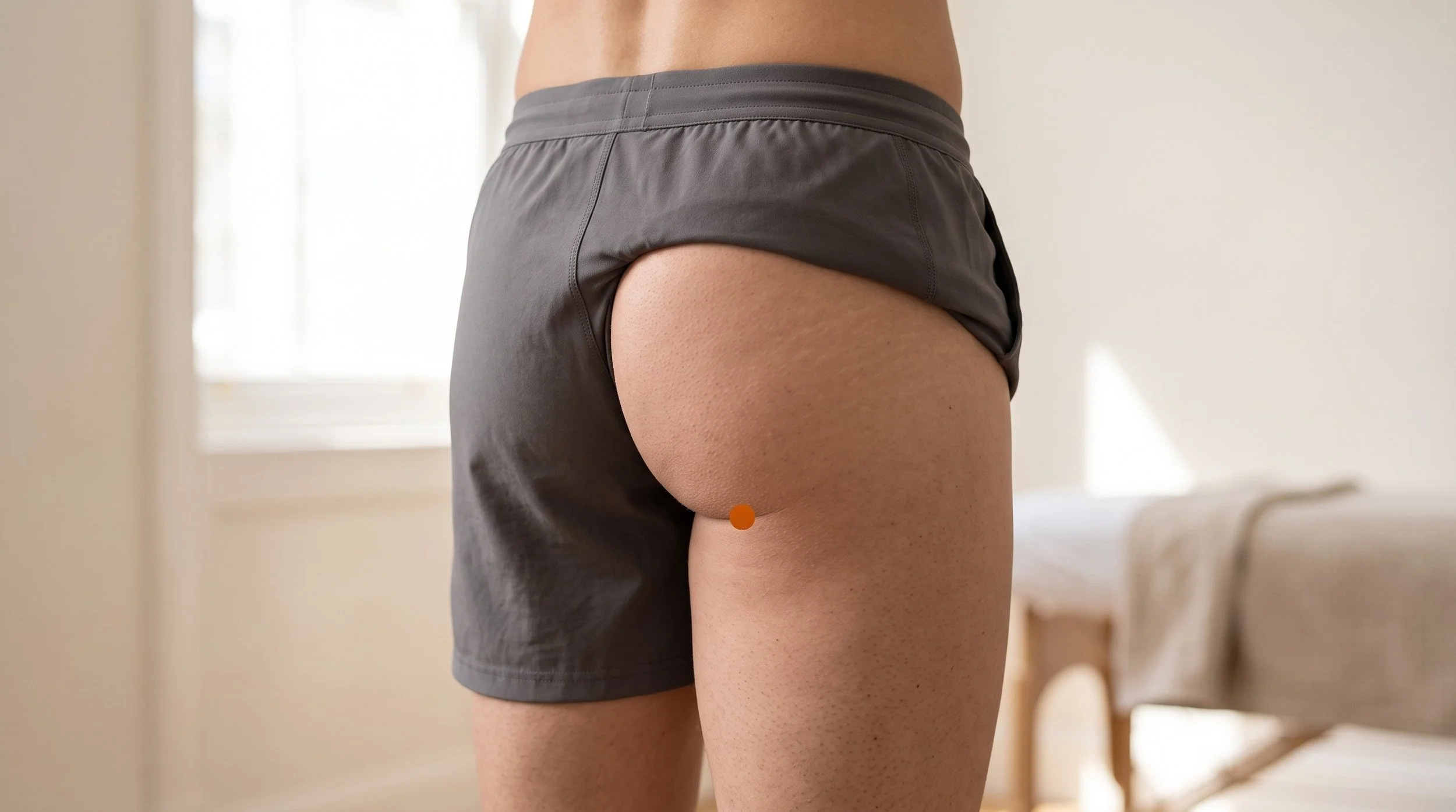
BL36 Acupuncture Point (Chengfu)
The Gluteal Fold Point on the Sciatic Pathway: Anatomy, Mechanism, and Why BL36 Anchors Treatment of Sciatica, Buttock Pain, and Hamstring Origin Problems
BL36, known in Chinese as Chengfu and usually translated as Hold and Support, sits in the center of the crease that forms where the buttock meets the back of the thigh, on a straight line running up from BL40 at the back of the knee. Bladder 36 is one of the few classical points that lies almost directly over the sciatic nerve trunk as it emerges from the deep gluteal space, which is why the bl 36 gluteal fold location shows up in sciatica protocols, deep gluteal pain programs, and modern hamstring origin work.
Classical texts describe it for lumbar, sacral, and buttock pain that runs down the back of the leg, and contemporary clinicians reach for it when someone tells us their pain gets worse the longer they sit.
- BL36 is located in the middle of the transverse gluteal crease, between the origins of the hamstrings and just deep to the lower border of gluteus maximus, with the sciatic nerve running beneath (Deadman et al., 2007).
- Traditional sources classify BL36 as a point that activates the channel, relaxes the sinews, alleviates pain, regulates the lower jiao, and treats hemorrhoids; in neurophysiological terms these categories map onto local muscular and connective tissue effects plus sacral segmental input (Deadman et al., 2007).
- The mechanism story here is unusually direct: needling this region stimulates skin, fascia, gluteal and hamstring muscle, and nerve trunk territory that shares spinal segments (roughly L4 to S3) with the very structures that generate sciatic pain, and repeated stimulation may recruit descending inhibitory pathways (Zhao, 2008).
- Research on acupuncture for sciatica has strengthened recently, with a multicenter sham-controlled trial reporting greater reductions in leg pain and disability with real needling (Tu et al., 2024), while broader reviews still describe modest average effects for back and leg pain (Mu et al., 2020; Vickers et al., 2018).
- In practice BL36 is rarely used alone; it typically joins sacral, lumbar, and lower leg points, and at Morningside it's often combined with dry needling of gluteus maximus, piriformis, and the hamstring origin when palpation reproduces the patient's pattern (Simons et al., 1999).
- De qi at Bladder 36 is usually a deep, heavy, spreading ache. A sharp electric sensation shooting toward the calf or foot means the needle is close to the nerve trunk and should be withdrawn slightly and redirected rather than pushed deeper (Valera-Calero et al., 2024).
Is Sitting Making Your Buttock and Leg Pain Worse?
Pain that builds after twenty minutes in a chair, a subway seat, or a long flight often traces back to the deep gluteal region rather than the spine alone. At Morningside Acupuncture we use BL36 with sacral and lumbar points, and pair it with targeted needling of the gluteal and hamstring muscles that compress the area under load. Treatment plans include practical sitting, loading, and mobility advice so the change holds between visits. Schedule a session to have your pattern assessed properly.
Schedule NowAnatomy of BL36: Why the Gluteal Fold Is Such an Important Location
From the surface inward, a needle at BL36 passes through skin and a variable layer of subcutaneous fat, then the lower border of gluteus maximus, and then into the interval between the origins of biceps femoris and semitendinosus as they descend from the ischial tuberosity. This is a high-load junction. The hamstrings work eccentrically every time you decelerate a stride, gluteus maximus fires to extend the hip, and the whole region is compressed against a chair whenever you sit.
That combination of tensile load from below and compressive load from behind is exactly why this area becomes tender in runners, cyclists, and people who sit for long stretches.
Deep to those muscles, the sciatic nerve runs downward after passing beneath piriformis, which places the trunk of the nerve directly under this point (Deadman et al., 2007). The posterior femoral cutaneous nerve supplies the overlying skin. Because the skin, muscle, and nerve territory here converge on lower lumbar and sacral spinal segments, needling BL36 delivers input into the same segmental pool that carries sciatic pain signals, which may dampen central sensitivity in that region.
Sustained or repeated stimulation is also thought to engage descending inhibitory pathways from the brainstem, releasing endogenous opioids and monoamines that reduce pain more broadly rather than only at the needle site (Zhao, 2008). A scoping review of needling for sciatica noted that acupuncture is supported for sciatic pain, though the neuropathic mechanisms behind point choice are rarely spelled out in trial protocols (Perreault et al., 2021).
The vascular structures accompanying the sciatic nerve run with it at depth, and the inferior gluteal vessels sit above. Standard needling is perpendicular at roughly 1 to 2 cun depending on tissue thickness, with practitioners aiming for a deep aching response rather than nerve contact (Deadman et al., 2007). Sciatic nerve depth varies substantially between individuals and correlates with body composition measures such as hip circumference and BMI, which is a good argument for adjusting needle length to the person in front of you rather than using one default (Valera-Calero et al., 2024).
Anyone needling in this region should be comfortable with the anatomy, and a sudden electric sensation traveling toward the foot is a signal to back off, not a target.
Related Best Acupuncture Points For Sciatica Related Acupuncture For Piriformis Trigger PointsBL36 at a Glance: Classification, Location, and Clinical Use
| Category | Detail |
|---|---|
| Traditional Name | Chengfu (Hold and Support, also translated Receiving Support) |
| Channel Classification | Bladder channel of Foot Taiyang, 36th point, posterior thigh |
| Point Categories | No five-shu, hui-meeting, or extraordinary vessel designation is recorded for this point in the classical literature. It's classified simply as a Bladder channel point of the buttock and posterior thigh, with traditional actions of activating the channel, relaxing the sinews and alleviating pain, regulating the lower jiao, and treating hemorrhoids (Deadman et al., 2007). |
| Precise Location | Prone, in the center of the transverse gluteal crease just below the buttock, in the depression between the hamstring muscles, on the vertical line running up from BL40 at the knee crease |
| Tissue Stimulated | Skin and subcutaneous tissue, the lower border of gluteus maximus, the shared hamstring origin region including biceps femoris, posterior femoral cutaneous nerve territory, and at depth the sciatic nerve trunk |
| Needle Depth / Direction | Perpendicular, 1 to 2 cun depending on tissue depth; deeper insertion approaches the sciatic nerve, so needle length and depth should be matched to the individual |
| De Qi Sensation | A deep, heavy, spreading ache or fullness in the buttock and upper thigh, sometimes with a dull sense of travel down the back of the leg; a sharp electric jolt toward the calf or foot means the needle should be withdrawn slightly and redirected |
| Primary Clinical Uses | Sciatica and pain radiating down the back of the leg, buttock pain aggravated by sitting, low back, sacral and coccyx pain, lower limb heaviness or weakness, hamstring origin pain in runners, and traditionally hemorrhoids |
| Common Point Combinations |
|
Deadman's point compendium presents Chengfu primarily as a point for pain that travels down the Bladder channel from the lumbar region and buttock, and singles out buttock pain and sciatic pain made worse by sitting as its particular indication.
Its traditional actions are given as activating the channel, relaxing the sinews and alleviating pain, regulating the lower jiao, and treating hemorrhoids, with classical indication lists covering three broad groups: pain of the low back, sacrum, coccyx, buttock, and leg along with weakness or wasting of the lower limb; disorders of urination, defecation, and the genitals; and chronic or bleeding hemorrhoids, for which the text describes it as a local, adjacent point.
These are traditional attributions rather than modern claims. What's striking is that a text tradition without imaging or dissection singled out the same aggravating factor, prolonged sitting, that clinicians today treat as a hallmark of deep gluteal and hamstring origin pain.
Why BL36 Is Used for Pain That Travels All the Way to the Calf and Foot
It surprises people that a needle placed in the crease under the buttock can change how the calf or foot feels. The explanation is segmental. Sensory fibers from the skin, fascia, and muscles around BL36 enter the spinal cord at roughly the same lower lumbar and sacral levels that receive input from the sciatic nerve and the tissues it supplies further down the leg. When several inputs converge on the same spinal segments, strong new input from needling can compete with and reduce the ongoing pain signal, which is one reason a proximal point may be felt distally.
Beyond the segment, needle stimulation activates descending pain modulation from the brainstem, with endogenous opioid and monoamine systems contributing to analgesia that outlasts the session itself (Zhao, 2008). This is the same mechanism family that helps explain why acupuncture effects in chronic pain trials persist beyond the treatment course rather than fading immediately (Vickers et al., 2018).
Locally, needling of taut, tender muscle at the gluteal fold may also reduce mechanical irritation of the nerve as it passes through the deep gluteal space, though this part of the story is more mechanistic reasoning than proven fact.
Practically, this means BL36 is chosen for a reason, not for coverage. If your pain map runs from the buttock down the back of the thigh into the calf, this point sits at the top of that map and gives a treatment access to the whole pathway. If your pain runs down the side of the leg instead, other points and other muscles usually matter more.
What the Research Shows for BL36
A fair caution before the numbers: no trial has isolated BL36 by itself. Sciatica and low back pain studies test multi-point protocols in which Chengfu commonly appears alongside sacral, lumbar, and lower leg points, so the evidence below supports the approach that includes this point rather than the point in isolation. Effect sizes in the broader acupuncture literature are moderate on average, and quality of evidence varies considerably.
| Study | Type | Focus | Key Finding |
|---|---|---|---|
| Tu et al., 2024 | Multicenter randomized sham-controlled trial | Chronic sciatica from herniated lumbar disc, 216 participants, 10 sessions over 4 weeks | Real acupuncture produced greater reductions in leg pain and disability than sham at week 4, with differences reported through longer follow-up. |
| Mu et al., 2020 | Cochrane systematic review | Acupuncture for chronic nonspecific low back pain, 33 trials and 8270 participants | Acupuncture appeared more effective than sham for pain relief, but the certainty of evidence was low and the difference did not reach the review's threshold for a clinically important change. |
| Rizzo et al., 2025 | Cochrane overview of reviews | Non-pharmacological and non-surgical treatments for low back pain in adults | Acupuncture is included among the non-drug options with supportive evidence for chronic low back pain, within an evidence base of variable certainty. |
| Vickers et al., 2018 | Individual patient data meta-analysis | Chronic musculoskeletal pain including back and neck pain, roughly 21,000 patients | Acupuncture was superior to both sham and no-acupuncture controls, with effects persisting over about a year and only modest decay. |
| Perreault et al., 2021 | Scoping review | Needling interventions and needling parameters used for sciatica | Current evidence was judged to support acupuncture for sciatic pain, though the rationale for point selection was inconsistent across trials. |
| Valera-Calero et al., 2024 | Observational ultrasound study | Skin-to-sciatic-nerve distance and predictors of depth in the gluteal region | Nerve depth varied with body measures such as hip circumference and BMI, supporting individualized needle length selection in deep gluteal needling. |
| Zhao, 2008 | Narrative review of mechanisms | Neural mechanisms of acupuncture analgesia | Analgesia is attributed to segmental spinal modulation plus descending inhibitory pathways involving endogenous opioids and monoamines. |
Runners With Stubborn High Hamstring Pain: Chengfu May Be Worth Considering
Hamstring origin pain that flares with hill work, speed sessions, and sitting on hard surfaces is one of the most common reasons NYC runners come to us. BL36 sits right at the transition between the gluteal fold and the hamstring group, so it lets us address both the muscular and neural contributors in one visit. We combine it with dry needling of biceps femoris and semitendinosus plus a graded loading plan. Book an evaluation and let's map out your return to running.
Schedule NowBL36 in the Context of Trigger Point Work
Acupuncture, as we define it, is the use of an acupuncture needle, and that includes the hundreds of styles practiced worldwide as well as dry needling. At BL36 the two traditions overlap almost perfectly. The point sits at the lower border of gluteus maximus and at the shared hamstring origin, and both regions are classic sources of referred pain into the buttock and posterior thigh (Simons et al., 1999). When we palpate along the gluteal fold and a taut band reproduces the patient's familiar symptom, that band becomes the target, whether the chart calls it a trigger point or a channel point.
A typical Morningside session for buttock and leg pain might combine the classical Chengfu sciatica point with dry needling of gluteus maximus, gluteus medius or minimus, piriformis, and biceps femoris or semitendinosus, chosen by exam rather than by protocol. Needling is followed by movement work, hip extension and hamstring loading, and specific advice about sitting tolerance, since sitting is the single most common aggravator in this presentation. The goal isn't just to quiet the area for a day but to change how much load it can take before it complains.
BL36 Sciatica Treatment at NYC's Highest-Rated Acupuncture Clinic
Morningside Acupuncture is the highest-rated acupuncture and dry needling clinic in New York City with over 500 five-star Google reviews, and sciatica and deep gluteal pain are among the conditions we see most. Our approach blends classical point selection along the Bladder channel with careful, anatomy-led needling of the muscles that reproduce your symptoms. Every plan is built around what your exam shows, not a fixed template. Schedule your visit and let's get your leg pain moving in the right direction.
Schedule NowFrequently Asked Questions
What does BL36 feel like when needled?
Most people describe a deep, heavy, dull ache or a sense of fullness spreading through the buttock and upper thigh, sometimes with a vague feeling of travel down the back of the leg. That's the de qi response and it usually eases within a minute or two. A brief muscle twitch is common when the needle contacts a taut band. What you should not feel is a sharp electric zap running to the calf or foot; if that happens, tell your practitioner, who will withdraw the needle slightly and change its angle.
Why needle the gluteal fold when my pain is in my calf and foot?
Because the tissues around BL36 share spinal segments with the structures that carry your calf and foot symptoms, and because the sciatic nerve passes directly beneath this location. Input from needling at the top of the pathway can influence pain processing for the whole segment rather than only the spot where the needle sits, an effect attributed to segmental modulation plus descending inhibition from the brainstem (Zhao, 2008). In clinical terms, treating where the pain starts often matters more than treating where you feel it most.
Can I press BL36 myself between sessions?
Yes, acupressure here is straightforward and safe when done with a broad, comfortable pressure. Lie on your side or stand and reach behind you, find the crease where the buttock meets the thigh, and work along its midline until you find the tender spot. Press with a thumb, a knuckle, or a firm ball placed against a wall for 30 to 60 seconds per spot, at an intensity around 4 to 6 out of 10, breathing normally. Two or three spots, once or twice a day, is plenty. A ball on a chair seat works well for seated pressure, but keep it under 90 seconds and stop immediately if you feel electric, tingling, or numb symptoms shooting down the leg, since that suggests you're compressing the nerve rather than the muscle.
Is BL36 safe to needle?
In trained hands, yes. The main consideration is the sciatic nerve at depth, and its distance from the skin varies considerably between individuals depending on body composition, which is why needle length and insertion depth should be selected for the person rather than by default (Valera-Calero et al., 2024). Practitioners aim for a dull spreading ache and treat a sharp radiating sensation as a signal to withdraw and redirect. Normal after-effects are mild soreness or a temporary heavy feeling in the leg for a day or so. Tell your acupuncturist if you take blood thinners, have had hip or hamstring surgery, or have a known nerve injury.
Where exactly is BL36 located?
Lie face down and let the leg relax. BL36 is in the center of the transverse crease that forms under the buttock, in the small depression between the hamstring muscles, on a vertical line that runs straight down to BL40 in the middle of the crease behind the knee (Deadman et al., 2007). A useful check is to find the sit bone with your fingers, then drop just below and slightly toward the midline of the thigh; if pressure there reproduces a familiar buttock or posterior thigh ache, you're in the right neighborhood.
References
- Deadman, P., Al-Khafaji, M., & Baker, K. (2009). A manual of acupuncture. Journal of Chinese Medicine Publications.
- O'Connor, J., & Bensky, D. (Eds. & Trans.). (1981). Acupuncture: A comprehensive text. Shanghai College of Traditional Medicine. Eastland Press.
- Cunningham, P. M. (2000). Acupuncture points: A practical guide to classical and modern usage. Odyssey Press.
- Simons, D. G., Travell, J. G., & Simons, L. S. (1999). Travell & Simons' myofascial pain and dysfunction: The trigger point manual, Vol. 1: Upper half of body (2nd ed.). Williams & Wilkins.
- Tu, J. F., Shi, G. X., Yan, S. Y., Ni, G. X., Yu, F. T., Cai, G. W., Liu, Z. S., Ma, C. Y., Wang, L. Q., Yang, J. W., Zhou, X. Q., Meng, X. L., Fu, H. Y., Li, J., Wan, W. J., Sun, T. H., Wang, X. Z., & Liu, C. Z. (2024). Acupuncture vs sham acupuncture for chronic sciatica from herniated disk: A randomized clinical trial. JAMA Internal Medicine, 184(12), 1417-1424. https://doi.org/10.1001/jamainternmed.2024.5463
- Mu, J., Furlan, A. D., Lam, W. Y., Hsu, M. Y., Ning, Z., & Lao, L. (2020). Acupuncture for chronic nonspecific low back pain. Cochrane Database of Systematic Reviews, 12(12), CD013814. https://doi.org/10.1002/14651858.CD013814
- Rizzo, R. R. N., Cashin, A. G., Wand, B. M., Ferraro, M. C., Sharma, S., Lee, H., O'Hagan, E., Maher, C. G., Furlan, A. D., van Tulder, M. W., & McAuley, J. H. (2025). Non-pharmacological and non-surgical treatments for low back pain in adults: An overview of Cochrane reviews. Cochrane Database of Systematic Reviews, 3(3), CD014691. https://doi.org/10.1002/14651858.CD014691.pub2
- Vickers, A. J., Vertosick, E. A., Lewith, G., MacPherson, H., Foster, N. E., Sherman, K. J., Irnich, D., Witt, C. M., & Linde, K. (2018). Acupuncture for chronic pain: Update of an individual patient data meta-analysis. Journal of Pain, 19(5), 455-474. https://doi.org/10.1016/j.jpain.2017.11.005
- Perreault, T., Fernández-de-las-Peñas, C., Cummings, M., & Gendron, B. C. (2021). Needling interventions for sciatica: Choosing methods based on neuropathic pain mechanisms. A scoping review. Journal of Clinical Medicine, 10(10), 2189. https://doi.org/10.3390/jcm10102189
- Valera-Calero, J. A., Varol, U., Plaza-Manzano, G., Fernández-de-las-Peñas, C., Belón-Pérez, P., López-Redondo, M., & Navarro-Santana, M. J. (2024). Testing the safety of piriformis dry needling interventions: An observational study evaluating the predictive value of anthropometric and demographic factors. Journal of Clinical Medicine, 13(22), 6674. https://doi.org/10.3390/jcm13226674
- Zhao, Z. Q. (2008). Neural mechanism underlying acupuncture analgesia. Progress in Neurobiology, 85(4), 355-375. https://doi.org/10.1016/j.pneurobio.2008.05.004
Disclaimer: This web site is intended for educational and informational purposes only. Reading this website does not constitute providing medical advice or any professional services. This information should not be used for diagnosing or treating any health issue or disease. Those seeking medical advice should consult with a licensed physician. Seek the advice of a medical doctor or other qualified health professional for any medical condition. If you think you have a medical emergency, call 911 or go to the emergency room. No acupuncturist-patient relationship is created by reading this website or using the information. Morningside Acupuncture PLLC and its employees and contributors do not make any express or implied representations with respect to the information on this site or its use. For any legal interpretation of scope of practice in your state, consult a licensed attorney or regulatory authority.
Read more from our blog