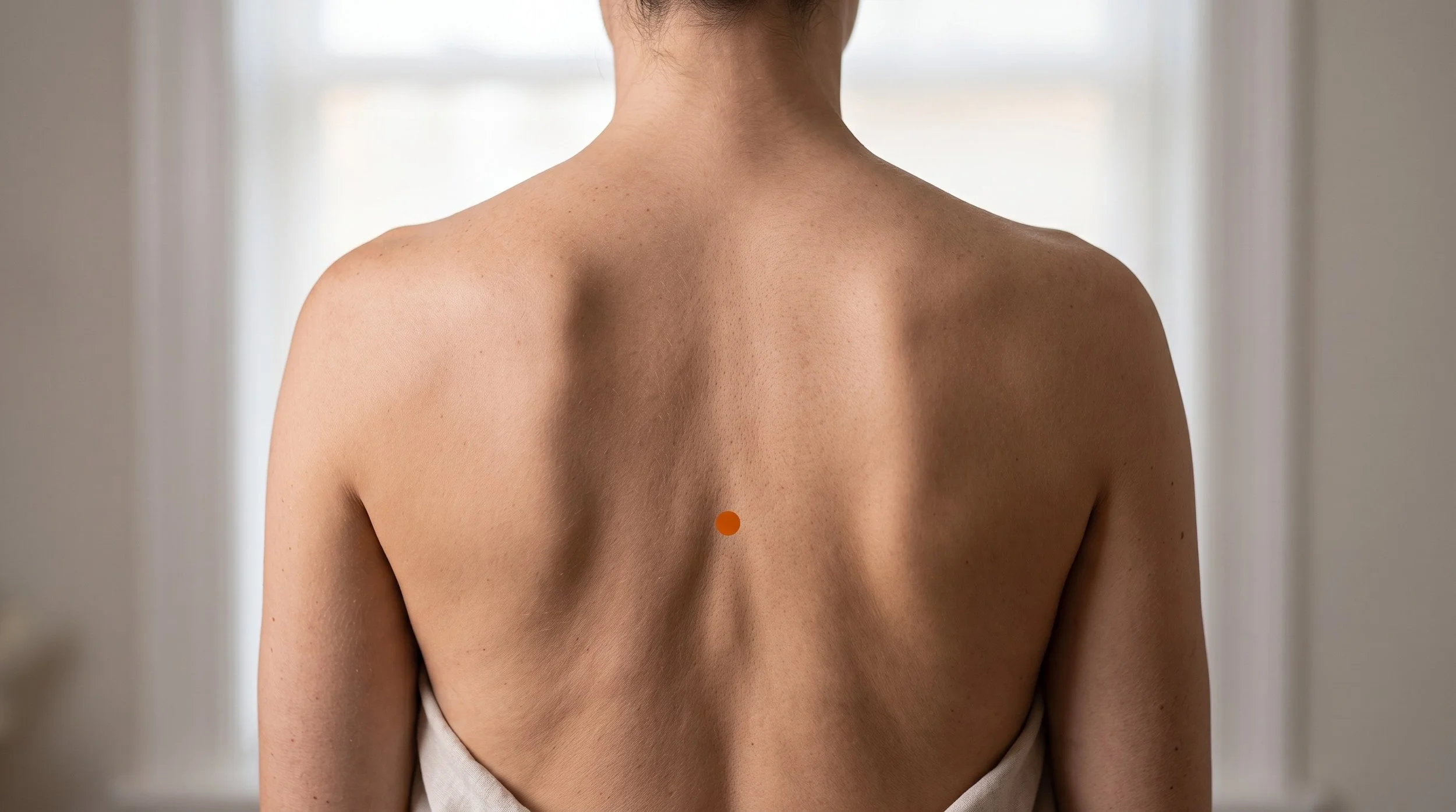
DU10 Acupuncture Point (Lingtai)
The Spirit Tower Below the Sixth Thoracic Vertebra: Anatomy, Mechanism, and Why This Midline Back Point Is Used for Skin Lesions, Cough, and Upper Back Pain
DU10 (Lingtai, often translated as Spirit Tower or Spirit Platform), also written GV10, is the Governing vessel point that sits directly on the midline of the upper back, in the small dip you can feel just below the spinous process of the sixth thoracic vertebra, level with BL16 on either side. Despite a poetic name borrowed from a classical term for the Heart, this point earned its reputation for something far more concrete: it's the classic empirical point for furuncles, boils, and clove sores, and it's also traditionally used for cough and wheezing, upper back pain, and neck stiffness (Deadman et al., 2009).
For a modern clinic, the GV10 acupuncture point is a compact mid-thoracic access site where skin, dense midline ligament, and the T6 spinal segment all converge, which is exactly why it shows up in both dermatological and respiratory point prescriptions.
- Location and layers: DU10 lies on the posterior midline in the depression below the T6 spinous process, level with BL16, with the needle passing through skin, subcutaneous tissue, and the supraspinous and interspinal ligaments rather than muscle belly (Deadman et al., 2009; O'Connor & Bensky, 1981).
- Traditional categories, translated: classical sources credit Lingtai with clearing heat and resolving toxicity and with easing cough and wheezing (Deadman et al., 2009). In neurophysiological language, those attributions map onto segmental modulation of T6 somatic and visceral afferent traffic plus autonomic effects on skin and airway tissues.
- Nerve story: the local supply is the medial branch of the dorsal ramus of the sixth thoracic spinal nerve, with blood supplied by a dorsal branch of the sixth intercostal artery and the vertebral venous plexus (O'Connor & Bensky, 1981). Stimulating this segment recruits A-delta and C-fiber input that engages spinal and brainstem pain modulation (Zhao, 2008).
- Research picture: individual patient data meta-analysis supports acupuncture for chronic musculoskeletal pain, including neck and back complaints (Vickers et al., 2018), while reviews of acupuncture for chronic cough and for acne report cautious, low to moderate certainty findings that involve multi-point protocols rather than DU10 alone (Lee et al., 2025; Mansu et al., 2018).
- Clinical practice framing: several classical texts list this point as contraindicated to needling, so modern practice uses a shallow, obliquely superior insertion of roughly 0.5 to 1 cun, keeping well clear of the spinal canal, which lies about 1.25 to 1.75 cun deep depending on build (Deadman et al., 2009).
- De qi: patients usually report a dull, spreading fullness or ache at the midline, sometimes radiating toward the low back or around into the chest wall, rather than sharpness (O'Connor & Bensky, 1981).
Stubborn Upper Back Tension That Won't Release Between Your Shoulder Blades?
Mid-thoracic stiffness rarely comes from one tissue, so we treat the midline and the muscles that pull on it. At Morningside Acupuncture, DU10 is often paired with adjacent Governing vessel points and paraspinal needling to reduce guarding across the T4 to T8 segments. We combine that with dry needling of the thoracic erector spinae and rhomboids when tender bands are part of your picture. Schedule a visit and we'll map exactly where your upper back is loading.
Schedule NowAnatomy of DU10: Why the T6 to T7 Midline Is Such an Important Location
DU10 sits on the posterior midline between the spinous processes of the sixth and seventh thoracic vertebrae, in the depression just below the T6 spinous process and level with BL16 to either side (Deadman et al., 2009; O'Connor & Bensky, 1981). A needle here passes through thin skin and subcutaneous tissue into the supraspinous ligament and then the interspinal ligament, so the tissue under the needle tip is dense collagen rather than contractile muscle (O'Connor & Bensky, 1981).
That matters clinically, because this midline column is loaded every time you round forward over a keyboard or phone: the interspinous and supraspinous ligaments take tensile strain in sustained flexion, while the multifidus, rotatores, and thoracic erector spinae working just lateral to the midline take the eccentric load of holding you up.
The segmental supply here is the medial branch of the dorsal ramus of the sixth thoracic spinal nerve (O'Connor & Bensky, 1981). Those medial branches innervate the midline ligaments, the deep paraspinal muscles, and the T5 to T6 zygapophyseal joints, which is why tenderness at governing vessel 10 so often accompanies segmental thoracic stiffness.
Needle stimulation at this level drives small-diameter afferent input into the T6 dorsal horn, where somatic and visceral afferents converge, and that input recruits spinal gating along with brainstem descending inhibition mediated by endogenous opioid, serotonergic, and noradrenergic systems (Zhao, 2008). In practical terms, that's the mechanism behind reduced local tenderness, less protective muscle guarding, and easier extension after treatment, rather than anything moving along a channel.
Depth discipline is the whole safety story at this point. The spinal canal lies roughly 1.25 to 1.75 cun beneath the skin surface, varying with body build, so needling is kept to an oblique superior insertion of about 0.5 to 1 cun, and several classical texts flagged this point as contraindicated to needling altogether (Deadman et al., 2009). Local vasculature includes a dorsal branch of the sixth intercostal artery and the vertebral venous plexus (O'Connor & Bensky, 1981).
Staying exactly on the midline with a shallow, superiorly angled needle also keeps the practitioner away from the interlaminar space and away from the pleura, which sits considerably lateral. Serious acupuncture adverse events are rare in prospective safety data, and the events that do occur are largely attributable to excessive depth or poor anatomical reasoning (White, 2004).
Related Pain Finder Upper Back Shoulder Arm Related Best Acupuncture Points For Back PainDU10 (GV10) at a Glance: Classification, Location, and Clinical Use
| Category | Detail |
|---|---|
| Traditional Name | Lingtai (Spirit Tower, also rendered Spirit Platform) |
| Channel Classification | Governing Vessel, point 10 (DU10, Du 10, GV10) (also called the Du Mai or Du channel) |
| Point Categories | A Governing vessel point with no five-shu, luo-connecting, or hui-meeting designation, and no meeting or crossing point status recorded in the major classics. In traditional terms it's credited with alleviating cough and wheezing and with clearing heat and resolving toxicity, and it's best known as an empirical point for furuncles, red-thread furuncle (lymphangitis), and clove sores. Several classical texts list it as contraindicated to needling, which shapes how it's needled today. |
| Precise Location | On the posterior midline of the back, in the depression immediately below the spinous process of the sixth thoracic vertebra, six intervertebral spaces below C7 and level with BL16. |
| Tissue Stimulated | Skin and subcutaneous tissue over the supraspinous and interspinal ligaments between T6 and T7, with thoracic multifidus, rotatores, and erector spinae immediately lateral. Related myofascial mapping for this region is covered on our Pain Finder Upper Back Shoulder Arm page. |
| Needle Depth / Direction | Oblique insertion angled superiorly, approximately 0.5 to 1 cun. The spinal canal lies about 1.25 to 1.75 cun deep depending on build, so depth is deliberately conservative and several classical sources treated the point as one to avoid needling. |
| De Qi Sensation | A dull, heavy distension and soreness at the midline that can spread toward the low back or forward around the chest wall. |
| Primary Clinical Uses | Empirically used for furuncles, boils, clove sores, and red-thread furuncle (lymphangitis); cough, wheezing, and chronic cough; upper back pain and soreness along the spine; stiffness of the neck. |
| Common Point Combinations |
|
In A Manual of Acupuncture, Deadman and colleagues point out an odd gap in the record for this point. The name Lingtai is an old term for the Heart that came to stand for the reasoning mind, and the story attached to it involves an observation tower built by King Wen so he could survey his realm. The point also sits one vertebra below BL15, the back shu point of the Heart. Yet no major classical text lists indications or combinations that draw on that association.
What the classics do record, consistently, is something entirely practical: Lingtai as the go-to point for furuncles, red-thread furuncle (lymphangitis), and clove sores, those small, hard, deep-seated purulent lesions, alongside cough, wheezing, back pain, and neck stiffness (Deadman et al., 2009). The Shanghai text adds hot and cold type common cold, prolonged cough, and soreness along the spine to the traditional list (O'Connor & Bensky, 1981).
That's the striking part of the pattern: a point with one of the most evocative names on the Governing vessel is remembered almost entirely for treating boils.
Why DU10 Is Used for Boils, Skin Lesions, and Stubborn Cough
The first half of the answer is segmental. DU10 sits at the T6 level, where afferents from the midline ligaments and deep paraspinal muscles enter the dorsal horn alongside visceral afferents and where sympathetic preganglionic neurons destined for the thoracic viscera and for the skin and vessels of the upper trunk originate.
Needling at a given spinal level can influence autonomic outflow and local blood flow within that same segmental territory, which offers a plausible framework for why a midline mid-thoracic point was historically applied to lesions of the upper back, neck, and face and to airway symptoms like cough and wheezing. Traditional sources describe this as clearing heat and resolving toxicity (Deadman et al., 2009); the physiological translation is segmental convergence plus vasomotor and autonomic modulation, not toxins being drawn out.
The second half is systemic. Needle stimulation reliably engages descending inhibitory pathways from the periaqueductal gray and rostral ventromedial medulla, involving endogenous opioids, serotonin, and noradrenaline, which is the best-supported account of acupuncture analgesia (Zhao, 2008). There's also a growing experimental literature on neural regulation of inflammation: in a mouse sepsis model, electroacupuncture reduced systemic inflammatory markers through a sciatic to vagal to adrenal circuit involving dopamine release (Torres-Rosas et al., 2014).
That's animal work at a different point and a different disease severity, so it doesn't demonstrate anything about boils in humans, but it does show that needle stimulation can reach immune signaling through defined neural routes rather than by anything mysterious.
Clinically, this means DU10 is best understood as one contributor within a prescription. For skin lesions it's paired with distal heat-clearing points, and the meta-analytic evidence for acupuncture in inflammatory skin conditions such as acne is limited and low in methodological quality, showing results roughly comparable to guideline treatments with fewer side effects (Mansu et al., 2018). For cough, reviews suggest acupuncture-related therapy added to conventional care may improve cough severity and cough-related quality of life, with moderate certainty at best (Lee et al., 2025). For upper back and neck pain, the pain evidence is stronger and more directly relevant (Vickers et al., 2018; Fang et al., 2024).
What the Research Shows for DU10 (GV10)
One note on naming before the evidence: in the research literature this point is almost always listed as GV10, the WHO standard code, so GV10 is the term to search if you want to read the studies below in full.
There's no dedicated randomized trial isolating DU10 as a single needle, and it would be misleading to imply otherwise. What exists are trials and reviews of multi-point protocols in which this region of the upper thoracic midline is one of several sites treated, plus mechanistic work on how needle stimulation affects pain processing and immune signaling. Read the table below as context for a reasonable clinical role, not as proof that one point does the work.
| Study | Type | Focus | Key Finding |
|---|---|---|---|
| Vickers et al., 2018 | Individual patient data meta-analysis | Acupuncture for chronic musculoskeletal pain, including neck and back pain | Acupuncture was associated with modestly better pain outcomes than sham and no-acupuncture controls, with effects that persisted over time. |
| Fang et al., 2024 | Systematic review and meta-analysis | Durability of acupuncture effects in chronic neck pain | Across 18 randomized trials, acupuncture as an adjunct appeared to provide pain relief that was still measurable at three and six months after treatment. |
| Lee et al., 2025 | Systematic review and meta-analysis | Acupuncture-related therapy for chronic cough | Pooling 30 trials with 2,835 participants, adding acupuncture-related therapy to conventional care was associated with improved cough severity and quality of life, though certainty was generally moderate because of risk of bias. |
| Mansu et al., 2018 | Systematic review and meta-analysis | Acupuncture and related therapies for acne vulgaris | Results were not statistically different from guideline-recommended pharmacotherapy and adverse events were fewer, but the authors stress that trial quality was generally low. |
| Torres-Rosas et al., 2014 | Experimental animal study | Neural control of systemic inflammation by electroacupuncture | In a mouse sepsis model, electroacupuncture reduced inflammatory signaling through a vagal and adrenal dopamine-dependent pathway, illustrating one plausible neuroimmune route. |
| Zhao, 2008 | Narrative review of mechanisms | Neural basis of acupuncture analgesia | Needle stimulation activates small-diameter afferents and engages descending inhibitory control involving opioid, serotonergic, and noradrenergic systems. |
| White, 2004 | Cumulative safety review | Range and incidence of significant adverse events after acupuncture | Serious adverse events were rare, and reported trauma cases were largely linked to excessive depth or inadequate anatomical care, which is why conservative depth matters at midline spinal points. |
Recurring Skin Flare-Ups Along the Upper Back, Neck, or Face?
Lingtai acupuncture has been used empirically for boils, clove sores, and inflamed lesions of the upper back for centuries, and modern clinics still reach for it as part of a broader plan. We use it alongside heat-clearing distal points and, when appropriate, treatment aimed at sleep, stress, and autonomic balance. Acupuncture isn't a substitute for dermatological or medical care for active infection, and we'll tell you plainly when a referral is the right call. Book a consultation to see whether this approach fits your case.
Schedule NowDU10 in the Context of Trigger Point Work
Acupuncture, as we define it, is treatment using an acupuncture needle, and that single definition covers hundreds of styles including trigger point dry needling. DU10 sits directly on the midline, so it isn't itself a muscle trigger point, but it's surrounded by muscles that generate mid-back complaints: thoracic multifidus and rotatores immediately deep and lateral, the thoracic erector spinae (iliocostalis thoracis, longissimus thoracis, spinalis), rhomboid major, middle and lower trapezius, and serratus posterior superior higher up.
Taut bands in these muscles refer pain into the interscapular region and along the spine, and they frequently reproduce exactly the ache patients point to when they reach over their shoulder (Simons et al., 1999).
In practice we treat the DU 10 back region as the segmental anchor and then address the myofascial contributors that keep loading it. A typical session might include a shallow oblique needle at DU10, paraspinal needling at the T5 to T7 levels, and dry needling of tender bands in the thoracic erector spinae and rhomboids, followed by scapular and thoracic extension work so the segment stops re-guarding. Because this area sits over the thorax, everything lateral to the midline is needled with strict attention to angle and depth, and the midline itself stays shallow (White, 2004).
DU10 Upper Back and Cough Treatment at NYC's Highest-Rated Acupuncture Clinic
Morningside Acupuncture is the highest-rated acupuncture and dry needling clinic in New York City with over 500 five-star Google reviews. We treat the DU 10 back region with careful, anatomy-first technique, combining Governing vessel points, Bladder channel back shu points, and myofascial needling where the exam calls for it. Every session includes a clear explanation of what we're needling and why. Schedule your appointment and let's build a plan around your goals.
Schedule NowFrequently Asked Questions
Is DU10 the same point as GV10?
Yes. DU10 and GV10 are two codes for the same point, Lingtai. DU comes from Du Mai, the Chinese name of the Governing Vessel, and it is the code used in most Chinese texts and many acupuncture schools. GV is the WHO standard abbreviation and the one you will see in most Western textbooks and research papers. You will also come across it written as Du 10, GV-10, or Governing Vessel 10. Whichever code is used, the location and the uses are the same.
What does DU10 feel like when needled?
Most people feel a dull, heavy fullness or an aching soreness right at the midline rather than anything sharp. That sensation can spread, sometimes toward the low back and sometimes forward around the chest wall (O'Connor & Bensky, 1981). Because the needle is angled upward and kept shallow, the feeling tends to be mild and settles within a few seconds. If you ever feel a sudden electric or radiating jolt, tell your practitioner immediately so the needle can be adjusted.
Why would a point on the mid-back be used for boils on the neck or face?
Traditionally, Lingtai was credited with clearing heat and resolving toxicity and was the empirical point for furuncles, clove sores, and red-thread furuncle (Deadman et al., 2009). The modern explanation is segmental rather than metaphorical: the T6 level contributes autonomic outflow to the skin and vessels of the upper trunk, and needle stimulation at a spinal level can modulate autonomic tone and local blood flow within that territory. Experimental work also shows that needle stimulation can influence immune signaling through defined neural circuits, at least in animal models (Torres-Rosas et al., 2014). None of this replaces medical treatment for an active skin infection.
Can I press DU10 myself between sessions?
Yes, though the mid-back is awkward to reach. The easiest approach is to place a tennis ball or lacrosse ball against a wall, lean back so it sits on the midline just below the bump of the T6 spinous process (roughly level with the lower third of your shoulder blades), and apply steady, tolerable pressure for 30 to 60 seconds. Repeat two or three times, breathing slowly, and give yourself a few minutes between rounds. A partner can also use thumb pressure at the same spot for 30 to 60 seconds. Keep the pressure moderate, never sharp, skip it entirely over broken or inflamed skin, and stop if you get any radiating or electric sensation.
Is DU10 safe to needle?
In trained hands, yes, with clear limits. Several classical texts listed this point as contraindicated to needling, and modern practice reflects that caution by using an oblique superior insertion of about 0.5 to 1 cun and no deeper, since the spinal canal lies roughly 1.25 to 1.75 cun beneath the skin depending on body build (Deadman et al., 2009). Prospective safety data indicate that serious adverse events from acupuncture are rare and that reported injuries generally trace back to excessive depth or poor anatomical technique (White, 2004). Tell your practitioner if you've had spinal surgery, have hardware or a known structural issue in the thoracic spine, take anticoagulants, or have any skin infection at the site.
Where exactly is DU10 located?
DU10 is on the posterior midline of the back, in the depression just below the spinous process of the sixth thoracic vertebra, level with BL16 on both sides (Deadman et al., 2009). To find it, locate the prominent C7 spinous process at the base of the neck and count down six intervertebral spaces. It sits between DU11 above (below T5) and DU9 below (below T7), roughly in the interscapular region. Because counting vertebrae by feel is easy to get wrong, a practitioner will typically confirm the level with palpation and surface landmarks before needling.
References
- Deadman, P., Al-Khafaji, M., & Baker, K. (2009). A manual of acupuncture. Journal of Chinese Medicine Publications.
- O'Connor, J., & Bensky, D. (Eds. & Trans.). (1981). Acupuncture: A comprehensive text. Shanghai College of Traditional Medicine. Eastland Press.
- Simons, D. G., Travell, J. G., & Simons, L. S. (1999). Travell & Simons' myofascial pain and dysfunction: The trigger point manual, Vol. 1: Upper half of body (2nd ed.). Williams & Wilkins.
- Vickers, A. J., Vertosick, E. A., Lewith, G., MacPherson, H., Foster, N. E., Sherman, K. J., Irnich, D., Witt, C. M., & Linde, K. (2018). Acupuncture for chronic pain: Update of an individual patient data meta-analysis. Journal of Pain, 19(5), 455-474. https://doi.org/10.1016/j.jpain.2017.11.005
- Fang, J., Shi, H., Wang, W., Chen, H., Yang, M., Gao, S., Yao, H., Zhu, L., Yan, Y., & Liu, Z. (2024). Durable effect of acupuncture for chronic neck pain: A systematic review and meta-analysis. Current Pain and Headache Reports, 28(9), 957-969. https://doi.org/10.1007/s11916-024-01267-x
- Lee, B., Kwon, C. Y., Jeong, Y. K., Ha, N. Y., Kim, K. I., Lee, B. J., & Lee, J. H. (2025). Acupuncture-related therapy for chronic cough: A systematic review and meta-analysis. Integrative Medicine Research, 14(1), 101121. https://doi.org/10.1016/j.imr.2025.101121
- Mansu, S. S. Y., Liang, H., Parker, S., Coyle, M. E., Wang, K., Zhang, A. L., Guo, X., Lu, C., & Xue, C. C. L. (2018). Acupuncture for acne vulgaris: A systematic review and meta-analysis. Evidence-Based Complementary and Alternative Medicine, 2018, 4806734. https://doi.org/10.1155/2018/4806734
- Torres-Rosas, R., Yehia, G., Peña, G., Mishra, P., del Rocio Thompson-Bonilla, M., Moreno-Eutimio, M. A., Arriaga-Pizano, L. A., Isibasi, A., & Ulloa, L. (2014). Dopamine mediates vagal modulation of the immune system by electroacupuncture. Nature Medicine, 20(3), 291-295. https://doi.org/10.1038/nm.3479
- White, A. (2004). A cumulative review of the range and incidence of significant adverse events associated with acupuncture. Acupuncture in Medicine, 22(3), 122-133. https://doi.org/10.1136/aim.22.3.122
- Zhao, Z. Q. (2008). Neural mechanism underlying acupuncture analgesia. Progress in Neurobiology, 85(4), 355-375. https://doi.org/10.1016/j.pneurobio.2008.05.004
Disclaimer: This web site is intended for educational and informational purposes only. Reading this website does not constitute providing medical advice or any professional services. This information should not be used for diagnosing or treating any health issue or disease. Those seeking medical advice should consult with a licensed physician. Seek the advice of a medical doctor or other qualified health professional for any medical condition. If you think you have a medical emergency, call 911 or go to the emergency room. No acupuncturist-patient relationship is created by reading this website or using the information. Morningside Acupuncture PLLC and its employees and contributors do not make any express or implied representations with respect to the information on this site or its use. For any legal interpretation of scope of practice in your state, consult a licensed attorney or regulatory authority.
Read more from our blog



