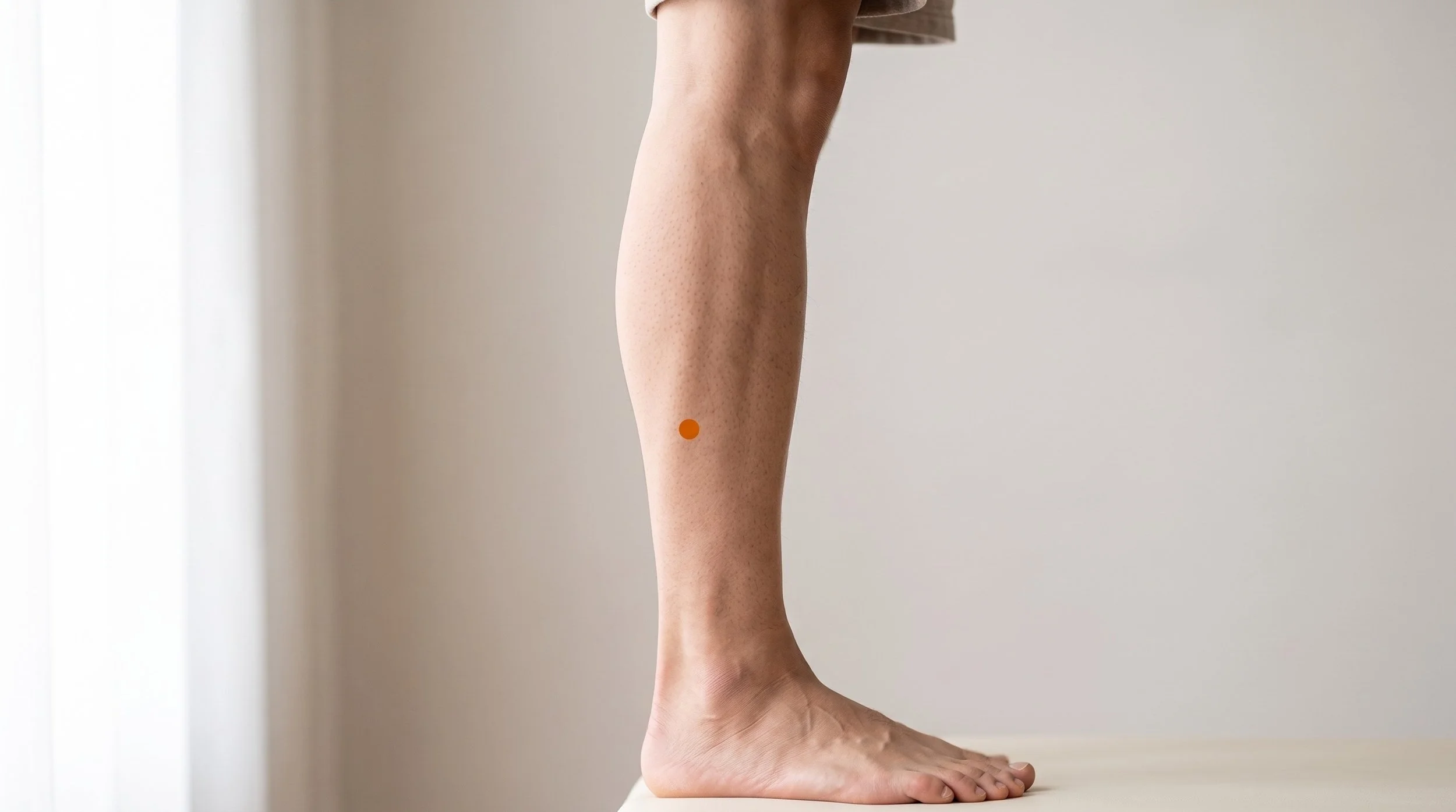
GB35 Acupuncture Point (Yangjiao)
The Yang Crossing on the Back Edge of the Fibula: Anatomy, Mechanism, and Why This Xi-Cleft Point Anchors Lateral Leg, Knee, and Sciatic Pain Treatment
GB35, known in Chinese as Yangjiao and usually translated as Yang Intersection or Yang Crossing, sits on the outer lower leg about a hand's span above the ankle bone, tucked into the groove along the back edge of the fibula. It's the xi-cleft (accumulation) point of the Yang Linking vessel, which in classical sources is the channel that ties the yang surfaces of the body together, and xi-cleft points were traditionally reserved for sharp, acute, stubborn presentations.
In plain clinical terms, the GB35 acupuncture point is a lateral leg access point: it sits in tissue that peroneal and calf muscles share, in nerve territory that overlaps the same spinal segments feeding the knee, the outer shin, and the sciatic distribution. That combination is why gallbladder 35 shows up in treatments for lateral leg aching, knee pain, and radiating leg symptoms, alongside a striking set of classical indications for chest and rib-side fullness and agitation.
- Yangjiao point location is straightforward once you find the bone: 7 cun above the tip of the outer ankle bone, in the depression at the posterior border of the fibula, which also works out to about one cun below the midpoint of the line from the malleolus tip to the popliteal crease (Deadman et al., 2009). Its neighbor GB36 sits at the same height on the front edge of the same bone.
- Needling passes through skin and subcutaneous tissue into the peroneal muscle mass and the fascial seam it shares with soleus and the deep posterior compartment, so the GB 35 leg point is as much a myofascial target as a channel point (Simons et al., 1999).
- Classically, GB35 is listed as the xi-cleft point of the Yang Linking vessel and as a crossing point where gallbladder and yang linking influence meet, with some texts also describing an effect across the three leg yang channels (Maciocia, 2005; Kim, 2008; Maciocia, 2006). Those designations are best read as a map of where the point tends to be used, not as a claim about literal energy flow.
- Mechanistically, needling here recruits superficial fibular and sural cutaneous fibers plus deeper muscle afferents in the L5 to S2 range, and that segmental input converges in the dorsal horn with input from the knee and lateral leg while also engaging descending inhibitory pathways from the brainstem (Zhao, 2008).
- The research picture is honest rather than dramatic: individual patient data meta-analysis supports acupuncture for chronic musculoskeletal pain (Vickers et al., 2018), Cochrane analysis of peripheral joint osteoarthritis found small benefits with much of the effect attributable to non-specific factors (Manheimer et al., 2010), and sciatica reviews and a sham-controlled trial suggest modest, real, but not spectacular improvements (Zhang et al., 2023; Tu et al., 2024).
- De qi at GB35 usually reads as a deep, heavy, slightly bony ache that spreads along the outer leg toward the ankle or upward toward the knee, sometimes with a brief cramping twitch if a taut band in the peroneals is engaged.
Outer Leg Pain That Won't Settle After a Run or a Long Day on Your Feet?
Lateral lower leg pain rarely comes from one tissue: the peroneals, the soleus seam, the fibular head, and the lumbar segments that feed them all tend to be involved together. At Morningside Acupuncture we use GB35 as one anchor in a lateral leg treatment, pairing it with nearby channel points and with dry needling of the peroneal group when taut bands are part of the picture. We reassess strength, single-leg balance, and provocation testing between sessions so the plan keeps moving. Schedule a visit and we'll map where your outer leg pain is actually coming from.
Schedule NowAnatomy of GB35: Why the Posterior Border of the Fibula Is Such an Important Location
GB35 sits in the shallow groove you can feel along the back edge of the fibula, roughly at the junction of the middle and lower thirds of the lower leg. Under the skin and subcutaneous fat, the needle enters the peroneal (fibular) muscle group, which runs down the outer shin and everts and stabilizes the foot, and passes toward the fascial seam where those muscles meet soleus and the deep posterior compartment. This region takes a beating in runners, hikers, dancers, and anyone who spends long days on hard city sidewalks, because the peroneals work constantly to control the ankle on uneven ground.
Taut bands in peroneus longus and brevis commonly refer pain along the outer leg and toward the lateral ankle, which is one reason this stretch of the fibula is such productive territory clinically (Simons et al., 1999). A practical location note: above the level of GB39 the fibula is harder to feel because muscle covers it, so most practitioners find the bone's back edge lower down near the ankle and trace that line upward.
The nerve geography here explains most of what GB35 does. Skin at the point is supplied by branches of the superficial fibular nerve, with sural nerve territory just posterior, and the muscle bellies underneath carry their own deep afferents. All of this traffic enters the cord around the L5 to S2 levels, which are the same segments that serve the lateral knee, the outer shin, the ankle, and the sciatic distribution down the back and side of the leg.
When afferents from the point converge on dorsal horn neurons that also receive input from painful structures nearby, needling can change how those neurons behave, and sustained stimulation additionally recruits descending inhibitory pathways from the midbrain and brainstem along with local release of opioid and non-opioid mediators (Zhao, 2008). That's the neurophysiological version of the traditional idea that a distal leg point can influence the whole limb.
Depth-wise, the fibula itself is the backstop, which makes this a comparatively forgiving point: a perpendicular insertion of about 1 to 1.5 cun stays in muscle without approaching anything hazardous when angled correctly. The peroneal artery and the deep fibular nerve run deeper and more anteromedially than the usual needle path, and the common fibular nerve wraps the fibular neck far above GB35, so the classic peroneal nerve caution belongs to the area just below the knee, not here.
As always, needling is angled along the bone rather than into it, and patients with lower leg swelling, suspected compartment issues, blood-thinning medication, or recent lower leg surgery need a modified approach.
Related Peroneus Longus Trigger Points Related Pain Finder Leg Ankle FootGB35 at a Glance: Classification, Location, and Clinical Use
| Category | Detail |
|---|---|
| Traditional Name | Yangjiao (Yang Intersection, also translated Yang Crossing) |
| Channel Classification | Gallbladder channel of the foot shaoyang, point 35 of 44, on the lateral lower leg |
| Point Categories | Xi-cleft (accumulation) point of the Yang Linking vessel (Yang Wei Mai); intersection point of the Gallbladder channel with the Yang Linking vessel; listed in some texts as a crossing point relating to the three leg yang channels |
| Precise Location | On the outer lower leg, 7 cun above the prominence of the lateral malleolus, in the depression at the posterior border of the fibula, approximately one cun below the midpoint of the line from the malleolus tip to the popliteal crease |
| Tissue Stimulated | Skin and subcutaneous tissue in superficial fibular and sural nerve territory, then the peroneal muscle group (peroneus longus and peroneus brevis) and the fascial seam it shares with soleus |
| Needle Depth / Direction | Perpendicular insertion 1 to 1.5 cun, angled along the posterior border of the fibula rather than into the bone; moxibustion is traditionally permitted |
| De Qi Sensation | A deep, heavy, bone-adjacent ache that often spreads down the outer leg toward the ankle or up toward the knee, sometimes with a brief twitch response if a taut peroneal band is engaged |
| Primary Clinical Uses | Lateral lower leg pain and cold-type aching, knee swelling and pain, weakness or heaviness of the lower limb, radiating outer leg symptoms, and in classical use chest and rib-side fullness plus fright palpitations |
| Common Point Combinations |
|
In A Manual of Acupuncture, Deadman and colleagues give Yangjiao two traditional action headings: activating the channel to relieve pain, and regulating Gall Bladder qi while calming the spirit.
The classical indication list, presented here as traditional attribution rather than as verified physiology, clusters into four groups: local limb complaints (knee swelling and pain, weakness or heaviness of the lower leg, aching described as cold in character, cramping of the sinews during acute disorders), chest and rib-side complaints (fullness, distention, and pain through the sides), mental-emotional agitation (states of fright and mania), and upper-body swelling (puffiness of the face and eyes, throat obstruction).
Other authors add sciatica, calf pain and cramping, lower limb swelling, and a general calming quality to the same list (Cunningham, 2000; Kim, 2008). What's striking is the pairing itself: a point on the outer shin that classical writers considered useful for a pounding, frightened chest. That combination of a limb location with chest and spirit indications is exactly the kind of pattern the extraordinary vessel framework was built to explain, since the Yang Linking vessel was described as running from the heel up the lateral body to the head (Maciocia, 2006).
Why GB35 Is Used for Chest Tightness and Fright Palpitations Despite Sitting on the Shin
The everyday uses of GB35 need little explanation. The point sits in the muscles that control the outer ankle and lower leg, and its cutaneous and muscular afferents enter the cord at the same L5 to S2 levels that serve the knee, the lateral shin, and the sciatic distribution. When several structures report into the same dorsal horn neurons, stimulating one of them can change the sensitivity of the whole pool, which is the working explanation for why needling the mid-shin can ease pain felt at the knee or the ankle (Zhao, 2008).
Add in the local effects at the needle site, where mechanical stimulation increases blood flow, changes muscle tone in taut bands, and alters the input coming from sensitized tissue, and you have a plausible account of the traditional indications for lateral leg pain, heaviness, and knee complaints.
The chest and palpitation indications are the interesting ones. Needling doesn't send anything up the leg to the heart, but strong somatic stimulation does reliably shift autonomic balance. Systematic review of heart rate variability studies found that acupuncture tends to reduce markers of sympathetic dominance, with the clearest changes in people who weren't already in a settled baseline state (Chung et al., 2014).
Descending pathways from the periaqueductal gray and rostral ventromedial medulla that mediate acupuncture analgesia overlap anatomically with the brainstem circuitry regulating heart rate and breathing (Zhao, 2008), so a limb point that produces a strong, sustained de qi sensation can plausibly influence how tight and braced the chest feels. That's a modest claim, and it's a very different claim from saying GB35 treats cardiac disease.
In practice, we don't select GB35 as a standalone treatment for palpitations or anxiety. We use it as a limb point in patients whose main complaint is musculoskeletal, and we note that many of them report a settling, downshifted feeling during the session. The classical pairing of leg location with chest indications is best understood as an old, careful observation of a real nervous system effect, described in the vocabulary available at the time.
What the Research Shows for GB35
No trial has isolated GB35. Like nearly every individual acupuncture point, it appears inside multi-point protocols, so the honest way to read the literature is to ask what acupuncture does for the conditions this point is chosen for, and then to treat point selection as clinical reasoning layered on top of that evidence. The reviews below cover chronic musculoskeletal pain, knee osteoarthritis, sciatica, and the autonomic effects that may underlie the calming reports patients describe.
Effect sizes are generally modest, sham comparisons complicate interpretation, and the strongest signal is for persistent pain rather than for acute or structural problems.
| Study | Type | Focus | Key Finding |
|---|---|---|---|
| Vickers et al., 2018 | Individual patient data meta-analysis | Chronic musculoskeletal, headache, and osteoarthritis pain across roughly 20,000 patients | Acupuncture outperformed both sham and no-acupuncture controls for chronic pain, with effects that persisted over time, though the difference from sham was smaller than the difference from usual care. |
| Manheimer et al., 2010 | Cochrane systematic review | Acupuncture for peripheral joint osteoarthritis, including the knee | Sham-controlled trials showed statistically significant but small benefits that did not meet the review's thresholds for clinical relevance, with larger effects seen against waiting list controls. |
| Zhang et al., 2023 | Systematic review and meta-analysis | Acupuncture for sciatica across 30 randomized trials | Acupuncture was associated with greater pain reduction than medication comparators and a favorable safety profile, though trial quality limits how firmly the conclusion can be stated. |
| Tu et al., 2024 | Multicenter randomized clinical trial | Acupuncture versus sham acupuncture for chronic sciatica from herniated disc | Ten sessions over four weeks produced modest improvements in leg pain and disability compared with sham, supporting real but limited specific effects. |
| Chung et al., 2014 | Systematic review with meta-analysis | Effect of acupuncture on heart rate variability | Across fourteen trials, acupuncture tended to lower low-frequency power and the low-to-high frequency ratio, consistent with a shift away from sympathetic dominance. |
| Zhao, 2008 | Narrative review of mechanism research | Neural mechanisms of acupuncture analgesia | Analgesic effects are attributed to segmental spinal modulation, descending inhibitory control, and release of endogenous opioids and other neuromodulators. |
Knee Pain That Tracks Along the Outside of the Joint?
Classical texts list swelling and pain of the knee among the main uses of Yangjiao, and modern practice keeps GB35 in rotation for lateral knee complaints because it sits in the same segmental neighborhood as the joint. We combine it with GB34 below the knee, local knee points, and targeted needling of the muscles that load the lateral chain. Every session includes movement retesting so you can feel what changed. Book an appointment and let's get your knee loading comfortably again.
Schedule NowGB35 in the Context of Trigger Point Work
The location of GB35 overlaps directly with territory that trigger point mapping treats as a common source of outer leg complaints. Peroneus longus and brevis harbor taut bands that refer pain along the lateral lower leg and toward the outer ankle and foot, and soleus, just behind the point, refers into the calf and heel (Simons et al., 1999). When a patient's outer leg pain reproduces on palpation right where the point sits, we're not choosing between a channel point and a myofascial target: it's the same tissue approached with the same tool, an acupuncture needle, under two descriptive systems.
In a typical Morningside session for lateral leg or knee pain, GB35 might be needled as a channel point with sustained de qi while dry needling addresses peroneus longus, peroneus brevis, and soleus, plus tibialis posterior when the medial shin is involved. If the knee is the primary complaint, we'll add local knee needling and GB34 below the fibular head. Between-session work matters as much as the needling itself, so we usually pair treatment with eccentric calf and peroneal loading, single-leg balance work, and a look at footwear and running or walking volume.
GB35 Lateral Leg and Knee Pain Treatment at NYC's Highest-Rated Acupuncture Clinic
Morningside Acupuncture is the highest-rated acupuncture and dry needling clinic in New York City with over 500 five-star Google reviews, and our approach blends classical point selection with sports medicine reasoning. GB35 is one of the points we reach for when outer leg and knee complaints need a distal anchor alongside local work. Sessions are one-on-one, unhurried, and built around what your exam actually shows. Schedule your visit today and start with a full assessment.
Schedule NowFrequently Asked Questions
What does GB35 feel like when needled?
Most people describe a deep, heavy, slightly dull ache close to the bone rather than a sharp sensation. That ache often spreads along the outer leg, sometimes downward toward the ankle and sometimes upward toward the knee, and it may build for a few seconds after the needle is manipulated. If a taut band in the peroneal muscles is engaged, you might feel a quick involuntary twitch followed by a cramping sensation that fades within seconds. Sharp, electric, or shooting sensations aren't the goal, and you should say so immediately if you feel one so the needle can be adjusted.
Why would a practitioner needle my shin for knee pain or pain higher up the leg?
Because the nervous system doesn't organize itself by body region the way our intuition does. The skin and muscle at GB35 send signals into the spinal cord at roughly the L5 to S2 levels, and those same levels receive input from the knee, the outer shin, and the sciatic distribution. Stimulating one input can change how sensitive that whole shared pool of neurons is, and sustained stimulation also engages descending pain-inhibiting pathways from the brainstem (Zhao, 2008). Practically, distal points like gallbladder 35 also let us work while an acutely painful knee or hip is left undisturbed, which is often more comfortable for the patient.
Can I press GB35 myself between sessions?
Yes, and it's easy to find. Sit with your knee bent and slide a thumb up the back edge of your fibula from the outer ankle bone, roughly a hand's span (about 7 cun, or the width of your own four fingers plus three more) above the ankle bone tip, until you land in a tender groove behind the bone. Press with your thumb at a moderate, tolerable intensity, aiming for a dull ache rather than sharpness, and hold for 30 to 60 seconds. Repeat two or three times per side, once or twice a day, and follow with gentle ankle circles and a calf stretch. Stop if the pressure produces numbness, tingling, or pain that lingers afterward.
Is GB35 safe to needle?
In trained hands, yes. The fibula sits directly beneath the point, which limits depth, and the major neurovascular structures of the lower leg run deeper and more anteromedially than the standard perpendicular insertion of 1 to 1.5 cun. The common fibular nerve, which is the well-known caution in this region, wraps the fibular neck well above GB35, near the knee. Standard precautions still apply: clean needle technique, extra care with anticoagulant medication, avoidance over broken or infected skin, and a modified approach in anyone with significant lower leg swelling, vascular disease, neuropathy, or a suspected compartment problem. Temporary soreness or a small bruise is the most common side effect.
Where exactly is GB35 located?
On the outer aspect of the lower leg, 7 cun above the prominence of the lateral malleolus, in the depression at the posterior border of the fibula. A useful cross-check: the distance from the ankle bone tip to the crease behind the knee is measured as 16 cun, so GB35 sits about one cun below the midpoint of that line. Because the fibula is covered by muscle higher up the leg, the reliable method is to feel for the bone's back edge near the ankle where it's easy to palpate, then trace that line upward toward the fibular head. GB36 sits at the same height on the front edge of the same bone, so getting the front-versus-back distinction right is what separates the two.
References
- Deadman, P., Al-Khafaji, M., & Baker, K. (2009). A manual of acupuncture. Journal of Chinese Medicine Publications.
- Maciocia, G. (2005). The foundations of Chinese medicine: A comprehensive text for acupuncturists and herbalists (2nd ed.). Elsevier Churchill Livingstone.
- Maciocia, G. (2006). The channels of acupuncture: Clinical use of the secondary channels and eight extraordinary vessels. Churchill Livingstone Elsevier.
- Cunningham, P. M. (2000). Acupuncture points: A practical guide to classical and modern usage. Odyssey Press.
- Kim, H. (2008). Handbook of Oriental medicine (3rd ed.). Harmony & Balance Press.
- Cecil-Sterman, A. (2012). Advanced acupuncture: A clinic manual. Classical Wellness Press.
- Simons, D. G., Travell, J. G., & Simons, L. S. (1999). Travell & Simons' myofascial pain and dysfunction: The trigger point manual, Vol. 1: Upper half of body (2nd ed.). Williams & Wilkins.
- Zhao, Z. Q. (2008). Neural mechanism underlying acupuncture analgesia. Progress in Neurobiology, 85(4), 355-375. https://doi.org/10.1016/j.pneurobio.2008.05.004
- Vickers, A. J., Vertosick, E. A., Lewith, G., MacPherson, H., Foster, N. E., Sherman, K. J., Irnich, D., Witt, C. M., & Linde, K. (2018). Acupuncture for chronic pain: Update of an individual patient data meta-analysis. Journal of Pain, 19(5), 455-474. https://doi.org/10.1016/j.jpain.2017.11.005
- Manheimer, E., Cheng, K., Linde, K., Lao, L., Yoo, J., Wieland, S., van der Windt, D. A. W. M., Berman, B. M., & Bouter, L. M. (2010). Acupuncture for peripheral joint osteoarthritis. Cochrane Database of Systematic Reviews, 2010(1), CD001977. https://doi.org/10.1002/14651858.CD001977.pub2
- Zhang, Z., Hu, T., Huang, P., Yang, M., Huang, Z., Xia, Y., Zhang, X., Zhang, X., & Ni, G. (2023). The efficacy and safety of acupuncture therapy for sciatica: A systematic review and meta-analysis of randomized controlled trials. Frontiers in Neuroscience, 17, 1097830. https://doi.org/10.3389/fnins.2023.1097830
- Tu, J. F., Shi, G. X., Yan, S. Y., Ni, G. X., Yu, F. T., Cai, G. W., Liu, Z. S., Ma, C. Y., Wang, L. Q., Yang, J. W., Zhou, X. Q., Meng, X. L., Fu, H. Y., Li, J., Wan, W. J., Sun, T. H., Wang, X. Z., & Liu, C. Z. (2024). Acupuncture vs sham acupuncture for chronic sciatica from herniated disk: A randomized clinical trial. JAMA Internal Medicine, 184(12), 1417-1424. https://doi.org/10.1001/jamainternmed.2024.5463
- Chung, J. W. Y., Yan, V. C. M., & Zhang, H. (2014). Effect of acupuncture on heart rate variability: A systematic review. Evidence-Based Complementary and Alternative Medicine, 2014, 819871. https://doi.org/10.1155/2014/819871
Disclaimer: This web site is intended for educational and informational purposes only. Reading this website does not constitute providing medical advice or any professional services. This information should not be used for diagnosing or treating any health issue or disease. Those seeking medical advice should consult with a licensed physician. Seek the advice of a medical doctor or other qualified health professional for any medical condition. If you think you have a medical emergency, call 911 or go to the emergency room. No acupuncturist-patient relationship is created by reading this website or using the information. Morningside Acupuncture PLLC and its employees and contributors do not make any express or implied representations with respect to the information on this site or its use. For any legal interpretation of scope of practice in your state, consult a licensed attorney or regulatory authority.
Read more from our blog



