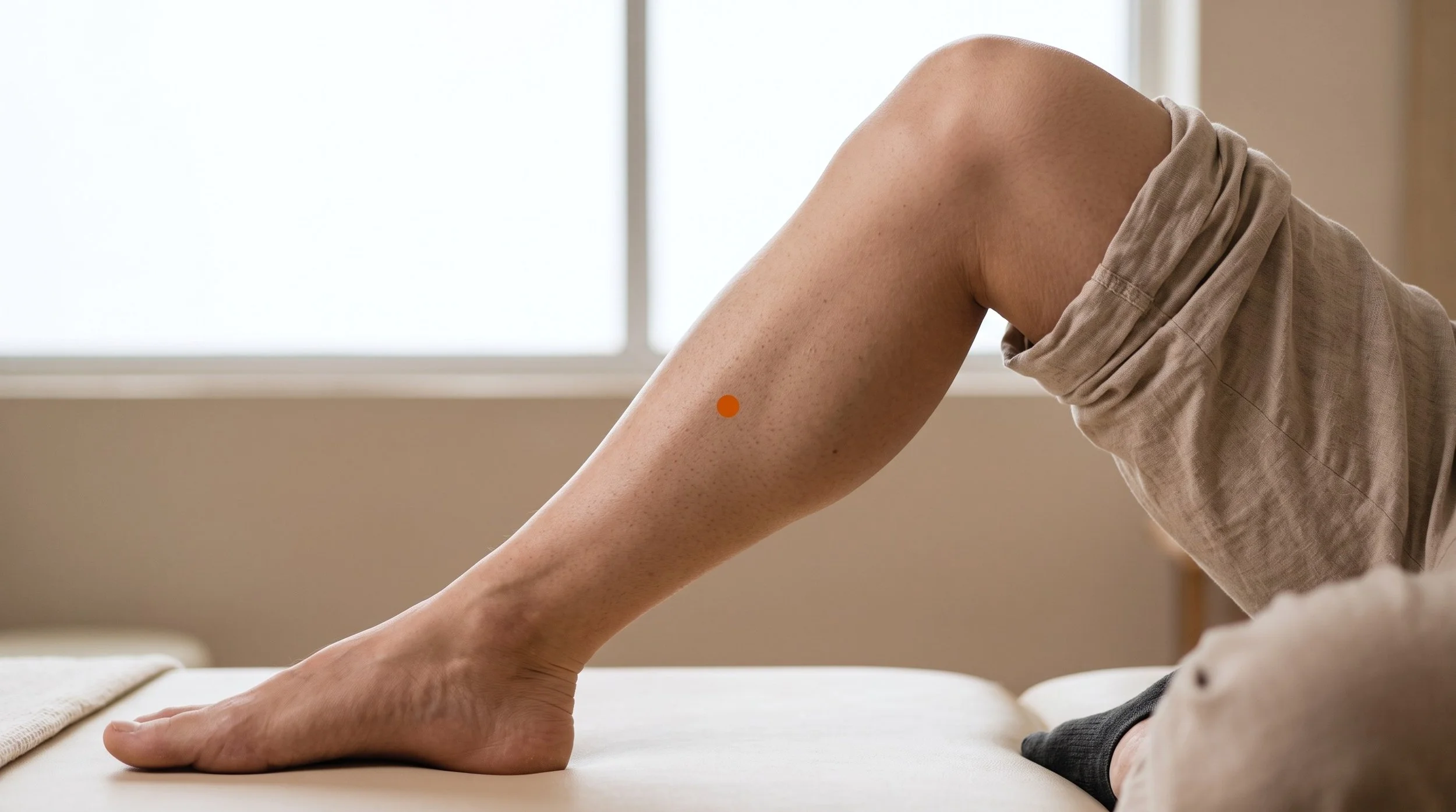
LV6 Acupuncture Point (Zhongdu)
The Central Capital on the Inner Shin: Anatomy, Mechanism, and Why the Liver Channel's Xi-Cleft Point Belongs in Acute Pelvic and Abdominal Treatment
LV6 (Zhongdu, often translated as Central Capital or Middle Capital), also written LR6, sits on the inner shin, roughly halfway between the inner ankle bone and the back of the knee, just behind the sharp edge of the tibia where the bone gives way to soft muscle. It is the xi-cleft point of the Liver channel, a category traditionally reserved for sudden, sharp, or acute presentations, and in the yin channels for problems involving blood. Classical sources direct the LV6 acupuncture point toward acute lower abdominal and hypogastric pain, prolonged uterine bleeding and lochia, and diarrhea, all of which sit far from the shin itself.
That distance is exactly what makes this point interesting: it is a limb point used for pelvic and digestive complaints, and the modern explanation runs through nerve signaling and autonomic reflexes rather than anything mystical.
- Location and layers: liver 6 is found 7 cun above the tip of the medial malleolus, immediately behind the medial border of the tibia, in the soft depression before the calf muscle mass. The needle passes through thin skin and subcutaneous tissue into the deep flexor group along the back of the tibia, so the LV 6 shin location is bony on one side and muscular on the other.
- Traditional categories, translated: the Zhongdu xi cleft point designation traditionally marks a place where channel qi and blood were said to gather and sink more deeply, which is why xi-cleft points were reserved for acute pain and, on yin channels, for bleeding patterns. In modern terms we treat this as a classical selection rule for high-intensity, short-course problems rather than a literal description of flow.
- Nerve geography: the superficial tissue here is saphenous nerve territory (L3 to L4) while the deeper flexors are supplied through tibial nerve branches, so needling recruits both cutaneous and deep muscular afferents, the mix most associated with strong needle sensation and central pain modulation (Zhao, 2008).
- Mechanism for pelvic and gut effects: distal limb stimulation influences visceral function largely through supraspinal reflex pathways rather than same-segment wiring, which is the current physiological account of why a shin point may change abdominal symptoms (Uchida et al., 2017).
- Research picture: no trial has isolated LV6, and reviews test multi-point protocols. Cochrane reviews of acupuncture for period pain and for irritable bowel syndrome describe low-quality or sham-equivalent findings (Smith et al., 2016; Manheimer et al., 2012), while individual patient data across chronic pain conditions suggest modest, persisting effects (Vickers et al., 2018).
- In practice and de qi: Zhongdu liver is not a daily-use point in most modern clinics, and it tends to appear when the medial shin is genuinely tender or when an acute presentation calls for a Liver channel xi-cleft. Patients usually describe a deep, heavy ache pressed against the bone, sometimes traveling up the inner leg, rather than a sharp sting.
Sharp Lower Abdominal Cramping That Comes On Fast?
Acute hypogastric cramping deserves a proper workup first, and once serious causes are ruled out, acupuncture can be a reasonable adjunct. At Morningside Acupuncture we use LV6 alongside SP6, LV3, and abdominal points when the medial shin is tender and symptoms flare in short, intense episodes. Treatment is paired with breathing and downregulation work so the nervous system is not fighting the needles. Schedule a visit and we will map your pattern before we needle anything.
Schedule NowAnatomy of LV6: Why the Back Edge of the Tibia at Mid-Shin Is Such an Important Location
The medial border of the tibia is one of the few places on the body where bone sits directly beneath skin with almost nothing in between. At mid-shin, roughly 7 cun above the medial malleolus, the finger rolls off that hard edge into a soft groove before the bulk of the calf begins. A needle placed here passes through thin skin and a shallow subcutaneous layer, through the deep fascia of the leg, and into the deep posterior compartment, where tibialis posterior and flexor digitorum longus attach along the back of the tibia.
These are the muscles that control arch collapse and push-off, so they load heavily during running, stair climbing, and long walking days, and they are a common source of aching along this exact border of the bone.
The overlying skin here is largely saphenous nerve territory, a sensory branch of the femoral nerve carrying L3 and L4 information, while the deeper flexor muscles receive tibial nerve supply. Needling the point therefore stimulates two different afferent populations at once: fine cutaneous fibers and the deeper muscle afferents that appear to matter most for producing strong needle sensation and engaging spinal and brainstem pain-modulating circuits (Zhao, 2008).
Because the pelvic organs are innervated through thoracolumbar and sacral segments rather than L3 to L4, effects on abdominal symptoms are best explained through convergence higher in the neuraxis and through somato-autonomic reflex pathways that limb stimulation is known to recruit (Uchida et al., 2017). Broad chronic pain data suggest that needling effects, while modest, are not simply the visit or the expectation (Vickers et al., 2018).
Deep structures matter more here than the shallow location suggests. The great saphenous vein runs up the medial leg near this level, and the posterior tibial vessels and tibial nerve travel deeper in the compartment, so needling stays close to the bone and moderate in depth. Standard technique is perpendicular insertion of roughly 0.5 to 1 cun, or oblique insertion angled proximally along the channel for 1 to 2 cun, with moxibustion listed as acceptable in point texts such as Kim's clinical charts.
Clean technique, careful angulation just behind the tibial border, and avoiding visible superficial veins keep the point straightforward in trained hands.
Related Liver Channel Related Tibialis Posterior Trigger PointsLV6 (LR6) at a Glance: Classification, Location, and Clinical Use
| Category | Detail |
|---|---|
| Traditional Name | Zhongdu (Central Capital, also translated Middle Capital) |
| Channel Classification | Liver channel of the foot jueyin, sixth point, on the medial lower leg (LV6, also written LIV6 or LR6) |
| Point Categories | Xi-cleft (accumulation) point of the Liver channel. No five-shu, hui-meeting, or extraordinary vessel designations appear for this point in the classical sources. Note that the name Zhongdu is shared with GB32 on the lateral thigh, so the two are distinguished by channel. |
| Precise Location | On the medial lower leg, 7 cun above the prominence of the medial malleolus, immediately posterior to the medial border of the tibia, in the depression between the bone and the calf muscle. An alternate method places it 0.5 cun distal to the midpoint between the tip of the medial malleolus and the popliteal crease. |
| Tissue Stimulated | Skin and subcutaneous tissue in saphenous nerve territory, deep fascia, and the deep posterior compartment flexors along the back of the tibia, including tibialis posterior with the gastrocnemius and soleus mass lying just posterior. |
| Needle Depth / Direction | Perpendicular insertion 0.5 to 1 cun just behind the medial tibial border, or oblique insertion directed proximally along the channel 1 to 2 cun. Moxibustion is traditionally considered applicable. |
| De Qi Sensation | A deep, heavy, spreading ache pressed against the bone, sometimes with a dull line of sensation traveling up the inner leg toward the knee or down toward the ankle with proximally angled needling. |
| Primary Clinical Uses | Traditionally used for acute lower abdominal and hypogastric pain including classical shan disorder, prolonged uterine bleeding and persistent lochia, diarrhea, and damp painful obstruction with heaviness or numbness of the legs. In modern clinical use it also serves as a local option for medial shin and deep calf tenderness. |
| Common Point Combinations |
|
Deadman's Manual of Acupuncture presents Zhongdu LIV-6 as the xi-cleft point of the Liver channel, traditionally credited with spreading Liver qi, regulating the lower jiao and blood, and draining damp. Its core indication list is short: sudden lower abdominal and hypogastric pain, classical shan disorder, diarrhea, and continued postpartum discharge or uterine bleeding.
Deadman notes that despite the xi-cleft status, which usually implies a robust role in acute and blood-related conditions, this point carries relatively few such indications. A scattering of classical texts adds a different flavor entirely, with the Classic of the Jade Dragon citing numbness of the body and of the hands and feet, the Investigation into Points Along the Channels describing wasted and weak legs, and the Thousand Ducat Formulas mentioning heat in the soles, a cluster that traditional commentary reads as an atrophy pattern attributed to damp-heat.
What is striking is the mismatch: a point with a prestigious classical category, a name suggesting a central capital, and yet very few surviving formulas, which suggests it was as under-used historically as it is today.
Why LV6 Is Used for Lower Abdominal Cramping and Prolonged Menstrual Bleeding
Patients reasonably ask how a point on the shin could matter for cramping in the pelvis. The honest answer is that it is not a same-segment relationship. Sensation from the skin at LV6 travels in the saphenous nerve at roughly L3 to L4, while the uterus and lower bowel report through thoracolumbar sympathetic and sacral parasympathetic routes. What limb points appear to do instead is feed strong afferent input into the spinal cord and brainstem, where signals from skin, muscle, and viscera converge and where the nervous system decides how loudly to broadcast a pain signal (Zhao, 2008).
The second half of the story is descending control and autonomic reflex. Needle stimulation that produces genuine deep sensation engages brainstem systems that dampen incoming nociceptive traffic, and it also recruits somato-autonomic pathways that can shift smooth muscle tone and blood flow. Research in this area shows that stimulation applied to the limbs tends to work through supraspinal circuits, while abdominal stimulation can act through direct segmental reflexes, which fits the classical habit of pairing a distal leg point with local abdominal points (Uchida et al., 2017).
Across chronic pain conditions more broadly, effects of needling are modest but measurable and appear to persist beyond the treatment course (Vickers et al., 2018).
Clinically, that translates to realistic framing. LV6 is chosen when the presentation is acute rather than smoldering, when the medial Liver channel line on the shin is tender to pressure, and when it can be combined with local abdominal or sacral points rather than used alone. It is a supporting instrument, not the whole treatment, and cramping that is severe, new, or accompanied by fever or abnormal bleeding needs medical evaluation first.
What the Research Shows for LV6 (LR6)
One note on naming before the evidence: in the research literature this point is usually listed as LR6, the WHO standard code, and sometimes as LV6 or LIV6, so it is worth searching all three if you want to read the studies below in full.
Point-specific evidence for LV6 does not exist in the way patients often hope. Clinical trials test protocols made of several points, so any conclusion about this point is inferred from the conditions it belongs to and from mechanism research on needling in general. The reviews below are worth reading as a set: they show meaningful uncertainty in gynecological and gastrointestinal applications, a more consistent though modest signal in chronic pain, and a plausible physiological framework for how a shin point could influence pelvic or digestive symptoms at all.
| Study | Type | Focus | Key Finding |
|---|---|---|---|
| Smith et al., 2016 | Cochrane systematic review | Acupuncture and acupressure for primary dysmenorrhoea | The review concluded there is insufficient evidence to establish whether acupuncture or acupressure reduce period pain, with evidence rated low or very low quality across comparisons. |
| Manheimer et al., 2012 | Cochrane systematic review | Acupuncture for irritable bowel syndrome, including diarrhea-predominant presentations | Sham-controlled trials showed no advantage of acupuncture over credible sham for symptom severity, though Chinese comparative trials reported greater benefit than two antispasmodic drugs. |
| Vickers et al., 2018 | Individual patient data meta-analysis | Acupuncture across chronic pain conditions in nearly 21,000 patients | Acupuncture was associated with modest but statistically significant benefit over both sham and no-acupuncture controls, with effects largely sustained at one year. |
| Uchida et al., 2017 | Narrative physiological review | Somatoautonomic reflexes produced by somatic stimulation, including needling | Reflex effects on visceral organs are described, with limb stimulation acting mainly through supraspinal circuits and segmental stimulation able to recruit spinal reflexes as well. |
| Zhao, 2008 | Mechanism review | Neural mechanisms of acupuncture analgesia | Needle stimulation of muscle and skin afferents is described as activating spinal and supraspinal pain-modulating systems along with endogenous opioid signaling. |
Inner Shin Tenderness That Shows Up When You Run?
The tissue under LV6 includes the deep flexors that load hard during running and long days on your feet in the city. We combine needling at the point with dry needling of tibialis posterior and soleus, then add load management guidance so the shin gets a chance to settle. Many patients notice less pressure along the bone within a few sessions. Book an evaluation and we will assess the whole lower leg, not just the sore spot.
Schedule NowLV6 in the Context of Trigger Point Work
The tissue immediately deep to LV6 is the same tissue we target when treating medial shin pain with dry needling. Tibialis posterior and flexor digitorum longus run along the back of the tibia here, and the soleus and medial gastrocnemius sit just posterior. Trigger points in these muscles are described as referring pain along the Achilles region, the medial ankle, and the calf, patterns that overlap the Liver channel line on the inner leg (Simons et al., 1999). When a patient points to soreness that follows the bone edge, we are often treating both a classical point and a myofascial target with the same needle.
At Morningside, this typically means combining LV6 with dry needling of tibialis posterior, soleus, and medial gastrocnemius when the presentation is mechanical, then adding LV3, SP6, or ST36 when the picture also involves cramping, digestion, or menstrual symptoms. We use the same needles for both approaches, since dry needling is one of the many needling styles that fall under acupuncture. Treatment is paired with loading advice for the calf and foot, because a shin that keeps getting overloaded will keep getting sore no matter how well it responds in the room.
LV6 Pelvic and Menstrual Pain Treatment at NYC's Highest-Rated Acupuncture Clinic
Morningside Acupuncture is the highest-rated acupuncture and dry needling clinic in New York City with over 500 five-star Google reviews, and our licensed acupuncturists treat menstrual pain, cramping, and digestive complaints with structured, research-informed plans. LV6 is one option within a Liver channel strategy that may also include SP6, LV3, and abdominal or low back points depending on your presentation. We explain what each needle is for, and we track outcomes across a course of care. Schedule your first session and let's build a plan that fits your cycle and your schedule.
Schedule NowFrequently Asked Questions
Is LV6 the same point as LR6 or LIV6?
Yes. LV6, LR6, and LIV6 are all codes for the same point, Zhongdu, point 6 of the Liver channel. LR is the WHO standard abbreviation and the one you will see in most research papers. LV is the form used by many American schools and clinics, and LIV appears in several widely used textbooks. You will also come across it written as Liver 6 or LIV-6. Whichever code is used, the location and the uses are the same.
What does LV6 feel like when needled?
Most people describe a deep, heavy ache that seems to press against the inner edge of the shin bone, sometimes spreading a few inches up or down the leg. With oblique needling angled toward the knee, the sensation may travel further up the inner leg. It should not feel sharp, burning, or electric. If it does, tell your acupuncturist so the needle can be adjusted, since a zinging sensation usually means the tip is close to a small nerve branch.
Why use a point on the shin for pain in the lower abdomen?
Because the nervous system, not the skin surface, is doing the work. Needling here creates strong afferent input that converges with visceral signaling in the spinal cord and brainstem, where descending pathways can turn down how loudly pain is broadcast (Zhao, 2008). Limb stimulation also drives autonomic reflexes through supraspinal circuits that may influence smooth muscle tone and blood flow in the abdomen (Uchida et al., 2017). In practice, distal points like LV6 are usually combined with local abdominal or low back points rather than used alone.
Can I press LV6 myself between sessions?
Yes, and it is easy to reach. Sit with your ankle crossed over the opposite knee, find the tip of the inner ankle bone, and slide your thumb up the inner shin about halfway to the back of the knee. Roll your thumb off the hard back edge of the tibia into the soft groove just behind it. Press firmly enough to feel a dull ache, hold steady or make small circles for 30 to 60 seconds, release, and repeat two or three times per leg. Doing this once or twice a day is reasonable. Stop if the pressure produces sharp pain, numbness, or tingling, and skip the area entirely over varicose veins, broken skin, or bruising.
Is LV6 safe to needle?
In trained hands it is a straightforward point. The main considerations are the great saphenous vein running up the medial leg and the deeper neurovascular bundle in the posterior compartment, both of which are avoided by staying close to the tibial border and using standard depths of about 0.5 to 1 cun perpendicular or 1 to 2 cun obliquely. Bruising is the most common minor side effect on the lower leg. Tell your acupuncturist if you take anticoagulants, have a history of blood clots or significant varicose veins, or have reduced sensation in the leg, and always seek medical evaluation for new, severe, or unexplained abdominal pain or abnormal bleeding rather than treating it with acupressure alone.
Where exactly is LV6 located?
On the inner lower leg, 7 cun above the prominence of the medial malleolus, immediately behind the medial border of the tibia in the depression between the bone and the calf muscle. A practical alternative is to find the midpoint between the tip of the inner ankle bone and the crease behind the knee, then move about half a cun toward the ankle. It sits one cun above LV5 (Ligou) on the same line. Do not confuse it with GB32, which shares the name Zhongdu but sits on the outer thigh.
References
- Deadman, P., Al-Khafaji, M., & Baker, K. (2009). A manual of acupuncture. Journal of Chinese Medicine Publications.
- Maciocia, G. (2005). The foundations of Chinese medicine: A comprehensive text for acupuncturists and herbalists (2nd ed.). Elsevier Churchill Livingstone.
- Maciocia, G. (2006). The channels of acupuncture: Clinical use of the secondary channels and eight extraordinary vessels. Churchill Livingstone Elsevier.
- Kim, H. (2008). Handbook of Oriental medicine (3rd ed.). Harmony & Balance Press.
- O'Connor, J., & Bensky, D. (Eds. & Trans.). (1981). Acupuncture: A comprehensive text. Shanghai College of Traditional Medicine. Eastland Press.
- Simons, D. G., Travell, J. G., & Simons, L. S. (1999). Travell & Simons' myofascial pain and dysfunction: The trigger point manual, Vol. 1: Upper half of body (2nd ed.). Williams & Wilkins.
- Smith, C. A., Armour, M., Zhu, X., Li, X., Lu, Z. Y., & Song, J. (2016). Acupuncture for dysmenorrhoea. Cochrane Database of Systematic Reviews, 2016(4), CD007854. https://doi.org/10.1002/14651858.CD007854.pub3
- Manheimer, E., Cheng, K., Wieland, L. S., Min, L. S., Shen, X., Berman, B. M., & Lao, L. (2012). Acupuncture for treatment of irritable bowel syndrome. Cochrane Database of Systematic Reviews, 2012(5), CD005111. https://doi.org/10.1002/14651858.CD005111.pub3
- Uchida, S., Kagitani, F., & Sato-Suzuki, I. (2017). Somatoautonomic reflexes in acupuncture therapy: A review. Autonomic Neuroscience: Basic and Clinical, 203, 1-8. https://doi.org/10.1016/j.autneu.2016.11.001
- Vickers, A. J., Vertosick, E. A., Lewith, G., MacPherson, H., Foster, N. E., Sherman, K. J., Irnich, D., Witt, C. M., & Linde, K. (2018). Acupuncture for chronic pain: Update of an individual patient data meta-analysis. Journal of Pain, 19(5), 455-474. https://doi.org/10.1016/j.jpain.2017.11.005
- Zhao, Z. Q. (2008). Neural mechanism underlying acupuncture analgesia. Progress in Neurobiology, 85(4), 355-375. https://doi.org/10.1016/j.pneurobio.2008.05.004
Disclaimer: This web site is intended for educational and informational purposes only. Reading this website does not constitute providing medical advice or any professional services. This information should not be used for diagnosing or treating any health issue or disease. Those seeking medical advice should consult with a licensed physician. Seek the advice of a medical doctor or other qualified health professional for any medical condition. If you think you have a medical emergency, call 911 or go to the emergency room. No acupuncturist-patient relationship is created by reading this website or using the information. Morningside Acupuncture PLLC and its employees and contributors do not make any express or implied representations with respect to the information on this site or its use. For any legal interpretation of scope of practice in your state, consult a licensed attorney or regulatory authority.
Read more from our blog



