SP10 Acupuncture Point (Xuehai)
SP10 Acupuncture Point (Xuehai)
The Sea of Blood Above the Kneecap: Anatomy, Mechanism, and Why a Quadriceps Point Is Used for Knee Pain, Menstrual Complaints, and Itchy Skin
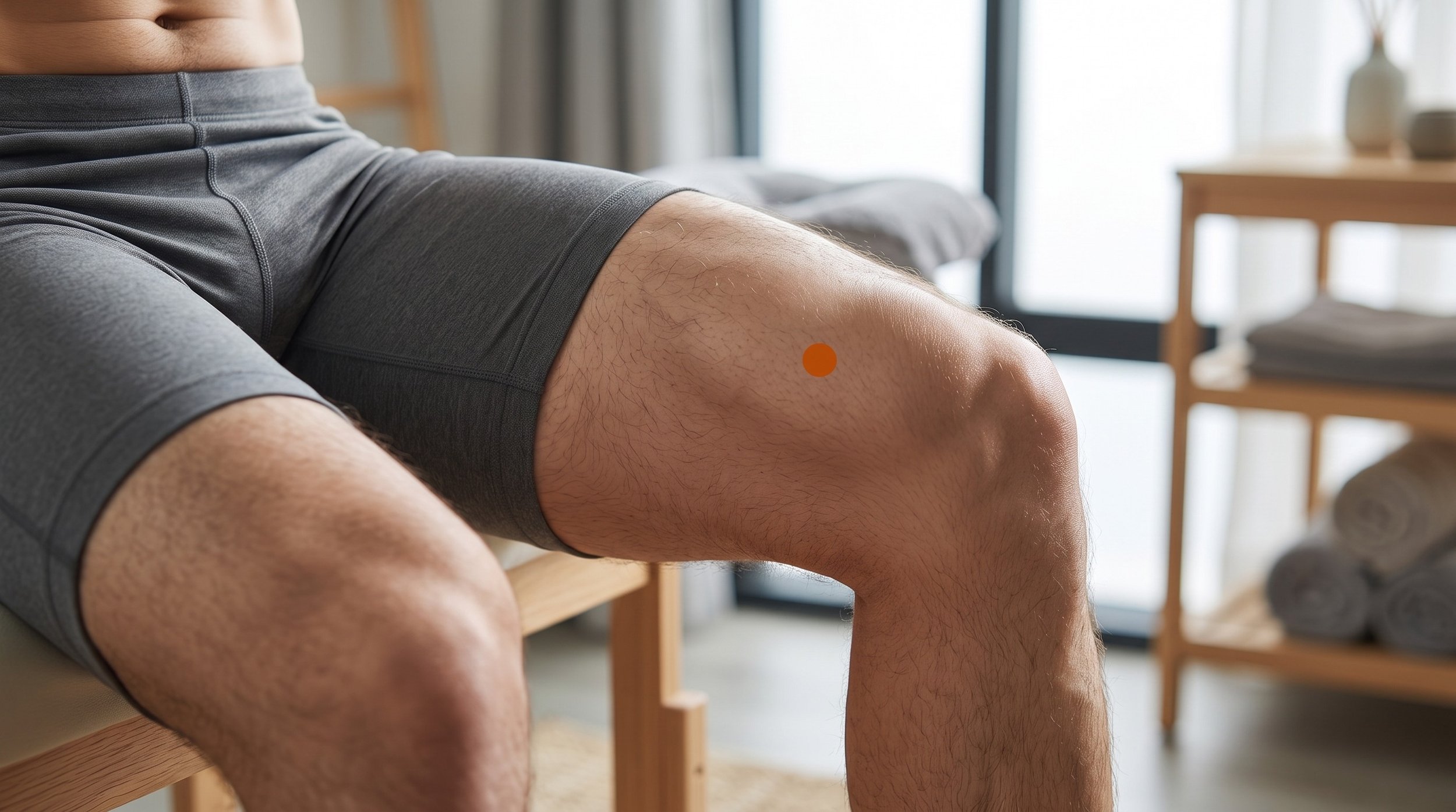
SP10 (Xuehai, translated as Sea of Blood) sits on the fleshy bulge of the inner thigh muscle just above the kneecap, roughly two thumb-widths up from the top inner corner of the patella when the knee is bent. In modern anatomical terms it lands squarely in the vastus medialis obliquus, the teardrop-shaped quadriceps head that stabilizes the kneecap during stairs, squats, and running.
That location gives the sp10 acupuncture point a double life: it is a practical local target for anterior and medial knee pain, patellar tracking problems, and quadriceps tightness, and it is simultaneously one of the most heavily used points in classical Chinese medicine for menstrual complaints and itchy skin conditions. Spleen 10 is a good example of a point whose traditional reputation and its plain musculoskeletal usefulness developed along separate lines and still both hold up in clinic.
- Location and layers: with the knee flexed, spleen 10 is 2 cun above the superior medial border of the patella, in the tender depression over the bulge of the vastus medialis (Deadman et al., 2001; Cheng, 1987). The needle passes skin and subcutaneous fat before entering dense, often tender oblique muscle fibers.
- Traditional categories, translated: classical texts attribute to SP10 the functions of invigorating and cooling the blood, harmonizing menstruation, and benefiting the skin (Deadman et al., 2001; Kim, 2010). In neurophysiological language those attributions map onto local muscle and vascular effects plus wider autonomic and immune modulation rather than any literal movement of blood.
- Mechanism: needling here recruits muscular branches of the femoral nerve and the anterior femoral cutaneous nerve (L2 to L4), and stimulation of muscle afferents at this depth engages spinal segmental inhibition and descending pain control pathways involving endogenous opioids, serotonin, and norepinephrine (Zhao, 2008).
- Research picture: acupuncture produces small to moderate benefits over sham and larger benefits over usual care for chronic musculoskeletal pain, including knee osteoarthritis (Vickers et al., 2018; Manheimer et al., 2010). SP10 is one of the few points with a body of skin-condition research attached to it, though results are mixed (Zheng et al., 2023).
- Clinical framing: SP10 is rarely used alone. It usually joins ST34, GB34, SP6, or LI11 depending on whether the session is aimed at the knee, the cycle, or the skin, and at Morningside it is often needled alongside trigger point work in the quadriceps (Simons et al., 1999).
- De qi: because the point sits in a thick, frequently irritable muscle belly, most people feel a deep ache or fullness that spreads toward the kneecap, sometimes with a brief involuntary twitch of the quadriceps if a taut band is engaged.
Knee Pain on Stairs, Squats, or Long Runs in NYC?
Medial and anterior knee pain often traces back to an overworked, poorly firing vastus medialis, exactly where SP10 sits. Our licensed acupuncturists palpate the quadriceps, patellar borders, and adductors before needling, so the point selection matches what your leg is actually doing. Treatment usually pairs SP10 with local knee points and targeted dry needling, then a short loading plan you can keep doing between visits. Schedule an evaluation and let's find out what your knee is protecting.
Schedule NowAnatomy of SP10: Why the Vastus Medialis Bulge Is Such an Important Location
With the knee bent, the inner thigh just above the kneecap forms a visible teardrop of muscle. That bulge is the vastus medialis, and its lowest oblique fibers (often called the VMO) angle sharply toward the patella. SP10 is located 2 cun proximal to the superior medial border of the patella, right on the crest of that bulge, in what classical texts describe simply as the tender depression there (Deadman et al., 2001; Cheng, 1987). The layers are shallow and forgiving: skin, subcutaneous fat, then muscle belly.
What loads this tissue is everything that decelerates the knee, including stairs, hills, squatting, cycling, and the eccentric control phase of running. Quadriceps tightness, patellofemoral irritation, post-surgical stiffness, and long periods of sitting all tend to leave this area sore to firm pressure, which is why the point so often palpates as tender before anyone touches it with a needle.
The nerve supply here is straightforward and clinically useful. Muscular branches of the femoral nerve innervate the vastus medialis, and the overlying skin is served by the anterior femoral cutaneous nerve, placing the point in the L2 to L4 segmental range (Cheng, 1987).
Needling into muscle at this depth activates group III and IV afferents, and that afferent barrage does two things at once: it engages segmental inhibition in the dorsal horn at the same spinal levels that receive input from the knee joint capsule and patellar retinaculum, and it recruits descending inhibitory pathways from the midbrain and brainstem that release endogenous opioids, serotonin, and norepinephrine (Zhao, 2008). In practical terms, that is why a needle placed in the thigh can change how the kneecap itself feels within a single session, and why the effect frequently outlasts the visit.
Deeper and slightly posterior to the point, the descending genicular vessels and the adductor canal contents run toward the knee, so needling is kept in the muscle belly rather than angled posteromedially into the canal. Standard practice is perpendicular insertion of about 1 to 1.5 cun, with shallower depths of roughly 0.5 to 1.2 cun also described (Deadman et al., 2001; Cheng, 1987; Kim, 2010). In a lean patient, 1 cun is often plenty to reach a taut band; in a heavily muscled thigh, more depth may be needed.
The point is well away from major nerves and arteries at the usual angle, and the most common side effects are minor bruising or a day of post-needle muscle soreness, similar to how a leg feels after unfamiliar squats.
Related Best Acupuncture Points For Knee Pain Related Acupuncture For Vastus Medialis PainSP10 at a Glance: Classification, Location, and Clinical Use
| Category | Detail |
|---|---|
| Traditional Name | Xuehai (Sea of Blood), SP10, also written Spleen 10 or SP-10 |
| Channel Classification | Point of the Spleen channel (leg taiyin), on the anteromedial thigh above the knee |
| Point Categories | No five-shu, crossing, or extraordinary vessel designation is recorded for this point in the standard references. It is classified among the points named for their therapeutic function rather than their location (Cheng, 1987), and some traditions list it as a harmonizing point, one position proximal to the he-sea point, used to normalize circulation of blood in luo channel treatment (Sterman, 2018). |
| Precise Location | With the knee flexed, 2 cun proximal to the superior medial border of the patella, on the bulge of the vastus medialis, directly above SP9. A common shortcut: cup your palm over the patient's opposite kneecap with the thumb spread at about 45 degrees, and the point falls under the thumb tip (Deadman et al., 2001; Cheng, 1987). |
| Tissue Stimulated | Vastus medialis obliquus muscle belly, overlying fascia and subcutaneous tissue; frequently overlaps palpable taut bands documented on our vastus medialis trigger points page, with referral patterns that can also involve the vastus intermedius |
| Needle Depth / Direction | Perpendicular insertion 1 to 1.5 cun into the muscle belly (shallower ranges of 0.5 to 1.2 cun are also described). Oblique insertion along the fibers is used for broader muscular effect. Avoid angling posteromedially toward the adductor canal. |
| De Qi Sensation | A deep, heavy ache or spreading fullness through the inner thigh, often traveling toward the kneecap. A brief, painless twitch of the quadriceps may occur if a taut band is contacted during trigger point style needling. |
| Primary Clinical Uses | Medial and anterior knee pain, patellofemoral irritation, quadriceps tightness and post-surgical knee stiffness; traditionally used for irregular or painful menstruation and for itchy inflammatory skin conditions such as hives and eczema |
| Common Point Combinations |
|
In the classical literature summarized by Deadman and colleagues, SP10 is treated as the premier point for disorders described at the blood level, which is how it earned the name Sea of Blood. The traditional attributions are two: moving stagnant blood and cooling heat in the blood, and both were applied mainly to gynecology and dermatology. Menstrual complaints marked by fixed stabbing pain and dark clotted flow were understood as stagnation, while heavy bleeding with signs of heat was understood as blood moving recklessly, and SP10 was reached for in both directions.
Classical dermatology used the same framework, distinguishing red inflamed lesions from purplish stagnant ones, and the texts even connected itching to the blood level through the saying that treating the blood settles the wind that causes itch. Later sources added a nourishing role, reasoning that stagnant blood must be cleared before new blood can be produced, which is why the point appears in post-partum and post-hemorrhage prescriptions.
What is striking is how narrow the classical claim actually was: a single point on the thigh, credited with authority over an entire physiological category, and cited in the Song of the Primary Points of the Fourteen Channels as capable of addressing all blood diseases.
Why SP10 Is Used for Itchy Skin and Menstrual Pain, Not Just Knees
Patients are often puzzled that a point on the thigh shows up in treatment plans for hives or period pain. The knee part is easy: SP10 shares spinal segments (roughly L2 to L4) with the knee joint capsule, the patellar retinaculum, and the medial quadriceps, so afferent input from the needle converges on the same dorsal horn neurons that carry knee pain signals, dampening their output (Zhao, 2008). The systemic uses work through a different route.
Sustained needle stimulation of muscle afferents anywhere in the body triggers descending inhibition from the periaqueductal gray and rostral ventromedial medulla and shifts autonomic balance, effects that are not limited to the segment where the needle sits (Zhao, 2008). That is the plausible bridge between a quadriceps point and complaints in the pelvis or the skin.
There is also point-specific laboratory work. In an animal model of urticaria, electroacupuncture applied at SP10 together with LI11 before sensitization was associated with reduced mast cell degranulation and lower IL-33 and ST2 signaling in skin tissue, which the authors linked to reduced IgE levels (Liu et al., 2023). This is a rat study, so it should be read as a mechanistic hint rather than clinical proof, but it is notable that the pairing tested in the lab is the same LI11 and SP10 combination the classical texts recommended for hives centuries earlier.
For menstrual complaints, the mechanism story is less about segmental overlap (uterine afferents travel through thoracolumbar and sacral pathways) and more about autonomic and neuroendocrine modulation plus general analgesia. That is an honest limitation worth stating: SP10's traditional gynecological reputation is far stronger than the point-specific physiological evidence behind it, and the clinical trials that include it always test it as part of a larger prescription.
What the Research Shows for SP10
Almost no trial isolates a single acupuncture point, so the evidence around SP10 is really evidence about protocols that include it. Multi-point sessions are the norm in both clinic and research, and reviews test the whole package against sham needling, usual care, or medication. Read the table below with that framing in mind: the studies tell you what treatments containing SP10 have achieved, not what SP10 does on its own. Effect sizes for pain are consistent but generally modest against sham and larger against no treatment, while the dermatology and gynecology literature is more uneven.
| Study | Type | Focus | Key Finding |
|---|---|---|---|
| Vickers et al., 2018 | Individual patient data meta-analysis (39 trials, about 20,800 patients) | Chronic musculoskeletal pain including knee osteoarthritis | Acupuncture was superior to both sham and no-acupuncture controls for chronic pain, with effects that persisted over 12 months rather than dissipating immediately. |
| Manheimer et al., 2010 | Cochrane systematic review | Peripheral joint osteoarthritis, mostly knee | Reviewers concluded acupuncture may produce small improvements in pain and physical function at 8 and 26 weeks, with the sham-controlled differences described as clinically modest. |
| Smith et al., 2016 | Cochrane systematic review | Acupuncture and acupressure for primary dysmenorrhea | The review found insufficient evidence to determine whether acupuncture or acupressure are effective for period pain, citing low quality trials and sparse adverse event reporting. |
| Zheng et al., 2023 | Multicenter randomized sham-controlled trial (330 participants) | Chronic spontaneous urticaria, using a protocol that included SP10 | Acupuncture produced measurable but limited improvement in weekly urticaria activity scores compared with sham and waitlist, and the authors were cautious about the clinical significance of the difference. |
| Liu et al., 2023 | Controlled animal study (electroacupuncture at LI11 and SP10) | Mast cell degranulation and IL-33/ST2 signaling in a rat urticaria model | Electroacupuncture pretreatment at these two points was associated with reduced skin reactions and lower IL-33 and ST2 expression, suggesting an immune-modulating pathway worth further study. |
| Velázquez-Saornil et al., 2017 | Randomized single-blinded clinical trial (44 patients) | Vastus medialis trigger point dry needling added to rehabilitation after ACL reconstruction | Adding needling of the vastus medialis to standard rehabilitation was associated with improvements in pain intensity, range of motion, and function compared with rehabilitation alone. |
Cramping Periods or Stubborn Itchy Skin?
SP10 has been used for centuries for menstrual complaints and inflamed, itchy skin, and it still appears in most modern research protocols for both. We combine it with SP6, LI11, and abdominal points, and we are candid about what the evidence does and does not support. Many patients use acupuncture as an adjunct alongside their gynecologist's or dermatologist's plan rather than instead of it. Book a consultation to talk through a realistic course of care.
Schedule NowSP10 in the Context of Trigger Point Work
Acupuncture means the use of an acupuncture needle, and that includes the hundreds of styles practiced worldwide, dry needling among them. SP10 is one of the clearest illustrations of the overlap, because the classical instruction to find the tender depression on the muscle bulge is essentially an instruction to palpate for a taut band in the vastus medialis. Trigger points in this muscle are well described and typically refer pain to the front and inner side of the knee, occasionally producing a sense of the knee giving way (Simons et al., 1999).
Trigger points in the quadriceps are common in people with knee osteoarthritis and in post-surgical knees, and needling the vastus medialis alongside a rehabilitation program has been associated with improved pain and range of motion after ACL reconstruction (Velázquez-Saornil et al., 2017).
At Morningside, SP10 is rarely the only needle in the leg. A typical knee session might combine SP10 with ST34 above the lateral quadriceps, GB34 below the knee, and dry needling of the vastus medialis, vastus intermedius, and rectus femoris, with the adductors or hamstrings addressed if palpation points there. When a taut band is engaged, patients may feel a quick twitch and then a distinct softening, followed by a day or two of workout-like soreness. We generally finish with loading work, isometric quad holds or step-downs, because needling reduces the guarding and the exercise is what keeps the change.
SP10 Knee and Quadriceps Treatment at NYC's Highest-Rated Acupuncture Clinic
Morningside Acupuncture is the highest-rated acupuncture and dry needling clinic in New York City with over 500 five-star Google reviews, and knee and quadriceps complaints are among the conditions we see most. Every session blends classical point selection with orthopedic assessment, myofascial palpation, and clear home exercise guidance. You will always know why a given point was chosen and what we expect it to change. Schedule your visit and get a plan built around your specific knee.
Schedule NowFrequently Asked Questions
What does SP10 feel like when needled?
Most people describe a deep, heavy ache or a sense of pressure spreading through the inner thigh toward the kneecap, rather than a sharp sensation. Because the point sits in a thick muscle belly that is often already tender, the first few seconds can feel intense before it settles into a dull fullness. If the needle contacts a taut band during trigger point style needling, you may feel a brief, involuntary twitch of the quadriceps, which is painless and usually followed by a noticeable release. Mild soreness in the thigh for a day afterward is common and not a problem.
Why needle a thigh point for period pain or hives instead of the abdomen or the rash itself?
Local treatment still has its place, and we often needle the abdomen or points near affected skin as well. But needling muscle anywhere in the body recruits descending inhibitory pathways and shifts autonomic activity in ways that are not confined to the treated segment (Zhao, 2008). Classical medicine arrived at SP10 for these complaints through a different logic (its traditional attributions of moving and cooling the blood), and modern protocols kept the point because it is accessible, well tolerated, and easy to combine with LI11 and SP6. It is worth being clear that the gynecological evidence in particular remains limited (Smith et al., 2016).
Can I press SP10 myself between sessions?
Yes, and it is one of the easier points to self-treat. Sit with your knee bent to about 90 degrees, find the top inner corner of your kneecap, then move roughly two thumb-widths up the thigh onto the soft bulge of muscle. Press with your thumb or the heel of your hand until you feel a firm, tolerable ache (about a 4 to 6 out of 10, never sharp), hold for 30 to 60 seconds, then release. Repeat two or three times per side, once or twice a day. Small circular pressure or slow strokes along the muscle fibers work equally well, and adding a few gentle knee bends afterward helps the change stick. Stop if you get numbness, tingling, or pain that lingers after you let go.
Is SP10 safe to needle?
It is considered a low-risk point when needled by a trained practitioner. The target is a thick muscle belly with no major nerve or artery in the direct perpendicular path at standard depths of about 1 to 1.5 cun (Deadman et al., 2001). Practitioners avoid angling posteromedially, since the adductor canal and the descending genicular vessels lie deeper and behind the point. Expected effects are minor bruising, brief bleeding at the site, or a day of muscle soreness. Tell your acupuncturist if you take blood thinners, have had recent knee surgery or an implant, or have a skin infection over the area, and needling is not performed through broken or inflamed skin.
Where exactly is SP10 located?
Bend the knee to about 90 degrees so the inner thigh muscle stands out. From the top inner corner of the kneecap, measure 2 cun (about two thumb-widths, or roughly one kneecap's height) straight up the thigh, and settle on the crest of the muscle bulge, where you will usually find a tender spot. A reliable shortcut for the sp 10 location: cup your palm over the kneecap with your fingers pointing up the thigh and your thumb spread at about 45 degrees, and the point lies beneath your thumb tip (Deadman et al., 2001; Cheng, 1987). It should also sit directly above SP9, which is in the depression below the inner knee.
References
- Deadman, P., Al-Khafaji, M., & Baker, K. (2009). A manual of acupuncture. Journal of Chinese Medicine Publications.
- Cheng, X. (Ed.). (1999). Chinese acupuncture and moxibustion (Rev. ed.). Foreign Languages Press.
- Kim, H. (2008). Handbook of Oriental medicine (3rd ed.). Harmony & Balance Press.
- Maciocia, G. (2005). The foundations of Chinese medicine: A comprehensive text for acupuncturists and herbalists (2nd ed.). Elsevier Churchill Livingstone.
- Cecil-Sterman, A. (2012). Advanced acupuncture: A clinic manual. Classical Wellness Press.
- Simons, D. G., Travell, J. G., & Simons, L. S. (1999). Travell & Simons' myofascial pain and dysfunction: The trigger point manual, Vol. 1: Upper half of body (2nd ed.). Williams & Wilkins.
- Zhao, Z. Q. (2008). Neural mechanism underlying acupuncture analgesia. Progress in Neurobiology, 85(4), 355-375. https://doi.org/10.1016/j.pneurobio.2008.05.004
- Vickers, A. J., Vertosick, E. A., Lewith, G., MacPherson, H., Foster, N. E., Sherman, K. J., Irnich, D., Witt, C. M., & Linde, K. (2018). Acupuncture for chronic pain: Update of an individual patient data meta-analysis. Journal of Pain, 19(5), 455-474. https://doi.org/10.1016/j.jpain.2017.11.005
- Manheimer, E., Cheng, K., Linde, K., Lao, L., Yoo, J., Wieland, S., van der Windt, D. A. W. M., Berman, B. M., & Bouter, L. M. (2010). Acupuncture for peripheral joint osteoarthritis. Cochrane Database of Systematic Reviews, 2010(1), CD001977. https://doi.org/10.1002/14651858.CD001977.pub2
- Smith, C. A., Armour, M., Zhu, X., Li, X., Lu, Z. Y., & Song, J. (2016). Acupuncture for dysmenorrhoea. Cochrane Database of Systematic Reviews, 2016(4), CD007854. https://doi.org/10.1002/14651858.CD007854.pub3
- Zheng, H., Xiao, X. J., Shi, Y. Z., Zhang, L. X., Cao, W., Zheng, Q. H., Zhong, F., Hao, P. S., Huang, Y., Chen, M. L., Zhang, W., Zhou, S. Y., Zhao, L., Liang, F. R., & Li, Y. (2023). Efficacy of acupuncture for chronic spontaneous urticaria: A randomized controlled trial. Annals of Internal Medicine, 176(12), 1617-1624. https://doi.org/10.7326/M23-1043
- Liu, S. J., Liu, J. T., Li, J. Q., Wang, C. C., Yu, M., Guan, Z. Q., Wang, L., & Ma, T. M. (2023). Effect of acupuncture pretreatment of Quchi (LI11) and Xuehai (SP10) on mast cells and IL-33/ST2 in rats with urticaria. Zhen Ci Yan Jiu (Acupuncture Research), 48(4), 311-316. https://doi.org/10.13702/j.1000-0607.20211282
- Velázquez-Saornil, J., Ruíz-Ruíz, B., Rodríguez-Sanz, D., Romero-Morales, C., López-López, D., & Calvo-Lobo, C. (2017). Efficacy of quadriceps vastus medialis dry needling in a rehabilitation protocol after surgical reconstruction of complete anterior cruciate ligament rupture. Medicine, 96(17), e6726. https://doi.org/10.1097/MD.0000000000006726
Disclaimer: This web site is intended for educational and informational purposes only. Reading this website does not constitute providing medical advice or any professional services. This information should not be used for diagnosing or treating any health issue or disease. Those seeking medical advice should consult with a licensed physician. Seek the advice of a medical doctor or other qualified health professional for any medical condition. If you think you have a medical emergency, call 911 or go to the emergency room. No acupuncturist-patient relationship is created by reading this website or using the information. Morningside Acupuncture PLLC and its employees and contributors do not make any express or implied representations with respect to the information on this site or its use. For any legal interpretation of scope of practice in your state, consult a licensed attorney or regulatory authority.
Read more from our blog