KI4 Acupuncture Point (Dazhong)
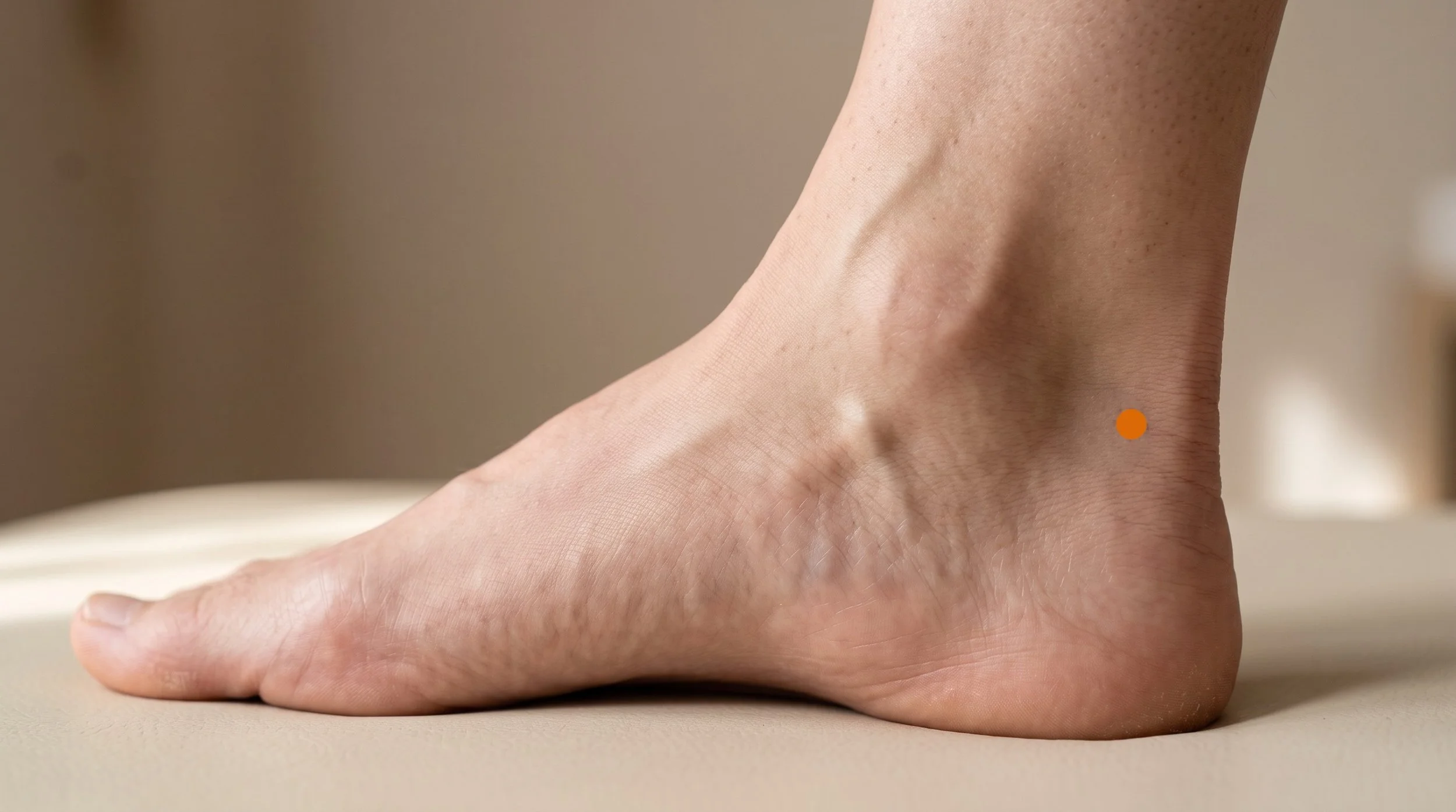
KI3 Acupuncture Point
The Great Bell at the Inner Heel: Anatomy, Mechanism, and Why the Kidney Luo-Connecting Point Links the Heel, the Low Back, and the Breath
KI4 (Dazhong, often translated as Great Bell) is the luo-connecting point of the Kidney channel, and it sits in a small hollow at the inner heel, roughly half a cun behind the midpoint between KI3 and KI5, right along the front edge of the Achilles tendon above the medial calcaneus. That location gives the ki4 acupuncture point an unusual double identity: it's a local point for heel pain and posterior ankle tension, and it's also a classical distal point for the low back, for breathlessness, and for the fearful, withdrawn, heavy-lidded states that older texts grouped under Kidney deficiency.
Anatomically the needle lands in soft tissue served by calcaneal branches of the tibial nerve, which carry S1 and S2 input, the same spinal segments that serve the lumbosacral spine and the sole of the foot. That segmental overlap is the modern way to make sense of a point at the heel being used for the back, and it's why kidney 4 shows up so often in treatment plans for plantar heel pain, Achilles irritation, and chronic lumbar stiffness.
- Location and layers: KI4 lies at the inner heel on the anterior border of the Achilles tendon, about 0.5 cun posterior to the midpoint of the KI3 to KI5 line (Deadman et al., 2007). The needle passes through thin, mobile skin and a modest subcutaneous layer into the loose connective tissue interval in front of the tendon, not into the tendon itself.
- Traditional category, translated: classical texts list KI4 only as the luo-connecting point of the Kidney channel, with its connecting vessel described as running toward the Bladder channel and threading up to the lumbar vertebrae (Deadman et al., 2007). In neurophysiological terms, that pathway description maps onto shared S1 and S2 innervation between the heel and the lumbosacral region rather than onto any literal flow of energy.
- Nerve story: medial calcaneal branches of the tibial nerve supply this territory, so needling here generates afferent traffic into lower sacral cord segments, where dorsal horn convergence and descending inhibitory pathways from the brainstem can modulate pain from the heel, calf, and low back (Zhao, 2008).
- Research picture: acupuncture and needling of local myofascial targets have been studied for plantar heel pain with cautiously favorable but low-certainty results (Clark & Tighe, 2012; Llurda-Almuzara et al., 2021), and individual patient data for chronic musculoskeletal pain suggest effects that persist beyond the treatment course (Vickers et al., 2018).
- Beyond pain: KI4's classical use for wheezing and shortness of breath has a modern parallel in asthma reviews, which suggest possible symptom and quality of life gains alongside standard care while noting inconsistent trial quality (McCarney et al., 2004; Pang et al., 2023). Nobody should change inhaler or controller medication based on acupuncture.
- De qi and practice framing: patients usually describe a dull, spreading ache or a heavy fullness around the heel and inner ankle, sometimes travelling toward the sole or up the calf. Insertion is oblique to perpendicular, angled anteriorly, to about 0.5 cun (Deadman et al., 2007), and KI4 is nearly always used inside a larger plan rather than on its own.
Stubborn Heel Pain That Hurts Most on the First Steps of the Day?
Plantar heel pain and Achilles irritation rarely respond to one thing done in isolation, which is why we treat the whole chain from the heel to the calf to the hip. At Morningside Acupuncture we combine points like KI4 and KI3 at the inner heel with dry needling of the soleus, tibialis posterior, and intrinsic foot muscles, then layer in loading advice you can actually keep up with. Sessions are calm, precise, and built around what your foot does all day in New York City. Schedule a visit and let's map out where your heel pain is really coming from.
Schedule NowAnatomy of KI4: Why the Front Edge of the Achilles Tendon Is Such an Important Location
The inner heel is a busy but shallow piece of real estate. At KI4 the skin is thin and slides easily over the tissue beneath it, and just under that sits a modest subcutaneous layer that thickens as it approaches the fat pad of the calcaneal tuberosity. The needle's target is the soft interval immediately in front of the Achilles tendon, where the tendon broadens toward its insertion on the back of the heel bone and where the paratenon and the fatty tissue of the deep posterior triangle fill the space.
Anterior to that interval, the tendons of tibialis posterior, flexor digitorum longus, and flexor hallucis longus curve around the medial malleolus toward the sole. This region gets loaded every time you push off, walk downhill, run, or stand for hours on hard floors, and it stiffens quickly after immobility, which is part of why heel and Achilles symptoms are so often worst with the first steps out of bed.
Sensation here travels through the medial calcaneal branches of the tibial nerve, which draw on the S1 and S2 spinal segments. Those same segments serve the lumbosacral spine, the gluteal region, the posterior calf, and the sole of the foot, so a needle at the heel is speaking to a piece of the spinal cord that's already listening to the low back. Needle stimulation recruits small myelinated and unmyelinated afferents, which produces segmental modulation in the dorsal horn and activates descending inhibitory pathways from the brainstem that use serotonin, noradrenaline, and endogenous opioids (Zhao, 2008).
Local effects matter too: needling triggers an axon reflex with brief vasodilation and changes the mechanical state of the tissue around the tendon. Pooled individual patient data across chronic musculoskeletal pain conditions suggest that these effects are more than momentary, with benefit that decays only slowly after a course of care (Vickers et al., 2018).
The structure to respect at the medial ankle is the neurovascular bundle. The posterior tibial artery, its veins, and the tibial nerve run anterior to KI4, in the groove between the medial malleolus and the calcaneus, closer to the KI3 line than to this point. That's precisely why the conventional technique for KI4 is an oblique to perpendicular insertion angled anteriorly to about 0.5 cun (Deadman et al., 2007): it keeps the needle in the shallow soft tissue plane in front of the tendon rather than driving it deep toward the tarsal tunnel.
Practitioners avoid needling into the substance of the Achilles tendon, take extra care with patients on anticoagulants, and modify or skip the point where there's fragile skin, active infection, or a diabetic foot with reduced sensation. Anyone with tarsal tunnel symptoms such as burning or numbness in the sole should mention it, since technique and depth get adjusted accordingly.
Related Kidney Channel Related Best Acupuncture Points For Back PainKI4 at a Glance: Classification, Location, and Clinical Use
| Category | Detail |
|---|---|
| Traditional Name | Dazhong (Great Bell, also translated as Big Bell), KI4 or KID-4 |
| Channel Classification | Foot Shaoyin Kidney channel, medial heel region |
| Point Categories | Luo-connecting point of the Kidney channel. This is the only point-category designation given to KI4 in the classical sources consulted; the Kidney connecting vessel is described as departing from here toward the Bladder channel and rising to the lumbar vertebrae, with some texts also tracing a branch toward the pericardium. The Great Compendium of Acupuncture and Moxibustion assigns luo excess and deficiency indications to this point, listing urinary retention for excess and lumbar pain for deficiency. |
| Precise Location | At the inner heel, approximately 0.5 cun posterior to the midpoint of a line between KI3 (behind the medial malleolus) and KI5 (1 cun below KI3), on the anterior border of the Achilles tendon above the medial calcaneus. Locate KI5 first, then find the hollow halfway between KI3 and KI5 and half a cun back toward the tendon. |
| Tissue Stimulated | Thin medial heel skin, subcutaneous tissue and calcaneal fat pad margin, the loose connective tissue and paratenon plane at the front edge of the Achilles tendon; functionally related myofascial targets include soleus, tibialis posterior, and the intrinsic foot muscles including abductor hallucis |
| Needle Depth / Direction | Oblique to perpendicular insertion directed anteriorly, about 0.5 cun (roughly 0.3 to 0.5 inch in most texts); shallow, angled away from the tendon and superficial to the tarsal tunnel contents |
| De Qi Sensation | A dull, heavy ache or spreading fullness at the inner heel, sometimes radiating into the sole, along the Achilles, or a short distance up the calf; occasionally a brief electric flicker toward the arch, which should prompt the practitioner to withdraw slightly and redirect |
| Primary Clinical Uses | Heel pain and plantar heel pain patterns, Achilles and posterior ankle tension, chronic low back stiffness, and traditionally wheezing and shortness of breath alongside standard medical care, fearfulness and low confidence, and daytime sleepiness |
| Common Point Combinations |
|
Deadman, Al-Khafaji, and Baker's A Manual of Acupuncture presents KI4 as a point that regulates Kidney function along two lines, and both are framed here as traditional attributions rather than physiological claims.
The first is respiratory: classical theory held that the Lung governs exhalation while the Kidneys govern the reception of breath, so when the lower system was considered too depleted to anchor the breath, symptoms such as wheezing, shortness of breath, chronic cough, and a dry, sore throat were attributed to fullness above with emptiness below, and Dazhong was chosen to address the upper fullness more forcefully than KI3 does.
The second is emotional: the Spiritual Pivot linked deficiency in the foot Shaoyin channel with a susceptibility to fear, and later commentators extended this to timidity, faltering confidence, poor concentration, and a wish to stay behind closed doors, along with heavy daytime sleepiness attributed to the same depletion. The text also notes that the Kidney connecting vessel rises from this point to the lumbar spine, which is why the same needle was used for stiff, aching low backs and for painful, swollen heels.
What's striking about the classical pattern is how coherently it bundles the heel, the low back, the breath, and courage into one point, a grouping that modern segmental anatomy explains for the musculoskeletal half and that we simply describe as traditional for the rest.
Why KI4 Is Used for Low Back Pain When It Sits Down at the Heel
The short answer is spinal segments. The medial calcaneal branches of the tibial nerve that supply the tissue around KI4 carry information into the S1 and S2 levels of the spinal cord, and those levels also receive input from the lower lumbar and sacral spine, the deep gluteal region, the hamstrings, the calf, and the sole. Neurons in the dorsal horn pool input from skin, muscle, tendon, and deeper structures within a segment, which is why pain from one part of a segment often feels smeared across the whole of it, and why stimulating one part can change how the rest is processed (Zhao, 2008).
When a classical text describes a connecting vessel rising from the heel to the lumbar vertebrae, the segmental map gives a plausible modern reading of the same clinical observation.
The second mechanism is not segment-specific at all. Needling reliably engages descending inhibitory systems that run from the periaqueductal gray and rostral ventromedial medulla down to the dorsal horn, using serotonergic, noradrenergic, and endogenous opioid signaling to turn down incoming nociception across a wide area (Zhao, 2008). This is one reason distal points in the ankle and foot can influence symptoms well away from the needle, and why a treatment that includes both local and distal points often feels different from local needling alone.
There's also a local component at the heel itself: needling produces a brief vasodilatory response and mechanically perturbs the connective tissue plane in front of the Achilles tendon, which may matter for tissue that has been chronically stiff and poorly loaded.
None of this means one needle at the inner heel fixes a back. In practice KI4 earns its place as part of a plan that also addresses local lumbar tissue, hip mechanics, calf and foot loading, and the sleep and stress factors that keep pain systems sensitized. Pooled trial data support acupuncture as a reasonable, low-risk option within multimodal care for chronic low back pain, with benefits that appear to hold up over months rather than fading immediately (Vickers et al., 2018; Rizzo et al., 2025).
What the Research Shows for KI4
It's worth being clear about what the research can and can't tell you. Almost no trial tests KI4 by itself; studies test protocols, and this point may or may not appear in a given protocol's prescription. What follows is evidence for the conditions KI4 is used within, which is a fair way to set expectations without overstating what any single point does. The heel pain literature is the closest match to this point's local use, the low back literature supports its distal use, and the respiratory and anxiety literature is more mixed and should be read as suggestive rather than settled.
| Study | Type | Focus | Key Finding |
|---|---|---|---|
| Clark & Tighe, 2012 | Systematic review | Acupuncture for plantar heel pain | Reviewers found that acupuncture produced results broadly comparable to commonly used conservative treatments, though the trials were small and methodologically variable. |
| Llurda-Almuzara et al., 2021 | Systematic review and meta-analysis | Dry needling for plantar heel pain and plantar fasciitis | Pooled data suggested reductions in pain and improvements in function, with the authors cautioning that study quality and follow-up periods limit confidence. |
| Rizzo et al., 2025 | Cochrane overview of reviews | Non-drug, non-surgical treatments for low back pain | Acupuncture emerged as one of the better-supported non-drug options for chronic low back pain, with moderate-certainty evidence for improvements in pain and function. |
| Vickers et al., 2018 | Individual patient data meta-analysis | Acupuncture for chronic musculoskeletal, headache, and osteoarthritis pain | Acupuncture outperformed both sham and no-acupuncture controls, and the effect appeared to persist rather than disappear once treatment stopped. |
| Pang et al., 2023 | Systematic review and meta-analysis | Acupuncture versus sham or placebo for adult asthma | The authors reported improvements in lung function measures and asthma-related quality of life, with substantial heterogeneity that tempers the conclusion. |
| McCarney et al., 2004 | Cochrane systematic review | Acupuncture for chronic asthma | This older review concluded there wasn't enough good-quality evidence to make recommendations, a useful counterweight to more recent optimistic pooling. |
| Yang et al., 2021 | Systematic review and meta-analysis | Acupuncture for anxiety disorders | Pooled results favored acupuncture over control conditions for anxiety symptoms, with the caveat that most included trials were small and at risk of bias. |
| Zhao, 2008 | Narrative review of mechanism research | Neural mechanisms of acupuncture analgesia | Describes how needle stimulation engages segmental spinal modulation and descending inhibitory pathways involving opioid, serotonergic, and noradrenergic signaling. |
Low Back Stiffness That Travels Down Into the Calf and Heel?
The Kidney luo-connecting channel was classically described as rising from the heel to the lumbar spine, and modern segmental anatomy gives that pairing a plausible basis in shared S1 and S2 input. We use the ki4 acupuncture point as a distal anchor alongside local lumbar and gluteal needling, so the back and the leg get treated as one system. Most patients feel a change in how the low back loads within the first few visits. Book an appointment and we'll build a plan around your specific pattern.
Schedule NowKI4 in the Context of Trigger Point Work
Heel pain patients almost never present with a problem confined to the heel. Soleus trigger points are a classic source of referred pain into the back of the heel and the Achilles region, and gastrocnemius, tibialis posterior, quadratus plantae, and abductor hallucis all contribute their own referral patterns into the foot (Simons et al., 1999).
At Morningside we'll often use the ki 4 heel location as a local point while dry needling the deep calf and intrinsic foot muscles that are actually generating the referral, because treating only the tender spot at the heel tends to give shorter-lived relief. Dry needling is acupuncture performed with an acupuncture needle and aimed at myofascial targets, so combining the two within one session is a matter of clinical reasoning rather than switching techniques.
The point's own position also sits close to structures that respond well to needling. The interval in front of the Achilles tendon is where the deep flexor tendons pass toward the tarsal tunnel, and chronically overworked tibialis posterior and flexor digitorum longus fibers higher in the calf frequently accompany medial ankle and arch complaints. For low back presentations we'll pair KI4 with needling of the lumbar paraspinals, quadratus lumborum, and gluteal muscles, using the distal point to engage the same S1 and S2 territory that the local work is addressing. The combination is chosen case by case, based on what reproduces your pain on examination rather than on a fixed protocol.
KI4 Heel and Low Back Pain Treatment at NYC's Highest-Rated Acupuncture Clinic
Morningside Acupuncture is the highest-rated acupuncture and dry needling clinic in New York City with over 500 five-star Google reviews, and we're known for treating pain with the same rigor a good physical therapist brings to movement. Dazhong is one of the points we return to for heel pain, posterior ankle tension, chronic lumbar stiffness, and for patients whose symptoms flare when they're anxious or depleted. Every treatment is done by a licensed acupuncturist who also holds myofascial trigger point certification. Schedule your first session and see what a thorough, anatomy-led approach feels like.
Schedule NowFrequently Asked Questions
What does KI4 feel like when needled?
Most people report a dull, heavy ache or a spreading fullness right at the inner heel, sometimes drifting into the arch or a short way up the Achilles. That sensation is called de qi, and it's the sign the needle has reached the intended tissue plane. Because the skin here is thin and the area is often tender in heel pain patients, the initial insertion can feel sharper than at fleshier points, though it usually settles within a few seconds. A brief electric or tingling sensation shooting into the sole means the needle is too close to a nerve branch, and your practitioner should withdraw slightly and redirect. Some patients notice the heel feels warmer or looser once the needles are removed.
Why would a point at the heel be used for low back pain or for breathing?
For the back, the answer is segmental. The tissue at KI4 is supplied by calcaneal branches of the tibial nerve, which carry S1 and S2 input, and those same cord segments receive input from the lumbosacral spine, gluteal region, and calf, so stimulation at one end of that territory can influence processing across it (Zhao, 2008). Classical texts described the Kidney connecting vessel rising from this point to the lumbar spine, which is the traditional way of noting the same clinical link. For breathing, the use is traditional rather than segmental: older sources attributed wheezing and shortness of breath to a failure of the lower system to anchor the breath and selected this point accordingly. Acupuncture research for asthma is mixed and should never replace inhalers, controller medication, or an asthma action plan (McCarney et al., 2004; Pang et al., 2023).
Can I press KI4 myself between sessions?
Yes, and it's an easy one to find. Sit with your ankle crossed over the opposite knee, locate the tip of the inner ankle bone, then slide your thumb back toward the Achilles tendon and down toward the heel until you feel a soft hollow just in front of the tendon, roughly a thumb's width below and behind the ankle bone. Press with the pad of your thumb at a moderate, comfortable pressure and hold for 30 to 60 seconds, or use small circles for a minute or two. Do both sides, two or three rounds, once or twice a day, and stop if the pressure produces sharp pain, numbness, or tingling into the sole. Acupressure here pairs well with gentle calf stretching and a short session of rolling the arch over a ball, and it works best as maintenance between treatments rather than as a substitute for them.
Is KI4 safe to needle?
In trained hands it's a low-risk point. The main structures to respect are the posterior tibial artery and tibial nerve, which lie anterior to this point in the groove between the medial malleolus and the heel bone, which is exactly why the standard technique is a shallow insertion of about 0.5 cun angled anteriorly rather than a deep one (Deadman et al., 2007). Practitioners keep the needle out of the Achilles tendon itself, use clean needle technique, and adjust or avoid the point where there's broken or fragile skin, local infection, significant swelling, or reduced sensation from diabetic neuropathy. Patients on blood thinners should mention it, since bruising is more likely. Transient soreness at the heel for a day afterward is the most common side effect.
Where exactly is KI4 located?
KI4 sits at the inner heel, approximately 0.5 cun posterior to the midpoint of a line drawn between KI3 and KI5, on the anterior border of the Achilles tendon above the medial calcaneus (Deadman et al., 2007). The practical way to find it is stepwise: locate KI3 in the depression between the tip of the medial malleolus and the Achilles tendon, then find KI5 one cun directly below KI3, then move to the midpoint between those two and slide half a cun back toward the tendon into a small hollow. Because luo points tend to sit in palpable depressions, gliding a fingertip over the area rather than pressing straight in makes the dip easier to feel, and the true spot on any given ankle may be a few millimeters from the textbook location.
References
- Deadman, P., Al-Khafaji, M., & Baker, K. (2009). A manual of acupuncture. Journal of Chinese Medicine Publications.
- Maciocia, G. (2006). The channels of acupuncture: Clinical use of the secondary channels and eight extraordinary vessels. Churchill Livingstone Elsevier.
- Cunningham, P. M. (2000). Acupuncture points: A practical guide to classical and modern usage. Odyssey Press.
- Simons, D. G., Travell, J. G., & Simons, L. S. (1999). Travell & Simons' myofascial pain and dysfunction: The trigger point manual, Vol. 1: Upper half of body (2nd ed.). Williams & Wilkins.
- Zhao, Z. Q. (2008). Neural mechanism underlying acupuncture analgesia. Progress in Neurobiology, 85(4), 355-375. https://doi.org/10.1016/j.pneurobio.2008.05.004
- Vickers, A. J., Vertosick, E. A., Lewith, G., MacPherson, H., Foster, N. E., Sherman, K. J., Irnich, D., Witt, C. M., & Linde, K. (2018). Acupuncture for chronic pain: Update of an individual patient data meta-analysis. Journal of Pain, 19(5), 455-474. https://doi.org/10.1016/j.jpain.2017.11.005
- Clark, R. J., & Tighe, M. (2012). The effectiveness of acupuncture for plantar heel pain: A systematic review. Acupuncture in Medicine, 30(4), 298-306. https://doi.org/10.1136/acupmed-2012-010183
- Llurda-Almuzara, L., Labata-Lezaun, N., Meca-Rivera, T., et al. (2021). Is dry needling effective for the management of plantar heel pain or plantar fasciitis? An updated systematic review and meta-analysis. Pain Medicine, 22(7), 1630-1641. https://doi.org/10.1093/pm/pnab114
- Rizzo, R. R. N., Cashin, A. G., Wand, B. M., Ferraro, M. C., Sharma, S., Lee, H., O'Hagan, E., Maher, C. G., Furlan, A. D., van Tulder, M. W., & McAuley, J. H. (2025). Non-pharmacological and non-surgical treatments for low back pain in adults: An overview of Cochrane reviews. Cochrane Database of Systematic Reviews, 3(3), CD014691. https://doi.org/10.1002/14651858.CD014691.pub2
- McCarney, R. W., Brinkhaus, B., Lasserson, T. J., & Linde, K. (2004). Acupuncture for chronic asthma. Cochrane Database of Systematic Reviews, 2004(1), CD000008. https://doi.org/10.1002/14651858.CD000008.pub2 [VERIFY BEFORE PUBLISHING]
- Pang, J., Shergis, J. L., Zheng, L., Liu, S., Guo, X., Zhang, A. L., Lin, L., Xue, C. C., & Wu, L. (2023). Clinical evidence for acupuncture for adult asthma: Systematic review and meta-analysis of randomised sham/placebo-controlled trials. Complementary Therapies in Medicine, 75, 102956. https://doi.org/10.1016/j.ctim.2023.102956
- Yang, X. Y., Yang, N. B., Huang, F. F., Ren, S., & Li, Z. J. (2021). Effectiveness of acupuncture on anxiety disorder: A systematic review and meta-analysis of randomised controlled trials. Annals of General Psychiatry, 20, 9. https://doi.org/10.1186/s12991-021-00327-5
Disclaimer: This web site is intended for educational and informational purposes only. Reading this website does not constitute providing medical advice or any professional services. This information should not be used for diagnosing or treating any health issue or disease. Those seeking medical advice should consult with a licensed physician. Seek the advice of a medical doctor or other qualified health professional for any medical condition. If you think you have a medical emergency, call 911 or go to the emergency room. No acupuncturist-patient relationship is created by reading this website or using the information. Morningside Acupuncture PLLC and its employees and contributors do not make any express or implied representations with respect to the information on this site or its use. For any legal interpretation of scope of practice in your state, consult a licensed attorney or regulatory authority.
Read more from our blog



