SP17 Acupuncture Point (Shidou)
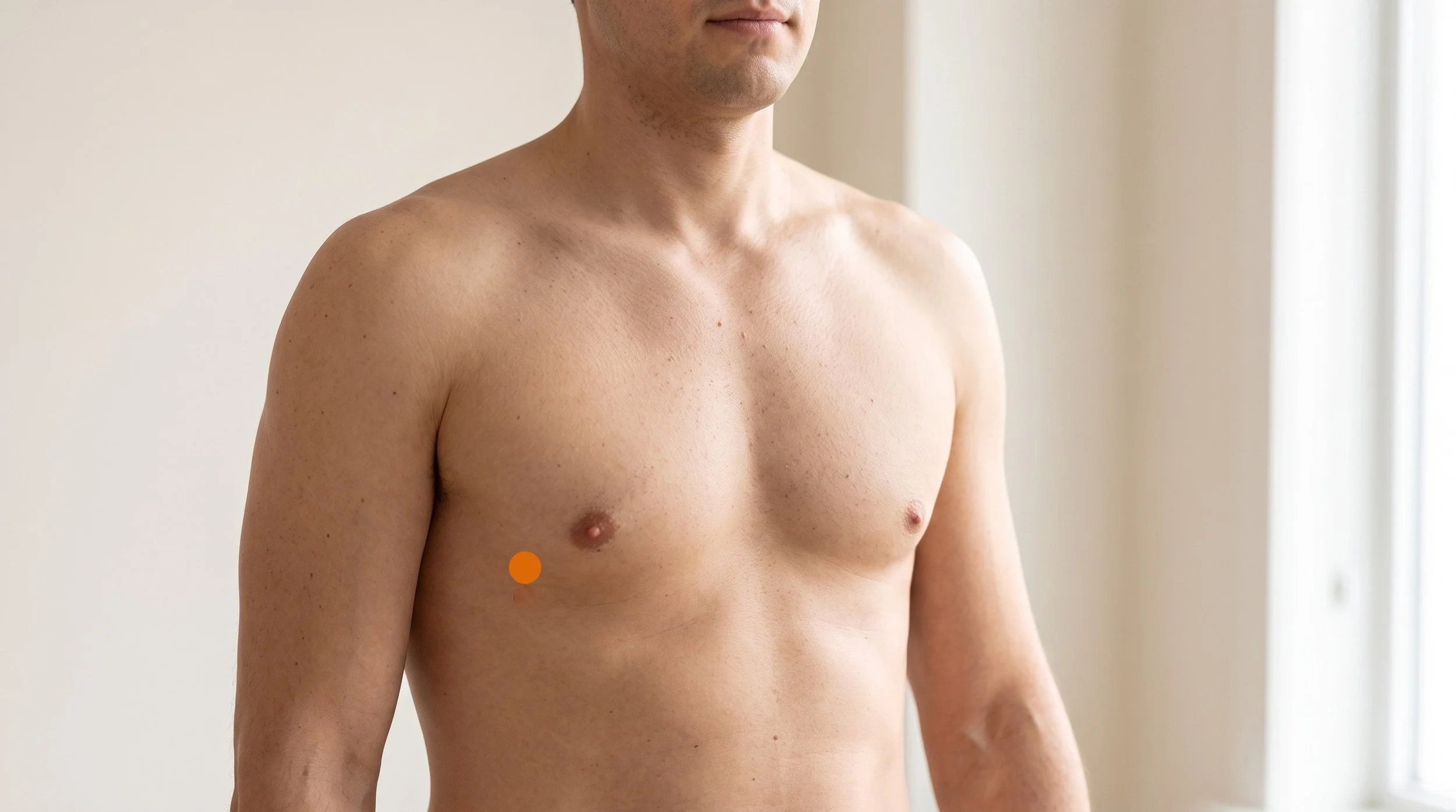
SP17 Acupuncture Point (Shidou)
Food Cavity on the Lateral Ribcage: Anatomy, Segmental Mechanism, and Why This Fifth Intercostal Space Point Bridges Chest Wall Pain and Digestive Complaints
SP17 (Shidou), whose name is usually rendered as Food Cavity, sits high on the side of the ribcage in the fifth intercostal space, roughly 6 cun lateral to the front midline and about two thumb-widths outside the nipple line. It is one of the Spleen channel's chest points, and in classical texts it was grouped with complaints that mix the two territories it straddles: pain and fullness along the ribs on one hand, and post-meal heaviness, belching and abdominal distention on the other (Deadman et al., 2001).
Anatomically it lies over serratus anterior and the intercostal muscles of the fifth rib space, a region loaded by breathing, coughing, overhead reaching and rotation, which is why the sp17 acupuncture point earns its place in modern practice mostly as a lateral chest wall point rather than as a digestive point used on its own.
- Shidou (spleen 17) is located in the fifth intercostal space, 6 cun lateral to the anterior midline, and the needle passes through skin, superficial fascia and the serratus anterior slip before reaching the intercostal muscle layer (Deadman et al., 2001).
- Traditional sources classify SP17 as a Spleen channel point said to dissipate accumulation of food and fluid and to promote digestion, with classical indications clustering around costal fullness, abdominal distention, belching and vomiting after eating (Deadman et al., 2001; Kim, 2007).
- The tissue here is supplied by the fifth intercostal nerve, whose dorsal horn segment also receives visceral afferents from the upper abdominal organs, a convergence pattern that helps explain why a rib-space point was historically linked to digestive symptoms (Zhao, 2008; Takahashi, 2013).
- Needling in this region may recruit spinal segmental inhibition and descending pain control pathways, mechanisms that have been mapped for acupuncture analgesia generally rather than for SP17 specifically (Zhao, 2008).
- The research picture is indirect: large individual patient data analyses support acupuncture for chronic musculoskeletal pain (Vickers et al., 2018), and a Cochrane review examined acupuncture for functional dyspepsia without producing robust conclusions (Lan et al., 2014), but neither isolates this point.
- De qi at SP17 is typically a dull, spreading ache or pressure that tracks along the rib space, sometimes with a warm band following the intercostal nerve; sharp pain, coughing or breath-catching means the needle should be withdrawn and repositioned.
Rib Pain That Flares Every Time You Take a Deep Breath?
Lateral chest wall pain is often dismissed because imaging looks normal, yet the serratus and intercostal tissue around SP17 is a common and treatable source. At Morningside Acupuncture we assess breathing mechanics, thoracic rotation and rib-space tenderness before needling, then use shallow oblique technique along the rib space combined with dry needling of the surrounding muscles. Most patients notice easier inhalation within the first few visits. Schedule a visit and let's find out what is actually driving your chest wall pain.
Schedule NowAnatomy of SP17: Why the Fifth Intercostal Space on the Lateral Ribcage Is Such an Important Location
From the surface down, SP17 passes through thin skin and superficial fascia over the lateral chest, then into the fibers of serratus anterior as they wrap from the ribs toward the shoulder blade, and finally toward the external and internal intercostal muscles filling the fifth rib space. This is a busy mechanical zone. Serratus anterior pulls the scapula forward and upward and stabilizes it against the ribcage during pressing, punching, throwing and overhead work, while the intercostals lengthen and shorten with every breath.
Add a persistent cough, a period of heavy training, a bout of upper respiratory illness or long hours hunched over a desk, and the tissue at this rib space can become tender, guarded and sensitive to inhalation.
The sensory supply comes from the fifth intercostal nerve and its lateral cutaneous branch (Deadman et al., 2001). That detail matters more than it sounds. Afferents from this thoracic segment enter the spinal cord at levels that also receive input from thoracic and upper abdominal viscera, so somatic and visceral signals share dorsal horn neurons. Needling somatic tissue in a shared segment can modulate how that pool of neurons behaves, which is the modern reading of why a point on the ribcage was historically credited with effects on the stomach and diaphragm (Zhao, 2008).
Beyond the segment, acupuncture stimulation engages descending inhibitory pathways from the brainstem that dampen pain transmission more broadly, and it produces measurable autonomic shifts that differ by body region, with trunk stimulation generally recruiting sympathetic reflexes and limb stimulation more often recruiting vagal ones (Takahashi, 2013).
Directly deep to the intercostal muscles lie the parietal pleura and lung, and the neurovascular bundle runs along the lower border of each rib. That anatomy dictates technique completely. SP17 is needled transverse-obliquely along the rib space to a depth of about 0.5 to 1 cun, angled so the shaft travels parallel to the chest wall rather than into it, and perpendicular insertion over the ribcage is avoided because it carries a substantial pneumothorax risk, especially in thin patients (Deadman et al., 2001).
Pneumothorax remains the most frequently reported serious adverse event in the acupuncture safety literature, and it is overwhelmingly a function of angle and depth over the thorax rather than of needling itself (He et al., 2012). In practice this means a shallow angle, a short needle, a hand braced on the ribcage, and no deep manipulation.
Related Serratus Anterior Trigger Points Related Intercostal Muscles Trigger PointsSP17 at a Glance: Classification, Location, and Clinical Use
| Category | Detail |
|---|---|
| Traditional Name | Shidou (Food Cavity), also recorded under the alternate name Mingguan (Gate of Life) |
| Channel Classification | Spleen channel (foot taiyin), lateral chest region |
| Point Categories | No five-shu, mu, luo, or extraordinary vessel intersection designations are recorded for this point in the standard references. It is a regular Spleen channel point on the lateral chest, and some classical groupings count it among the six bilateral chest points listed together as Yingshu (LU1, LU2, SP17, SP18, SP19, SP20). |
| Precise Location | Lateral chest, fifth intercostal space, 6 cun lateral to the anterior midline (about 2 cun lateral to the nipple line). Count rib spaces downward from the second intercostal space, which sits just below the sternal angle. |
| Tissue Stimulated | Skin and superficial fascia over the lateral ribcage, the serratus anterior slip at the fifth rib, and the intercostal muscles of the fifth space, supplied by the fifth intercostal nerve |
| Needle Depth / Direction | Transverse-oblique insertion along the intercostal space, 0.5 to 1 cun, needle angled parallel to the chest wall. Perpendicular insertion is not used here. |
| De Qi Sensation | A dull, spreading ache or band of pressure along the rib space, occasionally a warm or tingling line following the intercostal nerve laterally. Sharp pain, coughing, or difficulty taking a full breath is not de qi and calls for immediate needle withdrawal. |
| Primary Clinical Uses | Lateral chest and rib pain, costal breathing restriction, serratus and intercostal myofascial tension; traditionally used for fullness of the chest and hypochondrium, abdominal distention, belching and discomfort after eating |
| Common Point Combinations |
|
In the classical literature summarized by Deadman and colleagues, Shidou carries the striking alternate name Mingguan, or Gate of Life, and the Book of Bian Que's Secrets credited it with reaching what that text called the true Spleen qi, claiming it could address dozens of Spleen disorders and that heavy moxibustion here could rescue gravely ill patients (Deadman et al., 2001).
Those claims are traditional attributions rather than clinical evidence, and the same commentary notes their oddity: for a point described in such dramatic terms, other classical texts rarely cite it and combinations featuring it are sparse. What the surviving indications actually describe is a tight, coherent picture of what older writers called food stagnation, meaning distention and pain across the ribs and diaphragm with belching, vomiting after meals, rumbling and undigested food, alongside the local complaint of relentless pain along the costal region. The gap between the grand reputation and the modest practical record is what makes this point so interesting to read historically.
Why SP17 Is Used for Rib Pain That Gets Worse With Every Deep Breath
Patients often describe lateral chest pain in ways that sound alarming: a catch under the arm, a band of tightness along the ribs, an ache that spikes at the top of an inhale or when they roll over in bed. Once cardiac, pulmonary and fracture causes have been ruled out by a physician, a large share of these presentations come from the chest wall itself, meaning the intercostal muscles, the serratus slips over the ribs, and the sensitized nerves running between them.
SP17 sits directly in that territory. Needling within the same spinal segment as the painful tissue engages local and segmental mechanisms, including inhibition at the dorsal horn where those fifth intercostal afferents terminate, which may reduce how strongly the segment amplifies incoming signals (Zhao, 2008).
Segmental effects are only part of the story. Acupuncture stimulation also recruits descending inhibitory control from the midbrain and brainstem, releasing endogenous opioids, serotonin and noradrenaline that reduce pain transmission at spinal levels well beyond the needled segment (Zhao, 2008). This is why a well-chosen rib-space point often produces a change in overall guarding, not just a numb patch. There is a mechanical dividend too: when the intercostals and serratus stop bracing, ribcage excursion improves, and easier breathing tends to feed back into lower sympathetic drive.
The digestive side of this point's classical reputation is best explained through the same segmental lens rather than through any literal movement of energy. Thoracic segments carrying the intercostal nerves also receive afferent traffic from upper abdominal viscera, and experimental work shows that somatic stimulation at different body regions produces distinct autonomic responses on the gut, with trunk stimulation and limb stimulation acting through different pathways (Takahashi, 2013).
That gives a plausible physiological account for why chest and abdominal points were historically linked to distention and belching, while also explaining why we rarely rely on SP17 alone for digestive complaints and instead pair it with abdominal and lower limb points.
What the Research Shows for SP17
There is no clinical trial of SP17 as a standalone intervention, and readers should be skeptical of anyone claiming otherwise. What exists is evidence for acupuncture protocols that include chest, abdominal and limb points, plus mechanistic work on how needling affects pain processing and gut autonomic control. The table below summarizes the most relevant sources and what they can and cannot tell us about this particular point.
| Study | Type | Focus | Key Finding |
|---|---|---|---|
| Lan et al., 2014 | Cochrane systematic review | Manual acupuncture and electroacupuncture for functional dyspepsia | The review found some improvements in symptom and quality of life measures but judged the evidence too limited in quality to support firm conclusions about effectiveness or safety. |
| Guo et al., 2020 | Systematic review of effects and mechanisms | Acupuncture and electroacupuncture for functional dyspepsia | Reported symptomatic benefit across included trials alongside changes in gastric accommodation and autonomic measures, though trial quality and point protocols varied widely. |
| Vickers et al., 2018 | Individual patient data meta-analysis | Acupuncture for chronic musculoskeletal, headache and osteoarthritis pain | Acupuncture was superior to sham and to no-acupuncture control with effects persisting over time, supporting the general use of needling for chronic pain without isolating any single point. |
| Kietrys et al., 2013 | Systematic review and meta-analysis | Dry needling for upper quarter myofascial pain | Dry needling of trigger points may reduce pain in the upper quarter compared with sham or control in the short term, with limited data on longer follow-up. |
| Takahashi, 2013 | Narrative mechanistic review | Acupuncture effects on gastrointestinal function | Describes region-dependent somato-autonomic reflexes in which stimulation of trunk versus limb sites produces different effects on gastric motility. |
| He et al., 2012 | Systematic review of adverse events | Acupuncture safety, including pneumothorax | Pneumothorax was among the most commonly reported serious adverse events, reinforcing that thoracic points require shallow, angled technique from trained practitioners. |
| Zhao, 2008 | Neurophysiological review | Mechanisms of acupuncture analgesia | Summarizes segmental dorsal horn inhibition and descending opioid and monoaminergic pathways as the principal mechanisms underlying needling-induced analgesia. |
Post-Meal Fullness and Tightness Under the Ribs?
Classical texts placed Shidou among the points used for heaviness after eating, belching and distention that sits right under the ribcage. We combine chest and rib-space points with abdominal and lower limb points such as CV12 and ST36, and we pair the needling with breathing work that supports parasympathetic tone. Studies suggest acupuncture may help some functional digestive symptoms, though results vary and we set expectations honestly. Book an evaluation and we will build a plan around your specific pattern.
Schedule NowSP17 in the Context of Trigger Point Work
The location of SP17 overlaps closely with classic myofascial territory. Serratus anterior develops trigger points along the mid-lateral ribcage that refer pain around the side of the chest, toward the lower shoulder blade and sometimes down the inner arm, and patients frequently describe air hunger or an inability to get a satisfying breath (Simons et al., 1999). The intercostals themselves harbor tender points that produce sharp, band-like pain along a single rib space.
Because acupuncture is defined by the use of an acupuncture needle across hundreds of styles, dry needling of these muscles and classical point needling at SP17 are the same tool applied through different maps, and at Morningside we use both maps in one session.
In practice, that means palpating the fifth and sixth rib spaces and the serratus slips along the mid-axillary line, treating whatever taut, tender tissue we find, then adding SP17 and neighboring points such as SP18 or LV14 to cover the segment more broadly. Distal points may be added to recruit descending inhibition rather than piling more needles onto an already irritable chest wall. Needling over the ribcage is always shallow and angled, and we favor needling directly over a rib rather than deep in the space when the tissue allows.
Systematic review data suggest dry needling may reduce upper quarter myofascial pain in the short term (Kietrys et al., 2013), and we pair it with breathing retraining and thoracic mobility work so the gains hold.
SP17 Chest Wall and Digestive Treatment at NYC's Highest-Rated Acupuncture Clinic
Morningside Acupuncture is the highest-rated acupuncture and dry needling clinic in New York City with over 500 five-star Google reviews, and our Midtown practice blends classical point selection with orthopedic assessment. Points like SP17 demand precise, conservative technique over the ribcage, which is exactly the kind of detail our licensed acupuncturists train for. Whether your complaint is rib pain, restricted breathing or stubborn upper abdominal fullness, you get a plan built for your body. Schedule your appointment today.
Schedule NowFrequently Asked Questions
What does SP17 feel like when needled?
Most people feel a dull, spreading ache or a sense of pressure that runs along the rib space, and some notice a warm or slightly tingling line traveling toward the side of the chest. Because the needle is threaded almost flat under the skin, the sensation is usually milder than at thick muscular points like ST36. What you should not feel is sharp stabbing pain, an urge to cough, or any difficulty taking a full breath, and you should say so immediately if you do so the needle can be adjusted or removed.
Why needle the ribcage for symptoms that seem to come from the stomach?
Classical texts listed Shidou for fullness after eating, belching and distention, and the modern explanation is segmental rather than energetic. The fifth intercostal nerve enters the spinal cord at a level that also receives afferent input from upper abdominal organs, so needling somatic tissue in that segment can influence how that shared pool of neurons behaves, and experimental work shows that stimulation at different body regions produces different autonomic effects on the gut (Zhao, 2008; Takahashi, 2013). That said, we almost never use this point alone for digestive complaints, and we usually anchor treatment with abdominal and lower limb points.
Can I press SP17 myself between sessions?
Yes, acupressure here is safe because finger pressure cannot reach the pleura. Find the fifth rib space by counting down from the space just below the sternal angle, then slide about two thumb-widths lateral to the nipple line onto the side of the chest. Use two fingertips at moderate pressure and press along the rib space, sinking slowly for 30 to 60 seconds per tender spot, then repeat two or three times per side. Pairing each press with a slow exhale works well, and many people find it more effective to hold the pressure while taking five long breaths rather than rubbing vigorously. Two or three short sessions a day is plenty, and you should ease off if pressure sharpens the pain or makes breathing uncomfortable.
Is SP17 safe to needle?
It is safe in trained hands and requires respect. The lung lies just deep to the intercostal muscles, so this point is needled transverse-obliquely along the rib space to about 0.5 to 1 cun with the needle running parallel to the chest wall, never perpendicular, and extra caution applies to thin patients (Deadman et al., 2001). Pneumothorax is the most commonly reported serious adverse event in acupuncture safety reviews and is essentially a technique problem of angle and depth over the thorax (He et al., 2012). Anyone with a known lung condition, recent chest surgery, or a bleeding disorder should tell their acupuncturist before treatment.
Where exactly is SP17 located?
For sp 17 location, work from bony landmarks rather than guessing. Find the sternal angle, the small ridge where the manubrium meets the body of the sternum, and the space immediately below it is the second intercostal space. Count down to the fifth intercostal space, then move laterally to a line 6 cun from the anterior midline, which is roughly two thumb-widths outside the nipple line in men. The shidou point sits in that rib space on the side of the chest, over serratus anterior, one space below SP18 and one above SP16 in the channel's chest and abdomen sequence.
References
- Deadman, P., Al-Khafaji, M., & Baker, K. (2009). A manual of acupuncture. Journal of Chinese Medicine Publications.
- Cheng, X. (Ed.). (1999). Chinese acupuncture and moxibustion (Rev. ed.). Foreign Languages Press.
- Kim, H. (2008). Handbook of Oriental medicine (3rd ed.). Harmony & Balance Press.
- Cunningham, P. M. (2000). Acupuncture points: A practical guide to classical and modern usage. Odyssey Press.
- Simons, D. G., Travell, J. G., & Simons, L. S. (1999). Travell & Simons' myofascial pain and dysfunction: The trigger point manual, Vol. 1: Upper half of body (2nd ed.). Williams & Wilkins.
- Lan, L., Zeng, F., Liu, G. J., Ying, L., Wu, X., Liu, M., & Liang, F. R. (2014). Acupuncture for functional dyspepsia. Cochrane Database of Systematic Reviews, 2014(10), CD008487. https://doi.org/10.1002/14651858.CD008487.pub2
- Guo, Y., Wei, W., & Chen, J. D. (2020). Effects and mechanisms of acupuncture and electroacupuncture for functional dyspepsia: A systematic review. World Journal of Gastroenterology, 26(19), 2440-2457. https://doi.org/10.3748/wjg.v26.i19.2440
- Takahashi, T. (2013). Effect and mechanism of acupuncture on gastrointestinal diseases. International Review of Neurobiology, 111, 273-294. https://doi.org/10.1016/B978-0-12-411545-3.00014-6
- He, W., Zhao, X., Li, Y., Xi, Q., & Guo, Y. (2012). Adverse events following acupuncture: A systematic review of the Chinese literature for the years 1956-2010. Journal of Alternative and Complementary Medicine, 18(10), 892-901. https://doi.org/10.1089/acm.2011.0825
- Kietrys, D. M., Palombaro, K. M., Azzaretto, E., Hubler, R., Schaller, B., Schlussel, J. M., & Tucker, M. (2013). Effectiveness of dry needling for upper-quarter myofascial pain: A systematic review and meta-analysis. Journal of Orthopaedic & Sports Physical Therapy, 43(9), 620-634. https://doi.org/10.2519/jospt.2013.4668
- Vickers, A. J., Vertosick, E. A., Lewith, G., MacPherson, H., Foster, N. E., Sherman, K. J., Irnich, D., Witt, C. M., & Linde, K. (2018). Acupuncture for chronic pain: Update of an individual patient data meta-analysis. Journal of Pain, 19(5), 455-474. https://doi.org/10.1016/j.jpain.2017.11.005
- Zhao, Z. Q. (2008). Neural mechanism underlying acupuncture analgesia. Progress in Neurobiology, 85(4), 355-375. https://doi.org/10.1016/j.pneurobio.2008.05.004
Disclaimer: This web site is intended for educational and informational purposes only. Reading this website does not constitute providing medical advice or any professional services. This information should not be used for diagnosing or treating any health issue or disease. Those seeking medical advice should consult with a licensed physician. Seek the advice of a medical doctor or other qualified health professional for any medical condition. If you think you have a medical emergency, call 911 or go to the emergency room. No acupuncturist-patient relationship is created by reading this website or using the information. Morningside Acupuncture PLLC and its employees and contributors do not make any express or implied representations with respect to the information on this site or its use. For any legal interpretation of scope of practice in your state, consult a licensed attorney or regulatory authority.
Read more from our blog