KI5 Acupuncture Point (Shuiquan)
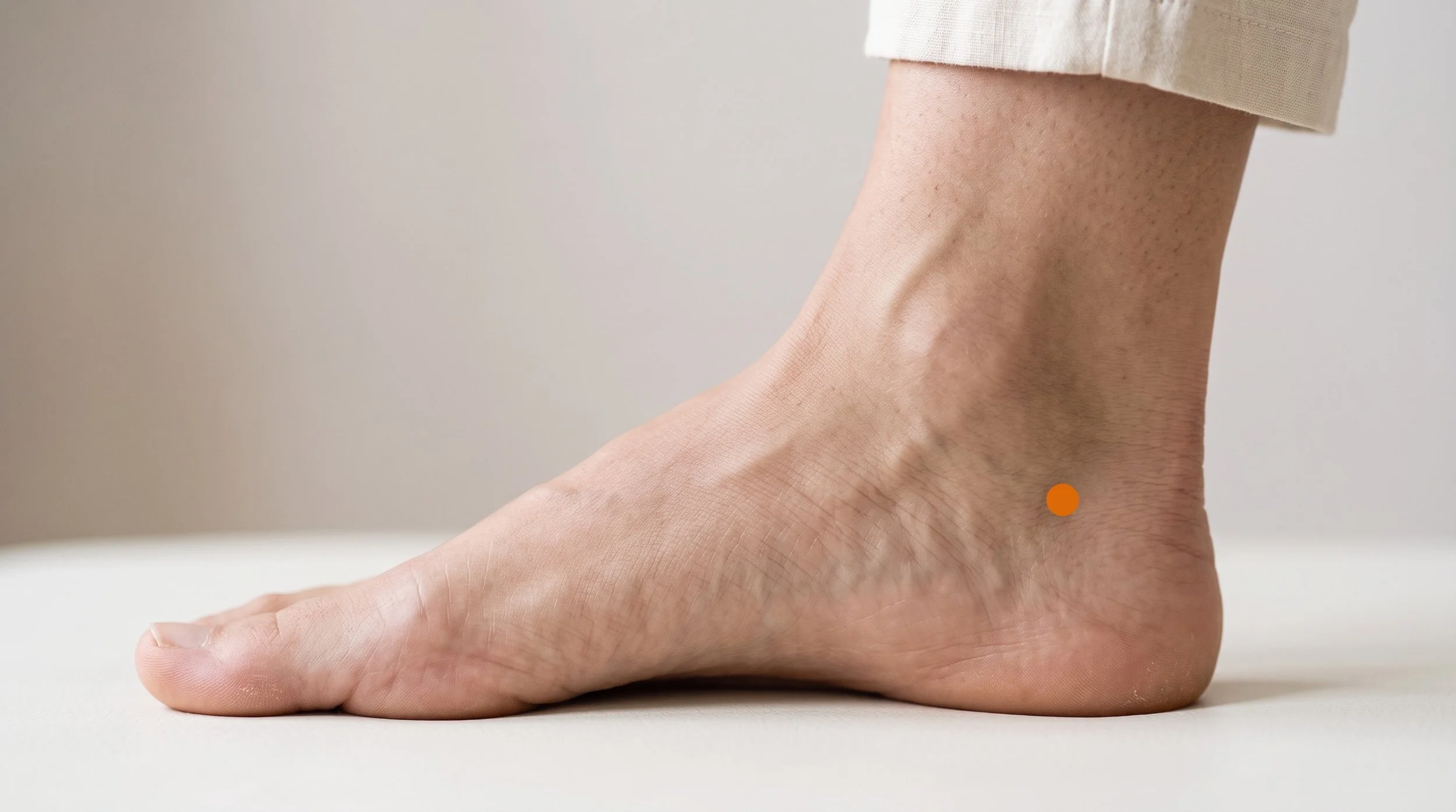
KI5 Acupuncture Point (Shuiquan)
The Water Spring at the Inner Heel: Anatomy, Mechanism, and Why This Xi-Cleft Point Belongs in Acute Menstrual Pain Protocols
KI5, known as Shuiquan or Water Spring, is the xi-cleft point of the Kidney channel and sits in a small depression on the inner heel, roughly a thumb's width below KI3 and just in front of and above the bony prominence where the Achilles tendon anchors into the calcaneus. It is a quiet point in the sense that most patients have never heard of it, yet the classical literature gives it an unusually narrow and specific job: acute, painful, obstructed menstruation, delayed or absent periods, and difficult, dribbling urination.
In modern terms, the ki5 acupuncture point is a small, easily located target in the medial calcaneal territory of the tibial nerve, close to sacral segmental input, which is part of why practitioners reach for kidney 5 when someone arrives mid-cycle with cramping that has already started.
- Location and layers: KI5 lies 1 cun below KI3 in the hollow anterior and superior to the medial calcaneal tuberosity, where the needle passes through thin skin and a fibrofatty heel pad before reaching the periosteal surface of the calcaneus and the fascial origins of the deep plantar muscles (Deadman et al., 2007).
- Traditional category, translated: it is the xi-cleft point of the Kidney channel, a classification traditionally reserved for acute presentations and pain, with the yin channel xi-cleft points additionally attributed with treating disorders of blood, which on the Kidney channel means menstruation (Deadman et al., 2007; Cunningham, 2018).
- Mechanism: needling here recruits medial calcaneal branches of the tibial nerve, which carry sacral segmental input, and stimulation of this kind is understood to engage spinal gating and descending inhibitory pathways from the brainstem rather than any literal flow of energy (Zhao, 2008).
- Research picture: reviews of acupuncture for period pain report reductions in pain scores in several trials but rate the certainty of evidence as low, so KI5 is best described as a plausible component of a protocol rather than a proven single-point treatment (Smith et al., 2016; Woo et al., 2018).
- Clinical framing: timing appears to matter more than point count in menstrual pain work, with trial and review data suggesting that treatment delivered close to or just before the onset of bleeding, and repeated across cycles, tends to track with better outcomes (Armour & Smith, 2016; Armour et al., 2017).
- De qi: patients usually report a dull, slightly heavy ache at the inner heel that may creep under the arch or up the inside of the ankle; because bone is close, the sensation turns sharp if the angle drifts, which is why the needle is directed away from the calcaneus (Deadman et al., 2007).
Struggling With Period Pain That Derails Your Week?
At Morningside Acupuncture we treat menstrual pain as a cycle-long pattern, not a single bad day, and KI5 is one of the distal points we use when cramping is sharp, sudden, and worst in the first forty-eight hours. Treatment is usually built around lower abdominal points, leg yin channel points such as SP6, and gentle work at the inner ankle and heel. We time sessions to your cycle so the strongest input lands where it may help most. Schedule a visit and let's map your cycle together.
Schedule NowAnatomy of KI5: Why the Medial Heel Above the Achilles Insertion Is Such an Important Location
KI5 sits in a shallow depression on the inside of the heel, one cun below KI3 and immediately anterior and superior to the medial calcaneal tuberosity, the block of bone into which the Achilles tendon anchors (Deadman et al., 2007). The tissue here is unusual: a thin, mobile skin layer over a dense fibrofatty heel pad, with the flexor retinaculum and the tarsal tunnel contents passing just above and in front, the origin of abductor hallucis running forward into the arch, and the periosteum of the calcaneus close beneath.
What loads this region is not muscle contraction so much as compression and traction, which is why standing occupations, hard flooring, and sudden increases in running volume can make the whole medial heel tender long before anyone thinks about acupuncture points.
The sensory supply comes largely from medial calcaneal branches of the tibial nerve, which arise from sacral roots (Deadman et al., 2007; Chinese Acupuncture and Moxibustion). That detail matters, because pelvic and uterine afferents also travel through thoracolumbar and sacral pathways, so input from the heel and input from the pelvis share territory in the lower cord.
Needling a point like KI5 produces a barrage of small-fiber afferent activity that is understood to engage segmental inhibitory interneurons and, more powerfully, descending control from the periaqueductal gray and rostral ventromedial medulla, with endogenous opioid and monoaminergic transmitters involved (Zhao, 2008). Practically, that means the point can influence how strongly pelvic pain is felt without doing anything at all to the uterus directly.
The posterior tibial artery, its veins, and the tibial nerve trunk run higher and slightly anterior, closer to KI3, so KI5 is comparatively safe as long as the needle is angled away from bone rather than driven into it. Standard practice is oblique to perpendicular insertion of 0.3 to 0.5 cun with the tip directed away from the calcaneus, and moxibustion is traditionally considered appropriate here (Deadman et al., 2007; Kim, 2015).
We avoid the point over broken or infected skin, use extra care in patients with diabetes or peripheral neuropathy, and stop advancing immediately if the sensation becomes bony and sharp.
Related Kidney Channel Related 2025 Achilles Tendinopathy ResearchKI5 at a Glance: Classification, Location, and Clinical Use
| Category | Detail |
|---|---|
| Traditional Name | Shuiquan (Water Spring), KI5, also written Kidney 5 or KID-5 |
| Channel Classification | Kidney channel of the foot shaoyin, fifth point of the channel |
| Point Categories | Xi-cleft (accumulation) point of the Kidney channel. Traditionally grouped with the yin channel xi-cleft points, which are attributed with treating acute conditions, pain, and disorders of blood. |
| Precise Location | On the medial heel, 1 cun inferior to KI3, in the depression anterior and superior to the medial calcaneal tuberosity at the Achilles insertion. |
| Tissue Stimulated | Thin medial heel skin and fibrofatty heel pad over calcaneal periosteum, near the flexor retinaculum and the proximal fascial origins of the deep plantar layer, including abductor hallucis |
| Needle Depth / Direction | Oblique to perpendicular, 0.3 to 0.5 cun, tip angled away from the calcaneus; moxibustion is traditionally permitted |
| De Qi Sensation | A dull, heavy ache at the inner heel that may spread into the arch or up the medial ankle; sharpness usually means the needle has drifted toward periosteum |
| Primary Clinical Uses | Painful periods, irregular or delayed menstruation, absent periods with tightness and pain below the chest at onset, uterine prolapse in classical listings, difficult or dribbling urination, lower abdominal and periumbilical pain, local medial heel and Achilles insertional discomfort |
| Common Point Combinations |
|
In A Manual of Acupuncture, Deadman and colleagues present KI5 as a point that regulates the Penetrating and Conception vessels and benefits menstruation, an attribution that rests on the classical claim that the uterus is linked to the Kidneys and that the maturation of Kidney essence governs the onset and rhythm of the cycle. Traditionally, the Kidneys are also credited with a role in forming blood, and the Liver is said to supply blood to those two vessels, so a Kidney channel point that treats blood disorders becomes, in classical logic, a menstrual point.
The indications recorded across the classical sources are tightly clustered: absent, delayed, irregular, or painful periods, prolapse of the uterus, lower abdominal pain, poor or clouded vision, and urination that is difficult or comes only in dribbles (Deadman et al., 2007; Chinese Acupuncture and Moxibustion; Kim, 2015; Cunningham, 2018).
What is striking is the specificity of one entry that recurs across texts: delayed menstruation accompanied by a sense of oppression and pain below the heart at the moment bleeding begins. That is not a vague pattern description, it is a clinical snapshot, and it tells you the point was reached for at a particular moment rather than used as general tonification.
Why KI5 Is Used for Menstrual Pain When It Sits All the Way Down at the Heel
The obvious question is how needling an ankle can influence a cramping uterus. Part of the answer is segmental. The medial calcaneal branches of the tibial nerve carry sacral input, and pelvic structures also send afferent traffic through sacral levels, so signals from the heel and signals from the pelvis converge on overlapping regions of the lower spinal cord. Convergence of this kind is the same principle behind referred pain, and it works in both directions: strong, sustained afferent input from a somatic site can dampen how readily second-order neurons relay visceral pain signals upward (Zhao, 2008).
The larger share of the effect is probably not segmental at all. Acupuncture stimulation reliably activates descending inhibitory systems running from the midbrain and medulla down to the dorsal horn, using endogenous opioids, serotonin, and norepinephrine, which is why distal points on the limbs can influence pain felt in the trunk (Zhao, 2008).
There is also a circulatory element worth mentioning cautiously: Doppler studies of leg point stimulation in primary dysmenorrhea have measured short-term changes in uterine artery resistance and pulsatility alongside drops in pain scores, which supports a reflex autonomic and vascular pathway even though the studies are small and the point tested was SP6 rather than KI5 (Yu et al., 2010).
None of this makes KI5 a standalone treatment. In practice it is one distal element in a prescription that usually includes abdominal points close to the pelvis, other leg yin channel points, and sometimes moxa, and its particular value is that it is easy to reach, comfortable, and traditionally indexed to acute, sharply painful presentations rather than chronic background discomfort.
What the Research Shows for KI5
There is no clinical trial that isolates KI5. The research base for menstrual pain tests whole protocols, most commonly built around SP6, Ren4, Ren6, ST29, and local abdominal points, sometimes with KI5 included as a channel-level addition. That means the honest framing is indirect: the evidence tells us something about whether acupuncture as a package may reduce period pain, and it tells us something about dose and timing, but it does not tell us what this specific point contributes. Reviewers have also been consistent that trial quality in this area is limited, so expectations should be set accordingly.
| Study | Type | Focus | Key Finding |
|---|---|---|---|
| Smith et al., 2016 | Cochrane systematic review | Acupuncture and acupressure for primary dysmenorrhea | The reviewers concluded there was insufficient evidence to determine whether acupuncture or acupressure are effective, with all comparisons rated low or very low certainty. |
| Woo et al., 2018 | Systematic review and meta-analysis | Acupuncture in women with primary dysmenorrhea | Pooled results suggested acupuncture may reduce pain intensity compared with control conditions, though the authors noted heterogeneity and methodological limitations across included trials. |
| Armour & Smith, 2016 | Narrative review | Relationship between acupuncture dose and menstrual pain outcomes | The review suggested that number of sessions, treatment frequency, and timing relative to the cycle may influence results more than the specific point selection. |
| Armour et al., 2017 | Exploratory randomized controlled trial | Treatment timing and mode of stimulation in primary dysmenorrhea | All acupuncture groups reported reduced menstrual pain over the study period, with the trial designed to generate hypotheses about timing rather than to confirm superiority of any one approach. |
| Yu et al., 2010 | Randomized clinical trial with Doppler imaging | Immediate effect of leg point needling on uterine artery blood flow | Needling SP6 during menstrual pain was associated with short-term reductions in pain scores and in uterine artery resistance indices compared with a control point. |
| Chen et al., 2013 | Meta-analysis | Acupuncture or acupressure at SP6 for primary dysmenorrhea | Acupressure at SP6 outperformed control conditions, while needling SP6 was not clearly superior to needling an unrelated point, which argues for caution about strong point-specificity claims. |
| Zhao, 2008 | Mechanistic review | Neural mechanisms of acupuncture analgesia | Analgesic effects are attributed to afferent nerve stimulation engaging spinal gating and descending inhibitory pathways involving opioid and monoamine transmitters. |
Heel, Achilles, and Inner Ankle Pain That Will Not Settle?
The tissue around KI5 is the same tissue that gets irritated in insertional Achilles problems and medial heel pain, so this location does double duty in our clinic. We combine careful needling near the calcaneal insertion with dry needling of the calf complex and intrinsic foot muscles, then pair it with loading advice you can actually follow. Every treatment is delivered by a licensed acupuncturist trained in both East Asian medicine and modern orthopedic assessment. Book an appointment and get a clear plan for your heel.
Schedule NowKI5 in the Context of Trigger Point Work
KI5 sits in territory that matters for two very different complaints. Locally, the medial heel just forward of the Achilles insertion overlaps with the proximal attachment zone of the deep plantar muscles, and referred heel pain is a documented pattern from soleus, quadratus plantae, and the intrinsic foot muscles (Simons et al., 1999).
When a patient comes in with medial heel pain rather than menstrual pain, we tend to use KI5 and KI3 as local input while dry needling the calf complex and, when the arch is involved, [abductor hallucis](https://www.morningsideacupuncturenyc.com/abductor-hallucis-trigger-points), which can reproduce heel and medial arch symptoms.
For pelvic and menstrual presentations the trigger point work happens far from the foot. Lower abdominal wall muscles can refer pain that mimics or amplifies visceral cramping, and hip adductors are a classic source of deep, hard-to-localize pelvic discomfort (Simons et al., 1999).
In those cases we may combine distal needling at KI5 and SP6 with careful assessment of the [abdominal obliques](https://www.morningsideacupuncturenyc.com/abdominal-obliques-trigger-points) and [adductor magnus](https://www.morningsideacupuncturenyc.com/adductor-magnus-trigger-points), since a proportion of what patients call period pain has a myofascial contribution layered on top of the visceral one. Sorting those layers apart is a large part of what the first visit is for.
KI5 Menstrual Pain Treatment at NYC's Highest-Rated Acupuncture Clinic
Morningside Acupuncture is the highest-rated acupuncture and dry needling clinic in New York City with over 500 five-star Google reviews, and our Upper West Side team sees menstrual pain, irregular cycles, and pelvic discomfort every week. We use points like KI5, SP6, and LV3 alongside abdominal points and, where appropriate, dry needling of the abdominal wall and hip muscles that can amplify pelvic pain. Sessions are unhurried, evidence-informed, and adjusted to where you are in your cycle. Schedule your first visit today.
Schedule NowFrequently Asked Questions
What does KI5 feel like when needled?
Most people describe a dull, slightly heavy ache right at the inner heel, sometimes spreading forward under the arch or up along the inside of the ankle. Because the calcaneus is close beneath the point, a well-angled needle feels deep and achy while a poorly angled one feels immediately sharp, so practitioners direct the tip away from bone and use a shallow depth of roughly 0.3 to 0.5 cun (Deadman et al., 2007). The sensation usually settles within a few seconds and fades once the needle is removed.
Why treat menstrual pain at the heel instead of only on the abdomen?
Distal points give access to pain modulation systems that are not limited to the area being treated. Afferent input from the foot and ankle enters the lower spinal cord, where it can influence how readily pain signals from pelvic structures are relayed, and it also recruits descending inhibitory pathways from the brainstem that reduce pain sensitivity more broadly (Zhao, 2008). There is also a practical reason: distal points can be used comfortably while a patient lies on their back or side with the abdomen warm and undisturbed, and small imaging studies have found short-term changes in uterine artery flow indices after leg point needling (Yu et al., 2010).
Can I press KI5 myself between sessions?
Yes, and it is one of the easier points to self-treat. Sit with the ankle crossed over the opposite knee, find the hollow behind the inner ankle bone where KI3 sits, then slide about a thumb's width down toward the heel until you land in a small depression just in front of the bony bump at the back. Press with the pad of your thumb at a firm but tolerable intensity, aiming slightly away from the bone rather than straight into it, and hold for thirty to sixty seconds, then release for ten seconds and repeat for three to five rounds per side. Two or three sessions a day in the few days before and during your period is a reasonable pattern. Stop if you feel numbness, tingling, or sharp shooting sensation, since those suggest you have drifted onto nerve tissue higher in the tarsal tunnel, and note that acupressure is a self-care adjunct rather than a substitute for evaluation of severe or worsening pelvic pain.
Is KI5 safe to needle?
It is a low-risk point in trained hands. The posterior tibial artery, its accompanying veins, and the tibial nerve trunk lie higher and more anterior near KI3, so shallow oblique needling angled away from the calcaneus keeps clear of them (Deadman et al., 2007). Expected effects are limited to brief local soreness or, occasionally, small bruising. We avoid needling through broken, inflamed, or infected skin, take extra care with patients who have diabetes, peripheral neuropathy, or poor lower limb circulation, and never force a needle into periosteum. Anyone with unexplained pelvic pain, heavy bleeding, or a possible pregnancy should be evaluated medically alongside acupuncture care.
Where exactly is KI5 located?
Find KI3 first, in the depression between the tip of the medial malleolus and the Achilles tendon. From there, move one cun inferiorly, which for most people is about a thumb's width down toward the sole, and feel for a small depression sitting anterior and superior to the medial calcaneal tuberosity, the bony prominence where the Achilles tendon attaches to the heel bone (Deadman et al., 2007; Chinese Acupuncture and Moxibustion). The spot is usually slightly tender to firm pressure and feels distinct from the harder bone immediately behind it.
References
- Deadman, P., Al-Khafaji, M., & Baker, K. (2009). A manual of acupuncture. Journal of Chinese Medicine Publications.
- Cheng, X. (Ed.). (1999). Chinese acupuncture and moxibustion (Rev. ed.). Foreign Languages Press.
- Kim, H. (2008). Handbook of Oriental medicine (3rd ed.). Harmony & Balance Press.
- Cunningham, P. M. (2000). Acupuncture points: A practical guide to classical and modern usage. Odyssey Press.
- Maciocia, G. (2005). The foundations of Chinese medicine: A comprehensive text for acupuncturists and herbalists (2nd ed.). Elsevier Churchill Livingstone.
- Maciocia, G. (2006). The channels of acupuncture: Clinical use of the secondary channels and eight extraordinary vessels. Churchill Livingstone Elsevier.
- Simons, D. G., Travell, J. G., & Simons, L. S. (1999). Travell & Simons' myofascial pain and dysfunction: The trigger point manual, Vol. 1: Upper half of body (2nd ed.). Williams & Wilkins.
- Smith, C. A., Armour, M., Zhu, X., Li, X., Lu, Z. Y., & Song, J. (2016). Acupuncture for dysmenorrhoea. Cochrane Database of Systematic Reviews, 2016(4), CD007854. https://doi.org/10.1002/14651858.CD007854.pub3 [VERIFY BEFORE PUBLISHING]
- Woo, H. L., Ji, H. R., Pak, Y. K., Lee, H., Heo, S. J., Lee, J. M., & Park, K. S. (2018). The efficacy and safety of acupuncture in women with primary dysmenorrhea: A systematic review and meta-analysis. Medicine, 97(23), e11007. https://doi.org/10.1097/MD.0000000000011007
- Armour, M., & Smith, C. A. (2016). Treating primary dysmenorrhoea with acupuncture: A narrative review of the relationship between acupuncture 'dose' and menstrual pain outcomes. Acupuncture in Medicine, 34(6), 416-424. https://doi.org/10.1136/acupmed-2016-011110
- Armour, M., Dahlen, H. G., Zhu, X., Farquhar, C., & Smith, C. A. (2017). The role of treatment timing and mode of stimulation in the treatment of primary dysmenorrhea with acupuncture: An exploratory randomised controlled trial. PLOS ONE, 12(7), e0180177. https://doi.org/10.1371/journal.pone.0180177
- Yu, Y. P., Ma, L. X., Ma, Y. X., Ma, Y. X., Liu, Y. Q., Liu, C. Z., Xie, J. P., Gao, S. Z., & Zhu, J. (2010). Immediate effect of acupuncture at Sanyinjiao (SP6) and Xuanzhong (GB39) on uterine arterial blood flow in primary dysmenorrhea. Journal of Alternative and Complementary Medicine, 16(10), 1073-1078. https://doi.org/10.1089/acm.2009.0326
- Chen, M. N., Chien, L. W., & Liu, C. F. (2013). Acupuncture or acupressure at the Sanyinjiao (SP6) acupoint for the treatment of primary dysmenorrhea: A meta-analysis. Evidence-Based Complementary and Alternative Medicine, 2013, 493038. https://doi.org/10.1155/2013/493038
- Zhao, Z. Q. (2008). Neural mechanism underlying acupuncture analgesia. Progress in Neurobiology, 85(4), 355-375. https://doi.org/10.1016/j.pneurobio.2008.05.004
Disclaimer: This web site is intended for educational and informational purposes only. Reading this website does not constitute providing medical advice or any professional services. This information should not be used for diagnosing or treating any health issue or disease. Those seeking medical advice should consult with a licensed physician. Seek the advice of a medical doctor or other qualified health professional for any medical condition. If you think you have a medical emergency, call 911 or go to the emergency room. No acupuncturist-patient relationship is created by reading this website or using the information. Morningside Acupuncture PLLC and its employees and contributors do not make any express or implied representations with respect to the information on this site or its use. For any legal interpretation of scope of practice in your state, consult a licensed attorney or regulatory authority.
Read more from our blog



