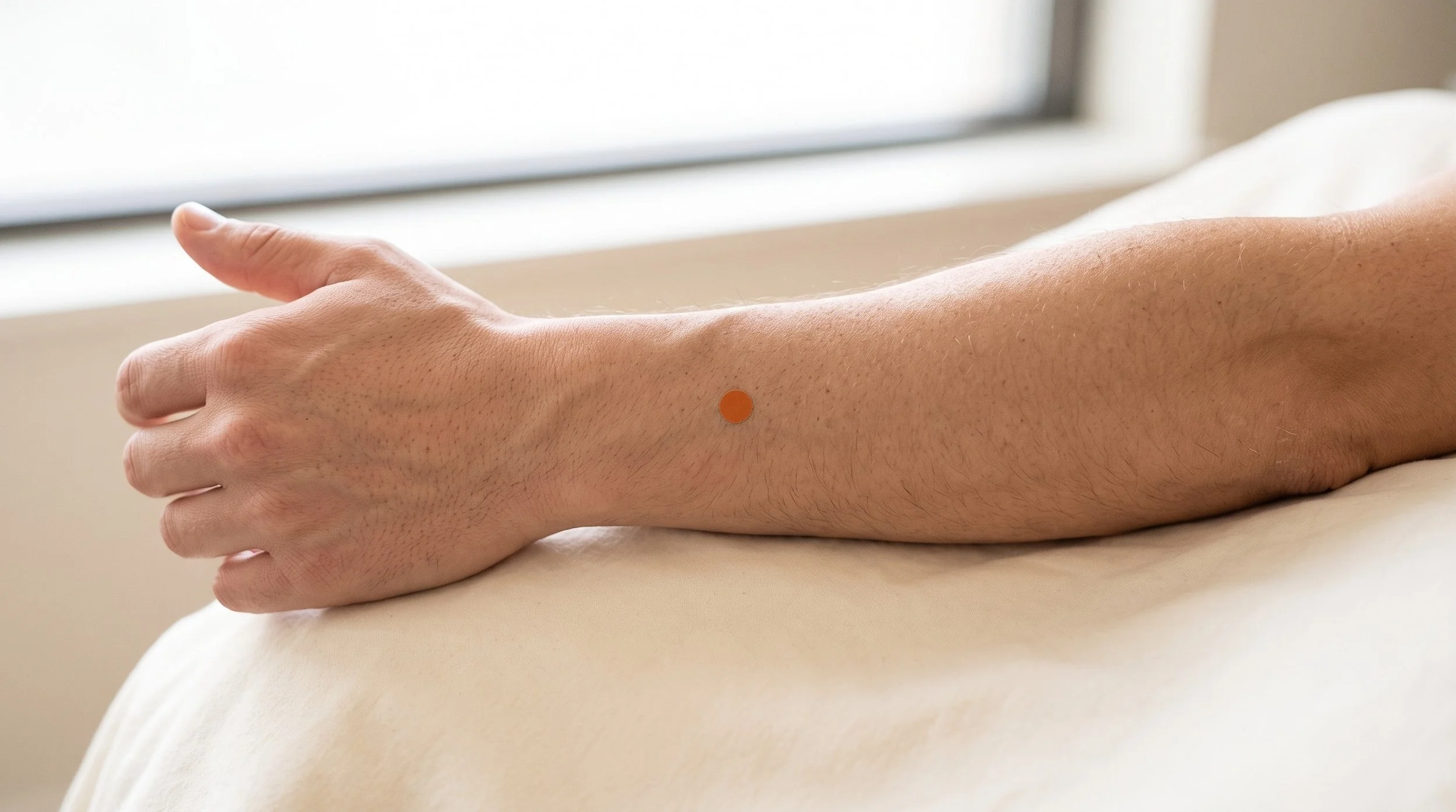
SJ8 Acupuncture Point (Sanyangluo)
The Three Yang Connection Between Radius and Ulna: Anatomy, Mechanism, and Why This Mid Forearm Point Serves Arm Pain, Hearing, and Voice
SJ8 (Sanyangluo, often translated as Three Yang Connection or Three Yang Luo), also written TE8, sits in the middle of the back of the forearm, four cun above the wrist crease, in the soft gap between the radius and the ulna on the thumb side of the extensor digitorum tendons.
In plain terms, if you turn your palm down and slide a fingertip up the back of the forearm from the wrist, SJ8 is the tender valley you find about a third of the way to the elbow, just before the muscle bellies thicken. Its name suggests a junction of the three yang channels of the arm, the same idea that gives SP6 its name in the leg, and classical texts recruited it for a narrow but memorable set of problems: sudden deafness, sudden loss of voice, arm pain with restricted movement, and low back pain after injury.
Clinically, the te8 acupuncture point is most useful today as an accessible forearm point that engages the deep extensor compartment and radial nerve territory while remaining far from the joint or lesion being treated.
- Location and layers: SJ8 lies 4 cun proximal to SJ4 in the depression between the radius and ulna, on the radial side of extensor digitorum, which places a needle through skin and superficial fascia into the extensor compartment near the interosseous membrane (Deadman & Al-Khafaji, 2007; Cheng, 1987).
- Traditional attribution: classical sources credit SJ8 with clearing the Sanjiao channel, freeing the sensory orifices, and moving stagnation to relieve pain (Deadman & Al-Khafaji, 2007). Read neurophysiologically, that describes a distal point used to modulate segmentally related structures in the arm, neck, and head rather than anything moving through the limb.
- Nerve geography: the region is innervated superficially by the posterior antebrachial cutaneous nerve and deeply by the posterior and anterior interosseous nerves, all carrying C6 to C8 input, so stimulation converges on the same cord segments that serve the shoulder girdle and lateral arm (Cheng, 1987).
- Mechanism: needling generates A delta and C fiber afferent traffic that recruits spinal gating, descending inhibition from the periaqueductal gray and rostral ventromedial medulla, and endogenous opioid release, which is the best supported explanation for distal point analgesia (Zhao, 2008).
- Research picture: pooled patient level data suggest acupuncture produces modest but persistent benefit over sham and no-acupuncture controls in chronic musculoskeletal pain (Vickers et al., 2018), while reviews of acupuncture added to conventional care for sudden sensorineural hearing loss report favorable pooled results with low certainty evidence (Zhang et al., 2015; Chen et al., 2019).
- Practice framing: several classical texts flagged SJ8 as a point not to needle, a caution most modern clinicians handle by using moderate depth and gentle technique rather than avoidance (Deadman & Al-Khafaji, 2007). De qi is usually a heavy, spreading ache that travels toward the elbow or down toward the fingers, and it should not feel like an electric shock.
Forearm, Elbow, or Shoulder Pain That Will Not Settle?
SJ8 is one of the forearm points we reach for when arm pain limits gripping, lifting, or reaching overhead. At Morningside Acupuncture we combine sanyangluo acupuncture with dry needling of the extensor group and shoulder girdle, then add loading exercise so the gains hold between visits. Every plan starts with an orthopedic exam, not a template. Schedule a visit and let us map where your arm pain is actually coming from.
Schedule NowAnatomy of SJ8: Why the Interosseous Gap of the Mid Forearm Is Such an Important Location
SJ8 sits at the junction of the distal and middle thirds of the line from SJ4 at the wrist to the lateral epicondyle, in the palpable furrow between the radius and the ulna on the radial side of the extensor digitorum tendons (Deadman & Al-Khafaji, 2007). A needle at this site passes through thin skin and superficial fascia into the extensor compartment, where the fibers of extensor digitorum, extensor pollicis longus, and abductor pollicis longus converge on the interosseous membrane (Cheng, 1987).
These are the muscles loaded by repetitive gripping, typing, racket sports, and long hours of tool or mouse use, which is why the area is so often tender even in people whose main complaint is at the elbow or hand rather than the mid forearm.
The nerve supply here is layered. The posterior antebrachial cutaneous nerve covers the skin, while the posterior and anterior interosseous nerves run deeper in the compartment (Cheng, 1987). All of this input enters the cord in the C6 to C8 range, the same segmental territory that supplies the lateral shoulder, upper arm, and part of the cervicothoracic junction. Stimulating a needle here therefore feeds afferent traffic into dorsal horn neurons that also receive input from painful shoulder and arm structures, which is the practical basis for treating a proximal problem from a distal site.
Beyond that segmental convergence, needling recruits descending inhibitory pathways involving the periaqueductal gray, brainstem, and endogenous opioid systems, producing effects that are not limited to the needled segment (Zhao, 2008).
Deeper still lie the posterior interosseous artery and vein and the interosseous membrane itself (Cheng, 1987). Because of that, conventional depth is 0.5 to 1.5 cun, most often with slightly oblique insertion toward the ulnar side or angled proximally or distally along the forearm, and some texts describe perpendicular insertion of 0.5 to 1.0 cun (Deadman & Al-Khafaji, 2007; Cheng, 1987).
It is worth knowing that the Systematic Classic and the Bronze Man both listed SJ8 as contraindicated to needling, a historical caution that modern practice generally answers with conservative depth and unhurried technique rather than avoiding the point (Deadman & Al-Khafaji, 2007).
Related Best Acupuncture Points For Shoulder Pain Related Extensor Digitorum Trigger PointsSJ8 (TE8) at a Glance: Classification, Location, and Clinical Use
| Category | Detail |
|---|---|
| Traditional Name | Sanyangluo (Three Yang Connection, also rendered Three Yang Luo), SJ8, also written TE8 or TB-8 |
| Channel Classification | Triple Burner (Sanjiao) channel of the hand shaoyang, mid forearm segment (SJ8, also written TE8 or TB8; also called the Triple Energizer, the Triple Heater or Triple Warmer) |
| Point Categories | No five-shu, luo-connecting, xi-cleft, or hui-meeting designation and no extraordinary vessel intersection. Its name implies a convergence of the three arm yang channels, mirroring SP6 in the leg, though classical sources do not formally list it as a crossing point (Deadman & Al-Khafaji, 2007; Maciocia, 2006). Noted in the Systematic Classic and the Bronze Man as contraindicated to needling. |
| Precise Location | On the dorsal forearm, 4 cun proximal to SJ4, in the depression between the radius and ulna on the radial side of extensor digitorum, at the junction of the distal and middle thirds of the SJ4 to lateral epicondyle line |
| Tissue Stimulated | Skin and superficial fascia, then the deep extensor compartment near the interosseous membrane, including extensor digitorum, extensor indicis, extensor pollicis longus and brevis, and adjacent extensor carpi ulnaris |
| Needle Depth / Direction | Slightly oblique toward the ulnar side, or oblique proximally or distally along the forearm, 0.5 to 1.5 cun; perpendicular 0.5 to 1.0 cun is also described. Moxibustion is traditionally permitted. |
| De Qi Sensation | Heavy, distending soreness in the mid forearm that commonly spreads toward the elbow or down toward the wrist and fingers; no sharp electrical sensation should be provoked |
| Primary Clinical Uses | Forearm and arm pain with restricted movement, elbow and grip complaints, distal support for neck and shoulder treatment, and traditionally sudden deafness, sudden loss of voice, toothache, chest and rib-side pain, and low back pain after traumatic injury |
| Common Point Combinations |
|
Deadman's Manual of Acupuncture is unusually candid about this point. The name promises a great deal, implying that SJ8 gathers the three yang channels of the arm the way SP6 gathers the three yin channels of the leg, yet the recorded indications never grew to match that promise, and the text notes there is little in the classical record to justify so grand a title (Deadman & Al-Khafaji, 2007).
What survives instead is a compact list presented as traditional attribution: sudden deafness, sudden loss of voice, toothache, heaviness and reluctance to move the limbs, fever, arm pain with inability to move the arm, and low back pain following traumatic injury. Maciocia's channel writing preserves the same naming logic, grouping SJ8 with GB35 and SP6 as points named for their supposed reach across multiple channels (Maciocia, 2006).
The striking part of the classical pattern is its emphasis on sudden events, hearing and voice lost abruptly rather than declining slowly, which suggests the point was reserved for acute, dramatic presentations rather than everyday complaints.
Why SJ8 Is Used for Sudden Hearing and Voice Changes, Not Just Forearm Pain
The most obvious use for SJ8 is local and regional. The point sits inside the deep extensor compartment, so needling it engages tissue that is genuinely loaded in people with grip-related forearm pain, tennis elbow patterns, and arm pain that limits reaching. Because the afferents here enter the cord at C6 to C8, the same levels that serve the lateral shoulder and upper arm, the point can also be used at a distance from an irritated shoulder or elbow, borrowing segmental convergence rather than needling the sore structure directly (Cheng, 1987).
Classical distal point mapping follows the same logic, listing SJ8 as a distal choice for the neck, the top of the shoulder, and the shoulder joint (Maciocia, 2006).
The head and neck uses are less intuitive. The Triple Burner channel is traditionally described as ascending the arm to the shoulder, neck, and the region behind the ear, which is how the classical texts explained treating ear and throat symptoms from the forearm. Neurophysiologically, a more defensible account is that strong needle stimulation anywhere in the body recruits descending inhibitory and autonomic responses through brainstem circuitry, along with endogenous opioid release, so effects are not confined to the needled segment (Zhao, 2008).
That is a mechanism for modulating pain and arousal, not a mechanism for restoring cochlear function, and it is important to keep the distinction clear.
On the hearing question specifically, systematic reviews of acupuncture as an add-on to standard care for sudden sensorineural hearing loss have reported favorable pooled results, but the authors themselves graded the evidence as low or very low certainty because of small samples and risk of bias (Zhang et al., 2015; Chen et al., 2019). Sudden hearing loss is a medical urgency that warrants prompt ENT evaluation and steroid treatment.
If acupuncture has a role, current evidence suggests it is as an adjunct alongside conventional care, not as a substitute for it, and SJ8 would be one distal point within a larger protocol.
What the Research Shows for SJ8 (TE8)
One note on naming before the evidence: in the research literature this point appears as TE8, the WHO standard code, and also as SJ8 or TB8 depending on the authors, so it is worth searching all three if you want to read the studies below in full.
There is no clinical trial of SJ8 on its own, and that is true of nearly every individual acupuncture point. Trials and reviews test multi-point protocols, so the honest framing is that SJ8 appears inside prescriptions for arm pain, neck and shoulder complaints, and ear and throat conditions, and the evidence below speaks to those protocols rather than to this single location. The most relevant reading for a forearm point is the literature on musculoskeletal pain and on needling of the extensor group, with the hearing loss reviews providing cautious context for the classical indications.
| Study | Type | Focus | Key Finding |
|---|---|---|---|
| Vickers et al., 2018 | Individual patient data meta-analysis | Acupuncture for chronic musculoskeletal, headache, and osteoarthritis pain | Acupuncture was associated with modest benefit over both sham and no-acupuncture controls, with effects that persisted over time rather than dissipating immediately. |
| Mu et al., 2020 | Cochrane systematic review | Acupuncture for chronic nonspecific low back pain | Acupuncture was better than no treatment for immediate pain and function, while comparisons with sham showed no clinically meaningful advantage and overall certainty was low. |
| Navarro-Santana et al., 2020 | Systematic review and meta-analysis | Trigger point dry needling for lateral epicondylalgia of musculoskeletal origin | Low to moderate certainty evidence suggested short term improvements in pain, disability, pressure pain sensitivity, and grip strength. |
| Zhang et al., 2015 | Systematic review and meta-analysis | Acupuncture for sudden sensorineural hearing loss | Adding acupuncture to conventional treatment was associated with better outcomes, though the authors rated the evidence low to very low certainty. |
| Chen et al., 2019 | Systematic review and meta-analysis | Acupuncture for sudden sensorineural hearing loss | Pooled results favored acupuncture as an adjunct, with the same methodological limitations urging cautious interpretation. |
| Zhao, 2008 | Mechanistic review | Neural mechanisms of acupuncture analgesia | Needle stimulation engages spinal gating, descending inhibitory pathways, and endogenous opioid systems, offering a plausible basis for distal point effects. |
Looking for Distal Points That Do Not Require Needling the Painful Area?
Some patients are too sensitive, too acute, or too guarded for local needling on the first visit. Triple burner 8 gives us a comfortable sj 8 forearm target that engages the same nerve segments serving the arm and shoulder while leaving the irritated tissue alone. We use it inside a broader plan that may include gentle manual therapy and graded movement. Book an appointment to start with an approach your nervous system can tolerate.
Schedule NowSJ8 in the Context of Trigger Point Work
Acupuncture, as we define it, is the use of an acupuncture needle, and that includes the hundreds of styles practiced worldwide as well as dry needling. SJ8 happens to sit directly over tissue that trigger point clinicians treat constantly. Taut bands in extensor digitorum, extensor indicis, and extensor pollicis longus refer pain into the forearm, wrist, and fingers, and referral from the extensor group can mimic or amplify lateral elbow pain (Simons et al., 1999).
When a patient's tenderness at the sj 8 forearm location reproduces their familiar symptoms, we treat it as both a classical point and a myofascial target rather than choosing between the two frameworks.
In practice, a typical session at Morningside might use SJ8 alongside needling of the common extensor origin, extensor carpi radialis brevis, extensor carpi ulnaris, and, when the shoulder girdle is involved, infraspinatus and the scapular stabilizers. Reviews of dry needling for lateral elbow pain suggest short term improvements in pain, disability, and grip strength, which pairs well with progressive loading rather than replacing it (Navarro-Santana et al., 2020).
We then check grip mechanics, wrist posture at the keyboard, and shoulder control, because forearm points relieve symptoms far more durably when the load that created them is addressed.
SJ8 Arm and Shoulder Pain Treatment at NYC's Highest-Rated Acupuncture Clinic
Morningside Acupuncture is the highest-rated acupuncture and dry needling clinic in New York City with over 500 five-star Google reviews. Our licensed acupuncturists blend classical point selection, including the te8 acupuncture point, with modern trigger point needling and rehabilitation-minded care. You get clear reasoning, measurable goals, and a treatment plan written for your presentation. Schedule your appointment today.
Schedule NowFrequently Asked Questions
Is SJ8 the same point as TE8 or TB8?
Yes. SJ8, TE8, and TB8 are all codes for the same point, Sanyangluo. SJ stands for San Jiao, the Chinese name of the channel. TE (Triple Energizer) is the WHO standard abbreviation and the one you will see in most Western textbooks and research papers. TB (Triple Burner) and TW (Triple Warmer) are older English renderings of the same name that still appear in many books. You will also come across it written as San Jiao 8 or Triple Energizer 8. Whichever code is used, the location and the uses are the same.
What does SJ8 feel like when needled?
Most people report a deep, heavy, slightly achy fullness in the middle of the forearm that spreads toward the elbow or down toward the wrist and fingers. That spreading sensation is de qi, and it usually builds over a few seconds rather than arriving as a jolt. If the extensor muscles are holding trigger points, you may feel a brief twitch or a familiar referral into the hand, which is useful diagnostic information. Sharp, electric, or radiating shock sensations are not the goal, and you should tell your acupuncturist right away if you feel one so the needle can be adjusted.
Why would a forearm point be used for neck, shoulder, or ear symptoms?
Two reasons, one anatomical and one systemic. The nerves supplying this part of the forearm carry C6 to C8 input, the same spinal segments that serve the lateral shoulder and upper arm, so a needle here converges on dorsal horn neurons already receiving signals from the painful region (Cheng, 1987). Beyond that, needle stimulation activates descending inhibitory pathways and opioid systems that act well beyond the treated segment (Zhao, 2008). Classical texts described the same clinical observation in channel language, listing SJ8 as a distal point for the neck, the top of the shoulder, and the shoulder joint (Maciocia, 2006).
Can I press SJ8 myself between sessions?
Yes, and it is easy to find. Rest your forearm palm down on a table, locate the wrist crease on the back of the wrist, then measure about four finger widths plus a thumb width up the forearm (roughly four cun) and feel for the soft groove between the two forearm bones. Press with your opposite thumb at a comfortable but definite pressure until you feel a dull ache, hold for 30 to 60 seconds, release, and repeat two or three times per side. You can add small circular movements or slowly open and close your fist while holding the pressure, which adds a gentle contract and release effect. Two or three short sessions a day is plenty, and you should stop if you get numbness, tingling into the hand, or pain that lingers afterward.
Is SJ8 safe to needle?
In trained hands, yes. Two classical texts, the Systematic Classic and the Bronze Man, listed SJ8 as contraindicated to needling, and modern practice acknowledges that caution by working at moderate depth with gentle technique (Deadman & Al-Khafaji, 2007). Standard depth is 0.5 to 1.5 cun with slightly oblique or angled insertion, which keeps the needle in muscle rather than driving hard into the interosseous membrane or the deeper posterior interosseous vessels and nerve (Deadman & Al-Khafaji, 2007; Cheng, 1987). Expected effects are minor and temporary, such as brief soreness or a small bruise. Tell your practitioner if you take blood thinners, have a bleeding disorder, or have known nerve injury in the arm.
Where exactly is SJ8 located?
SJ8 is on the back of the forearm, 4 cun proximal to SJ4 at the wrist, in the depression between the radius and ulna on the radial side of the extensor digitorum tendons (Deadman & Al-Khafaji, 2007). A reliable way to find it is to divide the distance from SJ4 to the lateral epicondyle of the elbow into three equal parts; SJ8 sits where the lower third meets the middle third. It is one cun above SJ6, and both points lie in the same interosseous groove, so palpating for the softest, most tender gap between the bones will usually put you in the right place.
References
- Deadman, P., Al-Khafaji, M., & Baker, K. (2009). A manual of acupuncture. Journal of Chinese Medicine Publications.
- Cheng, X. (Ed.). (1999). Chinese acupuncture and moxibustion (Rev. ed.). Foreign Languages Press.
- Maciocia, G. (2006). The channels of acupuncture: Clinical use of the secondary channels and eight extraordinary vessels. Churchill Livingstone Elsevier.
- Simons, D. G., Travell, J. G., & Simons, L. S. (1999). Travell & Simons' myofascial pain and dysfunction: The trigger point manual, Vol. 1: Upper half of body (2nd ed.). Williams & Wilkins.
- Zhao, Z. Q. (2008). Neural mechanism underlying acupuncture analgesia. Progress in Neurobiology, 85(4), 355-375. https://doi.org/10.1016/j.pneurobio.2008.05.004
- Vickers, A. J., Vertosick, E. A., Lewith, G., MacPherson, H., Foster, N. E., Sherman, K. J., Irnich, D., Witt, C. M., & Linde, K. (2018). Acupuncture for chronic pain: Update of an individual patient data meta-analysis. Journal of Pain, 19(5), 455-474. https://doi.org/10.1016/j.jpain.2017.11.005
- Mu, J., Furlan, A. D., Lam, W. Y., Hsu, M. Y., Ning, Z., & Lao, L. (2020). Acupuncture for chronic nonspecific low back pain. Cochrane Database of Systematic Reviews, 12(12), CD013814. https://doi.org/10.1002/14651858.CD013814
- Navarro-Santana, M. J., Sanchez-Infante, J., Gómez-Chiguano, G. F., Cleland, J. A., López-de-Uralde-Villanueva, I., Fernández-de-las-Peñas, C., & Plaza-Manzano, G. (2020). Effects of trigger point dry needling on lateral epicondylalgia of musculoskeletal origin: A systematic review and meta-analysis. Clinical Rehabilitation, 34(11), 1327-1340. https://doi.org/10.1177/0269215520937468
- Zhang, X. C., Xu, X. P., Xu, W. T., Hou, W. Z., Cheng, Y. Y., Li, C. X., & Ni, G. X. (2015). Acupuncture therapy for sudden sensorineural hearing loss: A systematic review and meta-analysis of randomized controlled trials. PLOS ONE, 10(4), e0125240. https://doi.org/10.1371/journal.pone.0125240
- Chen, S., Zhao, M., & Qiu, J. (2019). Acupuncture for the treatment of sudden sensorineural hearing loss: A systematic review and meta-analysis. Complementary Therapies in Medicine, 42, 381-388. https://doi.org/10.1016/j.ctim.2018.12.009
Disclaimer: This web site is intended for educational and informational purposes only. Reading this website does not constitute providing medical advice or any professional services. This information should not be used for diagnosing or treating any health issue or disease. Those seeking medical advice should consult with a licensed physician. Seek the advice of a medical doctor or other qualified health professional for any medical condition. If you think you have a medical emergency, call 911 or go to the emergency room. No acupuncturist-patient relationship is created by reading this website or using the information. Morningside Acupuncture PLLC and its employees and contributors do not make any express or implied representations with respect to the information on this site or its use. For any legal interpretation of scope of practice in your state, consult a licensed attorney or regulatory authority.
Read more from our blog



