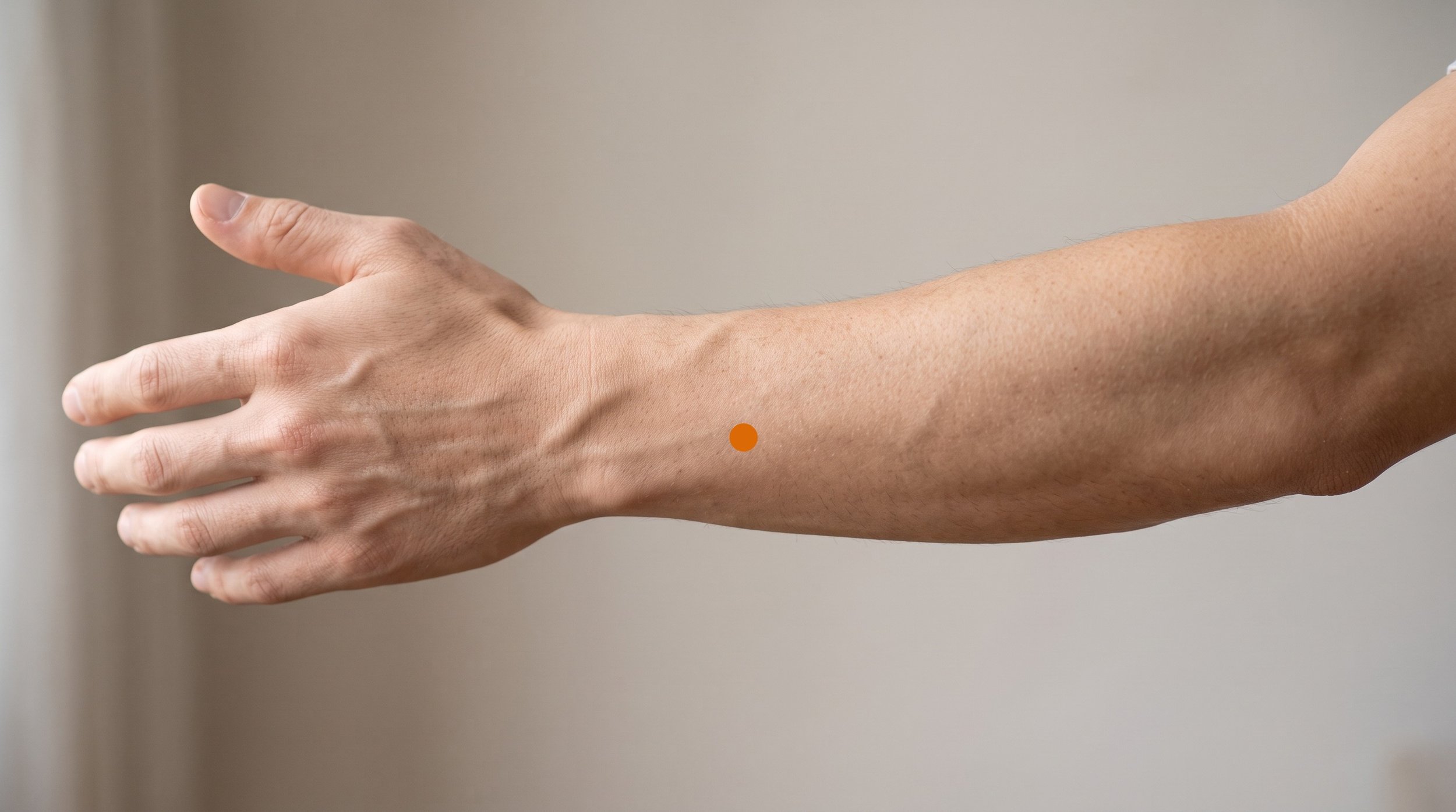
SJ7 Acupuncture Point (Huizong)
The Xi-Cleft Point Along the Ulnar Border: Anatomy, Mechanism, and Why Triple Burner 7 Is Reached For in Acute Ear and Forearm Complaints
SJ7 (Huizong), also written TE7, often translated as Ancestral Meeting or Converging Channels, is the xi-cleft point of the Triple Burner channel and sits on the back of the forearm about 3 cun above the wrist crease at SJ4, level with SJ6 but roughly one fingerbreadth toward the ulnar side, in the small groove between the shaft of the ulna and the belly of extensor digitorum.
It is one of those points that patients rarely ask for by name and that clinicians reach for constantly, because the sj 7 forearm location gives access to a dense band of extensor tissue and to the deep radial (posterior interosseous) nerve territory, while the classical literature files it with the ears. Xi-cleft points are the class traditionally used for acute and painful presentations, so the huizong xi cleft point tends to appear in treatment plans for sudden ear symptoms, flare-ups of pain along the lateral arm, and forearm overuse patterns that show up in a city full of keyboards, phones, and racquets.
- Location and layers: SJ7 lies against the radial border of the ulna between the ulna and extensor digitorum, so a needle passes skin, subcutaneous fascia, and extensor muscle before reaching the deep interosseous plane. A Manual of Acupuncture describes the point as three cun proximal to SJ4 and one fingerbreadth ulnar to SJ6, which makes SJ6 the practical landmark for finding it.
- Category translated: as the xi-cleft (accumulation) point of the channel, SJ7 belongs to the group traditionally reserved for acute, intense, or obstructive presentations, a framing Maciocia applies across all twelve channels. In modern terms, that simply means it is a point clinicians favor when symptoms are recent, sharp, or clearly localized to the lateral forearm and arm.
- Nerve story: the deep forearm at this level is served by the posterior interosseous branch of the radial nerve with cutaneous supply from the posterior antebrachial cutaneous nerve, all mapping to roughly C6 through C8. Needling recruits A-delta and group III afferents that engage spinal and brainstem circuits linked to endogenous opioid and monoaminergic inhibition (Zhao, 2008).
- Research picture: reviews of acupuncture for tinnitus report mixed results, with improvement on handicap questionnaires but not on all primary outcomes (Huang et al., 2021), while meta-analyses in sudden sensorineural hearing loss suggest added benefit when acupuncture is combined with standard care, tempered by trial quality concerns (Ren et al., 2024).
- Clinical framing: SJ7 is almost never used alone. It functions as a distal partner to local ear and jaw points, and large individual patient data analyses support acupuncture's role in chronic musculoskeletal pain when delivered as a multi-point course rather than a single needle (Vickers et al., 2018).
- De qi at SJ7 is usually a firm, deep ache or heaviness pressing toward the bone, sometimes spreading up the forearm toward the elbow or down toward the wrist. If the needle brushes extensor tissue that is already irritable, patients may feel a brief cramp or a twitch response, which Travell and Simons describe as typical of taut band stimulation.
Ringing Ears, Ear Fullness, or Jaw Tension That Will Not Settle?
Ear symptoms rarely live in the ear alone, and we assess the jaw, upper neck, and forearm channels before choosing points. SJ7 is often added as a distal partner to local points around the ear and temporomandibular joint, and we may pair it with manual therapy and home exercise. Results vary from person to person, and we track change session by session rather than promising outcomes. Schedule a visit and we'll build a plan around your presentation.
Schedule NowAnatomy of SJ7: Why the Groove Along the Radial Border of the Ulna Is Such an Important Location
Slide your thumb up the back of the forearm from the wrist and you will find the ulna as a firm ridge running toward the elbow. SJ7 sits just off that ridge on its radial side, in the soft valley where extensor digitorum meets bone. From the surface inward the needle encounters skin, a thin subcutaneous layer, the antebrachial fascia, then extensor digitorum and, deeper and more medially, extensor carpi ulnaris and the outcropping muscles of the thumb and index finger.
This is working tissue: every keystroke, grip, and backhand loads it, and Travell and Simons document that trigger points in the finger extensors refer pain down the forearm into the hand, a pattern many patients recognize instantly when this area is palpated.
The nerve geography explains most of what needling here does. The deep branch of the radial nerve continues as the posterior interosseous nerve along the interosseous membrane, supplying the extensor compartment, while surface sensation comes from the posterior antebrachial cutaneous nerve, with the dorsal cutaneous branch of the ulnar nerve nearby on the medial side. Those afferents enter the cord around the C6 to C8 segments, converging with input from the neck, shoulder, and lateral arm.
Stimulating them recruits small-diameter fibers that drive segmental inhibition at the dorsal horn and activate descending pathways from the periaqueductal gray and rostral ventromedial medulla, with opioid, serotonergic, and noradrenergic signaling all implicated (Zhao, 2008). This is why a needle in the forearm can change how tender the elbow or lateral arm feels within a single session.
Deep to the muscle sits the interosseous membrane with the posterior interosseous vessels, and beyond that the radius and ulna, so there is no cavity risk here and the main practical cautions are depth control and avoiding needling directly into the periosteum. Standard texts describe either a slightly oblique insertion angled toward the ulnar side or an oblique proximal or distal insertion of about 0.5 to 1.5 cun, while other manuals list perpendicular needling closer to 0.5 to 1.0 cun.
Moxibustion is traditionally considered appropriate at this point. Clean needle technique, appropriate needle length, and awareness of anticoagulant use are the usual sensible precautions for any forearm point.
Related Extensor Digitorum Trigger Points Related Extensor Carpi Ulnaris Trigger PointsSJ7 (TE7) at a Glance: Classification, Location, and Clinical Use
| Category | Detail |
|---|---|
| Traditional Name | Huizong, commonly rendered as Ancestral Meeting or Converging Channels |
| Channel Classification | Triple Burner (Sanjiao) channel of the Hand Shaoyang, point 7 of 23, also written TE7 or TB-7 (also called the Triple Energizer, the Triple Heater or Triple Warmer) |
| Point Categories | Xi-cleft (accumulation) point of the Triple Burner channel, the class traditionally applied to acute and painful presentations |
| Precise Location | Back of the forearm, 3 cun proximal to SJ4, level with SJ6 and about one fingerbreadth to its ulnar side, in the depression between the ulna and extensor digitorum communis; one classical method halves the distance from SJ4 to the lateral epicondyle, then halves again toward SJ4 |
| Tissue Stimulated | Skin and antebrachial fascia over extensor digitorum, with extensor carpi ulnaris and extensor indicis in the deeper and adjacent planes, along the radial border of the ulna in posterior interosseous nerve territory |
| Needle Depth / Direction | Slightly oblique toward the ulnar side, or oblique proximally toward the elbow or distally toward the wrist, 0.5 to 1.5 cun; perpendicular insertion of 0.5 to 1.0 cun is also described, and moxibustion is traditionally applicable |
| De Qi Sensation | Deep, dull ache or heaviness pressing toward the bone, often spreading along the extensor forearm; a brief twitch or cramp may occur if a taut band is engaged |
| Primary Clinical Uses | Traditionally listed for deafness, impaired hearing, tinnitus, ear pain, epilepsy, and pain of the skin, flesh, and arm; used clinically as a distal point for ear and jaw complaints and for extensor forearm and elbow pain |
| Common Point Combinations |
|
In A Manual of Acupuncture, Deadman and colleagues present SJ7 as the xi-cleft point of the Sanjiao channel with the traditional actions of clearing the channel and benefiting the ears, and the classical indication list is unusually compact: hearing loss, ringing in the ears, epilepsy, and pain of the skin and flesh. Chinese point compendia add ear pain and arm pain, and Maciocia notes that this point was traditionally singled out for pain in the arm.
Cunningham's point category tables even flag SJ7 as one of the few xi-cleft points whose classical indications do not track the usual theory neatly, since most of the group is dominated by acute pain and bleeding while this one leans toward the ears. All of this is traditional attribution rather than physiological description, but the pattern is striking: a small forearm point, one fingerbreadth off its better known neighbor, was consistently paired across centuries with points at the ear and jaw.
Why SJ7 Is Used for Ear Symptoms When It Sits on the Forearm
The first part of the answer is anatomical continuity. The Triple Burner channel runs from the ring finger up the extensor forearm, over the shoulder, and around the ear before ending at the eyebrow, so the classical pairing of a forearm point with the ear follows the pathway rather than defying it. Modern practitioners describe the same relationship differently: distal points recruit afferent input that ascends to brainstem nuclei where cervical, trigeminal, and autonomic circuits interact, and those circuits also modulate the muscles, vessels, and sensory processing around the ear and jaw.
Segmental convergence explains local forearm relief, while brainstem convergence offers a plausible, though still incompletely proven, route for distant effects.
The second part is descending control and blood flow. Needling reliably engages inhibitory pathways from the midbrain and medulla that use opioid, serotonergic, and noradrenergic signaling to reduce dorsal horn transmission, which is the best characterized mechanism in acupuncture analgesia (Zhao, 2008). Needling also produces autonomic and vascular responses, and imaging work in tinnitus patients has found changes in oxygenated hemoglobin in the temporal lobe alongside altered auditory cortex activation after acupuncture, suggesting central rather than purely local effects (Yu et al., 2023). These findings are early and drawn from small samples, so they support a mechanism worth investigating rather than a settled explanation.
For a patient, the practical translation is straightforward. SJ7 may be selected because it is comfortable to needle, sits on the channel that reaches the ear, and gives access to extensor tissue that is frequently part of the problem in forearm and elbow complaints. Whether it helps a given case of tinnitus or ear fullness is an open question that we test over a defined number of sessions rather than assume.
What the Research Shows for SJ7 (TE7)
One note on naming before the evidence: in the research literature this point appears as TE7, the WHO standard code, and also as SJ7 or TB7 depending on the authors, so it is worth searching all three if you want to read the studies below in full.
There is no clinical trial of SJ7 in isolation, and that is true for nearly every individual acupuncture point. Studies test protocols, usually a fixed or semi-standardized set of local and distal points delivered over several weeks, so the honest way to read the evidence is as support for the approach that SJ7 belongs to rather than for the point itself. The ear literature in particular is limited by small samples, variable outcome measures, and inconsistent control conditions, which is why the summaries below are cautious.
| Study | Type | Focus | Key Finding |
|---|---|---|---|
| Huang et al., 2021 | Systematic review and meta-analysis | Acupuncture for tinnitus across eight randomized trials | No significant difference was found on the primary visual analogue outcome, though handicap and severity questionnaire scores favored acupuncture, and the authors judged the overall evidence insufficient for firm conclusions. |
| Ren et al., 2024 | Systematic review and meta-analysis | Acupuncture for sudden sensorineural hearing loss, 28 trials | Adding acupuncture to conventional care was associated with better total effective and cure rates, but trial quality limits how confidently this can be applied. |
| Chen, Zhao & Qiu, 2019 | Systematic review and meta-analysis | Clinical efficacy of acupuncture in sudden sensorineural hearing loss | Pooled results suggested possible benefit as an adjunct, with the authors highlighting methodological weaknesses across the included studies. |
| Yu et al., 2023 | Functional near-infrared spectroscopy study | Cortical response to acupuncture in tinnitus patients | Acupuncture was associated with increased oxygenated hemoglobin in the temporal lobe and altered auditory cortex activation in a small sample. |
| Vickers et al., 2018 | Individual patient data meta-analysis | Acupuncture for chronic musculoskeletal, headache, and osteoarthritis pain | Acupuncture outperformed both sham and no-acupuncture controls with effects that persisted over time, supporting its use in multi-session courses. |
| Navarro-Santana et al., 2020 | Systematic review and meta-analysis | Trigger point dry needling for lateral epicondylalgia | Dry needling of forearm extensor trigger points was associated with reduced pain and disability, though the number and quality of trials remain modest. |
Forearm, Elbow, and Wrist Pain From Typing, Lifting, or Racquet Sports?
The tissue under SJ7 is the same extensor group that gets loaded by long keyboard days, heavy grip work, and overhead sport. We combine channel points such as SJ7, SJ5, and SJ6 with dry needling of extensor digitorum and extensor carpi ulnaris when palpation finds taut, tender bands. Treatment is paired with loading advice so the forearm gets stronger, not just quieter. Book an evaluation to see whether needling fits your case.
Schedule NowSJ7 in the Context of Trigger Point Work
Acupuncture means the use of an acupuncture needle, and that includes dry needling, so at Morningside the distinction between a channel point and a myofascial target is often a matter of intent rather than tools. SJ7 sits directly over extensor digitorum near its ulnar edge, with extensor carpi ulnaris just medial and extensor indicis deeper in the distal third of the forearm.
When a patient presents with lateral elbow pain, grip weakness, or aching that runs from the forearm into the back of the hand, palpation frequently finds taut bands in exactly this zone, and Travell and Simons describe finger extensor trigger points as referring pain distally in a pattern patients often mistake for a wrist or hand problem.
In practice that means SJ7 may be needled twice in the same treatment for different reasons: once as a channel point angled along the ulnar border, and once as part of a trigger point sequence through extensor digitorum and extensor carpi ulnaris where taut bands are found. Reviews of dry needling for lateral epicondylalgia report reductions in pain and disability when extensor trigger points are treated, usually alongside exercise (Navarro-Santana et al., 2020).
We pair needling with grip and wrist extensor loading, workstation adjustments, and gradual return to sport, since needling tends to open a window of reduced pain that loading is needed to hold.
SJ7 Ear and Forearm Pain Treatment at NYC's Highest-Rated Acupuncture Clinic
Morningside Acupuncture is the highest-rated acupuncture and dry needling clinic in New York City with over 500 five-star Google reviews, and our practitioners use classical point selection alongside modern orthopedic assessment. Points like SJ7 are chosen for a reason, explained in plain language, and integrated with movement and manual care. Every plan includes clear checkpoints so you know whether treatment is helping. Schedule your first session and let's get started.
Schedule NowFrequently Asked Questions
Is SJ7 the same point as TE7 or TB7?
Yes. SJ7, TE7, and TB7 are all codes for the same point, Huizong. SJ stands for San Jiao, the Chinese name of the channel. TE (Triple Energizer) is the WHO standard abbreviation and the one you will see in most Western textbooks and research papers. TB (Triple Burner) and TW (Triple Warmer) are older English renderings of the same name that still appear in many books. You will also come across it written as San Jiao 7 or Triple Energizer 7. Whichever code is used, the location and the uses are the same.
What does SJ7 feel like when needled?
Most people feel a firm, deep ache or a pressing heaviness against the bone rather than sharpness. The sensation may travel a short distance up toward the elbow or down toward the wrist, which is a normal de qi response. If the needle engages a taut band in the finger extensors, a brief cramp or visible twitch can occur, and that settles within seconds. Any bright, electric sensation should be reported immediately so the needle can be adjusted.
Why use a forearm point for an ear complaint instead of needling near the ear?
Usually both are used. The Triple Burner channel travels from the hand along the extensor forearm and around the ear, so classical formulas repeatedly pair SJ7 with local points such as SJ17 near the ear or ST7 at the jaw. Physiologically, distal points recruit afferent input that engages brainstem circuits where cervical, trigeminal, and autonomic pathways interact, which offers a plausible route for effects felt away from the needle (Zhao, 2008). Distal points are also easy to needle comfortably and allow the patient to rest without pressure on the head.
Can I press SJ7 myself between sessions?
Yes, acupressure at SJ7 is low risk. Find SJ6 first by measuring roughly four fingerbreadths up from the wrist crease on the back of the forearm between the two bones, then slide about one fingerbreadth toward the little finger side until your thumb drops into the groove next to the ulna. Press with your thumb at a firm but tolerable pressure, hold for 30 to 60 seconds, release, and repeat two or three times per side. Small circular pressure or slow wrist extension and flexion while holding the point can add a stretch component. Two or three short rounds a day is plenty, and you should stop if pressure causes numbness, tingling, or sharp pain.
Is SJ7 safe to needle?
SJ7 is considered a low-risk point in trained hands. There is no lung or major organ underneath, and the bones of the forearm limit depth. The main considerations are avoiding forceful contact with the periosteum, respecting the posterior interosseous nerve in the deep plane by keeping to the described depths of roughly 0.5 to 1.5 cun, and using standard clean needle technique. Mild bruising or brief soreness is the most common side effect. Tell your practitioner about blood thinners, bleeding disorders, or numbness in the hand before treatment.
Where exactly is SJ7 located?
SJ7 is on the back of the forearm, 3 cun proximal to SJ4 at the wrist, level with SJ6 but about one fingerbreadth toward the ulnar side, in the depression between the shaft of the ulna and the extensor digitorum muscle. A classical shortcut is to find the midpoint between SJ4 and the lateral epicondyle, then halve the lower segment again, which lands you at roughly the same level. The most reliable practical method is to locate SJ6 between the radius and ulna, then move sideways until your finger settles into the soft groove against the ulnar bone.
References
- Deadman, P., Al-Khafaji, M., & Baker, K. (2009). A manual of acupuncture. Journal of Chinese Medicine Publications.
- Maciocia, G. (2005). The foundations of Chinese medicine: A comprehensive text for acupuncturists and herbalists (2nd ed.). Elsevier Churchill Livingstone.
- Cheng, X. (Ed.). (1999). Chinese acupuncture and moxibustion (Rev. ed.). Foreign Languages Press.
- Kim, H. (2008). Handbook of Oriental medicine (3rd ed.). Harmony & Balance Press.
- O'Connor, J., & Bensky, D. (Eds. & Trans.). (1981). Acupuncture: A comprehensive text. Shanghai College of Traditional Medicine. Eastland Press.
- Cunningham, P. M. (2000). Acupuncture points: A practical guide to classical and modern usage. Odyssey Press.
- Simons, D. G., Travell, J. G., & Simons, L. S. (1999). Travell & Simons' myofascial pain and dysfunction: The trigger point manual, Vol. 1: Upper half of body (2nd ed.). Williams & Wilkins.
- Zhao, Z. Q. (2008). Neural mechanism underlying acupuncture analgesia. Progress in Neurobiology, 85(4), 355-375. https://doi.org/10.1016/j.pneurobio.2008.05.004
- Vickers, A. J., Vertosick, E. A., Lewith, G., MacPherson, H., Foster, N. E., Sherman, K. J., Irnich, D., Witt, C. M., & Linde, K. (2018). Acupuncture for chronic pain: Update of an individual patient data meta-analysis. Journal of Pain, 19(5), 455-474. https://doi.org/10.1016/j.jpain.2017.11.005
- Huang, K., Liang, S., Chen, L., & Grellet, A. (2021). Acupuncture for tinnitus: A systematic review and meta-analysis of randomized controlled trials. Acupuncture in Medicine, 39(4), 264-271. https://doi.org/10.1177/0964528420938380
- Ren, W., Tao, B., & Deng, H. (2024). The efficacy and safety of acupuncture in the treatment of sudden sensorineural hearing loss: A systematic review and meta-analysis. Integrative Medicine Research, 13(4), 101087. https://doi.org/10.1016/j.imr.2024.101087
- Chen, S., Zhao, M., & Qiu, J. (2019). Acupuncture for the treatment of sudden sensorineural hearing loss: A systematic review and meta-analysis. Complementary Therapies in Medicine, 42, 381-388. https://doi.org/10.1016/j.ctim.2018.12.009
- Yu, X., Gong, B., Yang, H., Wang, Z., Qi, G., Sun, J., Fang, Y., & Fan, X. (2023). Effect of acupuncture treatment on cortical activation in patients with tinnitus: A functional near-infrared spectroscopy study. IEEE Transactions on Neural Systems and Rehabilitation Engineering, 31, 729-737. https://doi.org/10.1109/TNSRE.2022.3231899
- Navarro-Santana, M. J., Sanchez-Infante, J., Gómez-Chiguano, G. F., Cleland, J. A., López-de-Uralde-Villanueva, I., Fernández-de-las-Peñas, C., & Plaza-Manzano, G. (2020). Effects of trigger point dry needling on lateral epicondylalgia of musculoskeletal origin: A systematic review and meta-analysis. Clinical Rehabilitation, 34(11), 1327-1340. https://doi.org/10.1177/0269215520937468
Disclaimer: This web site is intended for educational and informational purposes only. Reading this website does not constitute providing medical advice or any professional services. This information should not be used for diagnosing or treating any health issue or disease. Those seeking medical advice should consult with a licensed physician. Seek the advice of a medical doctor or other qualified health professional for any medical condition. If you think you have a medical emergency, call 911 or go to the emergency room. No acupuncturist-patient relationship is created by reading this website or using the information. Morningside Acupuncture PLLC and its employees and contributors do not make any express or implied representations with respect to the information on this site or its use. For any legal interpretation of scope of practice in your state, consult a licensed attorney or regulatory authority.
Read more from our blog



