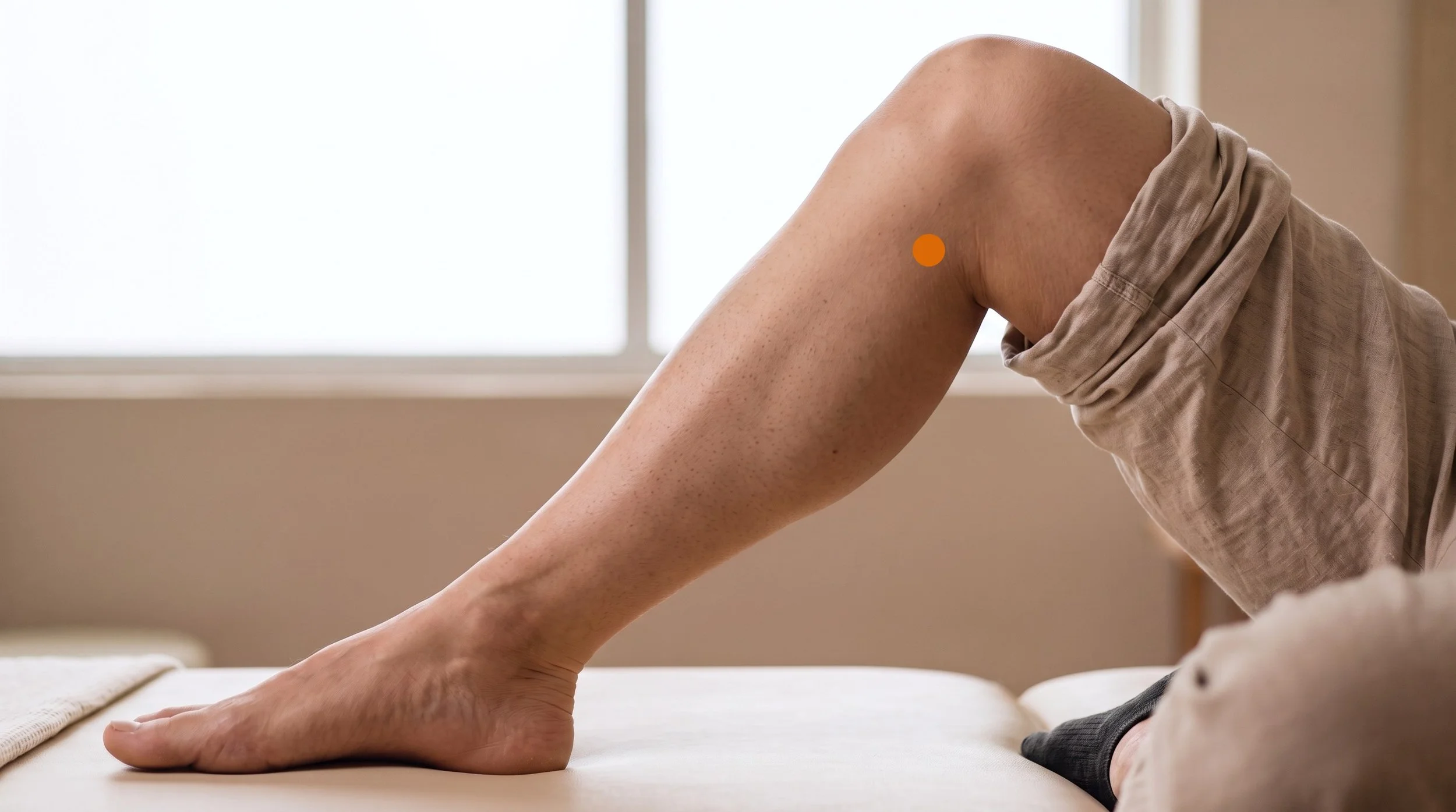
LV7 Acupuncture Point (Xiguan)
The Knee Joint Point Behind the Medial Condyle: Anatomy, Mechanism, and Why LV7 Earns Its Place in Medial Knee Pain Treatment
LV7 (Xiguan, often translated as Knee Joint or Knee Gate), also written LR7, is the seventh point of the Liver channel, and it is one of the few channel points whose name announces exactly what it was used for. You find it on the inner side of the upper calf, tucked behind and just below the bony bump of the medial tibial condyle, one cun posterior to SP9.
That places the LV7 acupuncture point in dense, clinically busy tissue: the upper attachment of the medial head of gastrocnemius, the deep border of the pes anserine tendons, and the soft tissue envelope that gets loaded every time you squat, descend stairs, or push off a stiff knee.
For patients with medial knee pain, swelling, and trouble fully bending or straightening, liver 7 is a local point that reaches structures most anterior knee points never touch.
- LV7 sits posterior and inferior to the medial condyle of the tibia, one cun behind SP9, in the upper portion of the medial head of gastrocnemius (Deadman et al., 2009; Cheng, 1999). The needle passes skin, superficial fascia, and the tendinous crossroads of the pes anserine group before reaching muscle.
- The classical actions attributed to this point are dispelling wind-damp, benefiting the knee, and relaxing the sinews (Deadman et al., 2009). Read neurophysiologically, that language describes reduced local nociceptive input, less protective muscle guarding, and improved tolerance for flexion and extension.
- Sensory territory here involves saphenous branches anteromedially and the medial sural cutaneous nerve posteriorly, with the tibial nerve and posterior tibial vessels lying deeper (Cheng, 1999). Because knee joint afferents and the surrounding muscles share segments roughly from L3 to S2, needling at LV7 converges on the same dorsal horn neurons that carry joint pain (Zhao, 2008).
- Needle stimulation at the upper medial leg has measurable local effects: photoplethysmography work showed that deep needle stimulation in the leg increases skin and muscle blood flow more than superficial insertion (Sandberg et al., 2003). Vascular and autonomic changes may be part of why local points on a stiff, cold-feeling knee are worth including.
- Research on this region is protocol-level rather than point-level. A Cochrane review of peripheral joint osteoarthritis found small sham-controlled benefits and larger effects against waiting list controls (Manheimer et al., 2010), while individual patient data from chronic pain trials support effects that persist beyond a course of treatment (Vickers et al., 2018).
- De qi at LV7 is usually a deep, heavy, spreading ache in the inner calf that can travel toward the kneecap or down toward the inner ankle. It should feel dull and full, never sharp, electric, or radiating into the foot.
Is Medial Knee Pain Limiting Your Stairs, Squats, and Walks?
Inner knee pain rarely comes from one structure alone: the joint line, the pes anserine tendons, and the medial gastrocnemius attachment all contribute. At Morningside Acupuncture we use LV7 alongside local knee points and dry needling of the surrounding muscles to reduce guarding and restore comfortable bending and straightening. Treatment is paired with practical loading advice so gains hold between visits. Schedule a session and let us assess what is actually driving your knee pain.
Schedule NowAnatomy of LV7: Why the Back Edge of the Medial Tibial Condyle Is Such an Important Location
To find the LV 7 knee point, first locate SP9 in the hollow formed where the medial condyle of the tibia meets the posterior border of the shaft, then move one cun posteriorly (Deadman et al., 2009). Under the needle are skin and superficial fascia, then the fanning tendons of the pes anserine complex (sartorius, gracilis, semitendinosus) as they converge onto the upper medial tibia, and then the upper fibers of the medial head of gastrocnemius (Cheng, 1999). This is a loading crossroads.
The pes anserine tendons resist valgus and rotational stress during stance, the medial gastrocnemius head crosses the back of the joint and works hard on stairs and hills, and the medial joint line takes the largest share of compressive load in most walking gaits. Patients with medial compartment osteoarthritis, medial collateral ligament strain, or a chronically irritable pes anserine bursa are often exquisitely tender within a finger's width of this point (Cunningham, 2000).
The nerve geography explains the clinical reach. Cutaneous supply in this area comes from saphenous branches anteromedially and the medial sural cutaneous nerve posteriorly, with the tibial nerve running deeper in the posterior compartment (Cheng, 1999). Both the knee joint capsule and the muscles crossing it are supplied by segments spanning roughly L3 through S2, so afferent traffic from the needle enters the same spinal levels that carry input from the painful joint.
That segmental convergence is a plausible route for local pain modulation, and needling is also understood to recruit descending inhibitory pathways involving endogenous opioid and monoaminergic systems (Zhao, 2008). Locally, needle stimulation appears to change tissue perfusion: deep needling in the leg produced larger increases in skin and muscle blood flow than superficial insertion in healthy volunteers (Sandberg et al., 2003).
Deeper still lie the posterior tibial artery and vein and the tibial nerve, which is why direction and depth matter (Cheng, 1999). Classical sources describe perpendicular insertion of one to two cun at this point, while modern texts often list a more conservative range of half a cun to one cun (Deadman et al., 2009; Kim, 2008).
In practice, depth is chosen for the patient's build and the tissue being targeted, the angle stays perpendicular or slightly anterior rather than aimed into the popliteal space, and any sharp, electric, or foot-referring sensation is a signal to withdraw and redirect. Moxibustion is traditionally applied here and is a reasonable adjunct when the knee feels cold and stiff (Cheng, 1999).
Related Best Acupuncture Points For Knee Pain Related Acupuncture For Knee PainLV7 (LR7) at a Glance: Classification, Location, and Clinical Use
| Category | Detail |
|---|---|
| Traditional Name | Xiguan (Knee Joint, also translated Knee Gate) |
| Channel Classification | Seventh point of the Liver channel (Foot Jue Yin), a local point on the medial aspect of the upper leg (LV7, also written LIV7 or LR7) |
| Point Categories | No five-shu, luo-connecting, xi-cleft, hui-meeting, or extraordinary vessel intersection designation is recorded for this point in the standard references. Traditional actions listed are dispelling wind-damp, benefiting the knee, and relaxing the sinews. |
| Precise Location | Posterior and inferior to the medial condyle of the tibia, 1 cun posterior to SP9. Locate SP9 in the depression in the angle between the medial condyle and the posterior border of the tibia, then measure one cun back. |
| Tissue Stimulated | Skin and superficial fascia, the deep aspect of the pes anserine tendons (sartorius, gracilis, semitendinosus), and the upper fibers of the medial head of the gastrocnemius; saphenous and medial sural cutaneous territory, with posterior tibial vessels and tibial nerve deeper |
| Needle Depth / Direction | Perpendicular insertion, commonly 0.5 to 1 cun in modern practice and up to 1 to 2 cun in classical sources, angled straight in or slightly anteriorly rather than toward the popliteal space. Moxibustion is traditionally applied. |
| De Qi Sensation | Deep, heavy, spreading ache in the inner calf that may travel toward the kneecap or down the medial leg; dull and full rather than sharp or electric |
| Primary Clinical Uses | Medial knee pain and swelling, difficulty flexing and extending the knee, inner knee pain radiating toward the patella, stiff cold-feeling knees in classical damp-cold presentations, medial collateral ligament and pes anserine irritation, medial gastrocnemius and hamstring strain |
| Common Point Combinations |
|
Deadman, Al-Khafaji, and Baker record LV7 with a narrow, confident brief: it dispels wind-damp, benefits the knee, and relaxes the sinews. The indication list stays close to home, covering swelling and pain of the knee, pain of the inner knee that radiates toward the kneecap, difficulty bending and straightening, and the classical joint patterns known as crane's knee wind, wind painful obstruction, and white tiger joint wind, along with cold-damp pouring downward.
A short tail of distal indications for abdominal and throat pain reflects the Liver channel's broader course, though these are rarely the reason the point is chosen today. All of these are traditional attributions rather than modern diagnoses. What stands out is the specificity: in a system where most points accumulate long and varied indication lists, this one stayed anchored to a single joint for centuries, which is a reasonable sign that generations of practitioners kept finding something useful in the tissue behind the medial condyle.
Why LV7 Is Used for Stubborn Inner Knee Pain That Anterior Points Do Not Reach
Most knee acupuncture happens on the front of the joint: the knee eyes, ST34, ST36, SP10. That works well for anterior and patellofemoral complaints, but a large share of knee pain is medial and posteromedial, sitting where the joint line, the pes anserine tendons, and the medial gastrocnemius attachment overlap. LV7 puts a needle into that exact zone.
Because the joint capsule and the surrounding muscles share spinal segments in the L3 to S2 range, sensory input generated at the point converges on the same dorsal horn neurons receiving input from the painful joint, which is one accepted route by which needling dampens local pain signaling (Zhao, 2008).
Beyond the segment, needling recruits system-wide inhibition. Experimental work describes activation of descending pathways from the midbrain and brainstem that use endogenous opioids, serotonin, and noradrenaline to reduce transmission at the spinal level, which helps explain why effects are not limited to the needled tissue (Zhao, 2008).
There is also a local vascular component: deep needle stimulation in the leg increased both skin and muscle blood flow more than superficial insertion in controlled measurements (Sandberg et al., 2003). For a chronically guarded, stiff medial knee, that combination of reduced nociceptive drive and improved local perfusion is a sensible framing for what a session may accomplish.
The honest caveat is that no trial has isolated this single point. Large individual patient data analyses show acupuncture outperforming sham and no-acupuncture controls for chronic musculoskeletal pain, with effects that decline only modestly over a year (Vickers et al., 2018), but those protocols always used multi-point prescriptions. LV7 is best understood as one well-chosen component of a knee treatment, not as a stand-alone intervention.
What the Research Shows for LV7 (LR7)
One note on naming before the evidence: in the research literature this point is usually listed as LR7, the WHO standard code, and sometimes as LV7 or LIV7, so it is worth searching all three if you want to read the studies below in full.
Nearly all of the knee research tests multi-point protocols, usually built around local knee points with distal additions, so evidence should be read as support for acupuncture treatment of the knee rather than proof of any one point. The reviews below vary in how favorable their conclusions are, which is itself informative: sham-controlled effects tend to be small, pragmatic comparisons tend to be larger, and durability appears reasonable but not indefinite. LV7 typically appears as a local medial addition within these kinds of protocols.
| Study | Type | Focus | Key Finding |
|---|---|---|---|
| Manheimer et al., 2010 | Cochrane systematic review | Acupuncture for peripheral joint osteoarthritis, including the knee | Sham-controlled trials showed statistically significant but small benefits that did not meet the review's clinical relevance threshold, while waiting list comparisons showed larger effects the authors attributed partly to expectation. |
| Vickers et al., 2018 | Individual patient data meta-analysis | Chronic pain including osteoarthritis, back, neck, and headache | Acupuncture was superior to both sham and no-acupuncture controls, with treatment effects persisting over roughly a year in the pooled patient-level data. |
| Chen et al., 2024 | Systematic review and meta-analysis | Durability of acupuncture effects after a completed course for knee osteoarthritis | The authors reported that improvements in pain and function may persist for three to six months after treatment ends, with a favorable safety profile, while calling for further study. |
| Liu et al., 2024 | Systematic review with pairwise and network meta-analysis | Effect and contributing factors in knee osteoarthritis, including technique and dose | The analysis examined whether acupuncture type, dose, and follow-up interval influence outcomes, suggesting treatment parameters matter and reinforcing that adequate course length is worth planning for. |
| Jiménez-del-Barrio et al., 2022 | Systematic review and meta-analysis | Dry needling of myofascial trigger points in hip or knee osteoarthritis | Pooled data from a small set of trials suggested possible short-term benefit for pain and function, though the evidence base remains limited in size and quality. |
| Sandberg et al., 2003 | Controlled physiological study | Skin and muscle blood flow responses to needling in the leg | Deep needle stimulation produced greater increases in local skin and muscle blood flow than superficial insertion, supporting a local vascular component to needling. |
Knee Osteoarthritis That Feels Stiff, Heavy, and Worse in Cold Weather?
Classical texts described exactly this presentation and reached for LV7 with moxibustion; modern clinicians read it as a stiff, poorly circulated, deconditioned joint. Our practitioners combine the Xiguan knee point with ST36, GB34, and the knee eye points, and often add gentle warming techniques when the joint feels cold and achy. Studies suggest acupuncture may reduce pain and improve function in knee osteoarthritis, though effects are modest. Book an appointment to build a knee plan you can stay consistent with.
Schedule NowLV7 in the Context of Trigger Point Work
LV7 lands squarely in territory that trigger point clinicians already treat. The medial head of gastrocnemius refers pain into the back and inner aspect of the knee and calf, and taut bands in its upper attachment are a common finding in patients who report medial knee pain with stair descent or a persistent pulling sensation behind the joint (Simons et al., 1999). Semitendinosus and gracilis, which contribute to the pes anserine group at the same level, can also refer into the posteromedial knee.
When a practitioner needles the Xiguan knee point and encounters a firm band with a local twitch response, the classical point and the myofascial target are effectively the same tissue approached from two traditions.
At Morningside we treat LV7 as an anchor for a broader medial knee session rather than a standalone technique. A typical visit may pair LV7 with dry needling of the medial gastrocnemius and medial hamstrings, add local anterior points such as the knee eyes and ST34 when the front of the joint is involved, and include ST36 or GB34 for a broader effect down the leg. Acupuncture here means the use of an acupuncture needle, whether the reasoning is channel-based or trigger point based, and the two frameworks converge often enough at this location that the distinction matters less than accurate palpation.
LV7 Knee Pain Treatment at NYC's Highest-Rated Acupuncture Clinic
Morningside Acupuncture is the highest-rated acupuncture and dry needling clinic in New York City with over 500 five-star Google reviews, and knee pain is one of the conditions we treat most often. Every session begins with an orthopedic assessment so points like LV7 are chosen for your specific pattern rather than from a template. We integrate channel-based acupuncture, trigger point dry needling, and graded loading in one visit. Schedule your first appointment and get a clear plan for your knee.
Schedule NowFrequently Asked Questions
Is LV7 the same point as LR7 or LIV7?
Yes. LV7, LR7, and LIV7 are all codes for the same point, Xiguan, point 7 of the Liver channel. LR is the WHO standard abbreviation and the one you will see in most research papers. LV is the form used by many American schools and clinics, and LIV appears in several widely used textbooks. You will also come across it written as Liver 7 or LIV-7. Whichever code is used, the location and the uses are the same.
What does LV7 feel like when needled?
Most people describe a deep, heavy, slightly achy fullness in the inner calf just below the knee, sometimes spreading up toward the kneecap or down the medial leg. That dull spreading quality is de qi, and it usually eases within seconds while the needle stays in place. If the gastrocnemius or hamstring tendons are involved, you may feel a brief cramp-like grab as a taut band releases. Sharp, burning, or electric sensations shooting into the foot are not the goal and should be reported immediately so the needle can be adjusted.
Why needle the inner calf when my pain is in the knee joint itself?
The knee joint capsule and the muscles crossing it share spinal segments, so sensory input generated at LV7 arrives at the same dorsal horn neurons that carry pain from the joint, which is one mechanism by which needling may reduce local pain signaling (Zhao, 2008). There is also a mechanical reason: the pes anserine tendons and the medial gastrocnemius attachment both live at this level and both refer pain into the knee, so what feels like joint pain is often partly soft tissue pain from the structures LV7 sits among (Simons et al., 1999).
Can I press LV7 myself between sessions?
Yes, and it is easy to reach. Sit with the knee bent to about 90 degrees, run your thumb up the inner shin until it stops under the bony flare of the medial tibial condyle (that hollow is SP9), then slide about a thumb's width backward into the soft tissue at the top of the calf. Press with your thumb at a firmness that feels like a satisfying deep ache rather than a sharp pain, hold for 30 to 60 seconds, release, and repeat two or three times per side. Two to three sessions a day is plenty, and gentle slow calf stretching afterward tends to make the effect last longer. Skip acupressure over swollen, hot, bruised, or recently injured tissue, and speak with a clinician if the knee locks, gives way, or swells rapidly.
Is LV7 safe to needle?
In trained hands, yes. The main considerations are depth and direction: the posterior tibial vessels and the tibial nerve lie deeper in the posterior compartment, so needling stays perpendicular or slightly anterior rather than angled toward the popliteal space, and depth is scaled to the patient's build (Cheng, 1999). Classical sources permit one to two cun while many modern texts recommend half a cun to one cun (Deadman et al., 2009; Kim, 2008). Expect the usual minor risks of any needling: brief soreness, occasional small bruising, and rare lightheadedness. Patients on blood thinners, with clotting disorders, or with a history of deep vein thrombosis or lower leg vascular disease should mention it, since the calf warrants extra caution.
Where exactly is LV7 located?
LV7 is on the inner side of the leg just below the knee, posterior and inferior to the medial condyle of the tibia, one cun behind SP9 (Deadman et al., 2009). The reliable way to find it is to locate SP9 first, in the depression in the angle formed by the medial condyle and the back border of the tibia, then measure one cun posteriorly into the soft tissue at the upper part of the medial head of gastrocnemius (Cheng, 1999). One cun is roughly the width of your own thumb at the knuckle. In most people the spot is noticeably tender when the medial knee is symptomatic.
References
- Deadman, P., Al-Khafaji, M., & Baker, K. (2009). A manual of acupuncture. Journal of Chinese Medicine Publications.
- Cheng, X. (Ed.). (1999). Chinese acupuncture and moxibustion (Rev. ed.). Foreign Languages Press.
- Kim, H. (2008). Handbook of Oriental medicine (3rd ed.). Harmony & Balance Press.
- Cunningham, P. M. (2000). Acupuncture points: A practical guide to classical and modern usage. Odyssey Press.
- Simons, D. G., Travell, J. G., & Simons, L. S. (1999). Travell & Simons' myofascial pain and dysfunction: The trigger point manual, Vol. 1: Upper half of body (2nd ed.). Williams & Wilkins.
- Zhao, Z. Q. (2008). Neural mechanism underlying acupuncture analgesia. Progress in Neurobiology, 85(4), 355-375. https://doi.org/10.1016/j.pneurobio.2008.05.004
- Vickers, A. J., Vertosick, E. A., Lewith, G., MacPherson, H., Foster, N. E., Sherman, K. J., Irnich, D., Witt, C. M., & Linde, K. (2018). Acupuncture for chronic pain: Update of an individual patient data meta-analysis. Journal of Pain, 19(5), 455-474. https://doi.org/10.1016/j.jpain.2017.11.005
- Manheimer, E., Cheng, K., Linde, K., Lao, L., Yoo, J., Wieland, S., van der Windt, D. A. W. M., Berman, B. M., & Bouter, L. M. (2010). Acupuncture for peripheral joint osteoarthritis. Cochrane Database of Systematic Reviews, 2010(1), CD001977. https://doi.org/10.1002/14651858.CD001977.pub2
- Chen, H., Shi, H., Gao, S., Fang, J., Yi, J., Wu, W., Liu, X., & Liu, Z. (2024). Durable effects of acupuncture for knee osteoarthritis: A systematic review and meta-analysis. Current Pain and Headache Reports, 28(7), 709-722. https://doi.org/10.1007/s11916-024-01242-6
- Liu, C. Y., Duan, Y. S., Zhou, H., Wang, Y., Tu, J. F., Bao, X. Y., Yang, J. W., Lee, M. S., & Wang, L. Q. (2024). Clinical effect and contributing factors of acupuncture for knee osteoarthritis: A systematic review and pairwise and exploratory network meta-analysis. BMJ Evidence-Based Medicine, 29(6), 374-384. https://doi.org/10.1136/bmjebm-2023-112626
- Jiménez-del-Barrio, S., Medrano-de-la-Fuente, R., Hernando-Garijo, I., Mingo-Gómez, M. T., Estébanez-de-Miguel, E., & Ceballos-Laita, L. (2022). The effectiveness of dry needling in patients with hip or knee osteoarthritis: A systematic review and meta-analysis. Life, 12(10), 1575. https://doi.org/10.3390/life12101575
- Sandberg, M., Lundeberg, T., Lindberg, L. G., & Gerdle, B. (2003). Effects of acupuncture on skin and muscle blood flow in healthy subjects. European Journal of Applied Physiology, 90(1-2), 114-119. https://doi.org/10.1007/s00421-003-0825-3
Disclaimer: This web site is intended for educational and informational purposes only. Reading this website does not constitute providing medical advice or any professional services. This information should not be used for diagnosing or treating any health issue or disease. Those seeking medical advice should consult with a licensed physician. Seek the advice of a medical doctor or other qualified health professional for any medical condition. If you think you have a medical emergency, call 911 or go to the emergency room. No acupuncturist-patient relationship is created by reading this website or using the information. Morningside Acupuncture PLLC and its employees and contributors do not make any express or implied representations with respect to the information on this site or its use. For any legal interpretation of scope of practice in your state, consult a licensed attorney or regulatory authority.
Read more from our blog



