CV7 Acupuncture Point (Yinjiao)
The Yin Intersection Below the Navel: Anatomy, Segmental Mechanism, and Why This Lower Abdominal Point Sits at the Crossroads of Menstrual and Pelvic Treatment
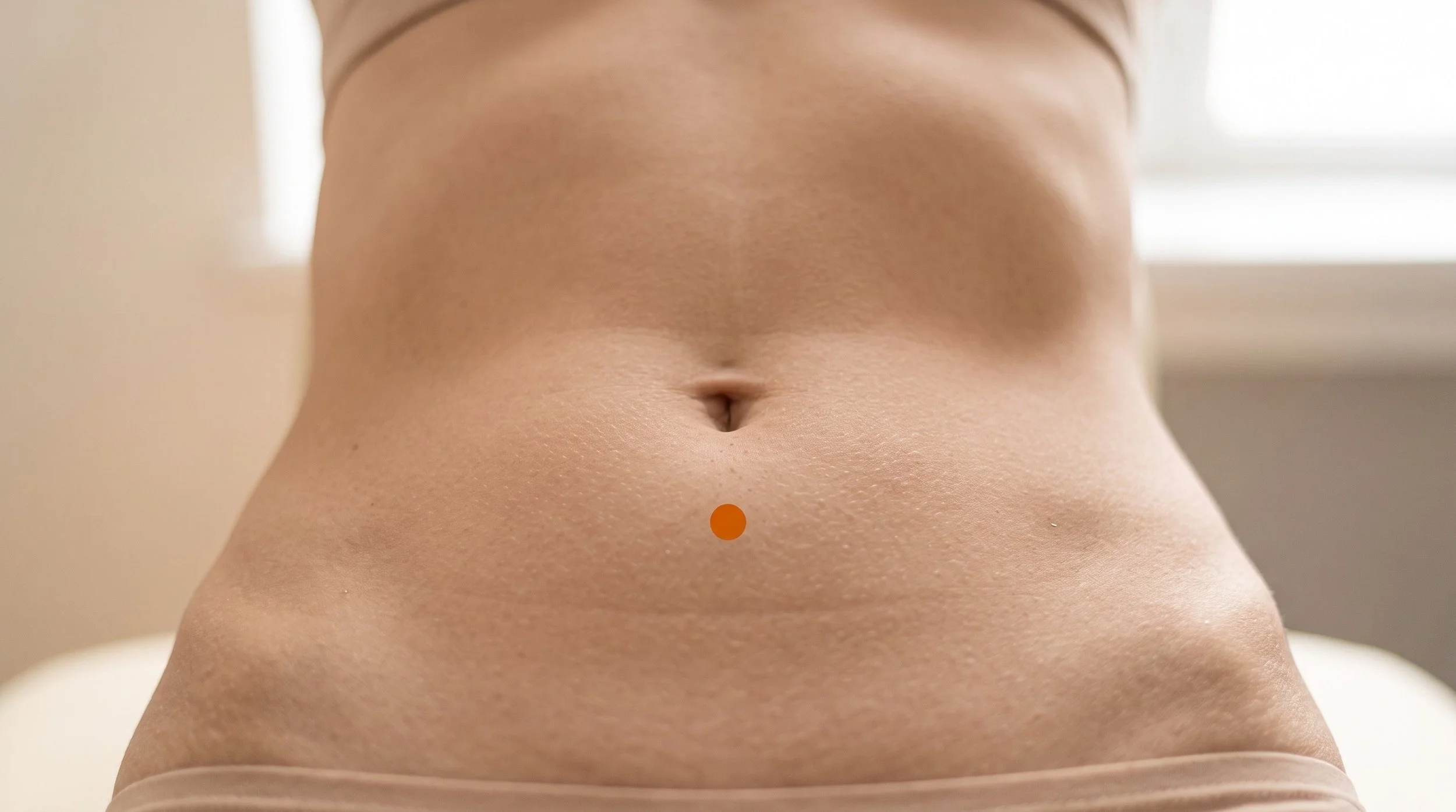
CV7 (Yinjiao, translated as Yin Intersection), also written Ren 7, is the seventh point of the Conception Vessel, located on the midline of the lower abdomen one cun below the center of the umbilicus and four cun above the upper border of the pubic symphysis (Deadman et al., 2009).
In plain terms, it sits roughly a thumb's width below your navel, right on the firm vertical seam of connective tissue that runs down the front of the belly. The classical literature treats it as a meeting place of the Conception and Penetrating vessels with the Kidney channel, which is why traditional sources group its indications around menstruation, fertility, and the lower abdomen and genital region.
Read through a modern lens, the interest of this CV7 acupuncture point is simpler and more concrete: it lies over a segmental field (roughly T10 to T11) that shares spinal cord territory with the uterus, adnexa, bladder, and lower gut, which makes it an anatomically sensible place to work when someone's main complaint sits low in the pelvis.
- Location and layers: CV7 is on the linea alba one cun inferior to the umbilicus, with needling described as perpendicular insertion of 0.8 to 1.5 cun and an explicit caution that deep insertion can enter the peritoneal cavity (Deadman et al., 2009). The needle passes skin, subcutaneous fat, and dense midline aponeurosis, not muscle belly, so the sensation is usually more of a spreading fullness than a twitch.
- Traditional categories: classical texts list CV7 as a meeting point of the Conception and Penetrating vessels with the Kidney channel, and its attributed actions center on regulating menstruation and benefiting the lower abdomen and genital region (Deadman et al., 2009). These are traditional attributions, presented here as historical clinical reasoning rather than physiology.
- Mechanism: the lower abdominal wall at this level is innervated by anterior cutaneous branches of the lower intercostal nerves, and those segments overlap with visceral afferents from the uterus, bladder, and lower bowel that reach the cord through the hypogastric and pelvic pathways, giving a plausible convergence route for local needling to influence pelvic sensation and autonomic tone (Zhao, 2008; Uchida et al., 2017).
- Autonomic and vascular effects: reviews of somatoautonomic reflexes show that somatic stimulation can shift visceral function through spinal and supraspinal reflex arcs, and abdominal stimulation drives different reflex patterns than limb stimulation (Uchida et al., 2017; Ma, 2022). A small early study also reported reduced uterine artery pulsatility index after repeated electro-acupuncture in women with high impedance, an intriguing but uncontrolled finding (Stener-Victorin et al., 1996).
- Research picture: Cochrane reviews of acupuncture for period pain, for ovulation disorders in polycystic ovary syndrome, and as an adjunct in assisted reproduction all conclude that current evidence is limited and uncertain rather than confirmatory (Smith et al., 2016; Lim et al., 2019; Cheong et al., 2013). Broader chronic pain data are more consistent but do not speak to this single point (Vickers et al., 2018).
- Clinical framing and de qi: CV7 is used as one element inside a larger plan, often with distal points and, where relevant, dry needling of the abdominal wall (Simons et al., 1999). Most people report a heavy, warm, spreading ache under the needle that may drift toward the pubic bone or groin, and the bladder should be emptied first for comfort and safety.
Struggling With Irregular Cycles, Cramping, or Pelvic Heaviness in NYC?
At Morningside Acupuncture, points on the lower abdominal midline like CV7 are chosen only after we map where your symptoms actually sit and how they behave across the cycle. We combine gentle needling of the Yinjiao abdomen region with distal points and, when the abdominal wall itself is tender, careful dry needling of the muscles that guard it. The goal is practical: fewer high-pain days, steadier cycles, and less bracing through the lower belly. Schedule a visit and let's build a plan around your pattern rather than a generic protocol.
Schedule NowAnatomy of CV7: Why the Linea Alba One Cun Below the Navel Is Such an Important Location
CV7 sits on the anterior midline of the lower abdomen, one cun below the center of the umbilicus and four cun above the pubic symphysis (Deadman et al., 2009). Working from the surface inward, a needle here encounters skin, a variable layer of subcutaneous fat, and then the linea alba, the tough vertical seam where the aponeuroses of the two rectus sheaths interlace. Deeper still lie the transversalis fascia, preperitoneal fat, the parietal peritoneum, and loops of small intestine.
This midline seam is loaded constantly and quietly: every breath, cough, laugh, and lift changes intra-abdominal pressure and tugs on it. Postpartum abdominal separation, laparoscopic port scars, cesarean scars, and long hours of seated flexion all change how the tissue here glides, and patients often describe the area as tight, numb, or oddly disconnected before it is ever described as painful.
The nerve geography is what makes this location clinically interesting. Sensory supply to the abdominal wall at this level comes from anterior cutaneous branches of the lower intercostal nerves, arriving at the midline after piercing the rectus sheath. Those same spinal segments receive visceral afferent traffic from the uterus and adnexa traveling with sympathetic fibers, while lower pelvic structures report in through sacral parasympathetic routes.
When somatic and visceral inputs share dorsal horn neurons, the nervous system can misattribute the source of a signal, which is one accepted explanation for why deep pelvic problems are so often felt as a vague band across the lower belly. Needling into a convergent segment engages large-diameter afferents and recruits spinal and brainstem circuits that modulate incoming nociception, including descending inhibitory pathways (Zhao, 2008).
Reviews of somatoautonomic reflex physiology add that somatic stimulation can also shift autonomic outflow, and that the body position of the stimulus matters, with trunk and limb stimulation driving distinguishable reflex patterns (Uchida et al., 2017; Ma, 2022).
Safety governs technique here. Because only fascia and fat separate the needle from the peritoneum, classical guidance sets perpendicular insertion at 0.8 to 1.5 cun with an explicit warning that deeper needling may penetrate the peritoneal cavity (Deadman et al., 2009).
In practice that means the bladder is emptied before treatment, depth is scaled down for slim patients, and the area is palpated first for hernias, pulsatile masses, and surgical scars. Angling shallowly along the midline, using shorter needles, or substituting indirect moxa or acupressure are all reasonable adjustments. Lower abdominal points including Yinjiao conception vessel are avoided during pregnancy, and any new, severe, or progressive abdominal pain belongs in a medical evaluation before it belongs on a treatment table.
Related Conception Vessel Related Kidney ChannelCV7 (Ren 7) at a Glance: Classification, Location, and Clinical Use
| Category | Detail |
|---|---|
| Traditional Name | Yinjiao (Yin Intersection), Conception Vessel 7, listed as REN-7 in Deadman & Al-Khafaji |
| Channel Classification | Conception Vessel (Ren Mai), anterior midline of the lower abdomen (CV7, also written REN7) |
| Point Categories | Meeting point of the Conception Vessel and the Penetrating Vessel with the Kidney channel (Deadman et al., 2009). No five-shu, he-sea, or hui-meeting designation is attributed to this point in the reference literature. |
| Precise Location | On the anterior midline of the lower abdomen, 1 cun inferior to the center of the umbilicus and 4 cun superior to the upper border of the pubic symphysis |
| Tissue Stimulated | Skin and subcutaneous fat over the linea alba, with the medial edges of the rectus sheath and the aponeurotic contributions of the abdominal obliques immediately lateral; small intestine lies deep to the peritoneum |
| Needle Depth / Direction | Perpendicular insertion 0.8 to 1.5 cun, scaled to body habitus. Caution: deep needling may penetrate the peritoneal cavity, so the bladder is emptied first and depth is reduced in slim patients |
| De Qi Sensation | A heavy, warm, spreading fullness or dull ache that may drift downward toward the pubic bone or groin. Sharp, electric, or stabbing sensations are not expected and mean the needle should be withdrawn or repositioned |
| Primary Clinical Uses | Traditionally used for uterine bleeding, irregular menstruation and infertility, for damp itching and sweating of the genital region, for pain and cold around the umbilicus, and for the surging upward sensation classical texts called running piglet qi (Deadman et al., 2009) |
| Common Point Combinations |
|
In A Manual of Acupuncture, Deadman and Al-Khafaji present CV7 as a crossing point where the Conception Vessel and the Penetrating Vessel meet the Kidney channel, three pathways that classical theory ties directly to the uterus. The Conception Vessel was called the sea of the yin channels and the Penetrating Vessel the sea of blood, and both were said to begin in the uterus and depend on Kidney vitality for their maturation, a framework the Inner Classic used to explain why cycles begin, run regularly, and permit conception.
Because of that attributed relationship, the classical indication list for this point is heavily gynecological: uterine bleeding, irregular or absent periods, prolonged postpartum discharge, and infertility of many described causes.
A second cluster follows the same channels downward to the perineum and genitals, giving indications such as retraction and pain of the genitals, sweating and damp itching there, hernia-type shan disorders, and pain or cold sensation encircling the navel. A third, stranger cluster covers running piglet qi, the classical name for a surging, galloping sensation rising from the lower abdomen toward the chest and throat.
What is striking about the classical pattern is its coherence: everything attributed to CV7 lives either in the pelvis or on the vertical line rising out of it, exactly the territory those channel maps described.
Why CV7 Is Used for Menstrual Irregularity, Genital Itching, and the Surging Sensation Classical Texts Called Running Piglet Qi
The unifying thread is segmental. The abdominal wall around the navel and just below it reports to the spinal cord through the lower thoracic nerves, and the uterus, ovaries, bladder, and lower bowel send their own afferent traffic into overlapping segments. When somatic and visceral inputs share second-order neurons in the dorsal horn, the brain receives a blended signal and localizes poorly, which is why deep pelvic irritation often presents as a diffuse ache across the lower belly, a dragging feeling toward the groin, or tenderness on the midline that has no local injury behind it.
Needling into that shared segment recruits large-diameter afferents and engages spinal and descending inhibitory circuits that dampen the incoming nociceptive stream (Zhao, 2008). That is a mechanism for changing how a region is felt and how protectively it is held, not a claim about correcting an underlying gynecological diagnosis.
The second thread is autonomic. Experimental work summarized in reviews of somatoautonomic reflexes shows that stimulating skin and muscle produces measurable changes in autonomic outflow to internal organs, mediated by spinal reflexes and supraspinal loops, and that the location of the stimulus shapes which reflex is recruited (Uchida et al., 2017; Ma, 2022). Trunk stimulation over a viscus tends to engage segmental sympathetic pathways, which is the most reasonable modern reading of why classical practice put so many pelvic indications on the lower abdominal midline.
Pelvic blood flow may also be part of the story: a small prospective study of women with high uterine artery impedance reported reduced pulsatility index after a course of electro-acupuncture, a finding that is suggestive but uncontrolled and too small to build claims on (Stener-Victorin et al., 1996).
That framing also makes sense of the odder indications. Damp itching and sweating in the genital region and the upward surging described as running piglet qi are both experiences with strong autonomic components, involving sweating, vascular tone, visceral sensation, and the alarm value the nervous system assigns to them. Traditional texts explained these through channel pathways ascending from the perineum and the lower abdomen; a contemporary clinician can describe the same territory as a segmental and autonomic field without invoking energy moving through vessels.
Either way, the practical takeaway is the same: symptoms felt in a vertical band rising out of the pelvis often respond better when the lower abdomen is treated alongside distal points, and persistent itching, discharge, or bleeding always warrants a gynecological workup first.
What the Research Shows for CV7 (Ren 7)
One note on naming before the evidence: in the research literature this point is almost always listed as CV7, the WHO standard code, while many textbooks and Chinese sources write Ren 7 or RN7, so it is worth searching those as well if you want to read the studies below in full.
There is no body of trials isolating CV7, and it would be misleading to imply otherwise. What exists is research on multi-point acupuncture protocols for the conditions this point traditionally serves, plus mechanistic work on how abdominal and segmental stimulation affects visceral function. Read honestly, the clinical reviews are cautious: Cochrane assessments of acupuncture for period pain, for ovulation disorders in polycystic ovary syndrome, and as an adjunct in assisted reproduction each conclude that the evidence is too limited or too inconsistent to support confident claims.
Evidence for acupuncture in chronic pain generally is stronger and more replicated, but it tests whole treatments rather than single points. CV7's role is best described as one anatomically reasoned component of a broader protocol, chosen for its segmental relationship to the pelvis, not as an intervention with its own proven effect.
| Study | Type | Focus | Key Finding |
|---|---|---|---|
| Smith et al., 2016 | Cochrane systematic review | Acupuncture and acupressure for primary dysmenorrhoea | The review found insufficient evidence to determine whether acupuncture or acupressure reduces period pain, with adverse event data often missing. |
| Lim et al., 2019 | Cochrane systematic review | Acupuncture for ovulation disorders in polycystic ovary syndrome | Available trials were too few and too uncertain to establish whether acupuncture improves ovulation or pregnancy outcomes in this population. |
| Cheong et al., 2013 | Cochrane systematic review | Acupuncture alongside assisted reproductive technology | Pooled results did not show a clear benefit of adjunctive acupuncture on live birth rates, and findings across trials were inconsistent. |
| Stener-Victorin et al., 1996 | Small prospective physiological study | Uterine artery blood flow impedance in women with high pulsatility index | Pulsatility index fell after a course of electro-acupuncture, though the sample was tiny and there was no randomized control. |
| Uchida et al., 2017 | Narrative physiological review | Somatoautonomic reflexes underlying acupuncture effects on visceral function | Somatic stimulation can alter autonomic outflow to internal organs through spinal and supraspinal reflexes, mostly demonstrated in anesthetized animal models. |
| Ma, 2022 | Mechanistic review | Somatotopic organization of acupuncture-evoked autonomic reflexes | Stimulation site along the body axis appears to determine which autonomic pathway is recruited, offering a testable basis for regional point selection. |
| Vickers et al., 2018 | Individual patient data meta-analysis | Acupuncture for chronic pain across multiple conditions | Acupuncture produced modest benefits over sham and larger benefits over no acupuncture, with effects that persisted over months rather than fading immediately. |
Preparing for Fertility Treatment and Looking for Thoughtful Support?
Traditional sources have long grouped conception vessel 7 with points used for menstrual irregularity and infertility, and modern research on acupuncture alongside assisted reproduction remains mixed rather than settled (Cheong et al., 2013). We say that plainly, then focus on what acupuncture may realistically help with: stress load, sleep, pelvic and low back discomfort, and how supported you feel through a demanding process. Care is coordinated respectfully around your reproductive endocrinologist's timeline. Book a consultation to talk through timing and expectations.
Schedule NowCV7 in the Context of Trigger Point Work
CV7 sits on connective tissue rather than in a muscle belly, but it is surrounded by muscle that frequently contributes to lower abdominal complaints. Travell and Simons documented that trigger points in the abdominal wall can refer pain across the belly and mimic visceral symptoms, including cramping, urinary urgency, and nausea, and that abdominal wall pain is often mistaken for organ disease and vice versa (Simons et al., 1999).
At Morningside, when a patient's lower abdominal pain is reproducible with palpation, changes with trunk position, or clusters around a cesarean or laparoscopy scar, we treat the wall as a genuine pain generator. That usually means needling rectus abdominis and the abdominal obliques with careful tangential technique and conservative depth, alongside gentler needling at the midline itself.
The combination is chosen deliberately rather than routinely. Midline points such as Ren 7 abdomen are used for their segmental relationship with pelvic structures, while dry needling of named muscles addresses the mechanical layer that has been guarding for months. Both are acupuncture in the sense that matters here, the use of an acupuncture needle, and the two intentions complement rather than compete.
Where the abdominal wall is thin, scarred, or post surgical, we reduce depth, angle more shallowly, or substitute manual work and indirect heat, and we always screen for hernias and other findings that make needling inappropriate.
CV7 Menstrual and Pelvic Discomfort Treatment at NYC's Highest-Rated Acupuncture Clinic
Morningside Acupuncture is the highest-rated acupuncture and dry needling clinic in New York City with over 500 five-star Google reviews, and our approach blends classical point selection with current pain science. Treatment plans that include Ren 7 abdomen needling are built around your anatomy, your cycle, and your comfort level, with clear explanations at every step. If you have had abdominal surgery, are pregnant, or are unsure whether abdominal needling suits you, we will tell you directly and adjust. Schedule an appointment to get started.
Schedule NowFrequently Asked Questions
Is CV7 the same point as Ren 7?
Yes. CV7 and Ren 7 are two codes for the same point, Yinjiao. CV stands for Conception Vessel and is the WHO standard abbreviation, the one you will see in most research papers. Ren comes from Ren Mai, the Chinese name of the vessel, and it is the form used in many textbooks and acupuncture schools. You will also come across it written as REN-7, RN7, or Conception Vessel 7. Whichever code is used, the location and the uses are the same.
What does CV7 feel like when needled?
Most people describe a heavy, warm, spreading fullness or a dull ache that sits under the needle and sometimes drifts down toward the pubic bone or groin. Because CV7 lies on the fibrous midline rather than in a muscle, you are less likely to feel a twitch and more likely to feel pressure or a slow ache building. A mild sense of the abdomen relaxing or a quiet gurgle in the gut is common and harmless. Sharp, burning, or electric sensations are not the goal, and should be reported immediately so the needle can be adjusted or removed.
Why needle the lower belly for menstrual symptoms instead of just treating the legs?
Both approaches have a rationale, and they are usually combined. Distal points on the legs, such as SP6 and LV3, are traditional mainstays and are convenient because they can be used with the patient comfortably supine and clothed. Local points like CV7 are chosen for a different reason: the lower abdominal wall shares spinal segments with the uterus, adnexa, bladder, and lower bowel, so needling there engages the same neural neighborhood where pelvic sensation is processed (Zhao, 2008; Uchida et al., 2017). In practice we pick based on the exam. If the lower abdomen is tender, guarded, or scarred, local work often matters more; if it is comfortable and the picture is systemic, distal points may carry more of the plan.
Can I press CV7 myself between sessions?
Yes, acupressure here is safe for most people when done gently. Find the center of your navel, move about one thumb's width straight down along the midline, and settle the pad of your thumb or two fingertips on that spot. Empty your bladder first, lie on your back with your knees bent so the abdominal wall softens, and press inward slowly until you feel firm pressure rather than pain, aiming for no more than a three or four out of ten. Hold for 30 to 60 seconds while breathing slowly into the belly, release, and repeat two or three times, for a total of two to five minutes once or twice a day. Small slow circles or a warm pack over the area work just as well for many people. Stop and check with a clinician if pressing provokes sharp pain, nausea, bleeding, fever, or pain that keeps worsening, and skip this point entirely if you are pregnant or might be.
Is CV7 safe to needle?
In trained hands, yes, with specific precautions. Classical guidance sets perpendicular insertion at 0.8 to 1.5 cun and warns explicitly that deep needling may penetrate the peritoneal cavity, so depth is always scaled to the individual (Deadman et al., 2009). We ask patients to empty the bladder before lower abdominal needling, palpate first for hernias, masses, and pulsation, and reduce depth substantially in slim patients. Lower abdominal points are avoided during pregnancy, and we take extra care around cesarean scars, laparoscopy ports, mesh repairs, and any area with numbness or altered sensation. Anyone on anticoagulants or with a bleeding disorder should tell us in advance, and new, severe, or escalating abdominal pain needs medical evaluation rather than needling.
Where exactly is CV7 located?
CV7 lies on the anterior midline of the lower abdomen, one cun below the center of the umbilicus and four cun above the upper border of the pubic symphysis (Deadman et al., 2009). A practical way to find it is to note that the distance from the navel to the top of the pubic bone is measured as five cun, so CV7 sits one fifth of the way down that line from the navel. Using your own hand, that is roughly one thumb's width below the navel, directly on the firm vertical seam of the linea alba. It shares that level with ST25 territory laterally, and it sits above CV5 and CV6, which continue down the same midline toward the pubic bone.
References
- Deadman, P., Al-Khafaji, M., & Baker, K. (2009). A manual of acupuncture. Journal of Chinese Medicine Publications.
- Simons, D. G., Travell, J. G., & Simons, L. S. (1999). Travell & Simons' myofascial pain and dysfunction: The trigger point manual, Vol. 1: Upper half of body (2nd ed.). Williams & Wilkins.
- Smith, C. A., Armour, M., Zhu, X., Li, X., Lu, Z. Y., & Song, J. (2016). Acupuncture for dysmenorrhoea. Cochrane Database of Systematic Reviews, 2016(4), CD007854. https://doi.org/10.1002/14651858.CD007854.pub3
- Lim, C. E. D., Ng, R. W. C., Cheng, N. C. L., Zhang, G. S., & Chen, H. (2019). Acupuncture for polycystic ovarian syndrome. Cochrane Database of Systematic Reviews, 2019(7), CD007689. https://doi.org/10.1002/14651858.CD007689.pub4
- Cheong, Y. C., Dix, S., Hung Yu Ng, E., Ledger, W. L., & Farquhar, C. (2013). Acupuncture and assisted reproductive technology. Cochrane Database of Systematic Reviews, 2013(7), CD006920. https://doi.org/10.1002/14651858.CD006920.pub3
- Stener-Victorin, E., Waldenström, U., Andersson, S. A., & Wikland, M. (1996). Reduction of blood flow impedance in the uterine arteries of infertile women with electro-acupuncture. Human Reproduction, 11(6), 1314-1317. https://doi.org/10.1093/oxfordjournals.humrep.a019378
- Uchida, S., Kagitani, F., & Sato-Suzuki, I. (2017). Somatoautonomic reflexes in acupuncture therapy: A review. Autonomic Neuroscience, 203, 1-8. https://doi.org/10.1016/j.autneu.2016.11.001
- Ma, Q. (2022). Somatotopic organization of autonomic reflexes by acupuncture. Current Opinion in Neurobiology, 76, 102602. https://doi.org/10.1016/j.conb.2022.102602
- Zhao, Z. Q. (2008). Neural mechanism underlying acupuncture analgesia. Progress in Neurobiology, 85(4), 355-375. https://doi.org/10.1016/j.pneurobio.2008.05.004
- Vickers, A. J., Vertosick, E. A., Lewith, G., MacPherson, H., Foster, N. E., Sherman, K. J., Irnich, D., Witt, C. M., & Linde, K. (2018). Acupuncture for chronic pain: Update of an individual patient data meta-analysis. Journal of Pain, 19(5), 455-474. https://doi.org/10.1016/j.jpain.2017.11.005
Disclaimer: This web site is intended for educational and informational purposes only. Reading this website does not constitute providing medical advice or any professional services. This information should not be used for diagnosing or treating any health issue or disease. Those seeking medical advice should consult with a licensed physician. Seek the advice of a medical doctor or other qualified health professional for any medical condition. If you think you have a medical emergency, call 911 or go to the emergency room. No acupuncturist-patient relationship is created by reading this website or using the information. Morningside Acupuncture PLLC and its employees and contributors do not make any express or implied representations with respect to the information on this site or its use. For any legal interpretation of scope of practice in your state, consult a licensed attorney or regulatory authority.
Read more from our blog