KI14 Acupuncture Point (Siman)
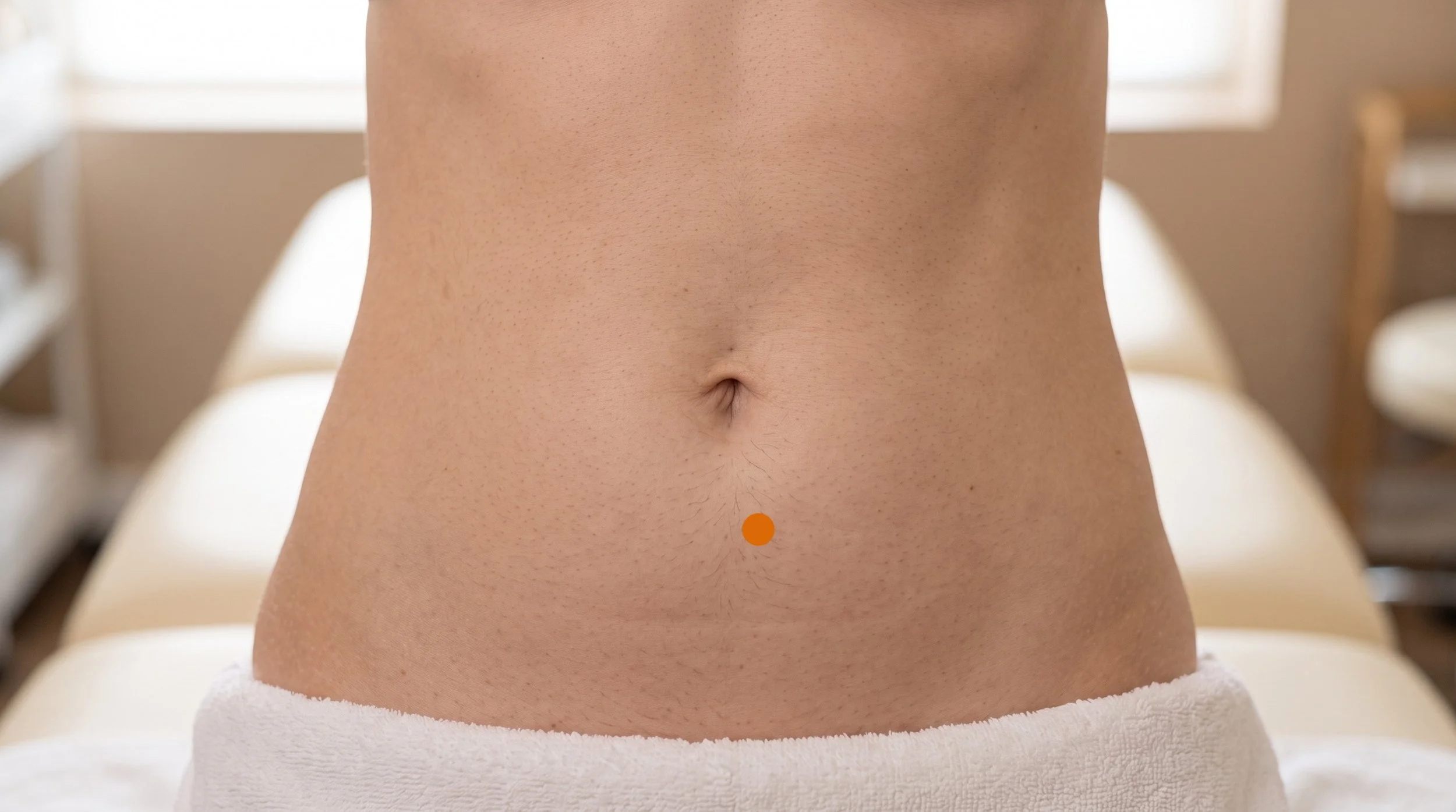
KI14 Acupuncture Point (Siman)
Four Fullnesses on the Lower Abdomen: Anatomy, Segmental Mechanism, and Why KI14 Sits at the Center of Menstrual and Lower Abdominal Pain Treatment
KI14 (Siman, translated as Four Fullnesses) is the fourth Kidney channel point on the lower abdomen, sitting 2 cun below the navel and just half a cun off the midline, immediately beside CV5. Classical texts list it as a meeting point of the Kidney channel with the Penetrating vessel (Chong mai), the vessel most closely tied in traditional theory to menstruation and pelvic blood (Deadman et al., 2000).
In plain terms, the ki14 acupuncture point lands on the belly of the rectus abdominis over the lower uterine and small intestinal region, which is exactly why it shows up so often in treatment plans for cramping period pain, postpartum abdominal pain, bloating and sluggish bowels. The point is small, superficially unremarkable, and clinically one of the more useful spots on the lower abdomen when needled carefully.
- Location and layers: kidney 14 sits 2 cun inferior to the umbilicus and 0.5 cun lateral to the midline, level with CV5, passing through skin, subcutaneous fat, the anterior rectus sheath and the rectus abdominis before reaching the parietal peritoneum (Deadman et al., 2000).
- Traditional categories, read neurophysiologically: the classical role of benefiting the lower jiao, moving stagnant blood and regulating the water passages maps onto modern language about segmental modulation of uterine, intestinal and bladder afferents plus local changes in blood flow (Uchida et al., 2017).
- Nerve story: the ki 14 abdomen location is supplied by the anterior cutaneous branches of the lower thoracoabdominal nerves (roughly T11 to T12), which enter the same spinal segments that receive sympathetic afferents from the uterus and lower gut through the hypogastric pathway (Uchida et al., 2017).
- Research picture: reviews of acupuncture for period pain remain cautious, with low certainty evidence overall (Smith et al., 2016), while a large sham controlled trial found that electroacupuncture including abdominal points increased complete spontaneous bowel movements in chronic severe functional constipation (Liu et al., 2016).
- Clinical framing: siman acupuncture is almost never used alone; it is typically one node in a lower abdominal cluster with CV points, distal leg points and, where appropriate, dry needling of the abdominal wall, since chronic pain trials test whole protocols rather than single points (Vickers et al., 2018).
- De qi: patients usually report a deep, spreading heaviness or a dull ache under the needle that can radiate toward the pubic bone or across the lower belly, a sensation associated with activation of small diameter afferents (Zhao, 2008).
Struggling With Period Pain or Cramping Below the Navel?
At Morningside Acupuncture we use KI14 as part of a lower abdominal treatment for menstrual cramping, pelvic heaviness and the deep aching that sits below the umbilicus. We combine it with distal points on the legs, warmth over the lower abdomen, and manual work on the abdominal wall when the muscle itself is guarded. Treatment is usually timed to the cycle, since many patients respond best when sessions are scheduled in the days before bleeding starts. Book a visit and we will build a plan around your cycle rather than a generic protocol.
Schedule NowAnatomy of KI14: Why the Lower Rectus Abdominis Beside CV5 Is Such an Important Location
KI14 lies on the lower abdominal wall, 2 cun below the umbilicus and 3 cun above the upper edge of the pubic symphysis, only 0.5 cun lateral to the midline and level with CV5 (Deadman et al., 2000). A needle here passes through skin and subcutaneous fat into the anterior layer of the rectus sheath and then into the medial fibers of the rectus abdominis. That muscle takes a constant load from sitting, bracing, coughing, postpartum recovery and post surgical scarring, and it commonly becomes tender and taut in exactly this lower segment. Because the point is so close to the linea alba, needle angle matters: the practitioner is aiming into muscle, not into the midline fascia.
The skin and muscle at this level are innervated by the anterior cutaneous branches of the lower thoracoabdominal nerves, roughly the T11 and T12 levels, with the umbilicus itself sitting near T10. Those same lower thoracic and upper lumbar segments receive visceral afferents from the uterus, the lower small intestine and the bladder through sympathetic pathways, so somatic and visceral inputs converge on shared dorsal horn neurons (Uchida et al., 2017).
Needling here can therefore influence how the nervous system processes signals coming from the pelvic organs, and repeated stimulation also recruits descending inhibitory control involving endogenous opioid and monoamine systems (Zhao, 2008). This is the modern explanation for why a point on the abdominal wall has traditionally been used for symptoms that are not in the abdominal wall at all.
Deep to the rectus abdominis lie the parietal peritoneum, loops of small intestine and, when full, the urinary bladder; the inferior epigastric vessels run in the deeper rectus sheath more laterally. Standard needling is perpendicular to about 1 to 1.5 cun, with the explicit caution that deep insertion may enter the peritoneal cavity (Deadman et al., 2000). Some modern manuals use a more conservative 0.5 to 1.0 cun depth and note that moxibustion is applicable here (Kim, 2015).
In practice, we ask patients to empty the bladder first, adjust depth to body habitus, and avoid abdominal needling entirely in pregnancy or over surgical hardware, hernia, or undiagnosed abdominal masses.
Related Rectus Abdominis Trigger Points Related Kidney ChannelKI14 at a Glance: Classification, Location, and Clinical Use
| Category | Detail |
|---|---|
| Traditional Name | Siman (Four Fullnesses), KI14, also written KID-14 or K-14 |
| Channel Classification | Kidney channel of the foot Shaoyin, fourth of the abdominal Kidney points |
| Point Categories | Meeting point of the Kidney channel with the Penetrating vessel (Chong mai); one of the Kidney channel points where the Penetrating vessel intersects, from KI11 to KI21; named for the four kinds of accumulation (qi, water, food and blood) |
| Precise Location | Lower abdomen, 2 cun below the umbilicus and 3 cun above the superior border of the pubic symphysis, 0.5 cun lateral to the midline, level with CV5 |
| Tissue Stimulated | Skin and subcutaneous tissue, anterior rectus sheath, and the medial fibers of the rectus abdominis; deeper fascia continuous with the transverse abdominis layer laterally |
| Needle Depth / Direction | Perpendicular insertion 1 to 1.5 cun in classical sources, with many modern texts using 0.5 to 1.0 cun; angle into muscle, not the midline; moxibustion is traditionally applicable |
| De Qi Sensation | Deep, dull heaviness or a spreading ache under the needle, sometimes traveling toward the pubic bone, the groin or across the lower belly; sharp or radiating sensation means the needle should be adjusted |
| Primary Clinical Uses | Lower abdominal pain and cutting pain below the navel, irregular menstruation and menstrual cramping, postpartum abdominal pain, abdominal distention and fluid retention, diarrhea and constipation |
| Common Point Combinations |
|
Deadman, Al-Khafaji and Baker note that the name Four Fullnesses has been read in more than one way, with one common interpretation pointing to four types of stagnation: qi, water, food and blood (Deadman et al., 2000). The classical indication lists do loosely honor that reading, with distention standing in for stuck qi, swelling and fluid retention for water, and bowel irregularity for food.
What is striking is how heavily the list tilts toward the fourth category. Traditional sources attribute to this point the treatment of cutting pain below the navel, retained lochia after childbirth, irregular bleeding and what older texts called malign blood, meaning blood that has escaped the vessels and settled rather than moving on. Other classical texts add cold accumulation in the uterus, vaginal discharge, seminal emission and turbid urinary discharge, along with a surging sensation rising from the lower abdomen known as running piglet qi (Deadman et al., 2000; Maciocia, 2006).
Read as a whole, the pattern is not four equal themes but one dominant one: a point traditionally reserved for pelvic pain that feels fixed, sharp and stubborn rather than diffuse.
Why KI14 Is Used for Menstrual Cramping That Feels Sharp and Fixed Below the Navel
The most useful modern explanation for a lower abdominal point like KI14 is convergence. Sensory nerves from the uterus and lower gut travel with sympathetic fibers into the lower thoracic and upper lumbar spinal segments, and the skin and muscle at the KI14 level feed into those same segments. When two inputs share dorsal horn territory, stimulating the somatic one can change how the visceral one is processed, which is the basis of the somatoautonomic and viscerosomatic reflexes studied in detail over the past half century (Uchida et al., 2017). That is also why menstrual pain so often refers to a band across the lower abdomen and into the low back rather than to a precise spot.
Alongside segmental effects, needling recruits descending inhibitory pathways from the brainstem that use endogenous opioids, serotonin and norepinephrine to dampen pain signaling, which helps explain why relief can outlast the session and why repeated treatments tend to build on each other (Zhao, 2008).
There is also a vascular side to the story. A small early study using Doppler measurement found reduced blood flow impedance in the uterine arteries after a course of electroacupuncture, a change the authors linked to reflex modulation of sympathetic tone rather than to any direct effect on the vessel itself (Stener-Victorin et al., 1996). That finding is small and non randomized, so it should be read as a plausible mechanism rather than as proof of clinical benefit.
Put together, this gives a reasonable account of the classical picture without invoking anything mystical. A point that traditionally moves stuck blood in the lower abdomen is, in modern terms, a point that sits in the right spinal segment to modulate uterine and intestinal afferents, that engages central pain inhibition, and that may shift local autonomic and vascular tone. Whether that translates into meaningful symptom change for any individual patient is a separate question, and one the research answers only partially.
What the Research Shows for KI14
It is worth being clear about what the evidence can and cannot say. No trial has tested KI14 in isolation, and almost none ever will, because acupuncture is delivered as a multi-point protocol shaped by examination. What the literature offers instead is evidence about protocols that frequently include lower abdominal points at or near this level, plus mechanistic work explaining how such points could plausibly act. The clinical results for menstrual pain are mixed and rated low in certainty, while the digestive evidence is somewhat stronger for specific conditions. The honest summary is that KI14 is a reasonable component of a treatment plan rather than a treatment in its own right.
| Study | Type | Focus | Key Finding |
|---|---|---|---|
| Smith et al., 2016 | Cochrane systematic review | Acupuncture and acupressure for primary dysmenorrhoea | The reviewers concluded there was insufficient evidence to determine whether acupuncture or acupressure helps period pain, with low or very low certainty across comparisons. |
| Liu et al., 2016 | Multicenter randomized sham-controlled trial (n = 1075) | Electroacupuncture, including abdominal points, for chronic severe functional constipation | Eight weeks of electroacupuncture increased complete spontaneous bowel movements compared with sham and was well tolerated, though longer-term follow up was not assessed. |
| Vickers et al., 2018 | Individual patient data meta-analysis | Acupuncture for chronic pain across musculoskeletal, headache and osteoarthritis conditions | Acupuncture was associated with modest but statistically significant benefit over sham and no-acupuncture controls, with effects persisting over time. |
| Uchida et al., 2017 | Narrative physiological review | Somatoautonomic reflexes underlying acupuncture effects on visceral function | The authors describe how somatic stimulation reaches autonomic efferents through spinal and supraspinal reflexes, while cautioning that most data come from anesthetized animals. |
| Stener-Victorin et al., 1996 | Small prospective non-randomized study | Uterine artery blood flow impedance after electroacupuncture | Pulsatility index in the uterine arteries fell after a course of treatment, suggesting a possible autonomic mechanism, though the sample was very small. |
| Zhao, 2008 | Mechanistic review | Neural mechanisms of acupuncture analgesia | Analgesic effects are attributed to afferent activation, segmental spinal modulation and descending inhibitory control involving opioid and monoamine systems. |
Bloating, Sluggish Digestion, or Lower Abdominal Distention?
The area around KI14 responds well to gentle, shallow to moderate needling when the lower abdomen feels tight, full or unresponsive after meals. We pair it with points that traditionally regulate the intestines and with autonomic focused work on the limbs, an approach supported by trials of abdominal electroacupuncture in constipation. Sessions include hands on assessment of the abdominal wall, because tight rectus abdominis fibers can mimic or amplify gut symptoms. Schedule an appointment to have your abdomen assessed properly.
Schedule NowKI14 in the Context of Trigger Point Work
KI14 sits directly over the lower rectus abdominis, and that overlap is clinically convenient. Trigger points in the lower rectus can refer pain across the lower abdomen in a horizontal band and are associated with symptoms that mimic visceral complaints, including cramping, bloating and a sense of fullness (Simons et al., 1999). When we palpate a taut, tender band at or near the KI14 level, we treat the muscle on its own terms: careful needling into the band, moderate depth, and attention to the twitch response rather than to a point coordinate. Because acupuncture and dry needling both use an acupuncture needle, this is a difference of reasoning, not of tool.
In a typical Morningside session for lower abdominal or menstrual pain, KI14 is combined with dry needling of the rectus abdominis and, when the lateral wall is involved, the internal and external obliques and the transverse abdominis. We add distal points on the legs for descending modulation, and we often finish with warmth over the lower abdomen. Patients with post surgical or postpartum abdominal walls get slower, shallower treatment, and scar tissue, hernia repairs and diastasis are assessed before any needle goes in.
KI14 Menstrual and Abdominal Pain Treatment at NYC's Highest-Rated Acupuncture Clinic
Morningside Acupuncture is the highest-rated acupuncture and dry needling clinic in New York City with over 500 five-star Google reviews. Our licensed acupuncturists treat menstrual pain, pelvic discomfort and functional digestive complaints with careful, evidence informed care that blends classical point selection with modern trigger point work. Every session includes a clear explanation of why each point, including KI14, was chosen for you. Schedule your visit today and start with a full evaluation.
Schedule NowFrequently Asked Questions
What does KI14 feel like when needled?
Most patients describe a deep, dull heaviness or a slow spreading ache under the needle, sometimes with a warm or sinking quality that travels toward the pubic bone or across the lower belly. Some feel a brief muscular twitch if the needle contacts a taut band in the rectus abdominis. It should not feel sharp, electric or burning; if it does, the needle needs to be withdrawn slightly or repositioned. Abdominal points often feel more sensitive than limb points simply because the area is guarded, so tell your practitioner if you are bracing.
Why needle the abdomen for menstrual pain instead of just the legs?
Both approaches are used, and most treatment plans include both. Local points such as KI14 sit in the same spinal segments (roughly T11 to L1) that receive sensory input from the uterus, so needling there can influence how those signals are processed through segmental convergence (Uchida et al., 2017). Distal leg points work more through descending inhibition and central mechanisms (Zhao, 2008). Combining the two gives you a local and a systemic route, which is how classical formulas and modern protocols alike are usually built.
Can I press KI14 myself between sessions?
Yes, acupressure here is straightforward and low risk for most people. Lie on your back with your knees bent so the abdominal wall softens, find the spot two thumb widths below your navel and a fingertip width off the midline, then press straight in with the pad of your index or middle finger using slow, moderate pressure. Hold for 30 to 60 seconds, breathing normally, then release and repeat two or three times per side, up to a few times a day. A warm compress over the lower abdomen first often makes it more comfortable. Skip it if you are pregnant, if the area is sharply painful, if you have an undiagnosed abdominal mass, or after recent abdominal surgery.
Is KI14 safe to needle?
In trained hands, yes, but it requires respect. Classical texts explicitly caution that deep needling may penetrate the peritoneal cavity, and standard depth is 1 to 1.5 cun with many practitioners staying shallower depending on body type (Deadman et al., 2000). We ask patients to empty the bladder first, since a full bladder rises above the pubic bone toward this level. Abdominal needling is avoided in pregnancy, over hernias, over surgical mesh or hardware, and in anyone with an undiagnosed abdominal mass or acute abdominal pain that needs medical evaluation. Choose a licensed acupuncturist rather than attempting this at home.
Where exactly is KI14 located?
On the lower abdomen, 2 cun (about two thumb widths) below the center of the umbilicus and 3 cun above the top edge of the pubic symphysis, 0.5 cun lateral to the midline on either side. It is level with CV5 on the midline, which makes CV5 the easiest landmark: find that point, then move a fingertip width to the side. KI14 is the fourth of the Kidney channel points running up the lower abdomen, sitting between KI13 below and KI15 above (Deadman et al., 2000).
References
- Deadman, P., Al-Khafaji, M., & Baker, K. (2009). A manual of acupuncture. Journal of Chinese Medicine Publications.
- Maciocia, G. (2005). The foundations of Chinese medicine: A comprehensive text for acupuncturists and herbalists (2nd ed.). Elsevier Churchill Livingstone.
- Maciocia, G. (2006). The channels of acupuncture: Clinical use of the secondary channels and eight extraordinary vessels. Churchill Livingstone Elsevier.
- O'Connor, J., & Bensky, D. (Eds. & Trans.). (1981). Acupuncture: A comprehensive text. Shanghai College of Traditional Medicine. Eastland Press.
- Kim, H. (2008). Handbook of Oriental medicine (3rd ed.). Harmony & Balance Press.
- Cunningham, P. M. (2000). Acupuncture points: A practical guide to classical and modern usage. Odyssey Press.
- Simons, D. G., Travell, J. G., & Simons, L. S. (1999). Travell & Simons' myofascial pain and dysfunction: The trigger point manual, Vol. 1: Upper half of body (2nd ed.). Williams & Wilkins.
- Smith, C. A., Armour, M., Zhu, X., Li, X., Lu, Z. Y., & Song, J. (2016). Acupuncture for dysmenorrhoea. Cochrane Database of Systematic Reviews, 2016(4), CD007854. https://doi.org/10.1002/14651858.CD007854.pub3 [VERIFY BEFORE PUBLISHING]
- Liu, Z., Yan, S., Wu, J., He, L., Li, N., Dong, G., Fang, J., Fu, W., Fu, L., Sun, J., Wang, L., Wang, S., Yang, J., Zhang, H., Zhang, J., Zhao, J., Zhou, W., Zhou, Z., Ai, Y., Zhou, K., Liu, J., Xu, H., Cai, Y., & Liu, B. (2016). Acupuncture for chronic severe functional constipation: A randomized trial. Annals of Internal Medicine, 165(11), 761-769. https://doi.org/10.7326/M15-3118
- Uchida, S., Kagitani, F., & Sato-Suzuki, I. (2017). Somatoautonomic reflexes in acupuncture therapy: A review. Autonomic Neuroscience: Basic and Clinical, 203, 1-8. https://doi.org/10.1016/j.autneu.2016.11.001
- Stener-Victorin, E., Waldenström, U., Andersson, S. A., & Wikland, M. (1996). Reduction of blood flow impedance in the uterine arteries of infertile women with electro-acupuncture. Human Reproduction, 11(6), 1314-1317. https://doi.org/10.1093/oxfordjournals.humrep.a019378
- Zhao, Z. Q. (2008). Neural mechanism underlying acupuncture analgesia. Progress in Neurobiology, 85(4), 355-375. https://doi.org/10.1016/j.pneurobio.2008.05.004
- Vickers, A. J., Vertosick, E. A., Lewith, G., MacPherson, H., Foster, N. E., Sherman, K. J., Irnich, D., Witt, C. M., & Linde, K. (2018). Acupuncture for chronic pain: Update of an individual patient data meta-analysis. Journal of Pain, 19(5), 455-474. https://doi.org/10.1016/j.jpain.2017.11.005
Disclaimer: This web site is intended for educational and informational purposes only. Reading this website does not constitute providing medical advice or any professional services. This information should not be used for diagnosing or treating any health issue or disease. Those seeking medical advice should consult with a licensed physician. Seek the advice of a medical doctor or other qualified health professional for any medical condition. If you think you have a medical emergency, call 911 or go to the emergency room. No acupuncturist-patient relationship is created by reading this website or using the information. Morningside Acupuncture PLLC and its employees and contributors do not make any express or implied representations with respect to the information on this site or its use. For any legal interpretation of scope of practice in your state, consult a licensed attorney or regulatory authority.
Read more from our blog



