KI13 Acupuncture Point (Qixue)
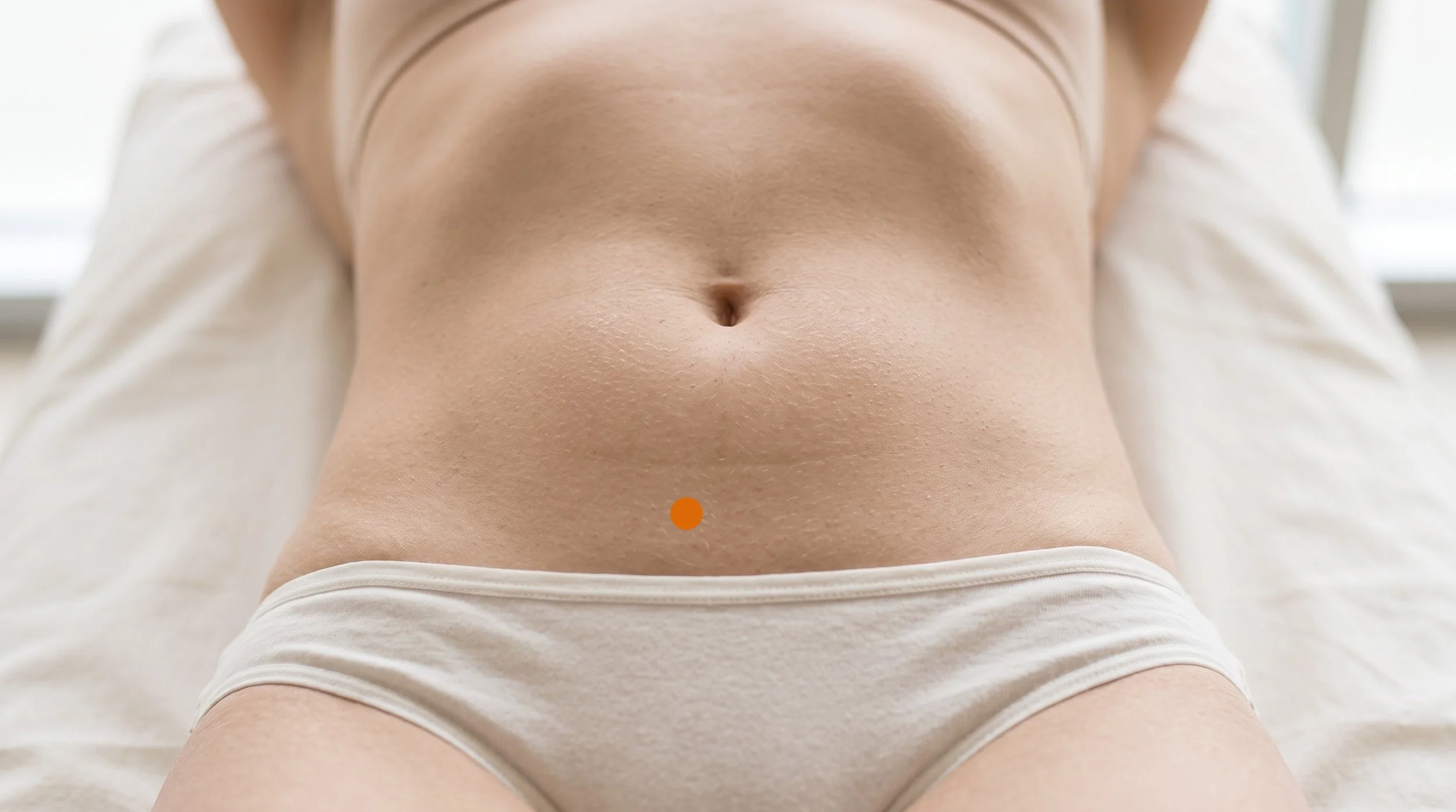
KI13 Acupuncture Point (Qixue)
The Qi Cave Beside the Lower Abdomen's Midline: Anatomy, Mechanism, and Why This Kidney and Penetrating Vessel Point Anchors Menstrual, Fertility, and Lower Abdominal Treatment
KI13, known in Chinese as Qixue and usually translated as Qi Cave or Qi Hole, sits low on the belly, three cun below the navel and only half a cun off the midline, right beside CV4 and about two cun above the top of the pubic bone. It's one of the abdominal points where the Kidney channel is classically described as meeting the Penetrating vessel, and that double membership is exactly why the ki13 acupuncture point shows up so often in menstrual, fertility, urinary, and lower abdominal treatment plans.
In modern terms, this is soft tissue over the medial edge of the rectus abdominis in a segmental neighborhood (roughly T10 to L1) that the uterus, bladder, and lower lumbar structures also report into, which gives a clean neurophysiological reason why a needle here can influence far more than skin and muscle.
- Location and layers: kidney 13 lies 3 cun below the umbilicus and 0.5 cun lateral to the midline, level with CV4, so the needle passes through skin, subcutaneous fat, the anterior rectus sheath, and the medial fibers of the rectus abdominis before reaching the deeper abdominal wall.
- Traditional attributions: classical sources credit Qixue with regulating the Penetrating and Conception vessels and the lower burner, supporting Kidney qi, and treating amenorrhea, irregular menstruation, uterine bleeding, leucorrhea, infertility, difficult urination, chronic diarrhea, abdominal pain, lumbar pain, and the striking presentation called running piglet qi.
- Mechanism: the ki 13 abdomen location shares spinal segments with pelvic viscera, so needling here is best explained by somatic input converging on the same dorsal horn neurons that receive visceral afferents, with reflex changes in sympathetic outflow rather than by any literal flow of energy (Zhao, 2008).
- Vascular and autonomic plausibility: an early Doppler study reported that repeated electroacupuncture, including abdominal and segmentally related points, was followed by lower uterine artery pulsatility in infertile women, a finding the authors attributed to reduced sympathetic vasoconstrictor tone (Stener-Victorin et al., 1996).
- Research picture: reviews of acupuncture in reproductive medicine test whole protocols rather than single points, and results are mixed, with a Cochrane review finding no clear benefit of acupuncture as an IVF adjunct (Cheong et al., 2013) while a separate Cochrane review of dysmenorrhea judged the evidence too low in quality for firm conclusions (Smith et al., 2016).
- De qi and practice framing: patients usually describe a dull, heavy, spreading fullness low in the belly rather than sharpness, and because a full bladder sits directly beneath this territory, we ask patients to empty the bladder before any lower abdominal needling.
Struggling With Irregular Cycles, Cramping, or Fertility Concerns?
At Morningside Acupuncture we use KI13 as part of a lower abdominal strategy alongside CV4, SP6, and lumbar points, chosen for your cycle pattern rather than pulled from a template. Treatment is gentle, the depth is conservative, and we coordinate with your OB-GYN or reproductive endocrinologist when you're in an active IVF or IUI cycle. Many patients pair in-clinic sessions with simple at-home warmth and breathing work between visits. Schedule a visit and we'll map out a plan built around your cycle.
Schedule NowAnatomy of KI13: Why the Lower Abdomen Beside CV4 Is Such an Important Location
Working from the surface down, the needle at KI13 meets skin and a variable layer of subcutaneous fat, then the anterior rectus sheath, then the medial fibers of the rectus abdominis, and below that the posterior sheath (largely absent this low), transversalis fascia, extraperitoneal fat, and peritoneum. The rectus abdominis in this lower region is loaded constantly: it stabilizes the trunk during sitting, lifting, and coughing, it shortens under desk posture, and it takes a beating after pregnancy, abdominal surgery, or heavy core training.
That tissue history matters, because taut, tender lower rectus fibers can themselves refer discomfort across the low belly and into the low back in patterns described in the myofascial literature (Simons et al., 1999), and those patterns can be confused with pelvic or urinary complaints.
The nerve geography here is the real story. Skin and muscle at this level are supplied by the lower intercostal and subcostal branches (roughly T10 to T12) with contributions from the iliohypogastric nerve (L1), while the uterus, bladder trigone, and adjacent pelvic structures send sympathetic afferents up through the hypogastric plexuses into the same lower thoracic and upper lumbar segments.
When those somatic and visceral inputs converge on shared dorsal horn neurons, a needle in the abdominal wall becomes a way to modulate processing for the whole segment, which is the standard neurophysiological account of both local and visceral acupuncture effects (Zhao, 2008). The same input engages spinal and supraspinal circuits that release endogenous opioids and recruit descending inhibition from the midbrain and brainstem, a mechanism supported by decades of experimental work (Zhao, 2008) and reflected clinically in pooled individual patient data on chronic pain (Vickers et al., 2018).
Deep to the point, the structures that demand respect are the bladder when it's distended, the peritoneum and underlying bowel in very lean patients, and, more laterally, the inferior epigastric vessels running behind the rectus. Because KI13 sits only half a cun off the midline, it stays medial to those vessels, but depth control still governs safety. Standard practice is perpendicular insertion of about 0.5 to 1 cun, with the caution repeated in Deadman's point manual that deep needling can reach a full bladder, so the bladder should be emptied first.
Angle and depth get reduced further in thin patients, and lower abdominal points are avoided or handled only by an experienced practitioner during pregnancy.
Related Kidney Channel Related Rectus Abdominis Trigger PointsKI13 at a Glance: Classification, Location, and Clinical Use
| Category | Detail |
|---|---|
| Traditional Name | Qixue (Qi Cave or Qi Hole); alternative names Baomen (Gate of the Uterus) and Zihu (Child's Door) appear in many classical texts, though the Supplement to the Thousand Ducat Formulas assigns those names to ST28 instead |
| Channel Classification | Kidney channel of Foot Shaoyin, thirteenth point, on the lower abdomen beside the Conception vessel |
| Point Categories | Meeting point of the Kidney channel with the Penetrating vessel (Chong mai), listed among the abdominal Chong mai intersection points that run from KI11 through KI21; not a five-shu, yuan, luo, xi, or hui-meeting point |
| Precise Location | Lower abdomen, 3 cun below the center of the umbilicus and 2 cun above the superior border of the pubic symphysis, 0.5 cun lateral to the anterior midline, level with CV4 (Guanyuan) |
| Tissue Stimulated | Skin, subcutaneous fat, anterior rectus sheath, and medial fibers of the rectus abdominis, with the transverse abdominis and abdominal obliques forming the adjacent wall; innervation from lower intercostal, subcostal, and iliohypogastric branches (approximately T10 to L1) |
| Needle Depth / Direction | Perpendicular insertion 0.5 to 1 cun; shallower in lean patients; the bladder must be emptied before treatment because deep insertion can penetrate a full bladder; moxibustion is traditionally applied here |
| De Qi Sensation | A dull, heavy, distending fullness that spreads across the lower abdomen and sometimes travels toward the pubic bone or groin, occasionally with a warm or drawing quality; sharp or electric sensations mean the needle should be adjusted |
| Primary Clinical Uses | Traditionally used for amenorrhea, irregular menstruation, uterine bleeding, leucorrhea, and infertility, plus difficult urination, chronic diarrhea, lower abdominal pain, lumbar pain, and the classical picture of running piglet qi |
| Common Point Combinations |
|
Deadman's point manual presents Qixue as a Kidney channel point that meets the Penetrating vessel, with traditional actions of regulating the Penetrating and Conception vessels and the lower burner, and a classical indication list that runs from amenorrhea, irregular menstruation, uterine bleeding, leucorrhea, and infertility to difficult urination, persistent diarrhea, abdominal pain, lumbar pain, and even redness of the eye starting at the inner canthus.
Other texts add related traditional framing: Kim's manual describes it as tonifying the Kidneys and nourishing Essence, Cunningham groups it with cold lower abdomen and infertility presentations, and Maciocia includes it in a protocol for what is traditionally called Kidney qi not firm.
The commentary that stands out most, though, concerns running piglet qi, a disorder described in the Essentials from the Golden Cabinet as a violent surge rising from the lower abdomen toward the throat, arriving in waves and often provoked by fright, and classified in the Classic of Difficulties among accumulations belonging to the Kidneys.
What makes the pattern striking is how recognizable it remains: a fear-triggered wave of sensation climbing the trunk with a sense of impending doom is language a modern clinician would associate with panic and autonomic arousal, and the classical response was to needle the lower abdomen where that surge was said to begin.
Why KI13 Is Used for Low Back Pain and Rushing Sensations Up the Trunk
Patients are often surprised that a point on the belly appears in classical lists for lumbar pain. The segmental picture explains it without any appeal to mysterious channels. The abdominal wall at this level and the lower lumbar structures draw innervation from overlapping lower thoracic and upper lumbar segments, and the pelvic organs feed afferent traffic into the same segments through the hypogastric plexuses.
When several inputs converge on the same dorsal horn neurons, the nervous system's map of front and back at that level is effectively shared, so stimulating the abdominal wall can change how the whole segment behaves (Zhao, 2008). Maciocia's channel text makes a similar observation from the classical side, noting that KI12 and KI13 both carry backache among their indications and describing a horizontal relationship between the lower abdomen and the lumbar Back-Shu points.
Beyond the segment, needling recruits ascending pathways that engage midbrain and brainstem circuits and release endogenous opioids, producing descending inhibition that dampens pain signaling more broadly (Zhao, 2008). Pooled individual patient data from nearly 21,000 patients in chronic pain trials found acupuncture superior to both sham and no-acupuncture controls, with effects that persisted over time, which supports the idea that these mechanisms are doing real clinical work even if the effect size is modest (Vickers et al., 2018).
For the abdomen specifically, there's also a vascular and autonomic angle: an early Doppler study of infertile women reported reduced uterine artery pulsatility after a course of electroacupuncture, which the authors interpreted as decreased sympathetic vasoconstrictor tone rather than a direct effect on the vessel wall (Stener-Victorin et al., 1996).
That autonomic framing is also the most sensible modern reading of running piglet qi. A rushing, upward-surging sensation that arrives suddenly, peaks, and fades, often triggered by fear, maps onto sympathetic arousal and interoceptive amplification far more comfortably than it maps onto anything anatomical. Needling the lower abdomen in a quiet room, with slow breathing and a warm, heavy de qi sensation settling below the navel, is a reasonable way to shift autonomic tone and redirect attention toward the belly instead of the throat.
We frame this to patients as calming a nervous system response, not as moving qi, and we're careful to rule out cardiac, thyroid, and psychiatric causes before treating a surging sensation as a purely functional complaint.
What the Research Shows for KI13
There's no trial that isolates KI13, and that's true of nearly every individual acupuncture point. Reproductive and menstrual studies test multi-point protocols in which lower abdominal points such as KI13, CV4, and CV6 typically appear alongside distal points like SP6 and ST36, so the fair conclusion is about the protocol, not the point. The evidence in this area is also genuinely mixed: some reviews report modest symptom benefit, a large randomized trial found no live birth advantage in one specific population, and a Cochrane review of IVF adjunct acupuncture found no clear effect on pregnancy outcomes.
We share that mixed picture openly with patients so expectations stay realistic, and we treat symptom relief, cycle comfort, sleep, and stress as the outcomes most likely to change.
| Study | Type | Focus | Key Finding |
|---|---|---|---|
| Cheong et al., 2013 | Cochrane systematic review | Acupuncture as an adjunct to assisted reproductive technology cycles | Pooled data across 20 randomized trials did not show clear evidence that acupuncture improves live birth or pregnancy rates in IVF, and the authors highlighted variability in protocols and controls. |
| Smith et al., 2016 | Cochrane systematic review | Acupuncture and acupressure for dysmenorrhea | Reviewers judged the overall quality of evidence very low, so no reliable conclusion could be drawn about acupuncture for period pain despite some positive individual trials. |
| Woo et al., 2018 | Systematic review and meta-analysis | Acupuncture for primary dysmenorrhea | Pooled results suggested acupuncture may reduce menstrual pain intensity compared with control conditions, though the included trials were small and at risk of bias. |
| Wu et al., 2017 | Multicenter randomized clinical trial | Acupuncture with or without clomiphene for live birth in women with polycystic ovary syndrome | Active acupuncture did not increase live birth rates compared with control acupuncture, a result that argues against treating acupuncture as a stand-alone fertility intervention in this population. |
| Stener-Victorin et al., 1996 | Prospective physiological study | Uterine artery blood flow impedance after electroacupuncture in infertile women | Pulsatility index in the uterine arteries fell after a course of electroacupuncture, which the authors attributed to reduced sympathetic vasoconstrictor activity. |
| Vickers et al., 2018 | Individual patient data meta-analysis | Acupuncture for chronic pain across roughly 21,000 patients | Acupuncture outperformed both sham and no-acupuncture controls with effects that persisted over time, supporting a real but modest treatment effect. |
| Zhao, 2008 | Narrative review of experimental neuroscience | Neural mechanisms of acupuncture analgesia | Needle stimulation activates spinal and supraspinal circuits, engaging endogenous opioid systems and descending inhibitory pathways that modulate pain and autonomic output. |
Lower Abdominal Heaviness, Bladder Pressure, or Nagging Low Back Ache?
The qixue fertility point sits in the same segmental territory that reports pelvic and lower lumbar complaints, which is why we often needle the lower abdomen and the low back in the same session. We combine KI13 and its neighbors with BL23, targeted dry needling of the abdominal wall and paraspinals, and manual therapy where it helps. You get a clear explanation of what we're treating and why. Book an evaluation and we'll assess the abdominal wall and lumbar spine together.
Schedule NowKI13 in the Context of Trigger Point Work
Acupuncture, as we define it, is the use of an acupuncture needle, and that includes the hundreds of styles practiced worldwide as well as dry needling. At KI13 the two frameworks land on nearly identical tissue. The classical point sits over the medial fibers of the lower rectus abdominis, and taut bands in that same region can produce lower abdominal aching, a sense of bladder or pelvic pressure, and referral into the low back, patterns documented in the trigger point literature (Simons et al., 1999).
When a patient reports lower abdominal discomfort that worsens with sitting, coughing, or core work, we palpate the rectus and the adjacent oblique and transverse abdominis layers before assuming the problem is visceral.
In practice we often combine a shallow, conservative needle at KI13 and CV4 with dry needling of tender points in the rectus abdominis and, when indicated, the external oblique and transverse abdominis, then add lumbar paraspinal work at the BL23 level to address the segment from both sides. Depth stays modest across the abdominal wall, the bladder is emptied first, and we skip abdominal needling entirely in pregnancy or when there's any red flag for acute abdominal pathology.
Patients who've had cesarean delivery, laparoscopy, or hernia repair frequently have scar-related restriction in this area, and treating the wall alongside the classical points often does more for lower abdominal heaviness than either approach alone.
KI13 Fertility and Menstrual Health Treatment at NYC's Highest-Rated Acupuncture Clinic
Morningside Acupuncture is the highest-rated acupuncture and dry needling clinic in New York City with over 500 five-star Google reviews, and our Midtown practice treats reproductive health, pelvic discomfort, and stress-related tension every week. We combine classical point selection such as KI13 with CV4, SP6, and BL23 with a modern understanding of segmental innervation and myofascial pain. Sessions are unhurried, hygienic, and documented so you can see how your response changes over a course of care. Schedule your first appointment and let's start with a thorough intake.
Schedule NowFrequently Asked Questions
What does KI13 feel like when needled?
Most patients describe a dull, heavy fullness low in the abdomen that spreads a little toward the pubic bone or groin, sometimes with a warm or drawing quality. It shouldn't be sharp, burning, or electric; if it is, the needle needs adjusting. The sensation usually settles within seconds and many people find lower abdominal needling relaxing, occasionally to the point of falling asleep, which is consistent with a shift toward parasympathetic tone.
Why needle the abdomen for menstrual or urinary problems instead of just the low back?
Because both the abdominal wall and the pelvic organs report into the same lower thoracic and upper lumbar spinal segments, a needle in the lower abdomen and one in the lumbar spine are effectively addressing the same neurological neighborhood from opposite sides (Zhao, 2008). Classical practice arrived at a similar conclusion from a different direction, pairing lower abdominal points like KI13 with lumbar Back-Shu points such as BL23. In the clinic we often use both, since the combination covers the segment more completely than either alone.
Can I press KI13 myself between sessions?
Yes, and it's an easy point to find. Lie on your back with knees bent so the abdominal wall softens, then measure roughly four finger widths straight down from the navel and move a thumb width off the midline to either side, which puts you at the level of CV4 and about halfway between the navel and the pubic bone. Press with two fingertips at a comfortable, moderate depth for 30 to 60 seconds while breathing slowly into the belly, release, and repeat two or three times per side. A warm compress or heating pad over the lower abdomen for 10 to 15 minutes is often more comfortable than pressure and works well before or during a period. Empty your bladder first, stop if the pressure feels sharp or increases pain, and skip abdominal self-massage entirely if you're pregnant, recently post-surgical, or dealing with undiagnosed abdominal pain.
Is KI13 safe to needle?
In trained hands, yes, with specific precautions. The main one is depth: a full bladder rises out of the pelvis and can be reached by a deep needle here, so the bladder should be emptied before treatment and insertion is kept to roughly 0.5 to 1 cun, less in lean patients. Lower abdominal points are avoided during pregnancy, and needling is postponed over active infection, unhealed surgical sites, hernias, or any acute abdomen that hasn't been medically evaluated. Anyone using acupuncture alongside fertility treatment should tell both their acupuncturist and their reproductive care team so timing can be coordinated.
Where exactly is KI13 located?
KI13 is on the lower abdomen, 3 cun below the center of the navel and 2 cun above the upper border of the pubic symphysis, 0.5 cun lateral to the midline on either side. That places it level with CV4 (Guanyuan) and immediately beside it, in the same vertical line as the other lower Kidney channel abdominal points KI11 through KI16. Using your own body proportions, the distance from navel to pubic bone is measured as 5 cun, so KI13 sits three fifths of the way down that line, just off center.
References
- Deadman, P., Al-Khafaji, M., & Baker, K. (2009). A manual of acupuncture. Journal of Chinese Medicine Publications.
- Maciocia, G. (2005). The foundations of Chinese medicine: A comprehensive text for acupuncturists and herbalists (2nd ed.). Elsevier Churchill Livingstone.
- Maciocia, G. (2006). The channels of acupuncture: Clinical use of the secondary channels and eight extraordinary vessels. Churchill Livingstone Elsevier.
- Cunningham, P. M. (2000). Acupuncture points: A practical guide to classical and modern usage. Odyssey Press.
- Kim, H. (2008). Handbook of Oriental medicine (3rd ed.). Harmony & Balance Press.
- O'Connor, J., & Bensky, D. (Eds. & Trans.). (1981). Acupuncture: A comprehensive text. Shanghai College of Traditional Medicine. Eastland Press.
- Simons, D. G., Travell, J. G., & Simons, L. S. (1999). Travell & Simons' myofascial pain and dysfunction: The trigger point manual, Vol. 1: Upper half of body (2nd ed.). Williams & Wilkins.
- Cheong, Y. C., Dix, S., Hung Yu Ng, E., Ledger, W. L., & Farquhar, C. (2013). Acupuncture and assisted reproductive technology. Cochrane Database of Systematic Reviews, 2013(7), CD006920. https://doi.org/10.1002/14651858.CD006920.pub3
- Smith, C. A., Armour, M., Zhu, X., Li, X., Lu, Z. Y., & Song, J. (2016). Acupuncture for dysmenorrhoea. Cochrane Database of Systematic Reviews, 2016(4), CD007854. https://doi.org/10.1002/14651858.CD007854.pub3 [VERIFY BEFORE PUBLISHING]
- Woo, H. L., Ji, H. R., Pak, Y. K., Lee, H., Heo, S. J., Lee, J. M., & Park, K. S. (2018). The efficacy and safety of acupuncture in women with primary dysmenorrhea: A systematic review and meta-analysis. Medicine, 97(23), e11007. https://doi.org/10.1097/MD.0000000000011007
- Wu, X. K., Stener-Victorin, E., Kuang, H. Y., Ma, H. L., Gao, J. S., Xie, L. Z., et al. (2017). Effect of acupuncture and clomiphene in Chinese women with polycystic ovary syndrome: A randomized clinical trial. JAMA, 317(24), 2502-2514. https://doi.org/10.1001/jama.2017.7217
- Stener-Victorin, E., Waldenström, U., Andersson, S. A., & Wikland, M. (1996). Reduction of blood flow impedance in the uterine arteries of infertile women with electro-acupuncture. Human Reproduction, 11(6), 1314-1317. https://doi.org/10.1093/oxfordjournals.humrep.a019378
- Zhao, Z. Q. (2008). Neural mechanism underlying acupuncture analgesia. Progress in Neurobiology, 85(4), 355-375. https://doi.org/10.1016/j.pneurobio.2008.05.004
- Vickers, A. J., Vertosick, E. A., Lewith, G., MacPherson, H., Foster, N. E., Sherman, K. J., Irnich, D., Witt, C. M., & Linde, K. (2018). Acupuncture for chronic pain: Update of an individual patient data meta-analysis. Journal of Pain, 19(5), 455-474. https://doi.org/10.1016/j.jpain.2017.11.005
Disclaimer: This web site is intended for educational and informational purposes only. Reading this website does not constitute providing medical advice or any professional services. This information should not be used for diagnosing or treating any health issue or disease. Those seeking medical advice should consult with a licensed physician. Seek the advice of a medical doctor or other qualified health professional for any medical condition. If you think you have a medical emergency, call 911 or go to the emergency room. No acupuncturist-patient relationship is created by reading this website or using the information. Morningside Acupuncture PLLC and its employees and contributors do not make any express or implied representations with respect to the information on this site or its use. For any legal interpretation of scope of practice in your state, consult a licensed attorney or regulatory authority.
Read more from our blog



