KI16 Acupuncture Point (Huangshu)
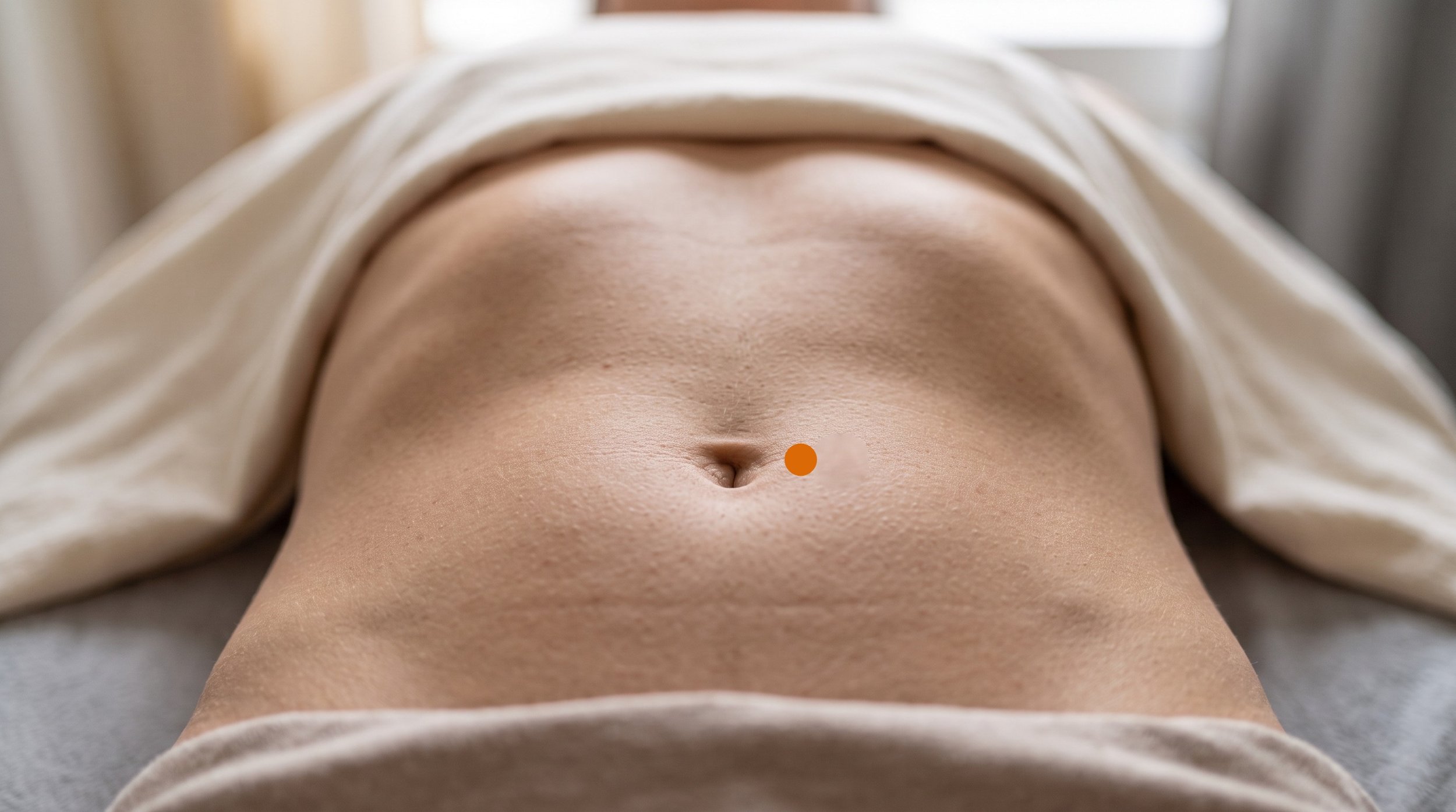
KI16 Acupuncture Point (Huangshu)
The Vitals Transport Point Beside the Navel: Anatomy, Segmental Mechanism, and Why This Abdominal Kidney Point Anchors Digestive Treatment
KI16 (Huangshu, often translated as Vitals Shu or the transporting point of the huang) sits on the abdomen just half a cun to the side of the center of the umbilicus, which places the needle in the medial fibers of the rectus abdominis at roughly the level of the tenth thoracic dermatome. It belongs to the Kidney channel and is classically listed as a meeting point of that channel with the Penetrating vessel (Chong mai), which is why the classical literature gives it a broader digestive and abdominal role than its position on the Kidney line alone would suggest (Deadman et al., 2007).
For clinicians, the ki16 acupuncture point matters because it lands in the same neurological neighborhood as the small and large intestine, so it is one of the most direct local options for constipation, cramping abdominal pain, borborygmus and cold, distended bellies that do not respond well to distal points alone.
- Location and layers: KI16 is 0.5 cun lateral to the middle of the umbilicus, so the needle passes through skin, subcutaneous fat, the anterior rectus sheath and the medial edge of the rectus abdominis before reaching the deeper fascial planes (Deadman et al., 2007). It sits level with CV8, ST25 and SP15, a row of points that classical texts credit with strong effects on the intestines.
- Traditional categories, read neurophysiologically: the Kidney and Penetrating vessel meeting status and the listed traditional actions of regulating qi, easing pain and warming the intestines describe, in modern terms, a local abdominal point used to modulate visceral sensation and gut motor activity through segmental reflexes (Deadman et al., 2007; Uchida et al., 2017).
- Nerve story: the umbilical region is supplied by the anterior cutaneous branch of the tenth intercostal nerve, and midgut viscera send afferents into the same lower thoracic cord segments, so needling here and visceral input converge on shared dorsal horn neurons (Uchida et al., 2017; Zhang et al., 2022).
- Mechanism evidence: experimental work shows that stimulating the abdominal wall changes intestinal motor activity through a spinal reflex with a sympathetic efferent limb, and that abdominal electroacupuncture can inhibit jejunal motility in an intensity dependent way involving sympathetic pathways and TRPV1 (Koizumi et al., 1980; Yu et al., 2016).
- Research picture: a large sham controlled trial found that eight weeks of electroacupuncture, including abdominal points, increased complete spontaneous bowel movements in chronic severe functional constipation, while a Cochrane review of acupuncture for irritable bowel syndrome found no benefit over sham despite improvements over some drug comparators (Liu et al., 2016; Manheimer et al., 2012). Neither result isolates KI16 itself.
- De qi and practice framing: patients usually report a heavy, dull, spreading fullness around the navel, sometimes with warmth or audible gurgling, and needling is kept shallow to moderate because deep insertion may reach the peritoneal cavity (Deadman et al., 2007).
Struggling With Constipation, Bloating or Cramping Abdominal Pain?
At Morningside Acupuncture we treat stubborn digestive complaints with a plan rather than a single point, and KI16 is frequently part of that plan when the discomfort is centered around the navel. We combine gentle abdominal needling with distal points, moxibustion when the belly feels cold, and hands on assessment of the abdominal wall itself. Many patients notice changes in bowel regularity and abdominal comfort within a few weeks of consistent care. Schedule a visit and let us build a protocol around your pattern.
Schedule NowAnatomy of KI16: Why the Rim of the Umbilicus Is Such an Important Location
KI16 lies just half a cun lateral to the center of the umbilicus, which in most adults places the needle at the medial border or medial fibers of the rectus abdominis, immediately lateral to the linea alba (Deadman et al., 2007). The tissue stack is short and predictable: skin, a variable layer of subcutaneous fat, the anterior rectus sheath, then the muscle itself. This region is loaded constantly by breathing mechanics, trunk flexion, coughing and abdominal bracing, and it is also where scar tissue accumulates after laparoscopic port sites, hernia repairs and pregnancy related changes to the linea alba.
Tenderness at KI16 is common in people with chronic bloating, and it is worth distinguishing whether the sore spot is skin, muscle, scar or a reflection of what is happening underneath.
The nerve geography is the reason this point is used for gut complaints. The skin and muscle around the umbilicus are supplied by the anterior cutaneous branch of the tenth intercostal nerve, and visceral afferents from the small intestine and proximal colon travel with the splanchnic nerves into the same lower thoracic and upper lumbar cord segments. Neural tracing work at the neighboring abdominal point ST25 found overlapping dorsal root ganglion labeling with the colon across roughly the T8 to L1 segments, along with associated sympathetic postganglionic neurons (Zhang et al., 2022).
That anatomical overlap is what allows somatic input at the abdominal wall to influence visceral output, a pathway described as the somatoautonomic reflex (Uchida et al., 2017). Needling also recruits A-delta and C fiber afferents that engage descending inhibitory control and endogenous opioid mediated analgesia at spinal and supraspinal levels (Zhao et al., 2008).
Deeper structures set the safety limits. Below the muscle and transversalis fascia sit the peritoneum and loops of small bowel, and the inferior epigastric vessels run within the rectus sheath lateral to the point.
Deadman gives perpendicular insertion of 1 to 1.5 cun with an explicit caution that deep needling may penetrate the peritoneal cavity, while other texts are more conservative at roughly 0.5 to 1 cun (Deadman et al., 2007; Kim, 2015).
In practice, depth is scaled to body habitus, the needle is angled perpendicular rather than obliquely toward the midline, and the point is avoided or replaced with moxibustion or acupressure in pregnancy, over an umbilical hernia, over recent surgical sites, or in anyone with significant abdominal distension. Any acute abdomen or unexplained change in bowel habit needs medical evaluation first.
Related Rectus Abdominis Trigger Points Related Kidney ChannelKI16 at a Glance: Classification, Location, and Clinical Use
| Category | Detail |
|---|---|
| Traditional Name | Huangshu (Vitals Shu, also translated as the transporting point of the huang or membranes) |
| Channel Classification | Kidney channel of Foot Shaoyin, sixteenth point, on the abdomen |
| Point Categories | Meeting point of the Kidney channel with the Penetrating vessel (Chong mai); one of the row of points level with the umbilicus that includes CV8, ST25 and SP15 |
| Precise Location | On the abdomen, 0.5 cun lateral to the center of the umbilicus, level with CV8 |
| Tissue Stimulated | Skin of the T10 dermatome, subcutaneous fat, anterior rectus sheath and the medial fibers of the rectus abdominis, with the deeper abdominal wall including the transverse abdominis and abdominal obliques often treated in the same session |
| Needle Depth / Direction | Perpendicular insertion, commonly 0.5 to 1.5 cun depending on body habitus and text consulted; do not needle deeply, since deep insertion may penetrate the peritoneal cavity |
| De Qi Sensation | Heavy, dull, spreading fullness around the navel, sometimes with warmth, a mild tugging feeling deep in the belly, or audible gurgling |
| Primary Clinical Uses | Constipation and dry stools including cold and deficiency presentations, cramping or cutting abdominal pain, cold and discomfort in the epigastrium, borborygmus, diarrhea and vomiting, with painful urinary dysfunction listed in classical sources |
| Common Point Combinations |
|
In Deadman's Manual of Acupuncture, KI16 is presented as a point whose traditional actions center on regulating qi to ease pain and on warming and regulating the intestines, and the commentary notes its position in the same horizontal line as CV8, ST25 and SP15, all points credited with strong intestinal effects (Deadman et al., 2007). Several classical sources recommended it for dry stools, and the Systematic Classic of Acupuncture and Moxibustion singled it out for cold gathering in the Large Intestine producing dry stools together with cutting abdominal pain.
Deadman's commentary makes a clinically useful distinction that is easy to miss: constipation with hard, dry stool was not automatically read as a heat or fluid deficiency problem, since cold, whether from a depleted constitution in older or debilitated patients or from excessive cold foods, could also leave stool dry because fluids were not being circulated and moved along.
That framing is what makes the classical picture striking, because it points to the subgroup of constipated patients who feel cold, tired and crampy rather than hot and dry, and who tend to do better with warming methods than with more fiber and more laxatives.
Why KI16 Is Used for Constipation That Feels Cold Rather Than Hot
The first part of the explanation is segmental. The skin and muscle at KI16 are innervated from the tenth thoracic level, and the small intestine and proximal colon send their sensory traffic into overlapping lower thoracic and upper lumbar cord segments. Neural tracing at the adjacent abdominal point ST25 confirmed that an abdominal point and the colon share dorsal root ganglion territory and are linked through sympathetic postganglionic neurons, which gives a concrete anatomical route for a needle in the abdominal wall to influence gut behavior (Zhang et al., 2022).
Experimental physiology supports the same idea from the other direction: stimulating abdominal skin and muscle reliably changes intestinal motor activity through a reflex whose center sits in the spinal cord and whose efferent limb is sympathetic (Koizumi et al., 1980). Abdominal electroacupuncture has been shown to inhibit jejunal motility in an intensity dependent manner, with sympathetic pathways and TRPV1 receptors implicated (Yu et al., 2016).
The second part is about pain and tone rather than transit. Needling recruits A-delta and C fiber afferents that activate descending inhibitory pathways from the brainstem and release endogenous opioids, which is the best supported explanation for acupuncture analgesia (Zhao et al., 2008). For a patient whose abdomen is guarded, tender and cramping, reducing that visceral hypersensitivity and softening the reflex tightening of the abdominal wall may matter as much as any direct effect on motility.
Reviews of somatoautonomic responses caution that findings from anesthetized animals do not translate one for one to conscious patients, and that the direction of effect depends on the segment stimulated and the state of the animal (Uchida et al., 2017).
This is also why the traditional cold pattern description is clinically useful rather than merely historical. Warming techniques at KI16, including moxibustion and warm needle, add a thermal and vascular input on top of the mechanical one, and patients who report a cold, heavy, crampy belly frequently describe the sensation of the abdomen letting go during treatment. That is a reasonable clinical target even though no trial has isolated KI16 or tested warming methods at this point specifically.
What the Research Shows for KI16
There is no trial that tests KI16 on its own, and that is true of nearly every individual acupuncture point. What the literature offers instead is evidence for multi-point protocols in which abdominal points around the navel are routine components, plus mechanistic work at neighboring abdominal points that explains how a needle at this level could plausibly change gut function. Read the table below as context for why KI16 is chosen, not as proof that this one point produces these results.
| Study | Type | Focus | Key Finding |
|---|---|---|---|
| Liu et al., 2016 | Multicenter randomized sham controlled trial (n = 1075) | Eight weeks of electroacupuncture, including abdominal points, for chronic severe functional constipation | Electroacupuncture produced a modest but statistically significant increase in weekly complete spontaneous bowel movements compared with sham, with effects persisting through follow up and no severe adverse events reported. |
| Manheimer et al., 2012 | Cochrane systematic review | Acupuncture for irritable bowel syndrome | The review found no benefit of acupuncture over sham acupuncture for IBS symptom severity, though improvements were seen when acupuncture was compared with some pharmacological and no treatment controls. |
| Zhang et al., 2022 | Animal neuroanatomical and electrophysiological study | Segmental links between the abdominal point ST25 and the colon in an IBS rat model | The abdominal point and the colon shared dorsal root ganglion innervation across roughly T8 to L1, and electroacupuncture reduced visceral hypersensitivity and normalized colonic slow wave activity in the model animals. |
| Yu et al., 2016 | Animal mechanistic study | Abdominal electroacupuncture at ST25 and jejunal motility | Stimulation inhibited jejunal motor activity in an intensity dependent manner, with sympathetic pathways and TRPV1 receptors appearing to mediate the response. |
| Koizumi et al., 1980 | Animal physiology study | Somatic afferent control of intestinal motility | Strong mechanical stimulation of abdominal skin consistently inhibited small intestinal motility through a spinal reflex, while similar stimulation of the limbs produced the opposite effect. |
| Uchida et al., 2017 | Narrative review | Somatoautonomic reflexes in acupuncture therapy | The review summarizes decades of evidence that somatic stimulation modulates visceral function through autonomic reflexes, while cautioning that responses in anesthetized animals may differ from those in conscious patients. |
| Vickers et al., 2018 | Individual patient data meta-analysis | Acupuncture for chronic pain conditions | Acupuncture was associated with modest but persistent reductions in chronic pain compared with sham and no acupuncture controls, supporting effects beyond expectation alone. |
Is Your Abdominal Pain Coming From the Gut or the Abdominal Wall?
Tight, tender rectus abdominis fibers can produce belly pain and bloating that feel identical to a digestive problem, and the two often coexist. Our clinicians palpate the abdominal wall carefully, screen for red flags, and use KI16 alongside dry needling of the rectus abdominis and obliques when the muscles are clearly involved. That combination may reduce both the wall pain and the visceral sensitivity that keeps it going. Book an evaluation to find out which layer is driving your symptoms.
Schedule NowKI16 in the Context of Trigger Point Work
KI16 sits directly over the medial fibers of the rectus abdominis, which makes it one of the abdominal points where classical point location and myofascial targeting genuinely overlap. Trigger points in the rectus abdominis are well described as producers of belly pain, bloating, nausea and horizontal band-like back pain, and they can convincingly imitate visceral disease (Simons et al., 1999). When we palpate a tender, ropey band running beside the umbilicus, needling that band is not a different treatment from needling KI16 so much as a different rationale for the same location. Acupuncture, as we define it, is the use of an acupuncture needle, and that includes dry needling approaches to taut bands.
In a typical Morningside session for abdominal pain or persistent bloating, KI16 might be combined with dry needling of the rectus abdominis, the external and internal obliques and the transverse abdominis, plus distal points such as ST36 to address the digestive picture. We screen carefully first, since abdominal wall needling is only appropriate once serious visceral causes have been ruled out, and we adjust depth for body habitus at every point on the abdomen.
Patients who have had abdominal surgery, C-sections or laparoscopic procedures often have restricted, sensitive tissue near the navel, and gentler technique with fewer needles and more time is usually the better choice there.
KI16 Digestive Treatment at NYC's Highest-Rated Acupuncture Clinic
Morningside Acupuncture is the highest-rated acupuncture and dry needling clinic in New York City with over 500 five-star Google reviews, and our practice is built around evidence informed, anatomy driven treatment. We use points like KI16 within structured protocols for constipation, IBS type symptoms, bloating and abdominal pain, always with clear safety screening for the abdomen. Treatments are unhurried, comfortable and tailored to how your symptoms actually behave. Schedule your appointment today.
Schedule NowFrequently Asked Questions
What does KI16 feel like when needled?
Most people feel a dull, heavy, spreading fullness around the navel rather than a sharp sensation. Some describe a mild deep tugging or a sense of warmth, and it is fairly common to hear the abdomen gurgle within a minute or two of insertion, which simply reflects changing gut activity. The abdomen is a sensitive area, so needling here is usually done with fine needles and shallow to moderate depth. Sharp, burning or radiating pain is not the goal and should be reported to your acupuncturist immediately so the needle can be adjusted or withdrawn.
Why needle the belly for constipation instead of just using distal points on the legs?
Because the abdominal wall shares spinal segments with the gut. The skin and muscle at the navel are supplied from the tenth thoracic level, and afferents from the small intestine and proximal colon enter overlapping cord segments, which gives local abdominal needling a direct route to influence visceral reflexes (Uchida et al., 2017; Zhang et al., 2022). Interestingly, experimental work suggests that abdominal and limb stimulation can push gut motility in opposite directions, with abdominal input acting largely through sympathetic pathways and limb input through vagal ones (Koizumi et al., 1980). That is one reason most protocols use both local points like KI16 and distal points like ST36 rather than choosing between them.
Can I press KI16 myself between sessions?
Yes, acupressure at KI16 is simple and low risk for most people. Lie on your back with knees bent so the abdominal wall relaxes, place your index and middle fingertips about a thumb width to each side of your navel, and press gently inward as you exhale. Hold steady, moderate pressure for 30 to 60 seconds, release, and repeat three to five times on each side, or use small slow circles for one to two minutes. Doing this once or twice a day, ideally in the morning or before a normal bowel movement time, is a reasonable routine. Keep the pressure comfortable rather than deep, stop if it provokes sharp pain, nausea or cramping, and skip it entirely if you are pregnant, have an umbilical or abdominal hernia, have had recent abdominal surgery, or have an acutely painful or distended abdomen.
Is KI16 safe to needle?
In trained hands, yes, with clear limits. The main caution is depth: the peritoneal cavity and loops of small bowel lie beneath the abdominal wall, and Deadman explicitly warns that deep needling at this point may penetrate the peritoneum (Deadman et al., 2007). Practitioners scale depth to body size, needle perpendicular, and avoid the point in pregnancy, over hernias or recent surgical sites, and in anyone with marked abdominal distension. Mild bruising is the most common minor side effect since the abdominal wall is well vascularized. Anyone with new, severe or unexplained abdominal pain, blood in the stool, unintended weight loss or a sudden change in bowel habits should see a physician before pursuing acupuncture for those symptoms.
Where exactly is KI16 located?
KI16 is on the abdomen, 0.5 cun lateral to the center of the umbilicus, which is about half a thumb width to the side of the middle of your navel (Deadman et al., 2007). It sits at the same horizontal level as CV8 at the navel center, ST25 two cun lateral, and SP15 four cun lateral, so the ki 16 navel landmark is the innermost of that row. In most people the point falls over the medial fibers of the rectus abdominis, just beside the linea alba. Kidney 16 is bilateral, meaning there is one on each side of the navel, and they are usually needled together.
References
- Deadman, P., Al-Khafaji, M., & Baker, K. (2009). A manual of acupuncture. Journal of Chinese Medicine Publications.
- Maciocia, G. (2006). The channels of acupuncture: Clinical use of the secondary channels and eight extraordinary vessels. Churchill Livingstone Elsevier.
- Kim, H. (2008). Handbook of Oriental medicine (3rd ed.). Harmony & Balance Press.
- Simons, D. G., Travell, J. G., & Simons, L. S. (1999). Travell & Simons' myofascial pain and dysfunction: The trigger point manual, Vol. 1: Upper half of body (2nd ed.). Williams & Wilkins.
- Liu, Z., Yan, S., Wu, J., He, L., Li, N., Dong, G., Fang, J., Fu, W., Fu, L., Sun, J., Wang, L., Wang, S., Yang, J., Zhang, H., Zhang, J., Zhao, J., Zhou, W., Zhou, Z., Ai, Y., ... Liu, B. (2016). Acupuncture for chronic severe functional constipation: A randomized trial. Annals of Internal Medicine, 165(11), 761-769. https://doi.org/10.7326/M15-3118 [VERIFY BEFORE PUBLISHING]
- Manheimer, E., Cheng, K., Wieland, L. S., Min, L. S., Shen, X., Berman, B. M., & Lao, L. (2012). Acupuncture for treatment of irritable bowel syndrome. Cochrane Database of Systematic Reviews, 2012(5), CD005111. https://doi.org/10.1002/14651858.CD005111.pub3 [VERIFY BEFORE PUBLISHING]
- Uchida, S., Kagitani, F., & Sato-Suzuki, I. (2017). Somatoautonomic reflexes in acupuncture therapy: A review. Autonomic Neuroscience, 203, 1-8. https://doi.org/10.1016/j.autneu.2016.11.001 [VERIFY BEFORE PUBLISHING]
- Yu, Z., Zhang, N., Lu, C. X., Pang, T. T., Wang, K. Y., Jiang, J. F., Zhu, B., & Xu, B. (2016). Electroacupuncture at ST25 inhibits jejunal motility: Role of sympathetic pathways and TRPV1. World Journal of Gastroenterology, 22(5), 1834-1843. https://doi.org/10.3748/wjg.v22.i5.1834 [VERIFY BEFORE PUBLISHING]
- Zhang, L., Yu, C., Chen, B., Chao, Y., Zhang, H., Zhao, Q., Yang, K., Zhang, Y., & Chen, S. (2022). Modulation of colonic function in irritable bowel syndrome rats by electroacupuncture at ST25 and the neurobiological links between ST25 and the colon. Frontiers in Neuroscience, 16, 930489. https://doi.org/10.3389/fnins.2022.930489 [VERIFY BEFORE PUBLISHING]
- Koizumi, K., Sato, A., & Terui, N. (1980). Role of somatic afferents in autonomic system control of the intestinal motility. Brain Research, 182(1), 85-97. https://doi.org/10.1016/0006-8993(80)90832-X [VERIFY BEFORE PUBLISHING]
- Zhao, Z. Q. (2008). Neural mechanism underlying acupuncture analgesia. Progress in Neurobiology, 85(4), 355-375. https://doi.org/10.1016/j.pneurobio.2008.05.004 [VERIFY BEFORE PUBLISHING]
- Vickers, A. J., Vertosick, E. A., Lewith, G., MacPherson, H., Foster, N. E., Sherman, K. J., Irnich, D., Witt, C. M., & Linde, K. (2018). Acupuncture for chronic pain: Update of an individual patient data meta-analysis. Journal of Pain, 19(5), 455-474. https://doi.org/10.1016/j.jpain.2017.11.005 [VERIFY BEFORE PUBLISHING]
Disclaimer: This web site is intended for educational and informational purposes only. Reading this website does not constitute providing medical advice or any professional services. This information should not be used for diagnosing or treating any health issue or disease. Those seeking medical advice should consult with a licensed physician. Seek the advice of a medical doctor or other qualified health professional for any medical condition. If you think you have a medical emergency, call 911 or go to the emergency room. No acupuncturist-patient relationship is created by reading this website or using the information. Morningside Acupuncture PLLC and its employees and contributors do not make any express or implied representations with respect to the information on this site or its use. For any legal interpretation of scope of practice in your state, consult a licensed attorney or regulatory authority.
Read more from our blog



