KI17 Acupuncture Point (Shangqu)
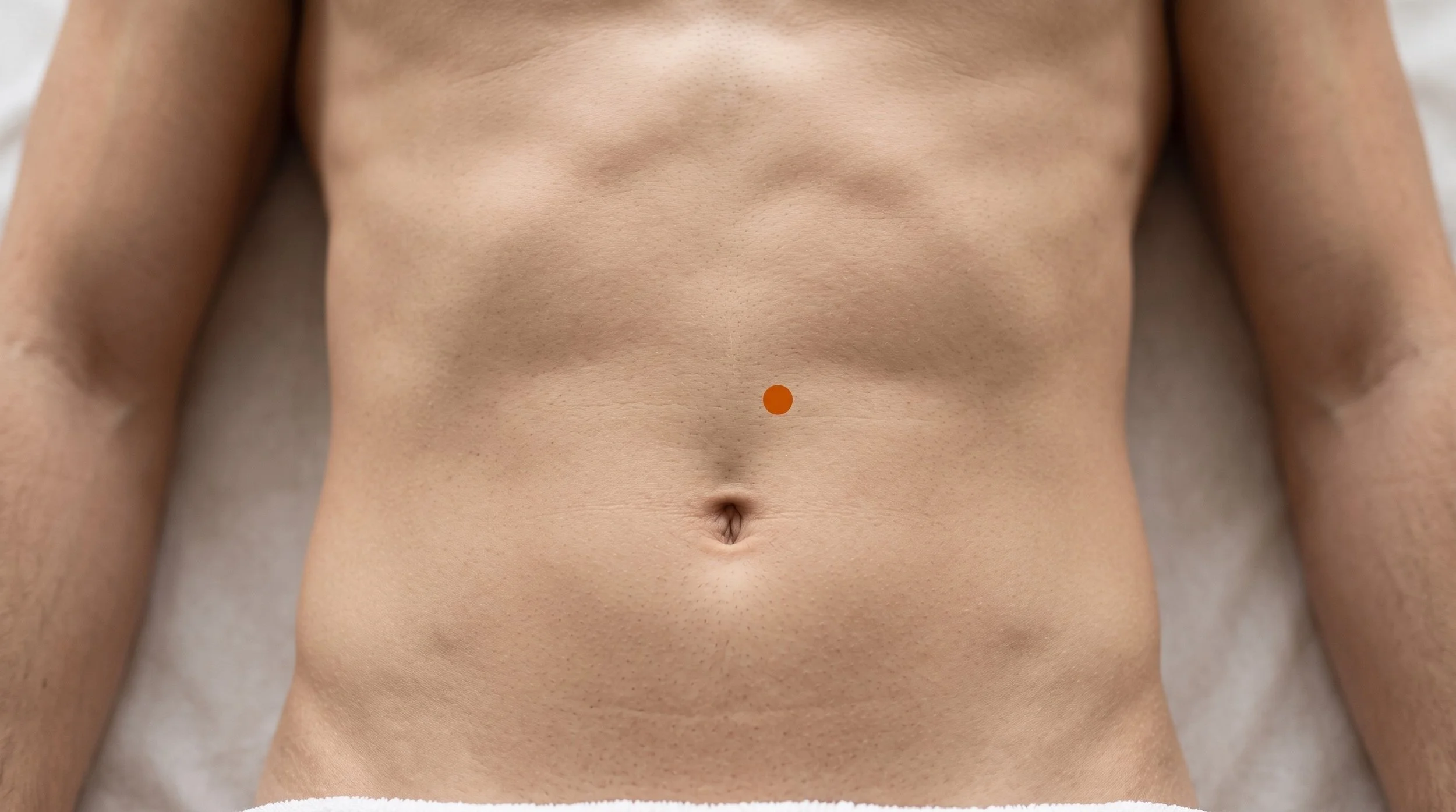
KI17 Acupuncture Point (Shangqu)
The Shang Bend Beside the Upper Abdomen: Anatomy, Segmental Mechanism, and Why This Kidney Channel Point Belongs in Digestive Treatment
KI17 (Shangqu, often translated as Shang Bend or Bent Metal) sits on the upper abdomen, two cun above the navel and just half a cun off the midline, immediately beside CV10 and level with ST23. It's one of the abdominal points where the Kidney channel is classically described as meeting the Penetrating vessel, and in the classical literature it was reserved for abdominal accumulations, cutting pain that came and went, and appetite that fell away when the belly hurt.
What makes the ki17 acupuncture point clinically interesting today isn't the poetry of its name but its address: it lies over the rectus abdominis in a thin, richly innervated band of abdominal wall whose sensory nerves share spinal segments with the stomach, small intestine, and transverse colon. That shared wiring is the reason a needle placed in the belly wall can influence how the gut beneath it behaves.
- Location and layers: KI17 is 2 cun above the umbilicus and 0.5 cun lateral to the midline, level with CV10 and with ST23 on the stomach channel. The needle passes through skin, superficial fascia, and the anterior rectus sheath into the medial fibers of rectus abdominis, with peritoneum and bowel not far below.
- Traditional categories, translated: classical texts list KI17 as a meeting point of the Kidney channel with the Penetrating vessel and summarize its action as dispersing accumulation and easing pain (Deadman et al.; Maciocia). In modern language, that describes a point used for cramping, distension, and stuck, obstructed abdominal sensations rather than a point for systemic Kidney tonification.
- Mechanism: needling here recruits anterior cutaneous and muscular branches of the lower thoracoabdominal nerves, which enter the cord at roughly the same segments that receive visceral afferents from the upper gut, and abdominal stimulation preferentially drives sympathetic gut reflexes while limb points tend to drive vagal ones (Yu, 2020).
- Research picture: reviews of acupuncture for functional dyspepsia and irritable bowel syndrome report modest symptom benefit with considerable heterogeneity and low certainty (Lan et al., 2014; Manheimer et al., 2012; Yang et al., 2022), and a large sham-controlled trial found electroacupuncture at abdominal and limb points increased bowel movements in chronic severe constipation (Liu et al., 2016).
- Clinical framing: KI17 is used as part of an abdominal cluster, not on its own. It's typically combined with CV12, CV10, ST25, and distal points like ST36 or PC6, an approach consistent with how multi-point protocols are actually tested in trials (Vickers et al., 2018).
- De qi at KI17 is usually a dull, spreading heaviness or a deep ache under the needle, sometimes with warmth or audible gut gurgling. Sharpness, radiating stabs, or a stretched pulling sensation mean the needle should be adjusted, and depth is kept conservative because the peritoneal cavity lies below (Deadman et al.; Kim).
Dealing With Bloating, Cramping, or Unpredictable Digestion?
Our acupuncturists treat digestive complaints the way we treat pain: by examining the abdominal wall, mapping where tenderness and guarding actually live, and needling points like KI17 in a segmental pattern that matches your symptoms. Sessions typically combine gentle upper abdominal needling with distal points such as ST36 and PC6, plus breathing and diaphragm work that helps calm a reactive gut. Most patients notice changes in comfort and regularity over a short series rather than after a single visit. Schedule an appointment and let's build a plan around your specific pattern.
Schedule NowAnatomy of KI17: Why the Upper Abdominal Wall Beside the Midline Is Such an Important Location
KI17 sits on a narrow strip of abdominal wall just off the linea alba, two cun above the navel and level with CV10. Under the fingertip the tissue is thin: skin, a layer of subcutaneous fat that varies enormously between patients, then the anterior rectus sheath and the medial fibers of rectus abdominis. This part of the abdominal wall is loaded constantly by trunk flexion, coughing, bracing during lifting, and prolonged desk-based sitting that keeps the abdomen shortened.
It's also the region that tightens reflexively when the gut is irritated, which is why patients with long-standing digestive complaints often present with a guarded, tender upper abdomen even when imaging is normal.
The sensory supply here comes from the anterior cutaneous branches of the lower thoracoabdominal nerves, which travel between the internal oblique and transversus abdominis before piercing the rectus sheath near the midline. Those same spinal segments receive visceral afferents from the stomach, duodenum, small bowel, and transverse colon through the splanchnic nerves.
Because somatic and visceral inputs converge on shared dorsal horn neurons, a needle in the belly wall becomes a way to speak to that convergence zone directly, and experimental work shows abdominal acupoint stimulation reliably modulates gastrointestinal motility through segmental sympathetic reflexes (Yu, 2020). Needling also engages the broader analgesic machinery described in the mechanistic literature, including descending inhibitory control and endogenous opioid signaling (Zhao, 2008).
Deep to the muscle, the superior epigastric vessels run within the rectus sheath, and below the transversalis fascia and peritoneum lie the transverse colon and loops of small intestine. The classical texts already recognized the stakes here: Deadman and colleagues describe perpendicular insertion of roughly 1 to 1.5 cun with an explicit caution that deep needling may enter the peritoneal cavity, while other modern manuals recommend a more conservative 0.5 to 1.0 cun (Kim; Cunningham).
In practice we needle KI17 shallowly and vertically, adjust depth to body habitus rather than to a fixed number, and avoid the point entirely in pregnancy, over surgical scars or hernias, and in patients with organomegaly or acute abdominal pathology.
Related Kidney Channel Related Rectus Abdominis Trigger PointsKI17 at a Glance: Classification, Location, and Clinical Use
| Category | Detail |
|---|---|
| Traditional Name | Shangqu (Shang Bend, also translated Bent Metal or Trade Bend) |
| Channel Classification | Kidney channel of the foot Shaoyin, upper abdomen |
| Point Categories | Meeting point of the Kidney channel with the Penetrating vessel (Chong mai). Not a five-shu, yuan-source, luo-connecting, xi-cleft, or hui-meeting point. |
| Precise Location | On the upper abdomen, 2 cun superior to the umbilicus and 0.5 cun lateral to the anterior midline, level with CV10 (Xiawan) and with ST23 (Taiyi). |
| Tissue Stimulated | Skin and superficial fascia, anterior rectus sheath, and the medial fibers of rectus abdominis, with the deeper abdominal wall including transversus abdominis and abdominal obliques contributing to the local segmental picture. |
| Needle Depth / Direction | Perpendicular insertion, classically 1 to 1.5 cun (Deadman et al.), with modern manuals often recommending 0.5 to 1.0 cun. Depth is matched to body habitus. Deep needling may penetrate the peritoneal cavity, so conservative depth is standard. Moxibustion is traditionally applicable. |
| De Qi Sensation | A dull, spreading heaviness or deep ache beneath the needle, occasionally with warmth, a sense of the abdomen softening, or audible gut sounds. Sharp, radiating, or stabbing sensations call for immediate withdrawal and repositioning. |
| Primary Clinical Uses | Traditionally used for abdominal masses and accumulations with periodic cutting pain, intestinal pain with poor appetite, epigastric pain and distension, vomiting, diarrhea, and constipation. Used in modern practice within abdominal protocols for functional digestive complaints and abdominal wall tenderness. |
| Common Point Combinations |
|
In the Deadman text, KI17 is presented as a meeting point of the Kidney channel with the Penetrating vessel, and its single summarized action is to disperse accumulation and relieve pain. The classical indication list gathers around a recognizable clinical picture: palpable abdominal masses accompanied by cutting pain that comes in episodes, intestinal pain that kills the appetite, and disordered bowel function running in either direction, meaning both vomiting with diarrhea and constipation.
Cunningham's commentary adds a curious detail from the name itself, noting that Shang refers to the note of the five-tone scale linked to metal and therefore to the Large Intestine, while Bend evokes the coiling of the gut, so the name essentially points at the bowel lying beneath. Maciocia's discussion of the Penetrating vessel groups KI17 with its neighbors as abdominal points associated with stabbing abdominal pain and masses.
What's striking is how consistent the pattern is across sources separated by centuries: this is not a general tonifying point but a narrowly aimed one, chosen for pain that has a stuck, obstructed, episodic quality in the belly, which is exactly the presentation modern patients describe as cramping that builds, peaks, and releases.
Why KI17 Is Used for Cramping Pain That Comes in Waves
The most common question we get about this point is why a Kidney channel point would be used for digestion at all. The answer has less to do with channel theory and more to do with geography. The Kidney channel's abdominal branch runs as a vertical line half a cun from the midline, so KI17 lands on a segment of belly wall whose nerve supply enters the spinal cord at the same levels that receive input from the stomach, small intestine, and transverse colon.
When two inputs converge on the same dorsal horn neurons, the brain has difficulty distinguishing their source, which is why gut irritation shows up as abdominal wall tenderness and why needling the wall can change how the gut feels (Zhao, 2008).
That convergence also works in the motor direction. Experimental work in animals shows a regional pattern: stimulation at abdominal points, which share segments with the viscera, tends to reduce gastrointestinal pressure through sympathetic pathways, while stimulation at limb points tends to increase motility through vagal pathways (Yu, 2020). This gives a plausible physiological reason for the traditional habit of pairing a local abdominal point like KI17 with a distal point like ST36, since the two act on different arms of the autonomic system rather than duplicating each other.
Alongside this, needling engages descending inhibitory pathways and endogenous opioid mechanisms that raise the threshold for pain more broadly (Zhao, 2008).
Practically, that translates into a specific clinical use. When a patient describes episodic, gripping upper abdominal pain with appetite that disappears during flares, and when palpation finds a tight, guarded upper abdomen, KI17 is a reasonable point to include. It's a small contribution within a larger treatment, and we'd never claim it resolves a digestive condition by itself, but it's well chosen for that presentation and it maps closely onto what the classical sources described.
What the Research Shows for KI17
There's no clinical trial isolating KI17. This is true of nearly every individual acupuncture point, because trials test whole protocols rather than single needles. What the literature can tell us is whether acupuncture protocols that include upper abdominal points help with the conditions KI17 has traditionally been used for, and whether there's a plausible physiological pathway.
The honest summary is that the clinical evidence for functional digestive disorders is mixed and generally low certainty, the constipation evidence is stronger and comes from one large sham-controlled trial, and the mechanistic evidence for abdominal points influencing gut motility is reasonably well developed in animal models. Read the table below as context for why this point belongs in a protocol, not as proof that it works on its own.
| Study | Type | Focus | Key Finding |
|---|---|---|---|
| Lan et al., 2014 | Cochrane systematic review | Manual acupuncture and electroacupuncture for functional dyspepsia | The review assessed efficacy and safety across trials but found the evidence base limited by methodological quality, so conclusions about benefit remained uncertain. |
| Manheimer et al., 2012 | Systematic review and meta-analysis | Acupuncture for irritable bowel syndrome symptom severity and quality of life | Acupuncture did not outperform sham in the pooled sham-controlled comparisons, though it compared favorably with some active treatments and as an adjunct. |
| Yang et al., 2022 | Systematic review and meta-analysis | Acupuncture and moxibustion for IBS symptom severity, abdominal pain, and quality of life | The authors reported benefit across these outcomes while noting the certainty of evidence ranged from very low to high and that better sham-controlled trials are needed. |
| Liu et al., 2016 | Multicenter randomized sham-controlled trial | Electroacupuncture at abdominal and limb points for chronic severe functional constipation | In 1075 patients, electroacupuncture increased mean weekly complete spontaneous bowel movements more than sham, with effects persisting into follow-up. |
| Yu, 2020 | Mechanistic review | Neural pathways by which acupuncture modulates gastrointestinal motility | Abdominal acupoints appear to inhibit gut motility through segmental sympathetic reflexes while limb points facilitate it through vagal pathways, supporting region-specific point selection. |
| Vickers et al., 2018 | Individual patient data meta-analysis | Acupuncture for chronic pain conditions | Acupuncture produced modest but persistent benefits over sham and no-acupuncture controls, supporting effects beyond placebo for chronic pain generally. |
Abdominal Wall Pain That Nobody Can Explain?
Not all belly pain comes from the organs. Trigger points in rectus abdominis and the obliques can refer pain across the upper abdomen and mimic visceral symptoms, and they respond well to precise dry needling.
At Morningside Acupuncture we palpate the abdominal wall carefully, distinguish myofascial from visceral drivers, and use KI17 and neighboring points as part of that assessment and treatment. Book a visit and we'll sort out what's actually generating your pain.
Schedule NowKI17 in the Context of Trigger Point Work
KI17 sits directly over the medial fibers of rectus abdominis, which makes it relevant to myofascial assessment as well as to channel-based point selection. Trigger points in the upper rectus abdominis can refer pain horizontally across the mid-back and produce a band of abdominal aching, and trigger points in the abdominal wall are well documented as capable of producing symptoms that closely mimic visceral complaints, including nausea, bloating, and cramping (Simons et al., 1999).
When we palpate a patient with chronic upper abdominal discomfort and find a discrete taut band that reproduces their familiar symptom, that finding changes the treatment plan substantially.
In those cases we use KI17 as one component of a combined approach: shallow, careful needling at the point itself, paired with dry needling of identified trigger points in rectus abdominis, the external oblique, and sometimes transversus abdominis, using flat or oblique angles and pincer grasp where the abdominal wall allows it.
All abdominal needling at Morningside follows the same rules regardless of whether we're calling it acupuncture or dry needling, since both use an acupuncture needle: shallow depth, angulation away from underlying organs, no aggressive perpendicular technique, and clear screening for pregnancy, hernia, surgical history, and acute abdominal pathology. Combining local abdominal work with distal points and with diaphragmatic breathing retraining tends to be more effective than needling the abdominal wall alone.
KI17 Digestive Treatment at NYC's Highest-Rated Acupuncture Clinic
Morningside Acupuncture is the highest-rated acupuncture and dry needling clinic in New York City with over 500 five-star Google reviews, and our Upper West Side practice blends classical point selection with modern pain science. We use KI17 within thoughtfully built abdominal protocols for cramping, bloating, poor appetite, and irregular bowel habits, always with careful depth control and clear explanation of what we're doing and why. You'll get an unhurried evaluation, a treatment plan you understand, and steady reassessment along the way. Schedule your appointment today.
Schedule NowFrequently Asked Questions
What does KI17 feel like when needled?
Most patients describe a dull, spreading heaviness or a deep ache under the needle, sometimes with a sense of warmth or of the abdomen relaxing. Gut sounds during or after treatment are common and generally a good sign that the autonomic system is shifting. The sensation should stay dull and tolerable. Sharp, electric, or stabbing sensations aren't normal at this point and mean the needle needs to be withdrawn and repositioned. Because the abdominal wall is thin here, we use light stimulation and typically don't manipulate the needle aggressively.
Why needle the belly for a digestive problem instead of a point on the arm or leg?
We usually do both, and there's a physiological reason. The abdominal wall at KI17 shares spinal segments with the stomach, small intestine, and transverse colon, so needling here acts through segmental sympathetic pathways, while distal limb points such as ST36 appear to work more through vagal pathways (Yu, 2020). Because the two act on different branches of the autonomic system, pairing a local abdominal point with a distal one isn't redundant. It's also how acupuncture protocols are actually structured in the trials that have tested them, which is why we treat KI17 as one component rather than a standalone intervention.
Can I press KI17 myself between sessions?
Yes, acupressure at KI17 is safe for most people when done gently. Lie on your back with your knees bent so the abdominal wall relaxes. Find your navel, move about two finger widths straight up, then shift a thumb's width to either side of the midline. Rest the pads of two fingers there and press slowly inward until you feel a mild, dull pressure, never a sharp pain. Hold for 30 to 60 seconds while breathing slowly into the belly, then release, and repeat two or three times per side. Doing this once or twice a day, ideally away from meals, is reasonable. Skip it during pregnancy, over any hernia or surgical scar, if you have acute or unexplained abdominal pain, or if pressure reproduces sharp or worsening symptoms, and see a physician instead.
Is KI17 safe to needle?
It's safe in trained hands, with real precautions. The main concern is depth: classical and modern texts both warn that needling too deeply here can penetrate the peritoneal cavity (Deadman et al.), which is why depth is kept conservative and matched to the patient's body habitus rather than to a fixed measurement. We avoid this point in pregnancy, over hernias, over recent surgical scars or suspected adhesions, in patients with organ enlargement, and in anyone with acute abdominal pain that hasn't been medically evaluated. Abdominal needling should always be performed by a licensed acupuncturist who palpates before inserting and can explain the depth being used.
Where exactly is KI17 located?
KI17 is on the upper abdomen, 2 cun above the center of the umbilicus and 0.5 cun lateral to the anterior midline. That places it immediately beside CV10 (Xiawan) and at the same horizontal level as ST23 (Taiyi) on the stomach channel. The Kidney channel's abdominal points run in a vertical line just half a cun off the midline, which is much closer to center than most people expect, so the practical landmark is: find the midline, measure roughly two thumb widths up from the navel, then step over by about half a thumb width. The point overlies the medial edge of rectus abdominis.
References
- Deadman, P., Al-Khafaji, M., & Baker, K. (2009). A manual of acupuncture. Journal of Chinese Medicine Publications.
- Cunningham, P. M. (2000). Acupuncture points: A practical guide to classical and modern usage. Odyssey Press.
- Kim, H. (2008). Handbook of Oriental medicine (3rd ed.). Harmony & Balance Press.
- Maciocia, G. (2006). The channels of acupuncture: Clinical use of the secondary channels and eight extraordinary vessels. Churchill Livingstone Elsevier.
- Simons, D. G., Travell, J. G., & Simons, L. S. (1999). Travell & Simons' myofascial pain and dysfunction: The trigger point manual, Vol. 1: Upper half of body (2nd ed.). Williams & Wilkins.
- Lan, L., Zeng, F., Liu, G. J., Ying, L., Wu, X., Liu, M., & Liang, F. R. (2014). Acupuncture for functional dyspepsia. Cochrane Database of Systematic Reviews, 2014(10), CD008487. https://doi.org/10.1002/14651858.CD008487.pub2
- Manheimer, E., Wieland, L. S., Cheng, K., Li, S. M., Shen, X., Berman, B. M., & Lao, L. (2012). Acupuncture for irritable bowel syndrome: Systematic review and meta-analysis. American Journal of Gastroenterology, 107(6), 835-847. https://doi.org/10.1038/ajg.2012.66
- Yang, Y., Rao, K., Zhan, K., Shen, M., Zheng, H., Qin, S., Wu, H., Bian, Z., & Huang, S. (2022). Clinical evidence of acupuncture and moxibustion for irritable bowel syndrome: A systematic review and meta-analysis of randomized controlled trials. Frontiers in Public Health, 10, 1022145. https://doi.org/10.3389/fpubh.2022.1022145
- Liu, Z., Yan, S., Wu, J., He, L., Li, N., Dong, G., Fang, J., Fu, W., Fu, L., Sun, J., Wang, L., Wang, S., Yang, J., Zhang, H., Zhang, J., Zhao, J., Zhou, W., Zhou, Z., Ai, Y., ... Liu, B. (2016). Acupuncture for chronic severe functional constipation: A randomized trial. Annals of Internal Medicine, 165(11), 761-769. https://doi.org/10.7326/M15-3118
- Yu, Z. (2020). Neuromechanism of acupuncture regulating gastrointestinal motility. World Journal of Gastroenterology, 26(23), 3182-3200. https://doi.org/10.3748/wjg.v26.i23.3182
- Zhao, Z. Q. (2008). Neural mechanism underlying acupuncture analgesia. Progress in Neurobiology, 85(4), 355-375. https://doi.org/10.1016/j.pneurobio.2008.05.004
- Vickers, A. J., Vertosick, E. A., Lewith, G., MacPherson, H., Foster, N. E., Sherman, K. J., Irnich, D., Witt, C. M., & Linde, K. (2018). Acupuncture for chronic pain: Update of an individual patient data meta-analysis. Journal of Pain, 19(5), 455-474. https://doi.org/10.1016/j.jpain.2017.11.005
Disclaimer: This web site is intended for educational and informational purposes only. Reading this website does not constitute providing medical advice or any professional services. This information should not be used for diagnosing or treating any health issue or disease. Those seeking medical advice should consult with a licensed physician. Seek the advice of a medical doctor or other qualified health professional for any medical condition. If you think you have a medical emergency, call 911 or go to the emergency room. No acupuncturist-patient relationship is created by reading this website or using the information. Morningside Acupuncture PLLC and its employees and contributors do not make any express or implied representations with respect to the information on this site or its use. For any legal interpretation of scope of practice in your state, consult a licensed attorney or regulatory authority.
Read more from our blog



