KI18 Acupuncture Point (Shiguan)
KI18 Acupuncture Point (Shiguan)
Stone Pass on the Upper Abdomen: Anatomy, Mechanism, and Why a Point Above the Navel Carries Gynecological and Digestive Indications
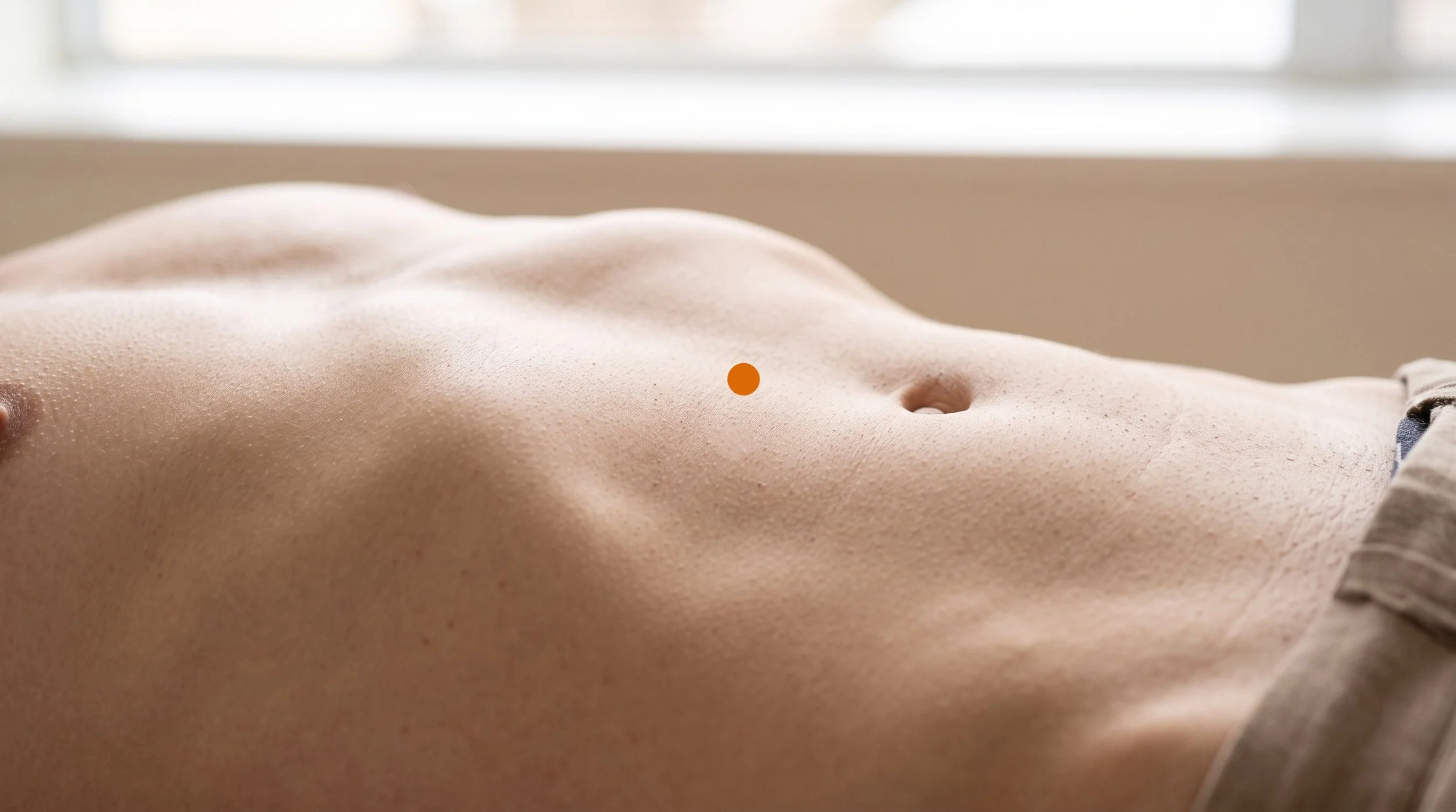
KI18 (Shiguan, translated as Stone Pass) sits high on the belly, three cun above the navel and only half a cun off the midline, right beside CV11. In plain terms, if you place a finger just to the side of the midline about midway between the navel and the base of the breastbone, you are over it. It belongs to the Kidney channel and is classically described as a meeting point of that channel with the Penetrating vessel, the extraordinary vessel said to arise in the uterus.
That double identity is what makes the ki18 acupuncture point interesting: it lies in territory that overlies the stomach and transverse colon, yet classical sources list it for severe abdominal pain, blood stasis patterns of the lower abdomen, hiccup and vomiting, and constipation. Clinically it functions as an upper abdominal access point for patients whose digestive and menstrual complaints travel together.
- Location and layers: KI18 is 3 cun above the umbilicus and 0.5 cun lateral to the midline, level with CV11, so the needle passes through skin, subcutaneous fat, the anterior rectus sheath, and the medial fibers of rectus abdominis before reaching the posterior sheath and, deeper still, the peritoneal cavity.
- Traditional attributions, translated: the classical actions listed in the Deadman point manual (regulating the lower burner and easing pain, moving qi and blood stasis, harmonizing the Stomach) map onto modern language as segmental modulation of visceral afferent traffic, altered abdominal wall muscle tone, and autonomic influence on gut motility (Ma, 2020).
- Nerve story: this part of the abdominal wall is supplied by anterior cutaneous and muscular branches of the lower thoracoabdominal nerves, roughly the T8 to T9 levels, which enter the same spinal segments that receive afferents from the stomach, duodenum, and proximal colon, a convergence that helps explain why local needling can change how upper abdominal symptoms are perceived (Zhao, 2008).
- Research picture: no trial has tested KI18 by itself. Abdominal electroacupuncture protocols have increased complete spontaneous bowel movements compared with sham in chronic severe functional constipation (Liu et al., 2016), while a Cochrane review of acupuncture and acupressure for period pain judged the evidence insufficient to draw firm conclusions (Smith et al., 2016).
- Clinical framing: we treat KI18 as a supporting local point inside a whole protocol rather than a standalone answer, usually alongside distal points and, where relevant, manual therapy and dry needling of the abdominal wall; individual patient data pooling suggests acupuncture's effects on chronic pain are modest but persistent over time (Vickers et al., 2018).
- De qi at KI18 is quiet: most patients report a dull, spreading heaviness or a mild inward pull under the fingertip rather than a sharp sensation, and some notice gurgling in the belly within a minute or two, which is consistent with reflex autonomic changes in gut activity (Ma, 2020).
Struggling With Cramping, Bloating, or Period Pain That Never Really Settles?
At Morningside Acupuncture we use KI18 as part of a targeted abdominal strategy for patients whose menstrual cramping, post-meal fullness, and lower belly tension overlap. Treatment usually pairs gentle needling of the ki 18 abdomen region with distal points on the legs and forearms, plus breathing and abdominal release work you can carry home. Sessions are calm, unhurried, and adjusted around your cycle when that matters. Schedule a visit and let's map out what your abdomen is actually doing.
Schedule NowAnatomy of KI18: Why the Upper Abdomen Beside CV11 Is Such an Important Location
KI18 lies 3 cun above the umbilicus and 0.5 cun lateral to the anterior midline, level with CV11, which puts it over the medial edge of the rectus abdominis close to the linea alba. From the surface inward, a needle crosses skin, a variable layer of subcutaneous fat, the anterior rectus sheath, the muscle belly itself, and then the posterior sheath and transversalis fascia. This is loaded tissue in everyday life: the rectus works during trunk flexion, coughing, straining, and bracing, and it also shortens in people who habitually hold the belly in.
Chronic guarding after abdominal surgery, prolonged constipation, or repeated cramping can leave taut, tender bands here that are easy to miss unless the abdomen is palpated deliberately.
The abdominal wall at this level is supplied by the lower thoracoabdominal nerves, roughly T8 and T9, which carry both cutaneous and muscular branches to the region. Those same spinal segments receive visceral afferents from the stomach, duodenum, and proximal gut, so somatic and visceral inputs converge on shared dorsal horn neurons. This convergence is the plain-science reason a body wall point can influence how visceral discomfort is experienced, and why tender abdominal wall spots often appear in people with long-standing gut symptoms.
Needling adds two further layers: local mechanical stimulation of Ad and C fibers that recruits descending inhibitory pathways from the brainstem, involving opioid, serotonergic, and noradrenergic signaling (Zhao, 2008), and segmental somato-autonomic reflexes in which abdominal stimulation can shift sympathetic and vagal outflow to the gut (Ma, 2020).
Deep to the muscle, the superior epigastric artery descends within the rectus sheath, and beneath the peritoneum sit the stomach and transverse colon depending on body habitus and gastric filling. Classical needling depth is given as perpendicular insertion of 1 to 1.5 cun, with an explicit caution that deep needling may enter the peritoneal cavity, and some modern texts favor a shallower 0.5 to 1 cun.
In practice we needle conservatively, angle away from depth in thin patients, avoid the point when the abdomen is distended or acutely tender in an undiagnosed way, and never needle a pregnant abdomen. Palpation before insertion is not optional here.
Related Rectus Abdominis Trigger Points Related Kidney ChannelKI18 at a Glance: Classification, Location, and Clinical Use
| Category | Detail |
|---|---|
| Traditional Name | Shiguan (Stone Pass), KI18, also written Kidney 18 and listed as KID-18 |
| Channel Classification | Kidney channel of the foot Shaoyin, upper abdominal section |
| Point Categories | Meeting point of the Kidney channel with the Penetrating vessel (Chong mai), one of the abdominal Kidney points through which that vessel is described as ascending |
| Precise Location | On the upper abdomen, 3 cun above the umbilicus and 0.5 cun lateral to the anterior midline, level with CV11 (Jianli). Note that one classical compendium places KI18 through KI21 at 1.5 cun lateral to the midline. |
| Tissue Stimulated | Skin, subcutaneous fascia, anterior rectus sheath and the medial fibers of rectus abdominis, with adjacent involvement of the abdominal obliques and transverse abdominis in wider abdominal wall treatment |
| Needle Depth / Direction | Perpendicular insertion 1 to 1.5 cun in classical sources, with shallower 0.5 to 1 cun used in many modern texts. Caution: deep needling may penetrate the peritoneal cavity. |
| De Qi Sensation | Dull heaviness, a spreading fullness, or a gentle inward tug rather than a sharp sensation; audible gut gurgling is common and harmless |
| Primary Clinical Uses | Severe stabbing abdominal pain including post-partum pain in classical listings, blood stasis patterns of the uterus and abdomen, hiccup, vomiting and retching, and constipation |
| Common Point Combinations |
|
In the Deadman point manual, Shiguan is presented as a genuine outlier among upper abdominal points. Its recorded indications include abdominal pain after childbirth, sharp pain along the flanks following delivery, what the classics call malign blood in the uterus, infertility, unbearable stabbing abdominal pain, constipation and dark urine, along with a separate cluster of upper digestive complaints such as hiccup, vomiting, and retching.
The text explains this range as an expression of the point's status as a meeting place of the Kidney channel with the Penetrating vessel, which was said to originate in the uterus and was nicknamed the sea of blood, a description echoed in Maciocia's discussion of the extraordinary vessels.
Read as traditional attribution rather than physiology, the underlying pattern is coherent: a picture of stagnant, pooled blood affecting the uterus, the abdomen generally, and the costal region, treated at a point that touches that whole territory. What makes it striking is the geography. A point three cun above the navel had no obvious business treating post-partum pain, yet the classical authors kept listing it there, which suggests they were tracking something observed in patients rather than something derived neatly from anatomy.
Why KI18 Is Used for Menstrual and Post-Partum Abdominal Pain Despite Sitting Above the Navel
The honest answer is that the segmental story only takes you partway. The abdominal wall at KI18 is innervated around the T8 to T9 levels, and the uterus sends afferents into roughly T10 through L1 as well as the sacral segments, so this is not a tidy same-segment match the way lower abdominal points are. What KI18 does sit squarely over is the upper gut territory, where segmental convergence is direct, and where needling can shift autonomic outflow through somato-autonomic reflexes that have been mapped in animal work and reviewed in the modern literature (Ma, 2020). For hiccup, retching, and upper abdominal cramping, that mechanism is straightforward.
For the gynecological indications, the more plausible mechanisms are regional and central rather than strictly segmental. Needling recruits descending inhibitory pathways that dampen pain signaling broadly rather than only at the treated segment, involving endogenous opioid, serotonergic, and noradrenergic systems (Zhao, 2008).
There is also a vascular thread worth mentioning cautiously: a small early study using electroacupuncture found reduced blood flow impedance in the uterine arteries of infertile women, which offers one physiological reading of the traditional language about moving stagnant blood (Stener-Victorin et al., 1996). That study was small and not randomized, so it should be read as suggestive rather than settled.
Finally, there is the abdominal wall itself. Patients with years of cramping, straining, or post-surgical guarding often develop tender, restricted tissue over the rectus abdominis, and that myofascial component can amplify what feels like purely visceral pain (Simons et al., 1999). Treating the wall directly, which is exactly what a needle at KI18 does, sometimes changes the whole picture even when the underlying visceral driver has not changed at all.
What the Research Shows for KI18
There is no clinical trial of KI18 in isolation, and it would be misleading to imply otherwise. What exists is research on multi-point protocols for the conditions this point traditionally addresses, plus mechanistic work explaining how abdominal needling could plausibly influence gut function and pain. Read the table below as evidence about the categories KI18 belongs to, not as evidence about the point itself, and expect modest effect sizes rather than dramatic ones.
| Study | Type | Focus | Key Finding |
|---|---|---|---|
| Smith et al., 2016 | Cochrane systematic review | Acupuncture and acupressure for primary dysmenorrhea | The reviewers concluded the available evidence was insufficient to establish whether these approaches help period pain, largely because of trial quality and heterogeneity. |
| Liu et al., 2016 | Multicenter randomized sham-controlled trial | Electroacupuncture at abdominal and body points for chronic severe functional constipation | Eight weeks of electroacupuncture increased weekly complete spontaneous bowel movements more than sham, with effects persisting during follow up and a good safety profile. |
| Vickers et al., 2018 | Individual patient data meta-analysis | Acupuncture for chronic pain across musculoskeletal and headache conditions | Acupuncture outperformed both sham and no-acupuncture controls by a modest margin, with benefits that decayed only slightly over twelve months. |
| Ma, 2020 | Narrative mechanistic review | Somato-autonomic reflexes and acupoint selectivity | Stimulation site and intensity appear to determine which autonomic pathway is engaged, offering a testable framework for why abdominal points may affect gut motility differently than limb points. |
| Stener-Victorin et al., 1996 | Small prospective non-randomized study | Electroacupuncture and uterine artery blood flow impedance in infertile women | Pulsatility index in the uterine arteries fell after a course of electroacupuncture, a preliminary signal that needs replication in controlled trials. |
| Zhao, 2008 | Mechanistic review | Neural mechanisms of acupuncture analgesia | Needling activates small-diameter afferents and engages spinal and supraspinal inhibitory circuits mediated by opioid and monoamine systems. |
Constipation and Sluggish Digestion? Shiguan Acupuncture May Help Support Motility
Slow transit, straining, and that heavy stuck feeling after meals respond well to a structured plan rather than a single point. We combine kidney 18 with abdominal and lower leg points, electroacupuncture when appropriate, and practical guidance on fiber, fluids, and movement. Most patients notice pattern changes across a short series rather than after one visit. Book an appointment and we'll build a realistic schedule with you.
Schedule NowKI18 in the Context of Trigger Point Work
Acupuncture, in our definition, means the use of an acupuncture needle, and that includes the hundreds of stylistic variations practiced worldwide, dry needling among them. At KI18 the two traditions overlap almost perfectly, because the point sits on the medial fibers of rectus abdominis, a muscle whose taut bands can refer pain across the belly and mimic or magnify visceral complaints (Simons et al., 1999). When a patient's upper abdominal ache changes with trunk position, coughing, or sitting up from lying, that is a hint the wall deserves attention alongside the viscera.
In practice we palpate the rectus above and below the navel, check the oblique attachments along the costal margin, and treat what is actually tender rather than needling a coordinate. A typical session might combine KI18 and a neighboring Kidney or Conception vessel point with careful, shallow dry needling of rectus abdominis and the abdominal obliques, then finish with distal points and breathing retraining so the abdomen learns to release rather than brace. Needle depth stays conservative throughout, because the peritoneal cavity is not far below.
KI18 Abdominal Pain Treatment at NYC's Highest-Rated Acupuncture Clinic
Morningside Acupuncture is the highest-rated acupuncture and dry needling clinic in New York City with over 500 five-star Google reviews, and our approach blends classical point selection with modern pain science. For abdominal pain, cramping, and digestive complaints we use shiguan acupuncture alongside trigger point work on the abdominal wall and clear home strategies between visits. Every plan is explained in plain language, with realistic timelines and no pressure. Schedule your first session and get started.
Schedule NowFrequently Asked Questions
What does KI18 feel like when needled?
Most people describe a dull, heavy fullness that spreads a little around the needle, sometimes with a soft inward tug as the abdominal wall responds. It should not be sharp or burning. Gurgling in the belly within a minute or two is common and generally a good sign that the gut is shifting out of a guarded state. If you feel anything sharp, tell your acupuncturist and the needle will be adjusted or removed.
Why needle a point above the navel for lower abdominal or menstrual symptoms?
Classical sources listed Shiguan for post-partum abdominal pain, stagnant blood in the uterus, and infertility because they considered it a meeting point of the Kidney channel with the Penetrating vessel, the vessel described as arising in the uterus. In modern terms, needling recruits descending pain-inhibiting pathways that are not limited to the treated spinal segment (Zhao, 2008), and the abdominal wall itself is often a contributor to pain that feels internal. Most treatment plans also include lower abdominal and distal points rather than relying on KI18 alone.
Can I press KI18 myself between sessions?
Yes, gently. Lie on your back with knees bent so the abdominal wall relaxes, find the midline halfway between your navel and the base of your breastbone, then slide about half a finger width to one side. Press with a flat fingertip using light to moderate pressure, no more than a comfortable four out of ten, and hold for thirty to sixty seconds while you breathe slowly into the belly. Repeat two or three times per side, once or twice daily. Skip it entirely if you are pregnant, if the pressure is sharply painful, if you have a hernia, recent abdominal surgery, or an undiagnosed abdominal mass, and see a physician for any new severe or persistent abdominal pain.
Is KI18 safe to needle?
In trained hands, yes, but it is a point that demands respect. The main caution recorded in the classical literature and repeated in modern manuals is that deep needling may penetrate the peritoneal cavity, so depth is kept conservative and adjusted for body size. We avoid the point in pregnancy, in acute undiagnosed abdominal pain, over hernias, scars, or recent surgical sites, and when the abdomen is distended or rigid. Minor bruising is the most common side effect, and abdominal points are always needled with the patient lying down.
Where exactly is KI18 located?
On the upper abdomen, three cun above the umbilicus and half a cun lateral to the anterior midline, level with CV11 (Jianli). Three cun above the navel is roughly the midpoint between the navel and the lower tip of the breastbone in most people, and half a cun is a narrow margin, so KI18 sits just off the linea alba on the inner edge of the rectus abdominis. One classical compendium placed this point and its neighbors 1.5 cun lateral instead, which is why careful palpation matters more than measurement alone.
References
- Deadman, P., Al-Khafaji, M., & Baker, K. (2009). A manual of acupuncture. Journal of Chinese Medicine Publications.
- Maciocia, G. (2005). The foundations of Chinese medicine: A comprehensive text for acupuncturists and herbalists (2nd ed.). Elsevier Churchill Livingstone.
- Simons, D. G., Travell, J. G., & Simons, L. S. (1999). Travell & Simons' myofascial pain and dysfunction: The trigger point manual, Vol. 1: Upper half of body (2nd ed.). Williams & Wilkins.
- Smith, C. A., Armour, M., Zhu, X., Li, X., Lu, Z. Y., & Song, J. (2016). Acupuncture for dysmenorrhoea. Cochrane Database of Systematic Reviews, 2016(4), CD007854. https://doi.org/10.1002/14651858.CD007854.pub3 [VERIFY BEFORE PUBLISHING]
- Liu, Z., Yan, S., Wu, J., He, L., Li, N., Dong, G., Fang, J., Fu, W., Fu, L., Sun, J., Wang, L., Wang, S., Yang, J., Zhang, H., Zhang, J., Zhao, J., Zhou, W., Zhou, Z., Ai, Y., Zhou, K., Liu, J., Xu, H., Cai, Y., & Liu, B. (2016). Acupuncture for chronic severe functional constipation: A randomized trial. Annals of Internal Medicine, 165(11), 761-769. https://doi.org/10.7326/M15-3118
- Ma, Q. (2020). Somato-autonomic reflexes of acupuncture. Medical Acupuncture, 32(6), 362-366. https://doi.org/10.1089/acu.2020.1488
- Stener-Victorin, E., Waldenstrom, U., Andersson, S. A., & Wikland, M. (1996). Reduction of blood flow impedance in the uterine arteries of infertile women with electro-acupuncture. Human Reproduction, 11(6), 1314-1317. https://doi.org/10.1093/oxfordjournals.humrep.a019378
- Vickers, A. J., Vertosick, E. A., Lewith, G., MacPherson, H., Foster, N. E., Sherman, K. J., Irnich, D., Witt, C. M., & Linde, K. (2018). Acupuncture for chronic pain: Update of an individual patient data meta-analysis. Journal of Pain, 19(5), 455-474. https://doi.org/10.1016/j.jpain.2017.11.005
- Zhao, Z. Q. (2008). Neural mechanism underlying acupuncture analgesia. Progress in Neurobiology, 85(4), 355-375. https://doi.org/10.1016/j.pneurobio.2008.05.004
Disclaimer: This web site is intended for educational and informational purposes only. Reading this website does not constitute providing medical advice or any professional services. This information should not be used for diagnosing or treating any health issue or disease. Those seeking medical advice should consult with a licensed physician. Seek the advice of a medical doctor or other qualified health professional for any medical condition. If you think you have a medical emergency, call 911 or go to the emergency room. No acupuncturist-patient relationship is created by reading this website or using the information. Morningside Acupuncture PLLC and its employees and contributors do not make any express or implied representations with respect to the information on this site or its use. For any legal interpretation of scope of practice in your state, consult a licensed attorney or regulatory authority.
Read more from our blog



