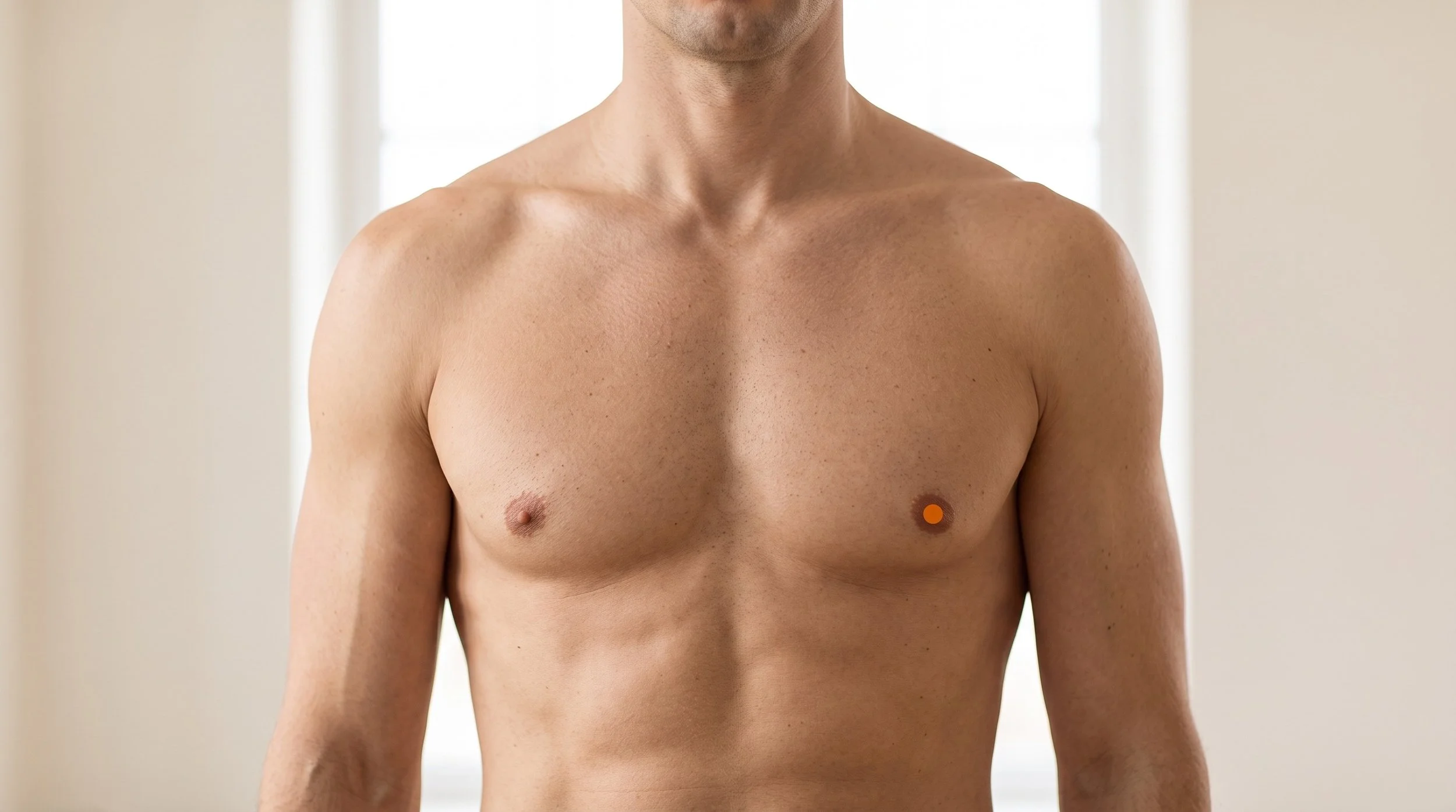
ST17 Acupuncture Point (Ruzhong)
Middle of the Breast: Anatomy, Segmental Mapping, and Why the Stomach Channel's Fourth Intercostal Landmark Is Measured From Rather Than Needled
ST17, known as Ruzhong or Middle of the Breast, is the seventeenth point of the Stomach channel and the strangest entry in the entire sequence: it sits at the center of the nipple, in the fourth intercostal space, 4 cun lateral to the front midline, and it is never treated. Classical sources kept Stomach 17 in the numbering while forbidding both needling and moxibustion on it, so its whole clinical value is cartographic.
The nipple is one of the most reliable surface landmarks on the human trunk, and the 4 cun mamillary line it defines, together with the fourth intercostal level it marks, is how practitioners find the points above it, below it, lateral to it, and on the midline beside it. Understanding the st17 acupuncture point is really about understanding how the chest is measured, and about the useful clinical lesson that a point having a number does not mean it has a needle.
- ST17 lies at the center of the nipple in the fourth intercostal space, 4 cun lateral to the anterior midline, over the pectoralis major and the fourth intercostal space, with parietal pleura and lung directly deep to that thin chest wall (Deadman et al., 2007).
- Traditional sources classify it as a reference point only. It carries no five-shu status, no hui-meeting role, and no extraordinary vessel intersection, and it's listed as contraindicated to both needling and moxibustion (Deadman et al., 2007; O'Connor & Bensky, 1981).
- The neurophysiology of the region is T4 territory: the nipple and areola are supplied most consistently by the anterior and lateral cutaneous branches of the fourth intercostal nerve, which is why this level maps so cleanly onto the upper thoracic segments (Schlenz et al., 2000; Smeele et al., 2022).
- Landmark accuracy isn't a trivial concern. A systematic review found considerable variation in where trained practitioners place the same acupuncture points, and evaluations of the cun system suggest finger-based measurement is less reliable than proportional bone measurement (Godson & Wardle, 2019; Yin et al., 2005).
- The prohibition also functions as a safety convention. Pneumothorax remains the most reported serious adverse event in acupuncture, and a review of licensing board cases found that documented precautions were absent in the cases examined, which is why chest needling elsewhere is done shallowly and obliquely (Ochi, 2023).
- There's no de qi at ST17 because there's no needle. When nearby chest points are treated, patients usually report a shallow, spreading, slightly dull ache rather than the deep heavy grasp typical of limb points, a sensation profile associated with mixed afferent fiber activation (Zhao, 2008).
Chest Tightness, Rib Pain, or Shallow Breathing?
At Morningside Acupuncture we treat the chest wall carefully and never on ST17 itself, using the fourth intercostal landmark to guide safe needling of the surrounding intercostal spaces, pectoralis major, and midline points. Shallow, oblique technique combined with breath work may reduce rib cage guarding and help the upper thorax move more freely. Every session starts with an orthopedic and postural assessment so the plan matches what's actually driving your symptoms. Schedule a visit and let's map it out together.
Schedule NowAnatomy of ST17: Why the Nipple and Fourth Intercostal Space Is Such an Important Location
From the surface down, ST17 sits on the nipple itself, a small region of highly innervated skin with dense sensory receptors and dermal smooth muscle rather than a muscle belly worth needling. Beneath it lie the breast or subareolar tissue, the fascia and fibers of pectoralis major, and then the fourth intercostal space with its external and internal intercostal muscles bridging the ribs.
This is a mobile, breathing structure: every inhalation lifts and rotates the ribs beneath this point, and habitual shallow chest breathing, forward shoulder posture, heavy pressing work in the gym, and post-surgical scarring all load the tissues immediately around it. That's precisely why the region matters clinically even though the ST 17 landmark itself is off limits.
The nerve geography here is unusually tidy, which is a large part of why classical anatomists anchored their chest measurements to this spot.
Cadaveric dissection work found that the nipple and areola are consistently supplied by anterior and lateral cutaneous branches of the third through fifth intercostal nerves, with the fourth being the most constant contributor (Schlenz et al., 2000), and a later systematic review and meta-analysis of dissection studies confirmed that the anterior and lateral branches of the fourth intercostal nerve cover the largest share of the nipple and surrounding skin (Smeele et al., 2022).
In pain-science terms, that makes this level a clean T4 reference. Somatic afferents from this dermatome converge in the upper thoracic dorsal horn with visceral afferents from the heart, esophagus, and upper digestive tract, which is the segmental convergence that explains why chest wall input and visceral sensation can feel confusingly similar to patients. Needling elsewhere in the same segment can modulate that shared dorsal horn traffic and recruit descending inhibitory pathways from the midbrain and brainstem (Zhao, 2008).
Deep to the intercostal muscles at this level are the endothoracic fascia, parietal pleura, and lung, and the chest wall in the thorax is thin. Reviews of acupuncture-related harm consistently identify pneumothorax as the most frequently reported serious adverse event, with recommended precautions including shorter needles, oblique or transverse angles, and immediate referral if a patient develops chest pain or breathlessness after treatment (Ochi, 2023). ST17 resolves this problem in the simplest possible way: it isn't needled at all, and moxibustion isn't applied to it either (Deadman et al., 2007).
Points in the adjacent spaces, when they're indicated, are typically needled obliquely or transversely and shallowly, and the ruzhong reference point tells the practitioner exactly which rib space they're working in before the needle ever comes out of the package.
Related Intercostal Muscles Trigger Points Related Stomach ChannelST17 at a Glance: Classification, Location, and Clinical Use
| Category | Detail |
|---|---|
| Traditional Name | Ruzhong (Middle of the Breast), Stomach 17 |
| Channel Classification | Seventeenth point of the Stomach channel of Foot Yangming, on the thoracic portion of the channel between ST16 above and ST18 below |
| Point Categories | Reference and landmark point only. No five-shu classification, no hui-meeting or influential designation, and no extraordinary vessel or meeting or crossing status is attributed to it in the classical literature; it's listed as contraindicated to both needling and moxibustion (Deadman et al., 2007). |
| Precise Location | At the center of the nipple, in the fourth intercostal space, 4 cun lateral to the anterior midline, level with CV17 on the front midline |
| Tissue Stimulated | None at the point itself. Regional treatment near this landmark targets pectoralis major and the intercostal muscles of the surrounding rib spaces, never the nipple. |
| Needle Depth / Direction | Never needled, and moxibustion isn't applied. Adjacent chest points such as ST16 and ST18 are needled obliquely or transversely at shallow depth, angled along the rib space and away from the pleura. |
| De Qi Sensation | Not applicable, since the point isn't needled. Neighboring chest points typically produce a shallow, spreading, mildly dull or heavy sensation rather than the deep grasping ache common at limb points. |
| Primary Clinical Uses | Purely locational: it defines the 4 cun mamillary line used across the chest and abdomen, marks the fourth intercostal level shared with CV17, and anchors the counting of chest points above, below, and lateral to it. It also serves as a teaching example that point numbering and point treatment are not the same thing. |
| Common Point Combinations |
|
In Deadman, Al-Khafaji, and Baker's A Manual of Acupuncture, the entry for Ruzhong is one of the shortest in the book: a location at the center of the nipple in the fourth intercostal space, 4 cun lateral to the midline, followed by the plain statement that the point is contraindicated to needling and moxibustion and is used simply as a reference (Deadman et al., 2007).
Older Chinese sources compiled in the Shanghai text add a wrinkle worth knowing, since the Systematic Classic of Acupuncture and Moxibustion prohibits both needling and moxa here, while several Tang dynasty formularies were recorded as permitting moxibustion alone, a disagreement that was eventually settled in favor of leaving the point alone entirely (O'Connor & Bensky, 1981). Traditionally, then, ST17 carries no actions, no patterns, and no indications: it was never assigned the functions that surrounding chest points received.
What's striking is that the classical compilers kept it in the sequence anyway. They understood that a channel is not only a list of therapeutic sites but also a coordinate system, and a coordinate system needs fixed, unmistakable origins.
Why ST17 Is Used for Measurement Rather Than Treatment
Patients sometimes ask why a spot that can't be treated gets a number at all. The answer is that the whole point-location system runs on proportional measurement from anatomical landmarks, and the nipple is one of the most visible and reproducible landmarks on the trunk. Once you fix the mamillary line at 4 cun from the midline and identify the fourth intercostal space, you've established both a vertical reference and a horizontal level, and every chest point around it becomes findable: CV17 on the midline at the same level, ST16 one space up, ST18 one space down, and the lateral chest points counted outward. The st 17 landmark is, in effect, the origin of the chest's coordinate grid.
That precision matters more than it might sound. A critical systematic review of point-location research found considerable variation in where qualified practitioners placed the same points, and concluded that accuracy is fundamental to both safe treatment and interpretable research (Godson & Wardle, 2019). Studies evaluating the cun measurement system have similarly questioned the reliability of finger-width methods and favored proportional bone-based measurement (Yin et al., 2005).
Fixed bony and surface landmarks are the correction for that drift, and in the chest the fourth intercostal space and the nipple line are among the sturdiest available.
There's a clinical safety dimension too. Every centimeter of uncertainty in the chest is a centimeter closer to structures nobody wants a needle near, and pneumothorax remains the most commonly reported serious complication of acupuncture, usually preventable with shorter needles, oblique angles, and awareness of pleural depth (Ochi, 2023).
When treatment in this region is appropriate, the effects we're after come from segmental input to the upper thoracic dorsal horn and from descending inhibitory pathways activated by needling generally (Zhao, 2008), and those effects can be obtained from safer neighboring sites and from distal points. The ruzhong reference point earns its keep by telling us where we are, so the needling can happen somewhere sensible.
What the Research Shows for ST17
There are no clinical trials of ST17, and there never will be, because the point isn't treated. What the literature offers instead is evidence relevant to why it exists: research on how accurately practitioners locate points, on the reliability of the cun measurement system, on the segmental innervation of the fourth intercostal level, and on the safety record of chest needling. Alongside that sits the broader evidence base for acupuncture in chronic pain, which tests multi-point protocols rather than single points, so no individual point's contribution can be isolated from those trials. Read the table below as context for the landmark's role, not as evidence of any therapeutic effect at the nipple itself.
| Study | Type | Focus | Key Finding |
|---|---|---|---|
| Godson & Wardle, 2019 | Critical systematic review | Accuracy and precision of acupuncture point location across location methods | The review reported considerable variation between qualified practitioners in locating the same points, supporting the value of fixed surface landmarks. |
| Yin et al., 2005 | Anthropometric evaluation study | Validity of the directional (finger) and proportional (bone) cun measurement methods | The authors concluded that finger-cun measurement is unreliable and that point location should rest primarily on proportional measurement. |
| Smeele et al., 2022 | Systematic review and meta-analysis of dissection studies | Innervation of the female breast and nipple-areola complex | Branches of the fourth intercostal nerve were the most consistent contributors to nipple innervation, anchoring this landmark firmly in the T4 segment. |
| Schlenz et al., 2000 | Cadaveric anatomical study | Sensory supply of the nipple-areola complex in 28 dissections | The nipple and areola were supplied by anterior and lateral cutaneous branches of the third to fifth intercostal nerves, with the fourth most constant. |
| Ochi, 2023 | Review of licensing board records | Pneumothorax after acupuncture and preventive technique | Pneumothorax is described as the most common serious complication of acupuncture, with shorter needles and oblique insertion recommended near the chest. |
| Vickers et al., 2018 | Individual patient data meta-analysis | Acupuncture for chronic musculoskeletal, headache, and osteoarthritis pain | Acupuncture was associated with modest but persistent benefits over sham and usual care, using multi-point protocols rather than single points. |
Want Acupuncture From Clinicians Who Take Chest Anatomy Seriously?
The reason Ruzhong exists as a reference point and not a treatment point is that the pleura sits close to the surface here, and good practice respects that. Our licensed acupuncturists use precise landmark-based location, appropriate needle lengths, and angled insertion whenever we work near the ribs. You'll get an explanation of exactly where the needles are going and why, before anything happens. Book an appointment to experience the difference careful technique makes.
Schedule NowST17 in the Context of Trigger Point Work
Dry needling is acupuncture performed with an acupuncture needle using a myofascial rationale, and the same anatomical limits apply: the nipple is not a needling target in any style. What the ST17 landmark does for trigger point work is orient the clinician in the rib cage. Referred pain from pectoralis major and from the intercostal muscles can spread across the front of the chest and into the arm, and the classic descriptions of chest wall referral patterns come from the trigger point literature (Simons et al., 1999). Knowing you're at the fourth intercostal level tells you which space you're palpating and which fibers you're likely feeling under your fingers.
At Morningside Acupuncture, chest wall complaints are treated with a combination of shallow, angled needling in the intercostal spaces away from the nipple, pectoralis major work above the rib cage where soft tissue depth allows, and distal points chosen to recruit segmental and descending pain modulation. We pair that with breathing retraining and thoracic mobility work, since rib cage stiffness and guarded breathing tend to keep chest wall tissues irritated. If your symptoms include unexplained chest pain, breathlessness, or anything cardiac in character, medical evaluation comes first and needling waits.
ST17 Region Chest and Rib Pain Treatment at NYC's Highest-Rated Acupuncture Clinic
Morningside Acupuncture is the highest-rated acupuncture and dry needling clinic in New York City with over 500 five-star Google reviews, and our Upper West Side practice blends classical point knowledge with modern pain science. For chest wall pain, intercostal irritation, and breathing restriction, we combine safe regional needling around the ST17 landmark with distal points and manual therapy. Treatment plans are built around measurable goals, not open-ended packages. Schedule your first session and get a clear assessment from the start.
Schedule NowFrequently Asked Questions
What does ST17 feel like when needled?
It doesn't feel like anything, because ST17 is never needled. Classical and modern sources list Ruzhong as contraindicated to both needling and moxibustion, and it exists in the Stomach channel numbering purely as a measurement landmark (Deadman et al., 2007). If you're being treated in this region, the needles go into the intercostal spaces or nearby chest points instead, where the usual sensation is a shallow, spreading, slightly heavy ache rather than a sharp one.
Why is a point that can never be treated still included in the Stomach channel?
Because a channel isn't only a list of treatment sites; it's also a map. The nipple is one of the clearest surface landmarks on the trunk, and fixing it as ST17 establishes both the 4 cun mamillary line and the fourth intercostal level, which together let practitioners locate CV17, ST16, ST18, and the lateral chest points reliably. Given that research has found meaningful variation in how practitioners locate the same points (Godson & Wardle, 2019), keeping a fixed, unmistakable origin in the sequence was a sensible decision by the classical compilers.
Can I press ST17 myself between sessions?
No, and there's no reason to. The nipple isn't an acupressure site, and pressing it won't produce any of the effects associated with nearby chest points. If you want to work on chest tightness at home, use CV17 on the breastbone at the same fourth intercostal level: place a thumb or two fingertips on the midline of the sternum and apply steady, moderate pressure for 30 to 60 seconds while breathing slowly through the nose, repeating two or three times, one to three times per day. PC6 on the inner forearm, about 2 cun above the wrist crease between the tendons, responds well to the same 30 to 60 second holds. Stop with any sharp pain, and skip self-treatment entirely over recent surgical sites, rashes, or unexplained lumps.
Is ST17 safe to needle?
No. It's one of the small number of points that the classical literature explicitly places off limits to both needle and moxa (Deadman et al., 2007), and the anatomy supports that: the chest wall is thin, and pneumothorax remains the most commonly reported serious adverse event associated with acupuncture, with prevention resting on shorter needles, oblique angles, and careful anatomical knowledge (Ochi, 2023). Any practitioner proposing to needle the nipple has misread the source material. Points in the adjacent rib spaces can be treated safely by trained clinicians using shallow, angled technique.
Where exactly is ST17 located?
At the center of the nipple, in the fourth intercostal space, 4 cun lateral to the anterior midline, level with CV17 on the sternum (Deadman et al., 2007). In practice, clinicians find the fourth space by counting down from the second rib at the sternal angle, then confirm the vertical line by dropping straight down through the nipple. That vertical line, the mamillary line, is what the rest of the chest and abdominal point locations are measured against.
References
- Deadman, P., Al-Khafaji, M., & Baker, K. (2009). A manual of acupuncture. Journal of Chinese Medicine Publications.
- O'Connor, J., & Bensky, D. (Eds. & Trans.). (1981). Acupuncture: A comprehensive text. Shanghai College of Traditional Medicine. Eastland Press.
- Kim, H. (2008). Handbook of Oriental medicine (3rd ed.). Harmony & Balance Press.
- Simons, D. G., Travell, J. G., & Simons, L. S. (1999). Travell & Simons' myofascial pain and dysfunction: The trigger point manual, Vol. 1: Upper half of body (2nd ed.). Williams & Wilkins.
- Godson, D. R., & Wardle, J. L. (2019). Accuracy and precision in acupuncture point location: A critical systematic review. Journal of Acupuncture and Meridian Studies, 12(2), 52-66. https://doi.org/10.1016/j.jams.2018.10.009
- Yin, C. S., Park, H. J., Seo, J. C., Lim, S., & Koh, H. G. (2005). An evaluation of the cun measurement system of acupuncture point location. The American Journal of Chinese Medicine, 33(5), 729-735. https://doi.org/10.1142/S0192415X05003284
- Smeele, H. P., Bijkerk, E., van Kuijk, S. M. J., Lataster, A., van der Hulst, R. R. W. J., & Tuinder, S. M. H. (2022). Innervation of the female breast and nipple: A systematic review and meta-analysis of anatomical dissection studies. Plastic and Reconstructive Surgery, 150(2), 243-255. https://doi.org/10.1097/PRS.0000000000009306
- Schlenz, I., Kuzbari, R., Gruber, H., & Holle, J. (2000). The sensitivity of the nipple-areola complex: An anatomic study. Plastic and Reconstructive Surgery, 105(3), 905-909. https://doi.org/10.1097/00006534-200003000-00012
- Ochi, J. W. (2023). Pneumothorax after acupuncture: Medicolegal consequences and prevention. Medical Acupuncture, 35(1), 9-12. https://doi.org/10.1089/acu.2022.0056
- Zhao, Z. Q. (2008). Neural mechanism underlying acupuncture analgesia. Progress in Neurobiology, 85(4), 355-375. https://doi.org/10.1016/j.pneurobio.2008.05.004
- Vickers, A. J., Vertosick, E. A., Lewith, G., MacPherson, H., Foster, N. E., Sherman, K. J., Irnich, D., Witt, C. M., & Linde, K. (2018). Acupuncture for chronic pain: Update of an individual patient data meta-analysis. Journal of Pain, 19(5), 455-474. https://doi.org/10.1016/j.jpain.2017.11.005
Disclaimer: This web site is intended for educational and informational purposes only. Reading this website does not constitute providing medical advice or any professional services. This information should not be used for diagnosing or treating any health issue or disease. Those seeking medical advice should consult with a licensed physician. Seek the advice of a medical doctor or other qualified health professional for any medical condition. If you think you have a medical emergency, call 911 or go to the emergency room. No acupuncturist-patient relationship is created by reading this website or using the information. Morningside Acupuncture PLLC and its employees and contributors do not make any express or implied representations with respect to the information on this site or its use. For any legal interpretation of scope of practice in your state, consult a licensed attorney or regulatory authority.
Read more from our blog



