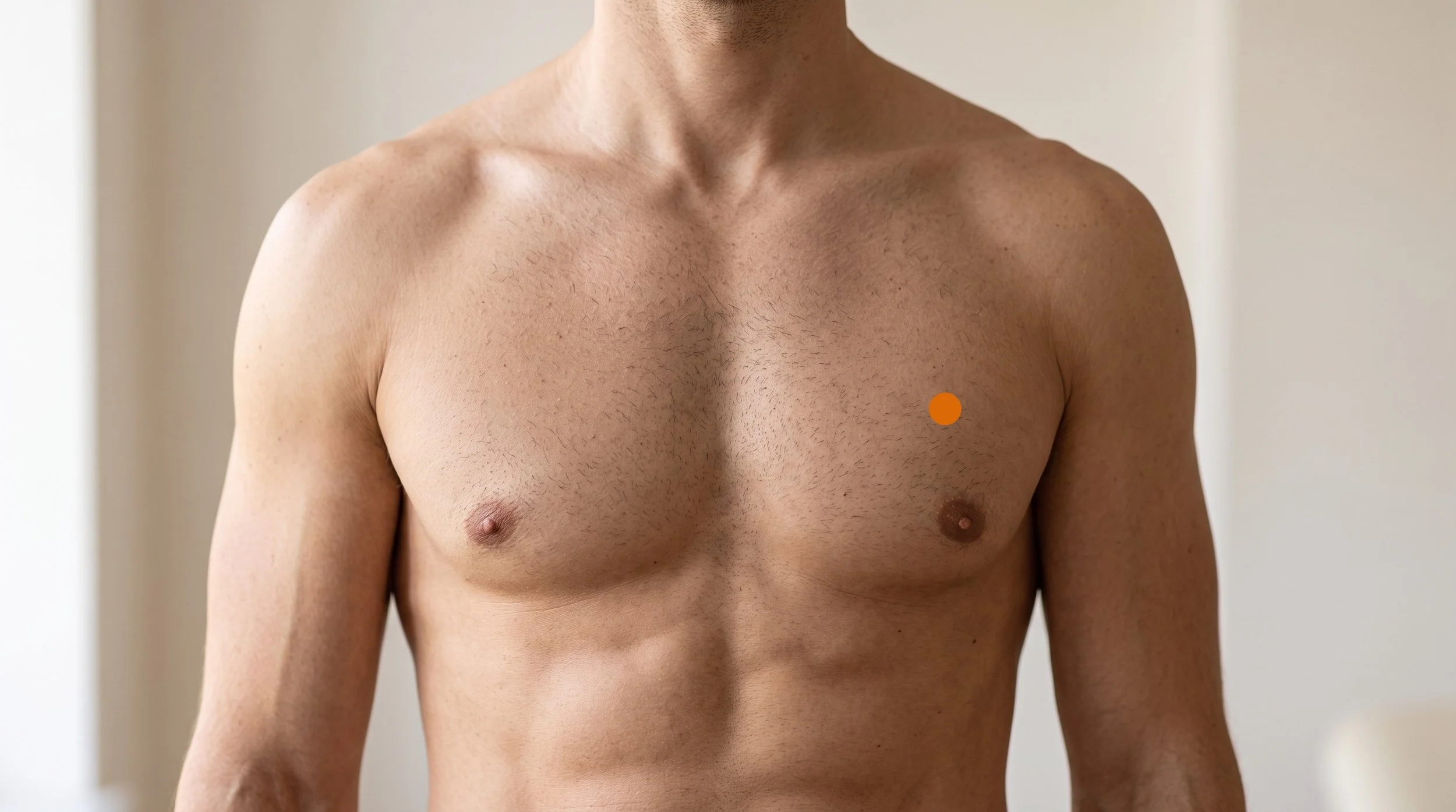
ST16 Acupuncture Point (Yingchuang)
The Breast Window in the Third Rib Space: Anatomy, Mechanism, and Why This Chest Point Sits Where Breathing, Breast Care, and Chest Wall Pain Overlap
ST16, known in Chinese as Yingchuang and usually translated as Breast Window, is the Stomach channel point that sits on the front of the chest in the third intercostal space, roughly four cun out from the midline on the nipple line and level with CV18.
In plain terms, it's one rib space above the nipple line landmark in most men and just above the upper edge of the breast in most women, resting on the fibers of pectoralis major with the intercostal muscles and, beneath them, the pleura and lung.
That anatomy explains both why the breast window point earns attention clinically and why it's needled with such discipline: the st16 acupuncture point gives direct access to the chest wall tissues that generate tightness, rib-space soreness, and the sense of a chest that will not fully expand, but it's always angled flat along the rib space rather than pushed straight in.
- Location and layers: stomach 16 lies in the third intercostal space on the mamillary line, level with CV18, with the needle passing through skin, superficial fascia, and pectoralis major before reaching the intercostal muscles (Deadman et al., 2007). Because the pleura sits immediately deep to that layer, insertion stays transverse or transverse-oblique at 0.5 to 0.8 cun.
- Traditional attributions, translated: classical sources credit ST16 with easing cough and wheezing and with benefiting the breasts, and list chest fullness with shortness of breath, restless sleep, fever and chills, and breast abscess among its indications (Deadman et al., 2007). Read neurophysiologically, that's a list of chest wall, respiratory, and autonomic complaints that share segmental territory.
- Nerve geography: the point sits in the sensory field of the anterior cutaneous branches of the upper thoracic intercostal nerves, whose dorsal horn segments also receive afferents from the lung, pleura, and breast, so stimulation here converges on the same spinal levels that process visceral chest sensation (Sato & Schmidt, 1973).
- Mechanism: needling recruits A-delta and C afferents that engage segmental inhibition and brainstem descending control involving opioid, serotonergic, and noradrenergic pathways, alongside local vascular and autonomic changes (Zhao, 2008; Sato & Schmidt, 1973). Chronic pain data from large individual patient meta-analyses suggest effects that exceed sham needling, though modestly (Vickers et al., 2018).
- Research picture: reviews of acupuncture for respiratory conditions remain mixed, with Cochrane finding insufficient evidence in chronic asthma (McCarney et al., 2004) while a placebo-controlled trial in COPD reported improved dyspnea on exertion (Suzuki et al., 2012). Breast-region evidence is early and comes mostly from mastalgia and lactation trials (Shi et al., 2024; Mangesi & Zakarija-Grkovic, 2016).
- De qi and practice framing: patients typically feel a shallow, spreading heaviness or warmth traveling along the rib space rather than a deep ache. Sharp, electric, or breath-catching sensations aren't the goal and prompt immediate repositioning, since pneumothorax is the most frequently reported serious adverse event in the acupuncture safety literature (He et al., 2012).
Chest Tightness or Rib Pain That Won't Let You Take a Full Breath?
Chest wall tension is often treated as a breathing problem when it's really a tissue problem: stiff intercostals, guarded pectoralis fibers, and a rib cage that stopped moving freely after illness, stress, or long desk hours.
At Morningside Acupuncture, ST16 is used as part of a chest-line strategy that pairs shallow needling in the rib space with breath work and treatment of the surrounding muscles. We map where your restriction actually lives before a single needle goes in. Schedule a visit and let's see how much easier your next full breath can be.
Schedule NowAnatomy of ST16: Why the Third Intercostal Space on the Nipple Line Is Such an Important Location
ST16 sits on the upper chest wall in the third intercostal space, about four cun lateral to the midline on the mamillary line and level with CV18 (Deadman et al., 2007). Under the skin and a thin layer of subcutaneous fat lie the fibers of pectoralis major running toward the humerus, and beneath those, the external and internal intercostal muscles bridging the third and fourth ribs. These are working tissues, not passive ones: pectoralis major loads with every push, press, and forward-reaching posture, while the intercostals contract with each breath and stiffen when breathing becomes shallow and apical.
Prolonged desk posture, coughing illnesses, anxious breathing patterns, and post-surgical guarding all leave their signature here as tenderness along the rib spaces and a chest that feels braced.
The sensory supply comes from the anterior cutaneous branches of the upper thoracic intercostal nerves, which carry information from skin, muscle, and periosteum back to the T3 and T4 spinal segments. Those same segments receive afferent traffic from the pleura, the airways, and the breast, which is the anatomical basis for referral in both directions: visceral irritation can be felt as chest wall soreness, and chest wall input can modulate how visceral sensation is processed.
Needling at this level activates small-diameter afferents that trigger segmental reflex changes in sympathetic outflow, a relationship documented in classic somatosympathetic reflex research (Sato & Schmidt, 1973), and recruits descending inhibitory pathways that dampen dorsal horn transmission through opioid and monoaminergic mechanisms (Zhao, 2008). Practically, that's why a shallow needle in a rib space can change how tight a whole chest feels.
Directly deep to the intercostal muscles is the parietal pleura, and behind it the lung. There's no soft margin for error, so ST16 is needled transverse-obliquely along the rib space, laterally or medially, or transversely along the channel line, at 0.5 to 0.8 cun, with deep or perpendicular insertion explicitly cautioned against because of the substantial risk of lung puncture (Deadman et al., 2007). Safety reviews consistently list pneumothorax among the most commonly reported serious acupuncture complications, almost always following inappropriately deep needling over the thorax (He et al., 2012).
Positioning matters too: the point is located above breast tissue, and needles are directed away from glandular tissue rather than into it. In practice this means a supine patient, a fingertip fixing the rib space, a fine needle, and a flat angle held from insertion to removal.
Related Pectoralis Major Trigger Points Related Intercostal Muscles Trigger PointsST16 at a Glance: Classification, Location, and Clinical Use
| Category | Detail |
|---|---|
| Traditional Name | Yingchuang (Breast Window) |
| Channel Classification | Sixteenth point of the Stomach channel of Foot Yangming, in the chest-line series that runs from ST13 down through ST18 |
| Point Categories | No five-shu, meeting, crossing, or hui-meeting designation appears in the standard references. ST16 is classified as a regional chest point of the Stomach channel, with traditional actions given as alleviating cough and wheezing and benefiting the breasts (Deadman et al., 2007). |
| Precise Location | On the chest in the third intercostal space, 4 cun lateral to the anterior midline on the nipple line, level with CV18. Find the second intercostal space at the sternal angle and count down one space. In men the nipple usually sits in the fourth intercostal space, so ST16 is one space above it. |
| Tissue Stimulated | Skin and subcutaneous fascia, fibers of pectoralis major, and the external and internal intercostal muscles of the third rib space, within anterior cutaneous intercostal nerve territory |
| Needle Depth / Direction | Transverse-oblique insertion along the intercostal space, medially or laterally, 0.5 to 0.8 cun, or transverse insertion up or down along the channel line. Deep or perpendicular needling is avoided because of the pleura beneath. |
| De Qi Sensation | A shallow, spreading heaviness, warmth, or mild tugging that travels along the rib space, often described as a band rather than a point. Sharp, electric, or breath-catching sensation is not expected and calls for immediate needle adjustment. |
| Primary Clinical Uses | Chest fullness with shortness of breath, cough and wheezing in classical use, chest wall and rib-space tenderness, breast tenderness and congestion in classical use, and restless sleep accompanied by chest oppression in classical use |
| Common Point Combinations |
|
In the Manual of Acupuncture, Deadman and colleagues present Yingchuang as a chest point traditionally used to ease cough and wheezing and to benefit the breasts, with an indication list that runs from fullness of the chest with shortness of breath to cough, restless sleep, fever and chills, swelling of the lips, rumbling in the abdomen with watery diarrhea, and breast abscess (Deadman et al., 2007). Two classical pairings from Supplementing Life are recorded: ST16 with LV3 for swelling of the lips, and ST16 with KI23 for breast abscess accompanied by chills and fever, shortness of breath, and disturbed sleep.
These are traditional attributions rather than modern clinical claims, and the older Chinese sources organized them by pattern rather than by diagnosis as we understand it today. What makes the grouping striking is its internal logic: a single spot on the upper chest was thought to influence breathing, breast inflammation, sleep quality, and even digestion, which is exactly the kind of clustering you'd expect from a point whose spinal segments receive both somatic and visceral input.
Why ST16 Is Used for Breathlessness and Restless Sleep, Not Just Breast Complaints
The oldest indication attached to Yingchuang isn't a breast complaint at all: it's fullness of the chest with shortness of breath. That makes sense once you look at the wiring. The tissues under ST16 report to the upper thoracic spinal segments, the same segments that receive afferent input from the airways, pleura, and thoracic sympathetic chain. Stimulating somatic afferents at a given segmental level produces measurable reflex changes in sympathetic outflow to structures sharing those segments, a principle established in decades of somatosympathetic reflex work (Sato & Schmidt, 1973).
Clinically, that translates into a plausible route by which chest wall needling may soften the guarding, shallow-breathing pattern that makes a tight chest feel like a lung problem.
There's a second, less segmental layer. Needling engages descending inhibitory systems from the periaqueductal gray and rostral ventromedial medulla, releasing endogenous opioids, serotonin, and noradrenaline into the dorsal horn, which lowers the gain on incoming nociceptive traffic system-wide (Zhao, 2008). In the largest pooled analysis of individual patient data across chronic pain conditions, acupuncture outperformed both sham needling and no-acupuncture control, with effects that persisted over time even though the difference from sham was modest (Vickers et al., 2018).
For someone whose sleep is broken by chest discomfort, that combination of local desensitization and central modulation is the most reasonable explanation for the classical association between this point and restless sleep with chest oppression.
Respiratory evidence deserves a straight answer: it's mixed. Cochrane's review of acupuncture for chronic asthma concluded that trial quality was variable and results inconsistent, leaving insufficient evidence for recommendations (McCarney et al., 2004). On the other hand, a placebo-controlled trial in patients with COPD receiving standard medication found improvement in dyspnea on exertion in the acupuncture group (Suzuki et al., 2012). Neither body of work isolates ST16, and neither should be read as a claim that a chest point treats lung disease.
What they support is a narrower and more honest position: acupuncture may help with the symptom of breathlessness and the chest wall tension that accompanies it, as part of medical care rather than instead of it.
What the Research Shows for ST16
No trial has tested ST16 by itself, and that's true of nearly every individual acupuncture point. Studies test protocols, usually with six to fifteen points chosen for a condition, so the honest framing is that ST16 appears as one component of chest-region and respiratory protocols rather than as an independently validated intervention. The table below summarizes the evidence closest to this point's traditional territory: respiratory symptoms, breast pain, lactation-related breast inflammation, general pain mechanisms, and safety. Read it as context for clinical reasoning, not as proof that a single point does anything on its own.
| Study | Type | Focus | Key Finding |
|---|---|---|---|
| McCarney et al., 2004 | Cochrane systematic review | Acupuncture for chronic asthma | Trials were of variable quality with inconsistent results, so the reviewers found insufficient evidence to make recommendations. |
| Suzuki et al., 2012 | Randomized placebo-controlled trial | Dyspnea on exertion in COPD patients on standard medication | The acupuncture group showed greater improvement in exertional breathlessness than placebo needling, though the trial was single-region and needs replication. |
| Shi et al., 2024 | Systematic review and meta-analysis | Acupuncture for cyclic and noncyclic breast pain | Pooled randomized trials suggested possible reductions in breast pain with few reported adverse events, while methodological limitations temper confidence. |
| Mangesi & Zakarija-Grkovic, 2016 | Cochrane systematic review | Treatments for breast engorgement during lactation | Compared with usual care, women receiving acupuncture had lower rates of fever and less severe symptoms by day five, but evidence quality across included treatments was low. |
| Vickers et al., 2018 | Individual patient data meta-analysis | Acupuncture for chronic pain across conditions | Acupuncture was superior to sham and to no-acupuncture control, with modest but persistent effect sizes. |
| Zhao, 2008 | Narrative mechanism review | Neural mechanisms of acupuncture analgesia | Analgesic effects are attributed to afferent-driven segmental inhibition plus descending opioid and monoaminergic control rather than to any single local action. |
| He et al., 2012 | Systematic review of adverse events | Safety reports in the Chinese literature, 1956 to 2010 | Pneumothorax ranked among the most frequently reported serious events, reinforcing shallow, angled technique over the thorax. |
Breast Tenderness, Congestion, and Cyclical Chest Discomfort?
Classical texts placed Yingchuang above the breast for a reason, and modern clinical work continues to use the chest-line points for tenderness, congestion, and the heavy, full feeling that comes and goes with the cycle. Our licensed acupuncturists combine cautious local needling above breast tissue with distal points and manual work, always inside a plan that respects medical workup for any new breast change. Nothing here replaces imaging or your physician's evaluation. Book an appointment and we'll build a plan that fits alongside your medical care.
Schedule NowST16 in the Context of Trigger Point Work
Acupuncture, defined simply as treatment using an acupuncture needle, includes hundreds of styles, and dry needling is one of them. At Morningside, the st 16 chest location often does double duty: it's a classical Stomach channel point and it sits directly over the clavicular and sternal fibers of pectoralis major in the third rib space.
Trigger points in pectoralis major are well documented as producers of anterior chest, breast, and medial arm pain that patients frequently mistake for something cardiac (Simons et al., 1999), and taut bands in the intercostals contribute a sharp, localized rib-space ache that worsens with a deep breath or a cough. When we palpate ST16 and find a tender, ropey band rather than a diffusely sore area, the treatment target becomes muscular, and the needling stays every bit as shallow and flat as it would for the classical point.
A typical session layers the two frameworks. We might needle ST16 transversely along the rib space, then treat pectoralis major and pectoralis minor away from the chest wall using safe angles over the rib rather than between ribs, add serratus anterior when the lateral chest is involved, and finish with distal points that support parasympathetic tone and easier breathing. Over the thorax, technique discipline is the whole game: needles stay in-plane, depth is conservative, and any sudden sharp or breath-related sensation ends that insertion.
Patients with a history of lung disease, bullae, thoracic surgery, or bleeding disorders get an even more conservative approach, and when the picture suggests cardiac, pulmonary, or breast pathology, the referral comes first.
ST16 Chest and Breast Region Treatment at NYC's Highest-Rated Acupuncture Clinic
Morningside Acupuncture is the highest-rated acupuncture and dry needling clinic in New York City with over 500 five-star Google reviews, and chest wall complaints are a regular part of our caseload. We use ST16 alongside dry needling of pectoralis major, pectoralis minor, and the intercostals, plus autonomic-focused points that support calmer, fuller breathing. Every chest treatment follows strict flat-needle technique and clear informed consent. Schedule your session and get an assessment that treats the whole chest, not just the sore spot.
Schedule NowFrequently Asked Questions
What does ST16 feel like when needled?
Most people feel very little at insertion because the needle is fine and stays shallow. Within a few seconds there's usually a mild spreading heaviness, a soft warmth, or a light tugging that travels along the rib space rather than sitting in one dot. Some patients notice the chest feels looser on that side or that a breath goes in a little further. What you should not feel is a sharp jab, an electric zing, or any sensation tied to breathing in, and if that happens your practitioner will adjust or remove the needle right away.
Why needle the chest itself instead of a distal point on the arm or leg?
Both approaches have a rationale, and good treatment usually uses both. Distal points work largely through central and descending mechanisms, while local chest points act on the tissues and spinal segments where the problem actually lives: the intercostal muscles, pectoralis fibers, and the upper thoracic dorsal horn segments that also receive input from the airways and breast (Sato & Schmidt, 1973; Zhao, 2008). When someone's complaint is rib-space tenderness, chest tightness, or a chest that won't expand, treating the segment directly gives feedback you can palpate before and after. ST16 is chosen when the chest wall itself is part of the problem, not just a place where symptoms are felt.
Can I press ST16 myself between sessions?
Yes, acupressure at this location is safe because fingers can't do what a needle can. Lie down or sit comfortably, find the sternal angle where the second rib meets the breastbone, slide out along that second rib space, then drop down one more space to the third. Move about four finger-widths out from the midline and you'll be in the right neighborhood, above breast tissue and over the pectoralis fibers. Press with a fingertip or thumb at moderate, comfortable pressure for 30 to 60 seconds, then breathe slowly into the ribs under your hand for another 30 seconds. Repeat two or three times per side, once or twice a day. Stop if pressure produces sharp pain, and see your physician rather than self-treating for any new lump, skin change, nipple discharge, fever with breast redness, or chest pain with exertion, sweating, or breathlessness.
Is ST16 safe to needle?
It's safe in trained hands and unforgiving in untrained ones. The pleura and lung sit directly beneath the intercostal muscles here, which is why the standard references specify transverse or transverse-oblique insertion at 0.5 to 0.8 cun and caution explicitly against deep or perpendicular needling (Deadman et al., 2007). Safety reviews list pneumothorax as one of the most frequently reported serious acupuncture complications, and it's overwhelmingly a technique problem rather than a point problem (He et al., 2012). At Morningside, chest needling is done supine, with the rib space fixed by the practitioner's fingers, a shallow angle held throughout, and clear instructions to report any sharp or breath-related sensation immediately. Anyone with significant lung disease, prior thoracic surgery, or a bleeding disorder should mention it before treatment.
Where exactly is ST16 located?
ST16 is on the front of the chest in the third intercostal space, about four cun lateral to the anterior midline on the nipple line, level with CV18 on the sternum (Deadman et al., 2007). The reliable way to find it is to locate the sternal angle, the small ridge where the manubrium meets the body of the sternum, which marks the second rib. The space just below that rib is the second intercostal space; count down one more and you're at the third, which is ST16's level. In men the nipple typically lies in the fourth intercostal space, so ST16 sits one space above it, and in women the point falls above the upper border of the breast rather than on it.
References
- Deadman, P., Al-Khafaji, M., & Baker, K. (2009). A manual of acupuncture. Journal of Chinese Medicine Publications.
- O'Connor, J., & Bensky, D. (Eds. & Trans.). (1981). Acupuncture: A comprehensive text. Shanghai College of Traditional Medicine. Eastland Press.
- Kim, H. (2008). Handbook of Oriental medicine (3rd ed.). Harmony & Balance Press.
- Cunningham, P. M. (2000). Acupuncture points: A practical guide to classical and modern usage. Odyssey Press.
- Simons, D. G., Travell, J. G., & Simons, L. S. (1999). Travell & Simons' myofascial pain and dysfunction: The trigger point manual, Vol. 1: Upper half of body (2nd ed.). Williams & Wilkins.
- McCarney, R. W., Brinkhaus, B., Lasserson, T. J., & Linde, K. (2004). Acupuncture for chronic asthma. Cochrane Database of Systematic Reviews, 2004(1), CD000008. https://doi.org/10.1002/14651858.CD000008.pub2
- Suzuki, M., Muro, S., Ando, Y., Omori, T., Shiota, T., Endo, K., Sato, S., Aihara, K., Matsumoto, M., Suzuki, S., Itotani, R., Ishitoko, M., Hara, Y., Takemura, M., Ueda, T., Kagioka, H., Hirabayashi, M., Fukui, M., & Mishima, M. (2012). A randomized, placebo-controlled trial of acupuncture in patients with chronic obstructive pulmonary disease (COPD): The COPD-acupuncture trial (CAT). Archives of Internal Medicine, 172(11), 878-886. https://doi.org/10.1001/archinternmed.2012.1233
- Shi, H., Chen, H., Gao, S., Fang, J., Zhu, L., & Liu, Z. (2024). Acupuncture for cyclic and noncyclic breast pain in women: A systematic review and meta-analysis of randomized controlled trials. European Journal of Integrative Medicine, 68, 102355. https://doi.org/10.1016/j.eujim.2024.102355
- Mangesi, L., & Zakarija-Grkovic, I. (2016). Treatments for breast engorgement during lactation. Cochrane Database of Systematic Reviews, 2016(6), CD006946. https://doi.org/10.1002/14651858.CD006946.pub3
- He, W., Zhao, X., Li, Y., Xi, Q., & Guo, Y. (2012). Adverse events following acupuncture: A systematic review of the Chinese literature for the years 1956-2010. Journal of Alternative and Complementary Medicine, 18(10), 892-901. https://doi.org/10.1089/acm.2011.0825
- Sato, A., & Schmidt, R. F. (1973). Somatosympathetic reflexes: Afferent fibers, central pathways, discharge characteristics. Physiological Reviews, 53(4), 916-947. https://doi.org/10.1152/physrev.1973.53.4.916
- Zhao, Z. Q. (2008). Neural mechanism underlying acupuncture analgesia. Progress in Neurobiology, 85(4), 355-375. https://doi.org/10.1016/j.pneurobio.2008.05.004
- Vickers, A. J., Vertosick, E. A., Lewith, G., MacPherson, H., Foster, N. E., Sherman, K. J., Irnich, D., Witt, C. M., & Linde, K. (2018). Acupuncture for chronic pain: Update of an individual patient data meta-analysis. Journal of Pain, 19(5), 455-474. https://doi.org/10.1016/j.jpain.2017.11.005
Disclaimer: This web site is intended for educational and informational purposes only. Reading this website does not constitute providing medical advice or any professional services. This information should not be used for diagnosing or treating any health issue or disease. Those seeking medical advice should consult with a licensed physician. Seek the advice of a medical doctor or other qualified health professional for any medical condition. If you think you have a medical emergency, call 911 or go to the emergency room. No acupuncturist-patient relationship is created by reading this website or using the information. Morningside Acupuncture PLLC and its employees and contributors do not make any express or implied representations with respect to the information on this site or its use. For any legal interpretation of scope of practice in your state, consult a licensed attorney or regulatory authority.
Read more from our blog



