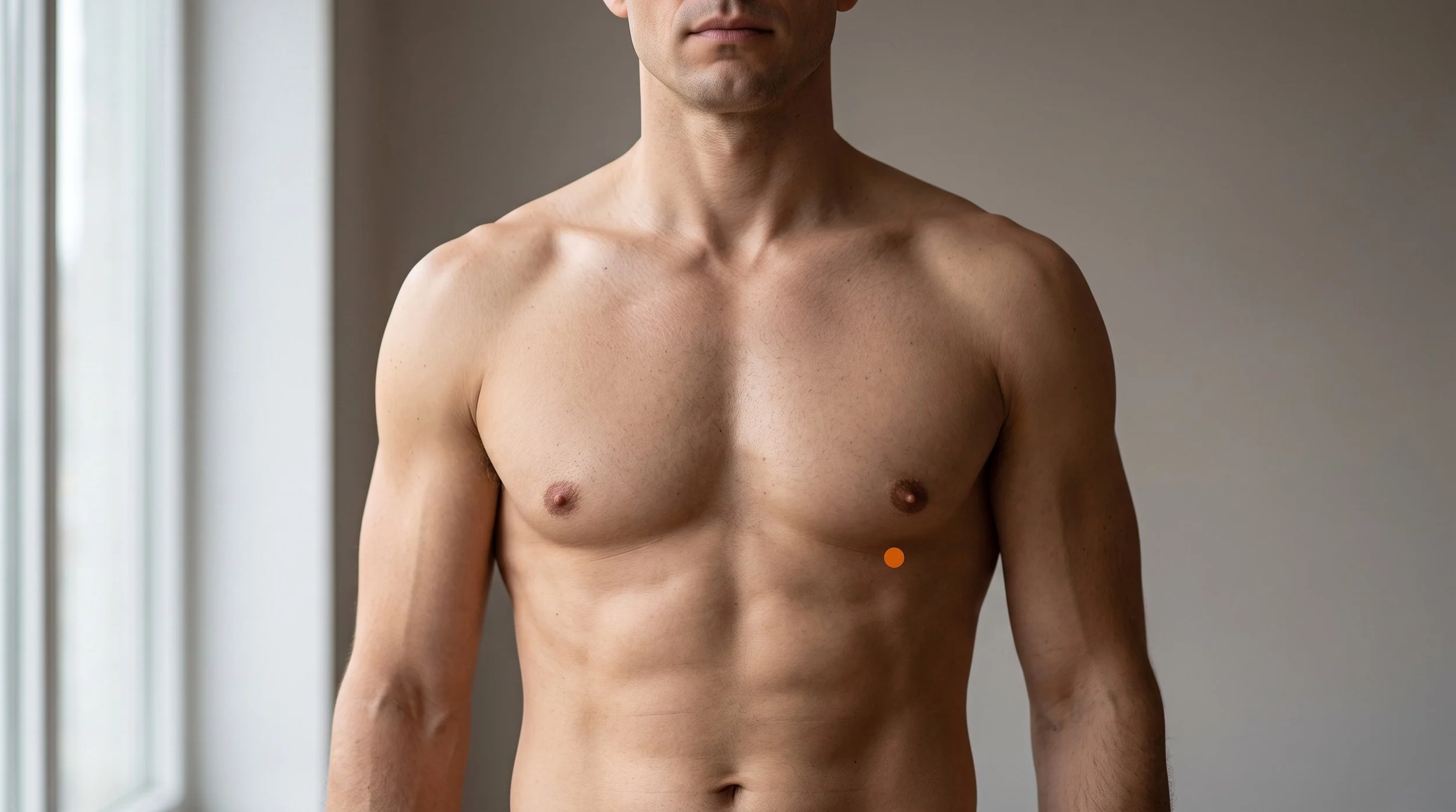
ST18 Acupuncture Point (Rugen)
The Root of the Breast in the Fifth Intercostal Space: Anatomy, Segmental Mechanism, and Why This Chest Point Anchors Breast and Rib Cage Treatment
ST18 (Rugen, often translated as Root of the Breast) is the eighteenth point of the Stomach channel and sits on the front of the chest in the fifth intercostal space, directly below the nipple line. In women it falls at the inframammary fold, in the crease beneath the breast tissue rather than on it, which is exactly why the classical texts named it a root. Anatomically it is a thin, highly innervated window over the intercostal muscles at the lower edge of pectoralis major, in the same spinal segments that supply the breast, the chest wall, and part of the diaphragmatic pleura.
Clinically it matters for two reasons: it is the classical principal local point for breast complaints (pain, tenderness, swelling, lactation problems), and it is a practical local point for anterior rib cage and chest wall pain, provided the needle is angled flat along the rib space rather than into the chest.
- ST18 lies in the fifth intercostal space on the mammillary line, at the lower border of the breast, with only skin, fascia, the tapering fibers of pectoralis major, and the external and internal intercostals between the needle tip and the pleura (Deadman et al., 2007; Cheng, 2010).
- Traditional sources describe ST18 as benefiting the breast, reducing swelling, unbinding the chest, and easing cough and wheezing, language that maps onto local nociceptive modulation, chest wall muscle relaxation, and altered autonomic tone rather than any literal flow of substance (Deadman et al., 2007; Kim, 2015).
- The point sits in fifth intercostal nerve territory (T5), the same segment that carries sensation from much of the breast and lower anterior chest, so needling here converges with breast and rib cage afferents in the dorsal horn, a plausible route for segmental inhibition (Zhao, 2008).
- The research picture is modest but consistent in direction: a 2024 systematic review of acupuncture for cyclic and noncyclic breast pain reported favorable pain outcomes with few adverse events, while Cochrane's engorgement review judged the trial evidence too limited for firm conclusions (Shi et al., 2024; Zakarija-Grkovic & Stewart, 2020).
- In practice ST18 is almost never used alone; it is one segmental anchor within a protocol that usually includes distal points, and individual patient data analyses suggest much of acupuncture's benefit in chronic pain reflects the total treatment rather than a single location (Vickers et al., 2018).
- De qi at ST18 is typically a broad, spreading heaviness or fullness across the front of the chest rather than a sharp point sensation, because the needle is laid nearly flat under the skin along the rib space (Shanghai College of Traditional Chinese Medicine, 1981).
Dealing With Breast Tenderness or Chest Wall Pain in NYC?
Cyclical breast tenderness, postpartum breast discomfort, and anterior rib cage pain all involve the same thoracic segments, and ST18 sits right in the middle of that territory. At Morningside Acupuncture we combine gentle, flat-angled needling at the root of the breast point with distal Stomach and Liver channel points and, where appropriate, dry needling of the chest wall muscles that refer pain into the same area. Every treatment starts with a full intake so that anything requiring medical evaluation gets referred first. Schedule a visit and we'll map your pattern before a single needle goes in.
Schedule NowAnatomy of ST18: Why the Fifth Intercostal Space at the Breast Root Is Such an Important Location
ST18 sits at the inframammary fold in the fifth intercostal space, on the vertical line dropped from the nipple. Locating it means counting rib spaces rather than trusting the nipple itself: in men the nipple usually sits in the fourth space, and in women breast shape and position make the nipple unreliable as a landmark, so the point is found by palpating down from the second rib space and then following the crease at the base of the breast (Deadman et al., 2007). The tissue there is thin.
Under the skin and superficial fascia lie the tapering lower fibers of pectoralis major, then the external and internal intercostal muscles bridging the fifth and sixth ribs. These layers get loaded by forward head and rounded shoulder postures, by heavy carrying and nursing positions, by chronic upper chest breathing, and by the guarded shallow breathing that follows any painful chest condition.
The nerve geography is what makes this location clinically interesting. The anterior and lateral cutaneous branches of the fifth intercostal nerve supply the skin and muscle here, and the same thoracic segments carry afferent traffic from the breast and the lower anterior chest wall (Cheng, 2010). When a needle stimulates A-delta and group III fibers in this territory, that input reaches dorsal horn neurons that also receive convergent signals from the breast and chest wall, which is the standard segmental explanation for why a local needle can quiet pain arising from deeper structures in the same segment.
Needling also recruits descending inhibitory pathways from the periaqueductal gray and rostral ventromedial medulla and triggers endogenous opioid and monoaminergic release, mechanisms that have been mapped in considerable detail (Zhao, 2008). Local effects matter too: needling produces measurable changes in cutaneous and muscular blood flow and in local inflammatory signaling, which is a more grounded way to read the traditional language about reducing swelling and stagnation in the breast area.
Deep to those thin muscle layers is the parietal pleura and the lung, and this is not a theoretical concern. Pneumothorax is repeatedly identified as the most common serious complication reported in acupuncture case literature, with chest, supraclavicular, and back insertions accounting for most cases (Wu et al., 2015). The standard convention for ST18 is therefore a transverse or shallow oblique insertion of roughly 0.5 to 1 cun, running medially or laterally along the intercostal space or upward and downward along the channel, and never perpendicular or deep (Deadman et al., 2007).
Classical sources also permit moxibustion here (Kim, 2015). At Morningside the needle is laid almost parallel to the chest wall, depth is kept conservative, and the point is skipped entirely when a patient's anatomy, body position, or medical history makes flat needling impractical.
Related Intercostal Muscles Trigger Points Related Pectoralis Major Trigger PointsST18 at a Glance: Classification, Location, and Clinical Use
| Category | Detail |
|---|---|
| Traditional Name | Rugen (Root of the Breast), also written as ST 18, Stomach 18, or ST-18 |
| Channel Classification | Eighteenth point of the Stomach channel of Foot Yangming, on the anterior chest wall; part of the chest series that runs from ST12 down to the costal margin |
| Point Categories | No five-shu, luo-connecting, xi-cleft, front-mu, or extraordinary vessel designations are recorded for this point in the classical literature. It is classified functionally rather than categorically: the principal local point for the breast, where the yangming channel crosses the base of the breast, with traditional actions given as benefiting the breast and reducing swelling, and unbinding the chest to ease cough and wheezing (Deadman et al., 2007; Kim, 2015). Standard texts also list it among the core local points for disorders of a specific organ or structure (Cunningham, 2019). |
| Precise Location | On the chest in the fifth intercostal space, directly below the nipple on the mammillary line, approximately 4 cun lateral to the anterior midline. In women it lies at the root of the breast, in the inframammary crease below the breast tissue itself. Count rib spaces down from the second intercostal space rather than using the nipple as a reference in female patients. |
| Tissue Stimulated | Skin and superficial fascia over the lower border of pectoralis major and the external and internal intercostal muscles of the fifth rib space; the point overlaps referral territory associated with pectoralis major and the intercostals |
| Needle Depth / Direction | Transverse-oblique insertion along the intercostal space, medially or laterally, 0.5 to 1 cun, or transverse insertion upward or downward along the channel. Deep or perpendicular needling is avoided because of substantial lung puncture risk. Moxibustion is traditionally applicable. |
| De Qi Sensation | Local distension, soreness, and a spreading heaviness across the front of the chest; some patients report a deep, weighted fullness behind the sternum rather than a sensation at the needle itself |
| Primary Clinical Uses | Breast pain and tenderness, breast swelling and mastitis-pattern presentations alongside medical management, lactation difficulties in classical use, chest and rib cage pain, and chest oppression with cough in classical use |
| Common Point Combinations |
|
Deadman's Manual of Acupuncture presents ST18 as the principal local point for disorders of the breast, and the reasoning behind that status is worth understanding as a traditional attribution rather than a physiological claim. The classical argument, credited to the Jin-Yuan physician Zhu Dan-xi, is that the Stomach yangming channel traverses the breast while the nipple belongs to the Liver jueyin, so essentially every breast complaint was read as a disturbance of one or both of those channels.
Because ST18 was said to regulate qi and blood across the whole breast region, the texts recommended it for any excess-type presentation involving pain, distension, swelling, or abscess, whether the attributed cause was Stomach heat or constrained Liver qi.
Nursing mothers received particular attention: rich food, held resentment, improper suckling, or exposure of the breast to external pathogenic influences were all described as producing stagnation that could transform into heat and pus, and scanty milk was attributed either to Liver qi failing to move freely or to Stomach and Spleen deficiency failing to produce enough qi and blood. The Great Compendium adds chest and diaphragm complaints to its remit, and the Ode of Xi-hong even mentions the point in connection with hastening labor, though the classical literature does not contraindicate it in pregnancy.
What is striking is the anatomical honesty of the whole picture: a tradition without modern neuroanatomy still converged on the fifth rib space at the base of the breast, precisely the segmental level that carries the breast's own innervation.
Why ST18 Is Used for Chest Tightness and Cough, Not Just Breast Complaints
Patients are often surprised that a point named for the breast appears in treatments for chest oppression, rib cage pain, and a persistent tight cough. The segmental explanation is straightforward. The fifth intercostal nerve supplying ST18 enters the spinal cord at a level that also receives afferent input from the chest wall, parts of the pleura, and the breast, so all of that traffic converges on shared dorsal horn neurons.
Stimulating a needle in that territory delivers a strong, well-defined sensory input into the same segmental gate, which can reduce the excitability of neurons receiving pain signals from deeper structures nearby (Zhao, 2008). This is the same logic behind treating any local point near a painful structure, and it does not require the point to have unique properties: it requires it to be in the right segment.
Beyond the segment, needling engages descending inhibitory control from the brainstem along with endogenous opioid and monoaminergic mechanisms, which is why patients often notice effects beyond the immediate area, including a general settling of breathing and a less guarded posture (Zhao, 2008). There is a mechanical dimension too. The lower fibers of pectoralis major and the intercostals at this level are commonly tender and short in people who breathe apically, who carry infants, or who have been protecting the chest after an injury or a long respiratory illness. Reducing tone in those tissues changes how the lower ribs move, and patients frequently report that the chest simply feels less bound afterward.
Realistically, ST18 is a contributor rather than a soloist. The large individual patient data analysis of acupuncture for chronic pain found reliable benefits over both sham and usual care, with differences between true and sham points that were real but modest, which suggests that the total treatment (needle stimulation, dose, and clinical context) drives much of the effect (Vickers et al., 2018). That is exactly how we use the root of the breast point: as the local anchor of a protocol, chosen because of where it is.
What the Research Shows for ST18
Almost no trial has isolated ST18 on its own, so the honest framing is that this point appears inside multi-point protocols and is evaluated as part of them. Breast-related acupuncture research is also uneven: several relevant reviews draw heavily on Chinese-language trials with methodological limitations, and the outcome measures used for engorgement and mastalgia vary considerably.
What the literature does support is that acupuncture protocols including chest and breast points are generally well tolerated and may reduce breast pain, while the evidence for lactation-related outcomes is preliminary and should never displace lactation consultation, medical evaluation, or antibiotics when they are indicated. Notably, ST18 (Rugen) appears explicitly among the protocol points listed in trials pooled by at least one recent breast pain meta-analysis, which is about as close to point-specific evidence as this location currently gets.
| Study | Type | Focus | Key Finding |
|---|---|---|---|
| Shi et al., 2024 | Systematic review and meta-analysis of RCTs | Acupuncture for cyclic and noncyclic breast pain in women | The authors concluded acupuncture may be a useful adjunct for relieving breast pain, with effects comparable to tamoxifen in cyclic pain and better than antibiotics for mastitis-related pain in the pooled trials, though certainty of evidence was low. |
| Li et al., 2024 | Systematic review and meta-analysis of eight RCTs | Acupuncture for mammary hyperplasia, with ST18 among the protocol points used | Pooled results favored acupuncture for breast pain and lump characteristics, but the authors judged the evidence insufficient in quality and called for more rigorous trials. |
| Zakarija-Grkovic & Stewart, 2020 | Cochrane systematic review | Treatments for breast engorgement during lactation, including acupuncture trials | The review found the evidence for all engorgement treatments, acupuncture included, too limited and heterogeneous to support firm recommendations. |
| Kvist et al., 2007 | Randomized controlled trial (205 mothers) | Acupuncture plus care interventions for inflammatory breast symptoms during lactation | Symptom severity scores differed in favor of the acupuncture groups on some contact days, but there were no significant differences in recovery time or antibiotic prescription, and the authors emphasized the central role of skilled breastfeeding care. |
| Bautista-Hernández et al., 2024 | Systematic review and meta-analysis | Acupoint stimulation for hypogalactia (insufficient milk production) | Pooled data suggested acupoint stimulation may increase milk quantity, though study quality and heterogeneity limit how confidently this can be applied. |
| Vickers et al., 2018 | Individual patient data meta-analysis | Acupuncture for chronic pain across roughly 20,000 patients | Acupuncture outperformed both sham and no-acupuncture controls for chronic pain, with effects that persisted over time, supporting its use as a reasonable referral option. |
| Zhao, 2008 | Narrative review of mechanism research | Neural mechanisms of acupuncture analgesia | Analgesic effects are attributed to segmental spinal inhibition plus descending control involving endogenous opioid and monoaminergic systems. |
| Wu et al., 2015 | Systematic review of adverse event case reports | Complications reported in the Chinese acupuncture literature, 1980 to 2013 | Pneumothorax was the most frequently reported serious complication, with chest, supraclavicular, and back insertions predominating, underscoring why chest points are needled transversely. |
Tight Chest, Shallow Breathing, and Rib Cage Restriction?
Chest oppression with a cough or a persistently guarded breathing pattern often has a muscular and segmental component that responds well to careful local work. ST18 is one of the points we use to address the fifth rib space, alongside pectoralis and intercostal release and breathing retraining. Patients frequently describe the chest feeling less braced within a session or two. Book an appointment and we'll assess how your rib cage is actually moving.
Schedule NowST18 in the Context of Trigger Point Work
ST18 sits in territory that myofascial pain practitioners know well. The lower fibers of pectoralis major and the intercostals of the fourth through sixth rib spaces are classic sources of anterior chest wall pain, and pectoralis major in particular can refer pain into the breast and chest in a distribution that patients describe in terms very close to the classical indications for this point (Simons et al., 1999).
When we needle in this region at Morningside, the distinction between an acupuncture point and a trigger point target is often a distinction of intent rather than location: the same fifth rib space serves both frameworks, and the needle handling is identical, flat and shallow along the intercostal space.
In a typical session for anterior chest wall pain we might combine ST18 with careful dry needling of pectoralis major along its lower border, pectoralis minor when the coracoid region is involved, and the intercostals at the tender segments, then add distal points to recruit broader descending inhibition. Breathing work is part of the plan, since chronically apical breathing keeps these tissues loaded.
As always, chest wall needling is preceded by screening: pain in this region can have cardiac, pulmonary, or breast pathology behind it, and anything that raises concern is referred for medical evaluation before we treat locally.
ST18 Breast and Chest Wall Treatment at NYC's Highest-Rated Acupuncture Clinic
Morningside Acupuncture is the highest-rated acupuncture and dry needling clinic in New York City with over 500 five-star Google reviews, and our approach pairs classical point selection with modern pain science and strict safety protocols for chest points. When we use the stomach 18 point we needle transversely along the rib space, never perpendicular, and we explain exactly what we're doing and why. If breast pain, chest tightness, or rib cage discomfort is limiting you, schedule your visit today.
Schedule NowFrequently Asked Questions
What does ST18 feel like when needled?
Because the needle is inserted almost flat under the skin and threaded along the rib space, most people feel a mild pinch at insertion followed by a broad, spreading heaviness or fullness across the front of the chest rather than a sharp local sensation. Classical descriptions of de qi here mention distension and soreness locally, sometimes with a deep, weighted feeling behind the sternum (Shanghai College of Traditional Chinese Medicine, 1981). Some patients notice their breathing drop lower and slower within a minute or two. Sharp, burning, or radiating pain is not expected and should be reported right away so the needle can be adjusted or removed.
Why needle the breast root instead of a distal point on the leg or hand?
Both approaches are used, and a good protocol usually includes both. ST18 is chosen because it sits in the same spinal segment as the breast and lower anterior chest wall, which allows for segmental convergence: local needle input can reduce the excitability of the dorsal horn neurons that also receive pain signals from those deeper structures (Zhao, 2008). Distal points such as LV3, ST36, ST39, and SI1 are added because they engage broader descending inhibition and because the classical formulas pair local and distal points precisely this way. In practice, when local needling is not appropriate for a given patient, the distal points can carry more of the treatment.
Can I press ST18 myself between sessions?
Yes, and acupressure is a reasonable self-care option at this location because pressure carries none of the depth risk that needling does. Find the fifth rib space by counting down from the second, then follow the crease at the base of the breast to the line below the nipple. Use flat fingertip pressure directed along the rib space, not straight into the chest, at a firmness that feels like a solid ache rather than a sharp pain. Hold for 30 to 60 seconds, release, and repeat two or three times per side, once or twice a day, ideally paired with slow nasal breathing that lets the lower ribs expand. Stop immediately if pressure produces sharp pain, if the area is red, hot, or acutely inflamed, or if there is any undiagnosed lump, skin change, or nipple discharge, all of which need medical evaluation rather than self-treatment.
Is ST18 safe to needle?
It is safe in trained hands and unforgiving of carelessness. The lung lies close beneath the thin muscle layers here, and the classical texts explicitly warn that deep or perpendicular insertion carries a substantial risk of puncturing it (Deadman et al., 2007). Reviews of acupuncture adverse event reports consistently identify pneumothorax as the most common serious complication, with chest insertions among the leading sites (Wu et al., 2015). This is why the point is needled transversely or at a shallow oblique angle to a depth of about 0.5 to 1 cun, with the practitioner tracking the needle path along the rib space rather than across it. We also screen carefully first, since chest pain can have cardiac, pulmonary, or breast causes that require medical workup. Anyone with a bleeding disorder, on anticoagulants, with breast implants or recent chest surgery, or who is pregnant should tell their acupuncturist so the plan can be adjusted.
Where exactly is ST18 located?
ST18 is on the chest in the fifth intercostal space, on the vertical line running down from the nipple, roughly 4 cun lateral to the midline. In women it sits at the root of the breast, in the inframammary crease below the breast tissue rather than on it. The reliable way to find it is to locate the second intercostal space first and count down three spaces, because nipple position varies: in men the nipple typically overlies the fourth space, and in women it is not a dependable landmark at all (Deadman et al., 2007). Palpating the crease under the breast and confirming the rib space with a fingertip is the standard clinical method.
References
- Deadman, P., Al-Khafaji, M., & Baker, K. (2009). A manual of acupuncture. Journal of Chinese Medicine Publications.
- Cheng, X. (Ed.). (1999). Chinese acupuncture and moxibustion (Rev. ed.). Foreign Languages Press.
- O'Connor, J., & Bensky, D. (Eds. & Trans.). (1981). Acupuncture: A comprehensive text. Shanghai College of Traditional Medicine. Eastland Press.
- Kim, H. (2008). Handbook of Oriental medicine (3rd ed.). Harmony & Balance Press.
- Maciocia, G. (2006). The channels of acupuncture: Clinical use of the secondary channels and eight extraordinary vessels. Churchill Livingstone Elsevier.
- Maciocia, G. (2005). The foundations of Chinese medicine: A comprehensive text for acupuncturists and herbalists (2nd ed.). Elsevier Churchill Livingstone.
- Cunningham, P. M. (2000). Acupuncture points: A practical guide to classical and modern usage. Odyssey Press.
- Simons, D. G., Travell, J. G., & Simons, L. S. (1999). Travell & Simons' myofascial pain and dysfunction: The trigger point manual, Vol. 1: Upper half of body (2nd ed.). Williams & Wilkins.
- Shi, H., Chen, H., Gao, S., Fang, J., Zhu, L., & Liu, Z. (2024). Acupuncture for cyclic and noncyclic breast pain in women: A systematic review and meta-analysis of randomized controlled trials. European Journal of Integrative Medicine, 68, 102355. https://doi.org/10.1016/j.eujim.2024.102355
- Li, J., Zhang, D., Hu, J., Cui, J., & Mansoor, K. M. (2024). The effectiveness and safety of acupuncture for mammary hyperplasia: A systematic review and meta-analysis. Journal of Pain Research, 17, 1761-1772. https://doi.org/10.2147/JPR.S457039
- Zakarija-Grkovic, I., & Stewart, F. (2020). Treatments for breast engorgement during lactation. Cochrane Database of Systematic Reviews, 2020(9), CD006946. https://doi.org/10.1002/14651858.CD006946.pub4
- Kvist, L. J., Hall-Lord, M. L., Rydhstroem, H., & Wilde Larsson, B. (2007). A randomised-controlled trial in Sweden of acupuncture and care interventions for the relief of inflammatory symptoms of the breast during lactation. Midwifery, 23(2), 184-195. https://doi.org/10.1016/j.midw.2006.02.003
- Bautista-Hernández, M. A., Argueta-Figueroa, L., Gómez-Jiménez, D. C., & Torres-Rosas, R. (2024). Evidence of the acupuncture points stimulation for the treatment of hypogalactia: A systematic review and meta-analysis. Enfermería Clínica (English Edition), 34(1), 61-73. https://doi.org/10.1016/j.enfcle.2024.01.002
- Wu, J., Hu, Y., Zhu, Y., Yin, P., Litscher, G., & Xu, S. (2015). Systematic review of adverse effects: A further step towards modernization of acupuncture in China. Evidence-Based Complementary and Alternative Medicine, 2015, 432467. https://doi.org/10.1155/2015/432467
- Zhao, Z. Q. (2008). Neural mechanism underlying acupuncture analgesia. Progress in Neurobiology, 85(4), 355-375. https://doi.org/10.1016/j.pneurobio.2008.05.004
- Vickers, A. J., Vertosick, E. A., Lewith, G., MacPherson, H., Foster, N. E., Sherman, K. J., Irnich, D., Witt, C. M., & Linde, K. (2018). Acupuncture for chronic pain: Update of an individual patient data meta-analysis. Journal of Pain, 19(5), 455-474. https://doi.org/10.1016/j.jpain.2017.11.005
Disclaimer: This web site is intended for educational and informational purposes only. Reading this website does not constitute providing medical advice or any professional services. This information should not be used for diagnosing or treating any health issue or disease. Those seeking medical advice should consult with a licensed physician. Seek the advice of a medical doctor or other qualified health professional for any medical condition. If you think you have a medical emergency, call 911 or go to the emergency room. No acupuncturist-patient relationship is created by reading this website or using the information. Morningside Acupuncture PLLC and its employees and contributors do not make any express or implied representations with respect to the information on this site or its use. For any legal interpretation of scope of practice in your state, consult a licensed attorney or regulatory authority.
Read more from our blog



