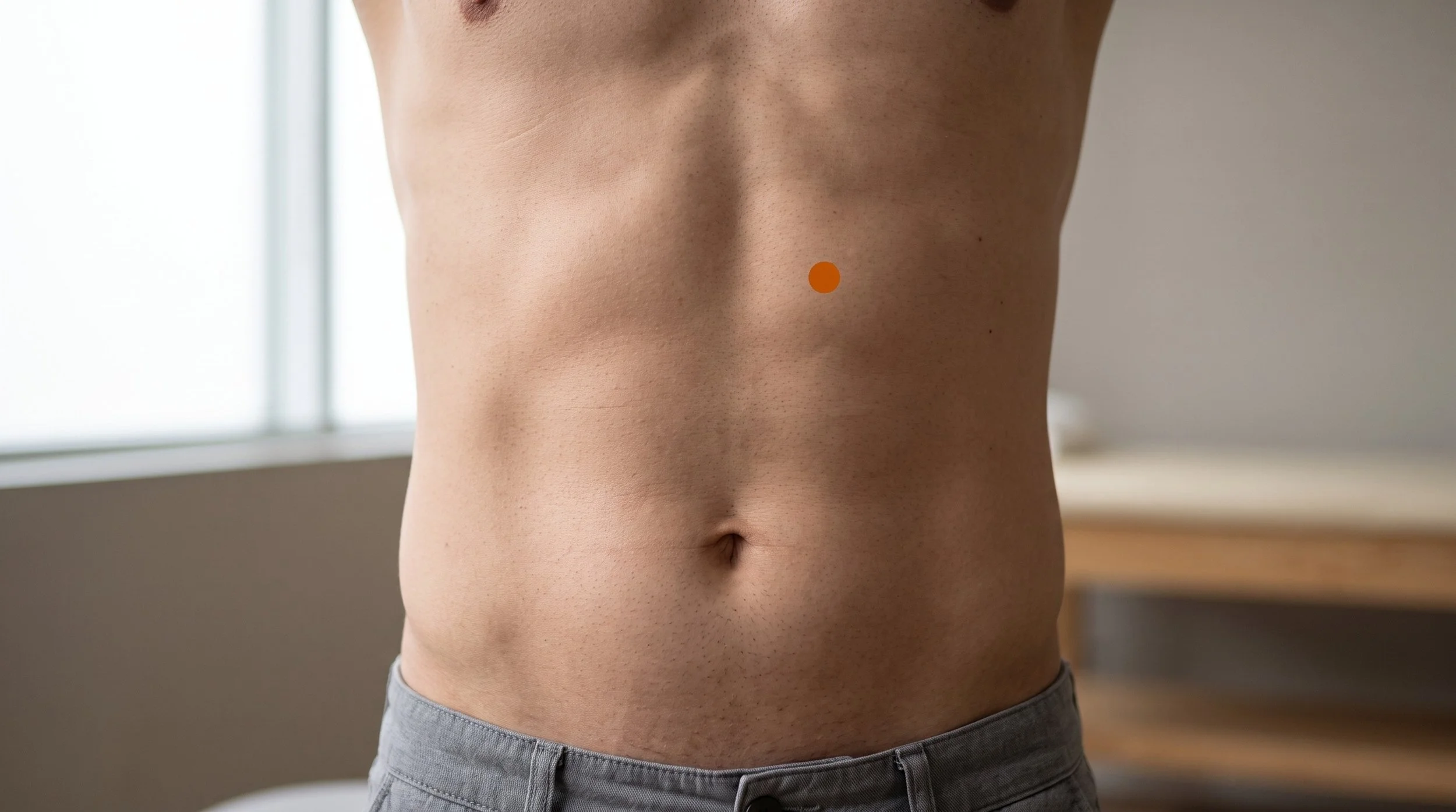
ST20 Acupuncture Point (Chengman)
Supporting Fullness Above the Navel: Anatomy, Segmental Mechanism, and Why This Upper Abdominal Stomach Point Belongs in Digestive Treatment
ST20, known in Chinese as Chengman and usually translated as Supporting Fullness, sits high on the abdomen, two thumb widths out from the midline and five thumb widths above the navel, level with CV13. That places the needle in the upper belly of the rectus abdominis, directly over the stomach and, on the right side, close to the lower edge of the liver.
Classically it belongs to the run of Stomach channel points that address fullness, distension, and rebellious upward symptoms, and in modern practice the st20 acupuncture point is used when a patient's upper abdomen feels tight, bloated, or guarded after eating, and when the abdominal wall itself is part of the picture rather than an innocent bystander.
- Location and layers: ST20 is 5 cun above the umbilicus and 2 cun lateral to the midline, level with CV13, with the 2 cun line falling roughly halfway between the midline and the palpable lateral border of the rectus abdominis (Deadman et al., 2007). The needle passes skin, superficial fascia, and the upper rectus abdominis inside its sheath.
- Traditional attribution: classical sources credit Chengman with harmonizing the middle burner and directing rebellious Stomach and Lung qi downward, and they list epigastric pain, vomiting, hiccup, difficult swallowing, poor appetite, distension, borborygmus, and costal hardness among its indications (Deadman et al., 2007; Cunningham, 2019).
- Mechanism in modern terms: the point sits in T7 to T8 territory, the same spinal segments that receive afferent traffic from the stomach and duodenum, so needling here is best explained as segmental viscerosomatic modulation rather than any movement of energy, layered on top of the diffuse endorphin and monoamine effects that follow needle stimulation (Zhao, 2008).
- Segmental versus distal: animal work suggests limb points such as ST36 drive a somatosensory-vagal-gastric reflex that abdominal stimulation does not reproduce, which is one reason abdominal points like ST20 are usually combined with distal points rather than used alone (Dong et al., 2025).
- Research picture: reviews of acupuncture for functional dyspepsia report modest improvements in postprandial fullness and early satiation, with wide variation in trial quality, and the largest sham-controlled trial of postprandial distress syndrome used multi-point protocols that included upper abdominal and limb points (Pang et al., 2016; Yang et al., 2020).
- De qi and dosing: patients usually describe a heavy, spreading fullness or a mild ache under the needle rather than sharpness, and depth stays conservative (0.5 to 1 cun) because deep insertion in a thin abdomen may reach the peritoneal cavity, and on the right an enlarged liver (Deadman et al., 2007).
Feeling Full, Bloated, or Tight After Every Meal?
Upper abdominal fullness that shows up within minutes of eating is one of the most common complaints we see, and it rarely responds to a single point. At Morningside Acupuncture we use ST20 alongside CV12, ST21, PC6, and ST36 as part of a treatment plan built around your symptom pattern, your eating habits, and how your abdominal wall actually palpates. Sessions are unhurried, and we track changes in fullness, appetite, and post-meal comfort visit by visit. Schedule an appointment and let's map out what is driving your symptoms.
Schedule NowAnatomy of ST20: Why the Upper Rectus Abdominis at the Level of CV13 Is Such an Important Location
From the surface inward, a needle at ST20 passes through skin and subcutaneous fat, then the anterior layer of the rectus sheath, then the upper belly of the rectus abdominis. This part of the muscle works constantly during breathing, coughing, sitting up, and bracing, and it tightens defensively when the gut underneath is irritated. Patients who habitually hold their breath, sit hunched over a laptop, or have been guarding after abdominal surgery often present with a firm, tender upper rectus that resists palpation on both sides of the midline.
The traditional description of a point that supports fullness matches what the hand actually finds there: a region that feels distended and unyielding.
The overlying skin and muscle at ST20 are supplied by the seventh and eighth intercostal nerves, and those same spinal segments receive visceral afferents from the stomach and upper duodenum. When two inputs converge on the same dorsal horn neurons, stimulation of the body wall can modify how that segment processes visceral signals, and it can also reduce the reflex muscle tone that visceral irritation generates.
Needle stimulation additionally recruits descending inhibitory pathways from the brainstem and releases endogenous opioids and monoamines, which is the best-characterized explanation for acupuncture analgesia generally (Zhao, 2008). Individual patient data from chronic pain trials suggest effects that persist beyond the treatment session, though the size of the benefit is moderate rather than dramatic (Vickers et al., 2018).
Deep to the muscle lie the peritoneum, the stomach, and on the right the inferior margin of the liver, which is why classical needling instruction for ST20 is perpendicular insertion of 0.5 to 1 cun and no more (Deadman et al., 2007). In a thin patient, deep needling here may enter the peritoneal cavity, and deep needling on the right may reach an enlarged liver, so depth is judged against body habitus rather than a fixed number.
In patients with a narrow subcostal angle the point can land on the costal margin itself, and the usual options are to locate slightly more medially, angle the needle transversely along the rib edge, or select a different point entirely (Deadman et al., 2007).
Related Rectus Abdominis Trigger Points Related Stomach ChannelST20 at a Glance: Classification, Location, and Clinical Use
| Category | Detail |
|---|---|
| Traditional Name | Chengman (Supporting Fullness), also rendered as Receiving Fullness |
| Channel Classification | Stomach channel of Foot Yangming, upper abdominal segment, level with CV13 Shangwan |
| Point Categories | No five-shu, hui-meeting, or extraordinary vessel intersection status is recorded for this point in the standard references. It is described simply as a Stomach channel point of the upper abdomen, with traditional actions of harmonizing the middle burner and descending rebellious Stomach and Lung qi. |
| Precise Location | On the upper abdomen, 5 cun above the umbilicus and 2 cun lateral to the anterior midline, level with CV13. The 2 cun line runs about halfway between the midline and the palpable lateral border of the rectus abdominis. In narrow-ribbed patients it may fall on the costal margin, in which case locate slightly more medially. |
| Tissue Stimulated | Skin, superficial fascia, rectus sheath, and the upper belly of the rectus abdominis; nearby fibers of the abdominal obliques and lower intercostal muscles are often involved in the same presentation |
| Needle Depth / Direction | Perpendicular 0.5 to 1 cun, kept shallow in thin patients; transverse or oblique along the costal margin when the point sits on the rib edge. Moxibustion is traditionally considered applicable. |
| De Qi Sensation | A heavy, spreading fullness or dull ache under the needle, sometimes with a sense of the abdominal wall softening; sharp or radiating pain is not expected and means the needle should be adjusted |
| Primary Clinical Uses | Epigastric pain and fullness, poor appetite, nausea and hiccup patterns in classical use, abdominal distension, and upper abdominal wall tension in modern myofascial presentations |
| Common Point Combinations |
|
In Deadman's Manual of Acupuncture, Chengman is presented as a point that harmonizes the middle burner and sends rebellious Stomach and Lung qi downward, and its traditional indication list clusters into three recognizable groups: symptoms of things moving upward instead of down (vomiting, hiccup, difficulty getting food down, spitting of blood), symptoms of pressure and distension (epigastric pain, abdominal fullness, rumbling, hardness and pain under the ribs), and breathing complaints such as shortness of breath, wheezing, and labored breathing with the shoulders raised.
Other classical commentaries add the image behind the name, that the stomach has reached its limit of fullness by the time it rises to this level, along with observations about tenderness so marked that clothing feels uncomfortable (Cunningham, 2019). These are traditional attributions rather than modern diagnostic claims, but what is striking is how consistently the classical picture puts digestive fullness and constrained breathing in the same list, which is exactly the overlap a clinician sees when a tight upper abdominal wall limits both the diaphragm and gastric accommodation.
Why ST20 Is Used for Upper Abdominal Complaints That Turn Out to Be Abdominal Wall Pain
The stomach and the skin and muscle at ST20 report to overlapping spinal segments around T7 and T8. That convergence explains two things patients notice. First, real gastric irritation can make the overlying abdominal wall tender and guarded, so the wall starts contributing its own pain.
Second, needling the wall at the matching segment can change how that part of the spinal cord handles incoming visceral traffic, along with the reflex tone of the muscle sitting over the organ. This is the standard segmental explanation for local abdominal needling, and it does not require any concept of energy moving through channels.
There is an interesting caveat that shapes how we use ST20 in practice. Experimental work indicates that the vagal reflex which speeds gastric motility is driven by stimulation at limb points rather than at abdominal sites, and that this somatosensory-vagal-gastric pathway depends on specific deep-tissue nociceptor populations (Dong et al., 2025). Abdominal points appear to work more through segmental spinal routes, including dampening of sympathetic outflow, than through direct vagal activation.
Practically, that argues for pairing ST20 with distal points such as ST36 or PC6 when the goal includes motility, rather than treating the abdomen alone.
Physiological studies in animal models of dyspepsia have shown that electroacupuncture can reduce gastric dysrhythmia and speed gastric emptying, with effects blocked by atropine and accompanied by shifts in autonomic balance, which supports a cholinergic and autonomic mechanism rather than a placebo-only account (Zhang et al., 2018). Human mechanistic reviews reach similar conclusions while noting that study quality is uneven and that effects on motility, accommodation, gut hormones, and central processing all appear in the literature without a single unifying result (Guo et al., 2020). In the clinic that means we frame ST20 as one contributor to a plan, not as a switch for the stomach.
What the Research Shows for ST20
There is no trial that isolates ST20 on its own, and there almost certainly never will be. Acupuncture research for digestive complaints tests multi-point protocols, usually mixing upper abdominal points such as CV12, ST21, and ST20 with distal points on the leg and forearm, so any evidence below speaks to the approach rather than to this single location. The picture that emerges is cautiously positive for functional dyspepsia and considerably more mixed for irritable bowel syndrome, with sham-controlled comparisons consistently smaller than comparisons against usual care.
| Study | Type | Focus | Key Finding |
|---|---|---|---|
| Yang et al., 2020 | Multicenter randomized sham-controlled trial (n=278) | Postprandial distress syndrome, a functional dyspepsia subtype dominated by fullness and early satiation | Acupuncture produced higher response and symptom elimination rates than sham over four weeks, with benefits maintained at twelve weeks. |
| Pang et al., 2016 | Systematic review and meta-analysis (16 RCTs, 1436 participants) | Manual acupuncture and electroacupuncture for functional dyspepsia | Reported improvements in dyspepsia indices and in postprandial fullness and early satiation, tempered by the low methodological quality of most included trials. |
| Guo et al., 2020 | Systematic review of mechanistic trials | How acupuncture and electroacupuncture may affect dyspeptic physiology | Suggests effects on gastric motility and accommodation, gut hormones, and autonomic and central activity, while calling for better designed studies. |
| Zhang et al., 2018 | Controlled animal study | Electroacupuncture in a rodent model of functional dyspepsia | Gastric slow wave rhythm and emptying improved, with the effect blocked by atropine, pointing to autonomic and cholinergic mediation. |
| Dong et al., 2025 | Mechanistic study in mice with human observations | Body region specificity of electroacupuncture effects on gastric function | Vagal gastric reflexes were driven from limb sites through deep-tissue TRPV1 fibers, supporting the practice of pairing abdominal points with distal ones. |
| Manheimer et al., 2012 | Cochrane systematic review (17 RCTs, 1806 participants) | Acupuncture for irritable bowel syndrome | No advantage over credible sham for symptom severity or quality of life, although patients reported more benefit than from two antispasmodic drugs in Chinese comparative trials. |
| Vickers et al., 2018 | Individual patient data meta-analysis (~21,000 patients) | Acupuncture for chronic pain conditions | Effects exceeded both sham and no-acupuncture controls and persisted over time, supporting acupuncture as more than expectation alone for pain outcomes. |
Is Your Upper Abdominal Pain Coming From the Gut or the Abdominal Wall?
Tender bands in the upper rectus abdominis can produce epigastric burning, nausea, and a full feeling that mimics a stomach problem, and they are easy to miss on imaging. Our licensed acupuncturists palpate the abdominal wall carefully before needling, then combine ST20 with dry needling of the rectus abdominis and intercostals when the tissue points that way. Many patients notice the difference between visceral discomfort and muscular tension for the first time in that session. Book a visit to get a clear assessment.
Schedule NowST20 in the Context of Trigger Point Work
The st 20 abdomen location overlaps directly with a well-described myofascial territory. Trigger points in the upper rectus abdominis can refer discomfort across the mid back and generate epigastric distress, nausea, and a bloated or burning sensation that patients reasonably interpret as a stomach problem (Simons et al., 1999).
At Morningside we palpate the upper abdominal wall in both a relaxed and a lightly braced position before deciding how to needle. When the tenderness reproduces the patient's familiar symptom under the fingers, that finding changes the treatment plan more than any textbook indication list does.
In practice, needling the supporting fullness point often happens in the same session as dry needling of the rectus abdominis, the lower intercostals, and the external oblique attachments along the costal margin, all with the same shallow, deliberate depth used for ST20 itself. Acupuncture, in the sense of using an acupuncture needle, is one method covering many styles, and channel-based point selection and trigger point needling are simply two ways of choosing where the needle goes.
Combining them lets us address both the segmental input to the stomach and the mechanical tension in the wall over it, then reassess at the next visit to see which component was actually driving the complaint.
ST20 Digestive Treatment at NYC's Highest-Rated Acupuncture Clinic
Morningside Acupuncture is the highest-rated acupuncture and dry needling clinic in New York City with over 500 five-star Google reviews, and digestive complaints are one of the reasons patients keep coming back. We integrate classical point selection, including ST20 and its traditional upper abdominal pairings, with modern trigger point work and clear, evidence-based explanations of what needling can and cannot do. Every plan is individualized, and we tell you honestly when acupuncture is not the right first step. Schedule your appointment today.
Schedule NowFrequently Asked Questions
What does ST20 feel like when needled?
Most people describe a dull, heavy fullness or a spreading ache that sits under the needle and may seem to sink a little deeper into the abdomen. Some feel the abdominal wall soften or a slight urge to take a deeper breath. Sharp, hot, or radiating pain is not the expected sensation at this point, and if it happens the needle should be withdrawn slightly or repositioned. Because the point is on a breathing surface, sensation can wax and wane with the breath, which is normal.
Why needle the abdomen directly instead of using points on the arms and legs?
Both approaches have a rationale, and good treatment usually uses them together. ST20 works segmentally: it sits in the same T7 to T8 territory that receives sensory input from the stomach, so stimulating the wall can influence how that spinal segment handles visceral signals and can reduce protective muscle tone over the organ. Distal points appear to work differently, with experimental evidence suggesting that limb stimulation drives vagal reflexes affecting gastric motility in a way abdominal stimulation does not (Dong et al., 2025). Pairing ST20 with PC6 or ST36 covers both routes.
Can I press ST20 myself between sessions?
Yes, gentle acupressure is reasonable for most people. Find the spot about five finger-widths above the navel and two thumb-widths out to the side of the midline, which usually lands on the firm band of the upper abdominal muscle. Lie down with your knees bent so the wall relaxes, then press with the flat pads of two fingers using slow, moderate pressure for 30 to 60 seconds per side, breathing normally rather than holding your breath. Repeat two or three times per side, once or twice daily, and stay well away from any sharp pain, pulsing sensation, or newly tender lump. Do not use pressure over an area of unexplained pain, during acute abdominal illness, or if you are pregnant without clearing it with your provider first.
Is ST20 safe to needle?
In trained hands, yes, with clear limits. The standard depth is 0.5 to 1 cun perpendicular, and that ceiling exists because deeper insertion in a thin abdomen may reach the peritoneal cavity, and on the right side may reach an enlarged liver (Deadman et al., 2007). Practitioners adjust depth for body size, avoid the point over surgical scars, hernias, or unexplained masses, and use caution in pregnancy and in patients on anticoagulants. Any new, severe, or persistent upper abdominal pain deserves a medical workup before acupuncture is considered as the answer.
Where exactly is ST20 located?
Stomach 20 lies on the upper abdomen, 5 cun above the umbilicus and 2 cun lateral to the anterior midline, level with CV13. A practical way to find it is to remember that the distance from the navel to the base of the sternum is 8 cun, so ST20 sits a little above the midpoint of that span, then move sideways to a line roughly halfway between the midline and the outer edge of the rectus abdominis muscle. In patients with a narrow rib angle the point can land on the costal margin itself, and in that case it is placed slightly more medially or needled transversely along the rib edge.
References
- Deadman, P., Al-Khafaji, M., & Baker, K. (2009). A manual of acupuncture. Journal of Chinese Medicine Publications.
- Cunningham, P. M. (2000). Acupuncture points: A practical guide to classical and modern usage. Odyssey Press.
- O'Connor, J., & Bensky, D. (Eds. & Trans.). (1981). Acupuncture: A comprehensive text. Shanghai College of Traditional Medicine. Eastland Press.
- Simons, D. G., Travell, J. G., & Simons, L. S. (1999). Travell & Simons' myofascial pain and dysfunction: The trigger point manual, Vol. 1: Upper half of body (2nd ed.). Williams & Wilkins.
- Yang, J.-W., Wang, L.-Q., Zou, X., Yan, S.-Y., Wang, Y., Zhao, J.-J., Tu, J.-F., Wang, J., Shi, G.-X., Hu, H., Zhou, W., Du, Y., & Liu, C.-Z. (2020). Effect of acupuncture for postprandial distress syndrome: A randomized clinical trial. Annals of Internal Medicine, 172(12), 777-785. https://doi.org/10.7326/M19-2880
- Pang, B., Jiang, T., Du, Y.-H., Li, J., Li, B., Hu, Y.-C., & Cai, Q.-H. (2016). Acupuncture for functional dyspepsia: What strength does it have? A systematic review and meta-analysis of randomized controlled trials. Evidence-Based Complementary and Alternative Medicine, 2016, 3862916. https://doi.org/10.1155/2016/3862916
- Guo, Y., Wei, W., & Chen, J. D. Z. (2020). Effects and mechanisms of acupuncture and electroacupuncture for functional dyspepsia: A systematic review. World Journal of Gastroenterology, 26(19), 2440-2457. https://doi.org/10.3748/wjg.v26.i19.2440
- Zhang, S., Li, S., Liu, Y., Ye, F., Yin, J., Foreman, R. D., Wang, D., & Chen, J. D. Z. (2018). Electroacupuncture via chronically implanted electrodes improves gastric dysmotility mediated by autonomic-cholinergic mechanisms in a rodent model of functional dyspepsia. Neurogastroenterology & Motility, 30(10), e13381. https://doi.org/10.1111/nmo.13381
- Dong, S., Zhao, L., Liu, J., Sha, X., Wu, Y., Liu, W., Sun, J., Su, Y., Zhuang, Z., Chen, J., Dong, Y., Xie, B., Zhou, A., Ji, H., Wang, Y., Deng, X., Jing, X., Ma, Q., Wang, N., & Liu, S. (2025). Neuroanatomical organization of electroacupuncture in modulating gastric function in mice and humans. Neuron, 113(19), 3243-3259.e11. https://doi.org/10.1016/j.neuron.2025.06.023
- Manheimer, E., Cheng, K., Wieland, L. S., Min, L. S., Shen, X., Berman, B. M., & Lao, L. (2012). Acupuncture for treatment of irritable bowel syndrome. Cochrane Database of Systematic Reviews, 2012(5), CD005111. https://doi.org/10.1002/14651858.CD005111.pub3
- Zhao, Z. Q. (2008). Neural mechanism underlying acupuncture analgesia. Progress in Neurobiology, 85(4), 355-375. https://doi.org/10.1016/j.pneurobio.2008.05.004
- Vickers, A. J., Vertosick, E. A., Lewith, G., MacPherson, H., Foster, N. E., Sherman, K. J., Irnich, D., Witt, C. M., & Linde, K. (2018). Acupuncture for chronic pain: Update of an individual patient data meta-analysis. Journal of Pain, 19(5), 455-474. https://doi.org/10.1016/j.jpain.2017.11.005
Disclaimer: This web site is intended for educational and informational purposes only. Reading this website does not constitute providing medical advice or any professional services. This information should not be used for diagnosing or treating any health issue or disease. Those seeking medical advice should consult with a licensed physician. Seek the advice of a medical doctor or other qualified health professional for any medical condition. If you think you have a medical emergency, call 911 or go to the emergency room. No acupuncturist-patient relationship is created by reading this website or using the information. Morningside Acupuncture PLLC and its employees and contributors do not make any express or implied representations with respect to the information on this site or its use. For any legal interpretation of scope of practice in your state, consult a licensed attorney or regulatory authority.
Read more from our blog



