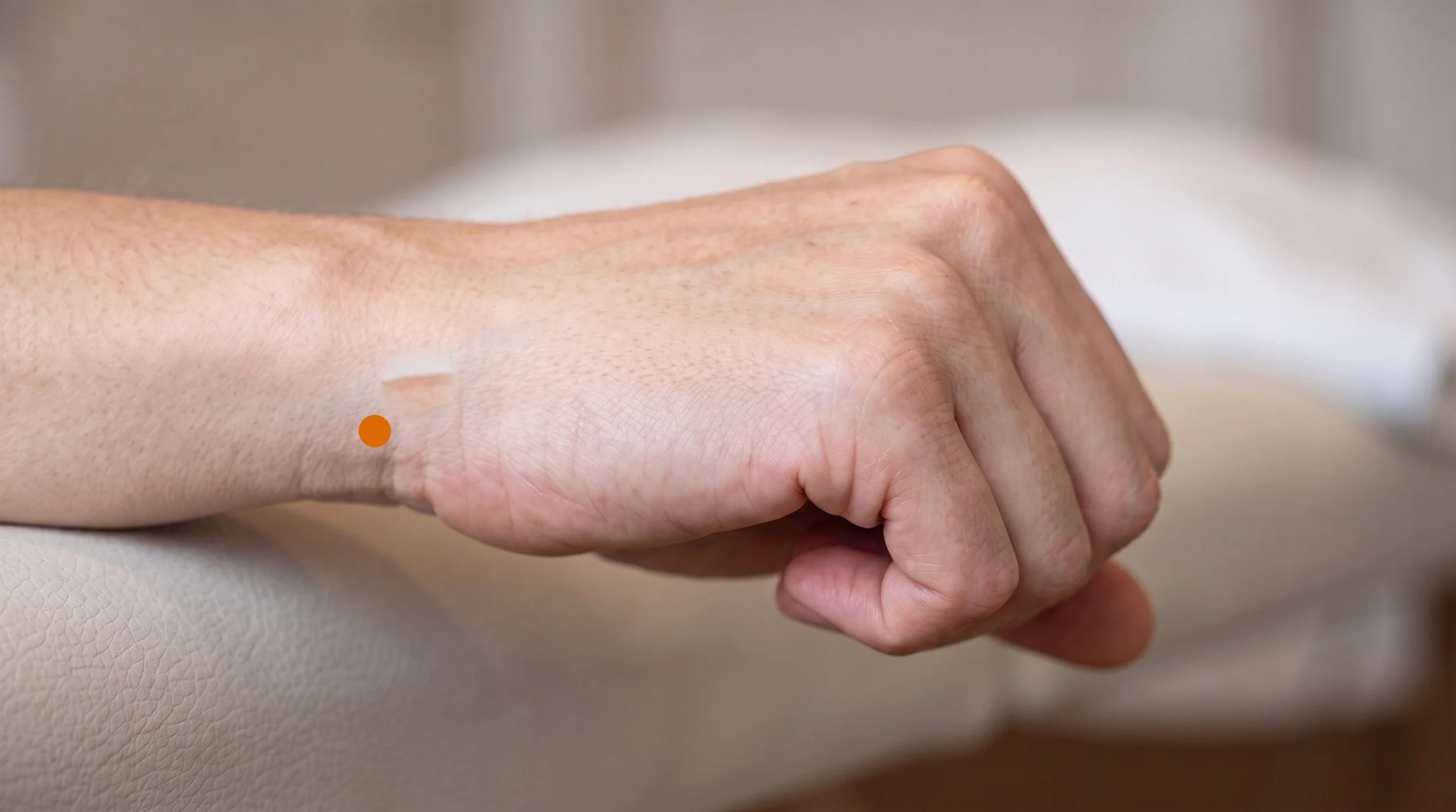
SI5 Acupuncture Point (Yanggu)
The Yang Valley at the Little-Finger Side of the Wrist: Anatomy, Mechanism, and Why a Small Wrist Point Was Classically Aimed at the Jaw, Ears and Eyes
SI5 (Yanggu, often translated as Yang Valley) sits in the small hollow on the little-finger side of the wrist, in the gap between the head of the ulna and the triquetral bone, just in front of the bony bump of the ulnar styloid. It is the jing-river point and the fire point of the Small Intestine channel, and it is one of three similarly named yang wrist points (LI5 Yangxi, SI5 Yanggu, TE4 Yangchi) that sit like beads across the back of the wrist (Deadman et al., 2001).
Clinically the si5 acupuncture point earns its place twice over: as a precise local point for ulnar-side wrist pain and stiffness, and as a distal point that classical texts aimed almost entirely at the head, specifically the jaw, teeth, ears and eyes.
- Location and layers: SI5 lies at the ulnar wrist in the depression between the ulnar head and the triquetrum, over thin skin, retinacular tissue and the dorsal wrist capsule near the triangular fibrocartilage region. Most texts describe it between the ulnar styloid and the triquetral bone, though in practice the styloid can be hard to feel and often sits slightly behind the point (Deadman et al., 2001).
- Traditional categories, translated: SI5 is traditionally classified as the jing-river and fire point of the Small Intestine channel, with attributed actions of clearing heat, reducing swelling and calming the spirit (Deadman et al., 2001). In modern language we treat these as descriptions of a distal point used for inflammatory-feeling head and face complaints and for agitation, not as literal fire or energy.
- Nerve geography: the point sits in territory served by the dorsal cutaneous branch of the ulnar nerve, so needling here recruits C8 and T1 afferents from skin, capsule and periosteum. Segmental input of this kind is one of the better-described routes by which needling modulates dorsal horn processing (Zhao, 2008).
- Beyond the segment: because the jaw and ear are trigeminal and upper cervical territory, SI5's classical head indications are best explained by heterosegmental and descending pain modulation rather than by a shared spinal level (Zhao, 2008). Needling at the wrist has also been shown to shift cortical sensory maps in carpal tunnel syndrome, which shows how a wrist-level input can register centrally (Maeda et al., 2017).
- Research picture: no trial isolates SI5, so its evidence sits inside multi-point protocols. Individual patient data pooling supports modest, durable benefits of acupuncture for chronic musculoskeletal pain (Vickers et al., 2018), while jaw and tinnitus reviews report short-term symptom improvement with clear methodological limits (La Touche et al., 2010; Huang et al., 2021).
- De qi and practice: needled perpendicularly 0.3 to 0.5 cun, SI5 usually produces a dull, heavy, slightly aching fullness in the ulnar wrist that may spread toward the little finger, rather than the strong spreading sensation of thicker muscular sites (Deadman et al., 2001). A sharp electric zing means the needle is close to a cutaneous nerve branch and should be withdrawn and redirected.
Ulnar Wrist Pain That Flares Every Time You Push Off a Desk?
Pain on the little-finger side of the wrist rarely comes from one structure alone, and at Morningside Acupuncture we map it before we needle anything. SI5 is one of our first choices when the tender spot sits right in the notch between the ulnar head and the triquetrum, and we pair it with forearm dry needling and grip mechanics work. Sessions include hands-on assessment, needling and loading advice you can use the same week. Schedule a visit and let's find out what your wrist is actually complaining about.
Schedule NowAnatomy of SI5: Why the Notch Between the Ulnar Head and Triquetrum Is Such an Important Location
Slide your finger down the little-finger side of the forearm until you meet the rounded head of the ulna, then step just distally into the soft dip before the carpal bones begin. That dip is the yanggu point location. The tissue stack here is shallow and specific: thin mobile skin, a fine layer of subcutaneous fat crossed by veins, retinacular fibers, then the dorsal capsule of the wrist and the region of the triangular fibrocartilage complex that cushions the ulna against the carpus.
The extensor carpi ulnaris tendon runs immediately alongside in its groove. This corner of the wrist is loaded every time you turn a doorknob, push out of a chair, hold a plank, swing a racket or type with the hands deviated toward the little finger, which is why the si 5 wrist area becomes tender in desk workers, lifters and racket sport players alike.
Sensory supply comes largely from the dorsal cutaneous branch of the ulnar nerve, with contributions from the posterior interosseous nerve to the deeper capsule, placing SI5 in a C8 and T1 receptive field. Needling here stimulates A-delta and C fibers in skin, fascia and periosteum, and that afferent barrage is the starting point for the segmental inhibition and descending modulation that underlie needling analgesia (Zhao, 2008).
Local effects matter too: reviews of microcirculatory studies report measurable changes in blood flow around needled tissue, though the direction and size of the change vary between studies (Kim et al., 2016). For an irritable joint corner that has been guarded for weeks, that combination of altered nociceptive input and local vascular response is a reasonable working model.
The safety picture at SI5 is straightforward but not trivial. Dorsal branches of the ulnar artery and small veins cross this region, and the joint capsule sits directly beneath, so needling is kept shallow and perpendicular at roughly 0.3 to 0.5 cun (Deadman et al., 2001). We avoid driving a needle into the joint line or the triangular fibrocartilage, avoid heavy manipulation over a swollen or acutely injured ulnar wrist, and reposition immediately if the patient reports a sharp radiating sensation into the little finger. Minor bruising is the most common side effect here because the skin is thin and vessels are superficial.
Related Small Intestine Channel Related Pain Finder Upper Back Shoulder ArmSI5 at a Glance: Classification, Location, and Clinical Use
| Category | Detail |
|---|---|
| Traditional Name | Yanggu (Yang Valley), Small Intestine 5 |
| Channel Classification | Fifth point of the Small Intestine channel of Hand Taiyang |
| Point Categories | Jing-river point and Fire point of the Small Intestine channel; no crossing, hui-meeting or extraordinary vessel designations are attributed to this point |
| Precise Location | At the ulnar border of the wrist, in the depression between the head of the ulna and the triquetral bone, just distal and slightly anterior to the ulnar styloid where that bump is palpable |
| Tissue Stimulated | Thin dorsal-ulnar skin and subcutaneous tissue, retinacular fibers, the dorsal wrist capsule and the region adjacent to the triangular fibrocartilage complex, with the extensor carpi ulnaris tendon sheath nearby; often combined with hand and forearm myofascial targets such as the Dorsal Interossei Trigger Points |
| Needle Depth / Direction | Perpendicular insertion 0.3 to 0.5 cun into the joint depression, kept shallow and never forced against the capsule |
| De Qi Sensation | A dull, heavy, slightly aching fullness in the ulnar wrist, sometimes spreading toward the little finger or up the ulnar forearm; a sharp electric sensation means the needle is near a cutaneous nerve branch and should be redirected |
| Primary Clinical Uses | Ulnar-side wrist pain and stiffness; traditionally used for toothache, jaw and submandibular swelling, lockjaw, tinnitus and hearing complaints, visual dizziness and red painful eyes, and for agitation |
| Common Point Combinations |
|
In Deadman, Al-Khafaji and Baker's point manual, SI5 is presented as the fire and jing-river point of the Small Intestine channel, with traditionally attributed actions of clearing heat, reducing swelling and calming the spirit. What is unusual, and the authors make a point of it, is how little the classical literature uses SI5 for the channel itself.
The more distal points of the Small Intestine channel dominate treatment of the hand, arm and shoulder, while SI5 was aimed upward at the head: swelling of the neck and under the jaw, lockjaw, tongue problems in infants, toothache, tinnitus and deafness, visual dizziness and red swollen eyes. Most sources reserved it for upper jaw toothache, while the seventh century physician Sun Si-miao used it for both jaws.
Its relationship to the Heart channel is also cited as the traditional rationale for its use in agitated states, and it appears in classical prescriptions for haemorrhoids alongside distal Bladder channel points. That combination is striking: a small joint point at the wrist that the tradition treated primarily as a head and face point.
Why SI5 Is Used for Jaw, Tooth and Ear Complaints Far From the Wrist
The honest answer is that SI5 does not share a spinal segment with the jaw or the ear. Its sensory input runs through the dorsal branch of the ulnar nerve into the C8 and T1 cord segments, while the teeth, jaw joint and outer ear are served mainly by the trigeminal nerve and upper cervical nerves. So the classical head indications cannot be explained by simple segmental convergence.
What they can be explained by is heterosegmental modulation: a strong, well-localized afferent input from a distal site recruits brainstem and spinal circuits that dampen nociceptive transmission more widely, including descending serotonergic and noradrenergic pathways and endogenous opioid mechanisms (Zhao, 2008).
There is also good reason to think a wrist-level input registers well above the wrist. In a sham-controlled imaging trial in carpal tunnel syndrome, needling improved median nerve conduction and increased the separation of finger representations in primary somatosensory cortex, changes that sham needling did not produce (Maeda et al., 2017). That study is about the median nerve rather than SI5, but it demonstrates the principle the classics were groping toward in their own vocabulary: peripheral needling at the wrist can change central sensory processing, not just local tissue.
For patients this means SI5 is used two ways. When the ulnar wrist itself is the problem, it is a local point that puts input directly into the irritated capsule and surrounding tissue, and local vascular responses to needling may contribute (Kim et al., 2016). When the complaint is in the jaw, teeth or ear, SI5 is a distal point that supports a treatment centered on local muscles and the upper neck. It is never used alone for a head complaint, and it should not be expected to replace dental or medical evaluation for tooth, ear or eye symptoms.
What the Research Shows for SI5
There is no clinical trial that tests SI5 by itself, and it would be misleading to imply otherwise. Acupuncture research almost always evaluates multi-point protocols chosen by the treating clinician, so the fair question is whether the conditions SI5 has traditionally been used for respond to acupuncture that plausibly includes it. On that question the picture is mixed but not empty: reasonably strong pooled data for chronic musculoskeletal pain, short-term positive signals for jaw pain and dental pain, and weaker, more heterogeneous data for tinnitus. The table below summarizes where things stand.
| Study | Type | Focus | Key Finding |
|---|---|---|---|
| Vickers et al., 2018 | Individual patient data meta-analysis | Chronic musculoskeletal, head and neck pain across nearly 21,000 patients | Acupuncture was better than sham and no-acupuncture controls, with effects that persisted over about a year, though differences from sham were modest. |
| La Touche et al., 2010 | Systematic review and meta-analysis | Acupuncture for pain in temporomandibular disorders | The authors concluded acupuncture is a reasonable adjunct for short-term pain relief in TMD, while noting substantial risk of bias in the included trials. |
| Di Francesco et al., 2024 | Systematic review and meta-analysis | Manual and laser acupuncture for temporomandibular disorders | Short-term reductions in muscular TMD pain were reported, but the authors judged the overall evidence base limited and called for more rigorous trials. |
| Ernst & Pittler, 1998 | Systematic review | Acupuncture for acute dental pain | Most included trials suggested an analgesic effect for dental pain, with the caveat that optimal technique and comparative efficacy remained undefined. |
| Huang et al., 2021 | Systematic review and meta-analysis | Acupuncture for tinnitus | No significant benefit appeared on the primary visual analogue outcome, though handicap and severity index scores improved; small, low-quality trials limit any conclusion. |
| Maeda et al., 2017 | Randomized sham-controlled neuroimaging trial | Wrist-level acupuncture in carpal tunnel syndrome | Real acupuncture improved median nerve conduction and cortical finger map separation, suggesting peripheral needling can influence central sensory processing. |
| Kim et al., 2016 | Systematic review of randomized crossover studies | Local microcirculatory changes after manual acupuncture | Most trials found some change in local blood flow after needling, but designs were small and inconsistent, so firm conclusions are not yet possible. |
| Zhao, 2008 | Narrative review of neurophysiology | Mechanisms of acupuncture analgesia | Needling analgesia is attributed to afferent fiber activation with segmental inhibition, descending control and endogenous opioid release. |
Jaw Tension, Clenching and Ear Fullness on the Same Side?
Jaw pain, tooth sensitivity and a plugged or ringing ear often travel together, and treatment usually needs both local and distal points. Our clinicians use SI5 alongside masseter and temporalis needling, upper cervical work and points around the ear, following the classical logic of the Small Intestine channel while explaining the mechanism in plain neurophysiology. Most patients notice how much of jaw pain is muscular once the tension is treated directly. Book an evaluation and we'll build the plan around your pattern.
Schedule NowSI5 in the Context of Trigger Point Work
Acupuncture is the use of an acupuncture needle, and that includes dry needling, so at Morningside SI5 and myofascial targets sit in the same treatment rather than in separate categories. For ulnar wrist complaints we commonly combine SI5 with needling of extensor carpi ulnaris, extensor digitorum, flexor carpi ulnaris and the interossei of the hand, since taut bands in the forearm extensors and flexors can refer discomfort into the wrist and hand and can keep an irritable joint corner loaded (Simons et al., 1999).
The point itself sits over joint capsule rather than muscle belly, so we treat it as a periosteal and capsular input and let the muscular work happen a few centimeters proximally.
When SI5 is used for jaw and ear complaints, the myofascial half of the plan usually matters more than the distal point. Masseter, temporalis, the medial and lateral pterygoids, sternocleidomastoid and upper trapezius all generate referred pain into the teeth, jaw joint and ear region, and these referral maps explain a great deal of what patients describe as toothache or ear pressure when dental and ENT examinations come back clear (Simons et al., 1999).
In practice SI5 becomes the distal anchor of that session while the local muscles receive the direct work, an arrangement that lines up neatly with the classical pairings of SI5 with facial and head points.
SI5 Wrist and Jaw Pain Treatment at NYC's Highest-Rated Acupuncture Clinic
Morningside Acupuncture is the highest-rated acupuncture and dry needling clinic in New York City with over 500 five-star Google reviews, and our treatments blend classical point selection with sports medicine style assessment. We use SI5 for ulnar wrist complaints and as part of head, jaw and ear protocols, always alongside movement and load strategies rather than needles by themselves. Every visit is one-on-one with a licensed acupuncturist. Schedule your appointment on the Upper West Side and get a clear plan from the first session.
Schedule NowFrequently Asked Questions
What does SI5 feel like when needled?
Most people feel a brief pinch as the needle passes the skin, then a dull, heavy, slightly achy fullness in the notch on the little-finger side of the wrist. Because the point sits over joint capsule and periosteum rather than thick muscle, the sensation tends to be more of a deep pressure than the spreading heaviness you might feel at a point like ST36. Some patients notice a faint trickle of sensation toward the little finger. A sharp, electric, zinging sensation is not the goal at SI5 and usually means the needle is close to a branch of the ulnar nerve, so tell your acupuncturist and the needle will be withdrawn slightly and redirected.
Why would a wrist point be used for toothache, jaw swelling or tinnitus?
Classical texts placed SI5 on the Small Intestine channel, which is described as traveling from the hand up the arm and neck to the face and ear, and they used it far more for the head than for the arm (Deadman et al., 2001). Physiologically, the wrist and the jaw do not share a spinal segment, so the effect is not simple segmental convergence. The better explanation is heterosegmental modulation: a distinct afferent input from a distal site engages brainstem and spinal circuits that reduce nociceptive transmission more broadly through descending inhibitory and opioid mechanisms (Zhao, 2008). In modern practice SI5 supports a treatment built around local jaw, neck and ear points rather than standing in for them, and jaw, tooth or ear symptoms always warrant proper dental or medical evaluation.
Can I press SI5 myself between sessions?
Yes, and it is an easy point to find on yourself. Rest your forearm on a table palm down, trace the little-finger side of your wrist until you find the rounded knob of the ulna, then slide just past it toward the hand into the small soft dip before the carpal bones. Press straight down with the pad of your opposite thumb using firm but comfortable pressure, roughly a 4 to 6 out of 10, and hold for 30 to 60 seconds while you breathe slowly. Repeat two or three rounds per side, up to two or three times a day. Small circular pressure or gentle wrist circles while you hold can help for stiffness. Stop if pressure produces sharp pain, numbness or tingling into the little finger, and skip it entirely over acutely swollen, bruised or recently injured tissue.
Is SI5 safe to needle?
In trained hands, yes. The standard approach is a shallow perpendicular insertion of about 0.3 to 0.5 cun into the joint depression (Deadman et al., 2001). The two practical considerations are the thin skin with superficial veins, which makes minor bruising a little more likely here than in muscular areas, and the dorsal cutaneous branch of the ulnar nerve, which is why sharp radiating sensations prompt repositioning rather than continued manipulation. Clinicians avoid forcing a needle into the joint line or the triangular fibrocartilage region, use extra caution with acute ulnar wrist injuries, swollen joints, anticoagulant use or bleeding disorders, and always use sterile single-use needles with clean technique.
Where exactly is SI5 located?
SI5 is at the ulnar border of the wrist, in the depression between the head of the ulna and the triquetral bone (Deadman et al., 2001). To find it, turn your palm down and run a finger along the little-finger side of the forearm until you meet the bony prominence of the ulnar head near the wrist crease, then step just distally into the soft hollow before the carpal bones begin. Many texts describe the point as lying between the ulnar styloid process and the triquetrum, but the styloid is not always easy to palpate and, where it can be felt, it often sits slightly behind the point itself, so the notch just in front of it is the more reliable landmark.
References
- Deadman, P., Al-Khafaji, M., & Baker, K. (2009). A manual of acupuncture. Journal of Chinese Medicine Publications.
- Simons, D. G., Travell, J. G., & Simons, L. S. (1999). Travell & Simons' myofascial pain and dysfunction: The trigger point manual, Vol. 1: Upper half of body (2nd ed.). Williams & Wilkins.
- Zhao, Z. Q. (2008). Neural mechanism underlying acupuncture analgesia. Progress in Neurobiology, 85(4), 355-375. https://doi.org/10.1016/j.pneurobio.2008.05.004
- Vickers, A. J., Vertosick, E. A., Lewith, G., MacPherson, H., Foster, N. E., Sherman, K. J., Irnich, D., Witt, C. M., & Linde, K. (2018). Acupuncture for chronic pain: Update of an individual patient data meta-analysis. Journal of Pain, 19(5), 455-474. https://doi.org/10.1016/j.jpain.2017.11.005
- La Touche, R., Goddard, G., De-la-Hoz, J. L., Wang, K., Paris-Alemany, A., Angulo-Diaz-Parreno, S., Mesa, J., & Hernandez, M. (2010). Acupuncture in the treatment of pain in temporomandibular disorders: A systematic review and meta-analysis of randomized controlled trials. The Clinical Journal of Pain, 26(6), 541-550. https://doi.org/10.1097/AJP.0b013e3181e2697e
- Di Francesco, F., Minervini, G., Siurkel, Y., Cicciu, M., & Lanza, A. (2024). Efficacy of acupuncture and laser acupuncture in temporomandibular disorders: A systematic review and meta-analysis of randomized controlled trials. BMC Oral Health, 24(1), 174. https://doi.org/10.1186/s12903-023-03806-1
- Ernst, E., & Pittler, M. H. (1998). The effectiveness of acupuncture in treating acute dental pain: A systematic review. British Dental Journal, 184(9), 443-447. https://doi.org/10.1038/sj.bdj.4809654
- Huang, K., Liang, S., Chen, L., & Grellet, A. (2021). Acupuncture for tinnitus: A systematic review and meta-analysis of randomized controlled trials. Acupuncture in Medicine, 39(4), 264-271. https://doi.org/10.1177/0964528420938380
- Maeda, Y., Kim, H., Kettner, N., Kim, J., Cina, S., Malatesta, C., Gerber, J., McManus, C., Ong-Sutherland, R., Mezzacappa, P., Libby, A., Mawla, I., Morse, L. R., Kaptchuk, T. J., Audette, J., & Napadow, V. (2017). Rewiring the primary somatosensory cortex in carpal tunnel syndrome with acupuncture. Brain, 140(4), 914-927. https://doi.org/10.1093/brain/awx015
- Kim, S. Y., Min, S., Lee, H., Cheon, S., Zhang, X., Park, J. Y., Song, T. J., & Park, H. J. (2016). Changes of local blood flow in response to acupuncture stimulation: A systematic review. Evidence-Based Complementary and Alternative Medicine, 2016, 9874207. https://doi.org/10.1155/2016/9874207
Disclaimer: This web site is intended for educational and informational purposes only. Reading this website does not constitute providing medical advice or any professional services. This information should not be used for diagnosing or treating any health issue or disease. Those seeking medical advice should consult with a licensed physician. Seek the advice of a medical doctor or other qualified health professional for any medical condition. If you think you have a medical emergency, call 911 or go to the emergency room. No acupuncturist-patient relationship is created by reading this website or using the information. Morningside Acupuncture PLLC and its employees and contributors do not make any express or implied representations with respect to the information on this site or its use. For any legal interpretation of scope of practice in your state, consult a licensed attorney or regulatory authority.
Read more from our blog



