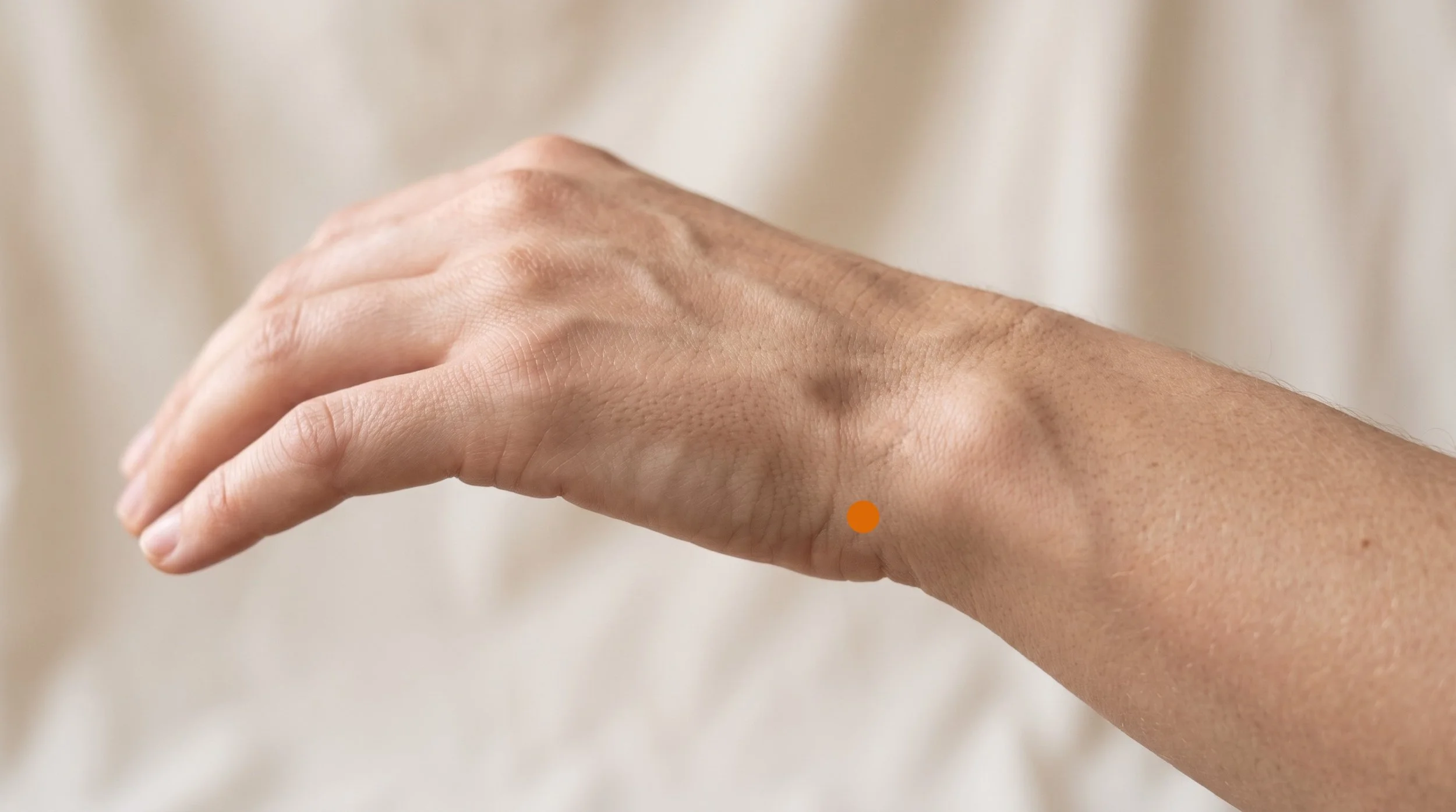
SI4 Acupuncture Point (Wangu)
The Wrist Bone Point on the Ulnar Border: Anatomy, Mechanism, and Why the Small Intestine Source Point Is Used for Hand, Wrist, Shoulder and Neck Complaints
SI4, known in Chinese as Wangu and translated as Wrist Bone, sits in the small hollow on the pinky side of the hand where the base of the fifth metacarpal meets the triquetral bone, right at the crease between palm and wrist. It's the yuan-source point of the Small Intestine channel, which in classical theory makes it the channel's anchor point, and it happens to share its pinyin name with GB12 behind the ear, so charts and class notes sometimes confuse the two.
Clinically the si4 acupuncture point earns its place for a very practical reason: it sits in tissue that gets loaded every time you grip, type, deviate the wrist toward the little finger, or push up off your hands, and it lies in the same neurological neighborhood (C8 and T1, ulnar nerve territory) as the hand and forearm complaints patients most often bring in.
- Location and layers: small intestine 4 is found in the depression between the fifth metacarpal base and the triquetrum on the ulnar border of the hand, with thin skin over hypothenar fascia, the origin region of abductor digiti minimi, and the nearby attachments of flexor carpi ulnaris at the pisiform and extensor carpi ulnaris at the fifth metacarpal base (Deadman et al., 2007).
- Traditional categories, read in modern terms: classical texts list SI4 as the yuan-source point of the hand taiyang channel and credit it with activating the channel, easing pain, reducing swelling and treating jaundice patterns; in clinical language, those are traditional attributions describing a point used for stiffness, contraction and pain anywhere along the arm to neck line (Deadman et al., 2007).
- Nerve story: the si 4 wrist location lies in dorsal ulnar cutaneous territory just outside Guyon's canal, so needling recruits small-diameter afferents entering C8 and T1 spinal segments, the same segments that serve the little finger, hypothenar muscles and much of the lower cervical to scapular region (Zhao, 2008).
- Mechanism beyond the local tissue: needle stimulation engages descending pain modulation from the brainstem alongside local vascular and autonomic changes, which helps explain why a point at the wrist can influence sensation and muscle guarding farther up the limb (Zhao, 2008).
- Research picture: no trial isolates the wrist bone point by itself, but individual patient data pooling shows acupuncture outperforming sham and no-acupuncture controls for chronic musculoskeletal pain (Vickers et al., 2018), and neuroimaging work in carpal tunnel syndrome suggests both local wrist and distal needling can reduce symptoms with measurable changes in somatosensory cortex organization (Maeda et al., 2017).
- What it feels like and how it's used: patients usually report a dull, spreading ache or heaviness that may travel into the little finger or up the ulnar forearm, and wangu si4 is typically combined with local wrist points, channel points along the arm, and dry needling of nearby forearm and hand muscles rather than used alone.
Ulnar Wrist Pain That Flares Every Time You Grip?
Pain on the little finger side of the wrist rarely comes from one structure, and it often involves the extensor carpi ulnaris, the hypothenar muscles and the cervical segments that supply them. At Morningside Acupuncture we use SI4 as part of a wrist-focused plan that pairs local needling with forearm and shoulder work, plus grip and loading advice you can actually follow at a desk or in the gym. Most patients notice changes in how the wrist tolerates gripping within a few sessions. Schedule a visit and we'll map where your wrist pain is really coming from.
Schedule NowAnatomy of SI4: Why the Ulnar Border of the Wrist Is Such an Important Location
SI4 sits in a genuine anatomical hollow. Run a finger up the little finger side of the hand from the fifth knuckle and you'll drop into a small depression where the base of the fifth metacarpal meets the triquetral bone, right where the palm ends and the wrist begins (Deadman et al., 2007).
The tissue there is shallow and dense: thin skin, a layer of subcutaneous fat, then hypothenar fascia and the origin region of abductor digiti minimi near the pisiform, with the flexor carpi ulnaris tendon anchoring into the pisiform just palmar to the point and the extensor carpi ulnaris tendon attaching at the fifth metacarpal base just dorsal to it. That makes this corner of the hand a convergence zone for wrist stabilizers.
It loads every time you grip a tool, hold a mouse in ulnar deviation, catch weight on the heel of the hand, swing a racket, or push up out of a chair, which is why the area gets tender in desk workers, lifters, climbers and racquet sport players alike.
Neurologically, the point sits in ulnar nerve country. The dorsal cutaneous branch of the ulnar nerve supplies the skin here, the ulnar nerve and artery pass just palmar to the pisiform through Guyon's canal, and the whole region reports to the C8 and T1 spinal segments. Those same segments serve the hypothenar and interosseous muscles, contribute to the lower cervical and scapular region, and share dorsal horn real estate with structures far above the wrist.
Needling stimulates A-delta and C fiber afferents that converge on those segments, and that input recruits spinal gating and descending inhibition from brainstem structures, along with local increases in blood flow and changes in autonomic tone (Zhao, 2008). Imaging work in carpal tunnel syndrome adds an interesting layer: acupuncture in that population was associated with reduced symptoms and with measurable reorganization of finger representations in primary somatosensory cortex, suggesting effects that aren't limited to the tissue under the needle (Maeda et al., 2017).
Safety here is mostly about respecting what lies deeper. The ulnar artery and nerve travel through Guyon's canal on the palmar side of the pisiform, and the carpal bones themselves sit immediately below the point, so the standard convention is a perpendicular insertion of roughly 0.3 to 0.5 cun into the joint depression rather than an aggressive angled thrust toward the palm (Deadman et al., 2007). A dull spreading ache is expected; a sharp electric zap into the ring and little fingers is not, and a careful practitioner will withdraw and redirect if that happens. The point is well tolerated, bleeding risk is low, and small bruises are the most common minor side effect.
Related Small Intestine Channel Related Pain Finder Forearm HandSI4 at a Glance: Classification, Location, and Clinical Use
| Category | Detail |
|---|---|
| Traditional Name | Wangu (Wrist Bone), Small Intestine 4 |
| Channel Classification | Small Intestine channel of Hand Taiyang, fourth point of the channel |
| Point Categories | Yuan-source point of the Small Intestine channel. Note the naming overlap: GB12 behind the ear is also called Wangu in pinyin, though it's a different point on a different channel. |
| Precise Location | On the ulnar (little finger) border of the hand, in the depression between the base of the fifth metacarpal bone and the triquetral bone, at the junction of palm and wrist. |
| Tissue Stimulated | Skin and subcutaneous tissue over hypothenar fascia, the joint capsule region between the fifth metacarpal base and triquetrum, the origin area of abductor digiti minimi, and the nearby attachments of flexor carpi ulnaris and extensor carpi ulnaris; dorsal ulnar cutaneous nerve territory, C8 and T1 segments. |
| Needle Depth / Direction | Perpendicular insertion 0.3 to 0.5 cun into the bony depression, angled away from Guyon's canal; moxibustion is traditionally permitted. |
| De Qi Sensation | A dull, heavy ache or pressure filling the ulnar wrist, often spreading toward the little finger or up the forearm; sharp electric sensations into the fingers mean the needle should be adjusted. |
| Primary Clinical Uses | Finger stiffness and difficulty making a fist, ulnar-sided wrist pain and weakness, elbow and forearm contraction, shoulder and scapular pain, neck stiffness along the channel line, and jaundice patterns in classical use. |
| Common Point Combinations |
|
In the Deadman, Al-Khafaji and Baker point manual, SI4 is presented first and foremost as the source point of the Small Intestine channel, and its traditional reputation is built around contraction and stiffness rather than any internal organ pattern. The commentary describes it as one of the points reached for when all five fingers are tight and hard to open and close, and as useful for pain and restriction traced along the channel through the wrist, elbow, arm, shoulder, neck and upper back.
Classical sources also credited it with acting at the far end of that line, easing swelling of the neck, cheek and submandibular area, and with helping tinnitus, which the text explains as treating the channel rather than an organ disharmony. The most striking entry is jaundice: the manual notes an empirical tradition of using this point for jaundice of different types and for costal pain with difficulty catching the breath, while frankly acknowledging that neither the channel pathway nor Small Intestine function explains it.
Presented as a traditional attribution, that honesty is the interesting part, because it shows classical authors recording what they observed even when their own theory couldn't account for it.
Why SI4 Is Used for Neck, Shoulder and Finger Stiffness Far From the Wrist
The first reason is segmental. The ulnar border of the hand, the hypothenar muscles and much of the lower cervical and scapular region share input at the C8 and T1 spinal levels. Sensory information from all of these converges on overlapping populations of dorsal horn neurons, which means a strong, well-localized stimulus at the hand enters the same processing hub that's currently receiving irritable input from a stiff neck or a guarded shoulder blade. Clinically that shows up as a patient reporting that the neck feels looser after a wrist point is needled, which sounds odd until you see the wiring (Zhao, 2008).
The second reason is central. Needle stimulation activates descending inhibitory pathways running from the midbrain and brainstem back down to the spinal cord, along with endogenous opioid and monoamine systems that turn down the volume on incoming pain signals across a wider area than the needle site (Zhao, 2008). This is why distal points can matter even when the painful tissue is elsewhere.
In carpal tunnel syndrome, a condition centered on the wrist, a randomized neuroimaging trial found that acupuncture reduced symptoms and was accompanied by changes in how the fingers were represented in the somatosensory cortex, with local and distal needling producing different patterns of change (Maeda et al., 2017). That's evidence for nervous system involvement rather than a purely local tissue effect.
The third reason is mechanical and specific to this location. Because SI4 sits where the wrist stabilizers converge, needling it often changes tone and tenderness in the tissue that actually restricts grip and wrist deviation. When someone can't close a fist comfortably, the limitation is frequently a mix of joint irritation, muscular guarding and protective cortical output rather than a single damaged structure, and a point that addresses all three routes at once is a reasonable place to start.
What the Research Shows for SI4
There's an honest caveat worth stating up front: no clinical trial has isolated SI4 as a standalone treatment. Acupuncture research almost always tests multi-point protocols, so the evidence below tells us about the treatment approach that SI4 belongs to rather than about this single point. The most relevant studies cover chronic musculoskeletal pain generally, neck disorders, shoulder pain and carpal tunnel syndrome, all conditions where an ulnar wrist source point may be included in a broader prescription. Results are generally positive but modest, and quality varies considerably across trials.
| Study | Type | Focus | Key Finding |
|---|---|---|---|
| Vickers et al., 2018 | Individual patient data meta-analysis | Chronic musculoskeletal pain, headache and osteoarthritis (about 20,000 patients) | Acupuncture was more effective than both sham and no-acupuncture controls, with effects that persisted over time, though differences from sham were modest. |
| Trinh et al., 2016 | Cochrane systematic review | Acupuncture for acute, subacute and chronic neck disorders | The review found moderate quality evidence that acupuncture relieved neck pain better than sham immediately after treatment, with mostly minor adverse events. |
| Maeda et al., 2017 | Randomized controlled neuroimaging trial | Local and distal acupuncture in carpal tunnel syndrome | Both verum acupuncture approaches reduced symptom severity, with changes in somatosensory cortex organization accompanying improvement. |
| Li et al., 2022 | Systematic review and meta-analysis | Electroacupuncture for carpal tunnel syndrome | Pooled results suggested symptom and function benefits, though the authors noted limited trial quality and called for larger studies. |
| Zhan et al., 2023 | Systematic review and meta-analysis | Acupuncture compared with rehabilitation therapy for post-stroke shoulder pain | Acupuncture appeared at least comparable to rehabilitation therapy for shoulder pain outcomes, with the usual caution about heterogeneous trial quality. |
| Zhao, 2008 | Narrative mechanistic review | Neural mechanisms of acupuncture analgesia | Describes segmental spinal gating, descending inhibition and endogenous opioid involvement as the main documented pathways for needle-induced analgesia. |
Stiff Fingers, Stiff Wrist, Stiff Neck All on the Same Side?
Classical texts treated the Small Intestine channel as one continuous line from the little finger to the shoulder blade and neck, and modern segmental anatomy gives that pattern a plausible basis. Our clinicians combine SI4 with points along the arm, scapular trigger point needling and cervical treatment when the whole line is involved. Sessions include manual therapy and movement guidance so the gains hold between visits. Book an appointment to have the full chain assessed rather than just the sore spot.
Schedule NowSI4 in the Context of Trigger Point Work
Acupuncture means the use of an acupuncture needle, and that includes dry needling, so at Morningside the wrist bone point and myofascial targets are handled with the same tool and the same anatomical reasoning. When someone presents with ulnar wrist pain and a weak grip, we often needle SI4 in its bony depression and then treat the muscles that actually load it: abductor digiti minimi and opponens digiti minimi in the hypothenar group, extensor carpi ulnaris along the ulnar forearm, flexor carpi ulnaris, and the interossei when the hand feels cramped.
Trigger points in the hypothenar and interosseous muscles can refer pain along the ulnar hand and fingers in ways that mimic nerve symptoms, which is worth sorting out before assuming an entrapment (Simons et al., 1999).
The point location and myofascial targets overlap here more than at most acupuncture points, since SI4 sits directly over the origin territory of abductor digiti minimi near the pisiform. That said, we rarely stop at the hand. Because the ulnar hand shares segments with the lower cervical spine and scapula, we frequently add needling to the scalenes, infraspinatus, subscapularis or serratus posterior superior when the referral pattern points upstream, and pair that with grip loading, nerve gliding where appropriate, and workstation changes. Treating only the sore wrist tends to give short-lived relief when the real driver sits at the shoulder blade or neck.
SI4 Wrist and Hand Pain Treatment at NYC's Highest-Rated Acupuncture Clinic
Morningside Acupuncture is the highest-rated acupuncture and dry needling clinic in New York City with over 500 five-star Google reviews, and wrist, hand and forearm complaints are among the conditions we treat most often. We use the wrist bone point alongside dry needling of the forearm extensors and hypothenar muscles, cupping, and graded loading for grip. Treatment plans are built around what your hands actually do all day, whether that's a keyboard, a kettlebell or a violin. Schedule your first session and start with a clear plan.
Schedule NowFrequently Asked Questions
What does SI4 feel like when needled?
Most people feel a brief pinch at insertion, then a dull, heavy, slightly achy fullness in the hollow on the pinky side of the wrist. That sensation is the de qi response, and it may spread toward the little finger, into the palm, or up the ulnar forearm. Some patients describe a mild warmth or a tugging feeling when the needle is gently manipulated. Because the point sits near ulnar nerve territory, a sharp electric shock into the ring and little fingers is not the goal; tell your practitioner if that happens and the needle will be adjusted or withdrawn.
Why would a point at the wrist help my neck and shoulder?
Two reasons. Anatomically, the ulnar wrist, the hypothenar muscles and much of the lower cervical and scapular region are supplied by the same C8 and T1 spinal segments, so their sensory input converges in the same part of the spinal cord and needle stimulation at the hand reaches that shared processing hub (Zhao, 2008). Functionally, needling also recruits descending pain modulation from the brainstem, which lowers pain sensitivity beyond the immediate area (Zhao, 2008). Classical texts arrived at the same clinical pattern by a different route, describing SI4 as the source point for stiffness anywhere along the Small Intestine line from the little finger to the neck (Deadman et al., 2007).
Can I press SI4 myself between sessions?
Yes, and it's an easy one to find on yourself. Turn your hand so the little finger side faces up, slide a thumb along the edge of the hand from the fifth knuckle toward the wrist, and you'll fall into a small dip just before the wrist crease. Press with your opposite thumb using firm but comfortable pressure, hold for 30 to 60 seconds, release, and repeat two or three times per hand. Two to four rounds a day is plenty. It works well combined with slow wrist circles, gentle finger opening and closing, and a break from whatever grip position aggravates it. Stop if pressure produces numbness, tingling or electric sensations into the fingers, and mention that to your clinician.
Is SI4 safe to needle?
It's considered a safe point when needled by a trained practitioner. The standard technique is a perpendicular insertion of about 0.3 to 0.5 cun into the bony depression, which keeps the needle away from the ulnar nerve and artery passing through Guyon's canal on the palmar side of the pisiform (Deadman et al., 2007). Carpal bones limit depth naturally. Minor bruising is the most common side effect, and people taking blood thinners should mention it beforehand. Anyone with a known ulnar neuropathy, a recent wrist fracture, an acutely inflamed joint or a local skin infection should have the area assessed before needling.
Where exactly is SI4 located?
On the little finger side of the hand, in the depression between the base of the fifth metacarpal bone and the triquetral bone, at the junction where the palm meets the wrist (Deadman et al., 2007). A reliable way to find it: trace the shaft of the fifth metacarpal from the knuckle back toward the wrist until your finger drops into a hollow just before the wrist crease, with the pea-shaped pisiform bone sitting slightly toward the palm side. It's between SI5 at the wrist joint and SI3 further out along the hand. Don't confuse it with GB12, which shares the pinyin name Wangu but sits behind the ear below the mastoid process.
References
- Deadman, P., Al-Khafaji, M., & Baker, K. (2009). A manual of acupuncture. Journal of Chinese Medicine Publications.
- Kim, H. (2008). Handbook of Oriental medicine (3rd ed.). Harmony & Balance Press.
- Maciocia, G. (2006). The channels of acupuncture: Clinical use of the secondary channels and eight extraordinary vessels. Churchill Livingstone Elsevier.
- Simons, D. G., Travell, J. G., & Simons, L. S. (1999). Travell & Simons' myofascial pain and dysfunction: The trigger point manual, Vol. 1: Upper half of body (2nd ed.). Williams & Wilkins.
- Vickers, A. J., Vertosick, E. A., Lewith, G., MacPherson, H., Foster, N. E., Sherman, K. J., Irnich, D., Witt, C. M., & Linde, K. (2018). Acupuncture for chronic pain: Update of an individual patient data meta-analysis. Journal of Pain, 19(5), 455-474. https://doi.org/10.1016/j.jpain.2017.11.005
- Zhao, Z. Q. (2008). Neural mechanism underlying acupuncture analgesia. Progress in Neurobiology, 85(4), 355-375. https://doi.org/10.1016/j.pneurobio.2008.05.004
- Trinh, K., Graham, N., Irnich, D., Cameron, I. D., & Forget, M. (2016). Acupuncture for neck disorders. Cochrane Database of Systematic Reviews, 2016(5), CD004870. https://doi.org/10.1002/14651858.CD004870.pub4
- Maeda, Y., Kim, H., Kettner, N., Kim, J., Cina, S., Malatesta, C., Gerber, J., McManus, C., Ong-Sutherland, R., Mezzacappa, P., Libby, A., Mawla, I., Morse, L. R., Kaptchuk, T. J., Audette, J., & Napadow, V. (2017). Rewiring the primary somatosensory cortex in carpal tunnel syndrome with acupuncture. Brain, 140(4), 914-927. https://doi.org/10.1093/brain/awx015
- Li, T., Yan, J., Hu, J., Liu, X., & Wang, F. (2022). Efficacy and safety of electroacupuncture for carpal tunnel syndrome (CTS): A systematic review and meta-analysis of randomized controlled trials. Frontiers in Surgery, 9, 952361. https://doi.org/10.3389/fsurg.2022.952361
- Zhan, J., Luo, Y., Mao, W., Wei, X., Zhang, P., Yan, X., Liu, J., & Lu, L. (2023). Efficacy of acupuncture versus rehabilitation therapy on post-stroke shoulder pain: A systematic review and meta-analysis of randomized controlled trials. Medicine, 102(29), e34266. https://doi.org/10.1097/MD.0000000000034266
Disclaimer: This web site is intended for educational and informational purposes only. Reading this website does not constitute providing medical advice or any professional services. This information should not be used for diagnosing or treating any health issue or disease. Those seeking medical advice should consult with a licensed physician. Seek the advice of a medical doctor or other qualified health professional for any medical condition. If you think you have a medical emergency, call 911 or go to the emergency room. No acupuncturist-patient relationship is created by reading this website or using the information. Morningside Acupuncture PLLC and its employees and contributors do not make any express or implied representations with respect to the information on this site or its use. For any legal interpretation of scope of practice in your state, consult a licensed attorney or regulatory authority.
Read more from our blog



