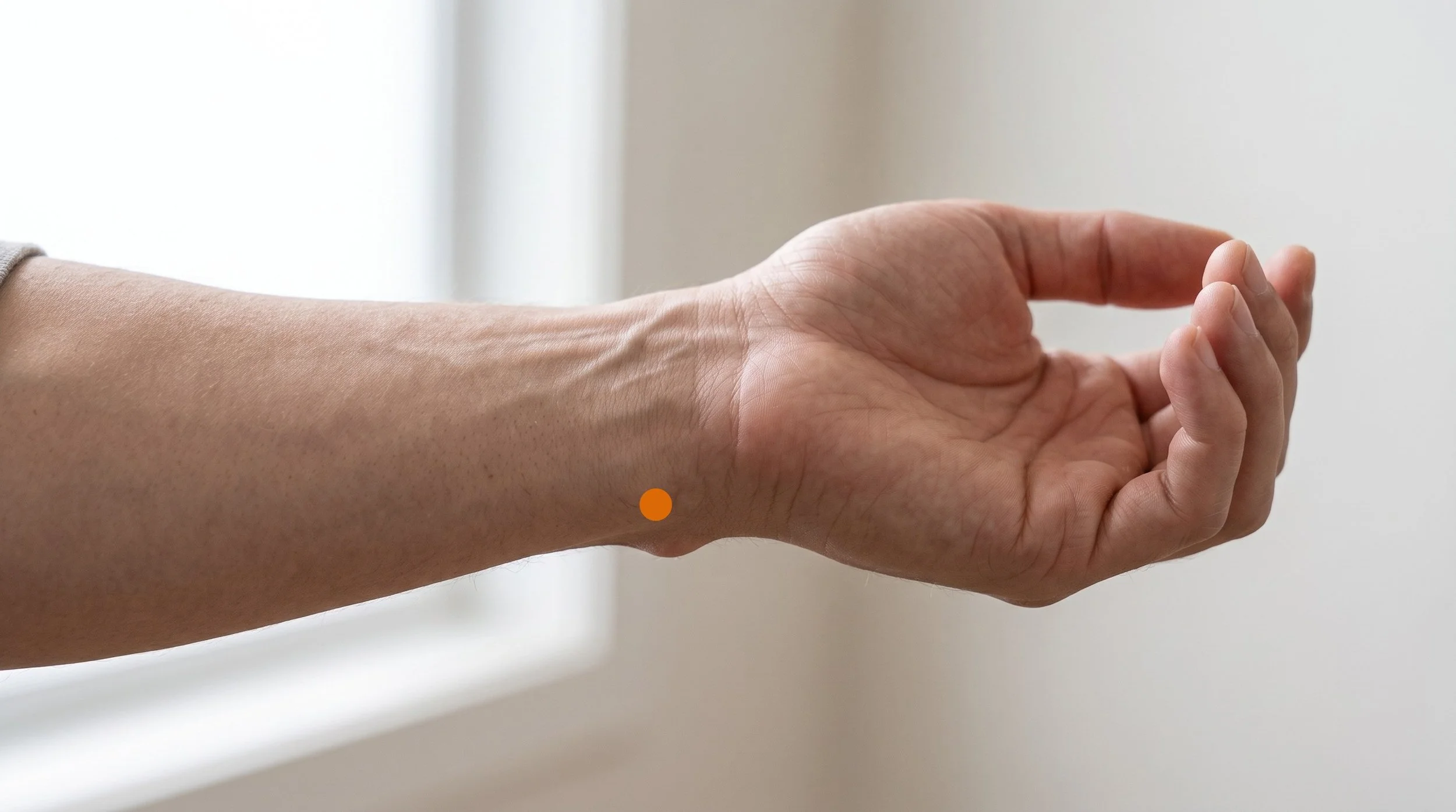
SI6 Acupuncture Point (Yanglao)
Yanglao at the Head of the Ulna: Anatomy, Mechanism, and Why This Small Wrist Point Is Reached For in Acute Shoulder, Scapular, and Back Pain
SI6 (Yanglao, often translated as Support the Aged or Nourishing the Elderly) is the sixth point of the Small Intestine channel and its xi-cleft point, the category traditionally reserved for sudden, severe, sharply localized pain. You find it on the back of the wrist at the head of the ulna: rest your palm on your chest and a small cleft opens on the thumb side of the bony bump of the ulnar styloid, right where a locating fingertip drops in.
The si6 acupuncture point matters clinically because it is a distal point with a wide reach: practitioners use it for acute shoulder and scapular pain, for acute low back sprain through the shared taiyang (Small Intestine and Bladder) relationship, for wrist pain that flares with forearm rotation, and, in classical texts, for dim or blurred vision, which is where the name comes from (Deadman et al., 2007).
- Location and layers: the point sits in the cleft between the ulnar head and styloid process, under thin skin and the fibers of the extensor retinaculum, with the extensor carpi ulnaris tendon running just to the ulnar side; the cleft physically opens and closes as the forearm rotates, which is why the palm-on-chest position is used to locate it (Deadman et al., 2007).
- Traditional categories, translated: xi-cleft points are classically described as places where channel qi and blood gather and sink more deeply, and are chosen for acute and painful presentations; in modern terms this is a distal, high-density somatosensory site used with strong stimulation and active movement rather than a claim about fluid physically pooling (Deadman et al., 2007).
- Nerve story: needling here recruits the dorsal branch of the ulnar nerve and the posterior antebrachial cutaneous nerve, plus periosteal and retinacular afferents, feeding input into lower cervical and upper thoracic cord segments that also receive input from the shoulder girdle and scapular region (Zhao, 2008).
- Mechanism beyond the segment: distal needling appears to work largely through descending inhibition from brainstem circuits and diffuse, whole-body modulation of pain signaling, which is the most plausible account of how a wrist point can change how a strained low back feels within minutes (Zhao, 2008).
- Research picture: large individual patient data analyses suggest acupuncture produces modest but real effects for musculoskeletal pain that persist beyond the treatment course (Vickers et al., 2018), while shoulder-specific and back-specific reviews remain more cautious and generally low certainty (Green et al., 2005; Mu et al., 2020).
- De qi at SI6: patients usually report a dull, heavy, slightly electric ache in the cleft that can spread up the ulnar forearm toward the elbow; because the periosteum is close, technique here is deliberately oblique and controlled rather than deep.
Sudden Shoulder or Scapular Pain That Feels Sharp and Stuck?
Acute shoulder and shoulder blade pain often responds better to a distal point plus movement than to needling the sore spot alone. At Morningside Acupuncture, SI6 is frequently used on the side of the pain (or the opposite side) while you gently work through the ranges that hurt, then paired with focused dry needling of the rotator cuff and periscapular muscles once the guarding settles. That combination is designed to buy you range of motion in the first visit, not the fifth. Schedule a visit and let's see how much motion we can free up today.
Schedule NowAnatomy of SI6: Why the Cleft at the Head of the Ulna Is Such an Important Location
The yanglao point location is defined by a moving landmark rather than a fixed one. At the back of the wrist, the head of the ulna forms a rounded prominence with the styloid process at its ulnar edge. Place a fingertip on the high point of that styloid with the palm face down, then have the person turn the palm onto the chest: the bone rotates beneath your finger and a narrow cleft opens on the radial (thumb) side.
Under the skin at this si 6 wrist site lie thin subcutaneous tissue, the dorsal venous network, the retinacular fibers that strap the extensor tendons down, and the periosteal surface of the ulnar head, with the extensor carpi ulnaris tendon in its groove nearby. This is a load-bearing corner of the wrist: pronation and supination, gripping while twisting, racket and tool use, and pushing up from a chair all stress the distal radioulnar joint and the tissues here.
Sensory supply to this territory comes mainly from the dorsal branch of the ulnar nerve with contributions from the posterior antebrachial cutaneous nerve, so needling SI6 delivers input into lower cervical and upper thoracic spinal segments (Deadman et al., 2007).
Those same segments receive afferents from the shoulder girdle, scapular muscles, and cervicothoracic junction, which gives a straightforward convergence explanation for why a wrist point is used for pain felt at the shoulder blade: inputs from distant tissues share dorsal horn neurons, and strong afferent traffic from one input can change how the pool of neurons processes the other. Layered onto that segmental effect is a broader, non-segmental one: needle stimulation engages descending inhibitory pathways from the midbrain and brainstem that reduce nociceptive transmission throughout the cord (Zhao, 2008). Both effects are ordinary neurophysiology, no energetic transfer required.
The deeper structures to respect are vascular and articular rather than dangerous: terminal branches of the posterior interosseous artery and vein, the dorsal venous network, and the distal radioulnar joint capsule sit close by. For that reason the standard technique is oblique or transverse-oblique insertion running proximally or distally along the forearm to a depth of about 0.5 to 1 cun, with some texts describing a shallower perpendicular approach of roughly 0.3 to 0.5 cun (Deadman et al., 2007).
Bruising is the most common minor event over the dorsal wrist, so clinicians tend to angle away from visible veins, avoid heavy perpendicular pressure into the joint line, and use gentler technique in patients on anticoagulants.
Related Small Intestine Channel Related Best Acupuncture Points For Shoulder PainSI6 at a Glance: Classification, Location, and Clinical Use
| Category | Detail |
|---|---|
| Traditional Name | Yanglao (Support the Aged, also translated Nourishing the Elderly) |
| Channel Classification | Sixth point of the Small Intestine channel (hand taiyang), on the dorsal ulnar wrist |
| Point Categories | Xi-cleft (accumulation) point of the Small Intestine channel, one of the twelve channel xi-cleft points traditionally selected for acute conditions and severe pain |
| Precise Location | On the back of the wrist at the head of the ulna: with the palm placed on the chest, the point falls in the cleft level with and just radial to the high point of the ulnar styloid process, the gap that opens as the forearm rotates |
| Tissue Stimulated | Skin and thin subcutaneous tissue over the ulnar head, extensor retinaculum fibers, periosteum of the ulnar head and styloid, with the extensor carpi ulnaris tendon and extensor digitorum compartment nearby |
| Needle Depth / Direction | Oblique or transverse-oblique insertion directed proximally or distally along the forearm, 0.5 to 1 cun; some texts describe shallow perpendicular insertion of 0.3 to 0.5 cun |
| De Qi Sensation | A dull, heavy, sometimes buzzing ache in the bony cleft that may travel up the ulnar side of the forearm; often noticeably strong for such a small point |
| Primary Clinical Uses | Acute shoulder, scapular, and upper arm pain; acute low back sprain as a distal point; wrist and forearm pain aggravated by rotation; stiff neck; classically, dim or blurred vision |
| Common Point Combinations |
|
In Deadman's A Manual of Acupuncture, SI6 is presented as the xi-cleft point of the Small Intestine channel, a category traditionally described as the place where channel qi and blood accumulate and sink deeper, and therefore as a point suited to acute, severe presentations rather than slow-building ones.
The classical indications attributed to it cluster into three groups: violent pain of the shoulder, upper arm, and back (described in vivid terms, as though the shoulder were broken or the arm dislocated), heaviness and pain of the lower back with difficulty sitting down and standing up along with tightness and painful obstruction reaching the foot, and eye complaints marked by dimming or blurring of vision.
The traditional explanation for the reach into the lower body is the taiyang relationship, which links the hand Small Intestine channel with the foot Bladder channel, and the explanation for the eye indications is the channel's stated connections to the inner and outer corners of the eye.
What is striking is the internal consistency of the classical picture: the same point is credited with the most violent musculoskeletal pain of the upper back and with the quiet, gradual dimming of an aging person's sight, and the name Support the Aged sits squarely on the second of those (Deadman et al., 2007).
Why SI6 Is Used for Acute Low Back Sprain When the Point Sits at the Wrist
Patients are understandably skeptical when a clinician needles the wrist for a back that seized up lifting a suitcase. The reasoning is not that something travels down the arm and into the spine. It is that an acutely sprained back is often too guarded and too tender to needle usefully at first, and that a strong sensory input delivered somewhere safe can change how the nervous system is processing the painful region.
Needle stimulation at a distal site activates descending pain-modulating pathways that dampen nociceptive transmission at spinal levels well away from where the needle sits, and it also engages widespread inhibitory mechanisms triggered by a distinct, tolerable stimulus (Zhao, 2008).
For shoulder and scapular pain the story is more local. The dorsal ulnar wrist and the shoulder girdle share overlapping spinal segments, so input from SI6 lands in the same neural neighborhood that is handling the shoulder complaint, a convergence effect that helps explain the classical emphasis on pain of the shoulder, scapula, and upper arm at this point (Deadman et al., 2007; Zhao, 2008).
In practice, this is why SI6 is so often needled with movement: the patient reaches, rotates, or bends while the needle is retained, which pairs the modulating input with the very motion the brain has learned to protect.
The classical eye indications deserve a plainer framing. Traditional texts credit SI6 with brightening the eyes and treating dim or blurred vision, and the point's name reflects that reputation (Deadman et al., 2007).
Modern research has not established that needling the wrist improves visual acuity, and we do not present it that way. What we can say is that the musculoskeletal uses of this point are supported by a coherent neurophysiological rationale and by a general body of evidence for acupuncture in chronic musculoskeletal pain (Vickers et al., 2018), while the vision indications remain a traditional attribution.
What the Research Shows for SI6
There is no body of trials isolating SI6 by itself, and that is worth saying plainly. Acupuncture research almost always tests multi-point protocols delivered over several sessions, so the honest question is not whether this single point works but whether the protocols it belongs to outperform sham, usual care, or no treatment.
The picture that emerges is modest and mixed: reasonably consistent evidence of benefit for musculoskeletal pain overall, with low-certainty findings in the shoulder and back literature specifically, and some suggestion that pairing needling with active movement matters for acute presentations.
| Study | Type | Focus | Key Finding |
|---|---|---|---|
| Vickers et al., 2018 | Individual patient data meta-analysis | Acupuncture for chronic pain including musculoskeletal and shoulder pain | Pooled patient-level data suggest acupuncture is superior to sham and to no-acupuncture controls, with effects that persist over time, though the difference from sham is modest. |
| Green et al., 2005 | Cochrane systematic review | Acupuncture for shoulder pain | The review found too little good-quality evidence to support or refute acupuncture for shoulder pain, while noting possible short-term benefit for pain and function. |
| Mu et al., 2020 | Cochrane systematic review | Acupuncture for chronic nonspecific low back pain | Low-certainty evidence suggested acupuncture may improve pain and function compared with usual care, with the certainty downgraded for risk of bias and imprecision. |
| Su et al., 2021 | Systematic review and meta-analysis | Acupuncture for acute low back pain | Pooled trials suggested acupuncture may reduce pain intensity in acute low back pain, though the included studies were heterogeneous and often methodologically limited. |
| Lin et al., 2016 | Randomized controlled trial | Acupuncture combined with active lumbar movement for acute lumbar sprain | Needling delivered while the patient actively moved the lumbar region was associated with better pain relief and mobility than conventional static needling in this small trial. |
| Zhao, 2008 | Narrative review of mechanisms | Neural basis of acupuncture analgesia | Analgesic effects are attributed to afferent activation, spinal segmental modulation, and descending inhibitory control rather than to any channel-specific transfer. |
Threw Your Back Out and Cannot Bend or Sit Comfortably?
Acute low back sprain is one of the classic reasons SI6 gets chosen far from the site of pain, because a locked, guarded back is often too irritable to needle directly at first. We needle the wrist, ask you to move within tolerance, and then add local and paraspinal work as the spasm eases. Studies suggest that pairing needling with active movement may improve both pain and mobility faster than needling alone (Lin et al., 2016). Book an appointment and we'll build the session around what you can actually move.
Schedule NowSI6 in the Context of Trigger Point Work
Small Intestine 6 is not a muscle belly point, so it is rarely a dry needling target in the trigger point sense. Its neighbors are: the extensor carpi ulnaris runs in its groove just ulnar to the point, and the extensor digitorum compartment lies radial to it, both of which can refer pain into the ulnar wrist and back of the hand in patterns that patients describe as wrist pain (Simons et al., 1999). When someone presents with dorsal wrist pain that worsens with twisting, we assess those forearm extensors and the distal radioulnar joint before assuming the pain belongs to the wrist itself.
In shoulder and scapular cases, we typically use SI6 as the distal, movement-paired input and reserve dry needling for the muscles generating the referral: infraspinatus, teres minor, subscapularis, rhomboids, levator scapulae, and upper trapezius. In acute low back sprain the same logic applies in reverse, with SI6 and active movement first, then quadratus lumborum, multifidus, and gluteal needling once the protective spasm has eased enough to tolerate local work.
Combining a distal classical point with targeted myofascial needling is standard practice at Morningside, and both are acupuncture in the sense that matters clinically: a filiform needle placed to change how the nervous system is handling the problem.
SI6 Shoulder and Back Pain Treatment at NYC's Highest-Rated Acupuncture Clinic
Morningside Acupuncture is the highest-rated acupuncture and dry needling clinic in New York City with over 500 five-star Google reviews, and our approach blends classical point selection with orthopedic assessment and trigger point needling. SI6 is one of the small, high-yield distal points we reach for when shoulder, scapular, wrist, or lumbar pain is acute and movement is limited. Every session includes a plan for what you do between visits, not just what happens on the table. Schedule your appointment on the Upper West Side and get started this week.
Schedule NowFrequently Asked Questions
What does SI6 feel like when needled?
Most people feel a heavy, dull, slightly buzzing ache right in the bony cleft, sometimes spreading up the ulnar side of the forearm toward the elbow and occasionally as far as the shoulder blade. Because the point sits over bone with very little soft tissue, the sensation can arrive quickly and feel stronger than the needle size suggests. It should be a distinct, tolerable ache, not a sharp or burning pain, and it usually fades within a minute or two of the needle settling.
Why needle the wrist for shoulder or low back pain instead of the painful area?
Two reasons, one practical and one neurological. Practically, an acutely sprained or guarded area is often too irritable to needle first, and a distal point lets us treat while you move the painful region, which studies suggest may improve both pain and mobility in acute lumbar sprain (Lin et al., 2016). Neurologically, distal needling engages descending inhibitory pathways and spinal segmental convergence, so input from the wrist can change how the nervous system processes signals from the shoulder girdle and back (Zhao, 2008). Local needling usually follows in the same visit or the next one.
Can I press SI6 myself between sessions?
Yes, and it is one of the easier points to self-treat because the landmark is obvious. Rest your palm flat on your chest so the forearm rotates, then use the opposite thumb to find the small cleft on the thumb side of the bony bump at the pinky-side edge of your wrist. Press in firmly enough to feel a clear ache (not a sharp pain), hold for 30 to 60 seconds, and while holding, gently move the painful area through a comfortable range: turn your head, roll the shoulder, or shift your hips. Repeat for two or three rounds and do this a few times a day. Stop if pressing reproduces numbness, tingling into the hand, or increasing pain.
Is SI6 safe to needle?
It is a low-risk point when treated with standard technique. There are no organs or major vessels beneath it, only skin, retinacular fibers, small dorsal veins, and the bony surface of the ulna, so clinicians use oblique or transverse-oblique insertion of roughly 0.5 to 1 cun along the forearm rather than driving perpendicularly into the joint (Deadman et al., 2007). The most common minor effect is a small bruise from a dorsal wrist vein, which is worth mentioning if you take blood thinners. Tell your acupuncturist about recent wrist injury, distal radioulnar joint instability, or local skin problems so the angle and depth can be adjusted.
Where exactly is SI6 located?
On the back of the wrist at the head of the ulna. The reliable way to find it: rest the forearm palm-down and place a fingertip on the high point of the ulnar styloid, the bony bump at the pinky-side edge of the wrist, then turn the palm onto the chest. As the forearm rotates, a cleft opens directly under your fingertip on the thumb side of that bump, and that cleft is small intestine 6. If your finger stays on the smooth bone rather than dropping into a gap, you are slightly too far toward the little finger; slide a few millimeters toward the thumb and rotate the forearm again.
References
- Deadman, P., Al-Khafaji, M., & Baker, K. (2009). A manual of acupuncture. Journal of Chinese Medicine Publications.
- Cheng, X. (Ed.). (1999). Chinese acupuncture and moxibustion (Rev. ed.). Foreign Languages Press.
- Kim, H. (2008). Handbook of Oriental medicine (3rd ed.). Harmony & Balance Press.
- Simons, D. G., Travell, J. G., & Simons, L. S. (1999). Travell & Simons' myofascial pain and dysfunction: The trigger point manual, Vol. 1: Upper half of body (2nd ed.). Williams & Wilkins.
- Zhao, Z. Q. (2008). Neural mechanism underlying acupuncture analgesia. Progress in Neurobiology, 85(4), 355-375. https://doi.org/10.1016/j.pneurobio.2008.05.004
- Vickers, A. J., Vertosick, E. A., Lewith, G., MacPherson, H., Foster, N. E., Sherman, K. J., Irnich, D., Witt, C. M., & Linde, K. (2018). Acupuncture for chronic pain: Update of an individual patient data meta-analysis. Journal of Pain, 19(5), 455-474. https://doi.org/10.1016/j.jpain.2017.11.005
- Green, S., Buchbinder, R., & Hetrick, S. (2005). Acupuncture for shoulder pain. Cochrane Database of Systematic Reviews, 2005(2), CD005319. https://doi.org/10.1002/14651858.CD005319
- Mu, J., Furlan, A. D., Lam, W. Y., Hsu, M. Y., Ning, Z., & Lao, L. (2020). Acupuncture for chronic nonspecific low back pain. Cochrane Database of Systematic Reviews, 2020(12), CD013814. https://doi.org/10.1002/14651858.CD013814
- Su, X., Qian, H., Chen, B., Fan, W., Xu, D., Tang, C., & Lu, L. (2021). Acupuncture for acute low back pain: A systematic review and meta-analysis. Annals of Palliative Medicine, 10(4), 3924-3936. https://doi.org/10.21037/apm-20-1998
- Lin, R., Zhu, N., Liu, J., Li, X., Wang, Y., Zhang, J., & Xi, C. (2016). Acupuncture-movement therapy for acute lumbar sprain: A randomized controlled clinical trial. Journal of Traditional Chinese Medicine, 36(1), 19-25. https://doi.org/10.1016/s0254-6272(16)30003-6
Disclaimer: This web site is intended for educational and informational purposes only. Reading this website does not constitute providing medical advice or any professional services. This information should not be used for diagnosing or treating any health issue or disease. Those seeking medical advice should consult with a licensed physician. Seek the advice of a medical doctor or other qualified health professional for any medical condition. If you think you have a medical emergency, call 911 or go to the emergency room. No acupuncturist-patient relationship is created by reading this website or using the information. Morningside Acupuncture PLLC and its employees and contributors do not make any express or implied representations with respect to the information on this site or its use. For any legal interpretation of scope of practice in your state, consult a licensed attorney or regulatory authority.
Read more from our blog



