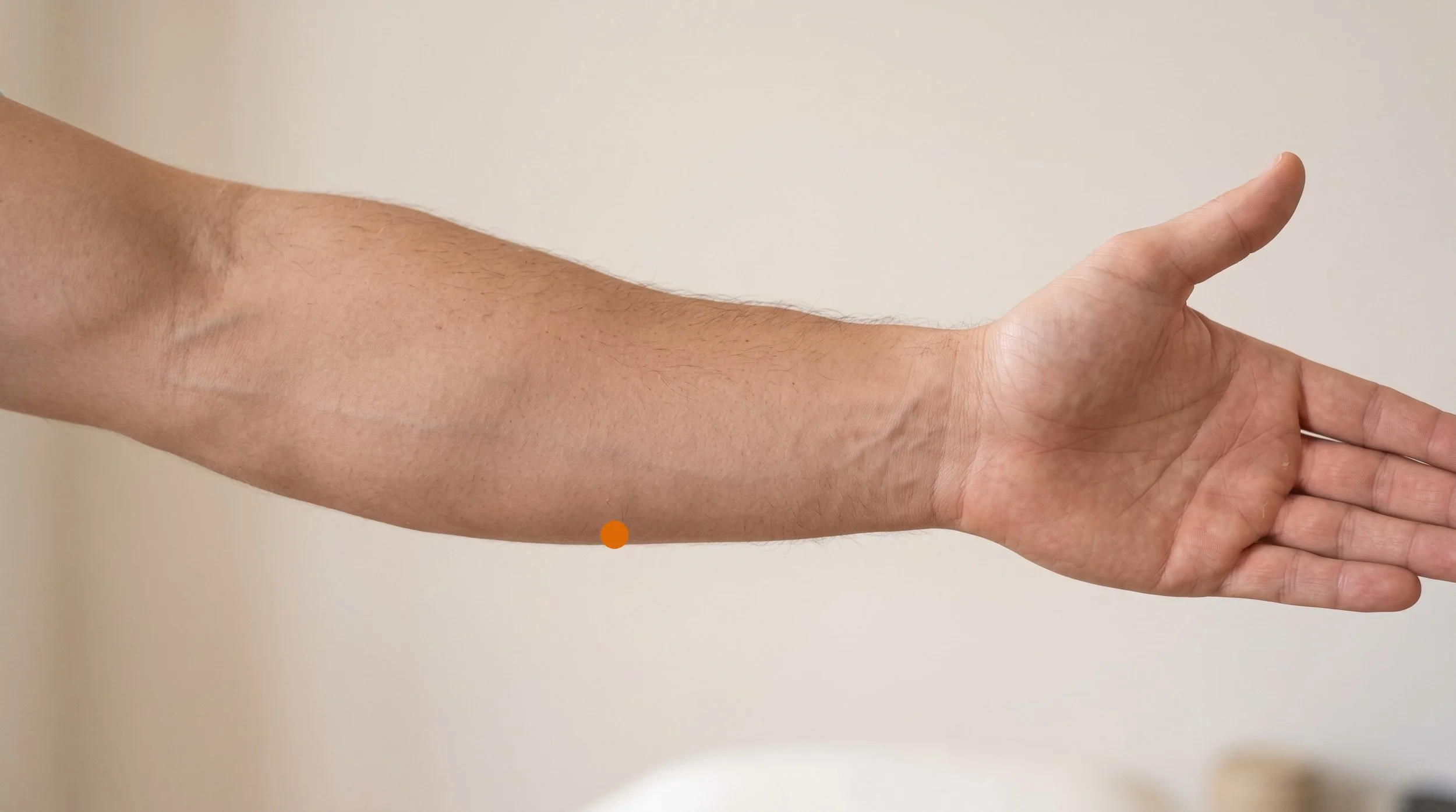
SI7 Acupuncture Point (Zhizheng)
The Branch of the Upright on the Ulnar Forearm: Anatomy, Mechanism, and Why This Luo-Connecting Point Links Grip Strength, Neck Tension, and Calm
SI7 (Zhizheng, often translated as Branch of the Upright) is the luo-connecting point of the Small Intestine channel, sitting midway up the ulnar side of the forearm in the shallow groove between the front border of the ulna and the muscle belly of flexor carpi ulnaris, about 5 cun above the wrist on the line running from SI5 to SI8.
In plain terms, rest the forearm across the chest, find the bony ridge of the ulna, and slide your thumb just in front of it roughly a third of the way up from the wrist crease toward the elbow: that soft, slightly tender crevice is the zhizheng point location. Clinically the si7 acupuncture point earns its keep in two very different ways, as a practical local and distal point for ulnar-sided forearm ache, elbow stiffness, weak grip and finger pain, and as a traditionally calming point whose classical reputation comes from the luo channel's described link to the Heart channel.
- Location and layers: SI7 lies in the groove between the anterior border of the ulna and flexor carpi ulnaris, 5 cun proximal to SI5, and the needle passes through skin, subcutaneous fascia and the ulnar border musculature of the forearm rather than any joint or cavity.
- Traditional categories: classical texts list SI7 as the luo-connecting point of the Small Intestine channel, and its traditional actions are described as releasing the exterior, calming the spirit, activating the channel and benefiting the finger joints, all presented here as traditional attributions rather than physiology.
- Mechanism: needling here recruits medial antebrachial cutaneous and deep muscular afferents entering the lower cervical and upper thoracic cord, where segmental convergence and descending inhibitory pathways plausibly account for effects on forearm, hand and neck symptoms (Zhao, 2008).
- Research picture: no trial has isolated SI7 by itself, so evidence is indirect, drawn from pooled data showing modest but real benefits of acupuncture in chronic pain and neck disorders (Vickers et al., 2018; Trinh et al., 2016) and from mixed but suggestive findings on anxiety and autonomic tone (Yang et al., 2021; Chung et al., 2014).
- Clinical framing: we use SI7 mainly as part of a regional plan for ulnar-sided forearm and elbow complaints, grip fatigue in keyboard and racquet athletes, and stress-loaded upper limb tension, rarely as a stand-alone point.
- De qi: patients typically describe a dull, spreading heaviness or ache along the ulnar forearm, sometimes tracking toward the little finger side of the hand; sharp electrical zings are not the goal and prompt immediate needle adjustment.
Struggling With Ulnar Forearm Pain, Weak Grip, or Stubborn Elbow Stiffness?
Ulnar-sided forearm complaints rarely come from one tissue, which is why we assess the wrist, elbow, and lower neck before we ever pick up a needle. At Morningside Acupuncture we use SI7 alongside dry needling of flexor carpi ulnaris and the deep finger flexors to reduce local tone while calming an irritable segment. Most patients notice easier gripping and less end-of-day forearm burn within a few sessions. Schedule a visit and we'll map out what's actually driving your symptoms.
Schedule NowAnatomy of SI7: Why the Groove Between the Ulna and Flexor Carpi Ulnaris Is Such an Important Location
The si 7 forearm location sits in a genuine anatomical corridor rather than a vague soft-tissue zone. Superficially there's thin skin and loose subcutaneous fascia, which is why this area is easy to palpate and why the point often presents as a small dip or crevice. Just deep to that lies the border between the sharp anterior edge of the ulna and the muscle belly of flexor carpi ulnaris, with the ulnar heads of the deep finger flexors nearby.
This region is loaded every time you grip, type, carry a bag, swing a racquet, or stabilize the wrist for hours of mouse work, so it is a frequent site of taut, tender, ropey tissue in the patients we see across Manhattan offices and gyms.
Neurologically, the skin overlying SI7 falls largely in medial antebrachial cutaneous territory, and the deeper muscular tissue is supplied by the ulnar nerve, with both pathways feeding into the lower cervical and upper thoracic spinal segments. That segmental address matters: afferent input from a needle here converges in the dorsal horn with input from the hand, elbow, and lower neck, which offers a plausible neurophysiological reading of why a forearm point was classically credited with effects on finger pain, elbow stiffness, and neck tension.
Needle stimulation also engages descending inhibitory systems that dampen dorsal horn transmission through opioidergic, serotonergic, and noradrenergic mechanisms (Zhao, 2008), and it produces local vascular and inflammatory changes around the needle that likely contribute to reduced tissue sensitivity.
The important deep structures are anterior to the point rather than under it. The ulnar nerve and ulnar artery travel in the anterior compartment, running along the deep surface of flexor carpi ulnaris toward the wrist, so a perpendicular insertion of 0.5 to 1 cun into the muscular groove at the ulnar border stays well away from the neurovascular bundle.
Classical texts give perpendicular insertion at that depth, and the point is best located and needled with the patient lying supine and the arm supinated or resting on the chest, which keeps the forearm stable and the landmarks obvious. If a patient reports a sharp shock or radiating electrical sensation into the little finger, the needle is withdrawn and redirected rather than manipulated further.
Related Small Intestine Channel Related Flexor Carpi Ulnaris Trigger PointsSI7 at a Glance: Classification, Location, and Clinical Use
| Category | Detail |
|---|---|
| Traditional Name | Zhizheng (Branch of the Upright), Small Intestine 7 |
| Channel Classification | Small Intestine channel of the hand taiyang |
| Point Categories | Luo-connecting point of the Small Intestine channel, the point from which the Small Intestine connecting channel departs to join the Heart channel and to ascend the arm toward the shoulder. See the Luo Connecting Channels overview for context. |
| Precise Location | On the ulnar aspect of the posterior forearm, 5 cun proximal to SI5, on the line joining SI5 and SI8, in the groove between the anterior border of the ulna and the belly of flexor carpi ulnaris; located with the arm supinated or resting on the chest. |
| Tissue Stimulated | Skin and subcutaneous fascia in medial antebrachial cutaneous territory, the ulnar periosteal border, and the adjacent musculature of flexor carpi ulnaris, with flexor digitorum profundus deeper and extensor carpi ulnaris just posterior. |
| Needle Depth / Direction | Perpendicular insertion 0.5 to 1 cun into the groove; angle slightly away from the anterior forearm to stay clear of the ulnar neurovascular bundle. |
| De Qi Sensation | Dull ache, heaviness, or a spreading pressure along the ulnar forearm, occasionally referring toward the little finger side of the hand; sharp electrical sensations are avoided. |
| Primary Clinical Uses | Ulnar-sided forearm and elbow stiffness, finger pain with weak grip in classical use, neck stiffness in classical use, and anxiety, fright, or restlessness in classical use via the Heart channel connection. |
| Common Point Combinations |
|
In A Manual of Acupuncture, Deadman and colleagues describe SI7 as having three traditional roles, and the logic behind each is worth understanding as classical attribution rather than physiology. First, because the Small Intestine belongs to taiyang, the most superficial of the six channels in classical theory, points along it were used for exterior-type febrile presentations, particularly those said to begin with neck and low back pain.
Second, as the luo-connecting point, SI7 is where the Small Intestine connecting channel was described as branching off to join the Heart channel, and this is exactly what the point's name refers to, the upright being the Heart; that link is the stated basis for its classical indications in mania-depression, fright, sadness, and anxiety, with the Golden Mirror of Medicine adding constrained emotions to the list.
Third, the point was credited with regulating the channel at a distance, covering headache and visual complaints as well as elbow contraction and, most distinctively, severe pain of the fingers with an inability to grip or make a fist. The Great Compendium also assigned excess and deficiency patterns to the luo point, slack joints with an immobile elbow for excess and warts for deficiency, a detail echoed in the classical connecting channel literature.
What makes the classical pattern striking is that a single forearm point was asked to cover both the hand, an area with almost no true distal points available, and the emotional territory of the Heart.
Why SI7 Is Used for Anxiety and Restlessness, Not Just Forearm Pain
The first half of the answer is segmental. Sensory input from SI7 travels through the medial antebrachial cutaneous nerve and the ulnar nerve into the lower cervical and upper thoracic cord, the same neighborhood that receives input from the hand, the medial elbow, and part of the lower neck and upper shoulder girdle. When those inputs converge on shared dorsal horn neurons, stimulating one territory can change how the whole segment behaves, which is a modern way of describing what classical texts framed as a channel relationship. This is also why a forearm point can be a reasonable addition to a neck plan rather than a strange detour.
The second half is systemic. Needling recruits descending inhibitory pathways from the brainstem that release endogenous opioids, serotonin, and noradrenaline onto spinal pain circuits, which is one of the better-characterized mechanisms behind acupuncture analgesia (Zhao, 2008). Alongside analgesia, needling appears to influence autonomic balance, with a review of heart rate variability trials reporting shifts in frequency-domain measures during and after treatment, though results varied considerably across studies and point selections (Chung et al., 2014).
For anxiety specifically, pooled analyses suggest a modest benefit over control conditions while flagging methodological weaknesses across the included trials (Yang et al., 2021).
Put together, the honest clinical position is this: SI7 is a well-placed point for ulnar-sided upper limb complaints with a plausible segmental rationale, and its calming reputation is a traditional attribution supported by general, not point-specific, evidence about acupuncture and arousal. We use it as one element of a treatment, and we set expectations accordingly.
What the Research Shows for SI7
There is no randomized trial that isolates SI7, and readers should be skeptical of any point page that implies otherwise. Clinical trials almost always test multi-point protocols, often selected by pattern or by region, so the fair way to read the evidence is to ask whether acupuncture protocols that plausibly include forearm and channel points help the conditions SI7 is used for. The table below summarizes the relevant reviews with that limitation in mind.
| Study | Type | Focus | Key Finding |
|---|---|---|---|
| Vickers et al., 2018 | Individual patient data meta-analysis | Chronic musculoskeletal pain, headache, and osteoarthritis across 39 trials | Acupuncture was better than both sham and no-acupuncture controls, with effects that persisted over time, though differences from sham were modest. |
| Trinh et al., 2016 | Cochrane systematic review | Acupuncture for neck disorders, 27 randomized trials | Reviewers reported benefits for pain and disability compared with sham or inactive controls, but rated the overall evidence quality as low to moderate. |
| Yang et al., 2021 | Systematic review and meta-analysis | Acupuncture for anxiety disorders | Pooled results favored acupuncture over control conditions with a small to moderate effect size, tempered by heterogeneity and risk of bias concerns. |
| Chung et al., 2014 | Systematic review with meta-analysis | Effects of acupuncture on heart rate variability | Some frequency-domain measures shifted with needling, offering partial support for autonomic modulation while results differed by point and population. |
| Zhao, 2008 | Narrative review of mechanism research | Neural mechanisms of acupuncture analgesia | Analgesic effects are attributed to afferent stimulation engaging spinal and supraspinal inhibitory circuits and endogenous neurotransmitter release. |
Carrying Stress in Your Neck, Jaw, and Forearms?
Stress rarely stays in one place: it shows up as clenched hands, tight forearms, and a neck that never fully lets go. SI7 is traditionally used as a calming point through the Small Intestine luo channel's classical link to the Heart channel, and we combine it with points that may help downshift autonomic arousal. Sessions are quiet, unhurried, and built around how your nervous system responds. Book an appointment and let's give your system a place to settle.
Schedule NowSI7 in the Context of Trigger Point Work
Because acupuncture is defined by the use of an acupuncture needle rather than by any single theoretical model, the same filament needle we use at SI7 can be redirected a few millimeters into a taut band and used as dry needling. At the ulnar forearm this overlap is unusually clean: the point sits on the border of flexor carpi ulnaris, a muscle whose trigger points are described as referring pain toward the ulnar wrist and hand, and the deep finger flexors and extensor carpi ulnaris are within easy reach of the same field (Simons et al., 1999).
In practice we often palpate first, then decide whether the session calls for classical point work, myofascial needling, or both in the same treatment.
For a patient with grip fatigue and ulnar-sided forearm burning, a typical Morningside session might combine SI7 with dry needling of flexor carpi ulnaris and flexor digitorum profundus, then move proximally to the medial elbow and lower cervical segments if the exam suggests a contribution from there. Local twitch responses are common in the flexors and usually feel like a brief cramp, while SI7 itself tends to produce a duller spreading ache. We finish with loading advice, because needling reduces sensitivity but tendon and grip capacity improve with graded work.
SI7 Forearm and Neck Pain Treatment at NYC's Highest-Rated Acupuncture Clinic
Morningside Acupuncture is the highest-rated acupuncture and dry needling clinic in New York City with over 500 five-star Google reviews, and our approach blends classical point selection with modern orthopedic assessment. We treat forearm, elbow, hand, and neck complaints in one integrated plan rather than chasing symptoms one at a time. Every treatment includes clear explanations of what we're needling and why. Schedule your visit today and see the difference a precise, anatomy-first approach makes.
Schedule NowFrequently Asked Questions
What does SI7 feel like when needled?
Most patients feel a dull, heavy, spreading ache or a mild pressure at the ulnar forearm, sometimes traveling toward the little finger side of the hand. That heaviness is the de qi sensation practitioners look for. Because the ulnar nerve runs deeper and more anterior in the forearm, an occasional patient feels a brief tingle; a sharp or electrical zing means the needle is repositioned right away, and it should not be worked through.
Why would a practitioner needle my forearm for neck stiffness or anxiety?
Two reasons, one modern and one classical. Neurologically, input from SI7 enters the lower cervical and upper thoracic segments, where it converges with input from the neck, shoulder girdle, and hand, so treating there can influence how that whole segment processes pain (Zhao, 2008). Classically, SI7 is the luo-connecting point whose channel was described as joining the Heart channel, which is the traditional basis for its use in fright, restlessness, and worry. The classical rationale is presented as traditional attribution, while the segmental explanation is the mechanism we rely on clinically.
Can I press SI7 myself between sessions?
Yes, and it's an easy point to self-treat. Rest your forearm across your chest or on a table, find the sharp ridge of the ulna, and slide your thumb just in front of it about 5 cun (roughly a third of the way) from the wrist crease toward the elbow until you feel a small dip or a tender, ropey band. Apply steady, moderate pressure with your thumb for 30 to 60 seconds, breathing slowly, then add small circular motions for another 30 seconds. Repeat two or three times per side, once or twice daily. Keep it at a tolerable four to six out of ten, stop if you get any numbness, tingling, or shooting sensation into the hand, and follow with a gentle wrist flexor stretch.
Is SI7 safe to needle?
In trained hands, yes. There is no organ or body cavity beneath this point, and standard perpendicular insertion of 0.5 to 1 cun stays within skin, fascia, and forearm muscle. The main structures to respect are the ulnar nerve and artery, which travel anterior and deep along the underside of flexor carpi ulnaris, so the needle is angled to remain in the ulnar border tissue. Minor bruising or short-lived soreness are the usual side effects. Let your practitioner know if you take blood thinners, have had ulnar nerve surgery or transposition, or have any skin condition or infection over the forearm.
Where exactly is SI7 located?
SI7 is on the ulnar aspect of the back of the forearm, 5 cun above the wrist on the line connecting SI5 at the wrist with SI8 at the elbow, in the groove between the anterior border of the ulna and the belly of flexor carpi ulnaris. The most reliable way to find it is to divide the forearm from wrist crease to elbow into twelve parts and count five up from the wrist, then palpate just in front of the ulnar ridge for a small depression that feels distinctly softer or more tender than the surrounding tissue. Classical instructions suggest locating and needling it with the patient lying down and the arm either supinated or resting on the chest.
References
- Deadman, P., Al-Khafaji, M., & Baker, K. (2009). A manual of acupuncture. Journal of Chinese Medicine Publications.
- O'Connor, J., & Bensky, D. (Eds. & Trans.). (1981). Acupuncture: A comprehensive text. Shanghai College of Traditional Medicine. Eastland Press.
- Cecil-Sterman, A. (2012). Advanced acupuncture: A clinic manual. Classical Wellness Press.
- Simons, D. G., Travell, J. G., & Simons, L. S. (1999). Travell & Simons' myofascial pain and dysfunction: The trigger point manual, Vol. 1: Upper half of body (2nd ed.). Williams & Wilkins.
- Zhao, Z. Q. (2008). Neural mechanism underlying acupuncture analgesia. Progress in Neurobiology, 85(4), 355-375. https://doi.org/10.1016/j.pneurobio.2008.05.004
- Vickers, A. J., Vertosick, E. A., Lewith, G., MacPherson, H., Foster, N. E., Sherman, K. J., Irnich, D., Witt, C. M., & Linde, K. (2018). Acupuncture for chronic pain: Update of an individual patient data meta-analysis. Journal of Pain, 19(5), 455-474. https://doi.org/10.1016/j.jpain.2017.11.005
- Trinh, K., Graham, N., Irnich, D., Cameron, I. D., & Forget, M. (2016). Acupuncture for neck disorders. Cochrane Database of Systematic Reviews, 2016(5), CD004870. https://doi.org/10.1002/14651858.CD004870.pub4
- Yang, X. Y., Yang, N. B., Huang, F. F., Ren, S., & Li, Z. J. (2021). Effectiveness of acupuncture on anxiety disorder: A systematic review and meta-analysis of randomised controlled trials. Annals of General Psychiatry, 20, 9. https://doi.org/10.1186/s12991-021-00327-5
- Chung, J. W. Y., Yan, V. C. M., & Zhang, H. (2014). Effect of acupuncture on heart rate variability: A systematic review. Evidence-Based Complementary and Alternative Medicine, 2014, 819871. https://doi.org/10.1155/2014/819871
Disclaimer: This web site is intended for educational and informational purposes only. Reading this website does not constitute providing medical advice or any professional services. This information should not be used for diagnosing or treating any health issue or disease. Those seeking medical advice should consult with a licensed physician. Seek the advice of a medical doctor or other qualified health professional for any medical condition. If you think you have a medical emergency, call 911 or go to the emergency room. No acupuncturist-patient relationship is created by reading this website or using the information. Morningside Acupuncture PLLC and its employees and contributors do not make any express or implied representations with respect to the information on this site or its use. For any legal interpretation of scope of practice in your state, consult a licensed attorney or regulatory authority.
Read more from our blog



