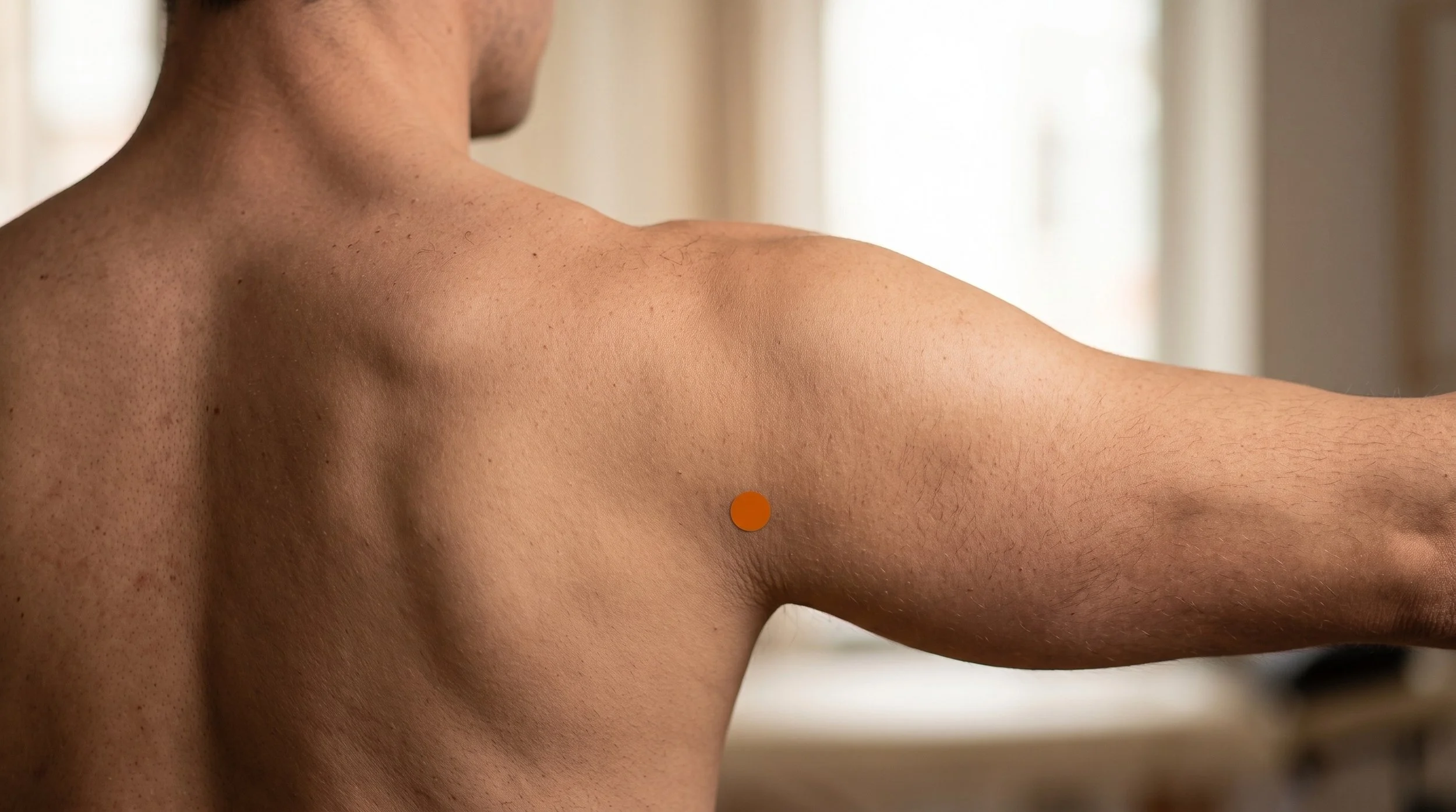
SI9 Acupuncture Point (Jianzhen)
The True Shoulder Point Behind the Deltoid: Anatomy, Mechanism, and Why SI9 Anchors Posterior Shoulder and Rotator Cuff Treatment
SI9 (Jianzhen, often translated as True Shoulder or Upright Shoulder) is the Small Intestine channel point tucked into the back of the shoulder, one cun above the rear armpit crease when the arm hangs relaxed at the side, in the soft depression just below the trailing border of the deltoid (Deadman et al., 2007). It is a small target with a lot of anatomy underneath it: posterior deltoid on the surface, teres major and the long head of triceps deeper, and the neurovascular corridor of the quadrangular space close by.
Clinically, the si9 acupuncture point earns its place because so much shoulder pain is felt exactly here, in the band of tissue behind and below the joint that patients point to when they say the ache sits deep in the back of the shoulder and gets worse when they lift the arm. That makes small intestine 9 one of the most reached-for posterior shoulder points in both classical practice and modern rotator cuff era needling.
- SI9 is located on the posterior shoulder, one cun above the posterior axillary crease with the arm adducted, in the depression below the rear border of the deltoid; the needle passes through posterior deltoid into teres major and the long head of triceps near the lateral border of the scapula (Deadman et al., 2007).
- Classical texts credit Jianzhen with expelling wind from the shoulder, benefiting the joint, and freeing the channel to relieve pain; read neurophysiologically, that traditional language describes reducing nociceptive drive from irritable posterior cuff and scapulohumeral tissue so that guarded, painful abduction becomes easier (Deadman et al., 2007).
- The tissue under si 9 shoulder is largely C5 and C6 territory, supplied by branches of the axillary and lower subscapular nerves with the radial nerve nearby, which places needle input into the same segmental pool that receives afferents from the glenohumeral capsule and rotator cuff, a plausible substrate for segmental pain modulation (Zhao, 2008).
- SI9 sits squarely inside the referral fields of teres minor, teres major, and infraspinatus, muscles whose trigger points project pain into the back of the shoulder and down the arm in patterns patients often mistake for nerve pinching (Simons et al., 1999).
- The research picture is modest rather than settled: an early Cochrane review of acupuncture for shoulder pain found the available trials too few and too small to draw firm conclusions (Green et al., 2005), while later work on manual acupuncture for shoulder impingement, which used SI9 among its points, reported improvements in pain and function from low quality studies (An et al., 2024).
- De qi at SI9 is usually a deep, heavy, spreading ache under the back of the deltoid that can fill the whole joint, and with deeper insertion some patients notice a brief electric or numb sensation traveling toward the elbow, which is a cue to withdraw slightly and redirect.
Is Your Shoulder Pain Sitting Deep Behind the Joint?
Posterior shoulder pain that flares when you reach overhead, sleep on that side, or press a bag against your back rarely comes from one structure alone. At Morningside Acupuncture we assess the whole shoulder complex, then use SI9 with adjacent Small Intestine points and targeted needling of the posterior cuff to reduce pain and restore comfortable range. Treatment is paired with simple loading work so gains hold between visits. Schedule a session and let us map where your pain is actually coming from.
Schedule NowAnatomy of SI9: Why the Depression Below the Posterior Deltoid Is Such an Important Location
With the arm hanging at the side, find the crease where the back of the armpit folds, then move about one cun (roughly a thumb width) upward into the soft dip just under the trailing edge of the deltoid (Deadman et al., 2007). The first layer is posterior deltoid, the fibers that decelerate the arm during reaching and take a beating in overhead sport, throwing, swimming, and desk postures that park the shoulder forward. Beneath that lies teres major and, close by, the long head of triceps as it heads toward the infraglenoid tubercle on the lateral border of the scapula.
These are the tissues that load every time you pull, row, carry, or push a door open behind you, and they are frequently tender to palpation in people whose shoulder pain sits behind rather than in front of the joint.
Nerve geography is what makes this point interesting. The axillary nerve and its companion vessels pass through the quadrangular space just above and medial to SI9, and the surrounding muscle is largely C5 and C6 in origin, with the radial nerve running deep in the neighborhood.
Because afferents from the glenohumeral capsule, the rotator cuff, and this posterior muscular envelope converge on overlapping dorsal horn segments, needle stimulation here recruits input into the same segmental pool that is already carrying the pain signal, a mechanism associated with local and segmental modulation of nociceptive transmission (Zhao, 2008).
Add the referral maps of teres minor, teres major, and infraspinatus, all of which project pain into the posterior shoulder and down the arm, and it becomes clear why patients so often localize their worst spot to within a finger width of this point (Simons et al., 1999).
Depth and direction matter for safety. Standard practice is perpendicular insertion of about 1 to 1.5 cun into muscle, with some texts angling slightly downward and going a little deeper in larger patients (Deadman et al., 2007). The needle should stay in the muscular mass and be angled away from the axilla, since the posterior circumflex humeral vessels and axillary nerve occupy the quadrangular space nearby, and medial angulation toward the chest wall is avoided entirely.
A sharp, radiating, electric response means the needle is too close to a nerve trunk and should be withdrawn and redirected rather than manipulated further.
Related Small Intestine Channel Related Best Acupuncture Points For Shoulder PainSI9 at a Glance: Classification, Location, and Clinical Use
| Category | Detail |
|---|---|
| Traditional Name | Jianzhen, commonly rendered as True Shoulder or Upright Shoulder (also translated Shoulder Chastity in older texts) |
| Channel Classification | Small Intestine channel of Hand Taiyang, ninth point, on the Small Intestine channel |
| Point Categories | No five-shu, hui-meeting, or extraordinary vessel intersection designations are assigned to SI9 in the texts used here; the neighboring SI10 carries the Yang Linking and Yang Heel intersections. In one modern presentation of the Luo vessel system, SI9 functions as the harmonizing point of the Small Intestine channel, being the point proximal to the he-sea point SI8. |
| Precise Location | Posterior shoulder, arm hanging adducted at the side, 1 cun superior to the posterior axillary crease, in the depression just inferior to the posterior border of the deltoid |
| Tissue Stimulated | Posterior deltoid superficially, then teres major and the long head of triceps, adjacent to teres minor and the infraspinatus referral field, near the quadrangular space and axillary nerve |
| Needle Depth / Direction | Perpendicular 1 to 1.5 cun into muscle, sometimes angled slightly inferiorly; keep the angle away from the axilla and never direct medially toward the chest wall |
| De Qi Sensation | Deep heavy distension and ache under the back of the deltoid, often spreading through the whole shoulder; occasionally a brief electric or numb feeling toward the elbow, which calls for withdrawing and redirecting |
| Primary Clinical Uses | Posterior shoulder pain with difficulty raising the arm, scapular and shoulder blade pain, rotator cuff related pain, numbness or heaviness along the back of the arm, upper limb weakness after stroke, and in classical use tinnitus and hearing complaints |
| Common Point Combinations |
|
Deadman's Manual of Acupuncture presents Jianzhen as a point that traditionally expels wind from the shoulder, benefits the joint, and activates the channel to relieve pain, and the classical indication list clusters into three groups: local musculoskeletal complaints (pain in the shoulder, upper arm, and scapula, inability to raise the arm, heat and pain in the supraclavicular fossa, and wind painful obstruction), limb numbness and weakness, and a smaller set of systemic and head symptoms including chills and fever from cold, tinnitus, and reduced hearing (Deadman et al., 2007).
Older Chinese clinical texts add sweating in the armpit, toothache, and jaw swelling to the traditional picture. Two named combinations survive: the Thousand Ducat Formulas grouping of SI9 with TE1 and LI15 for a hot shoulder with an immobile neck, and the Systematic Classic pairing of SI9 with SI4 for ear symptoms.
What is striking is the range attributed to one small spot behind the deltoid, and the fact that the ear indications track the course of the Small Intestine channel from the little finger up the arm to the face, a classical logic of connection rather than a claim about local anatomy.
Why SI9 Is Used for Numbness Down the Arm and, Classically, for Ringing in the Ears
Patients are often surprised that a point behind the shoulder is chosen for symptoms in the forearm and hand. The reason is segmental. The tissues under SI9 are supplied mainly from the C5 and C6 nerve roots, the same levels that feed the shoulder capsule, much of the cuff, and the upper arm, and afferent traffic from all of them converges on overlapping regions of the spinal cord. Needling into that shared segmental territory provides a competing stream of input that can dampen the transmission of nociceptive signals arising from irritated structures nearby (Zhao, 2008).
Layered on top of that, tight posterior cuff muscles produce their own referred symptoms: teres minor and infraspinatus can send heavy, achy, sometimes tingling sensations into the back of the shoulder and down the arm in ways that mimic nerve compression, so treating the muscle sometimes settles the arm complaint (Simons et al., 1999). The same reasoning explains why SI9 appears in protocols for post-stroke shoulder and arm involvement, where reviews report benefit alongside rehabilitation but rate the evidence cautiously (Zhan et al., 2023).
Beyond the local segment, needling appears to engage descending pain-inhibitory pathways from the brainstem that reduce sensitivity more broadly, which is one reason effects can extend past the area needled and past the session itself (Zhao, 2008). The large individual patient data meta-analysis of acupuncture for chronic pain, including chronic musculoskeletal pain, found effects that were modest in size but greater than sham and that persisted over time rather than dissipating immediately (Vickers et al., 2018).
That is the honest frame for SI9: a useful contributor to a treatment that reduces pain and improves function, not a switch that turns a shoulder problem off.
The classical ear indications are a different matter and should be described as traditional attribution rather than established mechanism. The Small Intestine channel is understood in classical theory to travel from the hand to the region of the ear, and points along its course, including SI9 paired with SI4, were used for tinnitus and hearing complaints on that basis (Deadman et al., 2007). There is no good modern evidence that needling the back of the shoulder changes hearing, and we do not present it to patients as a treatment for tinnitus.
We include it here because it is part of the point's documented history and because it explains why SI9 shows up in older formulas that otherwise look unrelated to the shoulder.
What the Research Shows for SI9
No trial has isolated SI9 on its own, and it is unlikely one ever will. Acupuncture research for the shoulder tests multi-point protocols, usually combining local posterior and lateral shoulder points with distal points and often with exercise or manual therapy, so the fair question is not whether SI9 works but whether protocols that include it help. The answer from the current literature is a qualified yes with meaningful caveats about study size and quality, and the honest summary is that shoulder acupuncture evidence remains thinner than the low back pain literature.
| Study | Type | Focus | Key Finding |
|---|---|---|---|
| Green et al., 2005 | Cochrane systematic review | Acupuncture for adults with shoulder pain | The review found too few and too small trials to support or refute acupuncture for shoulder pain, with only limited short-term signals. |
| An et al., 2024 | Systematic review and meta-analysis | Manual acupuncture for shoulder impingement syndrome, with SI9 among the points used in included protocols | Pooled results suggested reduced pain and improved shoulder function, though the authors emphasized high heterogeneity and low study quality. |
| Navarro-Santana et al., 2021 | Systematic review and meta-analysis | Trigger point dry needling for nontraumatic shoulder pain of musculoskeletal origin | Moderate to low quality evidence indicated a small effect on pain intensity and a larger effect on pain-related disability, mostly short term. |
| Liu et al., 2015 | Systematic review and meta-analysis | Dry needling of myofascial trigger points associated with neck and shoulder pain | Dry needling reduced trigger point pain in the short and medium term compared with sham or control, with other therapies competitive at medium term follow-up. |
| Zhan et al., 2023 | Systematic review and meta-analysis | Acupuncture compared with rehabilitation therapy for post-stroke shoulder pain | Acupuntcure protocols performed at least comparably to rehabilitation for shoulder pain and upper limb function, with the usual limits on trial quality. |
| Vickers et al., 2018 | Individual patient data meta-analysis | Acupuncture for chronic pain including musculoskeletal pain | Effects were modest but statistically greater than sham and largely sustained over twelve months. |
| Zhao, 2008 | Narrative mechanism review | Neural mechanisms of acupuncture analgesia | Analgesic effects are described through segmental spinal modulation and descending inhibitory pathways rather than any single local action. |
Rotator Cuff Trouble That Has Not Responded to Rest?
Cuff-related shoulder pain often needs input at the back of the joint, not just the front. Our clinicians combine SI9 with SI10, SI11, and dry needling of infraspinatus, teres minor, and teres major, alongside distal points chosen for broader pain modulation. Many patients notice easier arm elevation within the first few visits, though multi-session courses are the norm for chronic cases. Book an evaluation to get a plan built around your shoulder.
Schedule NowSI9 in the Context of Trigger Point Work
Because acupuncture means the use of an acupuncture needle across hundreds of styles, including dry needling, the distinction between needling SI9 as a channel point and needling the posterior shoulder as a myofascial target is more about reasoning than about tools.
At Morningside we usually do both in the same session. SI9 gives us reliable access to posterior deltoid, teres major, and the long head of triceps, and from that same window we palpate for taut bands in teres minor and infraspinatus, muscles whose referral patterns cover the exact zone patients describe when they say the pain lives behind and below the joint (Simons et al., 1999). Where a trigger point sits right at or beside the point location, the needle serves both purposes at once.
In practice, a posterior shoulder session might combine SI9 and SI10 for the back of the joint, SI11 over the infraspinatus fossa, and dry needling of teres major or teres minor where palpation reproduces the patient's familiar pain, plus distal points for broader modulation. Reviews of trigger point dry needling for nontraumatic shoulder pain report small improvements in pain and larger improvements in disability, mainly in the short term, which is why we treat needling as a way to open a window for loading and movement rather than as a standalone fix (Navarro-Santana et al., 2021; Liu et al., 2015). Cuff-specific exercise, scapular control work, and a graded return to overhead loading do the durable part of the job.
SI9 Shoulder Pain Treatment at NYC's Highest-Rated Acupuncture Clinic
Morningside Acupuncture is the highest-rated acupuncture and dry needling clinic in New York City with over 500 five-star Google reviews, and posterior shoulder pain is one of the complaints we see most. We use SI9 as part of a structured shoulder protocol that blends channel-based point selection with orthopedic-style needling of the muscles that refer into this exact area. Sessions are unhurried, evidence-informed, and built around what you need to get back to lifting, training, or simply sleeping through the night. Schedule your visit and start with a full shoulder assessment.
Schedule NowFrequently Asked Questions
What does SI9 feel like when needled?
Most people feel a deep, heavy, spreading ache under the back of the deltoid that can fill the whole shoulder and sometimes travels toward the elbow. If the needle finds a taut band in teres major or teres minor, there may be a brief cramp or twitch followed by a dull soreness that eases within a minute or two. A short-lived electric or numb sensation down the arm can occur because the axillary and radial nerves run nearby; that is a signal for the practitioner to withdraw slightly and change angle, not something to push through. Mild soreness at the site for a day afterward is common and usually settles with movement.
Why needle the back of the shoulder when my pain feels like it is inside the joint?
Pain that feels deep inside the shoulder is often generated or amplified by tissues behind and below it. The posterior cuff and the muscles around SI9 share nerve supply with the joint capsule at the C5 and C6 levels, so their input converges centrally and can be perceived as coming from the joint itself (Zhao, 2008). Teres minor and infraspinatus in particular refer pain into the deep shoulder and down the arm in patterns that feel joint-like (Simons et al., 1999). Needling where the problem is generated, rather than only where it is felt, is one of the reasons posterior points like SI9 stay in constant use.
Can I press SI9 myself between sessions?
Yes, and it is one of the easier points to self-treat. Let the arm hang, find the crease at the back of the armpit, move about a thumb width up into the soft hollow below the rear edge of the deltoid, then reach across with the opposite hand and press with the fingertips or the knuckles. Use steady, moderate pressure for 30 to 60 seconds at a time, breathing normally, and repeat two or three times per side; a total of three to five minutes once or twice a day is plenty. You can also lean the spot into a lacrosse ball against a wall for a similar effect. Pressure should feel like a satisfying deep ache, never sharp, and you should stop immediately if you feel tingling or electrical sensation down the arm.
Is SI9 safe to needle?
In trained hands, yes. The main considerations are the axillary nerve and posterior circumflex humeral vessels in the quadrangular space just above and medial to the point, and the radial nerve running deep nearby, which is why the needle is kept in the muscular mass, angled away from the axilla, and never directed medially toward the chest wall. Standard depth is roughly 1 to 1.5 cun perpendicular (Deadman et al., 2007). Temporary soreness or a small bruise is the most common side effect. Patients on blood thinners, with bleeding disorders, or with implanted devices should tell their practitioner beforehand so technique can be adjusted.
Where exactly is SI9 located?
Stand or sit with the arm relaxed and hanging at your side. Locate the crease where the back of the armpit meets the arm, then move about one cun (roughly the width of your thumb at the knuckle) straight upward. SI9 lies in the depression just below the posterior border of the deltoid, over teres major and near the lateral edge of the scapula (Deadman et al., 2007). If you are in the right place, firm pressure produces a deep, slightly tender ache rather than a surface pinch, and the spot is often noticeably more tender on the painful side.
References
- Deadman, P., Al-Khafaji, M., & Baker, K. (2009). A manual of acupuncture. Journal of Chinese Medicine Publications.
- O'Connor, J., & Bensky, D. (Eds. & Trans.). (1981). Acupuncture: A comprehensive text. Shanghai College of Traditional Medicine. Eastland Press.
- Cunningham, P. M. (2000). Acupuncture points: A practical guide to classical and modern usage. Odyssey Press.
- Cecil-Sterman, A. (2012). Advanced acupuncture: A clinic manual. Classical Wellness Press.
- Simons, D. G., Travell, J. G., & Simons, L. S. (1999). Travell & Simons' myofascial pain and dysfunction: The trigger point manual, Vol. 1: Upper half of body (2nd ed.). Williams & Wilkins.
- Green, S., Buchbinder, R., & Hetrick, S. (2005). Acupuncture for shoulder pain. Cochrane Database of Systematic Reviews, 2005(2), CD005319. https://doi.org/10.1002/14651858.CD005319
- An, S. J., Shin, W. C., Joo, S., Cho, J. H., Chung, W. S., Song, M. Y., & Kim, H. (2024). Effects of acupuncture on shoulder impingement syndrome: A systematic review and meta-analysis. Medicine, 103(37), e39696. https://doi.org/10.1097/MD.0000000000039696
- Navarro-Santana, M. J., Gómez-Chiguano, G. F., Cleland, J. A., Arias-Buría, J. L., Fernández-de-las-Peñas, C., & Plaza-Manzano, G. (2021). Effects of trigger point dry needling for nontraumatic shoulder pain of musculoskeletal origin: A systematic review and meta-analysis. Physical Therapy, 101(2), pzaa216. https://doi.org/10.1093/ptj/pzaa216
- Liu, L., Huang, Q. M., Liu, Q. G., Ye, G., Bo, C. Z., Chen, M. J., & Li, P. (2015). Effectiveness of dry needling for myofascial trigger points associated with neck and shoulder pain: A systematic review and meta-analysis. Archives of Physical Medicine and Rehabilitation, 96(5), 944-955. https://doi.org/10.1016/j.apmr.2014.12.015
- Zhan, J., Luo, Y., Mao, W., et al. (2023). Efficacy of acupuncture versus rehabilitation therapy on post-stroke shoulder pain: A systematic review and meta-analysis of randomized controlled trials. Medicine, 102(29), e34266. https://doi.org/10.1097/MD.0000000000034266
- Vickers, A. J., Vertosick, E. A., Lewith, G., MacPherson, H., Foster, N. E., Sherman, K. J., Irnich, D., Witt, C. M., & Linde, K. (2018). Acupuncture for chronic pain: Update of an individual patient data meta-analysis. Journal of Pain, 19(5), 455-474. https://doi.org/10.1016/j.jpain.2017.11.005
- Zhao, Z. Q. (2008). Neural mechanism underlying acupuncture analgesia. Progress in Neurobiology, 85(4), 355-375. https://doi.org/10.1016/j.pneurobio.2008.05.004
Disclaimer: This web site is intended for educational and informational purposes only. Reading this website does not constitute providing medical advice or any professional services. This information should not be used for diagnosing or treating any health issue or disease. Those seeking medical advice should consult with a licensed physician. Seek the advice of a medical doctor or other qualified health professional for any medical condition. If you think you have a medical emergency, call 911 or go to the emergency room. No acupuncturist-patient relationship is created by reading this website or using the information. Morningside Acupuncture PLLC and its employees and contributors do not make any express or implied representations with respect to the information on this site or its use. For any legal interpretation of scope of practice in your state, consult a licensed attorney or regulatory authority.
Read more from our blog



