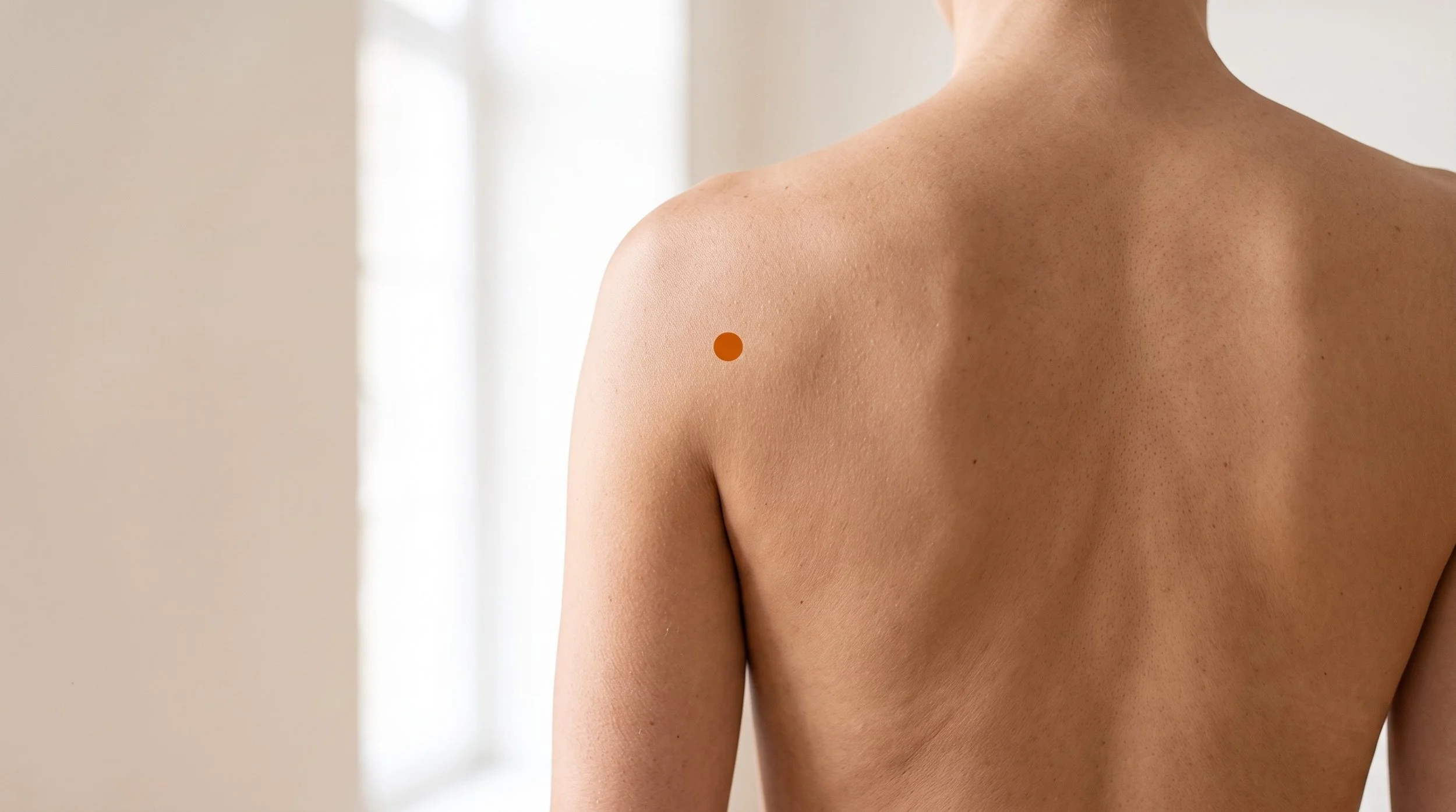
SI10 Acupuncture Point (Naoshu)
The Upper Arm Shu Beneath the Scapular Spine: Anatomy, Mechanism, and Why SI10 Anchors Posterior Shoulder and Rotator Cuff Treatment
SI10, called Naoshu in pinyin and usually translated as Upper Arm Shu, sits on the back of the shoulder in the soft hollow just under the bony ridge of the scapular spine, directly above SI9 when the arm hangs relaxed at the side. It's one of the deepest and most useful local points on the Small Intestine channel, because a perpendicular needle here passes through posterior deltoid into infraspinatus and angles toward the back of the glenohumeral joint itself.
Classical texts list the si10 acupuncture point for shoulder pain that spreads into the shoulder blade, for arm weakness, and for trouble lifting the arm, which is close to the modern picture of rotator cuff irritation, posterior capsule tightness, and frozen shoulder. In a busy New York City practice, small intestine 10 is one of the first points we palpate when a patient points behind the shoulder rather than in front of it.
- Location and layers: SI10 lies in the depression below the lateral scapular spine, directly above SI9, and the needle passes through skin and posterior deltoid into infraspinatus, close to the posterior glenohumeral joint capsule, which is why it's treated as a deep local point rather than a superficial one (Deadman et al., 2007).
- Traditional categories, read anatomically: the classical literature designates SI10 as a meeting point of the Small Intestine and Bladder channels with the Yang Linking and Yang Motility vessels, a set of intersections that in modern language simply marks it as a convergence zone for the posterior and lateral shoulder soft tissue envelope (Deadman et al., 2007).
- Mechanism: the tissue under this point is supplied largely by the suprascapular nerve (infraspinatus) and the axillary nerve (posterior deltoid), both carrying C5 and C6 fibers that also innervate the joint capsule, so needling here delivers input to the same spinal segments that receive nociception from the shoulder joint, a segmental convergence effect described in the analgesia literature (Zhao, 2008).
- Research picture: reviews of acupuncture for shoulder pain remain cautious, with the Cochrane review reporting limited evidence and possible short term benefit for pain and function (Green et al., 2005), while later frozen shoulder syntheses report more favorable but still low certainty results (Ben-Arie et al., 2020; Ji et al., 2025).
- Point-adjacent physiology: because SI10 overlies infraspinatus, needling studies of that muscle are directly relevant, and they suggest changes in corticospinal excitability (Laramée et al., 2021), local muscle blood flow (Brown et al., 2025), and pain sensitivity in referral zones (Calvo-Lobo et al., 2018).
- De qi: patients usually describe a deep, heavy, spreading ache that fans across the shoulder blade and sometimes travels down the outside of the arm, and when the needle contacts a taut band in infraspinatus there may be a brief involuntary twitch (Simons et al., 1999).
Is Your Shoulder Pain Sitting Behind the Joint Instead of in Front of It?
Pain that lives under the back corner of the shoulder blade often points to infraspinatus, teres minor, and the posterior capsule rather than the front of the shoulder. At Morningside Acupuncture we palpate the hollow below the scapular spine where SI10 sits, then needle it alongside the surrounding cuff tissue to reduce guarding and restore comfortable external rotation. Treatment is paired with simple loading advice so gains hold between visits. Schedule a visit and let's map where your pain actually starts.
Schedule NowAnatomy of SI10: Why the Hollow Below the Scapular Spine Is Such an Important Location
Slide a finger up from SI9 along the back of the shoulder and it drops into a soft notch just under the lateral end of the scapular spine. Under the skin and thin fascia lies the posterior head of the deltoid. Deeper still is the upper belly and tendon of infraspinatus, with teres minor just below it, and behind those sits the posterior aspect of the glenohumeral joint capsule.
These tissues take load every time you reach overhead, decelerate a throw, carry a bag on one side, or sleep on the shoulder, and they take a slower kind of load from hours of forward reaching at a keyboard, which leaves the posterior cuff lengthened and irritable. That combination of superficial muscle, deep cuff tissue, and nearby capsule is what makes SI10 a genuinely useful access point rather than just a surface landmark.
The nerve geography here is tidy. Posterior deltoid is supplied by the axillary nerve, infraspinatus and teres minor by the suprascapular and axillary nerves, and both trunks carry fibers from the C5 and C6 roots. Those same segments carry sensory information from much of the glenohumeral joint capsule, so needle input at SI10 arrives in the dorsal horn alongside the nociceptive traffic coming from the painful joint. Experimental work on acupuncture analgesia describes exactly this pattern of segmental convergence, along with spinal and supraspinal modulation that follows sustained needle stimulation (Zhao, 2008).
Needling of infraspinatus specifically has also been associated with short term changes in corticospinal excitability and pressure pain thresholds, which supports the idea that the effect isn't purely mechanical (Laramée et al., 2021). From a myofascial perspective, infraspinatus is a classic source of deep anterior shoulder and arm referral, so pain felt far from SI10 can still respond to needling here (Simons et al., 1999).
Deep and slightly inferior to this point is the quadrangular space, where the axillary nerve and posterior circumflex humeral artery pass, and above the scapular spine the suprascapular nerve and vessels run through the supraspinous fossa. Over the body of the scapula the bone itself shields the thorax, but a needle angled medially and superiorly above the spine of the scapula moves toward pleural territory, so the standard convention is a perpendicular insertion of roughly 1 to 1.5 cun directed into the shoulder rather than toward the chest (Deadman et al., 2007).
We adjust depth for body size, use gentle stimulation in thin or highly reactive patients, and stop advancing if the sensation turns sharp or electric rather than dull and spreading. Doppler work on infraspinatus needling has reported changes in local muscle blood flow, another reason the technique is kept controlled rather than aggressive (Brown et al., 2025).
Related Best Acupuncture Points For Shoulder Pain Related Infraspinatus Trigger PointsSI10 at a Glance: Classification, Location, and Clinical Use
| Category | Detail |
|---|---|
| Traditional Name | Naoshu (Upper Arm Shu), SI10, Small Intestine 10 |
| Channel Classification | Small Intestine channel (Hand Taiyang), posterior shoulder region |
| Point Categories | Meeting point of the Small Intestine and Bladder channels with the Yang Linking (Yang Wei) and Yang Motility (Yang Qiao) vessels; listed among the coalescent points of the Yang Motility vessel in the standard Chinese texts; described in some lineage systems as the opening point of the Small Intestine Divergent channel and as a blood-harmonizing point in the Small Intestine transverse luo protocol |
| Precise Location | On the back of the shoulder, in the depression immediately below the lateral scapular spine, directly above SI9 with the arm hanging adducted at the side |
| Tissue Stimulated | Posterior deltoid, then infraspinatus and teres minor, with deeper access toward the posterior glenohumeral joint capsule; suprascapular and axillary nerve territory (C5 to C6) |
| Needle Depth / Direction | Perpendicular insertion 1 to 1.5 cun into the shoulder, never angled medially over the rib cage; depth adjusted for build |
| De Qi Sensation | Deep, heavy, spreading ache under the shoulder blade that may fan toward the back of the arm; a brief muscle twitch is common when a taut band in infraspinatus is engaged |
| Primary Clinical Uses | Posterior shoulder pain radiating to the scapula, shoulder weakness with difficulty raising the arm, frozen shoulder presentations approached from behind, rotator cuff irritation, and infraspinatus-pattern arm pain |
| Common Point Combinations |
|
In A Manual of Acupuncture, Deadman and colleagues present Naoshu SI10 as a workhorse for shoulder pain and stiffness, especially when the complaint sits at the back of the joint, and they highlight that the point allows the needle to reach deeply into the shoulder rather than staying in surface tissue (Deadman et al., 2007).
Traditionally its actions are given as benefiting the shoulder and activating the channel to relieve pain, and its listed indications cluster around swelling and pain that radiates toward the scapula, weakness of the arm and shoulder, and inability to lift the shoulder, with a small tail of older systemic entries such as chills with fever and nodular swellings of the neck. The text also attributes extra shoulder influence to the point's status as a meeting place of the Yang Linking and Yang Motility vessels, which classical anatomy routes across the back, top, and front of the shoulder respectively.
What's striking is how narrowly the tradition kept its focus: for a point with four channel and vessel intersections converging on it, the classical indication list stays almost entirely regional, which is a fair reflection of how it's still used today.
Why SI10 Is Used for Arm Pain That Doesn't Feel Like a Shoulder Problem at All
Patients are often surprised when we needle the back of the shoulder for pain they feel deep in the front of the joint, down the outer arm, or even into the forearm. Infraspinatus, the muscle sitting directly beneath SI10, is one of the most reliable referral generators in the upper body, and its pattern travels forward into the shoulder and down the arm rather than staying where the taut band is (Simons et al., 1999).
Because the muscle, the joint capsule, and the skin over this region all report to the same C5 and C6 spinal segments, treating at SI10 puts input into the exact neural neighborhood that's processing the pain, wherever the patient happens to perceive it (Zhao, 2008).
Beyond the segment, needling recruits descending inhibitory pathways from the brainstem that dampen dorsal horn transmission more broadly, which helps explain why patients frequently report a general easing rather than a purely local change (Zhao, 2008). A large individual patient data meta-analysis of acupuncture for chronic pain, including musculoskeletal pain, found effects that were modest but persistent over follow up and larger than sham comparators, which is a reasonable expectation to set for a point like this one (Vickers et al., 2018).
There's also point-adjacent physiology worth knowing. Needling infraspinatus trigger points has been associated with reduced pain intensity and reduced sensitivity in the referral zone, including at distant sites in the same segment (Calvo-Lobo et al., 2018), with short term shifts in corticospinal excitability (Laramée et al., 2021), and with measurable change in local muscle blood flow along with improved range of motion (Brown et al., 2025).
None of these studies used the label SI10, but they were needling the same tissue at nearly the same place, which is precisely the overlap between acupuncture and dry needling that this point illustrates.
What the Research Shows for SI10
A caution before the table: almost no clinical trial isolates a single point, and SI10 has never been tested on its own. Shoulder trials use multi-point protocols in which SI10 typically appears alongside LI15, TE14, SI9, SI11 and distal points, sometimes with electroacupuncture, and usually with exercise or manual therapy layered on top. So the honest reading is that this point sits inside protocols that show promise, not that this point has been proven individually.
The infraspinatus needling studies are the closest thing we have to point-specific evidence, since they target the exact tissue that lies beneath SI10.
| Study | Type | Focus | Key Finding |
|---|---|---|---|
| Green et al., 2005 | Cochrane systematic review | Acupuncture for shoulder pain in adults | The review found few and methodologically varied trials, concluding there was little evidence to support or refute acupuncture, though short term benefit for pain and function was possible. |
| Vickers et al., 2018 | Individual patient data meta-analysis | Acupuncture for chronic musculoskeletal, headache, and osteoarthritis pain | Acupuncture was associated with modest but statistically significant benefit over both sham and no-acupuncture controls, with effects largely sustained over twelve months. |
| Ben-Arie et al., 2020 | Systematic review and meta-analysis | Acupuncture for frozen shoulder | Pooled results favored acupuncture for pain and function in adhesive capsulitis, although the authors flagged variable trial quality that limits confidence. |
| Ji et al., 2025 | Systematic review and network meta-analysis | Comparative effectiveness of acupuncture-related therapies for frozen shoulder | Acupuncture and related needling therapies appeared beneficial across comparisons, with the authors noting that overall certainty remains limited. |
| Calvo-Lobo et al., 2018 | Randomized clinical trial | Dry needling of infraspinatus trigger points in older adults with nonspecific shoulder pain | A single session reduced pain intensity and lowered sensitivity of satellite trigger points in the referral area in the short term. |
| Laramée et al., 2021 | Randomized sham-controlled feasibility study | Neurophysiological effects of infraspinatus dry needling in chronic shoulder pain | Preliminary data suggested real needling may increase corticospinal excitability of infraspinatus compared with sham, supporting a neurophysiological mechanism. |
| Brown et al., 2025 | Randomized clinical trial | Doppler-measured muscle blood flow after infraspinatus dry needling | Participants receiving real needling showed changes consistent with improved infraspinatus blood flow and gains in shoulder range of motion, without change in pressure sensitivity. |
| Liu et al., 2015 | Systematic review and meta-analysis | Dry needling for trigger points associated with neck and shoulder pain | Dry needling was more effective than sham or control for immediate pain relief, with weaker evidence at longer follow up. |
Struggling to Reach Overhead or Behind Your Back?
Loss of overhead reach and painful internal rotation are the two complaints that bring most shoulder patients through our door, and the si 10 shoulder point is central to how we approach both. We combine it with distal points and with dry needling of the muscles that reproduce your exact pain pattern, then track range of motion session to session. Most patients notice change within a few visits, though stubborn frozen shoulder presentations take longer. Book an evaluation and we'll build a realistic plan.
Schedule NowSI10 in the Context of Trigger Point Work
SI10 is one of the cleanest examples of overlap between channel points and myofascial targets, because the hollow below the scapular spine is also where the upper infraspinatus fibers and the posterior deltoid border meet.
At Morningside we palpate the region first, and if a taut band there reproduces the patient's familiar pain, the same needle serves both frameworks at once: it's the upper arm shu point in classical terms and an infraspinatus trigger point in modern terms. Depending on what the exam shows, we may add teres minor, posterior deltoid, and the more medial infraspinous fossa near SI11, and we frequently work levator scapulae and the upper thoracic paraspinals when the shoulder complaint has a neck component.
One useful clinical note from the point literature is that pain felt at the back of the shoulder is often referred from subscapularis, while pain felt at the front is often referred from infraspinatus, so the location of the complaint doesn't always name the culprit (Simons et al., 1999). That's why we treat SI10 as a starting position rather than a fixed prescription, and why we test range of motion before and after needling.
Short term reductions in pain and pressure sensitivity following needling of this muscle group have been reported in controlled trials (Calvo-Lobo et al., 2018; Liu et al., 2015), and we pair that window with loaded external rotation and scapular work so the change has something to hold onto.
SI10 Shoulder Pain Treatment at NYC's Highest-Rated Acupuncture Clinic
Morningside Acupuncture is the highest-rated acupuncture and dry needling clinic in New York City with over 500 five-star Google reviews, and posterior shoulder pain is one of the conditions we see most often. Our licensed acupuncturists use the upper arm shu point as part of a full assessment that includes cuff strength testing, movement screening, and targeted needling. You'll leave with a clear explanation of what's driving the pain and what to do about it. Schedule your appointment today.
Schedule NowFrequently Asked Questions
What does SI10 feel like when needled?
Most patients feel a deep, heavy, slightly spreading ache under the shoulder blade rather than a sharp pinch. The sensation often fans outward across the back of the shoulder and sometimes travels toward the outer arm, which is normal and usually means the needle has reached infraspinatus. If the muscle is holding a taut band, you may feel a quick involuntary twitch that passes in a second. Sharp, electric, or radiating-down-the-forearm sensations aren't the goal, so tell your acupuncturist immediately if that happens and the needle will be adjusted.
Why needle the back of the shoulder when my pain is in the front?
Because the muscle sitting under SI10 refers pain forward. Infraspinatus is a well-documented source of deep anterior shoulder and outer arm pain, so the place that hurts and the place that generates the pain are often different (Simons et al., 1999). The tissue at SI10, the posterior joint capsule, and the front of the shoulder also share C5 and C6 spinal segments, so needle input here reaches the same neural processing zone that's handling the pain you feel elsewhere (Zhao, 2008). In practice we palpate first, and if pressing under the scapular spine reproduces your familiar pain, that's a strong argument for treating there.
Can I press SI10 myself between sessions?
Yes, and it's one of the easier points to self-treat. Reach across your chest with the opposite hand, find the bony ridge of the scapular spine at the back of the shoulder, and drop your fingertips just below its outer end into the soft hollow. Apply steady, moderate pressure for 30 to 60 seconds, breathing normally, then release and repeat two or three times. A tennis or lacrosse ball against a wall works well too: lean the back corner of the shoulder into the ball, hold on the tender spot for about 60 to 90 seconds, and add slow arm circles once the pressure feels tolerable. Two or three short sessions a day is plenty, and pressure should read as a deep ache you can breathe through, never as sharp pain, numbness, or tingling down the arm.
Is SI10 safe to needle?
In trained hands, yes. The point is standardly needled perpendicular to a depth of roughly 1 to 1.5 cun (Deadman et al., 2007), and over the scapula the bone itself sits between the needle and the chest. The cautions are about angle and awareness: a needle angled medially and upward above the scapular spine moves toward the lung field, and the quadrangular space carrying the axillary nerve and posterior circumflex humeral artery lies deep and slightly below, so depth is scaled to the patient's build. Normal after-effects include a few hours of muscle soreness and occasional minor bruising. Tell your acupuncturist if you take blood thinners, have had shoulder surgery or a joint replacement, or have any implanted hardware in the area.
Where exactly is SI10 located?
Let the arm hang relaxed at your side. Find SI9 at the back of the shoulder just above the posterior armpit crease, then slide a finger straight up until it settles into a distinct depression immediately below the outer end of the scapular spine. That hollow is SI10. If you can't find SI9 first, trace the bony ridge of the scapular spine outward toward the shoulder tip and drop just beneath its lateral end. The point should feel like a soft dip framed by bone above and muscle below, and in patients with posterior shoulder complaints it's usually tender to firm pressure.
References
- Deadman, P., Al-Khafaji, M., & Baker, K. (2009). A manual of acupuncture. Journal of Chinese Medicine Publications.
- Maciocia, G. (2005). The foundations of Chinese medicine: A comprehensive text for acupuncturists and herbalists (2nd ed.). Elsevier Churchill Livingstone.
- Cunningham, P. M. (2000). Acupuncture points: A practical guide to classical and modern usage. Odyssey Press.
- Cecil-Sterman, A. (2012). Advanced acupuncture: A clinic manual. Classical Wellness Press.
- Simons, D. G., Travell, J. G., & Simons, L. S. (1999). Travell & Simons' myofascial pain and dysfunction: The trigger point manual, Vol. 1: Upper half of body (2nd ed.). Williams & Wilkins.
- Green, S., Buchbinder, R., & Hetrick, S. (2005). Acupuncture for shoulder pain. Cochrane Database of Systematic Reviews, 2005(2), CD005319. https://doi.org/10.1002/14651858.CD005319
- Vickers, A. J., Vertosick, E. A., Lewith, G., MacPherson, H., Foster, N. E., Sherman, K. J., Irnich, D., Witt, C. M., & Linde, K. (2018). Acupuncture for chronic pain: Update of an individual patient data meta-analysis. Journal of Pain, 19(5), 455-474. https://doi.org/10.1016/j.jpain.2017.11.005
- Zhao, Z. Q. (2008). Neural mechanism underlying acupuncture analgesia. Progress in Neurobiology, 85(4), 355-375. https://doi.org/10.1016/j.pneurobio.2008.05.004
- Ben-Arie, E., Kao, P. Y., Lee, Y. C., Ho, W. C., Chou, L. W., & Liu, H. P. (2020). The effectiveness of acupuncture in the treatment of frozen shoulder: A systematic review and meta-analysis. Evidence-Based Complementary and Alternative Medicine, 2020, 9790470. https://doi.org/10.1155/2020/9790470
- Ji, R., Huang, W., Weng, M., & Zhang, M. (2025). Comparative effectiveness of acupuncture-related therapies for frozen shoulder: A systematic review and network meta-analysis. Frontiers in Medicine, 12, 1673193. https://doi.org/10.3389/fmed.2025.1673193
- Calvo-Lobo, C., Pacheco-da-Costa, S., Martínez-Martínez, J., Rodríguez-Sanz, D., Cuesta-Álvaro, P., & López-López, D. (2018). Dry needling on the infraspinatus latent and active myofascial trigger points in older adults with nonspecific shoulder pain: A randomized clinical trial. Journal of Geriatric Physical Therapy, 41(1), 1-13. https://doi.org/10.1519/JPT.0000000000000079
- Laramée, A., Léonard, G., Morin, M., Roch, M., & Gaudreault, N. (2021). Neurophysiological and psychophysical effects of dry versus sham needling of the infraspinatus muscle in patients with chronic shoulder pain: A randomized feasibility study. Archives of Physiotherapy, 11, 23. https://doi.org/10.1186/s40945-021-00118-x
- Brown, J., Kearns, G., Brizzolara, K., Weber, M., & Wang-Price, S. (2025). The effects of dry needling on muscle blood flow of the infraspinatus muscle in individuals with shoulder pain: A randomized clinical trial. Journal of Manual & Manipulative Therapy, 33(4), 299-308. https://doi.org/10.1080/10669817.2025.2464542
- Liu, L., Huang, Q. M., Liu, Q. G., Ye, G., Bo, C. Z., Chen, M. J., & Li, P. (2015). Effectiveness of dry needling for myofascial trigger points associated with neck and shoulder pain: A systematic review and meta-analysis. Archives of Physical Medicine and Rehabilitation, 96(5), 944-955. https://doi.org/10.1016/j.apmr.2014.12.015
Disclaimer: This web site is intended for educational and informational purposes only. Reading this website does not constitute providing medical advice or any professional services. This information should not be used for diagnosing or treating any health issue or disease. Those seeking medical advice should consult with a licensed physician. Seek the advice of a medical doctor or other qualified health professional for any medical condition. If you think you have a medical emergency, call 911 or go to the emergency room. No acupuncturist-patient relationship is created by reading this website or using the information. Morningside Acupuncture PLLC and its employees and contributors do not make any express or implied representations with respect to the information on this site or its use. For any legal interpretation of scope of practice in your state, consult a licensed attorney or regulatory authority.
Read more from our blog



