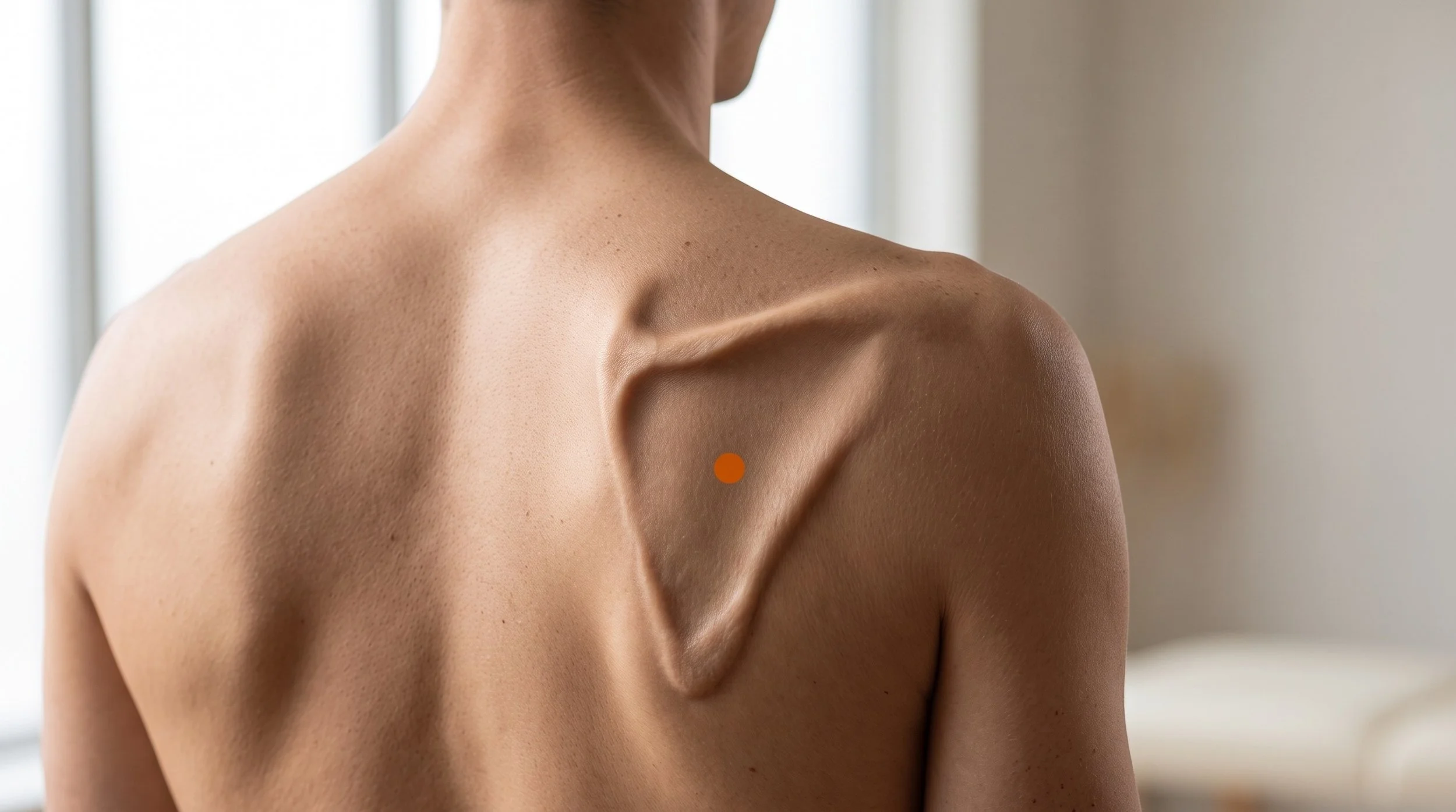
SI11 Acupuncture Point (Tianzong)
The Celestial Gathering Point in the Infraspinous Fossa: Anatomy, Mechanism, and Why This Scapular Point Anchors Shoulder and Rotator Cuff Treatment
SI11 (Tianzong, often translated as Celestial Gathering or Heavenly Gathering) is the scapular point of the Small Intestine channel, and for anyone treating shoulders it is one of the highest-value locations on the back of the body.
In plain terms, the si11 acupuncture point sits in the soft hollow on the back of the shoulder blade, roughly one third of the way down from the ridge of the scapular spine toward the bottom tip of the scapula, directly in the belly of the infraspinatus muscle. That single spot puts a needle into a rotator cuff muscle that is a notorious source of deep shoulder ache and pain that travels down the arm, which is why small intestine 11 shows up in classical formulas for scapular pain and in modern trigger point protocols for rotator cuff problems alike. Tenderness here is so common in shoulder complaints that palpating it is part of a standard shoulder exam in many acupuncture traditions.
- SI11 lies in the center of the infraspinous fossa of the scapula, with the needle passing through skin and fascia into the infraspinatus muscle belly and resting against the flat bony plate of the scapular blade, which makes it an unusually well-protected place to needle deeply into a rotator cuff muscle.
- Classical sources present SI11 as a point that activates the channel and relieves pain, unbinds the chest and rib-side region, and benefits the breasts (Deadman and Al-Khafaji). Read neurophysiologically, those traditional attributions describe segmental effects at the C5 and C6 and upper thoracic levels rather than any literal flow of energy.
- The infraspinatus is supplied by the suprascapular nerve, and infraspinatus trigger points classically refer pain to the front of the shoulder and down the arm, which explains why local needling at SI11 can change symptoms that patients feel somewhere else entirely (Simons et al., 1999).
- Needling a shoulder-girdle trigger point has been shown to raise pressure pain thresholds in muscles sharing the same spinal segments, evidence for a segmental antinociceptive mechanism rather than a purely local one (Srbely et al., 2010). Broader analgesia involves spinal gating and descending inhibitory pathways with opioid and monoamine signaling (Zhao, 2008).
- The research picture is cautious but supportive: an early Cochrane review found only limited short-term evidence for acupuncture in shoulder pain (Green et al., 2005), while a more recent meta-analysis of manual acupuncture for shoulder impingement reported moderate improvements in pain and function (An et al., 2024), and large individual patient data analyses support modest, durable effects for chronic musculoskeletal pain generally (Vickers et al., 2018).
- De qi at SI11 is typically a deep, heavy, spreading ache across the shoulder blade that many patients recognize immediately as "their" pain, and dry needling of an infraspinatus trigger point at the same location may produce a brief involuntary twitch.
Deep Shoulder Blade Ache That Will Not Let Go?
Pain buried behind the shoulder blade is one of the most common complaints we see, and SI11 is one of the first places we palpate. At Morningside Acupuncture we combine needling of the infraspinous fossa with assessment of your rotator cuff, scapular control, and desk or training loads, so treatment addresses the pattern and not just the sore spot. Most patients feel a change in range of motion within the first few sessions. Schedule a visit and we will map where your pain is actually coming from.
Schedule NowAnatomy of SI11: Why the Infraspinous Fossa Is Such an Important Location
From the surface inward, SI11 passes through thin skin and subcutaneous tissue, then through the thoracolumbar-style fascia covering the shoulder blade, and into the belly of the infraspinatus, one of the four rotator cuff muscles. Beneath the muscle is the flat plate of the scapula itself.
The infraspinatus works constantly to externally rotate the arm and to keep the head of the humerus centered during reaching, throwing, pressing, and carrying, which is why this muscle becomes tender in desk workers who sit with rounded shoulders, in overhead athletes, in new parents, and in anyone recovering from a shoulder injury who has been guarding the joint. Because the muscle is broad and relatively thin over bone, the whole fossa can be palpated and mapped rather than approached blindly.
The infraspinatus is innervated by the suprascapular nerve, carrying fibers from the C5 and C6 roots, and the overlying skin is supplied by upper thoracic cutaneous branches. That double innervation matters clinically: needling here delivers input to the same spinal segments that serve the glenohumeral joint capsule, the deltoid, and the lateral arm, so nociceptive traffic from the joint and from the muscle converge on shared dorsal horn neurons. This convergence is the plainest explanation for why a needle in the back of the shoulder blade can change pain felt at the front of the shoulder or down the arm.
Experimental work supports the idea: needling a shoulder-girdle trigger point raised pressure pain thresholds in a muscle sharing its segmental level while leaving distant, unrelated segments unchanged (Srbely et al., 2010). Trigger points in the infraspinatus are also documented as referring pain toward the anterior deltoid and down the arm, matching the patterns patients describe (Simons et al., 1999).
The deeper structures at SI11 are the circumflex scapular vessels running within the fossa and, more importantly for safety, the chest wall beyond the edges of the scapula. Standard needling is perpendicular or oblique, generally 0.5 to 1 cun, with some texts allowing oblique insertion up to 1.5 cun in larger patients (Deadman and Al-Khafaji; Shanghai College of Traditional Medicine).
The practical rule is simple: stay over the bony blade of the scapula, angle away from the medial and inferior borders, and never needle into an intercostal space, since needling near the chest wall carries a small pneumothorax risk that competent technique avoids entirely.
Related Best Acupuncture Points For Shoulder Pain Related Small Intestine ChannelSI11 at a Glance: Classification, Location, and Clinical Use
| Category | Detail |
|---|---|
| Traditional Name | Tianzong, translated as Celestial Gathering or Heavenly Gathering |
| Channel Classification | Small Intestine channel of Hand Taiyang, eleventh point |
| Point Categories | A regular point of the Small Intestine channel. The reference texts assign SI11 no five-shu status, no meeting or crossing designation, and no extraordinary vessel intersection; it is grouped clinically with the scapular and shoulder points SI9 through SI14. |
| Precise Location | On the scapula, in the tender depression at the center of the infraspinous fossa, at the junction of the upper and middle thirds of a line from the lower border of the scapular spine to the inferior angle of the scapula. When the inferior angle is hard to feel, an equilateral triangle drawn from SI9 and SI10 with the shoulder relaxed gives a workable si 11 location. |
| Tissue Stimulated | Skin and subcutaneous fascia, the infraspinatus muscle belly (see Infraspinatus Trigger Points), and the periosteum of the scapular blade, within suprascapular nerve territory (C5 and C6) |
| Needle Depth / Direction | Perpendicular or oblique insertion 0.5 to 1 cun, directed onto the scapular blade; some texts allow oblique needling to 1.5 cun. Keep the needle over bone and away from the intercostal spaces. |
| De Qi Sensation | Deep, heavy, aching distension that spreads across the shoulder blade and often refers into the back of the shoulder, deltoid, or upper arm; dry needling of an active trigger point here may produce a brief local twitch |
| Primary Clinical Uses | Shoulder blade pain, rotator cuff and impingement-type shoulder pain, referred arm pain, restricted shoulder mobility and overhead reach, postural upper back tension; traditionally also used for chest and rib-side fullness and for breast complaints |
| Common Point Combinations |
|
In the traditional literature summarized by Deadman and Al-Khafaji, SI11 is described as activating the channel and alleviating pain, moving qi to unbind the chest and rib-side region, and benefiting the breasts. Its classical indication lists cluster into three groups: heaviness and pain of the shoulder and scapula with inability to raise the arm or elbow, along with swelling around the cheek and jaw; fullness of the chest and flanks with cough; and breast complaints including pain, swelling, abscess, and poor milk supply.
The commentary notes that these attributions follow directly from where the point sits, and that it was valued for scapular pain of almost any origin, whether from strain, overuse, poor posture, patterns of constrained qi, or pain referred from gallbladder disease, with acute tenderness on palpation as the confirming sign. The Shanghai text adds severe painful hiccups and jaw swelling to the traditional list.
What makes the classical pattern striking is that a point chosen for the back of the shoulder blade was also trusted for the breast lying on the opposite side of the same body wall, an early recognition that pain and function can be addressed from front to back within a shared segment.
Why SI11 Is Used for Arm and Elbow Pain That Seems to Have No Local Cause
Patients often arrive convinced their problem is in the front of the shoulder or partway down the arm, and are surprised when firm pressure behind the shoulder blade reproduces exactly that sensation. The reason is convergence. The infraspinatus, the shoulder joint capsule, the deltoid, and the skin of the lateral arm all report to overlapping spinal segments around C5 and C6, so the nervous system has no perfect way to localize deep muscular nociception. Trigger points in the infraspinatus are documented as producing pain felt at the front of the shoulder and radiating down the limb (Simons et al., 1999). Needling SI11 places a controlled stimulus at the source rather than at the site where the pain is perceived.
Once the needle is in, several things happen at once. Local input from the needle and any twitch response alters the mechanical sensitivity of the tissue itself, while segmental effects reduce excitability in the shared dorsal horn pool. A double-blind trial showed that dry needling a shoulder-girdle trigger point increased pressure pain thresholds in a segmentally related muscle but not in a distant one, which is direct evidence for a segmental antinociceptive mechanism (Srbely et al., 2010).
A randomized trial in older adults with nonspecific shoulder pain likewise found that needling infraspinatus trigger points reduced pain intensity and lowered sensitivity in the referred pain area in the short term (Calvo-Lobo et al., 2018).
Layered on top of the segmental story are the wider mechanisms that acupuncture research has described for decades: activation of descending inhibitory pathways from the brainstem, with opioid and monoamine signaling that dampens pain transmission, along with local vascular and autonomic changes that may improve blood flow through a tight, hypoxic muscle (Zhao, 2008). None of this is a cure for a structural cuff tear, and we say so plainly. What it may offer is less pain, easier external rotation, and a better window in which to load the shoulder properly.
What the Research Shows for SI11
Almost no clinical trial tests SI11 alone. Reviews evaluate multi-point protocols for shoulder pain, impingement, and frozen shoulder, and SI11 is one component within them, though it appears very frequently because the infraspinous fossa is such a common tender site. The trigger point literature adds something closer to point-specific evidence, since several trials needled the infraspinatus at the exact location SI11 occupies.
Taken together the findings suggest modest, mostly short to medium term improvements in pain and function, with generally low adverse event rates when needling is performed competently. Study quality is uneven, sham comparisons are difficult in needling research, and effects are best understood as one part of a rehabilitation plan rather than a stand-alone answer.
| Study | Type | Focus | Key Finding |
|---|---|---|---|
| Green et al., 2005 | Cochrane systematic review | Acupuncture for shoulder pain in adults | Found only limited evidence of short-term benefit for pain and function, with too few adequately powered trials to draw firm conclusions. |
| An et al., 2024 | Systematic review and meta-analysis | Manual acupuncture for shoulder impingement syndrome | Pooled results from five randomized trials suggested moderate improvements in shoulder pain and function, with several trials needling rotator cuff trigger points including the infraspinatus. |
| Molsberger et al., 2010 | Randomized controlled trial (GRASP) | Chinese acupuncture versus sham and conventional orthopedic care for chronic shoulder pain | Reported greater improvement in the verum acupuncture group than in sham or conventional treatment, supporting a role for needling in persistent shoulder pain. |
| Calvo-Lobo et al., 2018 | Randomized clinical trial | Dry needling of infraspinatus trigger points in older adults with nonspecific shoulder pain | A single session that addressed both active and latent infraspinatus trigger points reduced pain intensity and referred-area sensitivity immediately and at one week. |
| Srbely et al., 2010 | Double-blind randomized controlled trial | Segmental effects of dry needling a shoulder-girdle trigger point | Needling raised pressure pain thresholds in a segmentally related muscle but not in a distant one, consistent with a segmental antinociceptive mechanism. |
| Vickers et al., 2018 | Individual patient data meta-analysis | Acupuncture for chronic musculoskeletal pain including shoulder pain | Found modest but statistically significant benefits over sham and no-acupuncture controls, with effects that persisted over about twelve months. |
Rotator Cuff Pain and Arm Symptoms That Do Not Match the Imaging?
Referred pain from the infraspinatus can mimic bursitis, impingement, or even a pinched nerve, which is why imaging findings and symptoms often disagree. We use SI11 alongside points such as LI15 and GB21, plus dry needling of the cuff muscles, to reduce mechanical sensitivity and restore comfortable overhead reach. Treatment is paired with simple loading exercises you can do between visits. Book an evaluation and let us test the shoulder properly.
Schedule NowSI11 in the Context of Trigger Point Work
SI11 and the primary infraspinatus trigger point occupy essentially the same real estate, which makes this one of the clearest overlaps between classical point location and myofascial mapping. In practice we palpate the whole fossa rather than a single coordinate, looking for taut bands, exquisite local tenderness, and a referral pattern that reproduces the patient's complaint, which for the infraspinatus commonly travels to the front of the shoulder and down the arm (Simons et al., 1999).
If the tender band sits slightly medial or lateral to the textbook si11 acupuncture point, we needle the tissue that is actually involved, because acupuncture as we practice it is defined by the use of an acupuncture needle rather than by allegiance to a single style.
A typical Morningside shoulder session pairs SI11 with dry needling of neighboring muscles that share the same functional problem: teres minor and teres major just below, posterior deltoid at the back of the joint, the rhomboids and levator scapulae for scapular control, and the upper trapezius when GB21 is tender. Points such as LI15 and TE14 are added at the front and top of the shoulder to cover the whole joint.
Needling is followed by range of motion work and progressive external rotation loading, since the evidence for trigger point needling is strongest in the short term and lasting change usually depends on what the shoulder is asked to do afterward (Calvo-Lobo et al., 2018).
SI11 Shoulder Pain Treatment at NYC's Highest-Rated Acupuncture Clinic
Morningside Acupuncture is the highest-rated acupuncture and dry needling clinic in New York City with over 500 five-star Google reviews, and shoulder pain is one of our busiest specialties. Every session blends traditional point selection with orthopedic testing and trigger point needling of the infraspinatus, teres minor, and surrounding scapular muscles. You get a clear explanation of what we found and a plan you can follow. Schedule your appointment on the Upper West Side today.
Schedule NowFrequently Asked Questions
What does SI11 feel like when needled?
Most people feel a deep, heavy, spreading ache in the shoulder blade rather than a sharp sensation. Because the needle enters an active rotator cuff muscle, that ache often refers into the back of the shoulder, the deltoid, or partway down the arm, and patients frequently say it reproduces their familiar pain. With dry needling of a taut band there may be a brief involuntary twitch, which feels like a quick internal jump and settles immediately. A dull post-needle soreness for a day or so is normal, similar to how a muscle feels after unfamiliar exercise.
Why needle the back of the shoulder blade when my pain is at the front of my shoulder?
Because the infraspinatus and the front of the shoulder joint report to overlapping spinal segments around C5 and C6, deep muscle pain from the back of the scapula is commonly perceived at the front of the shoulder or down the arm (Simons et al., 1999). Treating where the pain is felt can miss the tissue that is generating it. Needling a segmentally related trigger point has been shown to reduce mechanical sensitivity in muscles sharing that segment, which is why SI11 often changes anterior shoulder symptoms (Srbely et al., 2010).
Can I press SI11 myself between sessions?
Yes, and it is one of the easier points to self-treat. Reach across your chest with the opposite hand to find the hollow below the ridge of your shoulder blade, or lean the spot against a tennis or lacrosse ball placed on a wall. Apply steady pressure at an intensity you would rate about 4 to 6 out of 10, hold for 30 to 60 seconds, breathe slowly, and repeat two or three times per side, once or twice a day. Follow it with gentle external rotation of the arm to reinforce the new range. Ease off if pressure produces sharp pain, numbness, tingling, or symptoms travelling into the hand, and check in with your clinician instead.
Is SI11 safe to needle?
In trained hands it is a very safe point, because the scapular blade lies directly beneath it and acts as a natural backstop. The main caution is straightforward: needling must stay over bone and avoid angling past the medial or inferior border of the scapula into the intercostal spaces, since needling near the chest wall carries a small pneumothorax risk. Standard depth is 0.5 to 1 cun perpendicular or oblique, adjusted for body size (Deadman and Al-Khafaji). Tell your practitioner if you are very lean, have a history of lung disease, or take blood thinners. This point is not a substitute for medical evaluation of a suspected fracture, dislocation, infection, or acute nerve injury.
Where exactly is SI11 located?
SI11 sits in the middle of the infraspinous fossa, the shallow hollow on the back surface of the shoulder blade. Find the horizontal bony ridge of the scapular spine, then follow a line from its lower border down to the bottom tip of the shoulder blade; SI11 is at the junction of the upper and middle thirds of that line, in the tender depression. If the inferior angle is hard to palpate, an alternative is to relax the shoulder and draw an equilateral triangle from SI9 and SI10, which lands you in the same fossa. In practice the tender spot in that hollow is the point.
References
- Deadman, P., Al-Khafaji, M., & Baker, K. (2009). A manual of acupuncture. Journal of Chinese Medicine Publications.
- O'Connor, J., & Bensky, D. (Eds. & Trans.). (1981). Acupuncture: A comprehensive text. Shanghai College of Traditional Medicine. Eastland Press.
- Maciocia, G. (2006). The channels of acupuncture: Clinical use of the secondary channels and eight extraordinary vessels. Churchill Livingstone Elsevier.
- Simons, D. G., Travell, J. G., & Simons, L. S. (1999). Travell & Simons' myofascial pain and dysfunction: The trigger point manual, Vol. 1: Upper half of body (2nd ed.). Williams & Wilkins.
- Green, S., Buchbinder, R., & Hetrick, S. (2005). Acupuncture for shoulder pain. Cochrane Database of Systematic Reviews, 2005(2), CD005319. https://doi.org/10.1002/14651858.CD005319
- An, S. J., Shin, W. C., Joo, S., Cho, J. H., Chung, W. S., Song, M. Y., & Kim, H. (2024). Effects of acupuncture on shoulder impingement syndrome: A systematic review and meta-analysis. Medicine, 103(37), e39696. https://doi.org/10.1097/MD.0000000000039696
- Molsberger, A. F., Schneider, T., Gotthardt, H., & Drabik, A. (2010). German Randomized Acupuncture Trial for chronic shoulder pain (GRASP): A pragmatic, controlled, patient-blinded, multi-centre trial in an outpatient care environment. Pain, 151(1), 146-154. https://doi.org/10.1016/j.pain.2010.06.036
- Calvo-Lobo, C., Pacheco-da-Costa, S., Martínez-Martínez, J., Rodríguez-Sanz, D., Cuesta-Álvaro, P., & López-López, D. (2018). Dry needling on the infraspinatus latent and active myofascial trigger points in older adults with nonspecific shoulder pain: A randomized clinical trial. Journal of Geriatric Physical Therapy, 41(1), 1-13. https://doi.org/10.1519/JPT.0000000000000079
- Srbely, J. Z., Dickey, J. P., Lee, D., & Lowerison, M. (2010). Dry needle stimulation of myofascial trigger points evokes segmental anti-nociceptive effects. Journal of Rehabilitation Medicine, 42(5), 463-468. https://doi.org/10.2340/16501977-0535
- Vickers, A. J., Vertosick, E. A., Lewith, G., MacPherson, H., Foster, N. E., Sherman, K. J., Irnich, D., Witt, C. M., & Linde, K. (2018). Acupuncture for chronic pain: Update of an individual patient data meta-analysis. Journal of Pain, 19(5), 455-474. https://doi.org/10.1016/j.jpain.2017.11.005
- Zhao, Z. Q. (2008). Neural mechanism underlying acupuncture analgesia. Progress in Neurobiology, 85(4), 355-375. https://doi.org/10.1016/j.pneurobio.2008.05.004
Disclaimer: This web site is intended for educational and informational purposes only. Reading this website does not constitute providing medical advice or any professional services. This information should not be used for diagnosing or treating any health issue or disease. Those seeking medical advice should consult with a licensed physician. Seek the advice of a medical doctor or other qualified health professional for any medical condition. If you think you have a medical emergency, call 911 or go to the emergency room. No acupuncturist-patient relationship is created by reading this website or using the information. Morningside Acupuncture PLLC and its employees and contributors do not make any express or implied representations with respect to the information on this site or its use. For any legal interpretation of scope of practice in your state, consult a licensed attorney or regulatory authority.
Read more from our blog



