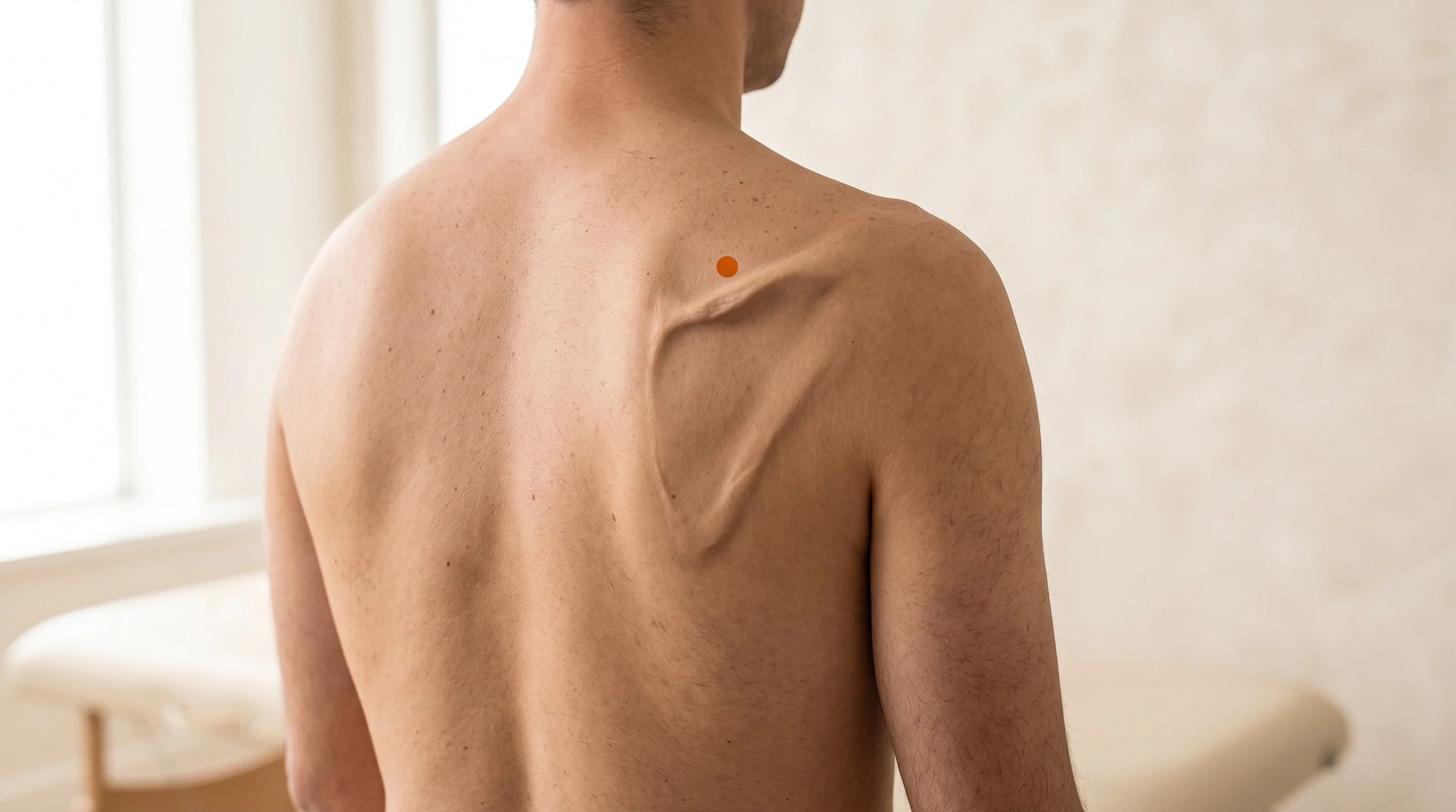
SI12 Acupuncture Point (Bingfeng)
Grasping the Wind Above the Scapular Spine: Anatomy, Mechanism, and Why This Suprascapular Fossa Point Anchors Rotator Cuff and Stiff Neck Treatment
SI12 (Bingfeng, often translated as "Grasping the Wind") sits in the middle of the suprascapular fossa, the soft hollow you can feel above the bony ridge of the shoulder blade, directly above SI11 and easiest to find when the arm is lifted and a small depression appears (Deadman et al., 2007). In plain anatomical terms, the si12 acupuncture point sits over the belly of supraspinatus, the rotator cuff muscle that helps initiate and stabilize arm elevation, which is exactly why small intestine 12 shows up so often in treatment plans for people who can't reach overhead without a catch of pain.
Classical sources group it as a crossing point where the Small Intestine, Large Intestine, Triple Burner and Gall Bladder channels meet across the shoulder girdle and neck, and modern practice reads that convergence as a practical map of where shoulder and neck pain tends to spread. Whether it's needled as a channel point or as a supraspinatus dry needling target, SI 12 shoulder work is about restoring pain-free elevation in a region loaded by desk posture, bag carrying, and overhead sport.
- Location and layers: SI12 lies in the center of the suprascapular fossa above SI11, in the depression that appears when the arm is raised, with skin and upper trapezius overlying the supraspinatus belly and the bony fossa floor beneath (Deadman et al., 2007).
- Traditional attribution: classical texts list SI12 as a meeting point of the Small Intestine channel with the Large Intestine, Triple Burner and Gall Bladder channels, all of which cross the scapula, shoulder and neck, and credit it with expelling wind and benefiting the shoulder and scapula (Deadman et al., 2007). Read anatomically, that cluster describes the shoulder girdle's shared innervation and referral territory rather than a flow of energy.
- Mechanism: the point sits in suprascapular nerve territory (C5 to C6), so needling recruits deep somatic afferents that converge in the same cervical segments as the rotator cuff tendons, glenohumeral capsule and acromioclavicular joint, a segmental convergence route that may reduce dorsal horn excitability and recruit descending inhibitory pathways (Zhao, 2008).
- Research picture: acupuncture for shoulder pain has been reviewed with cautious conclusions about short-term pain and function benefit (Green et al., 2005), individual patient data across chronic pain conditions favor acupuncture over sham and no-acupuncture control (Vickers et al., 2018), and trigger point needling of shoulder muscles shows modest short-term effects in meta-analysis (Navarro-Santana et al., 2021).
- Clinical framing: classical indications for SI12 center on shoulder and scapular pain with inability to raise the arm, stiff neck with restricted rotation, and pain or numbness through the upper arm (Deadman et al., 2007), which overlaps closely with the referral pattern described for supraspinatus trigger points (Simons et al., 1999).
- De qi and safety: patients usually report a deep, heavy, spreading ache in the fossa that can travel toward the shoulder joint or down the outer arm, and needling is kept oblique and medial rather than deep and perpendicular because the pleural apex lies in the wider region (Deadman et al., 2007; White, 2004).
Can't Raise Your Arm Without a Catch of Pain?
Painful arm elevation usually involves more than one structure: the cuff tendon, the trapezius above it, and the neck segments that feed both. At Morningside Acupuncture, SI12 is one of the first points we assess for suprascapular fossa tenderness, and we needle it obliquely alongside SI11, GB21 and cervical points to calm the whole shoulder girdle. We pair the needling with graded range of motion work so the gains carry over between visits. Schedule an evaluation and let's find out what's actually limiting your reach.
Schedule NowAnatomy of SI12: Why the Suprascapular Fossa Is Such an Important Location
Run your fingers along the top of the shoulder blade and you'll feel a firm bony ridge, the spine of the scapula. Above it is a shallow trough, the suprascapular fossa, and SI12 sits in the middle of that trough directly above SI11, in the depression that becomes obvious when the arm is lifted (Deadman et al., 2007). From the surface inward, the needle passes through skin and subcutaneous tissue, then the fibers of upper trapezius, then into supraspinatus, which fills the fossa and runs laterally under the acromion to attach on the humerus.
This is a high-demand region: supraspinatus helps initiate abduction and works constantly to keep the humeral head centered, while trapezius above it is loaded by desk work, phone use, bag straps, and any sustained overhead posture. Tenderness here is extremely common in people with rotator cuff related shoulder pain.
The nerve geography explains much of the clinical behavior. Superficially the area is supplied by branches of the cervical plexus and the accessory nerve, while the muscle itself is innervated by the suprascapular nerve arising from the upper trunk of the brachial plexus at roughly C5 to C6. Those are the same segments that supply the glenohumeral capsule, the cuff tendons, and the acromioclavicular joint, so afferent traffic from all of these structures converges on shared dorsal horn neurons.
Needling into the fossa produces a strong deep-tissue afferent volley that may reduce excitability in those same segments and engage descending inhibitory control from the brainstem, which is one of the better-characterized routes for acupuncture analgesia (Zhao, 2008). If the needle enters a taut band in supraspinatus, a local twitch response may occur, and this is the mechanistic overlap between a classical shoulder point and modern trigger point needling of a muscle whose referral pattern includes the deep shoulder and lateral arm (Simons et al., 1999).
Deeper structures matter here for safety. The suprascapular artery and vein travel through the region, and beneath the floor of the fossa the chest wall and the apex of the lung lie in the wider neighborhood. The scapular plate itself offers some protection over the fossa, but the needle can slide off bone medially or angle up into the supraclavicular region, which is why Deadman et al. (2007) specify oblique medial insertion toward the spine at 0.5 to 1 cun and warn that deep perpendicular insertion, particularly in thin patients, carries a substantial pneumothorax risk.
Pneumothorax remains the most frequently reported serious traumatic adverse event associated with acupuncture, and it's largely avoidable with correct angle, depth, and patient positioning (White, 2004).
In practice, that means the needle is aimed along the fossa rather than into it, and depth is chosen for the individual's build rather than from a textbook default.
Related Acupuncture for Shoulder Pain Related Supraspinatus Trigger PointsSI12 at a Glance: Classification, Location, and Clinical Use
| Category | Detail |
|---|---|
| Traditional Name | Bingfeng (Grasping the Wind), Small Intestine 12 |
| Channel Classification | Small Intestine channel (Hand Taiyang), twelfth point of the channel |
| Point Categories | Meeting (crossing) point of the Small Intestine channel with the Large Intestine, Triple Burner (Sanjiao) and Gall Bladder channels (Deadman et al., 2007). No five-shu, hui-meeting, or extraordinary vessel designations are attributed to this point. |
| Precise Location | In the center of the suprascapular fossa, directly above SI11, in the depression that forms when the arm is raised |
| Tissue Stimulated | Upper trapezius superficially, then the supraspinatus belly within the suprascapular fossa; overlying trapezius fibers are frequently involved in the same presentation |
| Needle Depth / Direction | Oblique medial insertion toward the spine, 0.5 to 1 cun. Deep perpendicular needling is avoided, especially in thin patients, because of pneumothorax risk (Deadman et al., 2007) |
| De Qi Sensation | Deep, heavy, spreading ache filling the fossa, sometimes travelling toward the shoulder joint or down the lateral upper arm; a brief twitch may occur if a taut band is engaged |
| Primary Clinical Uses | Shoulder and scapular pain with difficulty raising the arm, rotator cuff related shoulder pain in the supraspinatus territory, stiff neck with restricted rotation, and pain or numbness of the upper arm in classical use |
| Common Point Combinations |
|
In Deadman, Al-Khafaji and Baker's A Manual of Acupuncture, Bingfeng SI12 is presented as a crossing point where the Small Intestine channel meets the Large Intestine, Triple Burner and Gall Bladder channels, all of which travel across the scapula, shoulder and neck. Its traditional action is given as expelling wind and benefiting the shoulder and scapula, and the name itself, understood as grasping or controlling wind, was read by classical commentators as a statement of function rather than mere poetry.
The indications attributed to it are tightly regional: pain of the shoulder and scapula with inability to lift the arm, a stiff neck that won't turn, and aching or numbness spreading into the upper arm. What makes the classical picture striking is that a point defined by four converging channels was nonetheless used almost entirely for local complaints, with one Ming dynasty exception, Investigation Into Points Along the Channels, proposing a broader protective role against externally contracted wind and lingering cough with stubborn phlegm. That single outlier reading is why SI12 keeps a reputation for weather sensitivity and draughty-shoulder complaints that its neighbors don't carry.
Why SI12 Is Used for Stiff Neck and Arm Numbness, Not Just Shoulder Pain
Patients are often surprised that a point above the shoulder blade gets chosen for a neck that won't rotate, or for a vague numb ache running down the outside of the arm. The explanation is segmental. Supraspinatus and the tissues around it are supplied from roughly C5 to C6, the same levels that serve the shoulder capsule, the cuff tendons, and a good stretch of the lateral upper arm. Sensory input from all of those structures converges on shared neurons in the spinal cord, so the brain receives a blurred regional signal rather than a precise address.
Needling into the suprascapular fossa feeds a strong, well-localized input into that same segmental pool, and this convergence is one of the main routes by which acupuncture appears to reduce pain signaling (Zhao, 2008).
There's a second layer above the spinal cord. Needle stimulation that produces de qi activates brainstem and midbrain circuits that send inhibitory signals back down the cord, dampening transmission from the painful region and contributing to relief that outlasts the treatment session (Zhao, 2008). This descending component is part of why patients often report improvement in areas near, but not exactly at, the needled spot, including neck rotation that eases after the supraspinatus region is treated. It's also why a single well-placed needle in a tender fossa can change how the whole shoulder girdle moves.
The mechanical story matters too. When supraspinatus is irritable and guarded, the humeral head doesn't center well during elevation, and trapezius and levator scapulae work harder to compensate, which loads the neck. Reducing the irritability of the cuff muscle may let the shoulder move more normally, which in turn takes load off the neck. That's a modest, mechanical claim rather than a dramatic one, and it fits with what the trials on shoulder needling actually show: real but moderate short-term improvements in pain and function when needling is combined with exercise (Para-García et al., 2022).
What the Research Shows for SI12
There's no research isolating SI12 on its own, and it would be unusual if there were: shoulder trials test multi-point protocols, and SI12 typically appears inside a regional prescription with SI11, GB21, LI15 and cervical points, or as an anatomical target during supraspinatus dry needling. What the evidence can tell us is whether needling this region helps shoulder pain in general, and how large and durable those effects tend to be. The honest summary is that effects are real but moderate, best documented over the short and medium term, and most convincing when needling is paired with progressive exercise. Below are the reviews and trials most relevant to how SI12 is actually used.
| Study | Type | Focus | Key Finding |
|---|---|---|---|
| Green et al., 2005 | Cochrane systematic review | Acupuncture for adults with shoulder pain, including rotator cuff disease and adhesive capsulitis | The authors concluded that trials were few and diverse, so little could be firmly established, though there may be short-term benefit for pain and function. |
| Vickers et al., 2018 | Individual patient data meta-analysis | Chronic pain conditions including musculoskeletal shoulder and neck pain, nearly 21,000 patients | Acupuncture was superior to both sham and no-acupuncture control, with effects that persisted over time rather than dissipating immediately. |
| Navarro-Santana et al., 2021 | Systematic review and meta-analysis | Trigger point dry needling for nontraumatic shoulder pain of musculoskeletal origin | Dry needling of shoulder muscles was associated with short-term reductions in pain and related disability, with effects that appear modest and time-limited. |
| Para-García et al., 2022 | Systematic review and meta-analysis | Dry needling alone or with exercise therapy in subacromial pain syndrome | Pooled data suggested small short-term and mid-term improvements in pain, with the evidence graded as low quality. |
| White, 2004 | Cumulative safety review | Range and incidence of significant adverse events associated with acupuncture | Serious events were rare overall, but pneumothorax was among the most commonly reported traumatic events, underscoring the need for careful angle and depth near the thorax. |
| Zhao, 2008 | Narrative review of neurophysiology | Neural mechanisms of acupuncture analgesia | Needle-evoked afferent input engages segmental spinal inhibition and descending modulatory systems, providing a plausible mechanism for regional points like SI12. |
Stiff Neck That Won't Let You Turn Your Head?
Neck rotation and shoulder elevation share muscles, nerves, and spinal segments, which is why a stiff neck so often comes with a sore spot above the shoulder blade. Bingfeng is a classical choice for exactly that combination, and we use it with trapezius and levator scapulae dry needling to reduce guarding through the upper quarter. Most patients notice a change in how freely they can turn within the first two or three sessions. Book a visit and we'll build a plan around your movement, not just your pain map.
Schedule NowSI12 in the Context of Trigger Point Work
SI12 sits directly over supraspinatus, which makes it one of the clearest examples in the Small Intestine channel of a classical point and a myofascial target occupying the same real estate. Trigger points in supraspinatus are described as referring pain deep into the shoulder and down the lateral arm, sometimes as far as the elbow, and as contributing to the sense that the arm is heavy or difficult to lift (Simons et al., 1999).
That description lines up almost exactly with the classical indication list for Bingfeng, which pairs shoulder and scapular pain with inability to raise the arm and aching or numbness of the upper arm (Deadman et al., 2007). Whether a clinician calls the technique acupuncture or dry needling, the needle is going into the same muscle for the same reason.
At Morningside Acupuncture, we rarely treat this region in isolation. A typical session for rotator cuff related shoulder pain might combine SI12 with needling of infraspinatus at SI11, upper trapezius near GB21, levator scapulae at its scapular attachment, and cervical paraspinals, because guarding in one of these muscles tends to recruit the others. The needling angle at SI12 stays oblique and medial along the fossa for the safety reasons described above, and depth is adjusted for body type rather than applied uniformly.
We then layer in scapular control and loading exercises, since the meta-analytic evidence suggests needling and exercise together outperform needling alone for shoulder presentations (Para-García et al., 2022).
SI12 Shoulder Pain Treatment at NYC's Highest-Rated Acupuncture Clinic
Morningside Acupuncture is the highest-rated acupuncture and dry needling clinic in New York City with over 500 five-star Google reviews, and shoulder pain is one of the conditions we treat most. Our licensed acupuncturists combine channel-based points like SI12 with precise, anatomy-led needling of supraspinatus, infraspinatus and trapezius, plus loading advice you can actually follow. Every session is one on one, and every treatment plan is built around your goals for overhead work, lifting, or sport. Schedule your appointment today and get moving again.
Schedule NowFrequently Asked Questions
What does SI12 feel like when needled?
Most people describe a deep, dull, spreading heaviness that fills the hollow above the shoulder blade, sometimes with a warm ache travelling toward the front of the shoulder or down the outer arm. That distension and heaviness is de qi, the sensation clinicians look for at this point. If the needle enters a taut band in supraspinatus, you may feel a brief involuntary twitch followed by a short cramping sensation that settles within seconds. Sharp, electric, or radiating pain into the hand isn't expected, and you should tell your acupuncturist right away if you feel it so the needle can be adjusted.
Why treat above the shoulder blade when my pain is in the front of my shoulder or down my arm?
Because the tissues doing the hurting and the tissue being needled often share the same nerve supply. Supraspinatus, the cuff tendons, and the shoulder capsule are all served from roughly the C5 to C6 spinal levels, so their sensory input converges on the same spinal neurons and the brain localizes it poorly (Zhao, 2008). Supraspinatus trigger points are specifically described as referring pain into the deep shoulder and lateral arm rather than staying where they sit (Simons et al., 1999). Treating SI12 addresses the source region rather than chasing the location where the pain is felt.
Can I press SI12 myself between sessions?
Yes, and it's a practical spot to reach. Reach across your chest with the opposite hand and drape your fingers over the top of your shoulder, then find the bony ridge of the shoulder blade and slide your fingertips just above it, roughly midway between the base of your neck and the tip of your shoulder. Press into the soft hollow with moderate, steady pressure until you feel a satisfying ache rather than sharp pain, hold for 30 to 60 seconds, release, and repeat three to five times. Doing this two or three times a day works well, and it tends to help more if you follow each round with a few slow, pain-free arm raises to reinforce the change in movement. Self-pressure is safe because your fingers can't reach anything a needle could, but skip it over broken skin, rashes, or recent injury, and stop if pressure reproduces radiating arm symptoms.
Is SI12 safe to needle?
In trained hands, yes, but this is a point where technique genuinely matters. Deadman et al. (2007) specify oblique medial insertion toward the spine at 0.5 to 1 cun and warn that deep perpendicular needling, particularly in thin patients, carries a substantial risk of pneumothorax. Pneumothorax is rare overall but is among the most frequently reported serious traumatic events in acupuncture safety reviews, and it's strongly linked to inappropriate angle and depth near the thorax (White, 2004). A licensed acupuncturist will position you securely, angle the needle along the fossa rather than into the chest wall, and choose depth based on your build. Mild soreness or a small bruise afterward is the most common side effect.
Where exactly is SI12 located?
SI12 is in the center of the suprascapular fossa, the shallow trough above the bony ridge of the shoulder blade, directly above SI11 (Deadman et al., 2007). The classic way to find it is to raise the arm: a small depression appears in the middle of that trough, and the point sits in the depression. As a rough guide, it's about midway between the base of the neck and the outer tip of the shoulder, one finger-width or so above the scapular spine. Practitioners confirm it by palpation, since the tender, ropy spot in supraspinatus is usually easy to locate in someone with shoulder pain.
References
- Deadman, P., Al-Khafaji, M., & Baker, K. (2009). A manual of acupuncture. Journal of Chinese Medicine Publications.
- Cheng, X. (Ed.). (1999). Chinese acupuncture and moxibustion (Rev. ed.). Foreign Languages Press.
- Simons, D. G., Travell, J. G., & Simons, L. S. (1999). Travell & Simons' myofascial pain and dysfunction: The trigger point manual, Vol. 1: Upper half of body (2nd ed.). Williams & Wilkins.
- Green, S., Buchbinder, R., & Hetrick, S. (2005). Acupuncture for shoulder pain. Cochrane Database of Systematic Reviews, 2005(2), CD005319. https://doi.org/10.1002/14651858.CD005319
- Vickers, A. J., Vertosick, E. A., Lewith, G., MacPherson, H., Foster, N. E., Sherman, K. J., Irnich, D., Witt, C. M., & Linde, K. (2018). Acupuncture for chronic pain: Update of an individual patient data meta-analysis. Journal of Pain, 19(5), 455-474. https://doi.org/10.1016/j.jpain.2017.11.005
- Navarro-Santana, M. J., Sanchez-Infante, J., Gómez-Chiguano, G. F., Cleland, J. A., Fernández-de-las-Peñas, C., & Plaza-Manzano, G. (2021). Effects of trigger point dry needling for nontraumatic shoulder pain of musculoskeletal origin: A systematic review and meta-analysis. Physical Therapy, 101(2), pzaa216. https://doi.org/10.1093/ptj/pzaa216
- Para-García, G., García-Muñoz, A. M., López-Gil, J. F., Ruiz-Cárdenas, J. D., García-Guillén, A. I., López-Román, F. J., Pérez-Piñero, S., Abellán-Ruiz, M. S., Cánovas, F., & Victoria-Montesinos, D. (2022). Dry needling alone or in combination with exercise therapy versus other interventions for reducing pain and disability in subacromial pain syndrome: A systematic review and meta-analysis. International Journal of Environmental Research and Public Health, 19(17), 10961. https://doi.org/10.3390/ijerph191710961
- White, A. (2004). A cumulative review of the range and incidence of significant adverse events associated with acupuncture. Acupuncture in Medicine, 22(3), 122-133. https://doi.org/10.1136/aim.22.3.122
- Zhao, Z. Q. (2008). Neural mechanism underlying acupuncture analgesia. Progress in Neurobiology, 85(4), 355-375. https://doi.org/10.1016/j.pneurobio.2008.05.004
Disclaimer: This web site is intended for educational and informational purposes only. Reading this website does not constitute providing medical advice or any professional services. This information should not be used for diagnosing or treating any health issue or disease. Those seeking medical advice should consult with a licensed physician. Seek the advice of a medical doctor or other qualified health professional for any medical condition. If you think you have a medical emergency, call 911 or go to the emergency room. No acupuncturist-patient relationship is created by reading this website or using the information. Morningside Acupuncture PLLC and its employees and contributors do not make any express or implied representations with respect to the information on this site or its use. For any legal interpretation of scope of practice in your state, consult a licensed attorney or regulatory authority.
Read more from our blog



