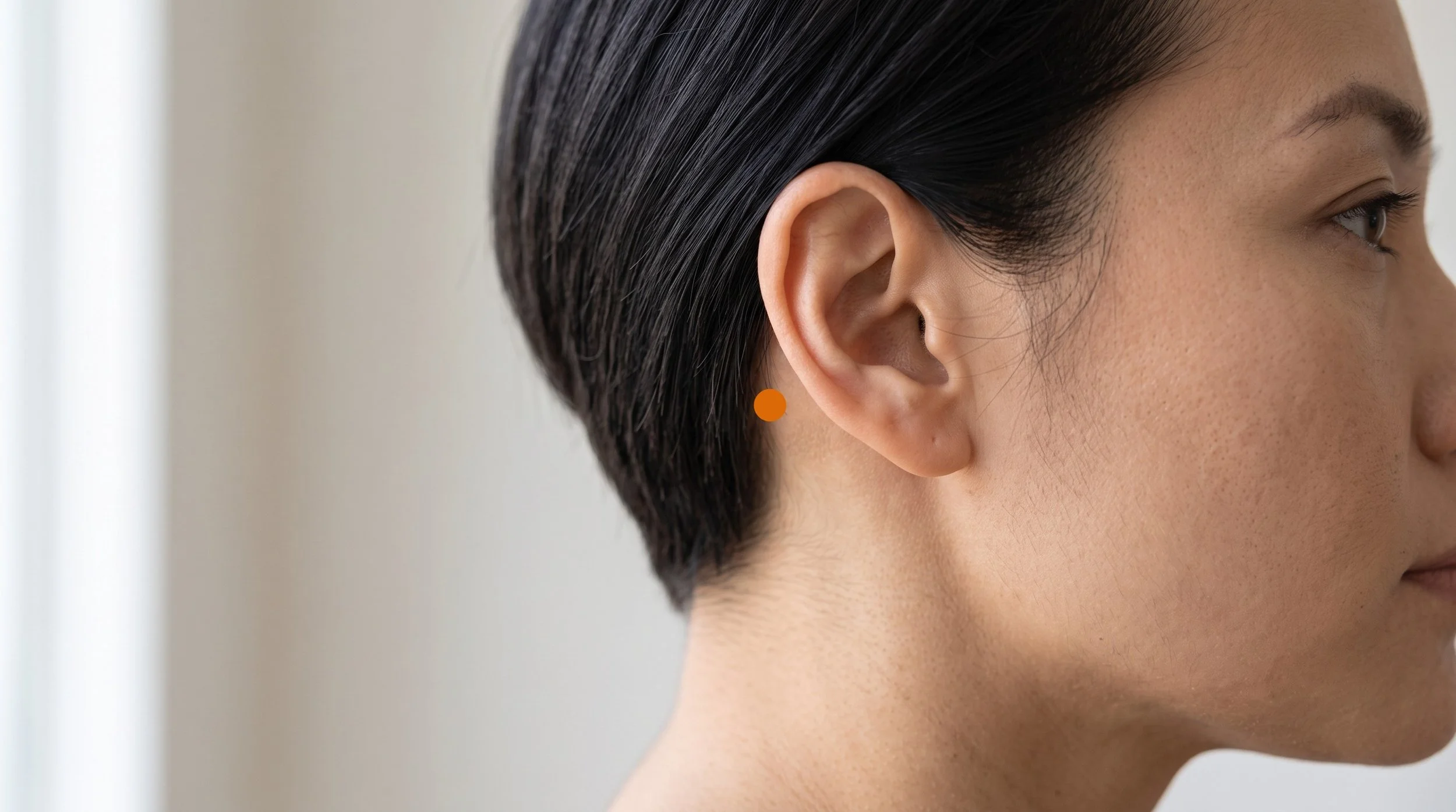
GB11 Acupuncture Point (Touqiaoyin)
The Yin Portals of the Head Behind the Ear: Anatomy, Mechanism, and Why This Mastoid Point Belongs in Headache, Ear, and Neck Treatment
GB11, known in Chinese as Touqiaoyin and usually translated as Yin Portals of the Head, sits behind the ear on the Gallbladder channel, tucked just inside the hairline on the curved arc of points that sweeps from GB9 down to GB12.
In plain terms, if you trace a line behind your ear that roughly mirrors the ear's own rim, the GB11 acupuncture point lies in a small depression a little more than two thirds of the way along that line, over the upper back edge of the mastoid bone. It matters clinically because this is where scalp, muscle attachment, and occipital nerve territory all overlap in one small patch of tissue, which is why gallbladder 11 shows up in treatment plans for one sided headache, pressure and pain around the ear, and stiff, aching upper neck.
- GB11 is a shallow, transverse scalp point over the mastoid region, where the galea and thin scalp tissue sit directly on the occipital attachment zone of sternocleidomastoid and splenius capitis, which is why posture, jaw clenching, and prolonged screen work can leave this area tender (Deadman et al., 2009).
- Classical texts list gallbladder 11 as a meeting point of the Gallbladder, Bladder, Small Intestine and Triple Burner channels, a traditional attribution that lines up neatly with the modern observation that four different pain referral territories converge behind the ear (Deadman et al., 2009; Cunningham, 2000).
- The mechanism story here is segmental. This zone is supplied by the lesser occipital nerve with contributions from the greater occipital nerve, both arising from upper cervical roots that share second order neurons with trigeminal input, so stimulation may modulate head and face pain through convergence and descending inhibition rather than anything local to the skull (Zhao, 2008).
- Research does not test GB11 on its own. The best available evidence tests whole protocols: Cochrane reviews report that acupuncture may reduce headache days in tension type headache and episodic migraine (Linde et al., 2016a; Linde et al., 2016b), and individual patient data pooling supports modest, persisting benefits for chronic pain including neck and head pain (Vickers et al., 2018).
- For ear symptoms the picture is far weaker. Systematic reviews of acupuncture for tinnitus consistently describe small, low quality trials and stop short of firm conclusions, so we frame ear related work as traditionally used and worth a trial, not as an established treatment (Kim et al., 2012; Huang et al., 2021).
- De qi at GB11 is usually a spreading, dull heaviness or pressure under the scalp that can travel toward the ear or up over the side of the head. Because the needle is threaded flat under the skin, patients often feel a brief pinch and then a tugging or full sensation rather than a deep ache.
Headaches That Start Behind the Ear and Wrap Around Your Head?
Head pain that begins at the mastoid or upper neck and travels forward is one of the patterns we see most often at Morningside Acupuncture. Our licensed acupuncturists use GB11 alongside GB20, occipital line points, and dry needling of the muscles that attach right there, so the scalp point and the muscle work reinforce one another. Most patients get a clear sense within a few visits of how much of their headache pattern is coming from the neck. Schedule a visit and let's map your pattern.
Schedule NowAnatomy of GB11: Why the Mastoid Border Is Such an Important Location
GB11 lies on a thin stretch of scalp just inside the hairline behind the ear, over the upper posterior aspect of the mastoid process. Under the skin sits the galea and its fascial continuation, and immediately beneath that is bone, along with the tendinous attachment zone where sternocleidomastoid and splenius capitis anchor to the mastoid and the adjacent occipital line. That attachment zone is loaded constantly: it stabilizes the head against gravity during desk work, resists forward head posture, and works overtime in people who clench, carry bags on one shoulder, or sleep with the neck rotated. Tenderness here is common and often surprises patients who assumed their headache was purely a head problem.
The nerve geography explains most of what GB11 does. The area behind the ear is supplied by the lesser occipital nerve with anastomotic contributions from the greater occipital nerve, both derived from upper cervical roots (Cheng, 1999). Those upper cervical afferents synapse in the same dorsal horn region that receives trigeminal input, a convergence that helps explain why upper neck tissue can produce pain felt in the temple, behind the eye, or around the ear.
Needling in this territory recruits small diameter afferents and engages spinal and supraspinal pain modulating systems, including descending inhibitory pathways using endogenous opioid, serotonergic, and noradrenergic signaling (Zhao, 2008). Nothing mystical is required: the point works on the nervous system that already links neck and head.
Vascular structures matter for technique. The branches of the posterior auricular artery and vein run through this region (Cheng, 1999), and scalp vessels bleed readily, so brief pressure after withdrawal is routine. Standard technique is transverse insertion of about 0.5 to 1.5 cun threaded flat along the scalp (Deadman et al., 2009), with shallower subcutaneous insertion of roughly 0.3 to 0.5 cun described in other texts (Kim, 2008).
Perpendicular deep needling is not appropriate here, both because bone lies immediately beneath and because the transverse approach gives the broad tissue contact the point is used for.
Related Best Acupuncture Points For Headaches Related Sternocleidomastoid Trigger PointsGB11 at a Glance: Classification, Location, and Clinical Use
| Category | Detail |
|---|---|
| Traditional Name | Touqiaoyin (Yin Portals of the Head), also rendered as Head Yin Orifices or Head Yin Cavity |
| Channel Classification | Gallbladder channel of Foot Shaoyang, eleventh point, in the behind the ear group running from GB9 to GB12 |
| Point Categories | Meeting (crossing) point of the Gallbladder, Bladder, Small Intestine and Triple Burner channels; no five-shu, extraordinary vessel, or hui-meeting designation is attributed to this point in the classical sources |
| Precise Location | Behind the ear, within the hairline, on the curved line from GB9 to GB12 that roughly parallels the rim of the ear, in a depression slightly more than two thirds of the way from GB9 toward GB12, over the upper posterior mastoid region |
| Tissue Stimulated | Scalp, galea, and periosteal border of the mastoid, over the occipital attachment zone of sternocleidomastoid and splenius capitis, within lesser occipital nerve territory |
| Needle Depth / Direction | Transverse insertion 0.5 to 1.5 cun threaded along the scalp, angled toward GB12 or GB9 depending on the target; some texts use shallower subcutaneous insertion of 0.3 to 0.5 cun. Never perpendicular and deep |
| De Qi Sensation | Dull heaviness, pressure, or tugging under the scalp behind the ear, sometimes spreading toward the ear canal, temple, or occiput; occasionally a brief sharp note on insertion through thin scalp tissue |
| Primary Clinical Uses | Headache and dizziness, one sided head pain behind and above the ear, ear pain, tinnitus and hearing complaints, stiffness and pain of the neck, and in classical use a bitter taste in the mouth and tongue disorders |
| Common Point Combinations |
|
In the classical literature summarized by Deadman and colleagues in A Manual of Acupuncture, the name Yin Portals of the Head is traditionally read as a reference to the sense organs linked to the five yin organs: eyes, ears, tongue, mouth, and nose. Traditional attributions credit GB11 with clearing the head, benefiting those sense organs, and moving the channel to relieve pain, and the classical indication lists cover headache and dizziness, eye and ear complaints, tongue stiffness and bleeding, a bitter or nauseating taste, plus neck stiffness and throat obstruction.
Older sources also record a broader set of systemic entries, including flank pain, cough, absence of sweating, tightness in the limbs, and heat in the hands and feet, which is a reminder that classical indication lists were compiled across centuries rather than written as a single coherent protocol.
What is striking is the internal logic: GB11 in the upper body is deliberately paired with GB44, Yin Portals of the Foot, and the classical indications map onto every listed sense organ except the nose, which is a rare example of a point name and its recorded uses lining up almost exactly.
Why GB11 Is Used for Ear Symptoms and a Bitter Taste, Not Just Headache
Patients are often puzzled that a point behind the ear appears in classical lists for the tongue, mouth, and eyes. The modern explanation is convergence. Sensory input from the upper cervical spine, the tissues behind the ear, and the trigeminal system feed into an overlapping region of the brainstem and upper cervical cord, so the nervous system does not keep sharp boundaries between the back of the head, the ear, the temple, and the face. Stimulating this territory can therefore change how pain and sensation are processed across a wider zone than the needle site itself (Zhao, 2008).
Beyond the segment, needling recruits descending inhibitory systems that dampen dorsal horn transmission using endogenous opioids, serotonin, and noradrenaline, along with local changes in blood flow and connective tissue tension (Zhao, 2008). That combination is why a shallow scalp point can influence a symptom pattern that spans the whole side of the head. Pooled patient level data across chronic pain conditions suggest acupuncture produces real, if moderate, effects that are not fully explained by placebo and that persist beyond the treatment course (Vickers et al., 2018).
For ear symptoms specifically, honesty matters more than enthusiasm. Reviews of acupuncture for tinnitus have repeatedly found that the trials are small and methodologically weak, with no consistent advantage over sham, so the evidence is inconclusive rather than positive (Kim et al., 2012; Huang et al., 2021). We use GB 11 head points for ear related complaints because the tissue and nerve supply make sense and because many patients with these complaints also have genuine cervical and jaw findings we can address, not because a strong evidence base exists.
What the Research Shows for GB11
There is no clinical trial of GB11 by itself, and there almost certainly never will be. Acupuncture research tests full protocols in which a mastoid or occipital point like Touqiaoyin is one component among six to fifteen needles, so the fair way to read the literature is as evidence about the treatment approach that GB11 belongs to, not about the point in isolation. With that framing, the headache and chronic pain evidence is reasonably encouraging, the neck pain and myofascial needling evidence is moderate but limited by trial quality, and the ear symptom evidence remains weak.
| Study | Type | Focus | Key Finding |
|---|---|---|---|
| Linde et al., 2016a | Cochrane systematic review | Acupuncture for prevention of tension type headache | Adding acupuncture to usual care was associated with fewer headache days for a substantial proportion of participants, with modest advantages over sham in the pooled trials. |
| Linde et al., 2016b | Cochrane systematic review | Acupuncture for prevention of episodic migraine | Acupuncture appeared at least comparable to standard prophylactic drug treatment and better than no prophylaxis, though the certainty of evidence was moderate at best. |
| Vickers et al., 2018 | Individual patient data meta-analysis | Chronic pain including neck pain and headache | Acupuncture outperformed both sham and no acupuncture controls, with effects that decayed only modestly over twelve months. |
| Pourahmadi et al., 2021 | Systematic review and meta-analysis | Dry needling for tension type, cervicogenic, and migraine headache | Dry needling of cervical and cranial muscles showed short term reductions in headache intensity and related disability, with the strongest signal for tension type headache. |
| Kim et al., 2012 | Systematic review of randomized trials | Acupuncture as a sole treatment for tinnitus | Trials were mostly of poor methodological quality and did not demonstrate consistent benefit over sham, so no firm conclusion could be drawn. |
| Huang et al., 2021 | Systematic review and meta-analysis | Acupuncture for tinnitus severity and loudness | Available trials were small and low in quality, leaving the evidence insufficient to support definitive conclusions about efficacy. |
| Zhao, 2008 | Mechanistic review | Neural mechanisms of acupuncture analgesia | Needle stimulation recruits segmental spinal gating and descending inhibitory pathways involving endogenous opioid, serotonergic, and noradrenergic systems. |
Ear Pressure, Ringing, or Jaw Related Head Pain in NYC?
Fullness around the ear, ringing, and tenderness behind the mastoid often travel together with tight jaw and neck muscles. We combine the GB 11 head region with local ear adjacent points, jaw and temporal work, and gentle upper cervical needling, always with realistic expectations about what the research does and does not show for tinnitus. If your ENT workup came back clear and the symptoms still bother you, a trial of care is reasonable. Book an evaluation and we'll build a plan around your presentation.
Schedule NowGB11 in the Context of Trigger Point Work
The location of GB11 sits directly over territory that trigger point clinicians already care about. Splenius capitis attaches at the mastoid and adjacent occipital region and refers pain to the top of the head and behind the eye, while the sternal and clavicular divisions of sternocleidomastoid attach at the mastoid and refer into the forehead, ear, and cheek (Simons et al., 1999). When a patient points behind the ear and describes pain that climbs over the head or settles behind the eye, the mastoid attachment zone under GB11 is usually part of the story.
At Morningside we treat this as one continuous region rather than two competing systems. A session might use GB11 threaded along the scalp, GB20 and suboccipital needling for the deep upper cervical muscles, and dry needling of splenius capitis, the upper trapezius, and sternocleidomastoid where taut bands and referral patterns are reproducible on palpation. All of it is acupuncture in the sense that matters here, meaning the use of an acupuncture needle, and the choice between a classical point and a myofascial target is driven by what the examination finds.
Reviews of needling for headache support this combined approach in the short term, particularly for tension type presentations (Pourahmadi et al., 2021).
GB11 Headache and Neck Pain Treatment at NYC's Highest-Rated Acupuncture Clinic
Morningside Acupuncture is the highest-rated acupuncture and dry needling clinic in New York City with over 500 five-star Google reviews, and head and neck pain is one of the things we treat most. Treatment blends classical point selection such as Touqiaoyin with modern trigger point needling of splenius capitis, sternocleidomastoid, and the suboccipitals. You get a clear plan, hands on care, and honest tracking of what changes between visits. Schedule your appointment today.
Schedule NowFrequently Asked Questions
What does GB11 feel like when needled?
Because the needle is threaded flat under the scalp rather than pushed straight down, most people feel a quick pinch at the skin followed by a tugging, full, or heavy sensation that spreads a short distance behind the ear. Some patients notice the sensation traveling toward the ear canal, the temple, or the back of the head, which is expected given the nerve supply of the area. The scalp is thin here, so a brief sharp note on insertion is common and should settle within seconds. Tell your acupuncturist if it stays sharp, since the angle can be adjusted.
Why needle behind the ear when my pain is in my forehead or temple?
Because the nervous system does not treat those areas as separate. Sensory nerves from the upper neck and the region behind the ear share processing space in the brainstem with trigeminal input from the face and forehead, so irritation at the mastoid attachments can be felt at the front of the head, and treatment behind the ear can influence pain felt there (Zhao, 2008). The muscles that attach right under GB11 also refer pain forward in predictable patterns (Simons et al., 1999). Treating where the problem is generated is often more useful than only treating where it hurts.
Can I press GB11 myself between sessions?
Yes, and it is easy to reach. Find the bony bump behind your ear (the mastoid), then slide your fingertip up and slightly back to the edge of your hairline until you feel a small tender hollow. Press with the pad of your index or middle finger using steady, moderate pressure, enough to feel a dull ache but never sharp pain. Hold for 30 to 60 seconds, release, and repeat two or three times per side, once or twice a day. Small circular massage for a minute or two works just as well. Stop if you get dizzy, if the tenderness worsens over days, or if pressing reproduces shooting or electric sensations.
Is GB11 safe to needle?
In trained hands, yes. The point is needled transversely along the scalp, typically 0.5 to 1.5 cun, and is never needled deeply or perpendicularly because bone lies immediately beneath (Deadman et al., 2009). The main practical consideration is bleeding, since branches of the posterior auricular vessels run through this region and scalp tissue bleeds easily, so brief pressure after needle removal is standard (Cheng, 1999). Let your practitioner know if you take blood thinners, have had recent ear or mastoid surgery, or have any skin breakdown or infection in the area.
Where exactly is GB11 located?
Behind the ear, inside the hairline, on the curved arc of Gallbladder points that runs from GB9 above the ear down to GB12 below and behind the mastoid, following a line roughly parallel to the ear's own rim. GB11 lies in a depression slightly more than two thirds of the way from GB9 toward GB12, over the upper posterior part of the mastoid process (Deadman et al., 2009). Some texts describe it more simply as sitting posterior and superior to the mastoid on the line joining GB9 and GB12 (Cheng, 1999). Palpating for the tender hollow at that level is the most reliable way to confirm it.
References
- Deadman, P., Al-Khafaji, M., & Baker, K. (2009). A manual of acupuncture. Journal of Chinese Medicine Publications.
- Cheng, X. (Ed.). (1999). Chinese acupuncture and moxibustion (Rev. ed.). Foreign Languages Press.
- Kim, H. (2008). Handbook of Oriental medicine (3rd ed.). Harmony & Balance Press.
- Cunningham, P. M. (2000). Acupuncture points: A practical guide to classical and modern usage. Odyssey Press.
- Simons, D. G., Travell, J. G., & Simons, L. S. (1999). Travell & Simons' myofascial pain and dysfunction: The trigger point manual, Vol. 1: Upper half of body (2nd ed.). Williams & Wilkins.
- Linde, K., Allais, G., Brinkhaus, B., Fei, Y., Mehring, M., Shin, B. C., Vickers, A., & White, A. R. (2016a). Acupuncture for the prevention of tension-type headache. Cochrane Database of Systematic Reviews, 2016(4), CD007587. https://doi.org/10.1002/14651858.CD007587.pub2
- Linde, K., Allais, G., Brinkhaus, B., Fei, Y., Mehring, M., Vertosick, E. A., Vickers, A., & White, A. R. (2016b). Acupuncture for the prevention of episodic migraine. Cochrane Database of Systematic Reviews, 2016(6), CD001218. https://doi.org/10.1002/14651858.CD001218.pub3
- Vickers, A. J., Vertosick, E. A., Lewith, G., MacPherson, H., Foster, N. E., Sherman, K. J., Irnich, D., Witt, C. M., & Linde, K. (2018). Acupuncture for chronic pain: Update of an individual patient data meta-analysis. Journal of Pain, 19(5), 455-474. https://doi.org/10.1016/j.jpain.2017.11.005
- Zhao, Z. Q. (2008). Neural mechanism underlying acupuncture analgesia. Progress in Neurobiology, 85(4), 355-375. https://doi.org/10.1016/j.pneurobio.2008.05.004
- Pourahmadi, M., Dommerholt, J., Fernández-de-Las-Peñas, C., Koes, B. W., Mohseni-Bandpei, M. A., Mansournia, M. A., Delavari, S., Keshtkar, A., & Bahramian, M. (2021). Dry needling for the treatment of tension-type, cervicogenic, or migraine headaches: A systematic review and meta-analysis. Physical Therapy, 101(5), pzab068. https://doi.org/10.1093/ptj/pzab068
- Kim, J. I., Choi, J. Y., Lee, D. H., Choi, T. Y., Lee, M. S., & Ernst, E. (2012). Acupuncture for the treatment of tinnitus: A systematic review of randomized clinical trials. BMC Complementary and Alternative Medicine, 12, 97. https://doi.org/10.1186/1472-6882-12-97
- Huang, K., Liang, S., Chen, L., & Grellet, A. (2021). Acupuncture for tinnitus: A systematic review and meta-analysis of randomized controlled trials. Acupuncture in Medicine, 39(4), 264-271. https://doi.org/10.1177/0964528420938380
Disclaimer: This web site is intended for educational and informational purposes only. Reading this website does not constitute providing medical advice or any professional services. This information should not be used for diagnosing or treating any health issue or disease. Those seeking medical advice should consult with a licensed physician. Seek the advice of a medical doctor or other qualified health professional for any medical condition. If you think you have a medical emergency, call 911 or go to the emergency room. No acupuncturist-patient relationship is created by reading this website or using the information. Morningside Acupuncture PLLC and its employees and contributors do not make any express or implied representations with respect to the information on this site or its use. For any legal interpretation of scope of practice in your state, consult a licensed attorney or regulatory authority.
Read more from our blog



