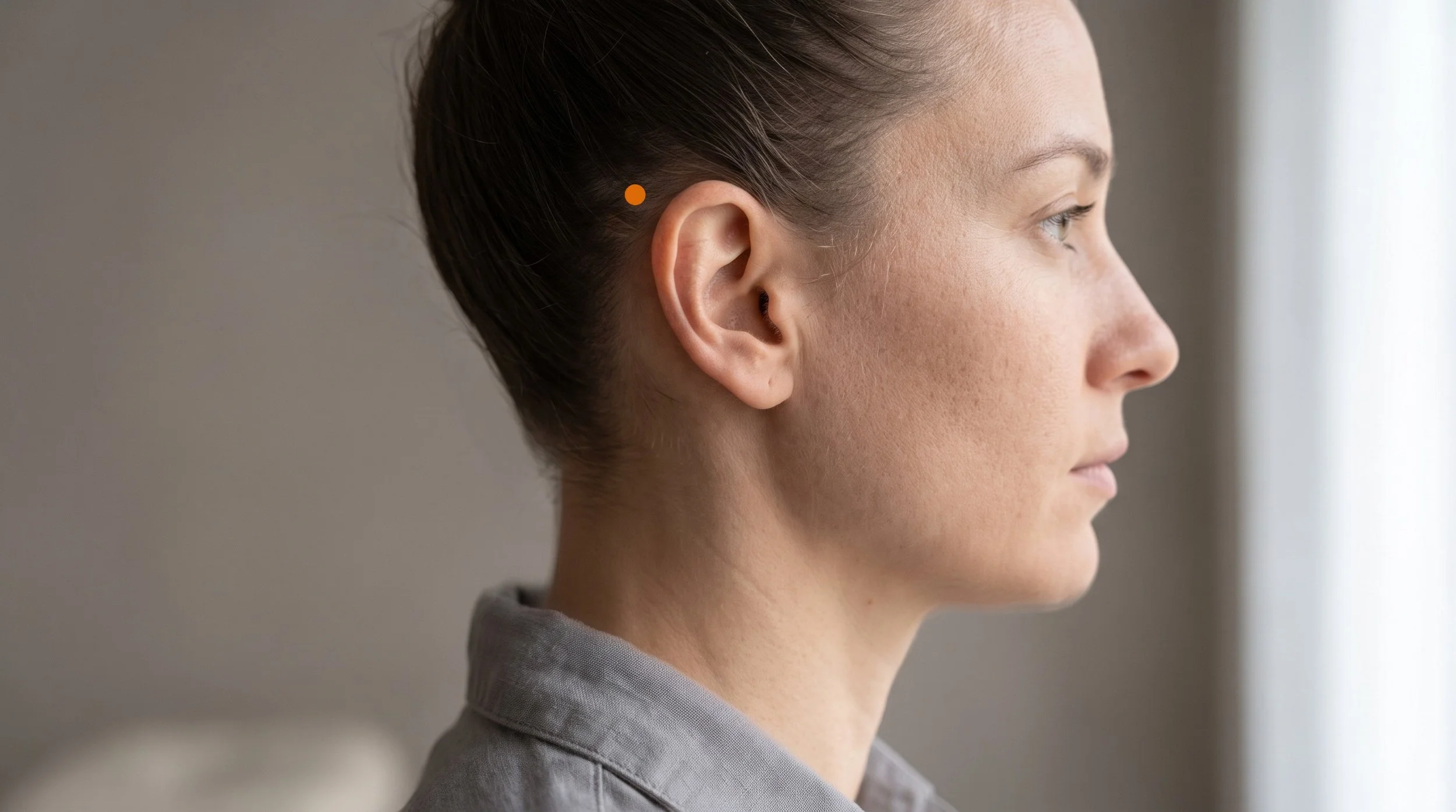
GB10 Acupuncture Point (Fubai)
Floating White Behind the Ear: Anatomy, Mechanism, and Why This Mastoid Point Belongs in Headache and Neck Treatment
GB10, known in Chinese as Fubai and usually translated as Floating White, is the tenth point of the Gallbladder channel and sits behind the ear inside the hairline, on the gentle curve that runs from GB9 down to GB12 roughly parallel to the rim of the ear. If you trace that arc, the Fubai point location is about one third of the way along it, over the upper slope of the mastoid where the posterior auricular muscles blend into the scalp fascia.
It is a thin, mobile piece of tissue with dense sensory innervation from the upper cervical nerves, which is exactly why the GB10 acupuncture point keeps showing up in treatment plans for headaches that feel heavy or band-like, for stiff necks that refer up behind the ear, and for the ear and jaw complaints that classical texts grouped with it. It is rarely the whole treatment, but it is a useful local anchor for the side and back of the head.
- Location and layers: GB10 lies behind the ear within the hairline on the curved line from GB9 to GB12, about one third of the distance from GB9, over the upper mastoid region where posterior auricular muscle fibers meet the epicranial fascia (Deadman et al., 2009).
- Traditional attribution: classical sources classify GB10 as a meeting point of the Gallbladder and Bladder channels and credit it with clearing the head, benefiting the neck region and moving the channel to ease pain, language that maps onto local sensory modulation of the lateral and posterior scalp (Deadman et al., 2009).
- Nerve geography: the tissue here is supplied largely by the lesser occipital nerve from the C2 root, and C2 afferents converge with trigeminal afferents in the trigeminocervical complex, a convergence that helps explain why neck-driven pain is felt across the side of the head (Bogduk, 2001).
- Mechanism: needling recruits A-delta and C fiber input that engages spinal gating and descending inhibitory pathways involving endogenous opioids, serotonin and noradrenaline, rather than anything that requires a literal flow of energy (Zhao, 2008).
- Research picture: no trial has isolated GB10, but Cochrane reviews of acupuncture for tension-type headache and episodic migraine, and a large individual patient data meta-analysis in chronic pain, support acupuncture protocols that commonly include head and neck points like this one (Linde et al., 2016a; Linde et al., 2016b; Vickers et al., 2018).
- De qi and practice: because this is a thin scalp region, GB10 is needled transversely under the skin, and the sensation is typically a spreading dull pressure or tugging rather than a deep ache, sometimes with a warm wave toward the ear or occiput (Deadman et al., 2009).
Headaches That Sit Behind the Ear and Over the Temple?
Head pain that wraps from the neck around the ear to the temple usually involves both upper cervical input and the muscles that cover the skull. At Morningside Acupuncture we use GB10 alongside neighboring behind-ear and suboccipital points, and we pair that with dry needling of the muscles that reproduce your pattern. Most patients notice changes in headache frequency and intensity within a handful of sessions. Schedule a visit and we will map exactly where your headache starts.
Schedule NowAnatomy of GB10: Why the Upper Mastoid Behind the Ear Is Such an Important Location
GB10 sits on a shallow, highly mobile shelf of tissue. Under the needle there is skin, a thin subcutaneous layer, the fibers and fascial attachments of the posterior auricular muscles, and the sheet of epicranial aponeurosis that continues backward toward occipitalis and forward toward the temporal fascia, all resting on the upper slope of the mastoid process of the temporal bone (Deadman et al., 2009). Sternocleidomastoid and splenius capitis anchor just below and behind this area, so tension traveling up the neck loads the very tissue GB10 sits in.
Patients who clench, who work long hours at a screen with the head carried forward, or who sleep with the neck rotated often report that this strip behind the ear feels tender or bruised before they notice anything in the neck itself.
The sensory supply here is mainly the lesser occipital nerve, a C2 branch that curls up behind the ear, with contributions from the greater occipital nerve behind it and the great auricular nerve below. That upper cervical territory matters because afferents from the C1 to C3 roots converge with trigeminal afferents on shared second-order neurons in the trigeminocervical complex, which is the accepted anatomic basis for pain arising in the neck being perceived across the head (Bogduk, 2001).
Needling into this field creates a strong, well-localized afferent volley that can influence that shared pool, and broader mechanistic work shows acupuncture stimulation recruits segmental inhibition plus descending control from the midbrain and brainstem using opioid and monoamine signaling (Zhao, 2008). In plain terms, a needle behind the ear can change how sensitive the whole head-and-neck circuit is, not just the square inch it entered.
Vascularly, the posterior auricular artery and vein run through this region, so the practical risk at GB10 is a small bruise or hematoma rather than anything structural. The mastoid bone lies directly beneath, which is protective, and the standard technique reflects the thin tissue plane: a transverse or oblique insertion of roughly 0.5 to 1.5 cun threaded along the scalp rather than any perpendicular deep needling (Deadman et al., 2009). Clean technique, gentle pressure after withdrawal, and awareness that scalp points bleed a little more than average are the main practice notes.
Related Best Acupuncture Points For Headaches Related Acupuncture For Neck PainGB10 at a Glance: Classification, Location, and Clinical Use
| Category | Detail |
|---|---|
| Traditional Name | Fubai (Floating White), GB-10 |
| Channel Classification | Tenth point of the Gallbladder channel of Foot Shaoyang, in the behind-the-ear group between GB9 and GB12 |
| Point Categories | Meeting (crossing) point of the Gallbladder and Bladder channels; grouped with GB9 and GB11 as behind-the-ear points whose indications overlap with the Window of Heaven points |
| Precise Location | Posterior to the ear within the hairline, on the curved line from GB9 to GB12 that runs roughly parallel to the rim of the ear, in a depression about one third of the distance from GB9 toward GB12, over the upper mastoid region |
| Tissue Stimulated | Skin and subcutaneous tissue, posterior auricular muscle attachments and epicranial fascia over the mastoid, with functional overlap into the suboccipital muscles and the muscles that cause neck pain |
| Needle Depth / Direction | Transverse (subcutaneous) insertion 0.5 to 1.5 cun threaded along the scalp, typically directed toward GB11 and GB12 or toward GB9 |
| De Qi Sensation | A spreading dull pressure, tugging or stretch under the skin, often with local warmth or a soft wave traveling toward the ear, temple or occiput; sharp pain means the needle should be adjusted |
| Primary Clinical Uses | Headache with a heavy or pressing quality, temporal and occipital head pain, neck stiffness and pain, ear complaints including tinnitus in classical use, and toothache in classical use |
| Common Point Combinations |
|
In A Manual of Acupuncture, Deadman and colleagues place GB10 in a small family with GB9 and GB11 whose recorded uses look surprisingly alike, and they note that these behind-the-ear points share territory with the Window of Heaven points: goiter and swelling of the neck, throat obstruction, stiffness and pain of the neck, and chest fullness with cough and phlegm, alongside the more expected head and sense organ indications of headache, head heaviness, toothache, tinnitus and hearing loss (Deadman et al., 2009).
What makes the classical record striking is that the same authors list distal uses for GB10 that have nothing to do with the head, including weakness of the legs with difficulty walking, an application justified by the Inner Classic principle of selecting points above when the problem lies below. These are traditional attributions rather than tested claims, and modern practice leans almost entirely on the local head, ear and neck indications, but the breadth of the old list is a reminder that classical point categories were built on pattern logic, not on regional anatomy alone.
Why GB10 Is Used for Head Heaviness, Ear Fullness, and Even Toothache
The most useful way to understand GB10 is by its nerve address. This patch of scalp is C2 territory through the lesser occipital nerve, and C2 afferents share second-order neurons in the upper cervical cord with afferents from the trigeminal nerve, which supplies the face, teeth, jaw and much of the front of the head (Bogduk, 2001). That shared wiring is why an irritable upper neck can produce pain that feels like it is coming from the ear, the temple or even a tooth, and why classical texts that never used the word convergence still listed toothache, tinnitus and headache under one point behind the ear. Treating into that convergence zone gives the nervous system new, non-threatening input in the same segment where the pain is being amplified.
Beyond the segment, needle stimulation activates descending pain control. Experimental work shows that acupuncture stimulation engages spinal inhibition and supraspinal circuits in the periaqueductal gray and rostral ventromedial medulla, releasing endogenous opioids along with serotonin and noradrenaline, which reduces how strongly nociceptive signals are relayed onward (Zhao, 2008). There are also local effects that patients feel directly: a small axon reflex response with increased blood flow in the treated tissue, and reduced tenderness in the muscle and fascia the needle passes through.
Clinically, that combination explains what GB10 tends to do well. It may reduce the heavy, capped sensation many people describe with tension-type headache, it may ease the tightness that makes turning the head uncomfortable, and it gives an entry point into ear and jaw related complaints without needling directly into the ear. It is not a standalone answer for tinnitus, dental pain or migraine, and any new or changing headache, hearing loss or tooth pain deserves an appropriate medical or dental workup first.
What the Research Shows for GB10
There is no randomized trial testing GB10 by itself, and it is worth being clear about that. Acupuncture research almost always evaluates multi-point protocols chosen by the treating clinician, so the honest framing is that GB10 is one of the local head and neck points commonly used inside protocols that have been studied for headache and neck pain. The reviews below tell you what those protocols achieve as a package, not what a single needle behind the ear does in isolation.
| Study | Type | Focus | Key Finding |
|---|---|---|---|
| Linde et al., 2016a | Cochrane systematic review | Acupuncture for the prevention of tension-type headache | Adding acupuncture to usual care was associated with more participants achieving at least a halving of headache frequency compared with usual care alone, with smaller differences against sham needling. |
| Linde et al., 2016b | Cochrane systematic review | Acupuncture for the prevention of episodic migraine | Acupuncture appeared at least comparable to prophylactic drug treatment for reducing migraine frequency, with moderate quality evidence and fewer reported adverse effects, though effects over sham were small. |
| Vickers et al., 2018 | Individual patient data meta-analysis | Chronic pain conditions including headache and neck pain | Acupuncture was superior to both sham and no-acupuncture controls, with effects that persisted over roughly a year, suggesting the benefit is not solely a placebo response. |
| Fang et al., 2024 | Systematic review and meta-analysis | Durability of acupuncture effects in chronic neck pain | Across eighteen randomized trials, acupuncture used as an adjunct therapy was associated with sustained pain relief at three and six months after treatment ended. |
| Pourahmadi et al., 2021 | Systematic review and meta-analysis | Dry needling for tension-type, cervicogenic and migraine headache | Dry needling produced short-term improvements in headache-related disability comparable to or better than other interventions, though study quality limits how firmly this can be stated. |
| Zhao, 2008 | Mechanistic review | Neural mechanisms of acupuncture analgesia | Needle stimulation activates segmental gating and descending inhibitory systems mediated by opioid and monoamine transmitters, providing a physiological account of point-based pain relief. |
Stiff Neck That Refers Up Into the Head?
A neck that will not turn comfortably often sends pain up behind the ear, and treating only the sore spot in the neck can miss half of the picture. We combine GB10 and the mastoid arc with needling of the suboccipitals, upper trapezius and splenius group, then add movement so the gains hold. Our clinicians explain each step so you know why a point behind your ear may help your neck. Book a session and let's get your range of motion back.
Schedule NowGB10 in the Context of Trigger Point Work
Acupuncture means the use of an acupuncture needle, and the hundreds of styles that use one include dry needling. At Morningside we treat GB10 as a channel point and as a regional access point at the same time. In a typical headache session, GB10 and its neighbors on the mastoid arc are threaded subcutaneously while the clinical driver of the pain is addressed in the muscle: the suboccipital group, upper trapezius, splenius capitis and cervicis, sternocleidomastoid, and sometimes temporalis and masseter when jaw clenching is part of the picture.
Trigger points in several of these muscles are documented to refer pain into the temple, behind the eye and around the ear, which is why patients often describe the referral pattern before they can point to the tender muscle (Simons et al., 1999).
The overlap is genuinely anatomical rather than metaphorical. GB10 sits where posterior auricular fibers and scalp fascia attach over the mastoid, immediately adjacent to the insertions of sternocleidomastoid and splenius capitis, so a needle placed here is working the same fascial neighborhood that manual therapists palpate for headache. The evidence base for needling these muscles in headache is encouraging but still modest in quality, showing short-term gains in headache-related disability and tenderness (Pourahmadi et al., 2021).
We combine the two approaches, then add active range of motion and simple postural or breathing changes so the tissue is not re-loaded the same way by the next work week.
GB10 Headache and Neck Pain Treatment at NYC's Highest-Rated Acupuncture Clinic
Morningside Acupuncture is the highest-rated acupuncture and dry needling clinic in New York City with over 500 five-star Google reviews. Our licensed acupuncturists blend classical point selection with modern pain science, so a point like GB10 is chosen for a reason you can understand. Whether your primary complaint is headache, neck stiffness or jaw and ear tension, we build a plan around your presentation rather than a template. Schedule your appointment today.
Schedule NowFrequently Asked Questions
What does GB10 feel like when needled?
Because the needle is threaded flat under the skin rather than pushed straight in, most people feel a brief pinch, then a spreading pressure or tugging sensation across the scalp behind the ear. Some patients describe a warm wave that travels toward the temple, the ear or the base of the skull, and many notice the surrounding tissue softening within a minute or two. The sensation should be dull and tolerable. Sharp, burning or electric pain is not the goal and simply means the needle needs adjusting.
Why would a point behind my ear help a headache in my forehead or temple?
Because sensory nerves from the upper neck and from the trigeminal nerve, which supplies the front of the head and face, converge on the same neurons in the upper cervical spinal cord (Bogduk, 2001). Input from one territory can therefore change how pain is perceived in the other, which is the accepted explanation for neck-related pain being felt over the eye or temple. Needling into that C2 field behind the ear gives the shared circuit competing input and helps engage descending inhibition (Zhao, 2008).
Can I press GB10 myself between sessions?
Yes, and it is easy to find on yourself. Place a fingertip just behind the top of your ear, move it back into the hairline, and slide along the curve toward the bony bump behind the ear until you find a tender, slightly hollow spot roughly a third of the way along. Use one or two fingertips with light to moderate pressure and small circular motions for 30 to 60 seconds per side, breathing slowly, then repeat two or three times through the day. Keep the pressure at a level you would call satisfying rather than painful, and stop if you feel dizzy, if the area is bruised, or if pressing reproduces sharp shooting pain.
Is GB10 safe to needle?
In trained hands it is a low-risk point. The mastoid bone lies underneath and the needle is inserted transversely just below the skin, so there is no deep structure at risk with correct technique. The posterior auricular vessels run through the region, so a small bruise or a drop of bleeding on withdrawal is the most common side effect, and steady pressure for a few seconds usually prevents it. Practitioners avoid needling through broken, infected or recently operated skin, take extra care with patients on blood thinners, and use clean single-use needles as standard.
Where exactly is GB10 located?
Behind the ear, inside the hairline, on the curved line that runs from GB9 above the ear back and down to GB12 in the hollow behind the mastoid process, following roughly the shape of the ear's rim. GB10 sits about one third of the way along that line measuring from GB9, in a slight depression over the upper part of the mastoid region (Deadman et al., 2009). A practical shortcut: trace back from the top of the ear attachment into the hair and press along the arc until you meet the first distinctly tender dip.
References
- Deadman, P., Al-Khafaji, M., & Baker, K. (2009). A manual of acupuncture. Journal of Chinese Medicine Publications.
- Cheng, X. (Ed.). (1999). Chinese acupuncture and moxibustion (Rev. ed.). Foreign Languages Press.
- Cunningham, P. M. (2000). Acupuncture points: A practical guide to classical and modern usage. Odyssey Press.
- Simons, D. G., Travell, J. G., & Simons, L. S. (1999). Travell & Simons' myofascial pain and dysfunction: The trigger point manual, Vol. 1: Upper half of body (2nd ed.). Williams & Wilkins.
- Linde, K., Allais, G., Brinkhaus, B., Fei, Y., Mehring, M., Shin, B.-C., Vickers, A., & White, A. R. (2016a). Acupuncture for the prevention of tension-type headache. Cochrane Database of Systematic Reviews, 2016(4), CD007587. https://doi.org/10.1002/14651858.CD007587.pub2
- Linde, K., Allais, G., Brinkhaus, B., Fei, Y., Mehring, M., Vertosick, E. A., Vickers, A., & White, A. R. (2016b). Acupuncture for the prevention of episodic migraine. Cochrane Database of Systematic Reviews, 2016(6), CD001218. https://doi.org/10.1002/14651858.CD001218.pub3
- Vickers, A. J., Vertosick, E. A., Lewith, G., MacPherson, H., Foster, N. E., Sherman, K. J., Irnich, D., Witt, C. M., & Linde, K. (2018). Acupuncture for chronic pain: Update of an individual patient data meta-analysis. Journal of Pain, 19(5), 455-474. https://doi.org/10.1016/j.jpain.2017.11.005
- Fang, J., Shi, H., Wang, W., Chen, H., Yang, M., Gao, S., Yao, H., Zhu, L., Yan, Y., & Liu, Z. (2024). Durable effect of acupuncture for chronic neck pain: A systematic review and meta-analysis. Current Pain and Headache Reports, 28(9), 957-969. https://doi.org/10.1007/s11916-024-01267-x
- Pourahmadi, M., Dommerholt, J., Fernández-de-Las-Peñas, C., Koes, B. W., Mohseni-Bandpei, M. A., Mansournia, M. A., Delavari, S., Keshtkar, A., & Bahramian, M. (2021). Dry needling for the treatment of tension-type, cervicogenic, or migraine headaches: A systematic review and meta-analysis. Physical Therapy, 101(5), pzab068. https://doi.org/10.1093/ptj/pzab068
- Bogduk, N. (2001). Cervicogenic headache: Anatomic basis and pathophysiologic mechanisms. Current Pain and Headache Reports, 5(4), 382-386. https://doi.org/10.1007/s11916-001-0029-7
- Zhao, Z. Q. (2008). Neural mechanism underlying acupuncture analgesia. Progress in Neurobiology, 85(4), 355-375. https://doi.org/10.1016/j.pneurobio.2008.05.004
Disclaimer: This web site is intended for educational and informational purposes only. Reading this website does not constitute providing medical advice or any professional services. This information should not be used for diagnosing or treating any health issue or disease. Those seeking medical advice should consult with a licensed physician. Seek the advice of a medical doctor or other qualified health professional for any medical condition. If you think you have a medical emergency, call 911 or go to the emergency room. No acupuncturist-patient relationship is created by reading this website or using the information. Morningside Acupuncture PLLC and its employees and contributors do not make any express or implied representations with respect to the information on this site or its use. For any legal interpretation of scope of practice in your state, consult a licensed attorney or regulatory authority.
Read more from our blog



